
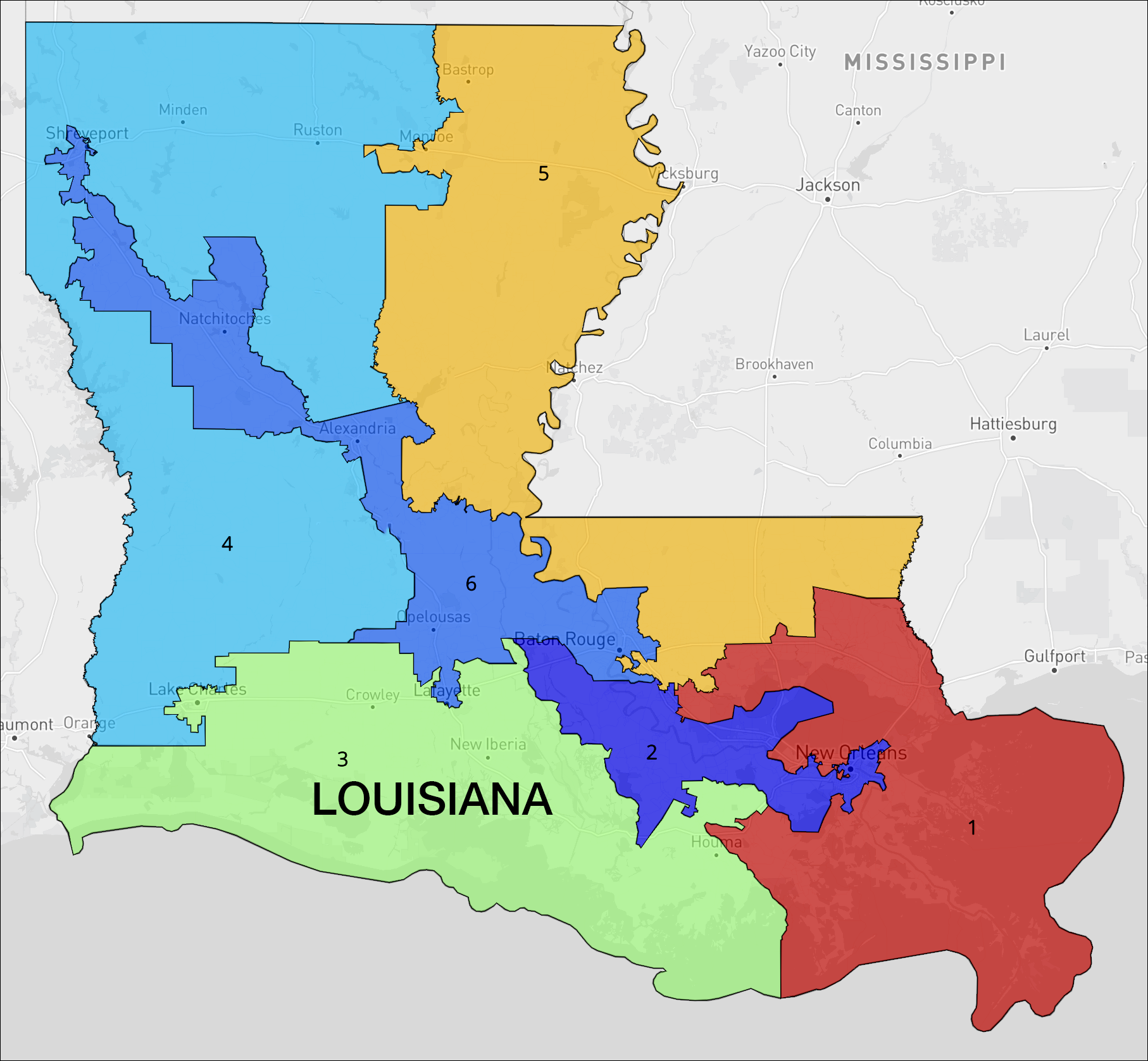
2024 Louisiana Congressional Districts map (view interactive version on Dave’s Redistricting App)
By Jim Ellis — Thursday, April 30, 2026
Louisiana
The US Supreme Court, months after initially hearing the Louisiana racial gerrymandering case, released its ruling yesterday.
In authoring the Court’s opinion, Associate Justice Samuel Alito outlined the reasons the justices upheld the three‑judge panel’s ruling in Callais v. Louisiana, which found that the congressional map used before the 2024 election constituted a racial gerrymander.
The ruling is viewed as favorable to Republicans and will almost certainly require Louisiana’s congressional map to be redrawn before the 2026 statewide primary on May 16. It is possible that the legislature could simply revert to the 2021 map that was in place for the 2022 election.
Activists in several states are already urging their legislators to redraw congressional maps. Such is the case in Georgia, Mississippi (for their state Supreme Court districts), and potentially South Carolina. The Florida legislature is now likely to pass the map that Gov. Ron DeSantis (R) produced, which was drawn in anticipation of a favorable Republican Louisiana ruling.
In the Callais decision, Justice Alito outlined the parameters of the Voting Rights Act. He wrote, “Because the Voting Rights Act did not require Louisiana to create an additional majority-minority district, no compelling interest justified the State’s use of race in creating SB8, and that map is an unconstitutional racial gerrymander.”
He further explained when race can be used as a factor in drawing legislative district boundaries. From later in the ruling, Justice Alito stated, “The Court’s precedents have identified “only two compelling interests” that can satisfy strict scrutiny: avoiding imminent and serious risks to human safety in prisons,” and “remediating specific, identified instances of past discrimination that violated the Constitution or a statute.”
Further explaining, the Justice wrote, “Properly understood, §2 thus does not intrude on States’ prerogative to draw districts based on nonracial factors, including to achieve partisan advantage. In short, §2 imposes liability only when the evidence supports a strong inference that the State intentionally drew its districts to afford minority voters less opportunity because of their race. Not only does this interpretation follow from the plain text of §2, but it is consistent with the limited authority that the Fifteenth Amendment confers.”
It remains to be seen which states besides Louisiana will redraw their maps before the 2026 election. Alabama, where officials were also required to add another minority district ahead of the 2024 election, is one possibility. With primary elections already underway in many states, most significant redistricting activity is likely to shift to the 2028 election cycle.
FL-11
Although he would have continued to represent a safely Republican district under Gov. Ron DeSantis’ proposed congressional map, eight-term US Rep. Dan Webster (R-Clermont) announced just after celebrating his 77th birthday that he will not seek re-election later this year.
Rep. Webster had been viewed as a potential retirement candidate throughout this election cycle. Under the DeSantis map, his central Florida 11th District is rated as safely Republican. In the proposed FL‑11, President Trump would have recorded a 57.2 to 41.5 percent victory margin over Kamala Harris.
Dan Webster was first elected to the Florida House of Representatives in 1980 and later became the chamber’s first Republican Speaker since Reconstruction. He was elected to the state Senate in 1998, where he went on to serve as Majority Leader.
The number of open House seats has now grown to 64. Thirty-eight of these seats are currently Republican held with 21 from the Democratic column. Five additional open districts have been created as a result of redistricting maps in California, Texas, and Utah.
Of the 64 seats in the open category, only 28 involve members retiring from elective office. This group includes two lawmakers who were paired in a new redistricting map with another incumbent of his own party, Reps. Lloyd Doggett (D-TX) and Burgess Owens (R-UT).
Twenty-seven Representatives are running for a different office, three have resigned their seats, two districts are open due to the incumbent’s death, and one has already been defeated in his primary election.
Once the Florida redistricting process is resolved, a crowded Republican field is expected to emerge for the now‑open 11th District. The Sunshine State candidate‑filing deadline for US House races is June 12, and the state’s primary is scheduled for Aug. 18.