
Tag Archives: Q-Poll

Cuomo Poll: Retirement Seen As
Preferential Over Resignation

By Jim Ellis

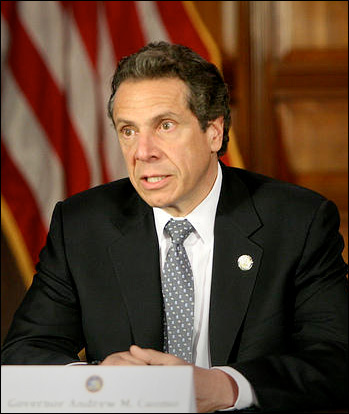
New York Gov. Andrew Cuomo (D)

March 8, 2021 — A new Quinnipiac University poll of the New York electorate (March 2-3; 935 self-identified NY registered voters, live interview) was released late last week after his press conference with mixed results for embattled Gov. Andrew Cuomo (D).

While his numbers are consistently bad with Republicans and Independents, the governor remains strong with his dominant Democratic base. Thus, while a majority of the Q-Poll respondents don’t favor the governor resigning, a large number believes he should not seek re-election in 2022.

To begin, the governor’s favorability ratio is 45:46 percent favorable to unfavorable, which is not particularly bad considering the negative effects of his dual-scandal situation, one involving COVID-related nursing home deaths and the other sexual harassment claims from former staff members.

The positive rating, however, is almost exclusively from Democrats. By a margin of 65:27 percent, self-identified Democrats still view the governor’s job performance positively. Republicans are wholly opposed, 13:82 percent positive to negative, and Cuomo is also decidedly upside-down with Independents, 33:57 percent.

Surprisingly, the polling sample still gives him positive reviews for his handling of the Coronavirus situation (56:41 percent), but, again, most of the favorable ratings come from Democrats, 80:18 percent, while Republicans and Independents both hold strongly negative opinions about how the governor has managed COVID-19: 17:80 percent among tested Republicans; 42:54 percent among Independents.

Once a small number of Democratic officials opened the spigot of dissent toward the governor, many more joined to form a high-flowing chorus. The calls for Cuomo’s resignation aren’t having much effect, however, as a majority, 55:40 percent, do not favor the governor giving up his office before his term ends. As mentioned above, however, the same polling sample does believe he should not seek a fourth term next year, and on this question, even the Democratic response is close.

Overall, 59 percent of the respondents say he should retire at the end of this term, while 36 percent believe he should run again. The Republican pro-retirement ratio registers 90:9 percent. Virtually two-thirds of the Independents (66:28%) say he should retire at the end of next year, while Democrats still barely back him remaining in office after the next election, 50:44 percent.

Continue reading

Florida: Biden Up

Former vice president, Joe Biden (Getty Images)


By Jim Ellis

June 20, 2019 — Quinnipiac University surveyed the Florida electorate (June 12-17; 1,279 registered Florida voters, 417 self-identified Democrats) and found former Vice President Joe Biden opening a substantial lead over Sens. Bernie Sanders (I-VT) and Elizabeth Warren (D-MA) there. He also posts a healthy advantage against President Trump in a hypothetical general election pairing in what is always a critical voting domain.

The Q-Poll numbers find Biden scoring a 41-14-12 percent advantage over Sens. Sanders and Warren, respectively, with South Bend Mayor Pete Buttigieg and Sen. Kamala Harris (D-CA) trailing in single-digits with eight and six percent, sequentially.

As Nate Silver, founder of the 538 statistical website, said in an interview this week that looking at general election polling this early is basically a futile exercise. It does, however, provide us a clue into candidates’ strengths and weaknesses. In the general election Q-Poll pairing, Biden records a 50-41 percent advantage over President Trump in Florida. This poll, of course, was taken before Trump’s Florida rally Tuesday night in which he kicked off his 2020 campaign.

Silver’s spoken sentiments are true because, among other reasons, so much time remains between now and the 2020 Nov. 3 election, and so many unknown events will occur that could alter the final outcome. Additionally, the campaign will drastically change when both parties have nominees and voters begin paying serious attention to the race.

Continue reading

The Tri-State Q-Poll Shows
Electorate Optimism

FEB. 11, 2015 — Quinnipiac University released the results of a three-state poll, covering the critically important presidential domains of Pennsylvania, Florida and Ohio.

The most interesting finding is how optimistic the people comprising the sampling cells are, particularly in Florida and Ohio. Such a tone is much different from what has been the norm for the past nine years.

All three polls were conducted during the Jan. 22 – Feb. 1 time period.

Pennsylvania

The Q-Poll surveyed 881 Pennsylvania registered voters, and tested Sen. Pat Toomey (R) as he begins his quest for a second term. At this point former Rep. Joe Sestak (D-PA-7), who lost to Toomey 49-51 percent in the 2010 Senate race, is the only announced major Democratic contender.

The results show Toomey residing in better re-election position than depicted in other early surveys. According to Quinnipiac, the senator has a job approval index of 43:25 percent positive to negative. Fellow Pennsylvania Sen. Bob Casey, Jr. (D) registered a similar 40:24 percent favorability ratio. On the ballot test, Toomey scores a healthy 45-35 percent advantage over Sestak.
Continue reading >

Q-Poll: Hillary Cruising

Former U.S. Secretary of State Hillary Rodham Clinton speaks to a crowd in Saskatoon, Saskatchewan on Wednesday, Jan. 21, 2015. (AP Photo/The Canadian Press, Liam Richards)

Former U.S. Secretary of State Hillary Rodham Clinton speaks to a crowd in Saskatoon, Saskatchewan on Wednesday, Jan. 21, 2015. (AP Photo/The Canadian Press, Liam Richards)

FEB. 4, 2015 — It is commonly believed that the path to the White House travels through big swing states such as Florida, Ohio and Pennsylvania. If so, former Secretary of State and First Lady Hillary Clinton is in strong shape less than two years before the next presidential vote.

Quinnipiac University went into the field to test the general electorates in these three critical places and found Clinton doing very well against the tested Republican candidates. The results, though too early to be a relevant predictor of any actual voting trend in November of 2016, provide us at least two important indicators.

First, the poll tells us that Clinton’s early low-key approach to this campaign is working. She has deliberately delayed forming a presidential committee, and kept a very low public profile. The Q-Poll results tell us that, so far, such a strategic move is paying dividends.
Continue reading >

NJ Senate Race: Already Over

Newark Mayor Cory Booker

Newark Mayor Cory Booker

The New Jersey special primary election to replace the late Sen. Frank Lautenberg (D) is scheduled for next Tuesday (Aug. 13), but according to Quinnipiac University’s final poll before the vote, the race is virtually over.

When Lautenberg died in early June and Gov. Chris Christie (R) scheduled the special election to choose a replacement, the early polling showed Newark Mayor Cory Booker with numbers approaching or breaking 50 percent of the Democratic vote with the other candidates, representatives Frank Pallone (D-NJ-6), Rush Holt (D-NJ-12), and state House Speaker Sheila Oliver, barely breaking past 10 percent or registering only in single digits.

In the just-released Q-Poll (Aug. 1-5; 2,042 registered New Jersey voters; 388 likely Democratic primary voters) the results have barely changed. According to the data, Booker commands support from 54 percent of the polling sample versus just 17 percent for Rep. Pallone, 15 percent for Rep. Holt, and only 5 percent for Speaker Oliver. With less than a week to go, it’s hard to conceive of any scenario that does not result in a Booker victory.

Forecasting toward the special general to be held Oct. 16, the Democrat vs. Republican results are similar. With former Bogota Mayor Steve Lonegan enjoying a commanding lead in the special Republican primary, a projected Booker-Lonegan pairing appears to be no contest. According to the Q-Poll, Booker would lead such a campaign 54-29 percent.

Though this primary battle has lacked serious competition, there are still some interesting points to be made. First, as it relates to the Q-Poll, there does appear to be some potential irregularities in the polling sample. With 2,042 people being interviewed, it’s hard to see how only 388 and 267 of them identify themselves as either Democratic or Republican primary voters, respectively. One would expect at least the Democratic number to be much  Continue reading >

Booker Cruising in Jersey Senate Poll; Corbett Improves in Pa.

Newark Mayor Cory Booker

Newark Mayor Cory Booker

New Jersey’s Fairleigh Dickinson University, as part of their March 4-10 Garden State survey (702 registered New Jersey voters; 323 Democratic primary voters), studied the upcoming 2014 open Senate race. Their findings present good news for Newark Mayor Cory Booker (D) and suggest that both Rep. Rush Holt (D-NJ-12) and Rep. Frank Pallone (D-NJ-6) have quite a bit of ground to close if they intend to enter the race. Of the two, Pallone is likely to run, while Holt’s candidacy is only a possibility.

According to the FDU results, Booker would lead Holt and Pallone 50-7-4 percent, respectively, if a Democratic primary vote were held during the present period. With such a wide spread, either or both of these potential candidates will have to create a negative image of Booker if they are to substantially gain on him. Typically, big city mayors don’t do particularly well in statewide electoral contests normally because the voters not residing in the largest city, and particularly so for rural voters, often have a negative image of big city politics. Therefore, we can expect to see serious questions raised about the city’s government and state of the local economy before Democratic voters go to the polls in June of 2014.

Booker is in equally good shape for the general election. The only potential GOP  Continue reading >

Polling Updates: New Jersey, Virginia

Gov. Chris Christie

Gov. Chris Christie

New Jersey

Fairleigh Dickinson University surveyed the New Jersey electorate (Jan. 2-6; 700 registered New Jersey voters), testing Gov. Chris Christie (R) against all comers.

For starters, the governor’s job approval rating remains in the stratosphere, as it has since Hurricane Sandy hit the state. Voters almost immediately began communicating positive impressions of the way he coordinated delivering aid to assist those suffering from the natural disaster. According to the data, a whopping 73 percent of the respondents give Christie’s job performance a positive rating, including Continue reading >

Crist Running Well Among Democrats

It appears more probable that former Florida Republican Gov. Charlie Crist will attempt to regain his old job, but this time as a Democrat. And, if his personal approval ratings, as captured by the latest Quinnipiac University Florida poll, are accurate, then his chances of performing well before his new party voters are rapidly improving.

Crist, who was literally run out of the Republican senatorial primary by then-former state House Speaker Marco Rubio two years ago, ran poorly in the Senate race as an Independent and officially registered as a Democrat last week.

The new Q-Poll (Dec. 11-17; 1,261 registered Florida voters) gives Crist an overall 47:33 percent positive to negative personal favorability rating. Surprisingly, this is much better than 2010 nominee Alex Sink, who only lost to incumbent Gov. Rick Scott by just one percentage point. Ms. Sink’s favorability index was 27:14 percent, which yields a decent 2:1 positive ratio, but her name familiarity is much lower than one would have guessed about a person who ran in a major statewide contest in 2010 and had previously served in a statewide position, while twice attracting more than 2.5 million votes.

More confirming research will have to be presented before accepting the premise that Crist would be doing this well within his new party, especially in comparison to as accomplished a Democrat as Alex Sink.

Major Swing State Polling Figures Show Obama Support

A series of new polls from three major swing states -Florida, Ohio and Pennsylvania – reveals that voters basically support President Barack Obama’s immigration policy, but are split on his handling of the economy.

Quinnipiac University released their research data this week from polls simultaneously conducted in those critical swing states, and the results reveal that the president has a discernible advantage over presumptive Republican nominee Mitt Romney in the three places, the culmination of which could decide the election. The polls, all from the June 19-25 period, report the following ballot test findings:

• Florida: Obama 45 percent – Romney 41 percent (1,200 Florida voters)
• Ohio: Obama 47 percent – Romney 38 percent (1,237 Ohio voters)
• Pennsylvania: Obama 45 percent – Romney 39 percent (1,252 Pennsylvania voters)

Since 1960, history dictates that no one has won the White House without taking at least two of the three aforementioned states. In comparing these results with the similar May 3 Q-Poll findings that gave Obama an eight-point lead in Pennsylvania with Florida and Ohio in virtual dead heats, suggests that the president has gained recent momentum. Today, Obama has clear leads over Romney in the three critically important states and, if such a pattern continues throughout the summer and into autumn, he stands in good position to secure a second term. Keeping in mind that voter disposition over a four-month time period in the modern campaign era can quickly change, this new data again suggests that the 2012 presidential contest will be tight in these three major battleground states.

The polls yield several basic conclusions. Initially, Florida, Ohio and Pennsylvania polling respondents support President Obama’s new immigration policy and are divided over whether he or Romney would be better for the country’s economy and their personal finances.

In Florida, on the heels of the President’s recent decision to prevent deportation of younger Illegal immigrants, Mr. Obama holds a sizable lead among Hispanic voters. Specifically, the Q-Poll indicates an Obama support factor within the Florida Hispanic cell segment at 56-32 percent, compared to 49-39 percent in the May Quinnipiac University poll. The earlier survey was in the field prior to Obama and Romney each making their respective immigration policy speeches. Increasing Republican share of the Hispanic voting block is crucial to a Romney win formula.

Furthermore, Obama leads in other demographic group cell sectors as well, including 85-6 percent support among black voters, which actually could be a low number when compared with voter history from 2008. White voters in Florida back Romney 50-35 percent. Obama also leads among Sunshine State women, 47-40 percent, while men are evenly divided with 43 percent for Obama and 42 percent for Romney.

In Ohio, we find similar results as the Buckeye State Q-Poll reveals 52-38 percent support for the president’s immigration policy. By a margin of 45-38 percent, respondents say he would do a better job than Romney in handling immigration. Obama currently possesses a discernible lead among Ohio Independents, which historically have proven to be a bellwether in determining which way the state will swing.

Pennsylvania women are strongly backing the president according to the Keystone State Q-Poll (48-36 percent), with men tipping 42-41 percent toward Romney. Voters in Pennsylvania don’t necessarily approve of the way Mr. Obama is handling his job as president, split 45-47 percent favorable to unfavorable, but his numbers are better than Romney’s upside down 34:39 percent personal image ratio.

In conclusion, the Florida, Ohio and Pennsylvania polls provide strong indications about which way the country will swing this fall. Today, it is fair to say that this race is still up for grabs, but the president clearly maintains the easier path to ultimate victory in November.

Florida Senate Race Changes Shape

Things are heating up in the Florida Senate challenge to incumbent Senator Bill Nelson (D). Former interim Sen. George LeMieux dropped out of the Republican race earlier in the week and, in a statement released early Wednesday, indicated that he believed the national Republican Party had thrown its support behind Rep. Connie Mack IV (R-FL-14).

Former governor Charlie Crist (R-I) appointed LeMieux to the Senate in 2009 to fulfill the unexpired term of Sen. Mel Martinez (R) after his abrupt resignation. Crist went on to run for the seat in 2010 without party affiliation and lost to freshman Sen. Marco Rubio (R).

The developments again reveal the power political establishment backing has over candidates, even those with relatively high familiarity with voters. The other late breaking development here, and the two are related, is the emergence of former Rep. Dave Weldon (R-FL-15), who just recently and surprisingly indicated that he is entering the Senate race. While Mack is still heavily favored over Weldon, the campaign is just now reaching the cusp of the stretch drive for the Aug. 14 primary when many things change. Aside from Weldon, retired Army Col. Mike McCalister is also in the Republican race.

In a poll released yesterday, Quinnipac University found that Sen. Nelson has a slight 43-39 percent edge over Rep. Mack, but the young Republican congressman appears to be the prohibitive favorite for his party nomination. The poll, conducted June 12-18, prior to LeMieux’s departure, surveyed 1,697 registered voters with a margin of error of +/- 2.4 percentage points. Mack polled the strongest among the GOP contenders, with the others trailing Nelson in double digits: 47-32 percent (LeMieux); 45-34 percent (McCalister); and 47-31 percent (Weldon).

Nelson’s slight lead over Mack is a net five point increase for the senator compared to the virtual tie Quinnipiac found in their May 24 poll (Mack leading 42-41 percent).

In the Republican primary, the Q-Poll shows Mack posting 41 percent, LeMieux in second with 8 percent, and McCalister following with 5 percent, while the late arriving Weldon registered only 3 percent among the 698 self-identified Republicans tested.

Though Mack and Nelson are running close in both private and public polling, it is Nelson’s major financial war chest that has most GOP operatives concerned. The senator has compiled an almost $8 million financial edge over his competitors and even with so many hot races taking place in Florida this cycle, he will still have the wherewithal to position himself strongly in the most expensive of television markets. Now with LeMieux out of the primary and Mack now clearly the GOP favorite, some Republican resources that otherwise would have gone towards winning the mid-August election can now be saved for the general.

The senator, who won his 2006 re-election with 60.3 percent of the vote, faces new economic challenges in the Sunshine state and, while he remains as the favorite in the race, the contest will definitely come down to the wire. This is a bona-fide contest with national implications.