Tag Archives: Rep. Ted Budd

The Controversy over Donald Trump’s Endorsement of NC Senate Candidate, Rep. Ted Budd


By Jim Ellis

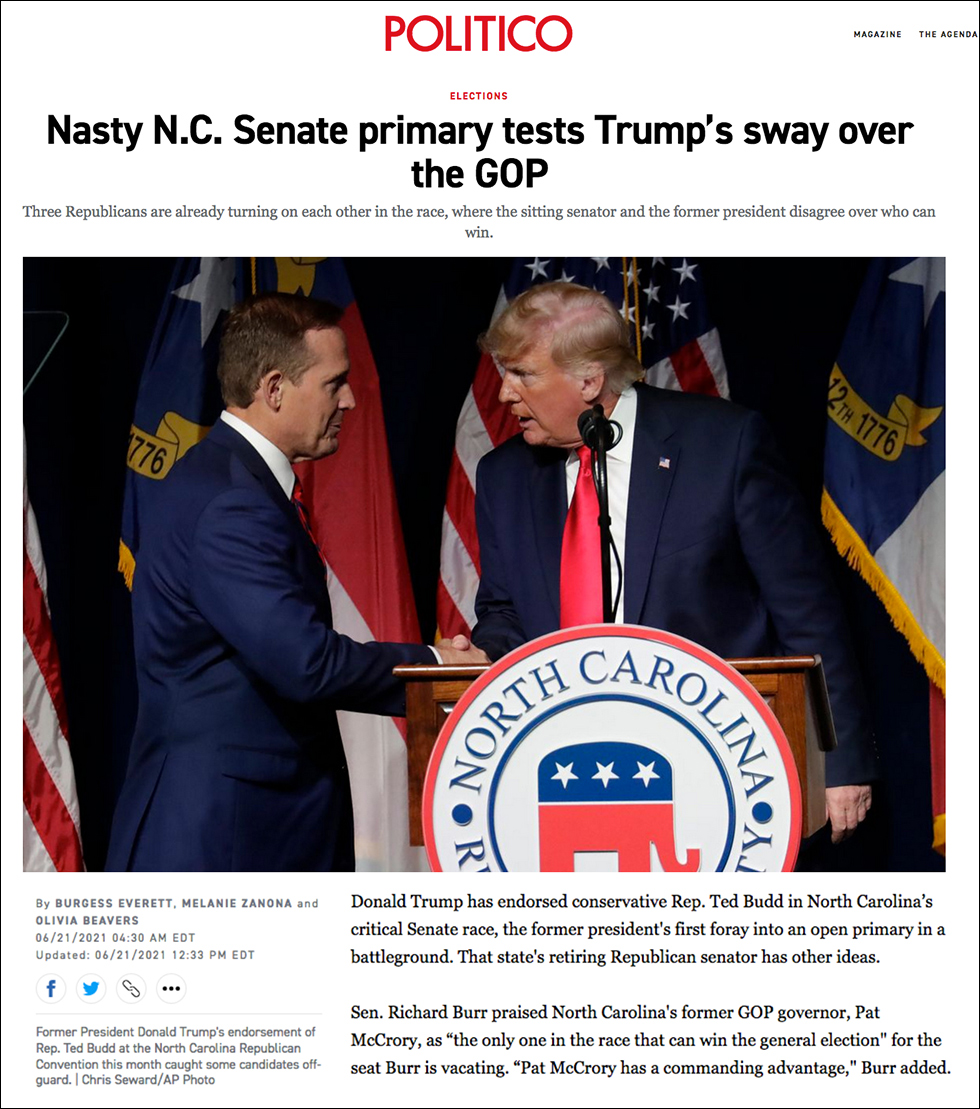
June 23, 2021 — Three Politico publication reporters, Burgess Everett, Melanie Zanona, and Olivia Beavers, combined on an article published yesterday (Nasty N.C. Senate primary tests Trump’s sway over the GOP) that merits refutation.

The piece details former President Trump’s public endorsement of US Senate candidate Ted Budd, the 13th District congressman, at the North Carolina Republican Party convention on June 5, and reactions to the development. Generally, and not surprisingly, it casts the endorsement and Rep. Budd’s statewide chances in a negative light.

Therefore, a number of points require balance.

1. To begin, the story quotes key Republicans, such as retiring North Carolina US Sen. Richard Burr (R) and South Carolina Sen. Lindsey Graham (R), who are downplaying the Trump endorsement’s effectiveness, with Sen. Burr going so far as claiming that ex-governor Pat McCrory is basically the only candidate who could win the upcoming general election. It is important to note here that McCrory failed to win re-election in 2016, the last time he was on a statewide ballot.

2. Secondly, a released Meeting Streets Insight poll conducted for the Budd campaign (June 9-10; 500 likely North Carolina Republican primary voters; live interview) highlights a different perspective.

The MSI survey found McCrory leading the GOP field 45-19-12 percent over Rep. Budd and former US representative, Mark Walker, respectively. When the polling sample is informed of the Trump endorsement – only 20 percent were aware before the pollsters provided the information – the ballot test completely flips to 46-27-8 percent with Rep. Budd leading, followed by ex-governor McCrory and former Rep. Walker. Obviously, this suggests the Trump endorsement still has power within the North Carolina Republican primary voter segment.
Continue reading

Trump Endorsement Matters in North Carolina Senate Primary

By Jim Ellis

Former President Donald Trump’s endorsement changes the face of the race for Senate in North Carolina.

June 16, 2021 — North Carolina US Rep. Ted Budd’s (R-Advance) Senate campaign released an internal Meeting Street Insights poll (June 9-10; 500 likely North Carolina Republican primary voters, live interview) Monday that finds former President Donald Trump’s endorsement completely changes the 2022 statewide Republican primary.

Rep. Budd is challenging former Gov. Pat McCrory and ex-US Rep. Mark Walker for the GOP nomination succeeding Sen. Richard Burr (R) who is not seeking re-election to a fourth term.

According to Meeting Streets, former Gov. McCrory would lead the field, as other polls have shown, by a wide margin. On the first ballot test, McCrory scores 45 percent preference as opposed to 19 perecent for Rep. Budd, while 12 percent choose ex-representative Walker.

The picture drastically changes, however, when the pollsters ask if the respondent is aware that former President Trump has endorsed Rep. Budd. Only 20 percent of the sampling universe expressed knowledge of this development. On what the pollster terms the “educated” ballot test, meaning the respondent is told that Trump has, in fact, endorsed Rep. Budd, we see the drastic transformation.

With the Trump endorsement becoming known, Rep. Budd soars to the lead with 46 percent support, while McCrory drops to 27 percent, and ex-Rep. Walker falls to eight percent.

McCrory’s campaign fielded a Public Opinion Strategies survey in early April (April 6-8; 500 likely North Carolina Republican primary voters, live interview) and found the former governor leading 48-13-9 percent over Walker and Budd, respectively.

This was followed later in the month by a Spry Strategies study (April 21-24; 700 likely Republican North Carolina primary voters; combination live interview and interactive voice response system) that found a 40-11-5 percent split, again with Rep. Budd trailing his two opponents.

Continue reading

New Seat Location in North Carolina

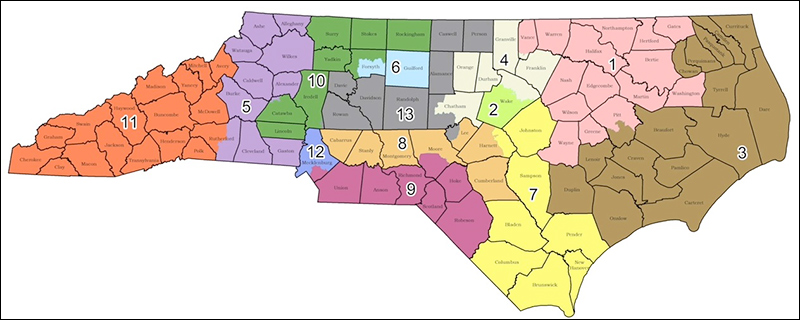
North Carolina’s 12 Congressional Districts

By Jim Ellis

May 21, 2021 — With the new reapportionment map public and the states gaining congressional districts now certain, we can begin to speculate where the new CDs might land. Today, we look at North Carolina, which continues to be one of the most important states from a national redistricting perspective.

The Census Bureau’s apportionment report, released on April 26, almost five months after their Jan. 1 deadline, contained the smallest transfer of congressional seats since the World War II era.

Just seven seats are moving from one state to another. As mentioned above, one of the recipients is North Carolina, the state that came the closest to gaining in the last census, missing by just a few thousand people. Today, we speculate as to how a new North Carolina congressional map might unfold.

The 2020 individual state population data has not yet been distributed and is not expected until October, apparently at the earliest. Once the specific state data is made public, the redistricting process can begin, but for now we can only use the latest available data (July 2019) for estimation purposes.

In examining the population numbers for each of the 13 current North Carolina congressional districts, we see that all must shed population to reach the state’s Census Bureau target number of 746,711 individuals, hence, the reason for the Tar Heel State gaining a new district.

In North Carolina, the state legislature has sole jurisdiction over redistricting. The governor, in this case Democrat Roy Cooper, has no veto power over the maps both houses jointly produce. This means the Republicans will control the process since they hold majorities in both the state House and Senate.

No matter what map is drawn, we can count on seeing post-redistricting litigation. In the previous decade, the courts twice altered the original map because of various lawsuits. The final iteration broke 8-5 in favor of the Republicans after the state Supreme Court redrew sections of the state and in effect awarded two previously Republican seats in Raleigh and Greensboro, respectively, to the Democrats.

Continue reading

Rep. Murphy to Challenge Sen. Rubio

By Jim Ellis

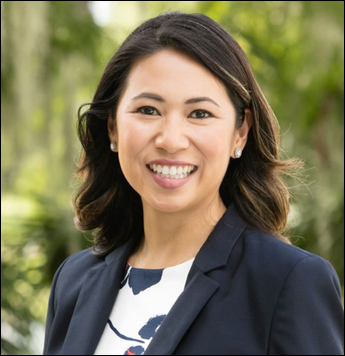
Florida Rep. Stephanie Murphy (D-Winter Park)

May 14, 2021 — According to the Axios news site, insiders close to Florida Rep. Stephanie Murphy (D-Winter Park) say that she has made the decision to challenge Sen. Marco Rubio (R) next year and will formally announce her campaign next month. The move had been expected for some time.

Rep. Murphy, a native of the country of Vietnam, was first elected to the House in 2016, defeating veteran Republican incumbent John Mica after the state Supreme Court had re-drawn the Florida congressional districts and made the 7th CD more Democratic. She unseated Rep. Mica 51-49 percent, and then scored re-election victories of 58 and 55 percent in 2018 and 2020, respectively.

A strong fundraiser, Rep. Murphy obtained over $3 million for both of her incumbent re-election campaigns. She ended the 1st quarter 2021 with a cash-on-hand figure of $1.43 million. Sen. Rubio posted $3.9 million in his campaign account during the same reporting period.

Assuming Murphy does enter the race next month, Democrats will have a credible challenger to Sen. Rubio, but one who still must be considered a decided underdog. In 2010, Sen. Rubio, then a state representative, defeated then-governor Charlie Crist, who was running as an Independent, and Democratic Congressman Kendrick Meek by a 49-30-20 percent margin. He was re-elected in 2016 with a 52-44 percent vote spread over then-congressman Patrick Murphy (D).

Florida races, as we know, are always competitive and usually very close, though the state has been trending more Republican over the past several elections. A Rubio-Stephanie Murphy race promises to become a national campaign.

With the Democrats apparently attracting a strong candidate in Florida, it is a good time to review the other key races.

In Pennsylvania, both parties are headed for very crowded primaries as each works to nominate a candidate to hopefully succeed retiring Sen. Pat Toomey (R). Afghan War veteran Sean Parnell entered the Republican primary earlier this week, but his only venture into elective politics was recording a two-point loss to Rep. Conor Lamb (D-Pittsburgh) last November in an Allegheny County suburban district.

Rep. Lamb, himself, may join the Democratic Senate campaign, meaning both parties are going to host political dogfights for the party nomination. In any event, however, the Pennsylvania race will be a top-tier national campaign.

Continue reading

The House Opens – Part II

By Jim Ellis

May 10, 2021 — In our second of the two-part series on the House open seats, today we analyze the eight Republican open seats from six states.

Two of the House’s five vacancies are currently Republican held and will be filled in special elections conducted from late June through Nov. 2. The six regular cycle Republican openings result from retirement decisions (2), and members seeking a different office (4).


AL-5 – Rep. Mo Brooks – running for Senate

Rep. Brooks (R-Huntsville), with former President Trump’s endorsement (which has proven extremely strong in other Republican primaries), is running for the Senate. Now that we know Alabama is not losing a seat in reapportionment, the open 5th District will elect a new member, and the 2022 Republican primary becomes the key focus.

Ex-President Trump carried this district in November with a 63-36 percent victory margin. Madison County Commission chairman Dale Strong (R) looks like the strongest candidate making an early announcement. Madison County encompasses half of the 5th District.


GA-10 – Rep. Jody Hice – running for secretary of state

In late March, Rep. Hice (R-Greensboro) announced that he will challenge Secretary of State Brad Raffensperger in the 2022 Republican primary. Raffensperger has come under heavy attack for his handling of the 2020 election, which makes him very vulnerable in a Republican primary.

As with all 14 of Georgia’s congressional districts, the 10th will be re-drawn as part of redistricting, but the GOP is in control of the process so we can count on this seat remaining safely Republican. We can expect a crowded GOP primary followed by a two-person runoff. The eventual Republican nominee then becomes a prohibitive favorite to the hold the seat in the 2022 general election.


NY-1 – Rep. Lee Zeldin – running for governor

With Rep. Zeldin (R-Shirley) in the governor’s race, the open eastern Long Island 1st District will likely host a competitive general election campaign. Already, one of the 2020 Democratic candidates, Suffolk County legislator Bridget Fleming, has announced her candidacy for the open seat. Nancy Goroff, the 2020 Democratic nominee who lost a 56-44 percent race to Rep. Zeldin, confirms that she is considering returning for a second campaign. We can expect NY-1 to be a hotly contested open seat next year and will be at least a moderate Democratic conversion opportunity race.


Continue reading

Major Senate Moves

By Jim Ellis

April 14, 2021 — With the Senate tied 50D-50R, and every 2022 campaign potentially meaning a change in majority status, we already see serious political moves being made or at least considered. This week began as being particularly active.

In the Last Frontier State of Alaska, 2020 Independent/Democratic nominee Al Gross, who opposed Sen. Dan Sullivan (R), confirms that he is considering challenging Sen. Lisa Murkowski (R) next year. The state’s new top four jungle primary system would virtually guarantee that both Sen. Murkowski and Dr. Gross would advance into the general election should both decide to run. For her part, Sen. Murkowski has not yet formally declared her 2022 political intentions, but she is expected to seek re-election.

Dr. Gross lost to Sen. Sullivan, 54-41 percent, despite exceeding the incumbent’s fundraising totals by almost a 2:1 margin. The Independent/Democrat spent over $19.5 million as compared to Sen. Sullivan’s expenditure total of $10.1 million. A total exceeding $27.2 million was expended from outside organizations, over $18 million of which aided Dr. Gross’ campaign.

Already announced is Republican former State Administrative Director Kelly Tshibaka; a Cygnal research firm survey of 500 Alaska registered voters taken in late March actually found her leading both Sen. Murkowski and Dr. Gross. The ballot test broke 34-19-18 percent in favor of Tshibaka with Sen. Murkowski and Dr. Gross significantly trailing. Under the new primary system, however, all three of these contenders, and a fourth candidate, would advance into the general election.

Former Kentucky state Rep. Charles Booker, who lost the 2020 US Senate Democratic primary to party nominee Amy McGrath in a close 44-42 percent result, has filed an exploratory committee for purposes of assessing his chances against Sen. Rand Paul (R) in a 2022 campaign.

Booker was literally outspent 10:1 in the Democratic primary, as McGrath hauled in more than $20 million even before advancing into the general election. She never figured on having to spend so much to defeat her intra-party opponent, however. Booker was able to maximize his political base in Louisville and with the African American community statewide to pull within 15,149 votes of McGrath with more than 544,000 people casting ballots in the primary election.

Sen. Paul won his 2014 re-election campaign with a 57-43 percent margin over Lexington-Fayette Urban County Mayor Jim Gray (D), which is the second largest municipality in Kentucky. National Democrats were high on the Gray campaign at its outset, but the race never materialized in what became a landslide Republican election year.

Reports emanating from North Carolina suggest that former Gov. Pat McCrory (R) could declare his Senate candidacy as early as today. McCrory was elected governor in 2012 with a 55-43 percent margin but would lose his attempt at re-election by just 10,263 votes from more than 4.7 million ballots cast, or less than a quarter of a percent.

Largely entangled with the infamous North Carolina bathroom bill that became a national story, the governor could not steer himself clear of the controversy and fell to then-Attorney General Roy Cooper (D). McCrory had previously run for governor in 2008, losing to incumbent Bev Perdue (D) by just three percentage points. Prior to running statewide, McCrory served 14 years as Charlotte’s mayor.

Continue reading

Early Senate 2022 Previews:
Florida & North Carolina

By Jim Ellis

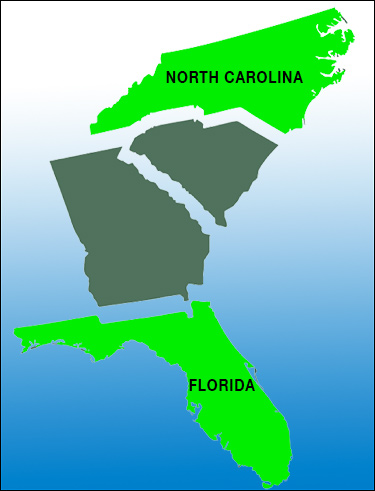
Jan. 14, 2021 — Regardless of how many in-cycle Senate seats – there are 34 in the 2022 election cycle – come into political play, we can count on seeing Florida and North Carolina once again hosting crucial battleground campaigns.

Florida is always consistent in their close vote totals, particularly when remembering the 2000 presidential campaign — and pollsters, while typically forecasting tight finishes, have often missed the outcomes. In fact, the cumulative polling community has predicted close Democratic victories in the last four key statewide elections: two presidential (2016 & 2020), one senatorial (2018), one gubernatorial (2018), and been wrong on each occasion.

Since 2016, inclusive, Florida has hosted eight statewide races with Republicans winning seven. Yet, their average cumulative vote percentage for these eight victorious campaigns was just 50.7 percent, with the high point being 52.0 percent (Sen. Marco Rubio-R, 2016). Democrats recorded the low winning total: 50.04 percent — 6,753 votes from 8,059,155 votes cast; agriculture commissioner, 2018; winner Nikki Fried (D) vs. Matt Caldwell (R). The aggregate average among the statewide contests in these three most recent election years is 50.7 – 47.9 percent in the GOP’s favor.

With this background, Sen. Rubio will presumably seek a third term next year against what will surely be a highly competitive Democratic opponent. At this point, most of the speculation surrounds two Democratic House members, neither of whom has closed the door on either running for the Senate or challenging Gov. Ron DeSantis (R) as he seeks a second term.

Reps. Stephanie Murphy (D-Winter Park) and Val Demings (D-Orlando) are the two most prominently mentioned prospective contenders, and it wouldn’t be surprising to see one run for Senate and the other for governor. It is less likely that we would see a primary developing between the pair in one of the races.

Other names being floated are Rep. Charlie Crist (D-St. Petersburg), who is always mentioned as a potential statewide candidate because he previously served both as attorney general and governor and lost two other statewide campaigns. Other potential contenders are Rep. Ted Deutch (D-Boca Raton) and former Rep. Debbie Mucarsel-Powell (D-Miami). The state’s lone Democratic office holder, Agriculture Commissioner Nikki Fried, is more often associated with running for governor as opposed to the Senate contest.

Continue reading

Deadlines Ahead in Ohio,
North Carolina 2020 Campaigns

By Jim Ellis

Dec. 17, 2019 — Interesting decisions await as candidate filing deadlines are approaching this week in Ohio (Dec. 18) and North Carolina (Dec. 20) for their respective March 17 and March 3 primaries.

The Ohio political situation, originally thought to be relatively mundane without a Senate campaign and little competition within the congressional delegation, may be changing.

In the 1st District, veteran Rep. Steve Chabot (R-Cincinnati), who lost this district in 2008 after first going to Congress in 1995 and then re-claiming the seat in 2010, again faces what will likely be a competitive re-election battle. In 2018, Chabot defeated Hamilton County Clerk of Courts Aftab Pureval by a 51-47 percent count, despite the Democratic nominee spending over $4 million for his campaign. Expected to file for the Democrats this year are healthcare executive Kate Schroder and US Air Force Reserve officer Nikki Foster.

The new potential contest coming onto the political scene emanates from the Youngstown area as Rep. Tim Ryan (D-Warren), who was an early presidential candidate but failed to generate any major attention, appears to be attracting strong opposition for the first time since he won his original congressional election in 2002.

Now reportedly moving toward challenging Rep. Ryan are former Lt. Gov. Mary Taylor, who fared poorly in the 2018 Republican gubernatorial primary, and ex-state Rep. Christina Hagan who scored over 40 percent of the vote against freshman Rep. Anthony Gonzalez (R-Rocky River/Medina) in the last nomination campaign from the neighboring 16th District.

Though both women have the ability to attract people and resources to their political efforts, the 13th CD is reliably Democratic and Congressman Ryan would be tough to dislodge. President Trump fared better than most Republicans here in 2016, but still lost 44-51 percent. President Obama, in both 2008 and 2012, topped 62 percent and Rep. Ryan has averaged 67.8 percent of the vote over his nine-term congressional career.

Still, House members who run for president often have a difficult time in their next re-election effort, so it remains to be seen if a credible challenge against the veteran congressman could develop legs.

Continue reading

House Retirement No. 36

Four-term Rep. George Holding (R-Raleigh) announced that he will not seek re-election next year.

By Jim Ellis

Dec. 10, 2019 — The 36th US House seat to come open lies in Raleigh, North Carolina, as four-term Rep. George Holding (R-Raleigh) announced late Friday that he will not seek re-election next year. He is in the rare situation of being forced from his position because of an unfavorable redistricting draw during the fifth election of the political decade.

We can expect to see a number of such redistricting-related instances occur throughout the country in the next election cycle, but to be still fighting redistricting legal battles, as they are in North Carolina, with a new census and apportionment directly upon us is unprecedented.

Rep. Holding says he is now not seeking re-election because of what he describes as the “terrible” manner in which the boundaries of his 2nd District have been reconstructed. The 2nd moves from a 53-44 percent Trump district to one that voted 60-36 percent for Hillary Clinton.

Though the Republican legislators reconfigured the map, the partisan division will increase the Democratic number by at least two seats, which directly affects the Raleigh and Greensboro and Winston-Salem areas. The court directive forced a criterion change upon the legislature, which responded with the new map.

The post-2020 election delegation will likely feature an 8R-5D split, and Democrats sued arguing they should have more in a state whose electorate typically splits close to 50/50. The three-judge panel that originally struck down the previous GOP map unanimously approved this latest mapping effort, so the new plan will stand for the 2020 elections.

This new congressional map significantly changes the North Carolina political picture. The Holding seat is now a Democratic primary fight, and the early leader is former state Rep. Deborah Ross, who challenged Sen. Richard Burr (R) in 2016 and held him to a hard fought 51-45 percent victory.

The other Republican incumbent left without a political home is three-term Rep. Mark Walker (R-Greensboro), and it is clear he will not seek re-election in the new 6th District. He is reportedly weighing his options for other political opportunities. Rep. Walker averaged 58.1 percent of the vote in his three congressional victories while the newly constructed NC-6 constituency supported Hillary in a 59-38 percent result.

Continue reading

Unending North Carolina Redistricting

By Jim Ellis

Nov. 20, 2019 — If it seems like the North Carolina redistricting process has dragged on for the entire decade, then your senses are correct, because it has. After seeing a mid-decade re-draw before the 2016 elections, another set of lines will be in place for 2020, and then another plan for the ensuing electoral decade beginning in 2022 will be enacted during the regular decennial process. North Carolina is a sure bet to gain a new congressional seat in 2020 reapportionment.

Last week, the Republican legislature produced a new map per court order that will concede two more seats to the Democrats. This plan is not final, however, as the new map still has must clear the legal process and certainly the Democrats will challenge in an attempt to get more. Republicans will counter and attempt to move the process away from the state three-judge panel which has been favorable to the Democratic arguments, and into federal court where they feel their own points may be given a more sympathetic hearing.

Racial gerrymandering was the subject of the original challenges, but when those arguments led to a new map without a net gain of Democratic seats, the plaintiffs filed political gerrymandering lawsuits. With the Supreme Court basically returning the political gerrymandering arguments back to the state courts, the Democrats, at least in North Carolina, are in much better position to get a map that better reflects their intended outcome.

With the current split being 10R-3D, which of the current members are in the deepest trouble under the new map? Though the map looks fundamentally similar to the current plan, there are sizable differences in district configuration from a political context.

The Daily Kos Elections site ran a voting analysis of the new seats, and it appears a new Tar Heel State delegation under this map would feature eight Republicans and five Democrats, or a net gain of two seats for the latter party.

The two current incumbents who would not likely return under the plan are Reps. George Holding (R-Raleigh) and Mark Walker (R-Greensboro). Their districts go from being a plus-10 Trump district for Holding to a minus-14 CD, and for Walker an original plus-15 Trump to a minus-11.

Continue reading