Tag Archives: Rep. Ted Budd

Rep. Budd’s Nomination Secure in NC?
A Close Gov. Race Brewing in NM

By Jim Ellis
May 16, 2022

Senate
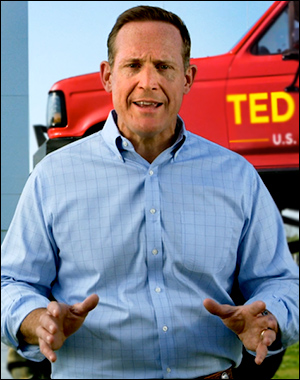
North Carolina Rep. Ted Budd (R-Advance)

North Carolina: Dueling General Election Polls — With US Rep. Ted Budd (R-Advance) now substantially ahead in 12 consecutive Republican primary polls from the end of March to present, it appears clear he is going to be nominated on Tuesday. Therefore, attention is already being paid to the formulating general election. Two polls featuring Rep. Budd and consensus Democratic nominee Cheri Beasley, the former state Supreme Court Chief Justice, have just been released.

The first, from the Beasley campaign that the Global Strategy Group conducted (April 28-May 4; 800 likely North Carolina general election voters) finds the poll sponsor and Rep. Budd tied at 45 percent. Emerson College also released their survey (May 7-9; 1,000 registered North Carolina voters) that gives Budd a 48-41 percent advantage. We can expect this to be one of the top Senate races in the country come November and will feature a plethora of public polls.

House

NC-1: Dems Have Clear Poll Leader; Republicans Attacking Their Own — The GQR survey research firm ran a poll of the open 1st District Democratic primary (May 6-8; 407 likely NC-1 Democratic primary voters) and find state Sen. Don Davis (D-Snow Hill) leading former state senator and 2020 US Senate candidate Erica Smith, 44-31 percent, as the candidates make their final pitch before Tuesday’s primary election.

The Republican-oriented Congressional Leadership Fund, loosely associated with House Minority Leader Kevin McCarthy (R-CA), is actively running ads against GOP candidate Sandy Smith, the 2020 CD-1 nominee who held incumbent Rep. G.K. Butterfield (D-Wilson) to a 54-46 percent re-election victory.

The CLF does not indicate support for another candidate, but former Rocky Mount Mayor Sandy Roberson appears to be Smith’s strongest competitor. The move is curious in that the ads lay out personal negatives against Smith that could be used against her in the general election should she win the GOP nomination. The new 1st, which the state Supreme Court drafted, is rated D+5, thus suggesting a competitive general election.

Governor

New Mexico: Close Race Brewing — Survey USA polling for KOB-TV in Albuquerque (April 29-May 7; 1,389 likely New Mexico general election voters; interactive voice response system and online) tested the upcoming governor’s race and finds 2020 US Senate Republican nominee and former television weatherman Mark Ronchetti pulling to within the margin of polling error against Gov. Michelle Lujan Grisham (D).

The ballot test breaks 47-43 percent in favor of the incumbent. More troubling for Gov. Lujan Grisham, however, is her results against the entire Republican field. Paired individually with each of five candidates, Gov. Lujan Grisham, though leading in every case, fails to reach 50 percent against any of her GOP opponents. The cumulative results portend a highly competitive November race.

Pennsylvania: Senate President Drops Out — Just days before Tuesday’s Pennsylvania primary, state Senate President Jake Corman has dropped his Republican gubernatorial bid and endorsed fellow contender Lou Barletta, the former congressman and 2020 US Senate nominee. With Corman never able to increase his support from low single digits, his withdrawal is designed to help Barletta overcome the polling lead that state Sen. Doug Mastriano (D-Fayetteville) has established.

Pennsylvania Republican leaders are reportedly nervous that Sen. Mastriano, who was a legislative leader in attempting to determine if there was widespread fraud in the state during the 2020 election, would be unable to defeat Attorney General Josh Shapiro, who is the consensus Democratic gubernatorial nominee. It is likely that the Corman-Barletta move will prove too little, too late, however.

States

Texas Attorney General: Paxton Leading Big — A CWS Research poll (May 4-10; 992 likely Texas Republican primary runoff voters; interactive voice response system and text) reports that Attorney General Ken Paxton is substantially ahead of Land Commissioner George P. Bush, the son of former Florida governor and 2016 presidential candidate Jeb Bush. The CWS results find AG Paxton holding a whopping 58-31 percent lead as the candidates move toward the state’s May 24 runoff election date. In the primary, Paxton garnered 42.7 percent of the vote, which is obviously short of the majority vote a candidate needs to win the nomination outright. In a field of four candidates, Bush finished second with 22.8 percent.

Rep. Budd Cements Lead in NC;
Sen. Manchin Goes Republican?

By Jim Ellis
May 5, 2022

Senate

North Carolina Rep. Ted Budd (R-Advance)

North Carolina: Rep. Budd Cements Lead — The Club for Growth, running a support independent expenditure for Rep. Ted Budd’s (R-Advance) US Senate campaign, released the results of their most recent WPA Intelligence poll (April 24-26; 500 NC likely Republican primary voters; live interview). While Rep. Budd led in the last six consecutive polls, the WPAi numbers now post him to a 20 percentage point lead over former Gov. Pat McCrory, 43-23 percent. Ex-US Rep. Mark Walker trails with nine percent support, while author Marjorie Eastman records four percent preference.

Considering North Carolina only has a 30 percent threshold to win a nomination outright, it appears the congressman is in strong position to clinch on May 17. The GOP winner will face consensus Democratic candidate Cheri Beasley, the former state Supreme Court Chief Justice. Sen. Richard Burr (R) is retiring after three terms.

House

FL-15: Candidates Enter Race — With the Florida congressional map now adopted, candidates are beginning to come forward. In the new open 15th District that contains half of the city of Lakeland and part of Hillsborough County, former US Rep. Dennis Ross is drawing Republican primary opposition. In the race are state Rep. Jackie Toledo (R-Tampa), retired Navy officer Kevin McGovern, and Afghan war Navy veteran Demetrius Grimes.

The seat leans Republican, but expect Democratic competition in the general election. At the early going, considering he represented more than 70 percent of this district for eight years in the House before retiring, Ross is the clear favorite for the party nomination and to capture the seat.

WV-2: Manchin Involved in Republican Campaign — The paired Republican congressional campaign between Reps. David McKinley (R-Wheeling) and Alex Mooney (R-Charles Town) has drawn an unusual advocate. Democratic Sen. Joe Manchin has endorsed Rep. McKinley, and is now starring for him in a new testimonial ad. Sen. Manchin dispels the notion that Rep. McKinley supported the Build Back Better legislation and directly criticizes Rep. Mooney.

With the primary fast approaching on May 10, we can expect Rep. Mooney to quickly counter the message. Sen. Manchin’s approval numbers are strong in West Virginia, but bringing a Democratic figure in to help decide a Republican primary battle could well backfire. Expect Mooney to attempt to turn the tables regarding this endorsement.

Helping explain Rep. McKinley’s move to highlight the Democratic senator, the latest public poll (Public Opinion Strategies for the Mooney campaign; April 26-28; 400 likely WV-2 Republican primary voters) gives Rep. Mooney a 20-point, 50-30 percent advantage as the two candidates begin the final week of campaigning. The two were forced into one district because West Virginia lost one of its three seats in national reapportionment.

Ohio Republican Turnout Dominates

By JIM ELLIS
May 5, 2022


Primaries

Turnout: Republicans Dominate in Ohio — Primary turnout can often be a harbinger of what happens in a general election. In the Buckeye State, Republicans claimed the turnout war in impressive fashion even when considering the Democratic contests were not particularly competitive. Compared to the 2018 midterm election, Republican turnout was up 28 percent, with over 1 million voting. Conversely, Democrat participation was down 26 percent from the last midterm with an aggregate turnout total of just over 510,000 voters, literally half of the GOP figure.

These results are close to the stats from Texas’ early March primary. Republican turnout there was up 26.6 percent, while Democratic participation grew only 3.6 percent. There were no contested statewide contests to measure the Indiana turnout. So far, the political enthusiasm gap is pointing toward the Republicans.

OH-11: Loss Could Mean a Presidential Run — Former Ohio state senator and 2020 Bernie Sanders for President national co-chair Nina Turner, who lost a 66-34 percent landslide Democratic primary election to Rep. Shontel Brown (D-Warrensville Heights/Cleveland) on Tuesday, is reportedly considering entering the 2024 presidential campaign. To say the least, Turner would enter the presidential nomination battle as a major underdog.

Senate

North Carolina: Two More See Budd Leading — A pair of new polls, one of which was conducted for the North Carolina Chamber of Commerce, echo the findings of all other surveys released since March 22. That is, Rep. Ted Budd (R-Advance) is topping former Gov. Pat McCrory, US Rep. Mark Walker, and author Marjorie Eastman.

In the NC Chamber poll, conducted through Atlantic Polling Strategies (April 25-28; released May 4; 534 likely North Carolina Republican primary voters; live interview and online), Rep. Budd is holding a 45-21-9-3 percent advantage. Meredith College (April 25-27; 1,225 adults; 588 likely North Carolina Republican primary voters; online) posts the Budd margin at 33-26-7-3 percent in the same order as above. The North Carolina primary is May 17. Rep. Budd has now led in eight consecutive published polls.

Governor

Florida: Rep. Crist Increases Primary Lead — A new St. Pete Polls survey (May 2-3; 1,859 likely Florida Democratic primary voters; online) projects that US congressman and former Gov. Charlie Crist holds a dominating lead in the Democratic primary. The ballot test result finds Crist capturing 52 percent of the Democratic preference vote, way ahead of state Agriculture Commissioner Nikki Fried’s 19 percent and state Sen. Annette Taddeo’s (D-Miami) five percent support. Interestingly, Taddeo was Crist’s lieutenant governor running mate when the pair lost to then-Gov. Rick Scott (R) in 2014. The winner of the Aug. 23 Democratic primary will then challenge incumbent Gov. Ron DeSantis (R) in the general election.

New York: Gov. Hochul’s Comfortable Lead — A new Emerson College poll (May 1-3; 1,000 likely New York voters, 444 likely New York Democratic primary voters; combination interactive voice response system, text, and online) sees Gov. Kathy Hochul leading her Democratic primary opponents, Rep. Tom Suozzi (D-Glen Cove) and NYC Public Advocate Jumaane Williams, by a 45-12-7 percent count.

More interesting, however, is the general election survey that includes former Gov. Andrew Cuomo running as an Independent. In this scenario, 33 percent would support a generic Democratic candidate, 33 percent a generic Republican candidate, while 16 percent would vote for Cuomo. There is no indication at this point, however, that the resigned governor will enter the race.

Self-Funding Candidates Saving GOP

By Jim Ellis

April 21, 2022 — The first-quarter financial reports are now public and we see a stark difference between Democrats and Republicans in funding for the key May primary Senate races, particularly in Pennsylvania and Ohio. If it wasn’t for self-funding candidates in these two states, the GOP would be in trouble.

In Pennsylvania, Democratic Lt. Gov. John Fetterman holds strong polling leads over his primary opponents as well as a major fundraising advantage over all contenders. According to the Federal Election Commission’s March 31 campaign finance reporting, Fetterman has raised just over $15 million for his US Senate effort.

His receipts total is well over $9 million more than his chief Democratic primary opponent, Rep. Conor Lamb (D-Pittsburgh), and his $5.7 million aggregate figure. The third competitive Democrat, state Rep. Malcolm Kenyatta (D-Philadelphia), has obtained $1.8 million. None of the three Democrats have self-funded their races to any degree.

The Pennsylvania Republicans, on the other hand, offer a stark contrast. While the top two GOP resource candidates, television doctor Mehmet Oz and ex-hedge fund CEO David McCormick, report aggregate receipts in the same realm as Fetterman, the sources are very different.

Dr. Oz posts total receipts through March 31 of $13.4 million and McCormick has $11.3 million. The difference, however, is that 82 percent of Dr. Oz’s money comes from him, and 61 percent of McCormick’s money is self-donated, mostly in the form of campaign loans.

The same pattern also appears for the third-highest funded Republican candidate, former US Ambassador Carla Sands. She reports $4.62 million in receipts, but 85 percent of that total comes from her personal funds. The fourth-place candidate, former lieutenant governor nominee Jeff Bartos, is the only one with a majority percentage of his dollars coming from contributors. He has raised $3.4 million, with 62 percent coming from individuals other than himself.

The story is the same in neighboring Ohio. There, the two top fundraising Republicans report self-funding as their major source.

Businessman Mike Gibbons leads all candidates in total receipts with $17.4 million raised. In his case, all but $1 million, or 94 percent of his aggregate total, comes from his own funds. The second-highest Republican in terms of dollars raised is state Sen. Matt Dolan (R-Chagrin Falls), who is a minority owner of the Cleveland Guardians MLB baseball club, with $11.1 million in receipts. He also has self-donated, mostly in terms of personal loans, 94 percent of his campaign treasury.

We also see the same pattern appear for the Ohio Democrats that exists in Pennsylvania. US Rep. Tim Ryan (D-Warren/Youngstown) is the consensus party candidate, way ahead of former Consumer Financial Protection Bureau official and 2020 congressional candidate Morgan Harper in terms of polling and money.

Continue reading

North Carolina Races Set – Part I

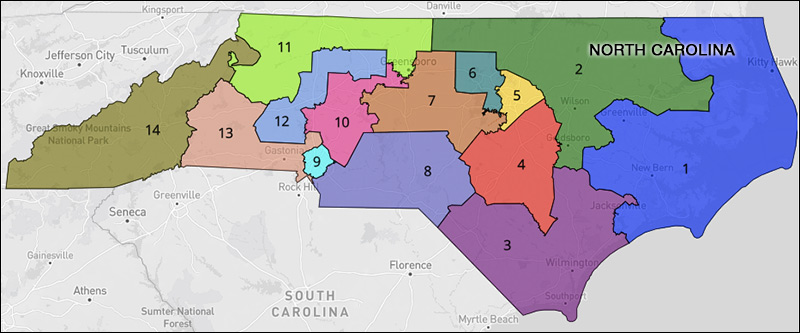
2022 North Carolina Congressional Redistricting Map

By Jim Ellis

March 8, 2022 — The chaotic Tar Heel State political scene quelled on Friday as the postponed candidate filing period finally came to a close. Today we look at the recent North Carolina redistricting past and future, along with an analysis of the open Senate race. Tomorrow, we examine the state’s 14 new US House districts.

The North Carolina state Supreme Court’s approved map will be in place for the 2022 midterm election, and as a result the candidate slate is less competitive than the originally conceived congressional plan would have yielded. While the Democrats won this most recent political battle, the state’s redistricting war, a fight between the legislature and state Supreme Court that has resulted in four different congressional maps being in passed into law and ultimately rejected since 2010, will likely continue.

The Republican legislature controls the redistricting pen because the North Carolina governor, in this case Democrat Roy Cooper, has no veto power over this subject matter. Democrats control the state Supreme Court with a 4-3 partisan majority, but there is at least an even chance that the balance of power will change after the midterm election.

Two of the Democratic judges are on the ballot this year and no Republicans. One of the two, Justice Robin Hudson, is not seeking re-election, so GOP chances of winning at least one of the two races are enhanced. If they succeed, Republicans will hold the court majority after the first of the year.

Since a court map is only an interim plan, the legislature can replace it at any time. Since the state high court did approve the legislature’s latest version of the state House and Senate maps, Republicans stand a strong chance of maintaining their majorities in both houses. Therefore, re-drawing the congressional map in 2023 should the NC Supreme Court have a different complexion could mean that the GOP would be able to enact a stronger plan next year.

Originally, North Carolina arguably looked to be the Republicans’ most important redistricting state in that it was one of just two places where the party could gain multiple congressional seats and the only one where a potential three-seat increase was within the realm of possibility. The outlook for the final 2022 map, however, gives the Democrats an advantage. It now appears more likely that the Dems will gain one or even two seats in the delegation.

The North Carolina judicial decision is a major blow to House Republican national prospects. While the party still has a good chance of re-taking the majority they lost in the 2018 election, the difficulty factor has increased through adverse court decisions here and in several other states.

Continue reading

GOP Battle Brewing in
North Carolina Senate

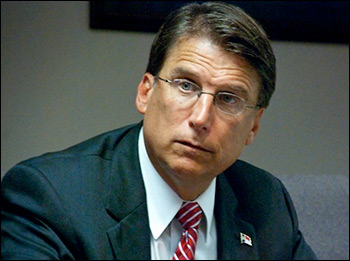
Former Gov. Pat McCrory (R-NC) – on thin ice in Senate bid? / Photo by Hal Goodtree, Flickr

By Jim Ellis

Jan. 17, 2022 — The North Carolina Senate candidates have dealt with more uncertainty than any other set of statewide political contenders in this election cycle. Some of the questions have now been answered, but others remain.

Due to the continuing congressional and state legislative redistricting legal battles that have hampered the state for virtually the entire preceding decade, even the candidate filing date and the primary schedule itself were in doubt until the courts finally set a political calendar.

In order to be more relevant for the 2020 presidential election, the legislature moved the state’s traditional May primary to early March to better influence the presidential nomination selection. By not taking action to move the primary back to May, it appeared that voters would choose their ’22 nominees on March 8.

In December, the state Supreme Court, after an early flurry of lower court redistricting action, took it upon themselves to transfer the state primary to May 17. They merely suspended the Dec. 17 candidate filing deadline, but did not issue a new date. Earlier this week, as part of its ruling upholding the GOP legislature’s congressional and legislative maps, the special three-judge panel assigned to hear the redistricting challenges set the filing deadline for March 4.

With these basic questions now answered, the candidates finally have a clear electoral timeline in which to work. With the Democrats earlier coming together on a consensus candidate, fireworks are beginning on the Republican side. In mid-December, state Sen. Jeff Jackson (D-Charlotte), thought to be a major US Senate contender, dropped his statewide bid. This makes former state Supreme Court Chief Justice Cheri Beasley an overwhelming favorite for the Democratic nomination.

In the past few days, a pair of Tar Heel State Republican primary Senate polls were released almost simultaneously, with both finding former Gov. Pat McCrory holding an edge over US Rep. Ted Budd (R-Advance). The ex-state chief executive’s advantage isn’t what one would expect for a well known party leader before his own partisan electorate, however. The McCrory campaign released their Strategic Partners Solutions survey (Jan. 5; 800 likely North Carolina Republican primary voters) that gives their man a 30-21-8 percent lead over Rep. Budd and former US Rep. Mark Walker.

The Civitas Institute’s latest Cygnal statewide poll (Jan. 7-9; 600 likely North Carolina Republican primary voters) also found McCrory holding an initial lead, but only through a 24-19 percent spread. Pushing for a decision from the 48 percent who said they were undecided and adding those preferences to the total actually finds Rep. Budd pulling into a small lead, 34-33 percent, when accounting for those who have “definitely” and “probably” made up their minds.

Continue reading

North Carolina in Political Abeyance

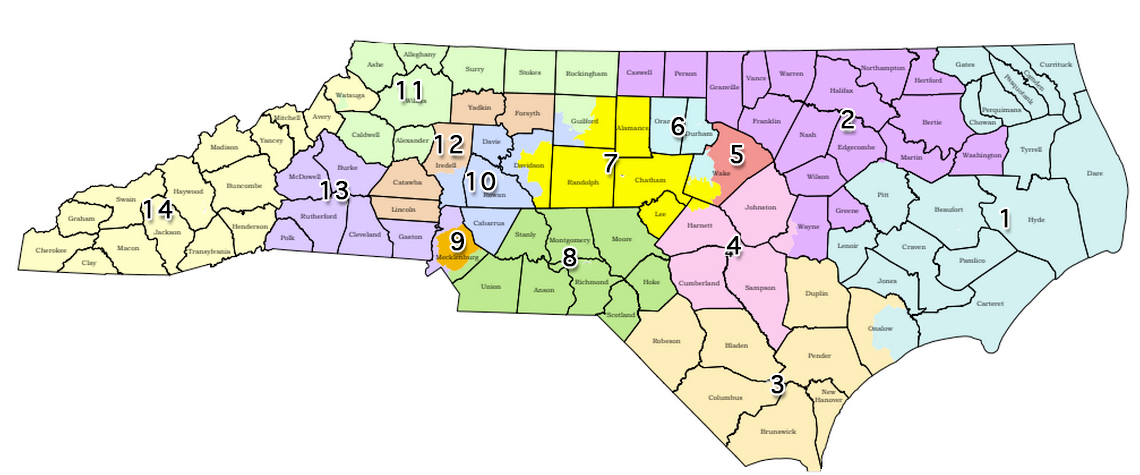
(Please click on map for expanded view.)


By Jim Ellis

Dec. 14, 2021 — Last week proved to be a topsy-turvy week in North Carolina politics, and situations are being created that won’t likely be resolved for some time.

First, a three-judge panel suspended the state’s Dec. 17 candidate filing deadline to allow consideration time for the filed partisan gerrymandering lawsuits. A day later, the en banc 15-member State Appellate Court overturned the judicial panel’s ruling and reinstated the Dec. 17 filing deadline. Just hours later, the state Supreme Court overruled the full Appellate Court and not only reinstated the original ruling suspending the candidate filing deadline, but postponed the North Carolina primary more than two months, moving it from March 8 to May 17.

The final ruling affects all candidates at every level because the primary now returns to the traditional May slot that North Carolina typically holds. The respective Democratic and Republican Party leaders moved the primary in 2020 to better position the state for the presidential nomination process. In the 2021 legislative session, the General Assembly took no action to move the primary back to May.

The judicial rulings also affect the statewide US Senate race. For example, ex-Congressman Mark Walker (R) is a Senate candidate who did not seek re-election to the House in 2020 because the late-decade court-ordered redistricting ruling tore his previous 6th District into several parts making the region unattainable for any Republican.

Many people on the right, including former President Donald Trump, are reportedly urging Walker to leave the Senate race and run in the state’s open 7th Congressional District. The newly created CD-7 in the Greensboro area, which Walker largely represented, would certainly be winnable for him. In actuality, he would only have to win a Republican primary. If this map stands, the new 7th will be safe for the GOP in any general election.

Currently, the former congressman trails badly in early US Senate polling, but he is planning to stay in the Senate race until at least the end of the year, or when the congressional map status becomes clear.

Continue reading

North Carolina Rep. G.K. Butterfield’s Retirement Leaves a Competitive 2nd

North Carolina Rep. G.K. Butterfield (D-Wilson)

By Jim Ellis

Nov. 22, 2021 — As was suggested earlier in the week, 10-term North Carolina Rep. G.K. Butterfield (D-Wilson) announced late last week that he will not seek re-election next year. He leaves a new 2nd District – his seat had been numbered NC-1 throughout his career – that will be more competitive in 2022.

Rep. Butterfield attacked the Republican-passed redistricting plan as a gerrymander on his way out and says the draw hurts African Americans in his district. He says that largely because an African American section of Pitt County was removed from the district, along with a small conservative county, and replaced with three larger and decidedly more Republican localities along the Virginia border.

North Carolina gained a seat in reapportionment, but the Butterfield seat was the only current Tar Heel State CD that needed to gain residents. The current 1st District was 58,205 individuals short of the state’s new population quota of 745,671 individuals per CD, so the map drawers had no choice but to add people. Virtually all of the surrounding counties are Republican.

The new 2nd District is certainly more competitive. While President Biden carried the current 1st District with a 54-45 percent margin, on par with Hillary Clinton’s 55-44 percent spread in 2016, the new 2nd District would have given Biden only a 51-48 percent vote split.

Though the new 2nd will be more competitive, the current 1st District was beginning to show signs of political change. This somewhat dispels Rep. Butterfield’s gerrymandering argument. While the previous eight elections delivered an average vote of 72.6 percent for Butterfield, his 2020 victory margin dropped to 54-46 percent opposite accountant and political activist Sandy Smith (R).

Though the state Supreme Court changed the North Carolina map for the 2020 election and basically awarded the Democrats two of the Republicans’ seats, the 1st was left largely unchanged. This suggests that the electorate could be transforming naturally, thus alternative reasons exist for the district becoming more conservative than simply altering the district lines.

We can expect to see competitive primaries in both parties, and things will quickly unfold now that the seat is open. Prior to the retirement announcement, Henderson City Councilman Jason Spriggs had announced a Democratic primary challenge to Rep. Butterfield but he was not rated as a serious challenge to the congressman.

Continue reading

Is the McCrory Lead a Mirage
In North Carolina Senate Race?

By Jim Ellis

Former North Carolina Gov. Pat McCrory

Oct. 28, 2021 — Former North Carolina Gov. Pat McCrory’s campaign did something rather strange this week.

They released their internal Pubic Opinion Strategies poll, which in and of itself is not unusual, and extolled how well McCrory was running, but they did not publish the ballot test numbers in the polling synopsis. Why? Because the figures aren’t as good as meets the eye.

Once found, the ballot test shows McCrory leading Rep. Ted Budd (R-Advance), 40-25 percent, a 15-point edge, which was truthfully cast as a double-digit lead. The underlying story, however, is that the ballot test actually represents a net gain of 20 percentage points for Budd.

In April, POS released their first public poll of the GOP primary and it showed McCrory leading Rep. Budd, 48-13 percent. Comparing the latest 40-25 percent result shows some sustained momentum for Rep. Budd in that McCrory’s support has dropped eight points while his own climbed a dozen.

A third candidate, former Rep. Mark Walker, only registered eight percent in this poll, but it is possible that he will not even file for the Senate at the Dec. 17 deadline. If the legislature moves forward with a version of the redistricting plan that puts the Greensboro area seat back in play for Republicans – a court decision robbed Walker of the House seat he held for three terms with their ruling changing the state’s congressional map before the 2020 election – it is quite possible that Walker would have the option of returning to a winnable House contest.

If Walker were to abandon the Senate race, it would be another plus for Rep. Budd. It is likely that more Walker voters will gravitate toward Budd than McCrory since they clearly are familiar with the former governor but chose not to back him in the three-way contest.

Pat McCrory was elected governor in 2012, but lost to then-Attorney General Roy Cooper (D) on the same night that Donald Trump claimed North Carolina against Hillary Clinton. In fact, Republicans won eight of 12 statewide elections that evening, with McCrory being the only GOP incumbent to fall.

Continue reading

North Carolina – A Different Take

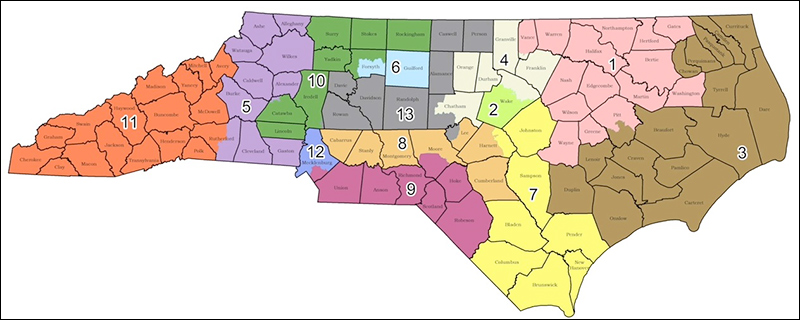
North Carolina’s 12 Congressional Districts

    By Jim Ellis

    Aug. 19, 2021 — Based upon the 2019 census estimates, it appeared that the new North Carolina congressional seat was bound for the Charlotte area, but the actual 2020 census figures released late last week may be suggesting a different location.

    In looking at the current 13 congressional districts, all but Rep. G.K. Butterfield’s (D-Wilson) 1st District must shed population, hence the reason North Carolina was awarded a new seat. While the census estimates found Rep. Alma Adams’ (D-Charlotte) 12th District being the state’s most over-populated CD, the actual census data finds another district moving beyond the resident number that the Adams’ seat must shed (159,818) in order to reach the state’s target population figure of 745,671 individuals.

    The new data find that freshman Rep. Deborah Ross’ (D-Raleigh) 2nd District is the state’s largest, housing 165,703 people over the state’s new per CD quota. Additionally, neighboring Rep. David Price (D-Chapel Hill), whose 4th District also contains part of Raleigh’s Wake County, also must shed a large number (129,692).

    Looking at the neighboring districts in the Charlotte area, the 8th and 9th CDs of Reps. Richard Hudson (R-Concord) and Dan Bishop (R-Charlotte), along with one county from Rep. Virginia Foxx’s (R-Banner Elk) western 5th District, means that the Charlotte area’s population surplus is approximately 250,000, while the Raleigh districts are over-populated by a slightly larger approximate figure of 300,000 people.

    In the east, the Butterfield district is short just 6,238 people and neighboring Rep. Greg Murphy’s (R-Greenville) 3rd District must shed 10,979 individuals, meaning a relatively simple swap between these two seats and a sliver from a third, most likely Rep. David Rouzer’s (R-Wilmington) 7th District, will easily bring these seats into balance.

    The western sector is also relatively well defined. Freshman Rep. Madison Cawthorn’s (R-Hendersonville) 11th District sits in the Tar Heel State’s far western corner. It needs to shed 22,890 people, but can only go one way, east, because this district is bordered on three sides by South Carolina, Georgia, and Tennessee. Therefore, Reps. Cawthorn, Foxx, and Patrick McHenry’s (R-Lake Norman) 10th CD all shedding relatively small population segments to the east should also be a relatively easy population balancing exercise.

    This suggests the new seat could be placed in the region between Raleigh and Charlotte, meaning those existing districts that lie between the two metropolitan areas – those of Hudson, Bishop, and Rep. Ted Budd’s (R-Advance) open 13th District, in addition to the severely over-populated seats of Reps. Adams, Ross, and Price – will likely see the greatest change.

    This brings us to the Republican-controlled state legislature and how they might draw the new congressional map. In North Carolina, the governor has no veto power over redistricting, so Democratic Gov. Roy Cooper will not be a factor in how the congressional and NC House and Senate maps are constructed. Republicans gained four seats in the state House in 2020 bringing their majority to 69-51. In the state Senate, Democrats added a net one seat thus lessening the GOP majority to 28-22. Therefore, the Republican leadership is in the driver’s seat.

    Continue reading