Tag Archives: Redistricting

Challenger Emerges in Texas;
Top Dem Declines to Run in Louisiana;
SCOTUS Redistricting Action in NC; Rep. Jackson Lee to Run for Mayor?

By Jim Ellis — Tuesday, Feb. 14, 2023

House

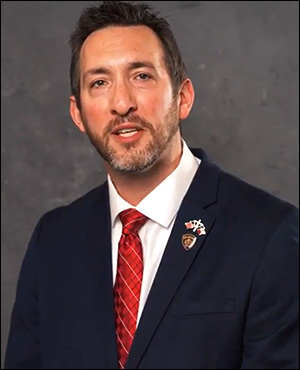
Army veteran Kyle Sinclair (R)

TX-28: New Rep. Cuellar (D) Challenger Emerges — Army veteran Kyle Sinclair (R), who lost 68-32 percent against Rep. Joaquin Castro (D-San Antonio) in Texas’ 20th District last November, announced he is moving to the 28th District to challenge veteran Rep. Henry Cuellar (D-Laredo). The congressman’s most serious vulnerability is in the Democratic primary; however, as illustrated in his 2022 victorious race for renomination decided in a May runoff by just 311 votes. We can expect to see more political action next year in this CD that stretches from San Antonio to the Mexican border.

Governor

Louisiana: Dem Chair Won’t Run — Though candidate filing for the Louisiana governor’s race doesn’t close until Aug. 10, the open-race field is already winnowing. At the end of last week, Louisiana Democratic Party chair Kate Bernhardt announced that she will not become a gubernatorial candidate after considering the possibility of entering. The top candidates appear to be Attorney General Jeff Landry (R), state Treasurer John Schroder (R), and state Transportation Secretary Shawn Wilson (D). Gov. John Bel Edwards (D) is ineligible to seek a third term. The state’s jungle primary is Oct. 14, 2023, with a runoff on Nov. 18 if no contender receives majority support in the first election.

States

North Carolina: State Supremes Schedule Action — The North Carolina state Supreme Court is sending clear signals to the US Supreme Court over the state’s election and redistricting law challenges. Before departing at the end of their term in January, the former NC Supreme Court panel, with a 4D-3R majority, declared the state Senate map a partisan gerrymander and overturned the NC voter identification law. On Friday, the new 5R-2D court announced it will hear arguments to overturn those rulings in the middle of March.

The move is significant since SCOTUS is considering the North Carolina political gerrymandering case and will rule before July 1. The state court, however, potentially taking action on similar cases before the US Supreme Court ultimately decides, could allow the latter panel simply to yield to the state’s decisions. At the end of the process and regardless of which court sets the final parameters, it is probable that we will see a complete redistricting of the North Carolina political boundaries before the 2024 election.

Cities

Houston: Rep. Jackson Lee Considering Mayor’s Race — Reports are emanating from Houston that veteran US Rep. Sheila Jackson Lee (D-Houston) is conducting citywide polling to determine her chances in the open mayor’s race scheduled for November of this year. Incumbent Sylvester Turner (D) is ineligible to seek a third term.

At this point the leading contender appears to be state Sen. John Whitmire (D), who was first elected to the legislature in 1972. He served 10 years in the state House of Representatives before moving to the state Senate in 1982. He is Texas’ longest-serving state senator.

If no candidate receives majority support on Nov. 7, a runoff between the top two finishers will be scheduled. The mayor’s race is non-partisan in that candidates’ party affiliations are not listed on the ballot. Other major candidates are City Councilman Robert Gallegos, former city councilwoman and 2020 US Senate candidate Amanda Edwards, and Houston Metro Board Member Chris Hollins.

McCarthy’s Win Even Closer

By Jim Ellis — Jan. 9, 2023

House

Colorado Rep. Lauren Boebert (R-Silt)

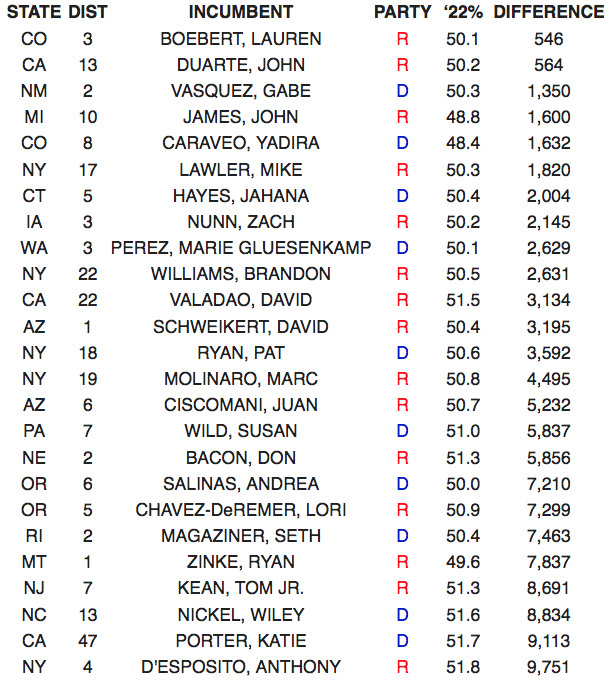
Speaker: A Dive Into the Numbers — The internal US House voting process that elected California’s Kevin McCarthy as Speaker Friday night on the 15th roll call was arguably even closer than the final 216-212-6 tally suggested. 

The two closest congressional elections, those of Reps. Lauren Boebert (R-CO) and John Duarte (R-CA), both would have affected the Speaker race outcome had the pair not won their tight November electoral contests. 

Though Boebert supported other members on the first 13 roll calls, her “present” vote on the last two helped make the difference in McCarthy’s marathon campaign for the Speakership. Rep. Boebert won her western Colorado re-election campaign with only a 546-vote margin. Duarte was victorious with a similar 564 vote spread in central California. Combined, the aggregate 1,110 vote victories ultimately provided what McCarthy needed to finally reach majority support.

In all, 25 November US House races were decided by less than 10,000 votes apiece. Of those, Republicans won 15 and Democrats 10. In 15 of these 25 elections, we saw the winning candidate flip the district from the previous party’s representation to his or her own. 

It is likely that most, if not all, of these 25 closest 2022 contests will become targeted races in the 2024 election cycle. Throughout the long election cycle, we will be paying particular attention to the 10 districts where the electorate voted opposite of the prognosticators’ pre-election calculation.

The FiveThirtyEight data organization, for example, rated all 435 House districts using past election trends, voter registration, and other statistics to formulate a point spread favoring a nominee of one party or the other.

The following 10 members over-performed their party’s projection and won a close contest in a seat that was expected to favor the opposite party’s nominee:

  • Rep. Marie Gluesenkamp Perez (D-WA-3; R+11)
  • Rep. David Valadao (R-CA; D+10)
  • Rep. Anthony D’Esposito (R-NY; D+10)
  • Rep. John Duarte (R-CA-13; D+7)
  • Rep. Mike Lawler (R-NY-17; D+7)
  • Rep. Susan Wild (D-PA; R+4)
  • Rep. Yadira Caraveo (D-CO-8; R+3)
  • Rep. Wiley Nickel (D-NC; R+3)
  • Rep. Lori Chavez-DeRemer (R-OR; D+3)
  • Rep. Brandon Williams (R-NY; D+2)

Redistricting may very well be back on the table for the 2024 congressional cycle, however. Irrespective of the US Supreme Court deciding the Alabama racial gerrymandering and the North Carolina partisan gerrymandering and legal jurisdiction cases before the end of June, we can expect redraws occurring in certain states.

The legislatures will likely redraw interim court-mandated maps in New York, North Carolina, and Ohio. Based upon a recent federal three-judge court ruling, South Carolina has been ordered to produce a new congressional map by March 31. The impending SCOTUS rulings could force Alabama, Illinois, Louisiana, and North Carolina (if not already done so by the time the high court rules) to change their maps.

The redraws would potentially help Republicans in Illinois and North Carolina, and Democrats in Alabama, Louisiana, New York, and South Carolina. The Ohio situation is unclear, at least for now.

With impending map changes coming in the aforementioned states, and possibly several more depending upon just how far-reaching the future SCOTUS decisions prove, we could again see a large number of seats falling into the competitive realm. This, in addition to the aforementioned 25 close likely targets from the previous election cycle. 

Those members are listed in their entirety below:

Electoral College — Left Coast, Right Coast; Republicans Choose Nominee in VA-4; North Carolina Supreme Court Rejects Map

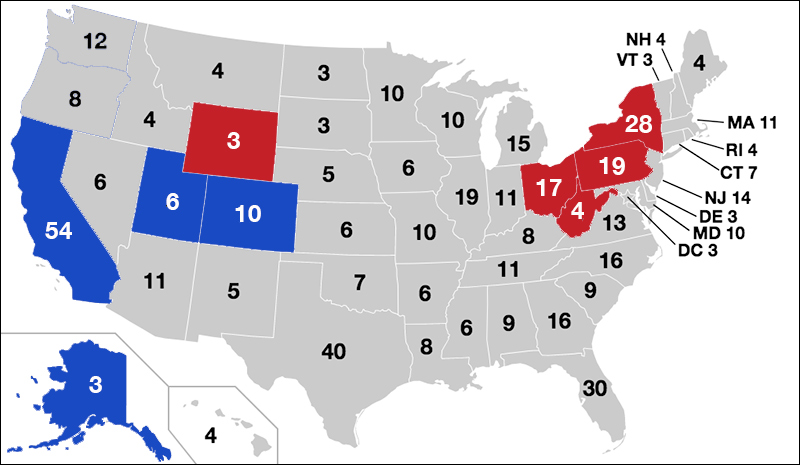
Electoral College Votes Per State, 2022 — blue moving more left, red moving more right


By Jim Ellis — Tuesday, Dec. 20, 2022

President

Electoral College: West Moving Left, East Moving Right — The researchers at the University of Virginia’s Center for Politics have completed a study regarding the country’s ideological shift during the past 20-plus years. Tracking all 50 states’ presidential votes from the 2000-2020 elections, we first see all of the western states now voting Democratic in greater percentages with the exception of Wyoming. The biggest shifts came in Alaska, California, Colorado, and Utah, though two of those four states still regularly produce at least smaller majority or plurality Republican victories.

Conversely, the south and east have trended more Republican with the strongest swings generally occurring in central south with only Maryland, Rhode Island, Vermont, and Virginia becoming more Democratic. Mid-Atlantic states such as New York, Ohio, Pennsylvania, and West Virginia have moved decidedly more Republican, though two of these four continue to regularly deliver clear Democratic majorities. Remaining constant in their voting pattern during this entire 20-year span are Illinois, Maine, Massachusetts, Minnesota, and South Carolina.

House

VA-4: Republicans Choose Special Election Nominee — Republicans re-nominated their 2020 and 2022 candidate in the Saturday, Dec. 17 “firehouse primary” through Ranked Choice Voting. The local 4th District Republican Party leadership did not release the actual results, only to say that pastor and US Navy veteran Leon Benjamin had defeated former Mecklenburg School Board member Dale Sturdifen, and non-profit advocacy organization director Derrick Hollie. Benjamin now advances to the Feb. 21 special general election to replace the late Rep. Donald McEachin (D-Richmond). He will again be a decided underdog in a district that the FiveThirtyEight data organization rates D+30.

The Democratic firehouse primary will be held today. Four candidates filed to run: state Sens. Jennifer McClellan (D-Richmond) and Joseph Morrisey (D-Richmond), former state Delegate Joseph Preston, and businessman Tavorise Marks. While the special election will be held in late February, Gov. Glenn Younkin’s (R) call required the parties to choose nominees by Dec. 23.

In another development, Colette McEachin, the late congressman’s widow, announced her endorsement of Sen. McClellan, joining most of the Virginia Democratic establishment who has already done so.

States

North Carolina: NC Supreme Court Tosses State Senate Map — The North Carolina state Supreme Court, with the 4-3 Democratic majority on the cusp of expiring, rejected the NC Senate map on a partisan vote as a partisan gerrymander. But, the action is likely to be short-lived and adds fuel to the speculation that the new legislature will re-draw all of the state’s redistricting maps after commencement. Doing so may well render moot the partisan gerrymandering case that the US Supreme Court recently heard.

Under North Carolina legislative procedure, the governor has no veto power over redistricting legislation, so whatever the legislature passes will become law. Because of the current court’s farewell action, the state Senate map must be re-configured. Since Republicans gained two seats on the state Supreme Court in the November election and will have a 5-2 majority beginning in January, the likelihood of not only the Senate map being redrawn but also the state House and congressional delegation plans is greater. The latter two maps are court-drawn interim placeholders, which the legislature can replace at any time.

Indiana Gov. Holcomb Leaves Door Open for Senate Bid, Sen. Braun Up in Released Gov Poll; CA-22 Re-Match Already Building; NC Redistricting Case Could be Moot

By Jim Ellis — Thursday, Dec. 8, 2022

Senate

Indiana Gov. Eric Holcomb (R)

Indiana: Gov. Holcomb Leaves Door Open — Early political reports coming from the Hoosier State suggest that Gov. Eric Holcomb (R) will not pursue a 2024 US Senate bid when his tenure as governor comes to an end. Gov. Holcomb is ineligible to seek a third term.

When asked about running for the Senate this week on wishtv.com, however, Gov. Holcomb replied, “there’ll be time for me to think about the future in the future. But it would be next to irresponsible for me to take my eye off the job that I’ve got.”

This response suggests the Senate race door is not fully closed and will certainly remain an option for Holcomb as time moves forward. With universal statewide name identification and the ability to quickly raise large amounts money, Gov. Holcomb has the luxury of waiting to make a decision until he sees how an open Senate field develops. First-term Sen. Mike Braun (R) is a clearly preparing a run for governor, thus leaving his Senate seat open.

House

CA-22: Re-Match Already Building — California Rep. David Valadao (R-Hanford) is tied for representing the most Democratic seat in the country that sends a Republican to the US House. Long Island Rep-Elect Anthony D’Esposito (R-Hempstead) holds the other. The FiveThirtyEight data organization rates both Valadao’s CA-22 and Mr. D’Esposito’s NY-4 at D+10.

Despite the odds stacked against him, Rep. Valadao was able to post a 51.5 – 48.5 percent victory over state Assemblyman Rudy Salas (D-Bakersfield) in November, who was arguably the most difficult opponent Valadao faced in his five winning electoral campaigns. Yesterday, Salas, who risked his Assembly seat to run for Congress, filed a committee to seek a re-match in 2024. If he ultimately follows through and runs two years from now, this race will again become a top national Democratic conversion target.

Governor

Indiana: Sen. Braun Releases Gov Poll — Sen. Mike Braun (R) is clearly moving toward making a quick gubernatorial announcement after filing a state gubernatorial campaign committee last week. Reports suggest that Sen. Braun may make his formal declaration as early as next week. In preparation for launching a gubernatorial bid, he just released the results of an internal poll.

The study, from the Mark It Red research group (Nov. 18-22; sample size not released), finds Sen. Braun opening with a large Republican primary advantage in what will be an open race for governor. According to the survey results, Sen. Braun would lead Lt. Gov. Suzanne Crouch and venture capitalist Eric Doden, 47-10-5 percent, respectively.

States

North Carolina: Redistricting Case Could be Moot — The North Carolina partisan gerrymandering case that was heard before the US Supreme Court yesterday is a potential landmark case, but some North Carolina state political sources suggest the arguments may go by the proverbial wayside. The high court will rule before the end of June, but before that occurs, the new North Carolina legislature may draft new redistricting plans for the US House, state Senate, and state House of Representatives. Since a court map is only an interim plan, the legislature can replace it with a permanent draw at any time.

If this occurs as described, and new maps are enacted –- remember, in North Carolina, the governor has no veto power over redistricting legislation -– it is possible that the action could render the case before the Supreme Court as moot. If so, the issue of whether the Constitution views state legislatures as solely independent when handling redistricting could well go unanswered.

NY Overreach = GOP Majority

CNN’s New York state redistricting map (more coverage on CNN)

By Jim Ellis — Nov. 22, 2022

House

New York State: Redistricting — There is an argument to be made that the New York Democratic redistricting brain trust helped create the new Republican US House majority. With their over-reach on the original map that the legislature and governor enacted, the end result became so egregious that even the Democratic lower and upper courts rejected the congressional map as a pure partisan gerrymander.

The original enacted plan would have yielded a 22D-4R partisan split in the NY congressional delegation of 26 members, thus costing the Republicans four of the eight Empire State seats they control in the current Congress.

Once the votes were cast on Nov. 8 in the districts that the judges’ special master drew to replace the legislature’s plan, the end result saw Republicans not losing four seats but rather gaining three in relation to the current map and seven when compared to the Democrats’ original draw.

Therefore, instead of the intended 22D-4R plan, the New York delegation now headed to Washington is comprised of 15 Democrats and 11 Republicans. With a small Republican majority of what ultimately may be 220-222 seats once the outstanding California and Alaska races are finally projected, the NY swing is arguably the difference in determining which party controls the House.

The Democrats’ map would have reduced the Republicans to just one seat on Long Island, taken the lone district they have in New York City, turned the GOP’s Syracuse seat strongly Democratic, and collapsed the southwestern Upstate seat of resigned Rep. Tom Reed (R) as the lost district in national reapportionment.

You will remember that New York lost a congressional seat by just 89 people when the Census Bureau announced each state’s congressional district compilation under the national reapportionment formula.

After striking down the legislature’s map and replacing it with their own special master’s plan, the court in effect restored much of New York to its historic congressional district pattern.

Under the legislature’s plan, Long Island’s 1st District (Rep. Lee Zeldin) was drawn from the far eastern part of Suffolk County all the way into Queens. This led to stashing a preponderance of the region’s Republican voters in Rep. Andrew Garbarino’s (R-Sayville) South Shore 2nd District. The concept then allowed the map architects to make Districts 3 and 4, both open in 2022 with Reps. Tom Suozzi (D-Glen Cove) running unsuccessfully for governor and Kathleen Rice (D-Garden City) retiring, safely Democratic. The court undid this design.

Now, the 1st District returns to a Suffolk County anchored seat, a CD that Republican Nick LaLota, a former local official and Navy veteran, won to succeed Rep. Zeldin. Rep. Garbarino is back but with a less Republican South Shore seat, which then created a marginal North Shore District 3 seat that Republican George Santos won 54-46 percent in a domain that the FiveThirtyEight data organization rates D+4.

The biggest surprise in New York, and perhaps the country, came in Rep. Rice’s open 4th CD, where Republican Anthony D’Esposito defeated heavily favored Democrat Laura Gillen, 52-48 percent, in a district that actually became more Democratic under the court map at D+10.

The other Republican gains came in the Hudson Valley, where state Assemblyman Mike Lawler (R-South Salem) upset Democratic Congressional Campaign Committee (DCCC) chairman Sean Patrick Maloney (D-Cold Spring) in a D+7 District 17, and Dutchess County Executive Marc Molinaro (R) rebounded from a special congressional election loss in August to claim a 51-49 percent win in a new 19th District rated as R+1.

In the 18th District, state Assemblyman Colin Schmitt (R) came within a percentage point of sweeping the Hudson Valley seats for the GOP, but Rep. Pat Ryan (D-Gardiner) held onto the 18th CD seat after he had won the 19th District special election three months earlier.

The Republican victory string ended with tech executive Brandon Williams (R) defeating former intelligence officer Francis Conole (D) by a percentage point to hold the open Syracuse seat, and former New York Republican Party Nick Langworthy easily won the new 23rd District from which Rep. Reed resigned and Rep. Joe Sempolinski (R-Canisteo) is serving as a caretaker.

The New York 2022 election cycle illustrates just how important map drawing and judicial decisions are in determining US House elections. The New York courts, for example, created a much more competitive political playing field, which certainly led to different results than we would have seen under the legislature’s partisan draw.

Considering that the US Supreme Court is likely to make landmark Voting Rights Act rulings on the Alabama and North Carolina cases before June ends next year, we will likely see new redistricting maps being drawn in several states, and New York could be one of those places. Any newly constructed map would take effect in the 2024 election. A major Supreme Court decision will add yet another dimension to what already promises to be another hot House campaign cycle coming in the new term.

Poll Posts Walker to Small Lead; Grassley Maintains Double-Digit Lead; Tight Polls in FL-13, NM-2

By Jim Ellis — Wednesday, Nov. 2, 2022

Senate

Georgia Sen. Raphael Warnock (D) and Republican challenger Herschel Walker

Georgia: University of Georgia Posts Walker to Small Lead — The University of Georgia, polling for the Atlanta Journal-Constitution newspaper, one of the more accurate of Peach State pollsters (Oct. 16-27; 1,022 likely Georgia general election voters; live interview), now becomes the sixth of the most recent seven survey research entities to project Republican Herschel Walker as having a slight lead over Sen. Raphael Warnock (D). The result means the contest is a dead heat with Walker up only 46-45 percent.

With the early vote reports favoring an increased Democratic performance based upon the party’s 2020 performance and Republicans not doing as well at this point, suggests that, first, we will have a very close finish, and second, the chance of advancing into another post-election runoff election could well occur since it is possible that neither candidate reaches the 50 percent mark. Under Georgia election law, candidates must exceed 50 percent to claim victory. Therefore, we could see a runoff election between the two major party candidates occur on Dec. 6 with Libertarian candidate Chase Oliver eliminated.

Iowa: Sen. Grassley Maintaining Double-Digit Lead — In the closing days of this Iowa Senate race, 89-year-old incumbent Sen. Chuck Grassley (R) is looking much stronger after two separate polls suggested the race had closed to within three percentage points. The new Cygnal firm’s Hawkeye State poll (Oct. 26-27; likely Iowa general election voters) projects the senator to be holding a 54-43 percent advantage over retired Navy Adm. Mike Franken (D).

Grassley’s favorability index, however, is down to 49.9 – 43.5 percent favorable to unfavorable. The pollsters find the generic question breaks +14 for Republicans. Though this is down from their previous poll, such a rating is substantial and should prove favorable for the GOP up and down the ticket next Tuesday night.

House

FL-13: Tight Poll in GOP Must-Win — The vacant 13th Congressional District in Pinellas County has been viewed as a must-win for the GOP if they are to score big on election night. Until he resigned to concentrate on his statewide race, ex-representative and former governor, Charlie Crist (D-St. Petersburg), represented the district. After redistricting, this seat became much more Republican — R+12 according to the FiveThirtyEight data organization.

A St. Pete Polls survey (Oct. 26-27; 509 likely FL-13 general election voters; interactive voice response system) sees Republican Anna Paulina Luna only slightly ahead of former Defense Department official Eric Lynn (D), however. This will be yet another race to closely monitor on election night.

NM-2: A Virtual Tie — The Democratic redistricting operation made New Mexico’s southern congressional district as favorable as possible for the party’s 2022 nominee, but polling continually shows this race will go down to the wire. While Las Cruces City Councilman Gabe Vasquez (D) leads in surveys, his margin is only two percentage points, 47-45 percent, over freshman Rep. Yvette Herrell (R-Alamogordo) according to the latest Research & Polling company survey (Oct. 20-27; 410 likely NM-2 general election voters; live interview).

Since the poll has an error factor of 4.8 percent, this race can clearly go either way. This is the fourth poll released regarding this race since July. All show a margin for Vasquez of two points or less.

Governor

Georgia: Kemp Up Well Beyond Margin of Error — The aforementioned University of Georgia poll for the Atlanta Journal-Constitution (see Georgia Senate above) also tested the state’s competitive governor’s race. Here, incumbent Gov. Brian Kemp (R) has led former state House Minority Leader Stacey Abrams (D) in polling throughout the election cycle. The UGA poll is consistent with this common finding.

Again, running far ahead of Republican Senate nominee Herschel Walker, Gov. Kemp posts a 51-44 percent advantage, well beyond the polling margin of error for such a statewide poll. The question becomes whether Kemp’s strong partisan run will be enough to develop a turnout model that helps Walker across the finish line, as well.

Movement in NC; Oklahoma Senate Races Headed Toward GOP, But Republican Gov. Stitt Trailing; Grassley Trouble in the Polls Deepens

By Jim Ellis — Wednesday, Oct. 19, 2022

Senate

Former North Carolina state Supreme Court Chief Justice Cheri Beasley (left) and Rep. Ted Budd (R-Advance)

North Carolina: Finally, Some Movement — The open North Carolina Senate race has been languishing as a dead heat — a virtual tie between US Rep. Ted Budd (R-Advance) and former state Supreme Court Chief Justice Cheri Beasley (D) for months. On Monday, East Carolina University released a survey (Oct. 10-13; 902 likely North Carolina voters; text & online) that finds Rep. Budd pulling away to a 50-44 percent advantage.

According to the poll analysis, the change is coming from the female sector. In the university’s September poll, Beasley led among women with a substantial 52-41 percent margin. The current respondent sample sees her lead among the female respondents dropping to 48-46 percent. Among men, Budd leads 54-39 percent.

Oklahoma: Both Senate Races Headed Toward GOP — While two polls find the Democratic candidate trending ahead in the Oklahoma gubernatorial race, the same polls, Amber Integrated study (Oct. 13-15; 500 likely Oklahoma general election voters) and Ascend Action, polling for Fox News Oklahoma TV stations (Oct. 10-12; 638 likely Oklahoma general election voters; live interview), projects the Republican candidates in both the regular and special US Senate elections to be in strong position.

Amber Integrated’s regular election poll shows Sen. James Lankford (R) holding a 52-36 percent margin over Democrat Madison Horn. In the special, Rep. Markwayne Mullin (R-Westville) leads former US Rep. Kendra Horn (D) by a similar 52-39 percent count. Ascend Action sees Sen. Lankford leading 51-37 percent, and Rep. Mullin posting a 50-39 percent spread.

House

GA-2: Rep. Bishop Up Only Four — A recent Trafalgar Group survey of the southwest Georgia electorate (Oct. 14-16; 515 likely GA-2 Democratic primary voters; multiple sampling techniques) projects Rep. Sanford Bishop (D-Albany) holding only a 50-46 percent advantage over GOP attorney Chris West, suggesting yet another close congressional race.

This one, unlike several others we’ve covered in the past two weeks, is not a particular surprise. Post-redistricting, the FiveThirtyEight data organization rated the new GA-2 seat as a D+4. Therefore, the Trafalgar poll is indicating the district is performing exactly as the voting history yields. Before the 2021 redistricting map was passed, the district was rated D+6. While Rep. Bishop remains the favorite for re-election, this is another pending Nov. 8 electoral contest that merits watching.

Governor

Oklahoma: Gov. Stitt Trailing in Two Surveys — We are now continuing to see data suggesting that Gov. Kevin Stitt (R) is in serious trouble against Superintendent of Public Instruction Joy Hofmeister (D). Two surveys find Hofmeister claiming a polling lead against the governor. The Amber Integrated research study (Oct. 13-15; 500 likely Oklahoma general election voters) gives Hofmeister a slight 46-45 percent edge.

Ascend Action, polling for Fox News Oklahoma TV stations (Oct. 10-12; 638 likely Oklahoma general election voters; live interview), sees a much larger Hofmeister lead. The latter poll projects a ballot test of 49-42 percent. Last week, the small-sample Sooner Poll (Oct. 3-6; 301 likely Oklahoma voters) was the first to detect a Hofmeister lead. The news organization found a 47-43 percent spread. A Democratic upset here would be surprising, but the data is suggesting that such an outcome is a clear possibility.

Iowa: Selzer & Company’s Different Result — Yesterday, we reported on a Selzer & Company poll for the Des Moines Register newspaper that sounded warning bells for Sen. Chuck Grassley (R). According to the Senate ballot test, the veteran incumbent led retired US Navy Admiral Mike Franken (D) by a scant 46-43 percent margin.

Now, Selzer is releasing its gubernatorial results culled from the same data (Oct. 9-12; 620 likely Iowa general election voters), and it should give the Grassley campaign even more cause for concern. The polling sample gives Gov. Kim Reynolds (R) a 52-35 percent margin against Democratic marketing consultant Diedre DeJear, a strong margin for a Republican candidate in what is typically a swing state.

House Updates – Including Gerrymandering: AL, CO, NM, NJ & NY

By Jim Ellis — Thursday, Oct. 6, 2022

House

Alabama redistricting map

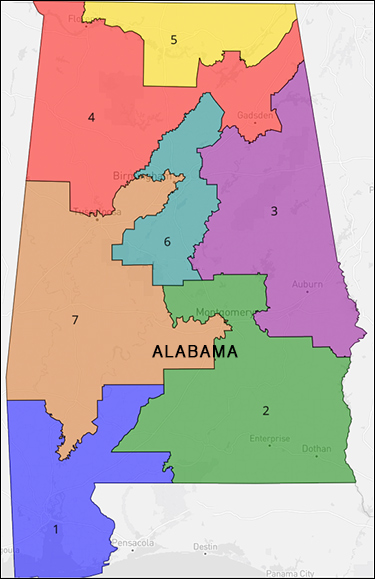
Redistricting: Supreme Court Hears Alabama Case — In one of the first cases on the US Supreme Court’s new term docket, oral arguments were heard for the Alabama racial gerrymandering redistricting case, which could result in a landmark ruling relating to future interpretation of the Voting Rights Act.

The state of Alabama is arguing its reasons for keeping the state’s congressional map, which features one strong majority minority district. The US government is arguing that a second minority seat can be drawn. The presentations consumed more time than usual for Supreme Court oral arguments, and now it is up to the nine justices to craft a definitive ruling, which will be released sometime before June next year.

In November, the high court will hear oral arguments on the North Carolina redistricting case, which will lead to a definitive ruling pertaining to judicial power over the constitutional authority of state legislatures.

CO-3: Rep. Boebert’s Slight Lead — Despite representing a relatively safely Republican western slope 3rd Congressional District, Colorado Rep. Lauren Boebert (R-Silt) looks to have a competitive race on her hands as we begin the campaign cycle’s final weeks. Colorado-based Keating Research conducted a poll for the Adam Frisch (D) campaign (Sept. 28-Oct. 2; 500 likely CO-3 voters; live interview & text). The ballot test results found Rep. Boebert’s lead shrinking to 47-45 percent, down from Keating’s 49-42 percent spread detected in its July survey.

Expect to see countering numbers from either the Boebert campaign or the National Republican Congressional Committee to soon be released.

NM-2: Gerrymandered District Yields Dem a Slight Edge — The Global Strategy Group, polling for the Gabe Vasquez (D) campaign, tested the NM-2 electorate to determine the state of the race featuring freshman Rep. Yvette Herrell (R-Alamogordo) and Vasquez, a Las Cruces City councilman. The GSG survey (Sept. 20-26; 500 likely NM-2 voters; live interview) sees Vasquez pulling ahead of Rep. Herrell, 45-43 percent.

The result is not particularly surprising in that the Democratic legislature and governor crafted the new 2nd CD to flip. Before redistricting, the FiveThirtyEight data organization rated the seat, R+14. Post-redistricting, we see a D+4 categorization. This district will still yield a close finish, and voter turnout will tell the ultimate tale.

NJ-7: Rep. Malinowski Internal Poll Shows Dead Heat — The Greenberg Quinlan Rosner Research organization conducted a congressional poll for two-term Rep. Tom Malinowski (D-Rocky Hill), who is again in a tight battle with former state Senate Minority Leader Tom Kean Jr. (R). In 2020, Kean held Rep. Malinowski to a 51-49 percent re-election win in a district that was more Democratic than the new 7th. The GQR survey (Sept. 20-26; 500 likely NJ-7 general election voters) sees both candidates now attracting 48 percent of the vote. The Democratic pollster, however, also detects a partisan generic party label split of 50-45 percent favoring the Republicans. NJ-7 is a key Republican conversion opportunity seat.

NY-22: Republican Breaks Ahead — The Syracuse-anchored 22nd District is open in the 2022 election cycle because Rep. John Katko (R-Syracuse), one of the 10 House Republicans who voted to impeach former President Trump, is not seeking a fifth term. Ironically, the court-drawn map actually makes this district two points more Republican than the seat the Rep. Katko consistently won.

Siena College conducted an independent poll for the Spectrum News Service (Sept. 25-28; 453 likely NY-22 general election voters) and sees Republican technology company executive Brandon Williams jumping out to a five point, 45-40 percent, advantage over former intelligence agency analyst Francis Conole (D).

With the respondents believing the country is on the wrong track by a 25:63 percent margin, it is not particularly surprising to also see Gov. Kathy Hochul (D) falling behind Rep. Lee Zeldin (R-Shirley/East Long Island) in this Upstate District. NY-22 is a must-win for the GOP in November.

Laxalt Leads in Four Consecutive Nevada Senate Surveys; Many Polls, Many Results in Arizona; Hassan in New Hampshire Senate Driver’s Seat

By Jim Ellis — Monday, Sept. 26, 2022

Senate

Former Nevada Attorney General Adam Laxalt, current Republican Senate candidate

Nevada: Four in a Row — As the plethora of polls keep coming, we now see Republican Adam Laxalt taking a small lead over Sen. Catherine Cortez Masto (D) in four consecutive surveys. From Sept. 8-20, Emerson College, Data for Progress (D), The Trafalgar Group (R), and Insider Advantage (R) posted leads for Laxalt at one to four percentage points.

Unlike Arizona polls (see next item) that find inconsistent margin results for Sen. Mark Kelly, these four pollsters all arrive at basically the same conclusion. Additionally, the senator fails to break a highwater mark of 46 percent in any of the surveys, a bad sign for any incumbent.

Arizona: Many Polls, Many Results — During the period of Sept. 6-19, six different pollsters tested the Arizona Senate race, and the results were wide ranging. All six agree that Sen. Mark Kelly (D) has a lead over venture capitalist Blake Masters (R), but the advantage span moves all the way from one to 12 points.

Three of the research entities — Emerson College, The Trafalgar Group (R), and Data for Progress (D) — find the Kelly margin at two points (Emerson) or one (Trafalgar; DfP). Another, Insider Advantage (R), pegs the Kelly lead at six points. Fabrizio Lee (R) / Impact Research (D) for AARP, posts the senator to an eight-point edge. Finally, Arizona-based OH Predictive Insights sees the largest Kelly margin, 47-35 percent. With such a diverse polling result universe, it is difficult to accurately depict this race’s true status.

New Hampshire: Sen. Hassan in Driver’s Seat — It appears that Gov. Chris Sununu (R) and various Republican strategists and consultants were correct to forecast that retired Army Gen. Don Bolduc (R) would not be a strong opponent against Sen. Maggie Hassan (D) in the November election. Three polls have now been released since the state’s Sept. 13 primary election — from Emerson College, the American Research Group, and the University of New Hampshire. The surveys were conducted within the Sept. 14-19 period. All three pollsters find Sen. Hassan leading the race with margins between 8 and 13 percentage points.

House

FL-2: Closer Than Expected — When the Florida redistricting map was adopted, most agreed the incumbent getting the worst draw was three-term Rep. Al Lawson (D-Tallahassee), who saw his Tallahassee to Jacksonville 5th District split into several parts. Left with tough choices, Rep. Lawson chose to seek re-election against Republican incumbent Neal Dunn (R-Panama City) in the new 2nd District.

The FiveThirtyEight data organization rates this seat that stretches from Tallahassee to the Emerald Coast as R+17. The Dave’s Redistricting App data group calculates the partisan lean as 54.5R – 43.8D.

A new David Binder Research (D) poll (Sept. 14-18; 600 likely FL-2 general election voters; live interview & online) finds Rep. Dunn holding only a 49-43 percent lead, however, which is a closer result than one would expect from a district with such strong Republican base numbers.

Governor

Nevada: Sheriff Lombardo Gaining Momentum — Three polling firms have tested the tight Nevada governor’s race between incumbent Democrat Steve Sisolak and Republican challenger Joe Lombardo, the Clark County sheriff. Emerson College, Data for Progress (D), and The Trafalgar Group (R), all see a race falling within the margin of error.

While Trafalgar finds Lombardo holding a three-point lead, the other two research entities see the candidates at even strength. Like Sen. Catherine Cortez Masto (D) as covered above (see Nevada Senate above), Gov. Sisolak is far short of attracting majority support. In these three polls conducted within the Sept. 8-20 period, the governor fails to break the 45 percent support level.

McCormick Concedes in PA; Michigan Gov. Whitmer Holds Huge Lead

Dr. Mehmet Oz (left) and former hedge fund CEO David McCormick

By Jim Ellis — June 6, 2022

Senate

Pennsylvania: McCormick Concedes to Dr. Oz — The long post-primary Pennsylvania Republican Senate drama finally came to a close Friday when former hedge fund CEO David McCormick conceded to television Dr. Mehmet Oz. The general election between Dr. Oz and Lt. Gov. John Fetterman (D) is now underway, but the Democratic nominee also has issues.

With the recount of the May 17 election progressing, including the ballots arriving after election day being added to the count, the results were not turning around to the degree that McCormick had publicly predicted. Therefore, instead of forcing what could have been a long drawn out post-election period of individual ballot challenges and lawsuits attempting to overturn Dr. Oz’s approximate 900 vote lead, McCormick decided the best course of action was to concede and allow the party to move forward.

As we know, Democratic nominee Fetterman suffered a stroke right before the primary as a result of a blood clot in his heart. Fetterman is now making statements that he was near death during the ordeal, and must refrain from active campaigning for an undetermined time. The situation creates a unique general election with both parties having internal challenges while having to conduct tough campaigns before a swing electorate.

Redistricting

Florida: State Supreme Court Says No — The Florida state Supreme Court, responding to a petition asking the high panel to review the new congressional map, said they do not have jurisdiction at this point in the process. The high court indicated that the District Court of Appeals is the body that must hear the case. With the June 17 candidate filing deadline coming nearer, further delays likely point to the enacted map being in place for the 2022 elections. The Florida primary is Aug. 23.

Governor

Michigan: Republicans Reeling After Ballot Disqualification — A new Target Insyght poll (May 26-27; 600 registered Michigan voters) finds Gov. Gretchen Whitmer (D) holding huge leads against the remaining GOP candidates after former Detroit Police Chief James Craig and businessman Perry Johnson were disqualified from the race because they failed to produce enough valid required petition signatures. Against all of the largely unknown Republican candidates, Gov. Whitmer scores either 57 or 58 percent opposite 24 percent for the top current GOP contender, businessman Kevin Rinke. With the candidate filing deadline long since passed, the Republicans now find themselves buried in a major political hole from which it will be difficult to recover.

Ohio: DeWine Leading, but Under 50 percent — Two days ago, Suffolk University released the results of their Ohio US Senate survey, which we covered, and yesterday their gubernatorial numbers were made public. The Suffolk study (May 22-24; 500 likely Ohio general election voters; live interview) finds Gov. Mike DeWine (R) leading Dayton Mayor Nan Whatley (D), 45-30 percent, with Independent Neil Petersen attracting 11 percent support. Gov. DeWine won re-nomination in May, but did so with only a plurality within his own party. While his general election lead is comfortable, being well under 50 percent continues to show a significant degree of political weakness.

Oregon: New Shock Poll — Republican pollster Nelson Research (May 25-27; 516 likely Oregon general election voters; live interview) finds new Oregon GOP gubernatorial nominee Christine Drazan, the former state House Minority Leader, taking a small but surprising 30-28 percent lead over former state House Speaker Tina Kotek (D). Additionally, Republicans are only one point behind (39-40 percent) on the generic ballot question.

These results are particularly surprising when seeing the Democrats outperform the Republicans in the recent May 17 primary turnout. Examining the polling methodology, the sampling universe skews high for both major parties. The survey respondents divide 40.1 percent Democratic, 33.5 percent Republican, and 26.4 percent non-affiliated. Actual Oregon partisan registration for May of 2022 is listed as Democratic 34.3 percent; Republican 24.6 percent; and Unaffiliated 34.3 percent. Therefore, the sample skew could largely account for the unexpected ballot test result.