Tag Archives: Redistricting

Trouble for Biden in Swing States; Incumbents Reign in 2023 Elections; Former Michigan Rep. Announces for Senate; What the Amo RI-1 Win Means

By Jim Ellis — Thursday, Nov. 9, 2023

President

President Joe Biden is in trouble in swing states. / Photo by Gage Skidmore

Siena College/NYT Poll: Trouble for Biden in Swing States — Siena College and the New York Times teamed up on recent polls in six key swing states all conducted during the Oct. 22 to Nov. 3 period. The six states are: Arizona, Georgia, Michigan, Nevada, Pennsylvania, and Wisconsin. The tested Republicans against President Joe Biden were former President Donald Trump, Florida Gov. Ron DeSantis, and ex-UN Ambassador Nikki Haley. In all instances, with the exception of Trump in Wisconsin, the named Republican would poll ahead of President Biden, thus unseating him if the election were today.

Of the three Republicans, Haley performs the strongest against the Biden. Her best number, +14, comes among Wisconsin likely voters. Trump’s best state is Nevada (+11); DeSantis tops President Biden by five percentage points among Arizona registered voters; Biden’s best showing comes against Trump in Wisconsin (+2).

The Democrats certainly have time to right their political ship, and if Trump is convicted in any of his criminal cases, that might get adjudicated before the election, and the tables could quickly turn. This campaign will prove the most unique of presidential elections.

Election 2023

Déjà Vu: Incumbents Reign — The 2023 odd-numbered year elections are now in the books, and, as we saw on Election Night, the results are very similar to what occurred a year earlier in the 2022 midterm elections.

Most of the political pundits are calling this election year a victory for Democrats despite having an unpopular president in office, while others cite the abortion issue as a continuing turnout driver, which also benefits Democrats. Both statements are true, but perhaps the more definitive underlying pattern is that the incumbents, just as they did in 2022, again reign supreme.

In 2022, 55 of the 56 US senators and governors who ran for re-election won. In the US House elections, 98.1 percent of incumbents who ran for re-election were successful. On Election Night, we saw two more incumbent governors win again.

Governors Andy Beshear (D) and Tate Reeves (R) in Kentucky and Mississippi, respectively, were re-elected with similar five percentage point margins. Polling in the two states suggested a closer result for both incumbents, but each was favored to win.

The Virginia situation is a bit different. Largely due to new court-imposed redistricting maps that radically changed the complexion of most districts, voters elected Democratic majorities in both houses of the legislature. It is inconsistent to rate the Virginia results as incumbent-oriented because we saw roughly one-third of all districts run without incumbents, and most of those office holders who did seek re-election found themselves in new districts vastly different from the one in which they were originally elected.

Democrats will now have at least 21 of 40 seats in the Virginia state Senate and 52 of 100 in the House of Delegates. The party division margin differences yield no change in the Senate, while Democrats converted at least four seats in the House.

While it’s difficult to overlay an incumbent victory matrix across the Old Dominion legislative elections, it is not unusual to see a state that has become reliably Democratic over the past two decades to again vote for that party’s candidates in the 2023 elections. Therefore, the fact that the state’s favored party over the course of time again performed better is consistent with the incumbent voting pattern seen elsewhere.

The abnormal facet of the incumbent-oriented elections we have witnessed in 2022 and now 2023 is that the issue polls consistently show voters certainly believing the country is headed down the wrong track, with similar feelings regarding most states. The state right direction/wrong track questions, however, are not as intensely negative as at the national level.

Yet, despite the recorded discontent, voters return to their respective polling places and almost unanimously re-elect the incumbents. This again suggests that the Republican campaign message machine needs an overhaul. It is clear that their campaign themes and approaches are not driving enough voters to support the GOP candidates in the most hotly contested races.

Once numbers become finalized, we can better understand the results. Because the 2023 vote tabulations verified the pattern set in 2022, it is likely this precursor favors incumbents at large, and more specifically the Democrats, to have another positive election year in 2024 despite what today’s issue polls may currently be projecting.

Senate

Michigan: Ex-Rep. Meijer Announces — Former one-term Congressman Peter Meijer (R), who was defeated for renomination in 2022, announced Monday that he will join the open Michigan US Senate field. The move had been expected for weeks, but is a curious one, nonetheless. It is hard to see a victory path for Rep. Meijer since he couldn’t get enough conservative support to defeat his ’22 GOP challenger, John Gibbs. Gibbs would then go onto lose the general election to now freshman Rep. Hillary Scholten (D-Grand Rapids).

The top Republican contenders for the party’s Senate nomination are former US Rep. Mike Rogers and retired Detroit Police Chief James Craig. It is possible that Meijer’s entry could actually help Rogers, since Craig and Meijer will likely both appeal to the more centrist element of the Republican voter base. If so, this will help Rogers unite the conservatives behind his candidacy and propel him to the nomination. Whoever wins the Republican primary will almost assuredly face Rep. Elissa Slotkin (D-Lansing) in the general election.

The open Michigan race is likely to be close, but Democrats will have at least a slight edge in the general election. Sen. Debbie Stabenow (D) is retiring after serving what will be four full terms once the current congressional session concludes at the beginning of 2025.

House

RI-1: Gabe Amo (D) Wins Special Election — Former Biden and Obama White House aide Gabe Amo virtually assured himself of succeeding resigned Rep. David Cicilline (D-Providence) when he won the Sept. 5 special Democratic primary. Amo easily defeated Republican Gerry Leonard Tuesday in the special general election. Upon winning the seat, Amo now will be sworn in to the House and serve the balance of the current term.

Rhode Island’s 1st Congressional District is solidly Democratic. The FiveThirtyEight data organization rates the seat as D+32. Dave’s Redistricting App calculates the partisan lean at 64.9D – 33.1R. President Biden carried the seat with a 64-35 percent victory margin in 2020. The Daily Kos Elections site ranks the seat as the 99th most vulnerable seat in the Democratic Conference — pretty secure. Therefore, there was little doubt as to which candidate would win the special election.

The Amo victory will bring the Democrats back to their full 213-member compliment in the House. The next special election, in UT-2, will be held on Nov. 21. Republican Celeste Maloy is favored to hold resigned Rep. Chris Stewart’s (R-Farmington) seat. Should she win, the House will be restored to its post-regular election division of 222R-213D.

Biden Challenger Poised; Jawando Drops Maryland Senate Bid;
A Challenger Emerges in IA-2; North Carolina Redistricting

By Jim Ellis — Tuesday, Oct. 24, 2023

President

Minnesota US Rep. Dean Phillips (D-Plymouth)

Rep. Dean Phillips: Reportedly Still Considering Biden Challenge — Media reports are again suggesting that three-term Minnesota US Rep. Dean Phillips (D-Plymouth) is still considering challenging President Joe Biden for the Democratic nomination. It is difficult to see how the congressman would have any reasonable path of victory in challenging the incumbent president of his party when starting at such a late date.

Rep. Phillips has been urging more prominent Democrats to challenge the president, the reason for which is he believes there should be competition for the party nomination. Phillips concedes, however, that he agrees with President Biden ideologically.

Senate

Maryland: Jawando Drops Senate Bid — Montgomery County Councilman Will Jawando (D), who was one of the first individuals to declare for the Senate once incumbent Sen. Ben Cardin (D) announced his retirement, now becomes the first to withdraw. Jawando indicated he does not see a path to victory for himself, hence his decision to end his campaign. With his main opponents for the Democratic nomination having much more in the way of resources, a gap which was looking to grow larger, Jawando was finding it hard to compete.

Rep. David Trone (D-Potomac) has already spent nearly $10 million on his race and is already advertising heavily. Prince Georges County Executive Angela Alsobrooks (D) has raised over $3 million. Jawando reported just over $320,000 in his campaign account. The May 14, 2024, Democratic primary will likely be the deciding factor and it appears the race is already becoming a two-way contest between Trone and Alsobrooks.

House

IA-2: Rep. Hinson Draws First Challenger — Disability rights activist Sarah Corkery (D) became the first individual from either party to announce a challenge to two-term Iowa US Rep. Ashley Hinson (R-Marion/Cedar Rapids). Three of the four Iowa districts are competitive, including Rep. Hinson’s 2nd. According to the FiveThirtyEight data organization, IA-2 rates R+4. Dave’s Redistricting App calculates the partisan lean at 51.4R – 45.6D. The Daily Kos Elections site ranks IA-2 as the 29th most vulnerable seat in the Republican Conference.

While the district is competitive on paper, Rep. Hinson is in strong position. She won re-election last year with a 54-46 percent margin against then-state Sen. Liz Mathis (D) who, like Hinson, is a former television news anchor and very strong challenger who spent $4.2 million in her race against the congresswoman. Rep. Hinson also outperformed then-President Donald Trump in the district by a net four percentage points. Therefore, though the district is politically marginal, Rep. Hinson, who is reporting more than $1.3 million in her 2024 campaign account, is a well-positioned incumbent.

North Carolina: Redistricting Numbers Calculated — North Carolina legislative leaders released two congressional maps late last week, and now we see voting trend analyses being made public. Dave’s Redistricting App has already calculated partisan leans for the pair of maps.

The map drawers obviously adopted a strategy of making the maximum number of Republican districts. They did so by giving each of the seats targeted for GOP candidates partisan trend numbers between 54 and 58 percent. The three Democratic districts have partisan trends between 66 and 74 percent. In the second map, the one that could produce an 11R-3D result, Rep. Don Davis’ (D-Snow Hill) 1st District would be up for grabs, with a partisan lean of 50.4D – 48.7R.

Expect the legislature to vote on the maps this week. Legal challenges will follow enactment, but the chance of the plan being upheld in the North Carolina Supreme Court with its new 5R-2D composition is strong.

Harris vs. Newsom for President?; Good/Bad News for Sen. Tester; Rep. Lesko to Retire; New Redistricting Maps in North Carolina; VA-10 News

By Jim Ellis — Friday, Oct. 20, 2023

President

Vice President Kamala Harris / Photo by Gage Skidmore

Democratic Poll: Harris vs. Newsom — Rumors have been rampant that the Democrats may somehow soon replace President Joe Biden as the party nominee. The Premise survey research company (Oct. 11-16; 1,417 registered US voters; 847 US Democratic registered voters; online) just tested the highly unlikely supposition.

The pollsters paired Vice President Kamala Harris against California Gov. Gavin Newsom. Many believe that Newsom would be Biden’s hypothetical replacement, but this first poll doesn’t concur. Premise reports a Harris lead over Newsom of 23-15 percent with a huge undecided factor. Expect President Biden to again become the Democratic nominee.

Marist College: First Three-Way Presidential Poll — Marist College, polling for National Public Radio (Oct. 11; 1,218 registered US voters), is the first survey research entity to release a Biden-Trump-Kennedy poll since Robert F. Kennedy Jr. announced he would run in the general election as an Independent.

While the Biden-Trump ballot test found President Biden leading 49-46 percent, which is slightly better for the incumbent than most other current national polls, the addition of Kennedy sees the electorate break away from former President Donald Trump to the greater degree. The three-way result is 44-37-16 percent in favor of Biden. The big difference comes in the Independent sector. In a two-way, Independents break toward Trump, 49-43 percent. When Kennedy is added, the Trump-Biden-Kennedy split evolves to 34-33-29 percent, respectively.

Senate

Montana: Good News & Bad News for Sen. Tester — Emerson College surveyed the Montana electorate (Oct. 1-4; 447 registered Montana voters; multiple sampling techniques) as part of a series of polls conducted in several states. Here, we see Sen. Jon Tester (D) leading aerospace company CEO Tim Sheehy (R) by a close 39-35 percent split. The good news for Sen. Tester in this poll is his maintaining a lead in a state the Republicans must win if they are to claim the Senate majority. The bad news is he fails to even reach the 40 percent plateau.

Rep. Matt Rosendale (R-Glendive), who most believe will enter the race, was not tested because he is not yet an announced candidate. Former Secretary of State Brad Johnson (R) just declared his own candidacy, so he, too, was not included.

House

AZ-8: Rep. Lesko (R) to Retire, Two New Candidate Possibilities — Three-plus term Arizona US Rep. Debbie Lesko (R-Peoria) announced that she will not seek re-election to her state’s 8th Congressional District next year.

The congresswoman indicated that time away from her family, including her 94-year-old mother, while expressing frustration saying, “it is hard to get anything done [in Congress],” led to the decision to bring her political career to a close.

Lesko first won election to the Arizona House of Representatives in 2008, before capturing a state Senate seat in 2014. After US Rep. Trent Franks (R) resigned from Congress, Lesko won the 2018 special election to become his successor. She was re-elected to a full term in the 2018 regular election and easily won two additional terms.

AZ-8 is reliably Republican. The FiveThirtyEight data organization rates the seat as R+22. Dave’s Redistricting App calculates a 57.3R – 40.8D partisan lean. The Daily Kos Elections site ranks the 8th as the 77th most vulnerable district in the current 221-member GOP Conference. Former President Trump scored a 56.1 – 42.5 percent victory over President Biden here in 2020.

Lesko’s (R-Peoria) retirement announcement has potentially attracted two well known names from the 2022 election cycle. Attorney General nominee Abe Hamadeh, who lost the statewide race by just 280 votes of over 2.5 million votes cast, and US Senate nominee Blake Masters are among the Republicans being mentioned as potentially having interest in the newly open congressional seat.

North Carolina: New Redistricting Maps Released — Tar Heel State legislative leaders released two proposed congressional maps for legislators to consider. Both would improve Republican prospects and likely break the current 7D-7R map into a plan that would largely benefit the GOP.

Each map would endanger three Democratic incumbents: Reps. Kathy Manning (D-Greensboro), Wiley Nickel (D-Cary), and Jeff Jackson (D-Charlotte). The first map would likely return a 10R-4D split, while the second plan could conceivably bring the Republicans a 11R-3D division.

The legislators will now have the opportunity to debate the map proposals, consolidate the draws into one map, and amend the bills. Once the legislature passes a final plan, expect the Democrats to sue. The state Supreme Court will likely have to make a final ruling, but this is a much different judicial panel from the one that continued to reject the legislature’s intent during the past decade.

In 2022, Republicans captured a majority on the North Carolina Supreme Court, reversing the Democrats’ 4-3 edge. The new court features five Republicans and two Democrats. Getting to the US Supreme Court is a much more difficult exercise because SCOTUS has generally made the state Supreme Courts the redistricting final arbiter.

VA-10: Del. Filler-Corn Switches to House Race — Former state House Speaker Eileen Filler-Corn (D-Springfield), who was ousted as minority leader after the Democrats lost the state House majority in the 2021 election, has altered her future political path. Originally saying she was not running for re-election to the state House of Delegates in order to prepare a run for governor in 2025, Filler-Corn announced that she now won’t run statewide but will instead enter the 2024 open 10th Congressional District race.

Incumbent Rep. Jennifer Wexton (D-Leesburg) is retiring due to health considerations. The 10th District will remain in Democratic hands, but next year’s nomination process promises to feature a competitive party primary.

Redistricting Update – Part I

By Jim Ellis — Tuesday, Oct. 3, 2023

House

A look at how things might play out in key states in the redistricting tug of wars

Six States: Both Parties Affected — Court rulings in two congressional redistricting states will likely be handed down within the next few days, and another’s legislature will soon begin to redraw their current boundaries.

The Alabama special master is mandated to report to the three-judge panel that ordered the redraw during next month’s first week. The New Mexico state Supreme Court directed the assigned lower court in Roswell to report its decision during the first few days of October. The North Carolina legislature is going into special session during the first week of October to redraw their maps.

Today, we look at the situation in the first six states that may see another round of congressional redistricting, those from Alabama through New York. Tomorrow, we will look at the remaining five domains from North Carolina through Wisconsin.

• Alabama: The US Supreme Court’s decision to uphold the federal three-judge panel’s ruling that disqualified the legislature’s map means that the court-appointed special master will deliver a final map to the court on or around Oct. 3. The released three public options are similar.

All would pair Reps. Jerry Carl (R-Mobile) and Barry Moore (R-Enterprise) in one southern Alabama district that would stretch the width of the state from Mississippi to Florida. A new majority minority 2nd District would then be created and anchored in Montgomery County. The end result will be a net gain of one seat for the Democrats.

• Florida: The lower court ruling declaring the Florida congressional map unconstitutional means the state will likely be forced to redraw the map at some future point. The state and the plaintiffs agreed the redraw would only affect the north Florida sector and concentrate on whether the former 5th CD, that previously stretched from Tallahassee to Jacksonville, will be reconstructed in some manner. The state is appealing the ruling, so we can count on seeing significant time elapse before this issue is decided.

The members’ districts most affected would be Reps. Neal Dunn (R-Panama City), Kat Cammack (R-Gainesville), and Aaron Bean (R-Fernandina Beach). The Florida primary is not until Aug. 20, 2024, so enough time remains for the map to be redrawn before the next election. Other regional members could also be tangentially affected. The concluding outcome would likely be a net gain of one seat for the Democrats.

• Georgia: A lawsuit challenging the state’s 6th District (Rep. Richard McCormick; R-Suwanee), claims that the Atlanta metro area has been gerrymandered to deny African Americans another seat. This case will require very significant time to maneuver through the entire legal process. Therefore, it is probable that any final judicial decision will not come before the 2024 election.

• Louisiana: The Louisiana situation is similar to that of Alabama’s. SCOTUS’ Alabama decision could force a redraw here, too, but no action has yet been taken. The state elections, including the governor’s office, are scheduled for Oct. 14, with a runoff on Nov. 18 for the undecided races. Candidates securing majority support are elected outright in the first election. Therefore, no redistricting action will occur until well after the state elections are concluded, and likely after the first of next year.

Considering Louisiana’s unique election system that holds its first regular vote concurrent with the general election, plenty of time remains for a court to force a legislative redraw of the congressional lines, or eventually appoint a special master to make the changes. The most apparent vulnerable reconfiguration member is Rep. Julia Letlow (R-Start). Should a redraw occur before the 2024 election, the Democrats would likely gain one seat in this delegation.

• New Mexico: Republicans have filed suit here, claiming the map is a partisan gerrymander. The New Mexico state Supreme Court has directed the lower court in Roswell to render a decision this week — the first week of October. The ruling’s losing party will undoubtedly appeal to the state Supreme Court. If they decide a redraw is in order, expect it to happen before the 2024 election.

The New Mexico primary is scheduled for June 4, 2024, with a yet to be determined candidate filing deadline, though it will be sometime in February. A redraw would give the Republicans a better chance of regaining the state’s southern congressional seat.

• New York: Currently, the New York map is an interim court draw that the legislature, with input from an appointed commission, can replace. It is expected the Democratic legislature will make a move to draw a more favorable map. Last time, the legislature attempted to draw a 22D-4R map, but even the Democratic controlled courts ruled that such was a partisan gerrymander. Therefore, when they make boundary changes, the map drawers will likely be more cognizant of going too far since Republicans are sure to repeal.

Still, Democrats could make significant gains under a new map. Even under the current plan, a two-seat gain appears to be a minimum. It would not be surprising to see the Democrats convert three or four seats here in the coming 2024 election.

Biden Maintains Standing Against Kennedy; Trump Grows Stronger; New California Open-Seat Candidate; Ex-Candidate Returns to NC-8 Race

By Jim Ellis — Friday, Sept. 15, 2023

President

President Joe Biden / Photo by Gage Skidmore

President Biden: Maintains Standing Against Kennedy — The newly released Issues & Insights TIPP poll (Aug. 30-Sept. 1; 606 likely US Democratic primary voters; online) again finds President Joe Biden holding an overwhelming lead over Robert F. Kennedy Jr. in a Democratic primary trial heat.

The margin, though still on the weak side for an incumbent president, considering that 32 percent of the Democratic respondents would choose a candidate other than Biden, continues to stake the President to a 68-10 percent margin.

More importantly than the Biden number, which fluctuates to a degree, the Kennedy support figure has remained consistent in the low double-digit range. The fact that we have seen little movement in the nomination campaign despite months of campaigning from Kennedy, suggests that the final result will not differ greatly from what we’re seeing in the multitude of similar polling totals.

Iowa: Trump Grows Stronger — The newly released Emerson College Hawkeye State survey (Sept. 7-9; 839 Iowa respondents; 357 likely Iowa Republican caucus attenders; multiple sampling techniques) stakes former President Donald Trump to a 50-39 percent advantage over President Biden in a head-to-head ballot test. If Green Party candidate Dr. Cornel West is added to the questionnaire, Trump would lead both Biden and West, 48-35-5 percent.

Comparing Trump’s current polling numbers to those found during the 2016 and 2020 election cycle indicates that the former president’s lead over Biden could be even greater. In the two previous elections, Trump clearly under-polled in Iowa surveys when compared with the ultimate final result.

House

CA-31: Ex-Rep Enters California Open Seat Campaign — Former US Rep. Gil Cisneros (D), who was elected in 2018 but defeated for re-election two years later in a pre-redistricting Los Angeles-Orange County congressional district, and then who served as a Defense Department Under Secretary in the Biden Administration, has once again become an unofficial congressional candidate. Cisneros this week filed exploratory committee documents with the Federal Election Commission that allow a potential candidate the ability to raise greater than $5,000 in campaign funds.

The former congressman is starting from scratch in his new CD. The open 31st District, from which veteran Rep. Grace Napolitano (D-Norwalk) is retiring, has no constituent in common with the district that Cisneros previously represented. He won’t have money problems, however. You may recall that in 2010, Cisneros, then a recently retired US Navy officer, won a $266 million Mega Millions lottery so campaign funding should not be a particular issue for him.

State senators Bob Archuleta (D-Norwalk) and Susan Rubio (D-Baldwin Park) who represent large parts of the current CD will offer stiff competition, however. The seat will remain in Democratic hands, and it is likely that two Democrats will advance into the general election from the California top-two jungle primary system but there is no early guarantee that Cisneros will be one of the qualifiers.

NC-8: Ex-Candidate Harris to Return — In 2018, it looked for a time that Republican former pastor Mark Harris had won a southern North Carolina congressional seat. After challenges uncovered serious voter fraud and a new election was called, Harris withdrew from the campaign.

Then-state Sen. Dan Bishop (R-Charlotte) went on to claim the seat despite being badly outspent in the special general election. Now, Bishop is leaving the House to run for state attorney general. Harris announced Tuesday that he will return as a candidate in what will be an open 2024 election.

The district, however, may be drastically changed once the legislature submits a new redistricting plan sometime next month, so it is likely too early to forge any serious predictions. The only other announced candidate from either party is former Union County Commissioner Allan Baucom. Currently, Union County is the Republican bedrock of the 8th CD, a district the FiveThirtyEight data organization rates as a whopping R+38.

GOP Changes Delegate Allocation Rules; Former Rep. Cisneros May Return; Re-Match Possible in New Hampshire, Other House News; Wisconsin Redistricting Lawsuit

By Jim Ellis — Friday, Aug. 4, 2023

President

California: GOP Changes Delegate Allocation Rules — The California Republican Party’s executive committee, a total of 100 members, voted to change the way the state allocates its Republican delegates. Despite California being a poor performer for Republicans, the presidential delegation to the GOP national convention is still the largest in the country. In 2024, the state will feature 169 voting delegates.

Instead of allocating the delegates through the state’s 52 congressional districts – three delegates per district plus at-large votes – the California GOP will now authorize a system that awards a winning candidate who obtains majority support in the March 5, 2024 primary all of the state’s delegate votes. Many states use this system, but California doing so will provide an extra vote boost to the Golden State primary winner.

At this point, several polls show former President Donald Trump at or exceeding the 50 percent threshold. The change makes it all the more likely that the nomination will be clinched as voting ends on Super Tuesday.

House

One-term ex-Congressman Gil Cisneros (D)

CA-31: Former Rep. Cisneros May Return — One-term ex-Congressman Gil Cisneros (D), a former US Navy officer who struck it rich in winning over $200 million from a major lottery, has resigned his position as Under Secretary of Defense. Speculation suggests this is his first definitive move to declare for retiring Rep. Grace Napolitano’s (D-Norwalk) Los Angeles County congressional seat.

Cisneros defeated now-Congresswoman Young Kim (R-La Habra) in 2018 from a 39th District that covered parts of Los Angeles and Orange counties. In 2020, Kim returned for a re-match and reversed the outcome. She now represents the post-redistricting 40th CD that covers parts of Orange, Riverside, and San Bernardino counties.

Already in the open 31st District race are state senators Bob Archuleta (D-Pico Rivera) and Susan Rubio (D-Baldwin Park) along with Community College Trustee and former Monrovia Mayor Mary Ann Lutz (D). It is likely that two Democrats will advance into the general election from the all-party primary. While Cisneros represented virtually none of the current 31st CD during his previous stint in the House, even Rep. Napolitano fails to reside within the district, so the lack of residency is likely not much of a detriment.

NH-2: Re-Match Possible — Former Hillsborough County Treasurer Robert Burns (R), who lost the 2022 congressional race 56-44 percent to veteran Rep. Annie Kuster (D-Hopkinton/ Concord), confirms that he is considering returning for a re-match. His decision is nowhere close to being made, however. He also says he would like to run for governor and would even consider a bid for Executive Councilor if one of those seats were to open. It is likely the Republican leadership would prefer a more committed candidate.

Since the New Hampshire June candidate filing deadline is later than most state’s primaries, this race will develop over a long period. At this point, Rep. Kuster will be favored to win a seventh term in 2024.

PA-7: New Candidate Announces — The Public Affairs director of the Philadelphia Convention Center, Maria Montero (R), announced her congressional candidacy Wednesday. This will be the second time she has run for the US House. Montero, also former staff member for Republican former Gov. Tom Corbett, entered the special nomination for the 12th District seat, closer to central PA, when then-Rep. Tom Marino (R) resigned. She lost to then-state Rep. Fred Keller who would go onto win the special election.

Already in the race are state Rep. Ryan MacKenzie (R-Macungie) and 2022 candidate Kevin Dellicker who secured 49 percent of the Republican primary vote. The winner will face vulnerable Rep. Susan Wild (D-Allentown) in a politically marginal 7th CD that covers the Allentown-Bethlehem-Easton area. In the past two competitive elections against Republican Lisa Scheller, Rep. Wild has been re-elected with 52 and 51 percent of the vote.

UT-2: Maloy Approved for Ballot — Celeste Maloy, who the Republican 2nd District convention chose as its candidate for the special election to replace resigning Rep. Christopher Stewart (R-Farmington), has faced a serious challenge to her standing as a candidate.

A state judge in ruling Wednesday over a lawsuit filed against Maloy claiming that she did not meet the state’s residency requirement to run for Congress, declared that she will be slated on the Sept. 5 special primary ballot. The judge stated that “the public interest favors respecting the party convention’s choice.” He further said that the election process is well underway, and ballots have been printed. Therefore, altering the candidate configuration would be disruptive.

Earning Republican ballot positions through the signature petition process are former state Rep. Becky Edwards and ex-Republican National Committeeman Bruce Hough. Democrats have united around state Sen. Kathleen Riebe (D-Cottonwood Heights). The special general election is scheduled for Nov. 21. Rep. Stewart will resign on Sept. 15.

States

Wisconsin: Redistricting Lawsuit Filed — A coalition of law firms and progressive left activists filed a challenge to Wisconsin’s state Senate and Assembly redistricting maps, labeling them partisan gerrymanders. Now that the new liberal majority state Supreme Court has taken office, the plaintiffs winning this lawsuit is probably just a matter of time.

The court will likely order a redraw of the two plans, which will almost assuredly be a precursor to the congressional map being re-configured as well. At this time, however, the federal plan is not included in this particular lawsuit.

Slotkin Posts Larger Lead in Senate Campaign; Alabama Redistricting Map Passes; Matos Challenged in Rhode Island; Maloy Challenged in Utah

By Jim Ellis — Tuesday, July 25, 2023

Senate

Michigan Rep. Elissa Slotkin (D-Lansing)

Michigan: Slotkin Posts Larger Lead — Mitchell Research conducted a new poll of the Michigan electorate (July 11-13; 639 likely Michigan voters; SMS text) and finds Rep. Elissa Slotkin (D-Lansing) recording a 44-38 percent lead over former Rep. Mike Rogers (R) and an even larger 41-28 percent advantage over ex-US Rep. Peter Meijer (R). Both are potential Senate candidates. The accuracy level of this poll could be questioned, however. The sample number of 639 is low for a purely electronic poll, and the all-text questionnaire did not accept any respondent who failed to answer all of the survey’s 22 questions.

House

Alabama: New House Redistricting Map Passes Legislature — On Friday, the Alabama legislature passed a new congressional map as directed, but the controversy appears far from over. The US Supreme Court decision that there could be another minority seat drawn on the Alabama map was addressed in the special session that Gov. Kay Ivey (R) called to comply with the SCOTUS ruling.

Assuming the governor signs the new legislation creating the map, the Democratic plaintiffs have already said they will object to the new plan. The initial challenge to this new map will return to the three judge panel who originally declared the Alabama map unconstitutional.

It will be up to the three Republican judges to determine if this plan meets the guidelines that the SCOTUS ruling outlined. We can expect detailed and possibly contentious arguments to occur when attorneys from both sides again appear before the judicial panel. The Alabama primary is being held concurrently with Super Tuesday, March 5, 2024, so expect the new lawsuit to be quickly filed.

RI-1: Matos’ Signatures Challenged — As last week closed, controversy arose in the special election to replace resigned Rhode Island Congressman David Cicilline (D). Lt. Gov. Sabina Matos, who polling suggests has opened a large lead over the field of 21 other Democrats, now may face a challenge over whether her required 750 petition signatures are all from legally registered voters.

Matos’ campaign spokesperson said they will review the signatures to ensure that she has met the legal requirement. If the challenge proves valid and Matos is disqualified, the race becomes wide open. The Democratic primary, the winning of which is tantamount to claiming the seat, is scheduled for Sept. 5.

UT-2: Lawsuit Filed Challenging Maloy’s Legitimacy — One of the special election Republican candidates who lost the Utah Republican Party’s 2nd District endorsing convention and did not file petition signatures to continue his candidacy, has now filed a lawsuit challenging the officially endorsed candidate, Celeste Maloy who is resigning Rep. Chris Stewart’s (R-Farmington) legal counsel.

Two weeks ago, objection to Maloy’s voter registration status arose since she last cast a ballot in Utah during the 2018 election. She moved to the Washington, DC area to work for Rep. Stewart, thus explaining her absence from the state. Lt. Gov. Deidre Henderson (R), who is the state’s chief elections officer, approved her petition, thus allowing her candidacy. Now, however, former candidate Quin Denning (R) is filing an official legal challenge to her status. He is claiming that Maloy reactivated her Utah voter registration at her sister’s house three days after filing her candidacy documents.

Former state Rep. Becky Edwards and ex-Republican National Committee chairman Bruce Hough have qualified via petition for the Sept. 5 special primary election. The Democrats have nominated state Sen. Kathleen Riebe (D-Cottonwood Heights). Rep. Stewart is scheduled to resign on Sept. 15.

Sen. Scott Shows Movement; Biden vs. GOP Candidates; Tight Race in Michigan; Alabama Redistricting

By Jim Ellis — Tuesday, June 20, 2023

President

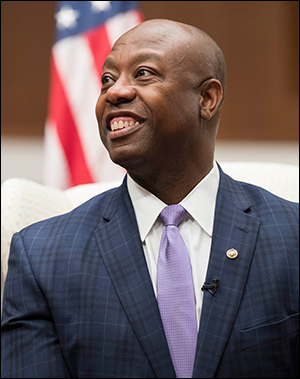
South Carolina Sen. Tim Scott (R)

Sen. Tim Scott: Showing Movement — Last week we saw New Hampshire polls found Sen. Tim Scott (R-SC) moving into either third place on the GOP ballot test question, or tying for that same position. Now, we see a new national poll showing similar upward mobility for the South Carolina senator.

YouGov America, polling for the University of Massachusetts (May 31-June 8; 1,133 US adults; online), finds former President Donald Trump again leading among national Republicans with a 56 percent preference figure while Florida Gov. Ron DeSantis trails with 26 percent support. Sen. Scott, though posting only four percent, moves past the other second tier candidates for third place.

The general election pairings also show him highly competitive with President Joe Biden. While Biden leads former President Donald Trump 43-40 percent in the national popular vote question and posts a 41-37 percent margin against Gov. DeSantis, Sen. Scott falls into the same realm. Despite not being well known nationally, he actually polls the best against the president, trailing only 37-35 percent.

Michigan Poll: Highly Competitive Results — The new EPIC-MRA Michigan poll (June 8-14; 60 likely Michigan voters; live interview) again reveals a familiar pattern. That is, President Biden’s job approval rating is extremely low, yet he pulls even in the ballot test with both former President Trump and Florida Gov. Ron DeSantis. The polling sample tilts slightly Republican because the black vote is under-represented by three points when compared to the US Census Michigan population figures.

While President Biden’s job approval ratio is a terrible 29:69 percent favorable to unfavorable (nine percent excellent; 20 percent pretty good; 25 percent just fair; 44 percent poor), he still pulls even with Trump in the Michigan ballot test at 44 percent apiece. When paired with Gov. DeSantis, the president trails by one point, 45-44 percent.

The EPIC poll obviously suggests that Michigan will be a battleground state in the presidential race, but most analysts are projecting it will remain in the Democratic column when the votes are ultimately counted.

Senate

Michigan: Poll Shows Tight Race — The aforementioned EPIC-MRA Michigan poll (see Michigan president above) also tested the impending open Wolverine State US Senate race. The pollsters pitted Rep. Elissa Slotkin (D-Lansing), the early favorite for the Democratic nomination, and retired Detroit Police Chief James Craig, potentially the most well known Republican. The ballot test revealed a tighter contest than expected with Rep. Slotkin holding only a 40-39 percent edge over retired Chief Craig. Both figures contain eight percent in the “lean” category for both Rep. Slotkin and Craig.

The Michigan race will likely move closer to the Democratic column as the year-long campaign evolves. There is a slight Republican skew in this polling sample as blacks are slightly under-represented. Both Rep. Slotkin and Craig are unknown to the majority of the respondent universe indicating that each will have to spend money to increase name identification. The seat is open because four-term incumbent Sen. Debbie Stabenow (D) is retiring.

House

Alabama Redistricting: Court Determines Re-Mapping Calendar — After last week’s US Supreme Court’s ruling that invalidated the Alabama congressional map, the federal three judge panel assuming jurisdiction has sent the map back to the state legislature to begin the re-drawing process. SCOTUS agreed with the plaintiffs in the case that a second majority minority district can be drawn in the state. The current map yields a 6R-1D split.

The court is giving the legislature until July 21 to produce a new map for judicial review. If the legislature cannot complete the plan within that time frame, the court may step in and order a special master to manage the map drawing process.

SCOTUS will also rule on the North Carolina partisan gerrymandering and judicial power lawsuit before the end of June. That ruling could have an effect upon the Alabama case as it relates to judicial control over the redistricting process. Therefore, the situation could again change once the North Carolina ruling is made public.

Polls Show Republican Presidential Race Getting Tighter; A Twist in Wisconsin; SCOTUS Rules on Alabama Redistricting; Special Election in UT-2

By Jim Ellis — Monday, June 12, 2023

President

Former President Donald Trump still up, but down in polling.

State Polls: Republican Race Getting Tighter — Two very recent Republican presidential state polls were released late last week, one from Wisconsin and the other in Utah. While the Wisconsin spread is typical of what we are seeing in other places, the Utah poll has closed to within one percentage point.

Public Policy Polling (June 5-6; 507 likely Wisconsin voters) sees former President Donald Trump leading the Wisconsin GOP primary but with well less than majority support. The ballot test gives the former president a 41-25 percent lead over Florida Gov. Ron DeSantis. Ex-Vice President Mike Pence is next with eight percent support, and no one else breaks five percent. In an isolation question featuring Trump and DeSantis, the former pPresident leads this only 43-39 percent.

The Utah numbers are much closer. In this Dan Jones & Associates poll for the Utah Republican Party (May 22-June 1; 421 registered Utah Republican voters), Trump’s advantage is only 27-26 percent over Gov. DeSantis.

Former Rep. Liz Cheney, not even a candidate, places third with seven percent, and no other candidate breaks the five percent mark. However, this poll’s long sampling period and small respondent universe, along with the introduction of Cheney into the mix, casts an accuracy shadow over this poll.

Senate

Wisconsin: Polling Leader Emerges; Not the GOP’s Top Choice — The Wisconsin Public Policy Polling survey (see President section above) also tested the state’s US Senate race featuring two-term incumbent Tammy Baldwin (D).

The Republican primary ballot test suggests that former Milwaukee County Sheriff David Clarke would lead a prospective group of GOP candidates with 40 percent preference. Placing second is Rep. Mike Gallagher (R-Green Bay) with 20 percent, followed by Rep. Tom Tiffany (R-Minocqua) at 10 percent. Clarke is not an official candidate, and viewed as someone who would be unlikely to win the general election. So far, Rep. Gallagher has not made a discernible move to enter the Senate race. Rep. Tiffany is testing the waters.

The Wisconsin race could become competitive, but Sen. Baldwin would begin any general election as the favorite to win in November.

House

Redistricting: SCOTUS Rules on Alabama — The US Supreme Court, on a 5-4 decision with Chief Justice John Roberts and Associate Justice Brett Kavanaugh joining the majority, ruled in favor of the plaintiffs in the Alabama racial gerrymandering case. Therefore, the Alabama map will be redrawn to reflect a second minority district from the state’s seven seats. Louisiana will likely have to be redrawn as well.

Possible redraws could occur in several other southern states. The ruling is clearly a win for the Democrats and gives them even better odds of re-capturing the House majority in the 2024 election.

UT-2: Special Election Set — Since Utah Rep. Chris Stewart (R-Farmington) submitted an irrevocable letter of resignation for Sept. 15 to Gov. Spencer Cox (R), that action has allowed the state’s chief executive to set at least the special primary election even before the congressman officially leaves office.

Under Utah law, the governor must schedule the special congressional election concurrent with another election. The municipal elections were scheduled for Aug. 15 and Nov. 7, but Gov. Cox is preparing to send the legislature a measure to change those dates to Sept. 5 and Nov. 21 and add the special congressional election to that ballot. These dates meet the federal electoral notice requirements.

The legislature is expected to comply. If they do not, the 2nd District seat could remain vacant for more than a year awaiting the regular primary schedule.

In this instance, the seat will be filled while Rep. Stewart remains in office, which is similar to the Oklahoma law that allows a resigning elected official to serve until a replacement is selected.

Alaska Moves to Repeal Ranked Choice Voting; Ranked Choice Voting Killed in Montana; NC Redistricting News; Reeves Increases Lead in Miss.

By Jim Ellis — Tuesday, May 2, 2023

States

Alaska Sen. Lisa Murkowski (R)

Alaska: Move to Repeal Ranked Choice Voting — In 2020, Alaska voters with only a 50.5 percent victory margin approved a top-four/Ranked Choice Voting election change that has had a major effect upon the state’s elections. Under the system, all candidates are placed on the same ballot with the top four finishers, regardless of party affiliation, advancing into the general election. In the regular vote, if no candidate receives majority support, the Ranked Choice process takes effect.

Supporters of Sen. Lisa Murkowski (R) were active in getting the measure passed correctly believing that the system would help her. A top-four structure would guarantee the senator advancing to the general election, thus bypassing what had proven to be her main point of vulnerability: a partisan Republican primary.

Now, conservative activists backed by Sarah Palin, former Alaska governor, and 2022 US Senate candidate Kelly Tshibaka are mounting a signature campaign for a ballot initiative that would repeal the current system. The legislature is also considering legislation to do the same. Proponents of the repeal initiative must submit 26,705 valid registered voter signatures to qualify the measure. The group has already recruited the mandatory 100 petition sponsors and received initial approval from the lieutenant governor, meaning the initiative is officially qualified for signature gathering. The group’s goal is to place the measure on the 2024 general election ballot.

Montana: Top-Two Primary Could Return, Ranked Choice Voting Killed — Late last week, Gov. Greg Gianforte (R) signed legislation to prohibit the Ranked Choice Voting system from being instituted in the state of Montana, joining several other states that have taken similar action.

Reports also suggest that proponents of legislation to use the 2024 US Senate race as a test case for the all-party jungle primary system that would qualify the top two finishing candidates for advancement into the general election may still be revived in the state House of Representatives before the current legislative session adjourns. The measure has already passed the state Senate but was tabled in a House policy committee. It is possible another committee could consider the measure and pass it to the floor for a vote in the session’s final days.

North Carolina: State Supreme Court Nullifies Previous Redistricting Ruling — In the 2022 election, Republicans converted two Democratic seats on the North Carolina Supreme Court, which gave the GOP a 5-2 majority. In the post-election session, the outgoing Democratic panel ruled that the state Senate boundaries were unconstitutional as was the North Carolina voter ID law. The congressional and state House maps are court-drawn. The new Republican court decided to reconsider these previous court rulings and on Friday reversed the directives.

This means the legislature can redraw all of the district maps and their chance of being upheld in this state Supreme Court is high. The new court and the legislature’s majority members are much closer in the way they view redistricting law and procedure. Therefore, we can soon count on seeing a new congressional plan that will likely break the 7R-7D current delegation’s partisan division. The new draw will inevitably add Republican seats to the congressional delegation at the likely expense of some of the less senior Democratic members.

The high court’s action could also lead to a moot ruling on a similar case currently before the US Supreme Court. If the federal justices take such action on the Moore vs. Harper political gerrymandering and judicial authority case, then we will not see a sweeping Supreme Court directive pertaining to political gerrymandering. This would, at least for the short term, continue the practice of awarding the final redistricting judicial authority to the 50 state Supreme Courts.

Governor

Mississippi: Gov. Reeves Increases Lead — A new Siena College poll of the Mississippi electorate (April 16-20; 783 registered Mississippi voters; live interview & online) projects Gov. Tate Reeves (R) expanding what was a closer lead over Mississippi Public Service Commissioner Brandon Presley (D). The ballot test yields Gov. Reeves a 49-38 percent advantage. In early March, Mason-Dixon Polling & Strategy found the governor holding a 46-39 percent edge.

While the Siena College poll revealed the governor’s job approval index at 53:46 percent favorable to unfavorable, his personal popularity remains upside down. This latest data projects for him only a 42:45 percent positive to negative ratio. Gov. Reeves faces only minor competition in the Aug. 8 Republican primary and Commissioner Presley is unopposed on the Democratic side. Therefore, it is clear the two will face each other in the Nov. 7 general election.