Tag Archives: President Biden

Rep. John Yarmuth to Retire

By Jim Ellis

Rep. John Yarmuth (D-Louisville)

Oct. 14, 2021 — In a video to his supporters and beginning with the phrase “it’s been an incredible journey since my first campaign in 2006 until now …” Kentucky US Rep. John Yarmuth (D-Louisville), the chairman of the House Budget Committee, announced Tuesday that he will not seek a 9th term in Congress next year.

Yarmuth indicated that he never intended to spend 16 years in Washington, figuring he would retire after five terms, but at the age of 75, with his birthday just before the next election, the veteran congressman indicated it is time to return to Louisville and begin enjoying retirement. He committed to vigorously serving the remainder of the current term.

Kentucky’s 3rd Congressional District is fully contained within Jefferson County and hosts the state’s largest city of Louisville. Under the 2020 census numbers, the 3rd only needs to shed 5,879 residents, suggesting that the district will remain largely intact after redistricting. The Kentucky legislature is again expected to draw a 5R-1D congressional map designed to hold for the ensuing decade.

The 3rd is Kentucky’s lone Democratic congressional seat, and returned a 60-38 percent margin for President Biden last November. Hillary Clinton recorded a 55-40 percent spread against then-candidate Donald Trump in 2016, and President Obama posted a 56-43 percent mark against Mitt Romney back in 2012, the first election under the current district lines.

Yarmuth came to the House in 2006, scoring an upset win over then-Rep. Anne Northup (R) in a much different and more competitive 3rd District. He unseated her with a close 51-48 percent margin in what proved to be a strong Democratic election year. Northup returned for a re-match in 2008, but Yarmuth easily won that contest with a 59-41 percent victory margin in the first Obama election year.

In the course of his seven re-election campaigns, Rep. Yarmuth averaged 61.4 percent of the vote and was never a targeted Democratic incumbent. He assumed the chairmanship of the Budget Committee in 2019.
Continue reading

New Redistricting Numbers

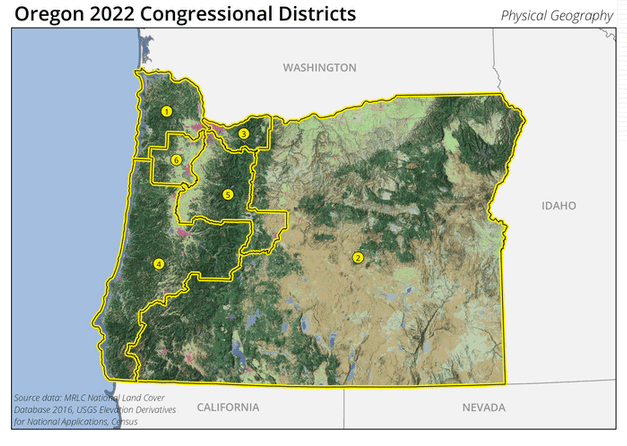
Oregon 2022 Congressional Districts (Go to Daily Kos story on Oregon’s new House map)

By Jim Ellis

Oct. 12, 2021 — The Daily Kos Elections website’s statistical team has already published presidential election numbers for some of the states that have completed their redistricting process. Therefore, we have a bit more information about the new districts in Oregon and Maine, which allows us to better analyze the political landscape.

In Oregon, the Daily Kos team has published the Biden-Trump 2020 numbers for the new six Beaver State congressional districts, which makes comparing with previous data possible.

Rep. Suzanne Bonamici’s (D-Washington County) 1st District actually makes her previously safe northwestern Oregon seat even stronger. This new district gives her all of downtown Portland. President Biden posted a 68-29 percent margin in the new 1st, a net 10-point increase from his spread in the current district (63-34 percent).

The state’s lone Republican district, OR-2, also sees its percentages increasing for the incumbent’s benefit, who is freshman Rep. Cliff Bentz (R-Ontario/East Oregon). Instead of finding a 56-42 percent margin in former President Donald Trump’s favor, the new 2nd expands to 61-37 percent, a similar net 10-point improvement for the GOP as the Democrats saw in District 1.

Making the 2nd District so overwhelmingly Republican is reflective of the Democratic legislature’s plan to pack as many GOP voters as possible into the 2nd to facilitate achieving their goal of drawing a 5D-1R statewide map.

Rep. Earl Blumenauer’s (D-Portland) 3rd District, previously the Democrats’ safest Oregon seat, remains so, but with a slightly smaller margin. Under the newly adopted district lines, President Biden would have recorded a 73-25 percent victory as opposed to his 74-23 percent spread under the current map.

Perhaps the biggest change on the Oregon map, other than adding a new district, was making the Eugene-anchored 4th District safer for veteran representative and House Transportation and Infrastructure Committee Chairman Peter DeFazio (D-Springfield).

The Biden margin in the previous 4th was 51-47 percent, and the congressman only recorded 51.5 percent in his 2020 re-election victory, one of the smallest of his 18 electoral triumphs. In the new 4th, President Biden’s victory spread would have been 55-42 percent, a net Democratic gain of nine percentage points.

Continue reading

Youngkin Closing on McAuliffe

By Jim Ellis

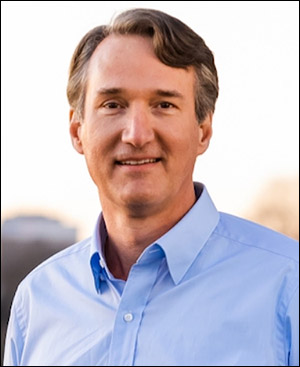
Glenn Youngkin, Virginia Republican governor candidate

Oct. 8, 2021 — A new Emerson College poll (Oct. 1-3; 620 likely Virginia voters, live interview and online panel with weighted responses) finds former Virginia Gov. Terry McAuliffe and ex-hedge fund CEO Glenn Youngkin in a virtual dead heat on the ballot test. McAuliffe is clinging to a bare 49-48 percent edge, but the underlying numbers suggest Youngkin may not be quite that close.

While Youngkin enjoys a very strong lead in the rural areas (57-42 percent) McAuliffe does better than he in the much larger urban areas (59-36 percent) thus negating, and then some, any edge the challenger may have established.

Surprisingly, considering recent poor Republican performance among suburban voters, Youngkin pulls slightly ahead of McAuliffe, 49-48 percent, within this category. Breaking even here would be a huge benefit for Youngkin should this trend prove real and is sustained.

Among women, McAuliffe has a 51-45 percent edge, which is actually a credible split for a Republican nominee in a Democratic state. Youngkin, however, needs to perform better among men than his 50-46 percent split found in this survey. Targeting men should be a key focal point for the Youngkin campaign in the closing days of the race.

Among minority groups, Emerson finds that Youngkin is outperforming a typical Republican candidate. The split among blacks, however, of 72-25 percent in McAuliffe’s favor, is suspect. Usually a Republican candidate is closer to the 10 percent level within this cell segment. It is not particularly unusual, however, to see a Republican polling better among blacks than what would be the actual performance factor once the votes are cast, and that pattern may appear again when the final votes are recorded in this contest.

The Hispanic segmentation is interesting. Republicans have been doing better within the Hispanic cell, and particularly so in 2020; so Youngkin actually leading McAuliffe within this group, 55-45 percent, may not be shocking but certainly appears inflated.

It wouldn’t be particularly surprising to see Youngkin pull more votes from Hispanics than a typical Republican candidate, but it is unlikely he would post a majority within this group. Still, while probably not as rosy a picture as this poll paints for Youngkin, it is probable that he will draw a greater Hispanic share than originally projected for him at the beginning of this campaign.

Continue reading

NH Gov. Sununu Polling Positively

By Jim Ellis

New Hampshire Gov. Chris Sununu (R)

Sept. 3, 2021 — The St. Anselm College’s New Hampshire Institute of Politics poll was released this week (Aug. 24-26; 1,855 registered New Hampshire voters, online weighted responses), and it contains good news for three-term Granite State Gov. Chris Sununu (R). From this data, Sununu records his largest lead of the early 2022 election cycle, 49-41 percent, over first term incumbent Sen. Maggie Hassan (D).

Gov. Sununu has yet to enter the race and says he will make a final decision about his political future well into next year. Since New Hampshire is one of two states that limits its governors to two-year terms, Sununu is in the middle of his third term even though completing just his fifth year in office. He is eligible to run for a fourth term, and beyond.

Because New Hampshire has one of the latest primaries on the election calendar – Sept. 13 in 2022 – it wouldn’t be surprising for the governor to wait even until the end of the next legislative session to declare his political intentions for the midterm cycle. With his win percentage increasing to 65.1 percent in 2020 after victories of 52.8 and 49.0 percent in his first two elections and with a current 64:34 percent positive favorability ratio, the governor has the luxury of waiting along with the ability to clear the GOP field regardless of the office for which he ultimately declares.

With Gov. Sununu as the GOP’s Senate nominee, New Hampshire becomes the Republicans’ best national conversion opportunity, and he is obviously under heavy pressure from party leaders to run.

For her part, Sen. Hassan is prepared for a tough fight. Through the June 30 Federal Election Commission financial disclosure period, she reported raising $11.3 million during her out-of-cycle four years, with a whopping cash-on-hand figure of $6.56 million.

The Democrats appear fortunate that the election is so far away. The poll’s underlying numbers suggest they would fare badly in the New Hampshire general election if voting were in a close time proximity, but the Granite State electorate is wholly unpredictable. Since the turn of the century, no state has swung as wildly as New Hampshire, with the electorate going heavily for both parties in different election years.

Continue reading

New Poll Again Shows Tight
Numbers in Georgia Senate Race

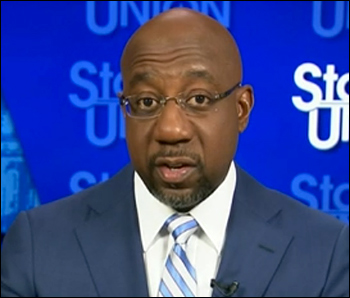
Georgia freshman Sen. Raphael Warnock (D)

By Jim Ellis

Aug. 11, 2021 — Late last week, Public Policy Polling released their new Georgia Senate findings (Aug. 4-5; 622 Georgia voters, interactive voice response system) and the results place the new Peach State Senate race in familiar territory: a virtual tie.

While PPP finds that freshman Sen. Raphael Warnock (D) leads three tested Republican potential nominees, former Sen. Kelly Loeffler, retired football star Herschel Walker, and three-term state Agriculture Commissioner Gary Black, only when paired against Black does Warnock’s edge extend beyond the polling margin of error. This early poll suggests what the conventional political wisdom already predicts, that the 2022 Senate race will again feature a close finish.

To reiterate, Sen. Warnock, though winning his seat only in 2020, must run for a full six-year term next year because he won the special election to fill the unexpired portion of former Sen. Johnny Isakson’s (R) final term. You will remember that Sen. Isakson resigned at the end of 2019 due to health reasons and Gov. Brian Kemp (R) appointed Loeffler to fill the seat until the special election was conducted.

The PPP results find Walker, who has yet to announce (and it’s still even unclear as to whether he will run), in the best position of the three tested potential candidates. In this poll, Sen. Warnock’s edge is 48-46 percent. Loeffler fares comparably with Walker, though slightly worse, trailing 44-47 percent. Commissioner Black, the only officially announced candidate of the group, falls behind by eight percentage points, 38-46 percent.

The favorability indexes provide further clues. Keeping in mind that almost everyone tends to skew negatively on the PPP favorability scores, the two benchmarks, President Biden and former President Trump, score 46:48 percent favorable to unfavorable and 43:48 percent, respectively. Sen. Warnock posts a 43:42 percent job approval score. Walker, obviously exclusively due to the personal recognition coming from both his college and professional football career, has the best result: 41:28 percent. Loeffler fares poorly: 28:47 percent, while Commissioner Black is an even split at 15:15 percent; still, that means 70 percent of the voters don’t have enough information about him to form an opinion.

These numbers provide us with several conclusions: first, Sen. Warnock has yet to establish himself beyond a partisan framework. The 85:8 percent score among Democrats carries his overall positive mark. He records a predictable 6:78 percent mark among Republicans, but perhaps most indicative, just 33:45 percent among those classifying themselves as political Independents.

Continue reading

Ohio Specials Today

Ohio’s Congressional Districts

By Jim Ellis

Aug. 3, 2021 — Though the two Ohio special congressional elections won’t officially be decided until the Nov. 2 general election, today’s nomination contest in both the vacant 11th and 15th congressional districts will unofficially choose the succeeding representatives in the respective Democratic and Republican primary elections.

District 11, the vacated Cleveland-Akron seat because former Rep. Marcia Fudge (D-Cleveland) resigned to accept her appointment as Housing & Urban Development Secretary, is a solidly Democratic seat (Biden ’20: 80-19 percent; Clinton ’16: 80-17 percent). Though yielding a Democratic primary of 13 candidates, the race is boiling down to a two-way contest between former state senator and 2020 Bernie Sanders for president national co-chair Nina Turner and Cuyahoga County councilwoman and local Democratic Party chair Shontel Brown.

The 15th District lies in southern Ohio and contains some of the south Columbus suburbs of Franklin County along with 11 largely rural counties southwest, south, and southeast of the state’s capital city. The former incumbent here, Steve Stivers (R-Columbus), resigned his office in May to accept a position as president/CEO of the Ohio Chamber of Commerce. This, after testing the waters for a US Senate run. OH-15 is a reliable Republican district (Trump ’20: 56-42 percent; Trump ’16: 55-40 percent) that has grown more conservative over time.

Originally, it appeared that former Sen. Turner was a lock in the 11th District. She had big leads in polling and fundraising, but in the past six weeks, Brown has made major strides. While the latest polling still projects her trailing just outside the polling margin of error, the prevailing political trend is definitively moving in the local official’s direction.

This race is also shaping up as a battle between the two major factions within today’s Democratic Party: the Democratic socialists, led by Independent Sen. Bernie Sanders (I-VT), Reps. Alexandria Ocasio-Cortez (D-NY), Ilhan Omar (D-MN), and the political action committee known as the Justice Democrats, opposite the national party establishment featuring such individuals as House Majority Whip Jim Clyburn (D-SC), the Congressional Black Caucus leadership, and Hillary Clinton.

While keeping her ads positive, some of Brown’s outside supporters, namely the Democratic Majority for Israel PAC, have highlighted public comments Turner previously made about President Biden, Vice President Harris, all before they were elected to their present positions, and the Democratic Party in general. Conversely, Brown’s campaign ads highlight her strong support for President Biden and his stated policy agenda.

Continue reading

OH-11: Special Election Tightening

By Jim Ellis

OH-11

July 14, 2021 — For most of the special election campaign to replace Housing & Urban Development Secretary Marcia Fudge in her vacated US House district, it appeared that former state senator and Bernie Sanders for President 2020 national co-chair Nina Turner was a lock for the Democratic nomination. As the contest steams toward an Aug. 3 special Democratic primary election date it appears, however, that the political battle is far from over.

Cuyahoga County Councilmember and County Democratic Party chair Shontel Brown is making major strides that have come to the surface in the past two weeks. According to a just-released Normington Petts survey for the Brown campaign (July 5-8; 400 OH-11 likely Democratic special primary election voters, live interview), ex-Sen. Turner now holds only a 43-36 percent margin over Brown with the 11 minor Democratic candidates splitting the remaining 7 percent preference total.

In the firm’s first poll of this race back in April, Turner led Brown, 42-10 percent. As Jill Normington notes in her released polling synopsis, the latest results find Brown gaining 26 support percentage points between the time the two Normington Petts polls were conducted as compared to just one for Turner.

With recently announced endorsements from Hillary Clinton, House Majority Whip Jim Clyburn (D-SC), Buckeye State 2018 gubernatorial nominee Richard Cordray, Ohio US Rep. Joyce Beatty (D-Columbus), the Congressional Black Caucus, and 18 local mayors, in addition to an impressive array of community, religious, and labor leaders from the district, it appears Brown is gaining serious momentum with three weeks remaining in the primary cycle.

Turner has her own strong support organization, too, most notably from Cleveland Mayor Frank Jackson, state Senate Minority Leader Kenny Yuko, former Ohio Democratic Party chairman David Pepper, and the Justice Democrats led by New York Rep. Alexandria Ocasio-Cortez. Turner also draws support from her own group of a dozen Ohio state legislators and many local officials, along with a large number of Cleveland and Akron community and religious leaders.

Originally, Turner was lapping the entire field in terms of money raised and spent. Now, however, Brown has caught her in this area, too. According to the Daily Kos Elections site, Turner has spent $1.2 million in the campaign as compared to Brown’s $617,000, but they also track another $475,000 coming in from an outside negative ad expenditure targeted against Turner from the Democratic Majority for Israel organization.
Continue reading

Pew’s Post-Election Findings

By Jim Ellis

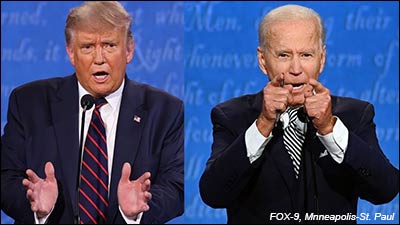
The candidates in action at the first presidential debate in Cleveland, Ohio: President Donald Trump (left) and former vice president Joe Biden.

July 8, 2021 — The Pew Research Center conducted a post-election poll and spent seven months developing their conclusions. On the last day of June, they publicized their report.

The study, conducted just after the November election (Nov. 7-12; 11,818 individuals through groups of screened panelists, online) was exhaustive.

Quoting the methodology description, “noncitizens and those who refused the citizenship question (N=450), voters who refused to answer the vote choice question (N=84) and panelists who declined to provide their names and thus could not be matched to a voter record (N=139) were removed, leaving 11,145 panelists for analysis.” Of this latter number, 9,668 respondents were validated as voters, meaning the research team verified with a local election office that the particular individual had in fact voted.

The basic voter segmentation conclusions were speculated upon in most media sectors during the early post-election period, but this research validates and expands upon the discovered patterns. Largely, President Biden received a significant boost from suburban voters, which proved the major difference in his increasing Democratic popular vote performance.

Despite losing the popular vote by a substantial margin, former President Trump surprisingly improved his standing with several groups such as Hispanics, Asians, black men, young voters, and women, but not to the degree necessary to counter Biden’s strength with suburban voters.

For example, among suburban voters, according to the Pew research, Biden recorded 54 percent support as compared to Hillary Clinton’s 45 percent in the 2016 election. Conversely, Trump only carried white voters 51-47 percent in the most current election, a major reduction from the 54-38 percent spread he posted four years earlier.

While Trump declined in the suburbs, his performance among rural voters was even stronger than his 2016 benchmark. In 2020, Trump’s percentage among rural voters rose to 65 percent from his 59 percent previous showing. Additionally, rural female voters largely account for his overall increase among women as he moved from 39 percent in ’16 to 44 percent in 2020.

Continue reading

Texas GOP Mayoral Victories

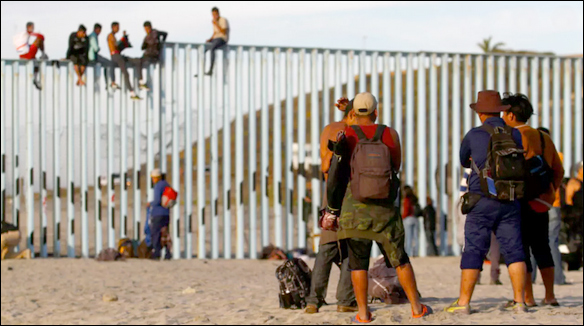
Along the US-Mexican border

By Jim Ellis

June 8, 2021 — On Saturday, Republican candidates picked up three victories in a trio of Texas mayoral runoffs, the most surprising of which came in the Mexican border city of McAllen where the Hispanic population is close to 85 percent.

McAllen City Commissioner (Council) Javier Villalobos, a former Hidalgo County Republican Party chairman, won the mayoral runoff election with a 51-49 percent victory. This on the heels of the Texas-Mexico border region voting much more Republican in 2020 than in previous electoral history. From the congressional district that houses McAllen, Rep. Vicente Gonzalez (D-McAllen) won his November re-election contest with only a 50.5 – 47.6 percent victory margin.

In Ft. Worth, an election that broke more definitively along partisan lines, though all of the mayoral elections in the state are nonpartisan in that the candidate’s political party affiliation does not appear on the ballot, Republican Mattie Parker defeated Tarrant County Democratic Party chair Deborah Peoples. The spread was 54-46 percent in a contest where turnout more than doubled the aggregate mayoral vote of four years ago. Voter participation was up in all three of the Texas city runoff elections, but none like the huge increase in Ft. Worth.

The least partisan of the races occurred in Arlington, where former police officer and local businessman Jim Ross defeated Arlington City Councilman Michael Glaspie, also with a 54-46 percent margin. In this election, law enforcement seemed to dominate the campaign as five different police and fire associations rallied to support Ross.

As mentioned above, South Texas voting ventured more toward the Republicans in November even though Democrats still proved victorious in the region. Biden’s margin over then-President Trump dropped as low as 50-48 percent in Rep. Gonzalez’s 15th District, and under 52 percent in three of the four CDs that touch the Texas-Mexico border.

Continue reading

NM-1: A Pattern?

By Jim Ellis

Albuquerque, New Mexico-anchored NM-1 Congressional District

June 4, 2021 — Several media reports — typified by an MSNBC website analysis article that Steve Benen authored after Tuesday’s New Mexico special election — are trying to make the point that Melanie Stansbury’s landslide victory is a potential benchmark for future Democratic victories. Such a conclusion is a stretch.

The two-pronged premise is that Stansbury was so strong that she even ran ahead of President Biden’s performance in the district, and that the Republican campaign’s emphasis on the crime problem and the national effort to defund the police proved a political failure.

While Stansbury, a two-term state representative, scored a 60-36 percent win in the Albuquerque anchored congressional district that former Rep. Deb Haaland (D) resigned to become US Interior Secretary, her performance is not unusual. In fact, her vote total was less than two points above the mean average Democratic congressional percentage since the party converted the seat from the Republicans back in 2008.

To the argument that Stansbury’s victory margin was larger than President Biden’s 60-37 percent spread against then-President Trump, and it was only one percentage point better, it is not unusual for a House campaign to outperform the top of the ticket. In most instances, the congressional winner is better known than his or her competitor, has greater funding and outside support, and is consistently in position to overwhelm the opposition. Such is rarely the case in a national presidential campaign or in a major statewide contest for senator or governor.

The crime issue was certainly a focal point of Republican nominee Mark Moores, an Albuquerque state senator. The national party, however, did very little to support Moores, virtually conceding the race from the outset based upon the voting history here for more than a decade.

For an underdog candidate in Moores position, emphasizing the crime issue, on paper, made sense as a point of attack. Albuquerque, according to FBI statistics has the ninth worst violent crime statistics in the country, meaning 1,352 crimes per 100,000 residents according to the latest available figures (2019). To put this number in perspective, Chicago, which has drawn much national media attention for its high murder rate, ranks 31st on the same scale, at 943 crimes per 100,000 city residents.

Perhaps one reason the crime issue did not propel the Moores candidacy is there was no serious effort to defund the Albuquerque Police Department, nor is there the sharp racial tension that is present in some of the cities where we saw serious problems along with a local movement to reorder policing.

Continue reading