Tag Archives: Kansas

Early Clues for Dems’ Early Targets

By Jim Ellis

April 1, 2020 — The Senate Majority PAC, one of the chief advocacy entities for Democratic candidates, has reserved media time totaling $69.2 million from August through the election, as reported on the Daily Kos Elections website. The expenditures provide us some clues into how the Democratic establishment and their progressive left allies view their strategic attack points in relation to the national political landscape.

The early media time reservations are invested in five states: Arizona, Colorado, Iowa, Maine, and North Carolina. This is certainly not the limit of the SMP planned expenditures, nor is the organization likely committed to fulfilling the entirety of this time buy without having negotiated an escape clause. All depends upon their agreements with the individual television outlets and does not include any future expenditure the group may make for radio and digital advertising.

Setting the stage, the five states are all clearly top-tier Republican-held targets of which the Democrats would have to convert nearly all in order to wrest Senate control away from the current majority. That number grows if they fail to defend their own vulnerable seats in either Alabama or Michigan, or both.

The largest time reservation is in North Carolina, where Democrats hope newly nominated Cal Cunningham, a former state senator and 2010 US Senate candidate (lost Democratic nomination to then-secretary of state Elaine Marshall who would lose the general election to GOP Sen. Richard Burr), can unseat first-term incumbent Thom Tillis (R) in a state that has defeated more senators than any other in the modern political era. Of the $69.2 million in national reservations the group made, $25.6 million is dedicated to North Carolina media markets.

Arizona gets the second largest share with $15.7 million dedicated toward helping retired astronaut Mark Kelly, already the consensus Democratic candidate, challenge appointed Sen. Martha McSally (R). Iowa, where Democrats will nominate a candidate on June 2 to challenge first-term Sen. Joni Ernst (R), will see $13.1 million of the SMP media buy. Maine gets $9.6 million to oppose Sen. Susan Collins (R), and Colorado $5.2 million largely for negative ads against first-term Sen. Cory Gardner (R).

Continue reading

Mid-Year Senate Primaries

By Jim Ellis

Jan. 24, 2020 — The second in our three-part series about the in-cycle Senate races covers the 13 contests with June and early August primary dates:
JUNE 2

Iowa: Sen. Joni Ernst (R) stands for a second term and will likely face Des Moines real estate executive Theresa Greenfield (D) in the general election. Greenfield, who aborted a congressional run in 2018 when her campaign effort didn’t collect the requisite number of legal petition signatures, enjoys at least unofficial backing from the Democratic establishment and party leadership. The leaders’ first choice to run, freshman Rep. Cindy Axne (D-Des Moines), decided to seek her first re-election instead of jumping into a statewide battle.
Sen. Ernst is favored for re-election but some of her approval ratings have been low. Much will depend upon the national political trend, particularly at the presidential level. Iowa is typically a swing state that has been moving right in most recent elections, though the Democrats did gain two congressional seats in the last election.

Montana: Sen. Steve Daines (R) stands for a second term, and with the Democrats unable to convince outgoing governor and former presidential candidate Steve Bullock to run for the Senate, most of the political attention has shifted to the open governor’s race and at-large US House contest. With Rep. Greg Gianforte (R-Bozeman) again running for governor, both the governor’s office and the state’s lone House seat are open for the coming election.
In fact, when looking at the entire statewide ticket, mostly due to term limits and statewide officials running for other offices, five of the seven statewide races are open contests in 2020. Therefore, the lack of attention and concentration on the Senate race certainly helps Sen. Daines. At this point, with the March 9 candidate filing deadline less than a month away, the type of candidate who could give the senator a serious run has not yet emerged.

New Jersey: Sen. Cory Booker (D) backed away from the presidential contest in order to concentrate on his re-election campaign. While state law was changed to allow candidates to run for offices simultaneously, Sen. Booker decided the time to exit the presidential race was upon him before embarrassing losses in Democratic primary states encouraged stronger primary competition for his re-election back home. Now concentrating on New Jersey full-time, Sen. Booker looks safe for re-election.

Continue reading

Pompeo for Senate?

By Jim Ellis

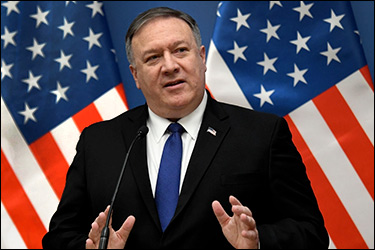
US Secretary of State Mike Pompeo

Nov. 25, 2019 — Ever since Kansas Sen. Pat Roberts (R) announced last January that he would retire at the end of the current Congress there has been consistent speculation that US Secretary of State and former Wichita area congressman, Mike Pompeo, would resign his national position and return to Kansas to run for the open seat. Despite repeated denials from Secretary Pompeo, the speculation would not die.

Now, it appears the rumors of him entering the race have greater foundation, as more concrete stories that he will soon resign and announce his candidacy are regularly surfacing. The Senate Republican leadership is clearly in favor of the Pompeo move, originally fearing that former Kansas Secretary of State Kris Kobach could win a crowded August Republican primary with only a vote plurality and then perform as badly in the general election as he did when he lost the 2018 open governor’s race.

With Republicans holding 53 of the chamber’s 100 seats but having to defend 23 incumbents and open seats on the 2020 Senate election map versus only 12 for the Democrats, the GOP cannot afford an electoral debacle in what should be a safe seat. It was only two years ago that another flawed Republican Senate candidate bungled the Alabama special election, thus allowing Democrat Doug Jones to win the position that Sen. Jeff Sessions had resigned to become US Attorney General.

Currently, eight individuals have announced for the Republican nomination led by Kobach, US Rep. Roger Marshall (R-Great Bend), and state Senate President Susan Wagle (R-Wichita). Polling and local political intel suggests that Pompeo would have little trouble winning the nomination, and the seat, if he were to enter the race. If he does become a candidate, some of the others, and particularly Rep. Marshall, would have time to exit the race and pivot back toward seeking re-election to their current position.

Originally, state Treasurer Jake LaTurner (R) had been in the Senate race – in fact, he was the first to enter the contest immediately after Sen. Roberts made public his intentions – but he has already exited and, at the behest of former Gov. Jeff Colyer (R), is now challenging freshman Rep. Steve Watkins (R-Topeka) for re-nomination in the 2nd Congressional District.

Continue reading

A Brewing Battle Emerging in Kansas

Freshman Rep. Steve Watkins (R-Topeka)

By Jim Ellis

Oct. 17, 2019 — Former legislative aide Abbie Hodgson, the only announced Democratic candidate in the KS-2 congressional race, withdrew her challenge to freshman Rep. Steve Watkins (R-Topeka) Wednesday because she claims not to possess the fundraising ability to conduct a credible campaign. At this point, there is no alternative Democrat on the horizon in the Kansas district, but that will soon likely change.

Rep. Watkins won a tight 48-47 percent general election victory over former state House Minority Leader and 2014 gubernatorial nominee Paul Davis (D) last November to succeed retiring Rep. Lynn Jenkins (R). This came after political newcomer Watkins, a West Point graduate, Army Ranger and Afghanistan veteran, won a tight seven-way Republican primary but with only 26.5 percent of the vote. Controversy arose when a major independent expenditure committee emerged, which was principally funded by the candidate’s father, to back Watkins.

More potential upheaval surrounds Rep. Watkins, but it simmers below the surface. Rumors were flying around in August that the congressman would imminently resign his office because of a rumored scandal that was about to become public. Watkins took no such action, and to date nothing involving scandalous activity has come to light.

This has not stopped certain Republicans from taking action, however. In early September, reportedly at the behest of former Gov. Jeff Colyer (R) who lost his own bitter primary to then-Secretary of State Kris Kobach, state Treasurer Jake LaTurner made a surprising move. He was the first declared US Senate candidate after incumbent Pat Roberts (R) announced his retirement, but he then transferred from the statewide campaign to instead enter the primary to challenge Watkins in the Topeka-anchored congressional district.

Kansas’ 2nd is a decidedly Republican seat, but not intensely so. The CD occupies 23 eastern Kansas counties and parts of two others. It runs vertically from the Nebraska border to Oklahoma and consumes the territory between the Kansas City metro area and Wichita.

Continue reading

2020 Senate Races: The Latest

By Jim Ellis

Aug. 15, 2019 — New developments are occurring in 2020 Senate races across the country and several are apparently unofficially set for the general election. Below is a recap:

ALABAMA: Two polls have been conducted since both former state Supreme Court Chief Justice Roy Moore and retired Auburn University football head coach Tommy Tuberville joined the Republican race. Each survey showed Tuberville with the lead. The most recent, from the Cygnal research firm (June 22-23), finds Tuberville leading Rep. Bradley Byrne (R-Mobile), 29-21 percent. Judge Moore, the 2017 special election GOP nominee, recorded only 18 percent support among the likely GOP voters. An April 14 Republican run-off is likely after the March 3 primary. The eventual party nominee faces Sen. Doug Jones (D) in the general election.

ARIZONA: While the general election already appears set between appointed Sen. Martha McSally (R) and retired astronaut Mark Kelly (D), the special election schedule is not as clear cut. The 9th Circuit Court of Appeals is considering a lawsuit that challenges the length of McSally’s current appointment. The ultimate ruling could mean an earlier special election. Currently, the special cycle is to run concurrently with the regular 2020 election calendar.

COLORADO: Signs continue pointing to former Gov. John Hickenlooper leaving the Democratic presidential campaign and entering the Colorado Senate race. He looks strong in a Democratic primary – a recent Garin Hart Yang Research poll posts him to a 61-10 percent lead — but he will face a tough general election against incumbent Sen. Cory Gardner (R).

IDAHO: Sen. Jim Risch (R) has announced his re-election campaign for a third term and looks to be a lock for another win.

ILLINOIS: Minority Whip Dick Durbin now has no Democratic primary opposition as state Rep. Anne Stava-Murray (D-Downers Grove) announced several weeks ago that she was ending her Senate campaign. Sen. Durbin is the prohibitive favorite for re-election.

IOWA: The Democratic establishment is coalescing around Des Moines real estate executive Theresa Greenfield. At this point, the general election pairing looks to feature Sen. Joni Ernst (R) and Greenfield.

KANSAS: There is less conjecture that US Secretary of State Mike Pompeo (R) will return to Kansas and run for the open Senate seat and more thought that western Kansas Rep. Roger Marshall (R-Great Bend) will become a candidate. Mr. Marshall already has $1.4 million in his federal campaign account for the 2020 election cycle. He will face a crowded Republican primary but should be favored. Democrats feature a primary between former US Attorney Barry Grissom and ex-one-term Rep. Nancy Boyda.

Continue reading

Kobach Announces in Controversy

By Jim Ellis

Former Kansas secretary of state and 2018 Republican gubernatorial nominee Kris Kobach

July 10, 2019 — In most runs for public office, the day a candidate announces is one of the best campaign days. For former Kansas secretary of state and 2018 Republican gubernatorial nominee Kris Kobach, his declaration that he would run for Sen. Pat Roberts (R) open seat looks to have turned out differently.

Kobach’s Senate announcement on Monday, though speculated upon for several weeks, was met with a considerable amount of negativity from members of his own party including a spokeswoman for the National Republican Senatorial Committee (NRSC). Through a reported tweet from an interview with the Kansas City Star newspaper she said, “just last year [ex-Sec of State] Kris Kobach ran [as GOP nominee for governor] and lost to a Democrat. Now, he wants to do the same and simultaneously put President Trump’s presidency and [the GOP] Senate majority at risk.”

Kobach, the sitting secretary of state at the time, defeated Gov. Jeff Colyer in the 2018 Republican gubernatorial primary by just 343 votes of over 317,000 ballots cast. Colyer was the state’s lieutenant governor who ascended to the governorship when two-term incumbent Sam Brownback resigned to accept a federal appointment. Post-nomination, the Kobach general election campaign was routinely rated as poor, from a lack of fundraising to deficient campaign strategy and implementation that caused him to lose 48-43 percent to then-state Sen. Laura Kelly (D-Topeka) who attracted a significant amount of Republican support.

Prior to his running for governor, Kobach was tabbed by President Trump to be vice-chairman and lead administrator for the President’s Advisory Committee on Election Integrity under Vice President Mike Pence. But Kobach’s leadership of this organization was also called into question. Asking for voter information from states that even Republican chief election officials routinely refused to turn over, the panel was dissolved after only seven months of existence with no tangible accomplishment.

Continue reading

The Early Targets

By Jim Ellis

April 3, 2019 — Continuing our early outlook of the 2020 House situation, we can begin by narrowing the field to those districts where Republicans will be concentrating at least their initial efforts in order to reclaim the majority they lost in November.

After the 2016 election, there were 12 districts that supported President Trump but elected a Democrat to the House. After the 2018 midterm, that number rose to 31. For the Republicans to regain the majority, they will need to convert a net 18 seats back to their column, or 19 if the Democrats score a victory in the NC-9 special election to be held later this year in the Charlotte-Fayetteville metro areas in southern North Carolina.

The other two House special elections, PA-12 (May 21) and NC-3 (Sept. 10), unless huge upsets occur, look to remain within the Republican stable of districts.

Of the 31 Trump/House Democrat seats, 16 of them also voted for Mitt Romney over President Obama in 2012. Furthermore, a dozen within this group elected a Republican Representative until the 2018 election. They are:

  • GA-6 – Rep. Lucy McBath (D) – Defeated Karen Handel (R)
  • IL-14 – Rep. Lauren Underwood (D) – Defeated Randy Hultgren (R)
  • MI-8 – Rep. Elissa Slotkin (D) – Defeated Mike Bishop (R)
  • MI-11 – Rep. Haley Stevens (D) – Replaced David Trott (R)
  • NJ-11 – Rep. Mikie Sherrill (D) – Replaced Rodney Frelinghuysen
  • NM-2 – Rep. Xochitl Torres Small (D) – Replaced Steve Pearce (R)
  • NY-22 – Rep. Anthony Brindisi (D) – Defeated Claudia Tenney (R)
  • OK-5 – Rep. Kendra Horn (D) – Defeated Steve Russell (R)
  • SC-1 – Rep. Joe Cunningham (D) – Replaced Mark Sanford (R)
  • UT-4 – Rep. Ben McAdams (D) – Defeated Mia Love (R)
  • VA-2 – Rep. Elaine Luria (D) – Defeated Scott Taylor (R)
  • VA-7 – Rep. Abigail Spanberger (D) – Defeated Dave Brat (R)

Continue reading

2020 Senate Review – Part I

By Jim Ellis

March 25, 2018 — Only nearing the end of March in the off-year, already a great deal of early 2020 Senate action has occurred. Thus, it is a good time to begin reviewing all 34 statewide federal races that will adorn next year’s ballot in a three-part series. Today, we look at the first dozen in alphabetical order:

  • Alabama – Sen. Doug Jones (D) – From the Republican perspective, this could be the most important race in the country. The GOP must convert this seat in order to provide a better cushion to protect their Senate majority.
    The 2017 special election became a debacle for the Republicans that allowed Sen. Jones to unexpectedly slip past politically wounded former state Supreme Court Chief Justice Roy Moore. Already, Rep. Bradley Byrne (R-Mobile) and state Auditor Jim Zeigler (R) have announced their 2020 Senate candidacies. Judge Moore claims to be seriously considering running again, which could again create the same adverse situation that previously plagued the Republicans. Toss-up

  • Alaska – Sen. Dan Sullivan (R) – At this point, there seems little in the way of opposition developing either in the Republican primary or general election against Sen. Sullivan. Safe Republican

  • Arizona – Appointed Sen. Martha McSally (R) – Another critically important Senate race that has already featured substantial action. Sen. McSally’s appointment came after her defeat in the 2018 Senate race and she faces a difficult campaign ahead to win the 2020 special election. Whoever wins next year serves the remaining two years of the late Sen. John McCain’s (R) final term. The seat next comes in-cycle for a full six-year term in 2022.
    Mark Kelly, a retired astronaut and husband of former Rep. Gabrielle Giffords (D-Tucson), has already announced his candidacy and will be a major candidate. In early April, Rep. Ruben Gallego (D-Phoenix), whose ex-wife, Kate Gallego, was just elected Mayor of Phoenix in a special election, is expected to enter the Democratic primary. Since Arizona holds a late August primary, a tough Democratic nomination fight would benefit McSally just as her difficult 2018 Republican primary played to Democratic Sen. Kyrsten Sinema’s advantage. Toss-up

  • Continue reading

The Early Senate Maneuvers

By Jim Ellis

Jan. 23, 2019 — Though it is only January of the off-year, already early moves are being made in anticipation of an active 2020 US Senate campaign cycle. With 34 in-cycle Senate races on the ballot, as many as 16, at this point, could become competitive in either the primary or general election.

Below is a quick synopsis of the latest happenings in several states:


OPEN SEATS

• Kansas: The open seat is Kansas is already active with backroom discussions. After first indicating that he would not leave his current position to run for the Senate, pressure is being put on Secretary of State Mike Pompeo to re-consider his decision to stay out of the battle to succeed the retiring Sen. Pat Roberts (R).

Facing a badly split Republican Party in the Sunflower State, many GOP leaders at the state and federal level believe that Pompeo would be the best candidate to unify the disparate factions, which would enable him to easily hold the seat in the general election. This, after the party just lost the governorship.

• Tennessee: Former Gov. Bill Haslam (R) left office on Saturday and says he will decide in the next few weeks whether to seek retiring Sen. Lamar Alexander’s (R) open seat. No one has yet come forward to announce his or her candidacy — the prospective field presumably frozen until Haslam makes public his political plans. Should the former governor decide to run, he would quickly become a prohibitive favorite in the Republican primary and general election.
Continue reading

Senate: Early Handicapping

By Jim Ellis

Jan. 17, 2019 — The 2020 Senate election cycle features 34 races instead of 33 because of the Arizona special, and this time it is the Republicans who must defend the preponderance of seats. In 2018, Democrats held 26 of the 35 seats up for election; in this cycle, Republicans must protect 22 of the 34 Senate positions.

Republicans are first risking two open seats, those of Sen. Pat Roberts in Kansas and Lamar Alexander of Tennessee. At this point, both should remain in the GOP column. They also face a slew of competitive races in as many as eight incumbent states. Democrats, on the other hand, must defend in one highly competitive campaign, that of Sen. Doug Jones in Alabama, and a potentially viable contest in Minnesota.

But the most vulnerable Republican races will attract serious political attention. Appointed Sen. Martha McSally (AZ), Sen. Cory Gardner (CO), and North Carolina first term incumbent Thom Tillis are facing difficult election or re-election campaigns, in addition to Sen. Jones.

Martha McSally lost the 2018 Arizona Senate race to new Sen. Kyrsten Sinema (D) by 55,900 votes of more than 2.384 million ballots cast, or a margin of 2.4 percentage points. This, however, in the same election where Republican Gov. Doug Ducey scored a strong 56-42 percent re-election victory.

Continue reading