Tag Archives: Kansas

Pennsylvania Voting Rules

By Jim Ellis

Sept. 21, 2020 — Pennsylvania’s Democratic controlled Supreme Court changed their state election procedures late last week in a series of rulings on a lawsuit that the Pennsylvania Secretary of State and PA Democratic Party previously filed.

Under the new process, receiving votes after the election is allowed if “no evidence exists” that the ballot was mailed after Election Day, Nov. 3. The deadline for ballot acceptance now moves from 8 pm on Election Day to 5 pm, Friday, Nov. 6. Pennsylvania becomes the 17th state to allow post-election reception for this 2020 election. The ruling increases the chances that we will not have a winner declared on election night.

Additionally, three other rulings will allow drop boxes to be used as ballot receptacles in the various counties, affirmed that poll watchers can only serve in their own county of residence, and Green Party candidate Howie Hawkins’ name was removed from the ballot. The court did not grant the lawsuit motion to allow ballot harvesting, which would permit third parties to deliver ballots to the authorities or ballot drop boxes.

The drop boxes will be placed in various locations around a county and voters can deposit their ballots without using the postal service to transfer their vote to the county election authorities. Hawkins’ name was removed from the ballot because the court said he “failed to comply with the Election Code’s strict mandate” and the attempts to fix the problem “did not suffice to cure that error,” but the specifics were not addressed.

With the large number of absentee ballots expected here and in other states, the trend toward allowing post-election reception, and the laws that some states, like Pennsylvania, have to control when the mail ballots can be counted, makes it less likely that we will see a definitive presidential campaign result on Nov. 3. The same will be true for certain US Senate and House races.

Of the 17 states, now including Pennsylvania, that are allowing post-election ballot reception, seven appear competitive. The others, Alaska, California, Kansas, Massachusetts, Mississippi, New Jersey, Utah, Virginia, Washington, and West Virginia will likely declare a clear winner relatively early in the counting period.

Continue reading

Where the Senate Stands

By Jim Ellis

Aug. 28, 2020 — A tough battle is underway for the US Senate majority, and both parties are fiercely attempting to assume control in the next Congress. Republicans hold a 53-47 majority, but a win in Alabama would send them to 54-46, and that makes the Democrats’ road to the majority all the more difficult.

Democrats need a net conversion of three Republican seats if Joe Biden is elected president, and four if President Trump wins re-election.

Today, we take a snapshot look at polling figures in the key campaign states. How the states listed below eventually fall will determine which party runs the Senate for the 117th Congress.

Below, we provide you the two most extreme results of recent publicly released surveys from the competitive campaigns. The Ellis Insight ratings depict where the race is today, which is not solely based upon polling.


ALABAMA – Lean R (possible conversion)

Morning Consult (July 24-Aug. 2; 80 likely Alabama voters)
• Tommy Tuberville (R) – 52%
• Sen. Doug Jones (D) – 35%

Auburn University at Montgomery (July 2-9; 55 registered Alabama voters)
• Tommy Tuberville (R) – 44%
• Sen. Doug Jones (D) – 36%


ARIZONA – Lean D (possible conversion)

Redfield & Wilton Strategies (Aug. 16-18; 856 likely Arizona voters)
• Mark Kelly (D) – 53%
• Sen. Martha McSally (R) – 34%

OnMessage (Aug. 2-4; 40 likely Arizona voters)
• Mark Kelly (D) – 48%
• Sen. Martha McSally (R) – 48%


COLORADO – Lean D (possible conversion)

Public Policy Polling (Aug. 18-19; 731 Colorado voters)
• Ex-Gov. John Hickenlooper (D) – 51%
• Sen. Cory Gardner (R) – 42%

Morning Consult (July 17-26; 61 likely Colorado voters)
• Ex-Gov. John Hickenlooper (D) – 48%
• Sen. Cory Gardner (R) – 42%


GEORGIA–A – Lean R/Toss

Garin Hart Yang Research Group (Aug. 10-13; 60 likely Georgia voters)
• Jon Ossoff (D) – 48%
• Sen. David Perdue (R) – 46%

Survey USA (Aug. 6-8; 62 likely Georgia voters)
• Sen. David Perdue (R) – 44%
• Jon Ossoff (D) – 41%


Continue reading

Eight Men Out

By Jim Ellis

Poster for the movie, “Eight Men Out”

Aug. 20, 2020 — The 1988 movie “Eight Men Out” about the 1919 baseball World Series carries a title that also aptly describes the 2020 congressional primary season. At this early point in the voting cycle, already eight US House members have been denied re-nomination, which will oust them from office — a large number when comparing to typical campaign years.

It’s worth noting these results because the incumbent defeats are geographically widespread and not confined to one party. Of the eight, five are Republicans, three are Democrats, and each come from different states.

Looking at the eight campaigns, however, only two reasons largely explain the incumbent losses within the respective intra-party elections: ideology and ethics.

Florida Freshman Rep. Ross Spano (R-Dover) from his Lakeland-anchored district this past Tuesday is the latest to lose. The others are, chronologically from the beginning: Reps. Dan Lipinski (D-IL), Steve King (R-IA), Denver Riggleman (R-VA), Eliot Engel (D-NY), Scott Tipton (R-CO), Steve Watkins (R-KS), Lacy Clay (D-MO), and Spano.

In each case, the Democratic losses are ideologically driven. In Illinois, New York, and Missouri, veteran Democrats lost their seats to challengers from the far left, all backed by the Justice Democrats PAC that is loosely associated with New York Rep. Alexandria Ocasio-Cortez. The insurgent campaign strategy in each case was to cast the incumbent as not being sufficiently progressive in addition to more specific attacks.

In Illinois back in March, media consultant Marie Newman returned to again challenge Rep. Lipinski after losing to him 51-49 percent in the 2018 Democratic primary. Rep. Lipinski, an eight-term Chicago suburban congressional veteran whose father held the seat for 22 years before him, had established a moderate record — yet even moving left for the current term couldn’t stop the coming trend. Turnout increased 16 percent when compared to the 2018 primary, and Newman flipped a 49-51 percent loss into a 47-45 percent victory.

Eliot Engel represented the Bronx in Congress for what will be 32 years after serving for 12 years in the New York State Assembly. Aided by Engel campaign mistakes, middle school principal Jamaal Bowman swept to victory with strong assistance from the Justice Democrats. The key themes here were Engel losing touch with his constituents and being out of step with today’s Democratic Party.

Continue reading

Recapping the Primaries

By Jim Ellis

Aug. 6, 2020 — Five states held their primary elections on Tuesday night and many were close, most of which are now complete. Additionally, electorates in several safe open House seats chose a party primary winner who will be the next representative. Therefore, we want to recap the final action along with a projection for the general election.


ARIZONA

Arizona Senate candidate, retired astronaut Mark Kelly (D); appointed Sen. Martha McSally (R)

Senate: Appointed Sen. Martha McSally scored a 76 percent victory in the Republican primary against minimal opposition, while retired astronaut Mark Kelly was unopposed on the Democratic side. Arizona will host a major national Senate campaign in the fall, and Kelly has the early sustained polling lead.

Even with him facing no opposition on Tuesday, Democratic turnout rose nine percent when compared to 2018, but 55,617 more people voted in Tuesday’s GOP primary. This, after more Democrats had voted early according to pre-election ballot tabulations. Because of the large number of mail ballots present in this election, it is likely that the final count is incomplete.

AZ-1: Rep. Tom O’Halleran (D-Sedona) scored only a 59 percent Democratic primary win over former Flagstaff City councilwoman Eva Putzova on Tuesday, despite a better than 2:1 spending advantage. Attorney Tiffany Shedd won the Republican nomination. This district could become competitive, but Rep. O’Halleran is the clear favorite for re-election. The expansive eastern Arizona district leans Democratic as the party’s 3,000-plus vote edge in primary turnout suggests.

AZ-2: Rep. Ann Kirkpatrick (D-Tucson) was easily re-nominated on Tuesday and is a heavy favorite in the general election. Defense contractor Brandon Martin won the Republican primary, but he faces a very uphill climb against Kirkpatrick in November. Despite more Republicans than Democrats voting statewide, Democrats outpaced Republican turnout in this district by a substantial 75,780 to 58,277.


KANSAS

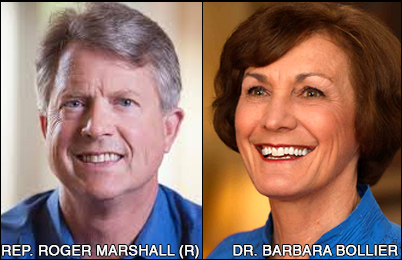
Senate: Rep. Roger Marshall (R-Great Bend) convincingly won the controversial Republican primary, and advances into a general election race with state Sen. Barbara Bollier (D-Mission Hills), a physician and former Republican. This will be a competitive general election despite the strong Republican voter history because Bollier already has over $4 million cash-on-hand to begin the November campaign cycle. We will soon see new polling here. The last published poll pairing Marshall and Bollier came from the Civiqs research organization at the beginning of June: Marshall 42-41 percent.

Continue reading

Wacky Wins in a Senate Primary; Incumbents Watkins & Clay Lose

By Jim Ellis

Aug. 5, 2020 — We review last night’s primary action in the states of Kansas, Missouri, Michigan, Arizona and Washington:


KANSAS

Rep. Roger Marshall (R-Great Bend)

The 2020 election cycle’s wackiest Senate primary ended last night with a big victory for Kansas Rep. Roger Marshall (R-Great Bend) as he defeated former secretary of state and 2018 gubernatorial nominee Kris Kobach and Kansas City Plumbing Company owner and self-funder Bob Hamilton in the statewide Republican primary.

The Marshall victory margin is 40-26-19 percent over the two men, while former Kansas City Chiefs football player and state Turnpike Commission chairman Dave Lindstrom captured 6.7 percent of the vote, best among the also-ran candidates.

The race featured both parties making seven-figure media buys. The national Republican leadership, however, came in to run negative spots against Kobach, a risky strategy in case he would become their nominee. It was clear that Republican survey research provided virtually the same results that Democrats were seeing, namely Kobach winning his primary would give the Democrats the inside track toward snatching away what should be a safe Republican seat.

The other unusual Kansas Senate facet was seeing Democratic organizations come into the state to actively boost Kobach in the GOP primary. He lost the 2018 governor’s race to Democrat Laura Kelly, and the party leaders believed Kobach would be the weakest general election candidate to oppose their party’s consensus nominee, state Sen. Barbara Bollier (D-Mission Hills). Now, she must run against the Republicans’ presumed strongest candidate, Rep. Marshall.

Interestingly, the most recent publicly released poll, which dated back to the beginning of June from the Civiqs organization surveying for the Daily Kos Elections website, found Rep. Marshall and Sen. Bollier falling into a virtual tie. It is likely, however, as the new Republican nominee, that Marshall will become a clear favorite to win in November.
Continue reading

Primary Preview – Part II

Bob Hamilton, self-funding and running clever ads, such as the one above, could be the spoiler in today’s Kansas Democratic senate primary race.


By Jim Ellis

Aug. 4, 2020 — We wrap up our two-part report about today’s August 4th primary with coverage of the Arizona and Kansas nominating elections.


ARIZONA

The US Senate race is on the ballot, though the nominations in both parties are virtually set and have been for months. There is action in three of the state’s nine congressional districts, however.

Senate: Appointed Sen. Martha McSally (R) will easily win nomination tonight. She faces only skincare company CEO Daniel McCarthy, who has raised just over a half-million dollars for his effort. Sen. McSally has attracted over $30 million and brandishes more than $11 million in the bank. That is the good news for her; the bad is her consensus Democratic opponent, retired astronaut Mark Kelly, has brought in an incredible $46 million and had over $21 million remaining in his campaign account at the end of June.

This is a top-tier challenge race, and a Democratic must-win, but not much will be settled tonight.

According to the Phoenix-based Data Orbital polling firm, over 2.6 million absentee ballots have been requested for the primary, and 1.06 million have been returned for a participation rate of 45.6 percent. Therefore, the state already has a primary voter turnout rate of 26.7 percent. Democrats have a 9,900-unit advantage in returned ballots to date.
Continue reading

The Wild Kansas Senate Race

By Jim Ellis

July 21, 2020 — As we approach the Aug. 4 primaries, it’s clear that the Kansas Senate Republican primary will be the top attraction of that election day. An intra-party nomination clash in what should be a relatively safe open-seat campaign has devolved into a mixed-message political brawl.

Embattled Kansas Senate Republican candidate Kris Kobach

Just in the past month we’ve seen Democratic money coming into the Sunflower State in an attempt to influence the Republican primary, and national Republican money making an appearance trying to destroy the former GOP gubernatorial nominee. Furthermore, a well-healed third Republican candidate was being described as a multi-million dollar plumber who contributes more to Democrats. And, yesterday we saw a new ad with a candidate saying that it’s really “a badge of honor” that the Democrats are now attacking him because they’re afraid to face him in the general election.

When veteran Sen. Pat Roberts (R) announced his retirement last year, 2018 gubernatorial nominee Kris Kobach, fresh from running the disastrous Presidential Commission on Election Integrity that yielded no results before being disbanded, jumped into the Senate race. Because Kobach ran such a poor gubernatorial campaign and virtually handed the office to then-Democratic state senator Laura Kelly two years ago, Republican leaders were fearful of him becoming the Senate nominee. Democrats were also seeing early polling numbers indicating that they could beat Kobach while other Republicans were faring much better in general election ballot test pairings.

Continue reading

Kansas Rep. Watkins’ Legal Woes

By Jim Ellis

July 16, 2020 — On Tuesday night, within an hour of him stepping onto a congressional debate stage in Kansas, freshman Rep. Steve Watkins (R-Topeka) was indicted in state court. He is charged with interference with law enforcement, providing false information, voting without being qualified, unlawful advance voting, and failing to notify the DMV of change of address according to the Shawnee County District Attorney’s office as reported in The Hill newspaper.

Freshman Rep. Steve Watkins (R-Topeka)

Immediately Rep. Watkins claimed the timing of the indictments was politically motivated, though Republican District Attorney Mike Kagay naturally denied that was the case. Still, being charged three weeks before the primary election on what should be considered a minor activity that is treated as a felony, i.e., where a person declares his residence and whether he voted in a different city council district race that didn’t comply with his stated residence, arguably opens the DA’s actions to legitimate criticism.

The base controversy surrounds Watkins registering to vote at a UPS postal center in 2018. The congressman claims he made a mistake on the voter registration form by listing his mailing address rather than his street address. In a 2019 Topeka municipal election, Watkins apparently voted in the district race that housed the UPS store location he used as his mailing address, which is different from that of his stated residence; hence, the vote fraud charge.

Questions surrounding Watkins’ residence have been raised since he returned to Kansas to run for the open 2nd District seat. He re-located to Topeka after spending time in the military and living for most of the past few years in Alaska where he participates in the annual Iditarod races.

Attacking the residence issue, Rep. Watkins’ principal Republican primary opponent, Kansas state Treasurer Jake LaTurner, was already running an ad about the congressman registering to vote at the UPS store and owning two homes in Alaska “but none in Topeka” before the indictments came down, and now such residency issues will likely be at the forefront of the remaining three weeks in the primary cycle.

The Watkins controversy, however, does not end with the freshman congressman. His father, Dr. Steve Watkins Sr., a local Topeka physician, is reportedly under a Federal Election Commission investigation for allegedly making contributions in the name of another that combined exceeded his maximum individual limits. According to a Politico news story, Dr. Watkins confirms he is under investigation for giving money to his family members and associates in order for them to contribute to the congressional campaign. This is would be a serious charge that normally carries prison time. To date, no charges have been filed against Dr. Watkins.

Continue reading

Kansas Beginning to Hop

By Jim Ellis

June 1, 2020 — The open Kansas Senate race is more interesting this year than typical for what is normally a safe Republican state; in fact, it is becoming one of the most intriguing races in the country.

Former Kansas secretary of state and 2018 Republican gubernatorial nominee Kris Kobach

Democrats believe they have a chance of stealing this contest if former Kansas secretary of state and 2018 defeated gubernatorial nominee Kris Kobach were to win the GOP nomination. And it appears that early polling numbers and even the Kansas Republican Party chairman agree.

Things started to unravel back in the 2018 Republican gubernatorial primary when Kobach, then the sitting Kansas secretary of state, challenged Gov. Jeff Colyer in the party nominating contest and managed to beat him by 343 votes from more than 317,000 ballots cast. Colyer ascended to the governor’s office when elected incumbent Sam Brownback (R) resigned to accept a federal position.

The outcome split the already badly divided Kansas Republican Party – fragmented between moderates and conservatives – and coupled with a lackluster, while some say non-existent, Kobach general election gubernatorial campaign effort, Democrat Laura Kelly was able to win the statewide contest 48-43 percent with nine percent going to various minor party candidates.

Democrats are hyped because of that outcome, and Republicans clearly nervous. After months of speculation that US secretary of state and former Kansas congressman Mike Pompeo would leave his position and enter the Senate contest, the party leadership is now solidly coalescing around US Rep. Roger Marshall (R-Great Bend). Republican Party chairman Mike Kuckelman last week even publicly called upon all of the candidates beside Rep. Marshall to exit the race in order to give the congressman a one-on-one shot at denying Kobach the party nomination.

Yesterday, state Senate President Susan Wagle (R-Wichita) announced she would end her Senate quest, stating among other reasons that she did not want to split the party. Kuckelman believes that that crowded field would help Kobach win the nomination because he could do so with a plurality vote, fearing that his hard-right base may be enough to win a crowded field race.

Continue reading

The Kansas Senate Poll

By Jim Ellis

April 17, 2020 — For weeks, Democratic leaders and strategists have maintained that the open Kansas Senate seat is competitive for them if former secretary of state, Kris Kobach, who lost the 2018 governor’s race as the party nominee, wins the 2020 Republican primary on Aug. 4. Public Policy Polling released a survey a couple days ago that seems to confirm such a premise, at least on the numerical surface.

According to the PPP research (April 13-14; 1,27 registered Kansas voters via interactive response device or text message), consensus Democratic Senate contender Barbara Bollier, a state senator from Mission Hills who is a former Republican legislator, would lead Kobach 44-42 percent in a head-to-head match-up.

Kobach is not the only Republican in the race, however, and his nomination is nowhere near being a foregone conclusion. PPP did not test Rep. Roger Marshall (R-Great Bend) or Kansas state Senate president, Susan Wagle (R-Wichita), against Sen. Bollier or, if they did, such numbers were not released. Therefore, we don’t have a clear perception of the Democratic candidate’s overall strength before the Kansas electorate.

The underlying numbers would suggest another Republican would fare better against Sen. Bollier. President Trump’s job approval rating according to this poll is 52:43 percent favorable to unfavorable, and the generic partisan question – “ … would you vote for the Democratic candidate or the Republican candidate” – is 50-40 percent in favor of an unnamed Republican.

Additionally, after push questions were asked of the respondents that paint Sen. Bollier in a much more positive light than Kobach, particularly that “she is a physician and wants to run for the Senate to help other people,” the numbers don’t change significantly. Post push questions, the secondary ballot test went to only 47-42 percent in Dr. Bollier’s favor.

Considering the nature of the slanted questions, which PPP routinely uses in many of their more ideologically based surveys, one would expect the ballot test to have grown substantially in the favor of the candidate who was painted in the most positive light, in this case Dr. Bollier.

The closeness of the secondary ballot test is even more noticeable when the pollsters asked the respondents which of the two candidates would do a better job handling the coronavirus pandemic. By a 50:18 percent ratio, the respondent universe stated the belief that Dr. Bollier would do an excellent or good job in handling the situation. On the other hand, Kobach’s split was an upside-down 34:44 percent in response to the same question. Yet, the ballot test number did not significantly change.

Continue reading