Tag Archives: Indiana

Primary Results in Ohio, Indiana;
An Odd Lt. Gov. Appointment in NY

By Jim Ellis
May 4, 2022

Primaries

Author J.D. Vance, Ohio Senate Candidate

Ohio: Vance, Ryan Move to General — Best-selling author J.D. Vance, armed with an endorsement from former President Donald Trump, won the open Ohio US Senate Republican nomination last night with a 32-24-23 percent victory over former state Treasurer Josh Mandel and state Sen. Matt Dolan (R-Chagrin Falls). Businessman Mike Gibbons, who spent almost $17 million of his own money on the race, finished fourth with 12 percent, ahead of ex-Ohio Republican Party chair Jane Timken who posted only six percent support.

Polling proved to be accurate. The late race surveys were consistently showing Vance breaking into the lead, and the ballot tests were projecting he would win a close finish over Mandel and Sen. Dolan, which happened.

Ohio Rep. Tim Ryan

For the Democrats, as expected, US Rep. Tim Ryan (D-Warren/Youngstown) was an easy winner, capturing 70 percent of the Democratic vote from a turnout that was significantly lower than the party performance in the most recent 2018 midterm election. Thus, Vance and Ryan now advance into what should be a competitive general election.

Turning to Cleveland, which hosted the most competitive Democratic congressional primary, freshman Rep. Shontel Brown (D-Warrensville Heights/Cleveland) easily turned back former state senator and 2020 Bernie Sanders for President campaign national co-chair Nina Turner by a landslide 66-34 percent margin. The two ran against each other in the 2021 special election that first elected Rep. Brown.

In the Toledo-anchored 9th District, Iraq War veteran and Trump campaign activist J.R. Majewski (R) claimed the Republican nomination, defeating both state Rep. Craig Riedel (R-Defiance) and state Sen. Theresa Gavarone (R-Bowling Green). Majewski now advances into the general election against the Democratic US House member who has served longer than anyone in her party. Rep. Marcy Kaptur (D-Toledo) was first elected in 1982. This will be a highly competitive general election in a new 9th CD that carries a R+6 rating.

Former Trump White House aide Max Miller (R), armed with the former president’s endorsement, easily won the Republican nomination since incumbent Rep. Bob Gibbs (R-Lakeville) surprisingly decided to retire after filing for re-election. Miller now becomes the heavy favorite to capture the R+14 open seat in the general election.

Staying in the northern Ohio region, the new open 13th District that looks to be playing as an even political domain, will feature a battle between state Rep. Emilia Sykes (D-Akron), who was unopposed in the Democratic primary, and TV commentator and former Miss Ohio in the USA beauty pageant, Michelle Gesiotto Gilbert, who captured the party nomination against six Republican opponents as another Trump-endorsed Ohio candidate. The Sykes-Gilbert contest begins as a toss-up general election campaign.

Indiana: Ex-Sen. Houchin Wins Open Seat GOP Nod — The Hoosier State battle in the southeastern corner of the state to succeed retiring Rep. Trey Hollingsworth (R-Jeffersonville) ended as many predicted. There, resigned state Sen. Erin Houchin, a former congressional aide to ex-Sen. Dan Coats (R-IN), won the Republican primary last night, defeating former Congressman Mike Sodrel and Bronze Star medal winner Stu Barnes-Israel, 37-26-21 percent.

Houchin now becomes the prohibitive favorite in the open 9th District general election. She will face educator Matthew Fyfe who won the Democratic primary but raised and spent less than $50,000 for his primary campaign.

In the northwestern 1st District, US Air Force Reserve Lt. Col. Jennifer-Ruth Green easily defeated former La Porte Mayor Blair Milo, 47-22 percent, to capture the Republican nomination. She advances to face freshman Rep. Frank Mrvan (D-Highland/Gary) who is on the ballot for a second term. The congressman was renominated in an 86 percent landslide.

Governor

Ohio: Gov. DeWine’s Unimpressive Win — Incumbent Mike DeWine successfully won re-nomination for a second term, but with only 48 percent support from within his own party. Had the anti-DeWine voters coalesced behind one candidate, it is now apparent that such an individual may have denied the governor a primary victory. Former US Congressman Jim Renacci scored 28 percent of the vote and farmer Joe Blystone posted 22 percent.

For the Democrats, Dayton Mayor Nan Whaley easily defeated former Cincinnati Mayor John Cranley with 65 percent of the vote. Whaley carried all but eight of the state’s 88 counties, including nipping Cranley in his home county of Hamilton. Whether or not Mayor Whaley can force Gov. DeWine into a tight November contest remains to be seen, but she did exhibit strength within her party while the governor’s performance among Republicans was clearly disappointing.

House

NY-19: Rep. Delgado Chosen as Lieutenant Governor — Yesterday, Gov. Kathy Hochul (D) chose US Rep. Antonio Delgado (D-Rhinebeck) as her new lieutenant governor. Delgado replaces her first choice, Lt. Gov. Brian Benjamin (D) who was indicted for bribery and forced to resign. The selection of Rep. Delgado is an interesting one in that the appointment creates another vacancy in the US House and forces an additional special election. Currently, four Republican and one Democratic House seats are vacant for various reasons.

The Upstate 19th District may undergo significant change when the new congressional maps are court drawn later this month. The move to choose a House member is curious in that it creates further uncertainty for the Democrats now that their 22D-4R map has been disqualified as a partisan gerrymander. The current 19th District is rated R+4, while the re-drawn district on the rejected map rates D+4. Under a new draw, this seat will almost assuredly become a top Republican conversion target. Delgado was first elected to the House in 2018.

Rep. Hollingsworth to Retire;
Tennessee Map Advances

By Jim Ellis

Indiana Rep. Trey Hollingsworth (R-Jeffersonville)

Jan. 14, 2022 — Three-term Indiana Rep. Trey Hollingsworth (R-Jeffersonville) announced Wednesday that he will not seek re-election in the autumn, becoming the 12th Republican to retire in this election cycle. The congressman’s retirement decision means at least 46 seats will be open in the 2022 House election.

Saying, “I ran for Congress to return this government to the people from the career politicians who had broken it, and I will be damned if I become one in the process,” Hollingsworth will draw his congressional career to a close after six years. When he first ran in 2016, he pledged to serve no more than four terms. He expresses a desire to return to the private sector.

Indiana’s 9th District occupies most of the state’s southern sector and for years was a Blue Dog Democratic area. For 17 terms, Congressman Lee Hamilton (D), who became chairman of the House Intelligence and Foreign Affairs Committees, represented the district. Democrat Baron Hill succeeded him in 1998, and served until his defeat at the hands of Republican businessman Mike Sodrel in 2004. Two years later, Hill recaptured the seat and held it until his second loss in 2010, this time to attorney Todd Young (R) who is now the Hoosier State’s senior senator.

Since the Young victory in 2010, the 9th has performed as a solid Republican district. Donald Trump carried in the seat in 2016 with a 61-34 percent margin, and again in 2020 with a similar 61-37 percent vote spread.

Under the new Indiana congressional map, the new 9th moves to the north and east, but retains its population centers in Jeffersonville, Clarksville, and New Albany, all across the Ohio River from Louisville, KY, and in the college town of Bloomington where the Indiana University resides.

Dave’s Redistricting App rates the new seat as a 59.7 percent Republican domain, while the FiveThirtyEight statistical site projects the new IN-9 with an R+30 rating, up from R+27 on the current map. The Republican primary is expected to be crowded and competitive. The Indiana candidate filing deadline is Feb. 4 for the May 3 statewide primary.
Continue reading

Bass for Mayor; Redistricting Update

By Jim Ellis

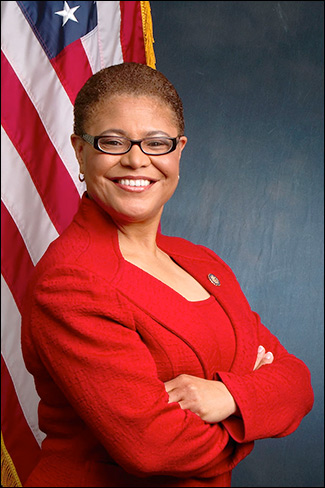
California Rep. Karen Bass (D-Los Angeles)

Sept. 29, 2021 — Reports were surfacing last week that California Rep. Karen Bass (D-Los Angeles), who had been on candidate Joe Biden’s short list for the vice presidential nomination, was deciding whether to eschew re-election next year for a chance to run for LA mayor. Now, she has made the decision. On Monday, Rep. Bass formally entered the citywide race.

The mayor’s election likely will be semi-open. Mayor Eric Garcetti (D) has been nominated as US ambassador to India, and upon obtaining his Senate confirmation, the City Council will be empowered to appoint an interim mayor. That individual will have the opportunity of then seeking a full four-year term during the regular election cycle. Certainly, Rep. Bass could be a potential appointee. Should Mayor Garcetti not receive a timely confirmation as ambassador, he would be ineligible to seek a third term, so in any event, the mayor’s contest will be highly competitive.

From a federal perspective, Bass running for mayor means her 37th Congressional District will be open. Of the 18 congressional districts that are wholly or partially contained within Los Angeles County, 17 of them need a population influx. With California losing a seat, it appears that the Los Angeles area will absorb the reduction.

Since Rep. Bass is the first Golden State House member to announce that he or she won’t seek re-election, her 37th District that needs 38,173 people to meet the state’s CD population quota of 760,350 people for the new 52 district map – a west Los Angeles County seat centered around the Culver City community – now becomes a prime target for elimination.

In the mayor’s race, Bass will at least face Los Angeles City Council President Pro Tempore Joe Buscaino, LA City councilman and former state Senate president and ex-US Senate candidate Kevin de Leon, and LA City Attorney Mike Feuer. It is likely others will enter the race once the political situation surrounding Mayor Garcetti is defined, and the congressional and legislative redistricting picture becomes clearer.

Redistricting Update

Several states are making progress in drawing new congressional maps. Colorado will send a final plan to the state Supreme Court as early as today. Indiana and Maine are close to finalizing maps that will strengthen both states’ political divisions, 7R-2D in the Hoosier State, and 2D-0R in the latter.

Oregon is also moving toward completion of a map that may prove a reach for the Democratic majority. Gaining a sixth seat in national reapportionment, the Democrats are trying to craft a 5D-1R map. Though Republicans have a significant base in the state, the Democrats maintain a tight grip on the statewide races thanks to dominant Portland, which serves as the lynchpin to their Beaver State political success.

Therefore, though the Dems have a clear edge in five of the new CDs, the early partisan analysis figures suggest that the Republicans would have at least an outside chance of prevailing in one of the districts, most likely that of Rep. Kurt Schrader (D-Canby/Salem), and possibly in the new 6th District open seat. More will be known when in depth political data is available and candidates begin to come forward.

The Texas Republican Senate’s congressional map was unveiled yesterday. As predicted, the GOP map drawers used the state’s two new seats as somewhat of a buffer, at least in the Austin area, to strengthen districts that were showing weakness. Should this map be enacted, Reps. Chip Roy (R-Austin), Michael McCaul (R-Austin), John Carter (R-Round Rock), and Roger Williams (R-Austin) all receive much stronger Republican seats. In exchange, one of the new seats goes to Travis County and will await a new Democratic inhabitant.

The other new seat appears destined for Harris County. There, sophomore Rep. Lizzie Pannill Fletcher (D-Houston) moves from a political marginal district to a rock solid Harris-Ft. Bend County Democratic District. This allows the second new seat to fall to a Republican and be fully contained within Harris County. In the northern part of the region, Rep. Dan Crenshaw (R-Houston) receives a substantially better district, and assumes part of Republican Montgomery County.

In the Dallas-Ft. Worth Metroplex, the region doesn’t get a new district, but a reconfiguration allows all incumbents, both Republicans and Democrats, to improve upon their present internal political standing.

This Texas map is a long way from enactment. The state House Democrats are unified to vote against any Republican map, and while the GOP has the strength to pass what they want in the Senate, the state House is a different story. It is likely we will see the current 30-day special session end in deadlock, with another 30-day session to follow. The Democratic strategy is to force the redistricting process to court, while the Republicans will attempt to pass a series of maps into law. Expect this story to be with us for many weeks to come.

First Indiana Map Published

Indiana Congressional Districts Draft Map (click on map to see larger file size details)

By Jim Ellis

Sept. 17, 2021 — The Indiana House Republican majority caucus released the state’s first 2021 congressional redistricting map, and it appears to strengthen the party’s 7-2 grip on the Hoosier State federal delegation.

Political data is not readily accessible, but the geographic outline and reaction from at least one former Democratic congressional candidate suggests the biggest change comes in the state’s 5th District. IN-5 is the geographically central seat that had been trending away from being the safe Republican CD we saw during the previous decade’s early period.

Former state representative and 2016 lieutenant governor nominee Christina Hale (D), who lost to freshman Rep. Victoria Spartz (R-Noblesville) by a relatively close open seat 50-46 percent count last November, claims the House Republicans “kneecapped” any Democrat wanting to run in this district for the foreseeable future.

Though the official political data is not available, the Daily Kos Elections team calculated that former President Trump would have carried this new version of the 5th District with a 57-41 percent margin. His victory totals in the present 5th from 2020 and 2016 were 50-48 and 53-41 percent, respectively.

The current 5th District encompasses all or part of eight central Indiana counties including just over 180,000 people from Marion County in the northern Indianapolis suburbs. These are the precincts making the 5th more competitive as they now lean Democratic.

The proposed CD-5, and this released map, are a long way from being adopted through the legislative process; it would see a jettisoning of all of its Marion County population. Instead, the new district would occupy five whole counties north of Indianapolis and the Marion County line in addition to annexing almost all of Howard County.

The district coming into Marion County to replace the residents shed from the 5th is Rep. Greg Pence’s (R-Columbus) 6th District. Instead of moving in a north south direction along the Ohio border as is the current configuration, the proposed IN-6 would move from the Ohio border and enjoin counties to the west all the way into Marion County. The 6th, however, would assume the necessary Marion County population in the southern portion of the Indianapolis metropolitan area instead of the northern territory.

Continue reading

Census by District

By Jim Ellis

Aug. 17, 2021 — We can now see exactly where each congressional district in the country stands in terms of population. The Census Bureau delivered the state redistricting data last week, and the Daily Kos Elections site data team segmented the numbers into individual congressional districts.

Below is a chart of the 38 states that have more than two districts, isolating the CDs that are the most over and under populated. The “High” column depicts the district that is the most over-populated in the state, while the “Low” is the one requiring the most new residents. The “+/-” column shows how many districts in the particular state are over and under populated.

The most robust district is that of Texas freshman Rep. Troy Nehls (R-Richmond). His southwest Houston seat houses just under one million people, at an exact count of 972,309. The least populated seat is West Virginia’s 3rd District (Rep. Carol Miller-R): 326,267 people under quota. With all of the Mountain State seats seriously down, it is clear as to why West Virginia lost a seat in reapportionment.

There are only two states, Colorado and Oregon, where all of the current districts are over-populated. Both entities gain one seat in reapportionment. On the other end of the spectrum, Michigan and Pennsylvania saw all districts falling below their new population quota, and in Illinois, 17 of their current 18 do as well. All three states are losing a district.

It is not surprising that California lost a seat for the first time in history. A total of 35 of their current 53 seats require more population versus 18 that must shed residents. New York barely lost a seat, by just 89 people statewide, which is surprising when seeing 23 of their current 27 districts requiring additional population.

The states are now converting their new data into their redistricting software systems. After that, most will hold hearings for public input prior to district construction beginning.

STATE DIST INCUMBENT HIGH LOW +/-
Alabama 5 Mo Brooks (R) 43,348 4, 3
7 Terri Swell (D) -53,143
Arizona 5 Andy Biggs (R) 86,414 3, 6
2 Ann Kirkpatrick (D) -50,133
Arkansas 3 Steve Womack (R) 86,266 2, 2
4 Bruce Westerman (R) -66,283
California 45 Katie Porter (D) 53,645 18, 35
-1 40 Lucille Roybal-Allard (D) -70,139
Colorado 4 Ken Buck (R) 148,823 7, 0
+1 3 Lauren Boebert (R) 36,543
Connecticut 4 Jim Himes (D) 25,627 2, 3
2 Joe Courtney (D) -21,288
Florida 9 Darren Soto (D) 186,381 21, 6
+1 13 Charlie Crist (D) -41,756
Georgia 7 Carolyn Bourdeaux (D) 94,304 8, 6
2 Sanford Bishop (D) -92,108
Illinois 7 Danny Davis (D) 10,986 1, 17
-1 17 Cheri Bustos (D) -79,907
Indiana 5 Victoria Spartz (R) 50,921 5, 4
8 Larry Bucshon (R) -38,579
Iowa 3 Cindy Axne (D) 61,382 1, 3
4 Randy Feenstra (R) -31,730
Kansas 3 Sharice Davids (D) 57,816 1, 3
1 Tracey Mann (R) -33,697
Kentucky 6 Andy Barr (R) 33,300 4, 2
5 Hal Rogers (R) -57,592
Louisiana 6 Garret Graves (R) 40,173 3, 3
4 Mike Johnson (R) -47,947
Maryland 4 Anthony Brown (D) 26,772 6, 2
7 Kweisi Mfume (D) -68,401
Massachusetts 7 Ayanna Pressley (D) 18,714 4, 5
1 Richard Neal (D) -50,635
Michigan 11 Haley Stevens (D) -17,368 0, 14
-1 5 Dan Kildee (D) -104,476
Minnesota 3 Dean Phillips (D) 24,586 5, 3
7 Michelle Fischbach (D) -39,978
Mississippi 4 Steven Palazzo (R) 37,196 3, 1
2 Bennie Thompson (D) -65,829
Missouri 3 Blaine Luetkemeyer (R) 35,121 6, 2
1 Cori Bush (D) -54,618
Nebraska 2 Don Bacon (R) 47,170 2, 1
3 Adrian Smith (R) -53,152
Nevada 3 Susie Lee (D) 79,374 2, 2
1 Dina Titus (D) -73,332
New Jerseyy 8 Albio Sires (D) 47,314 5, 7
2 Jeff Van Drew (R) -41,606
New Mexico 2 Yvette Harrell (R) 8,181 2, 1
1 Melanie Stansbury (D) -11,264
New York 12 Carolyn Maloney (D) 34,717 4, 23
-1 23 Tom Reed (R) -83,462
North Carolina 2 Deborah Ross (D) 165,703 12, 1
+1 1 G.K. Butterfield (D) -6,238
Ohio 3 Joyce Beatty (D) 23,119 2, 14
-1 6 Bill Johnson (R) -99,512
Oklahoma 1 Kevin Hern (R) 36,806 3, 2
2 Markwayne Mullin (R) -69,793
Oregon 1 Suzanne Bonamici (D) 157,843 5, 0
+1 4 Peter DeFazio (D) 117,399
Pennsylvania 10 Scott Perry (R) -5,379 0, 18
-1 15 Glenn Thompson (R) -90,540
South Carolina 1 Nancy Mace (R) 87,689 3, 4
6 Jim Clyburn (D) -84,741
Tennessee 4 Scott DesJarlais (R) 62,976 5, 4
9 Steve Cohen (D) -77,122
Texas 22 Troy Nehls (R) 205,322 28, 8
+2 13 Ronny Jackson (R) -59,517
Utah 4 Burgess Owens (R) 65,265 1, 3
3 John Curtis (R) -31,190
Virginia 10 Jennifer Wexton (D) 100,750 6, 5
9 Morgan Griffith (R) -87,917
Washington 7 Pramila Jayapal (D) 28,862 6, 4
6 Derek Kilmer (D) -33,730
West Virginia 2 Alex Mooney (R) -275,777 0, 3
-1 3 Carol Miller (R) -326,627
Wisconsin 2 Mark Pocan (D) 52,678 2, 6
4 Gwen Moore (D) -41,320

More Redistricting Delays – Part I

By Jim Ellis

Feb. 17, 2021 — The Census Bureau announced just before the Presidents’ Day holiday break that there will be yet another long delay in transmitting the census data to the states. Without the new numbers, redistricting becomes unachievable.
The new target date is Sept. 30, postponed from their first postponement date of July 30. At this point, the postponed apportionment release date remains April 30, long after the statutory deadline of Jan. 1. Apportionment is the first critical step in the redistricting process since this informs the states how many congressional seats they will be awarded for the current decade.

The late September target (and there’s no guarantee even this date will be met) will make it difficult for many states to finish their redistricting on time, and could force the process into the courts if state legislatures are unable to convene or meet a legislative calendar in terms of allowing public input. Even now, at least several states will have to enact emergency legislation to change deadlines to avoid violating pre-existing legal redistricting deadlines.

The delays have already changed the political situation in New Jersey and Virginia. With both states having odd-numbered year state legislative elections, the two are always the first to receive their new census data. In both states, legislative elections will now proceed under the 2011 maps with previously enacted amendments. When the lines are eventually completed, it is possible that new elections, possibly for 2022, will be ordered in Virginia. New Jersey voters passed a referendum in November that allows redistricting to occur before the 2023 state legislative elections.

Another problem could be lawsuits filed against the eventual apportionment. Apparently, the principal problem for the delays is exactly which people to count and where they are placed. College students, for example, are typically counted at the university campus on which they reside. Now, however, so many are not attending in-person classes. Therefore, arguments are ongoing as to where this group should be counted, either at school or back at their primary residence.

Additionally, one of President Biden’s new executive orders reversed Trump Administration policies about whether or not to count non-citizens. This change of direction has also created further delays.

Based upon these controversies, and others, it is probable that at least one potential losing state – apparently Alabama is on the cusp of losing a seat but may not depending upon the counting criteria – could sue over the apportionment conclusion meaning even further delays as various potential lawsuits wind their way through the judicial process toward final determination. All of this could conceivably mean redistricting is postponed until the 2024 election cycle.

Continue reading

Early House Outlook – Part III

By Jim Ellis

Jan. 22, 2021 — Continuing with our electoral preview for the US House, today we look at 13 states in the country’s northeastern region. Monday, we conclude in the south.


• Connecticut – 5 Seats (5D)

With all of the Nutmeg State’s five congressional districts venturing past the 700,000 resident mark, each of Connecticut’s CDs appear secure after the state lost a seat in 2010 reapportionment. With Democrats holding the redistricting pen, expect only perfunctory changes in the congressional delegation map with each incumbent being awarded a safe seat. All were re-elected in 2021 within a vote percentage range between 56 and 65.


• Illinois – 18 Seats (13D5R)

Democrats have a big advantage in the Illinois delegation and, with the party leaders in control of the redistricting pen, their edge is positioned to expand. Despite the Republicans holding less than half of the number of Democratic seats comprising the delegation, it is one of the Dem’s members who is likely to be paired with another incumbent.

The state has actually lost population (approximately 250,000 residents) when compared with the 2010 census, meaning Illinois will certainly lose one CD with the outside possibility of dropping two. Since the major population loss is coming from the downstate area, the Democrat map drawers will have little trouble taking the seat from the Republicans and can justify such a draw based upon the region losing so many people. This, even though Rep. Cheri Bustos’ (D-Moline) seat has the lowest population figure in the state.

The Chicago area gives the Democrats some redistricting challenges, however. Three of their metro incumbents, Reps. Marie Newman (D-La Grange), Sean Casten (D-Downers Grove), and Lauren Underwood (D-Naperville) scored re-election percentages of 56.4, 52.8, and 50.7 respectively, meaning all three will be lobbying to add more Democrats to their districts. Their lower win percentages are a clue that the metro districts are already stretched to the maximum from a Democratic perspective, so it’s possible such an over-reach could have backfire potential.


• Indiana – 9 Seats (2D7R)

The nine Hoosier State seats also appear secure from a population standpoint, so Indiana looks to be a sure bet to retain all of its nine congressional districts. One seat to watch from a competitive perspective is that of freshman Rep. Victoria Spartz (R-Noblesville), who won an Indianapolis suburban CD in a tight 50-46 percent margin. Democrats will target her in 2022. All of the veteran incumbents seeking re-election broke the 61 percent mark. Freshman Democrat Frank Mrvan (D-Highland/Gary) succeeded retiring Rep. Peter Visclosky (D) with a 57-40 percent victory margin.


• Maine – 2 Seats (2D)

The Pine Tree State again holds two districts with smaller base population figures for the coming decade, one from the north and the other south. Democrats hold both and will control the redistricting pen but with only approximately 30,000 people needing to move from the southern 1st District (Rep. Chellie Pingree-D) to the northern 2nd (Rep. Jared Golden-D), the map will only change marginally. The 2nd CD is the more competitive seat of the two and will again be contested but the state’s Ranked Choice Voting system tends to give the Democrats an added advantage.


• Massachusetts – 9 Seats (9D)

The Bay State, home to one of the Democrats’ most loyal constituencies in the entire country, will retain its nine districts after dropping a seat in the 2010 reapportionment. All nine Democratic incumbents are safe and will continue to be so. The victory percentage range fell between 58-74 percent for the nine current Democratic incumbents, all but one of whom was running for re-election.


• Michigan – 14 Seats (7D7R)

Michigan redistricting will be different in 2021 with the introduction of a voter-passed redistricting commission. The citizen members will be tasked with reducing the 14-member delegation to 13, and Republicans will likely find themselves on the short end. Rep. John Moolenaar’s (R-Midland) 4th CD looks to be the most vulnerable. The districts in the northern part of the state all must gain population, and with Rep. Moolenaar’s seat being surrounded by the rest, his is the most likely to be split in pieces order to feed the others.

Reps. Elissa Slotkin (D-Holly/Lansing) and Haley Stevens (D-Rochester Hills), with respective 2020 win percentages of 50.9 and 50.2, will be in need of more Democrats that may not be forthcoming. Therefore, we could see a more competitive Michigan congressional delegation at least in the early part of the new decade.
Continue reading

Plethora of House Polls Released; All Tell Unique Stories

By Jim Ellis

Aug. 14, 2020 — In the past several days, 14 polls in 13 competitive House districts were publicly released, and they all tell a unique story. The synopsis is below (in alphabetical order):


CO-3:
• GQR Research – Mitsch Bush (D) 43%; Boebert (R) 42%

Greenberg Quinlan Rosner Research (Aug. 3-6; 400 likely CO-3 voters) went into the field to test Democratic candidate Diane Mitsch Bush versus Republican Lauren Boebert, who unseated Rep. Scott Tipton (R-Cortez) in the June Republican primary.

The result here is not particularly surprising considering that Boebert was a shocking upset winner in the GOP primary. Mitsch Bush has a huge cash advantage, but Republicans will likely rally around Boebert in a district where President Trump should comfortably win.


IL-13:
• RMG Research – Londrigan (D) 43%; Rep. Davis (R) 41%

After seeing the 2018 election between Rep. Rodney Davis (R-Taylorville) and challenger Betsy Dirksen Londrigan (D) evolve into a 50.3 – 49.6 percent result, the pair returns for Round 2. The RMG poll (July 27-Aug. 7; 400 likely IL-13 voters), though over a very long sampling period, finds what has been clear for some time, that the 2020 edition will yield another tight race.


IN-5:
• WPA Intelligence – Spartz (R) 47%; Hale (D) 40%

The new WPA Intelligence poll (Aug. 4-6; 400 likely IN-5 voters) produces the opposite result of a survey we saw from the GBAO research organization in late June (June 25-28; 500 likely IN-5 voters). The latter study projected Democratic former state representative and ex-lieutenant governor nominee Christina Hale topping Republican state Sen. Victoria Spartz, 51-45 percent.

According to the current WPA data, Sen. Spartz, a Ukrainian immigrant, now holds a 47-40 percent advantage. The latter numbers are more consistent with the district’s voting history. Incumbent Rep. Susan Brooks (R-Carmel) is retiring.


Continue reading

Moving to the General

By Jim Ellis

June 4, 2020 — The June 2nd primary featured 10 states, and now the candidates are set for November. Below is a recap of the races from Tuesday’s primary that project as competitive this fall, and an early prognosis for each.


IN-5:

• St. Sen Victoria Spartz (R) vs. Christina Hale (D)
Trump ’16: 53-41%    |   2018 Congressional: 57-43% R (Brooks)

Ukrainian born state Senator Victoria Spartz topped a field of 15 Republican candidates with 41% on Tuesday night, after a nasty primary that resulted in some of the other contenders running ads touting that they were born in America. Democrat Christina Hale, a former state Representative and 2016 Lt. Governor nominee, had an easier time in her primary, and won with 39% of the vote, which was slightly under pre-election estimates.

Ms. Spartz is the favorite to win in November in a traditionally Republican district, but one that is moving more toward the center. Democrats will see how this race begins to unfold, but this is a seat on their secondary target list. We can expect Spartz to be tested early, and if the numbers suggest an opening, the Democrats will go for an upset win.


IOWA-SENATE:

• Sen. Joni Ernst (R) vs. Theresa Greenfield (D)
Trump ’16: 51-42%    |    2016 US Senate: 60-36% R (Grassley)

Iowa is one of three Republican firewall states to keep the Senate majority, with Montana and Maine being the other two. Sen. Joni Ernst seeks her first re-election and is now paired with Des Moines real estate executive Theresa Greenfield. The Democratic establishment backed Greenfield, but she came under attack in the primary and defeated two opponents with 47% of the vote, a bit under pre-election projection.

All races in Iowa are competitive, so we can expect intense political competition here from the presidential race all the way through each of the state’s four House districts. Polling will show the Senate race as close until Election Day, but what should be another Trump victory here will help set the table for the remainder of the races. Sen. Ernst is rated as a slight favorite as the general election now officially begins.


IA-1:

• Rep. Abby Finkenauer (D) vs. St. Rep. Ashley Hinson (R)
Trump ’16: 49-45%     |     2018 Congressional: 50-45% D

Freshman Rep. Abby Finkenauer (D-Dubuque) defends her seat for the first time and faces a top opponent in Republican state Rep. Ashley Hinson (R-Cedar Rapids), a former television news anchor. The 1st District looked to be the safest Democratic seat in the state after 2011 redistricting, but the electorate hasn’t voted that way. This will be a top tier Republican challenge race, and one to watch. Rep. Finkenauer certainly begins with the incumbent’s advantage, but the IA-1 campaign is a top national GOP target. If the Republicans are to have any chance of re-taking the House majority, Ms. Hinson will have to win.


IA-2:

• Rita Hart (D) vs. St. Sen. Marianette Miller-Meeks (R)
Trump ’16: 49-45%     |     2018 Congressional: 54-42% D (Loebsack)

The 2nd District, located in Iowa’s southeastern sector, is the district that has played best for Democrats during the decade despite President Trump carrying it in 2016.

Democrats feature former state Senator and 2018 Lt. Governor nominee Rita Hart who was even unopposed in an open seat primary. Republicans counter with first-term state Senator Marianette Miller-Meeks (R-Ottumwa), who begins her fourth race for the congressional seat. Ms. Hart is the clear favorite here, and Dr. Miller-Meeks will have to prove her credibility nationally after three losses. If she does not begin the general election in competitive fashion, this race will quickly turn Ms. Hart’s way.
Continue reading

Rep. King (R) Falls in Iowa;
Mrvan, Fernandez Clinch Seats

By Jim Ellis

June 3, 2020 — Ten entities held primary elections yesterday, and among the voting results we saw a second US congressman being denied re-nomination, as well as two primary victors who have virtually secured their seats in the next Congress:


Former VP Joe Biden

• DISTRICT OF COLUMBIA: Former vice president Joe Biden easily won the DC primary last night in capturing 78 percent of the vote, which is a significant improvement over his last two performances in Oregon and Hawaii. Biden is now within shouting distance of officially clinching the Democratic nomination and will do so next week when six more states vote in their primary elections.


• IDAHO: 2018 gubernatorial nominee Paulette Jordan with her 86 percent Democratic primary win yesterday will challenge Sen. Jim Risch who seeks a third term. Sen. Risch is a clear favorite to win in November.

Both US Reps. Russ Fulcher (R-Meridian) and Mike Simpson (R-Idaho Falls) were easy winners for re-nomination scoring 80 and 72 percent victories, respectively, and each has minimal opposition in the general election.


• INDIANA: Biden recorded a solid 76 percent in his Hoosier State Democratic primary. Gov. Eric Holcomb (R) will square-off with Democratic former health commissioner Woody Myers in November as both men were unopposed in yesterday’s primary. Gov. Holcomb appears safe for re-election in the fall.

North Township Trustee Frank Mrvan, with retiring Rep. Peter Visclosky’s (D-Merrillville/Gary) endorsement, defeated Hammond Mayor Tom McDermott state Rep. Mara Candelaria Reardon (D-Lake County) in the open 1st Congressional District, and now becomes the prohibitive favorite to succeed Visclosky in the next Congress.

In the Indianapolis area’s 5th CD, state Sen. Victoria Spartz (R-Noblesville) scored an impressive victory over three Republican opponents to capture the party’s open seat congressional nomination. Spartz will now battle former state representative and 2016 lieutenant governor nominee Christina Hale (D) in the general election. Likewise, Hale defeated three Democratic opponents to win her nomination. The Ukrainian born Spartz is favored to succeed retiring Rep. Susan Brooks (R-Carmel) but the Democrats are expected to make a run at the seat.

Continue reading