Tag Archives: California

Rep. Porter Announces for Senate in California, Candidates Immediately Announce for Her Seat; Virginia State Races

By Jim Ellis — Wednesday, Jan. 11, 2023

Senate

California: Rep. Porter (D) Announces for Senate — California Rep. Katie Porter (D-Irvine) yesterday announced (see above video) that she will enter the 2024 US Senate campaign, apparently irrespective of what veteran Sen. Dianne Feinstein (D-CA) decides about her own political future.

Accompanying the Porter video announcement was a poll that the David Binder Research company conducted for the congresswoman’s campaign committee soon after the November election. The study tested a hypothetical general election battle between Reps. Porter and Adam Schiff. Also included in the poll were Reps. Barbara Lee and Ro Khanna (D-Fremont), the latter of whom has also discussed running for the Senate. No Republican alternative was listed.

The Binder survey (Nov. 19-21, 2022; 600 registered California voters; live interview & online) projected that Reps. Porter and Schiff would advance into the general election from the state’s top two jungle primary system. Between Porter and Schiff, the electorate would break 37-26 percent in Porter’s favor with Republicans backing the Orange County congresswoman at a 25-5 percent clip. This is largely due to Schiff’s strong negative ratings among Republicans, likely over his prominent role in the Trump impeachment process.

House

CA-47: Candidates Declare for New Open Seat — We also saw quick action in what will be an open 47th Congressional District now that Porter is an announced Senate candidate. Former California state Rep. Scott Baugh immediately declared that he would run again, as did former Congressman Harley Rouda (D). The latter man was elected to the House in 2018 from the former 48th District, approximately 59 percent of which now lies in Porter’s new 47th. In 2020, Rouda lost his re-election to current 45th District US Rep. Michelle Steel (R-Orange County).

The CA-47 seat now becomes the second district to already open for the 2024 election cycle. Earlier, Rep. Alex Mooney (R-WV) announced that he will challenge Sen. Joe Manchin (D) next year, thus opening in northern West Virginia 2nd Congressional District for the next election.

States

Virginia Senate: Democrats Capture Vacant Seat — Though Republican state Sen. Jen Kiggans (R-Virginia Beach) defeated US Rep. Elaine Luria (D-Norfolk) in the November election, Tidewater Democrats rebounded last night with a tight win to convert her vacated Senate seat. Democrat Aaron Rouse captured a close 50.4 – 49.5 percent win over Republican Kevin Adams to expand the Dems’ Senate advantage to 22-18.

In 2020, President Biden carried this state Senate district with a 54-44 percent margin, but GOP Gov. Glenn Youngkin won the seat 52-48 percent in the 2021 gubernatorial election. Therefore, the 7th Senatorial District is clearly politically marginal in nature.

Virginia House: Each Party Wins One Special Delegate Election — In two House of Delegates special elections, each party held a risked vacancy in landslide proportions. In the 24th District where Delegate Ronnie Campbell (R-Rockbridge) passed away in December, the deceased incumbent’s wife, Ellen Campbell, easily succeeded her late husband with a 66-34 percent victory.

In Fairfax County’s 35th House of Delegates district, Democrat Holly Seibold recorded a 67-33 percent win to keep the seat in the Democratic column. She will replace Del. Mark Keam (D) who resigned to accept a position in the Biden Administration. The pair of victories now yield 52 Republicans and 48 Democrats in the state House.
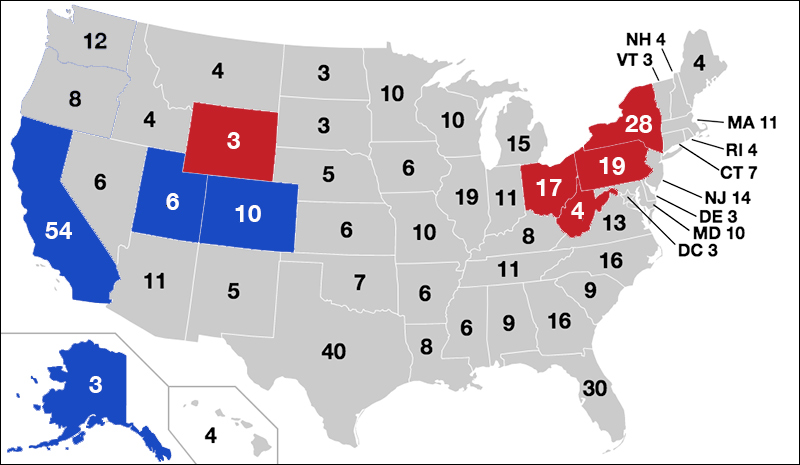
Electoral College — Left Coast, Right Coast; Republicans Choose Nominee in VA-4; North Carolina Supreme Court Rejects Map

Electoral College Votes Per State, 2022 — blue moving more left, red moving more right


By Jim Ellis — Tuesday, Dec. 20, 2022

President

Electoral College: West Moving Left, East Moving Right — The researchers at the University of Virginia’s Center for Politics have completed a study regarding the country’s ideological shift during the past 20-plus years. Tracking all 50 states’ presidential votes from the 2000-2020 elections, we first see all of the western states now voting Democratic in greater percentages with the exception of Wyoming. The biggest shifts came in Alaska, California, Colorado, and Utah, though two of those four states still regularly produce at least smaller majority or plurality Republican victories.

Conversely, the south and east have trended more Republican with the strongest swings generally occurring in central south with only Maryland, Rhode Island, Vermont, and Virginia becoming more Democratic. Mid-Atlantic states such as New York, Ohio, Pennsylvania, and West Virginia have moved decidedly more Republican, though two of these four continue to regularly deliver clear Democratic majorities. Remaining constant in their voting pattern during this entire 20-year span are Illinois, Maine, Massachusetts, Minnesota, and South Carolina.

House

VA-4: Republicans Choose Special Election Nominee — Republicans re-nominated their 2020 and 2022 candidate in the Saturday, Dec. 17 “firehouse primary” through Ranked Choice Voting. The local 4th District Republican Party leadership did not release the actual results, only to say that pastor and US Navy veteran Leon Benjamin had defeated former Mecklenburg School Board member Dale Sturdifen, and non-profit advocacy organization director Derrick Hollie. Benjamin now advances to the Feb. 21 special general election to replace the late Rep. Donald McEachin (D-Richmond). He will again be a decided underdog in a district that the FiveThirtyEight data organization rates D+30.

The Democratic firehouse primary will be held today. Four candidates filed to run: state Sens. Jennifer McClellan (D-Richmond) and Joseph Morrisey (D-Richmond), former state Delegate Joseph Preston, and businessman Tavorise Marks. While the special election will be held in late February, Gov. Glenn Younkin’s (R) call required the parties to choose nominees by Dec. 23.

In another development, Colette McEachin, the late congressman’s widow, announced her endorsement of Sen. McClellan, joining most of the Virginia Democratic establishment who has already done so.

States

North Carolina: NC Supreme Court Tosses State Senate Map — The North Carolina state Supreme Court, with the 4-3 Democratic majority on the cusp of expiring, rejected the NC Senate map on a partisan vote as a partisan gerrymander. But, the action is likely to be short-lived and adds fuel to the speculation that the new legislature will re-draw all of the state’s redistricting maps after commencement. Doing so may well render moot the partisan gerrymandering case that the US Supreme Court recently heard.

Under North Carolina legislative procedure, the governor has no veto power over redistricting legislation, so whatever the legislature passes will become law. Because of the current court’s farewell action, the state Senate map must be re-configured. Since Republicans gained two seats on the state Supreme Court in the November election and will have a 5-2 majority beginning in January, the likelihood of not only the Senate map being redrawn but also the state House and congressional delegation plans is greater. The latter two maps are court-drawn interim placeholders, which the legislature can replace at any time.

Sen. Sinema Officially Becomes an Independent; Rep. Khanna Considers Senate Race; Automatic Recount Beginning in Rep. Boebert’s CO-3

By Jim Ellis — Monday, Dec. 12, 2022

Senate

Sen. Kyrsten Sinema (I-AZ)

Arizona: Sen. Sinema Officially Becomes an Independent — Sen. Kyrsten Sinema on Friday announced that she is leaving the party and will represent Arizona as an Independent. As her standing before the Democratic Party electorate is poor, this move seems to clearly indicate that she is preparing for a re-election campaign. According to job approval ratings that were taken from polls conducted well before the November election, Sen. Sinema’s numbers had dropped to the point where she would be a severe underdog in a Democratic primary against her likely intra-party opponent, US Rep. Ruben Gallego (D-Phoenix). In a three-way race against Gallego and a Republican nominee, however, her re-election chances significantly improve.

Little will change in terms of her voting record, but the campaign strategy completely transforms for all involved. Not having to worry about re-nomination, Sen. Sinema will advance directly into the general election assuming she can obtain valid registered voter petition signatures from 45,000 Arizonans. She can begin signature gathering right away, so even this large number should be attainable over such a long duration.

Rep. Gallego, who had been rumored as a Sinema Democratic primary challenger, continues to move forward with his Senate plans. While admittedly convening a Senate planning group, the congressman says he will not formally decide about running until after the first of the year. Republican Pinal County Sheriff Mark Lamb also confirms he is considering entering the Senate GOP primary.

Regardless of who decides to run, the 2024 Arizona Senate race will be another contest attracting huge national attention. Sen. Sinema’s move to the Independent ballot line certainly increases her chances of winning, but she is certainly no lock to claim a second term in the next election.

California: Rep. Khanna Considers Senate Race — California Rep. Ro Khanna (D-Fremont), who was just elected to a fourth term in the House, said over the weekend that he would consider running for the Senate in 2024 if incumbent Sen. Dianne Feinstein (D), who will be 91 years of age at the time of the next election, decides to retire as expected.

Rep. Khanna further said he would more than likely seek re-election in 2024, but the door is clearly open to him exploring a senatorial run in what is expected to be a crowded Democratic battle should the seat open. The congressman has been a strong fundraiser, averaging a total receipts figure of over $4 million per election cycle for his four successful congressional campaigns along with $5-plus million remaining in his federal account, so he would have the financial base to begin a statewide run.

House

CO-3: Automatic Recount Beginning — The recount for the close CO-3 congressional race featuring Rep. Lauren Boebert (R-Silt) and Democratic former Aspen City Councilman Adam Frisch is close to completion in the district that covers Colorado’s Western Slope region. Though Frisch has already conceded the race to Rep. Boebert, the recount is taking place under the state’s election law that mandates a re-tabulation for any contest that falls within a margin of just one-half a percent.

Though Rep. Boebert’s 548-vote lead from 327,124 ballots cast is expected to stand, the 27 involved counties that comprise the 3rd District must continue the recount. Frisch says he is likely to run again in 2024. The recount process must be completed by tomorrow so the election certification process can be completed.

VA-4: Special Election Candidates Beginning to Come Forward — While Gov. Glenn Youngkin (R) has yet to call a special congressional election to replace the late Rep. Donald McEachin (D-Richmond) who passed away in late November, several individuals have come forward to announce their candidacies.

The first is state Delegate Lamont Bagby (D-Richmond), who has been a long-time supporter and confidant of Rep. McEachin’s. State Sen. Jennifer McCellan (D-Richmond), who placed third in the 2021 Democratic gubernatorial primary, also says she will enter the special congressional election. Before winning her state Senate seat in 2017, McClellan served six terms in the state House of Delegates.

For the Republicans, who have little chance in a 4th District that the FiveThirtyEight data organization rates as D+30, their two-time nominee and Christian pastor Leon Benjamin says he will enter the special election field.

Virginia’s 4th Congressional District begins in Richmond and then travels south all the way to the North Carolina border. The CD includes the cities of Richmond, Petersburg, and Emporia, along with the Colonial Heights, Chester, and Lawrenceville communities.

Indiana Gov. Holcomb Leaves Door Open for Senate Bid, Sen. Braun Up in Released Gov Poll; CA-22 Re-Match Already Building; NC Redistricting Case Could be Moot

By Jim Ellis — Thursday, Dec. 8, 2022

Senate

Indiana Gov. Eric Holcomb (R)

Indiana: Gov. Holcomb Leaves Door Open — Early political reports coming from the Hoosier State suggest that Gov. Eric Holcomb (R) will not pursue a 2024 US Senate bid when his tenure as governor comes to an end. Gov. Holcomb is ineligible to seek a third term.

When asked about running for the Senate this week on wishtv.com, however, Gov. Holcomb replied, “there’ll be time for me to think about the future in the future. But it would be next to irresponsible for me to take my eye off the job that I’ve got.”

This response suggests the Senate race door is not fully closed and will certainly remain an option for Holcomb as time moves forward. With universal statewide name identification and the ability to quickly raise large amounts money, Gov. Holcomb has the luxury of waiting to make a decision until he sees how an open Senate field develops. First-term Sen. Mike Braun (R) is a clearly preparing a run for governor, thus leaving his Senate seat open.

House

CA-22: Re-Match Already Building — California Rep. David Valadao (R-Hanford) is tied for representing the most Democratic seat in the country that sends a Republican to the US House. Long Island Rep-Elect Anthony D’Esposito (R-Hempstead) holds the other. The FiveThirtyEight data organization rates both Valadao’s CA-22 and Mr. D’Esposito’s NY-4 at D+10.

Despite the odds stacked against him, Rep. Valadao was able to post a 51.5 – 48.5 percent victory over state Assemblyman Rudy Salas (D-Bakersfield) in November, who was arguably the most difficult opponent Valadao faced in his five winning electoral campaigns. Yesterday, Salas, who risked his Assembly seat to run for Congress, filed a committee to seek a re-match in 2024. If he ultimately follows through and runs two years from now, this race will again become a top national Democratic conversion target.

Governor

Indiana: Sen. Braun Releases Gov Poll — Sen. Mike Braun (R) is clearly moving toward making a quick gubernatorial announcement after filing a state gubernatorial campaign committee last week. Reports suggest that Sen. Braun may make his formal declaration as early as next week. In preparation for launching a gubernatorial bid, he just released the results of an internal poll.

The study, from the Mark It Red research group (Nov. 18-22; sample size not released), finds Sen. Braun opening with a large Republican primary advantage in what will be an open race for governor. According to the survey results, Sen. Braun would lead Lt. Gov. Suzanne Crouch and venture capitalist Eric Doden, 47-10-5 percent, respectively.

States

North Carolina: Redistricting Case Could be Moot — The North Carolina partisan gerrymandering case that was heard before the US Supreme Court yesterday is a potential landmark case, but some North Carolina state political sources suggest the arguments may go by the proverbial wayside. The high court will rule before the end of June, but before that occurs, the new North Carolina legislature may draft new redistricting plans for the US House, state Senate, and state House of Representatives. Since a court map is only an interim plan, the legislature can replace it with a permanent draw at any time.

If this occurs as described, and new maps are enacted –- remember, in North Carolina, the governor has no veto power over redistricting legislation -– it is possible that the action could render the case before the Supreme Court as moot. If so, the issue of whether the Constitution views state legislatures as solely independent when handling redistricting could well go unanswered.

Murkowski Re-Elected, Peltola Wins Full Term in Alaska; CA-13 is The Last Outstanding Race to be Called

By Jim Ellis — Tuesday, Nov. 29, 2022

Senate

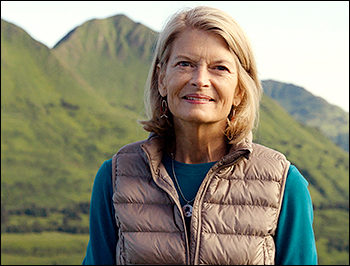
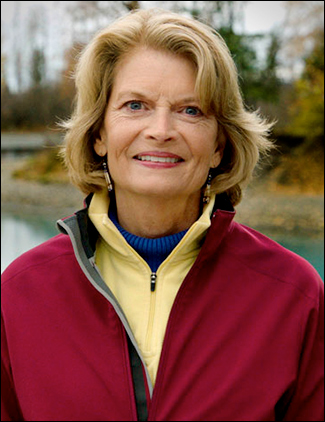
Alaska Sen. Lisa Murkowski (R)

Alaska: Sen. Murkowski Re-Elected — Over the Thanksgiving break, we saw several more races called. The complete results came in Alaska where the final tabulations, including the Ranked Choice Voting (RCV) rounds, were released and contests decided.

As expected, Sen. Lisa Murkowski (R) was re-elected after nipping former State Administration Director Kelly Tshibaka (R), 43.4 – 42.6 percent in the aggregate vote, a margin of 1,914 votes. In the first RCV round, with fourth place finisher Buzz Kelley’s (R) votes being distributed, the race became even tighter, with Sen. Murkowski’s lead reduced to only 44.5 – 44.3 percent, a spread of just 339 votes. 

The final result was easily predictable, and one could argue Sen. Murkowski really won her re-election when people voted to change the state’s election system in 2020. Initiated with support from the senator’s political organization, the hybrid jungle primary/Ranked Choice Voting system allowed Sen. Murkowski to skip what was her most vulnerable election, a partisan Republican primary. With four people now automatically advancing into the general election, the partisan nomination phase within the traditional election cycle was in effect eliminated. In 2010, Sen. Murkowski lost the Republican primary, but was re-elected when she won a write-in Independent campaign in that year’s general election.

House

AK-AL: Rep. Peltola Wins Full Term — After winning the August special election through the Ranked Choice Voting system to replace the late Alaska Rep. Don Young (R), at-large Rep. Mary Peltola (D-Bethel) has now clinched a full term after the state’s preliminary final vote count was released the day before Thanksgiving. The end result was predictable, especially when Rep. Peltola easily placed first in the aggregate count, with a 49-26-23 percent margin over former Gov. Sarah Palin (R) and businessman Nick Begich III (R).

The first round of Ranked Choice Voting, which eliminated distant fourth-place finisher Chris Bye (Libertarian), almost put Peltola over the top. In this round, against both Palin and Begich, Rep. Peltola scored 49.2 percent of the adjusted vote. This result meant eliminating Begich, who was the third-place finisher. The third RCV round easily went to Rep. Peltola, who defeated Palin on a 55-45 percent tabulation. The Peltola victory increases the House Democratic Conference to 213 members as compared to the Republicans’ 221 with one California race remaining outstanding.

CA-13: The Last One Outstanding — We now have 434 US House races projected and the final partisan division count comes down to the end result from California’s new 13th Congressional District in the Fresno area. This post-election period could go on for some time.

The aggregate count, with a projected 96 percent of the votes recorded, although these estimates have not proven particularly reliable throughout the California counting process, gives Republican agri-businessman John Duarte a 593-vote lead over state Assemblyman Adam Gray (D-Merced). The county with the largest outstanding vote at a 90 percent estimated recorded figure, is Stanislaus, which slightly favors Gray.

Depending upon this last outcome, the Republican House majority will be either 221-214 or 222-213. Another Speaker vote for California Republican Kevin McCarthy could also be critical in relation to how that internal race unfolds on Jan. 3.

We can expect further days before a preliminary count is revealed, and it is likely we will see a long period of vote challenges from both sides prior to final certification of a winner. The California election certification deadline is Dec. 16.

Governor

Alaska: Gov. Dunleavy Re-Elected Outright — One race that did not need a Ranked Choice Voting round was the Alaska governor’s contest. Incumbent Gov. Mike Dunleavy (R) won a second term in the aggregate count, scoring 50.3 percent of the vote against three other candidates.

In a distant second place was Democratic former state representative Les Gara who posted 24.2 percent of the vote, while former Gov. Bill Walker, again running as an Independent, followed. The latter man recorded 20.7 percent of the aggregate popular vote. In the final general election qualifying position was Republican former Kenai Borough Peninsula Mayor Charlie Pierce who managed to secure only 4.5 percent of the vote.

Gov. Dunleavy, who faced an aborted recall effort early in his tenure, is the first re-elected Alaska chief executive since Democratic Gov. Tony Knowles won a second term in 1998.

Warnock Leads in New Runoff Poll; WVa. Gov. Considers Senate Race;
Kiley Wins CA-3 – Republican Majority Now at 221; Questions Over McCarthy’s Leadership

By Jim Ellis — Monday, Nov. 28, 2022

Senate

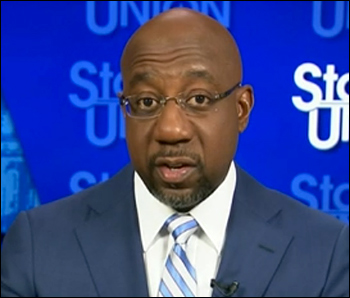
Georgia freshman Sen. Raphael Warnock (D)

Georgia: Sen. Warnock Leads in New Poll — The Fabrizio Lee (R) and Impact Research (D) polling team conducted another survey for the AARP organization, this time of the Georgia Senate runoff election scheduled for Dec. 6.

According to the joint poll (Nov. 11-17; 500 likely Georgia runoff voters; live interview), the first published study of this race since the general election yielded a 49.4 – 48.5 percent result for Sen. Raphael Warnock (D) over retired professional football player Herschel Walker (R), the incumbent again posts a small advantage. The AARP ballot test finds Sen. Warnock’s lead a reaching 51-47 percent. As is the case with all runoff elections, voter turnout will likely be the determining factor.

West Virginia: Gov. Justice Considering Senate Race — While Rep. Alex Mooney (R-Charles Town) has already announced his bid to challenge Sen. Joe Manchin (D) next year, Gov. Jim Justice (R), who is ineligible to seek re-election in 2024, indicated last week that he, too, is considering launching a Senate campaign.

Gov. Justice’s approval numbers are high – rated as the sixth most popular governor nationally at 65:29 percent favorable to unfavorable according to the Morning Consult quarterly ratings for the period ending Sept. 30, 2022 – so he would certainly be a formidable candidate for the Republican nomination and against Sen. Manchin. A Triton Polling & Research organization August poll found Gov. Justice leading Sen. Manchin 47-32 percent in an early hypothetical race survey, for example.

House

CA-3: Republican Kevin Kiley Declared Winner — The Associated Press, in a race that appeared to be clinched days ago, finally projected California Republican state Assemblyman Kevin Kiley (R-Granite Bay/Sacramento) as the winner of the newly created open 3rd Congressional District that stretches from the northern Sacramento suburbs all the way into southern California via the Nevada border. The FiveThirtyEight data organization rates CA-3 as an R+8 district, so the outcome of Kiley defeating Democratic physician and Iraq War veteran Kermit Jones is hardly a surprise result.

The Kiley victory brings the Republican House total to 221 with two races outstanding, the CA-13 seat that is a close contest between agri-businessman John Duarte (R) and state Assemblyman Adam Gray (D-Merced), and the at-large Alaska seat of Rep. Mary Peltola (D-Bethel).

Once the Alaska contest advances into the Ranked Choice Voting rounds, which began right after Thanksgiving, the system will produce another victory for Peltola. Therefore, count her in the Democratic column. The race between Duarte and Gray is very tight: Duarte has an 852-vote lead with an estimated 93 percent of the vote counted. Therefore, this contest can still go either way when examining from where the outstanding votes lay.

Speakership: More Republicans Express Negative Views Toward McCarthy — Last week we covered a story indicating that three Republicans were headed toward a “No” vote for House Minority Leader Kevin McCarthy (R-CA) in his quest to become Speaker of the House. Reps. Andy Biggs (R-AZ) and Matt Gaetz (R-FL) publicly announced their opposition to McCarthy, while Rep. Matt Rosendale (R-MT) said he does not believe McCarthy would be a successful Speaker.

Now joining the “No” chorus are Reps. Ralph Norman (R-SC) and Bob Good (R-VA). Texas Rep. Chip Roy (R-Austin) was among those expressing similar feelings of failure regarding a McCarthy Speakership. With the Republicans having a 222-member conference at best (if John Duarte holds his lead in the CA-13 outstanding race), McCarthy has little margin with which to play in order to secure his 218 votes to be elected Speaker during the Jan. 3 initial roll call of members.

Schiff Explores Senate Race; Valadao Re-Elected; House Candidate Filings

By Jim Ellis — Nov. 23, 2022

Senate

California Rep. Adam Schiff (D-Burbank)

California: Rep. Schiff Exploring Senate Race — With most people believing that Sen. Dianne Feinstein (D) will not seek re-election in 2024 when she will be 91 years of age, Southern California Rep. Adam Schiff (D-Burbank) said that he is considering launching a US Senate exploratory committee. Schiff is already in a battle to keep his seat on the Intelligence Committee after Rep. Kevin McCarthy (R-CA) — should he be elected Speaker — said that Schiff and Rep. Eric Swalwell (D-CA) would be removed from the panel.

Should Sen. Feinstein retire, we will see a strong Democratic battle to replace her. In California’s jungle primary system, it is likely that two Democrats would advance into the general election. One thing is certain: Rep. Schiff would be able to raise the money to compete. In his bid for re-election to the House in the current cycle, he raised more than $22 million.

House

CA-22: Rep. David Valadao Wins Re-election — The Associated Press, late Monday afternoon Pacific time, projected that Rep. David Valadao (R-Hanford) had defeated state Assemblyman Rudy Salas (D-Bakersfield) in their hard-fought congressional race. This, despite Rep. Valadao finishing a distant second on the jungle primary back in June when he received only 26 percent of the vote versus Salas’ 45 percent in a field of four candidates in the most Democratic congressional district in the country that elects a Republican to the House.

According to the California Secretary of State’s official count, Valadao held a 3,381 vote lead with just over 100,000 votes counted. Based upon the number of outstanding ballots and where they are from, the AP made the unofficial projection. The Valadao victory gives the Republicans 220 members in the new Congress as compared to 212 Democrats. Three races, two in California and one in Alaska, remain uncalled. Republicans lead in both Golden State races, Democrats in the Last Frontier.

NC-13: Hines Files 2024 Committee — The court-drawn North Carolina congressional map featured a new 13th District that contained the southern Raleigh suburbs, the city of Fayetteville, and Republican Johnston County, which made the CD a toss-up seat. Democratic state Sen. Wiley Nickel carried the district with a 52-48 percent margin, defeating Republican Bo Hines, who received the Trump endorsement in the GOP primary.

Hines, 27, was a former football player for North Carolina State University, but had no other particular ties to the region and actually planned to run in another district before this open seat was drawn. He filed a new 2024 committee on Monday, presumably sending signals that he intends to run again.

Hines did not receive particularly favorable marks as a candidate, and there is a good chance we will see a new North Carolina map drawn after the Supreme Court rules on the state’s partisan gerrymandering case before them. Even if Hines decides to run, he can expect heavy competition in the Republican primary before getting another opportunity of opposing Rep-Elect Nickel.

WV-2: State Treasurer Announces for House — Rep. Alex Mooney (R-Charles Town) already announcing that he will challenge Sen. Joe Manchin (D) in the next election year has ignited the first of what promises to be political musical chairs for what will be an open 2nd Congressional District. State Treasurer Riley Moore (R) announced his congressional candidacy Monday and is the first major candidate to enter the 2024 race. Rep. Mooney’s successor will likely be decided in the Republican primary in a seat that the FiveThirtyEight data organization rates as R+34.

Murkowski Takes Lead; Manchin Opponent Announces; Each Party Gains Seat in House

By Jim Ellis — Monday, Nov. 21, 2022

Senate

Alaska incumbent Sen. Lisa Murkowski (R)

Alaska: Murkowski Takes Lead — The Alaska ballot count slowly continues, and now with 87 percent of the projected vote recorded Sen. Lisa Murkowski (R) has assumed the aggregate vote lead over Republican challenger Kelly Tshibaka. According to this latest tabulation, Sen. Murkowski now has a 1,658-vote edge over Tshibaka.

The aggregate count, however, won’t likely end this election. Since the leading candidate will almost assuredly finish under the 50 percent majority mark – Sen. Murkowski now has 43.3 percent – we will then see the contest falling into the Ranked Choice Voting system. This, too, should favor Sen. Murkowski. Though Tshibaka is likely to receive more second-choice votes from the first eliminated conservative Republican candidate who has already endorsed her, Sen. Murkowski will receive many more from the second eliminated candidate, sure to be Democrat Pat Chesbro. At the end of this very long counting process expect Sen. Murkowski to be re-elected.

West Virginia: First Senate Announcement — West Virginia Rep. Alex Mooney (R-Charles Town) last week announced that he will challenge Sen. Joe Manchin (D) in the 2024 Senate race. He is the first such individual to announce for the next Senate election cycle in any state. In the 2022 election cycle, Mooney was paired with Rep. David McKinley (R-Wheeling) because West Virginia lost one of its three congressional seats in national reapportionment. In a tough Republican primary campaign, Rep. Mooney defeated Rep. McKinley, 54-36 percent, and went onto win the general election with 65 percent of the vote.

Back in August, Triton Research ran early ballot test questions pairing Sen. Manchin with several potential Republican challengers, including Rep. Mooney. In that pairing, Mooney led the senator 45-38 percent. Another potential Manchin opponent, Attorney General Patrick Morrisey (R) who challenged him in 2008, indicates he is considering another Senate bid but said he is also looking at what will be an open governor’s race, a potential bid for what will now be Rep. Mooney’s open congressional seat, or simply to seek re-election to his current position.

House

CA-13: Closest Race Continues On — In what could end as being the closest race in the country when all the votes are finally counted, Republican agri-businessman John Duarte (R) has re-captured the lead over state Assemblyman Adam Gray (D-Merced) with 73 percent of the projected vote counted. Currently, Duarte has an 865-vote lead. Looking at the five counties in the newly created District 13 that stretches from the Stockton area border to the south of Fresno, the race is close in each place.

Though the outstanding vote total in San Joaquin County is the largest and a place that clearly favors Gray, the total vote is too low to make a substantial difference in the overall count. Therefore, if percentages for the two candidates remain consistent among the outstanding votes, Duarte could win a very close victory. Therefore, we can expect not only a long waiting period to arrive at a final count, but a recount and vote challenge period will almost certainly follow. This may be the last race in the country to be called.

CO-3: Rep. Boebert Projected; Dem Concedes — Though Colorado Rep. Lauren Boebert (R-Silt) may be the projected winner with just a 554-vote margin from a total vote count of 327,110, and Democrat Adam Frisch has conceded the race, the tabulation process may not be over. Because the race is within the .5 percent range that triggers an automatic recount under Colorado state law, we still may see a post-election proofing procedure after the final canvass even though Rep. Boebert has declared victory and Frisch conceded. At this point, however, with the Boebert projection, the Republican House total increases to 219.

CO-8: Democrat Caraveo Wins New Seat — Colorado’s new 8th District earned in national reapportionment was drawn as a 50/50 seat with the slightest Democratic lean, and that is exactly the way the election finished. Over the weekend, Democratic state Rep. Yadira Caraveo (D-Eastlake) was projected the winner, claiming a 1,625-vote win from a total of 236,426 currently counted ballots, giving her a 48.4 – 47.7 percent victory over Weld County Republican state Sen. Barbara Kirkmeyer.

Because this margin is likely to remain beyond the .5 percent mandatory recount range, this win will soon be certified. The Caraveo victory brings the Democratic House total to 212 with four seats remaining outstanding.

Where the Uncalled Races Stand

By Jim Ellis — Friday, Nov. 18, 2022

House

The House majority has been decided and leadership races are underway; still seven congressional contests remain uncalled. Today, we take a quick look at where each of these campaigns are leaning.

The seven uncalled races are all in Alaska, California and Colorado. They are: AK-AL (Peltola-D), CA-3 (open), CA-13 (open), CA-22 (Valadao-R), CA-47 (Porter-D), CO-3 (Boebert-R), and CO-8 (open). At this writing, Republicans lead in four of these campaigns and Democrats three.

Alaska’s Mary Peltola (D) on track to be re-elected.

• AK-AL — According to the CNN Elections site, 81 percent of the Alaska vote has been recorded. A two-week post-election period to accept ballots from the wilderness has always been part of Alaska election law, so the elections take a long while to be finalized and certified. With the change in the state’s voting system beginning with this election, where the Ranked Choice Voting system has been added for races where no candidate receives majority support in the aggregate vote, the process is even longer.

In the at-large congressional, freshman Rep. Mary Peltola (D-Bethel), who won the August special election to replace the late Rep. Don Young (R), has a healthy lead and is approaching the majority plateau. She leads former Gov. Sarah Palin (R) and businessman Nick Begich III (R) by a 48.1 – 26.1 – 23.8 percent. Libertarian candidate Chris Bye holds the remaining 1.7 percent, and he will be the first eliminated assuming the campaign advances into the RCV round. At the end of the elongated process, expect Rep. Peltola to be re-elected.

• CA-3 — California’s 3rd Congressional District is a redistricting-created open seat that contains much of the territory that Rep. Tom McClintock (R-Elk Grove) currently represents. McClintock chose to seek re-election in new District 5, and scored a 61 percent victory.

The leader in this R+8 district that stretches from Sacramento down the California-Nevada border all the way into the southern part of the state is Assemblyman Kevin Kiley (R-Granite Bay/Sacramento). He holds a 52.4 – 47.6 percent lead over physician and Iraq War veteran Kermit Jones (D), a margin of 9,479 votes with 60 percent tabulated.

Kiley leads in six of the district’s nine counties, but one of his biggest advantages is in Placer County, the district’s largest and where only 42 percent of the vote is tabulated. With Kiley receiving 55.9 percent of this county’s votes to date, he has a big edge. Therefore, when more of this district is finally reporting under California’s very long counting system, expect Kiley to clinch this seat for the Republicans.

• CA-13 — In the redistricting-created open 13th CD that stretches from the Sacramento County border to Fresno, we see one of the closest uncalled races. Here, with 71 percent of the estimated vote counted and the lead seesawing back and forth between agri-businessman John Duarte (R) and state Assemblyman Adam Gray (D-Merced), the race is still anybody’s to win.

Currently, Duarte has re-captured a lead with a scant 827-vote lead. Gray, however, leads in three of the district’s five counties, but the margins are tight in each of the domains. This is one that could come down to the very last few votes. Going to a re-count after the total vote is finally presented is a likelihood.

• CA-22 — This Fresno-Bakersfield district is the most Democratic seat in the country, D+10 according to the FiveThirtyEight data organization, that sends a Republican to the House. At this point, with only 51 percent counted, Rep. David Valadao (R-Hanford) leads state Assemblyman Rudy Salas (D-Bakersfield) by 4,445 votes.

From the three counties, however, Salas leads in the largest, Kern, with 52.3 percent of the vote and only 43 percent of the county vote is tabulated. Therefore, Salas has room to grow. Rep. Valadao holds strong leads in the other two counties, which are smaller, and at least 90 percent has been recorded in each. This race will get closer, but as long as Valadao continues to hold his share in Kern County, he might have enough of a margin to hold on.

• CA-47 — Some entities have already projected Rep. Katie Porter (D-Irvine) as the winner over former state Assemblyman Scott Baugh (R). With a reported 8,250-vote lead in the Orange County seat, it is likely just a matter of time until she is officially declared the campaign’s victor.

• CO-3 — Yesterday was the deadline in Colorado to accept all post-election ballots including ones from overseas. The after-count has seen Rep. Lauren Boebert’s (R-Silt) lead cut in half, and now she has only a 551 vote edge over former Aspen City Councilman Adam Frisch (D). Depending upon how many votes remain to be counted, this election could still go either way. Expect the final totals to be released as early as today, and a re-count will likely be part of this campaign’s conclusion.

• CO-8 — Colorado’s new congressional district, CD-8, awarded through national reapportionment, was drawn as a 50-50 partisan seat and is performing as drawn. With the after-votes still being counted, Democratic state Rep. Yadira Caraveo (D-Eastlake) holds a 1,625 vote lead over state Sen. Barbara Kirkmeyer (R-Weld County). Though more of the votes are expected to come from Kirkmeyer’s home turf, the margin will likely reduce even further. This could be another re-count race, but it appears likely that Caraveo will be leading when the count finalizes.

In the end, the uncalled races should yield the Republicans two to three more seats, meaning their majority figure will be 220 or 221.

Senate Majority Now Decided;
House Majority Continues
To Remain in Limbo

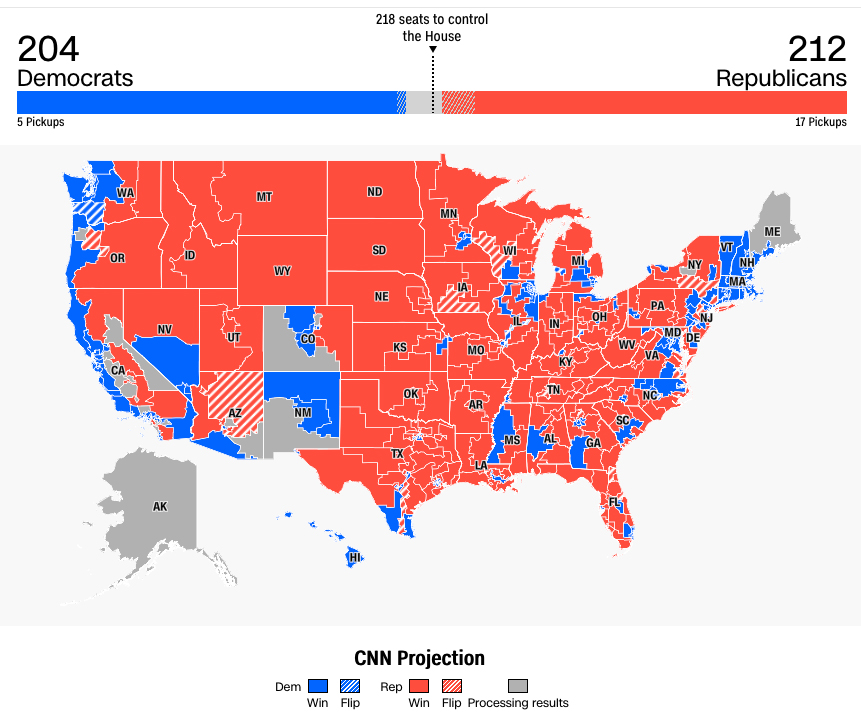
Click on map or here to see CNN’s interactive 2022 elections results House map: CNN

By Jim Ellis — Monday, Nov. 14, 2022

Now, just about a week beyond the 2022 election, each major party still has a chance of controlling the US House, while the Democrats, with late victories in Arizona and Nevada, have secured at least a 50-50 ostensible Senate majority when counting the vice president’s tie-breaking vote.

Senate

Senate: Majority Decided — Just one of the 35 Senate elections still remains undecided: the Georgia race that will head to a post-election runoff on Dec.6. Once the tight Arizona, Nevada, and Wisconsin races were called for incumbents Mark Kelly (D-AZ), Catherine Cortez Masto (D-NV), and Ron Johnson (R-WI) the majority was decided in favor of the Democrats.

The Georgia race unofficially finds incumbent Raphael Warnock (D) holding 49.4 percent of the vote versus Republican Herschel Walker’s 48.5 percent. Libertarian Chris Victor taking 2.1 percent, or just over 48,000 votes, denied both major party candidates the opportunity of reaching the 50 percent plateau. Therefore, the two finalists advance to a new election.

A Warnock win would put the Senate balance of power at 51-49 with the Democrats in control and not needing the vice president to make a tie-breaking vote. A Walker win would leave the Senate without a true majority at 50-50, thus requiring Vice President Kamala Harris’ deciding call on straight party line votes.

The Alaska Senate race is also undecided, but the state’s new electoral system that sends four candidates to the general election won’t be final for another two weeks.

It is obvious that contest will winnow down to a battle between two Republicans, Sen. Lisa Murkowski and former Alaska Director of Administration Kelly Tshibaka. While Tshibaka leads the aggregate vote count, it has become clear that she and Sen. Murkowski will eventually advance into the Ranked Choice runoff.

Though Tshibaka is, and may remain, the vote leader, the RCV runoff system looks to favor Sen. Murkowski. Regardless of which woman is declared the victor when the lengthy process ends, the GOP will retain the Alaska Senate seat.

House

House: Majority Count Remains in Limbo — The House races are still very much undecided with 19 races uncalled. Considering that 10 of those races are in California and one in New York where it will likely take weeks to arrive at final totals, it could be quite some time until we know the ultimate outcome.

According to the CNN election site count, of the 19 uncalled races the Democrats lead in nine, Republicans eight, and two are pure toss-ups, both of which the GOP candidate has a slight count edge. Republicans, however, sitting at 212 called races in their favor versus 204 for the Democrats, need only six of the 19 to fall their way, while Democrats require 14 to claim a bare majority.

It appears the final margin may come down to just one or two seats. The GOP lead seems relatively secure in five of their eight advantage seats, which would give them 217, while the Democrats appear to have solid advantages in another seven of their nine, which puts them at 211.

Therefore, the Republican projection appears to lie in the 217-221 range, while the Democrats’ best-case scenario looks to be scoring a 218-217 slight majority. These predictions, however, are based upon rudimentary projections that could easily change once the actual votes are finally tabulated in all 19 outstanding campaigns.

Governor

Aggregate Governor: Incumbents Dominate — Surprisingly little change occurred in the 36 governors’ races in terms of party change. Democrats, as predicted, easily converted the Maryland and Massachusetts open seats.

The 36 governors’ races are also almost complete, with only Alaska and Arizona uncalled.

In returns that defied polling and thus favor the Democrats, Arizona Secretary of State Katie Hobbs (D) leads former news anchorwoman Kari Lake (R) in the governor’s race, and her advantage may be enough to clinch the office once the state works through its counting delays.

At this point, Hobbs holds a 50.5 – 49.5 percent lead with an estimated 93 percent of the vote counted. This translates into approximately 180,000 votes remaining to be tallied. To win, Lake would have to receive more than 56 percent of the outstanding vote to make up her 26,000-plus vote deficit, which is difficult.

In the only competitive election resulting in a partisan conversion, Republican Clark County Sheriff Joe Lombardo (R) unseated Nevada Gov. Steve Sisolak (D). In races that were largely decided in the states’ respective Democratic primaries, Wes Moore and Maura Healey successfully converted Republican governorships in Maryland and Massachusetts, respectively.

Oregon, the site of perhaps the most interesting governor’s race because it featured a three-way battle, saw former state House Speaker Tina Kotek (D) prevail over ex-House Minority Leader Christine Drazan (R) and former state Sen. Betsy Johnson (I). Polling correctly suggested that Johnson had dropped well off the pace but also largely projected incorrectly that Drazan was positioned for a close upset win. In the end, the election broke 47-44-9 percent in Kotek’s favor with an estimated 93 percent of the all-mail vote counted.

Alaska Republican incumbent Mike Dunleavy looks to be in position to potentially clinch re-election outright, thus exceeding the 50 percent mark within the aggregate vote and avoiding a Ranked Choice Voting instant runoff. With ballots being allowed two weeks to report from the wilderness, it will be just before Thanksgiving when all of the Last Frontier races finally conclude.