
Tag Archives: Rep. Russell Fry

South Carolina Senate Special
Election Candidate Filing Closes

By Jim Ellis — Thursday, July 30, 2026

Senate

Candidate filing closed yesterday for the South Carolina special Republican Senate primary, and no fewer than eight individuals filed to challenge appointed Sen. Darline Graham despite her carrying President Trump’s endorsement.

The death of Sen. Lindsey Graham earlier this month required state Republican leaders to schedule a quick special election to replace him on the ballot. The primary will be held Tuesday, Aug. 11. If no candidate receives a majority, the top two finishers will advance to an Aug. 25 runoff.

The headline challengers are two sitting US House members: Rep. Ralph Norman (R‑Rock Hill), who finished a distant third in June’s gubernatorial primary, and Rep. Russell Fry (R‑Murrell’s Inlet/Myrtle Beach).

Other notable entrants include former Myrtle Beach Mayor and ex‑City Councilman Mark McBride – an unwelcome development for Rep. Fry, since McBride is likely to siphon votes from the northeastern South Carolina region – and wealthy businessman Mark Lynch, who drew 29 percent in his June primary challenge to Lindsey Graham. Former Governor and Congressman Mark Sanford, who considered entering the 1st District regular primary but ultimately did not, also filed for the Senate special.

Three apparent also-ran candidates also filed: former Waterboro City Councilman Duke Buckner, businesswoman Glenda Gail Parker, and biochemical engineer Sam Shepherd.

This crowded field makes it unlikely that any candidate, including Sen. Graham, will reach the 50 percent threshold. The most probable runoff scenario involves two of the three leading contenders – Sen. Graham, Rep. Norman, and Rep. Fry. Should Graham fail to win outright, she would enter the runoff at a disadvantage, since a majority of voters would have already chosen someone else.

Historically, family members of deceased officeholders often perform well in replacement elections, though Democratic family members typically perform better than Republicans.

In terms of campaign resources, Rep. Norman is independently wealthy and capable of quickly self‑funding at a seven‑figure level. Rep. Fry has roughly $1 million in his House campaign account that can be transferred to a Senate committee. Sen. Graham must raise funds into a new federal committee, but a supportive Super PAC has indicated it is prepared to spend $1.5 million on her behalf. Lynch, who spent more than $5 million on his unsuccessful June challenge, is also well‑financed and capable of again investing heavily, this time in a short‑term race.

Turnout will be key, as is typical in special elections. In June, 464,709 voters participated in the regular Senate primary, and it is likely that considerably fewer will cast ballots in the Aug. 11 special primary.

Lindsey Graham received 264,091 votes in securing his 57 percent primary win, giving the late Senator’s sister a substantial Graham‑aligned vote base from which to begin assembling a victory coalition. In the regular Senate primary, Mark Lynch drew 134,360 votes, and in the Republican gubernatorial primary, Rep. Ralph Norman received 80,790 votes.

With at least these three candidates capable of attracting significant support, the Aug. 11 primary is poised to be highly competitive, increasing the likelihood that the nomination will not be decided until the Aug. 25 runoff.

The eventual Republican nominee will be favored in November against Democratic nominee Annie Andrews, given South Carolina’s strong Republican voting history. It remains to be seen which of the major contenders will ultimately secure the nomination.
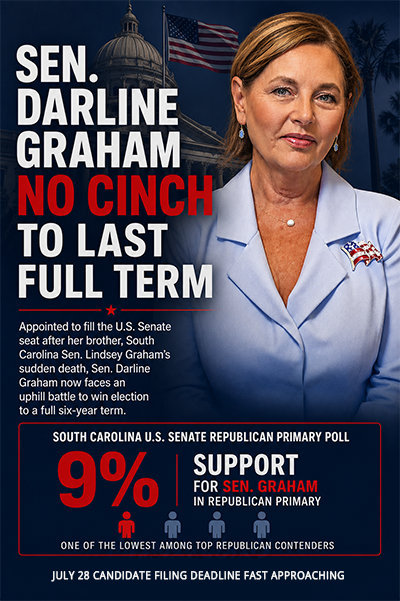
Polling: Appointed Sen. Darlene
Graham No Cinch to Last Full Term

By Jim Ellis — Thursday, June 23, 2026.

US Senate

There has been some question as to whether the announced South Carolina special election Senate Republican candidates would reconsider their plans now that appointed Sen. Darline Graham has decided to run for the full six-year term. Two new polls may have just provided early answers.

With the July 28 candidate filing deadline approaching, two new surveys suggest that Reps. Ralph Norman (R Rock Hill) and Russell Fry (R Murrell’s Inlet/Myrtle Beach), along with businessman Mark Lynch, have little incentive to withdraw. Contrary to early assumptions, Sen. Darline Graham apparently does not begin the race with a clear advantage.

The new polling, conducted by Peak Insights (July 18–20; 900 likely Republican special primary voters; live interview & text) and Innovative Communication Strategies (July 20-21; 788 likely Republican special primary voters; text to web), indicates that another individual – one not currently running – holds the early lead.

Peak Insights finds former Congressman and Fox News host Trey Gowdy holding a 38 percent preference figure, well ahead of Rep. Norman at 13 percent, and Rep. Fry and Sen. Graham (listed on the survey questionnaire as Darline Graham Nardone) tied with nine percent. Lynch follows with seven percent support. ICS did not test Gowdy; without him in the field, their results show Rep. Norman holding a 19-16-12-9 percent edge over Sen. Graham (also listed as Darline Graham Nardone on the survey questionnaire), Rep. Fry, and Lynch.

Gowdy’s strength is notable given that he has made no visible move toward entering the race. Sen. Tim Scott (R), now the state’s senior Senator, has publicly argued – prior to Sen. Graham’s announcement – that Gowdy would be the strongest possible Republican nominee. The Peak Insights data suggests that the Senator’s assessment is correct.

Another central question in what now appears to be a competitive contest is campaign finance. Sen. Graham begins with no funds, as she must form a new federal campaign committee. Only $2,000 from Lindsey Graham’s account could be transferred to her campaign, assuming the committee treasurer has authority to make disbursements following the principal’s death.

Rep. Fry is in the strongest financial position: his June 30 FEC report shows $1.04 million available for transfer to a Senate committee. Rep. Norman reports $90,314 cash on hand but he has substantial personal wealth and could quickly self fund. Lynch, who challenged Sen. Lindsey Graham in this year’s regular primary, retains more than $568,000 cash on hand after loaning his campaign over $5 million.

Among the major contenders, Sen. Graham is therefore at the greatest financial disadvantage, and the compressed timeline makes lightning-fast fundraising difficult. A supportive Super PAC could intervene on her behalf, and given her endorsement from President Trump, such an effort is plausible. If her campaign can assemble an operational structure – likely with significant assistance from Lindsey Graham’s former political staff – she will be able to communicate the Trump endorsement, which has been a decisive asset in almost all Republican primaries.

The key question is whether a newly formed Graham campaign, even with Trump’s backing, can win outright on Aug. 11. If these polls are reasonably accurate – and both point to similar conclusions about Sen. Graham’s early standing – it appears unlikely that any candidate will reach a majority.

Based upon current information, the Aug. 11 primary is likely to force a runoff on Aug. 25 between the top two finishers. In a head-to-head contest between Sen. Graham and either Rep. Norman or Rep. Fry, the available data suggests that the result is uncertain.

Seven States Host Primaries;
More House News

By Jim Ellis — June 7, 2022

Primaries

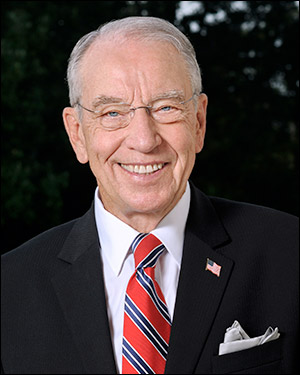
Iowa’s seven-term US Sen. Chuck Grassley (R) will be 89 at the time of the general election.

Voting Today: Seven States Host Primaries — One of the busiest nomination days occurs today and voters will be choosing November candidates in states stretching from California to New Jersey. Those state primaries on the calendar for today include California, Iowa, Mississippi, Montana, New Jersey, New Mexico, and South Dakota. One special general election will also be determined, that being the race in California’s 22nd District from which former Congressman Devin Nunes (R) resigned at the end of last year. Republican former state Assembly Minority Leader Connie Conway is the clear favorite to win the special, but will have no place on a congressional ballot during the regular election.

Some of the more interesting races include Iowa Democrats choosing an opponent for veteran Sen. Chuck Grassley (R), who will be 89 years old at the time of the general election, former Interior Secretary Ryan Zinke, attempting to return to the House of Representatives from Montana; Mississippi Congressman Steven Palazzo (R-Biloxi), fighting for re-nomination amid an ethics investigation; and a host of US House incumbents attempting to win post-redistricting CDs that in some cases are very different than the ones they currently represent.

House

NY-23: Dems Decide on Nominee; Filing Ends Friday — Gov. Kathy Hochul (D) has scheduled the replacement special election for resigned Rep. Tom Reed’s (R) vacant seat to run concurrently with the regular Aug. 23 congressional primary. Under New York electoral procedure, the party leaders nominate candidates for special elections, and the local Democratic leadership has already made their selection. Retired Air Force Colonel Max Della Pia was selected as the special election nominee, and he will face whomever the Republican leadership decides to nominate. Della Pia also said he will file for the regular term, but the voters will choose the nominee for that race, also on Aug. 23.

Several Republicans are in the mix, the most noteworthy name being mentioned of late is New York Republican Party chairman Nick Langworthy. Candidate filing for the regular election ends this Friday, June 10.

The southwestern Upstate district favors the Republicans. The FiveThirtyEight data organization rating is R+23. Dave’s Redistricting App scores it 55.37 percent R and 41.98 percent D. Former President Trump carried the new 23rd District in 2020 by a 55-43 percent count.

SC-7: Rep. Rice Trailing in Primary Poll — With the South Carolina primary fast approaching on June 14, the Trafalgar Group released a new survey of the Palmetto State’s 7th District that features Republican incumbent Tom Rice (R-Myrtle Beach) who is fighting for re-nomination after being one of the 10 House Republicans to support the second attempt to impeach former President Trump.

According to the Trafalgar data (May 26-29; 572 likely SC-7 Republican primary voters; mixed data collection elements), Rep. Rice trails state Rep. Russell Fry (R-Murrell’s Inlet), Trump’s endorsed candidate, by a substantial 42-25 percent clip within the field of seven Republican candidates. If no one receives majority support, which appears likely according to this poll, the top two will advance into a two-week runoff campaign that will be decided June 28.

Texas: Canvasses for Two Dem Runoffs Finally End — Though recounts are likely to be called, the canvassing process for the state’s two unresolved May 24 runoff elections has concluded. At the end of the counting, both leaders heading into the canvass gained strength.

In Rep. Henry Cuellar’s (D-Laredo) 28th CD, the Congressman increased his lead from a small spread of 177 votes in the unofficial count to 281 votes. In the open McAllen-anchored 15th CD, businesswoman Michelle Vallejo (D) increased her tiny lead from 23 votes to 30. In the latter race, attorney and Iraq War veteran Ruben Ramirez is indicating that he will ask for the ballots to be counted again citing the razor-thin difference between the two competitors. Contenders have until tomorrow to officially request recounts.

Assuming that Cuellar and Vallejo are both certified the winners of their runoffs, which is the likely outcome in both cases, they will face Republican former congressional aide Cassy Garcia (R) and insurance agent and 2020 nominee Monica de la Cruz (R), respectively.