Tag Archives: Texas

Census Reapportionment:
The Hidden Votes

By Jim Ellis — Thursday, March 9, 2023

President

Census Reapportionment: The Hidden Votes — Already, the 2024 presidential race has actually gotten closer. The 2020 national election was decided by a 74 electoral vote margin, a 306-232 margin for Democrat Joe Biden. Without any state changing its 2020 outcome, however, his victory spread has now decreased to 68 EVs.

Census reapportionment is the reason, and it makes a net six-vote difference in the Republicans’ favor based upon Donald Trump’s aggregate EV number from the last election. This is because reapportioning the number of US House seats throughout the country affects and changes the electoral vote count (EVC). As you know, the EVC is comprised of each state’s federal representatives, meaning two senators and the number of House members each entity possesses.

Therefore, under the new totals, Biden’s winning count over his Republican opponent would be 303-235. Understanding that the presidential winner needs 270 electoral votes, the Republican deficit is now 35 as opposed to 38. This is important because it changes the number of states that Republicans must convert in order to win the next race.

President Biden loses electoral votes in California, Illinois, Michigan, New York, and Pennsylvania, but gained two back in Colorado and Oregon. The first five lost a congressional seat apiece in reapportionment, while the latter two gained a district apiece. Conversely, the next Republican nominee would gain electoral votes in Texas (2), Florida, Montana, and North Carolina, but lose one apiece in Ohio and West Virginia. Thus, the Republicans gained an aggregate three electoral votes while the Democrats lost three, for the net swing of six.

For the next Republican nominee, he or she must again re-establish the party’s southern core. Former President Trump needed to carry the southern tier states of Arizona, Texas, Georgia, North Carolina, and Florida to position himself throughout the rest of the country. He failed to do so, losing Arizona and Georgia, but the next nominee must return these two entities to the GOP column if the party is to have any chance of again winning the White House.

If the next Republican nominee fails to take these two states, for a total of 27 electoral votes (Georgia 16; Arizona 11), there is no realistic chance of cobbling together a 270-vote victory coalition. The GOP nominee will need at least one more state to convert in addition to Arizona and Georgia, with Wisconsin’s 10 votes being the simplest numerical path to an outright state coalition victory.

Continue reading

Dixon Won’t Run for Senate; Pelosi Successor Waiting in the Wings; A Gonzales Challenger; A Republican Leads Liberal Group’s Poll

By Jim Ellis — Wednesday, March 8, 2023

Senate

Michigan School Board member Nikki Snyder (R)

Michigan: Tudor Dixon Won’t Run for Senate — Over the weekend, Tudor Dixon, the defeated 2022 Republican gubernatorial candidate, announced she will not join the forming open US Senate field. Last week, three-term US Rep. Elissa Slotkin (D-Lansing) entered the race, and is widely viewed as the favorite for the Democratic nomination and the seat. In December, four-term incumbent Debbie Stabenow (D) announced that she will retire at the end of this Congress.

We can soon expect more Republican action in this race. Michigan School Board member Nikki Snyder is the only announced GOP candidate. Others reportedly considering the race are US Rep. Bill Huizenga (R-Holland), and former Reps. Fred Upton, Mike Rogers, and Peter Meijer.

House

CA-11: Pelosi Successor Waiting in the Wings — California state Sen. Scott Wiener (D-San Francisco) is making his political future known. Anticipating that former House Speaker Nancy Pelosi (D) will not seek re-election in 2024, Sen. Wiener has filed a congressional exploratory committee with the Federal Election Commission. He says he will run for the 11th District seat, which covers most of the San Francisco peninsula, if Rep. Pelosi decides to retire.

He could be getting the jump on another scenario, also. Should Ambassador to the Holy See Joe Donnelly (D) resign later this year to mount a race for governor of Indiana as many believe he will, odds are strong that Pelosi will be appointed as his replacement. If so, a special election would then be scheduled for District 11. The ambassador of the United States to the Holy See is the official representative of the United States of America to the Holy See, the leadership of the Catholic Church. Before his ambassadorial appointment, Donnelly served both in the House and Senate. He was defeated for re-election to the Senate in 2018.

TX-23: Rep. Gonzales’ Primary Challenge — US Rep. Tony Gonzales (R-San Antonio), after the Texas Republican Party recently voted to censure him for his support of gun control legislation, voting for the establishment of the January 6th Committee, and border legislation that the organization felt was not strong enough, drew Republican primary opposition. Medina County Republican Party chair Julie Clark announced that she will challenge the two-term incumbent who in 2022 scored the largest re-election percentage (55.9 percent) for any Republican since former Rep. Henry Bonilla’s 2004 victory.

Governor

North Carolina: GOP Lieutenant Governor Leads Liberal Group’s Poll — Raleigh based Public Policy Polling conducted a survey of the North Carolina electorate for the progressive left Forward Carolina organization (March 2-3; 704 registered North Carolina voters) and finds an unsurprisingly tight battle developing between unannounced gubernatorial candidate Mark Robinson (R), the state’s lieutenant governor, and Attorney General Josh Stein (D) who is an official contender. The poll results find the two locked in a dead heat with Robinson holding a 44-42 percent edge. The lieutenant governor’s strong 56-28 percent showing in the state’s substantial rural areas is what catapults him to the lead.

Robinson was elected lieutenant governor as a Republican in 2020 despite now term-limited Democratic Gov. Roy Cooper (D) winning re-election. Robinson carried the state 51.6 – 48.4 percent. Attorney General Stein survived a close re-election battle in the same year, slipping past his Republican opponent with only a 50.1 – 49.9 percent victory margin. The open NC governor’s race will undoubtedly feature a tight finish.

Presidential Data Points; Williamson Challenges Biden; Dems Look for Cruz Challenger; Slotkin’s Senate Track; Wilson to Announce for Louisiana Governor’s Race?

By Jim Ellis — Thursday, March 2, 2023

President
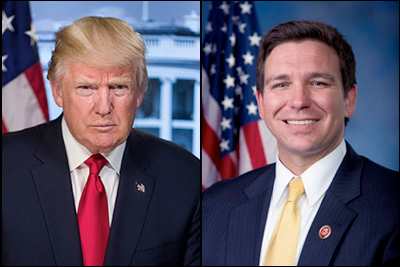
Former President Donald Trump; Florida Gov. Ron Desantis

Emerson College Poll: National Data Reveals Interesting Underlying Points — Emerson College is reporting the results of their latest national survey (Feb. 24-25; 1,060 registered US voters; interactive voice response system & online panel) and while some of the results are consistent with other polling – former President Trump leading Gov. Ron DeSantis and the GOP field by a wide margin nationally; President Biden upside-down on the job approval question (44:50 percent) – other data points are proving more interesting.

First, in the general election ballot test, Trump records a 46-42 percent edge over President Biden nationally, which is one of his better polling showings. Second, in contrast to several other recent national polls, the 476 tested Democratic primary voters give overwhelming support, 71 percent, to President Biden as the 2024 party nominee. Interestingly, a whopping 85 percent within the youngest segment, those aged 18-34, are supportive of this position. Third, while Trump records a 55-25 percent national lead over Gov. DeSantis, the latter manages to gain among Hispanics, college educated Republican voters, GOP voters over 65, and Midwest respondents when compared with Emerson’s January poll.

Marianne Williamson: Biden’s First Dem Challenger Emerges — Author Marianne Williamson (D), who ran for President in 2020 but fared very poorly in that year’s Democratic nomination campaign, said she will formally announce her 2024 national campaign on Saturday. Williamson will not become a major factor in the race, but could earn some delegates in New Hampshire if the state fails to adhere to the Democratic National Committee schedule and, as a result, President Biden decides not to enter the state’s primary. Otherwise, a Williamson campaign will be a non-factor.

Senate

Texas: New Democrat Potential Candidate Emerging — Democratic leaders have been attempting to recruit a strong opponent for Sen. Ted Cruz (R) as he seeks a third term next year, and most of the early speculation has centered around former HUD Secretary, presidential candidate, and ex-San Antonio mayor, Julian Castro, and US representative and former NFL football player Colin Allred (D-Dallas). With neither man so far jumping into the race, statements from Texas Democratic Party chairman Gilberto Hinojosa, as reported in the Daily Kos Elections blog, suggest that outgoing Houston mayor and former veteran state Rep. Sylvester Turner may be moving toward becoming a candidate.

Democrats are expected to make a run at Sen. Cruz, but in a presidential election year with the turnout model almost assuredly favoring the eventual Republican presidential nominee the future Democratic candidate will be in a decided underdog position.

Michigan: Rep. Slotkin’s Senate Track — Three-term US Rep. Elissa Slotkin (D-Lansing), as expected for weeks, formally announced that she will run for the Senate next year. In December, four-term incumbent Debbie Stabenow (D) announced that she will retire at the end of this Congress. Rep. Slotkin, one of the more prolific fundraisers in the House, is already perceived as the favorite for the Democratic nomination and the general election.

Though there was much activity right after Sen. Stabenow announced that she would step down, only one elected official, Michigan School Board member Nikki Snyder (R), has actually declared her candidacy until Rep. Slotkin made her intention known.

While Rep. Slotkin has the inside track to the Democratic nomination and may not even face a significant intra-party opponent, several Republicans are still contemplating whether to run for the open Senate seat. Among them are former gubernatorial nominee Tudor Dixon, US Rep. Bill Huizenga (R-Holland), and former Reps. Fred Upton, Mike Rogers, and Peter Meijer.

Prominent Michigan politicos who have said they will not run for the Senate include Gov. Gretchen Whitmer (D), Lt. Gov. Garlin Gilchrist (D), Attorney General Dana Nessel (D), Secretary of State Jocelyn Benson (D), US Reps. Haley Stevens (D-Birmingham) and John James (R-Farmington Hills), and state Senate Majority Whip Mallory McMorrow (D-Oakland and Wayne Counties).

House

CA-12: First Open-Seat Candidate Emerges — Bay Area Rapid Transit Board member Lateefah Simon (D) became the first individual to announce her candidacy for California’s new open 12th District, which encompasses the cities of Oakland and Berkeley. Twelve-term Rep. Barbara Lee (D-Oakland) is leaving the House to run for the Senate.

The 12th, a coalition majority minority seat, is the most Democratic district in this bluest of states. The FiveThirtyEight data organization rates it D+77, while the Dave’s Redistricting App partisan lean finds a 89.7D – 8.3R spread. Therefore, two Democrats advancing to the general election in what is expected to be a crowded all-party qualifying election field is a virtual certainty.

Potential candidates include state Sen. Nancy Skinner (D-Berkeley), Assemblywomen Mia Bonta (D-Oakland) and Buffy Wicks (D-Oakland), former Oakland Mayor Libby Schaaf (D), and several local officials.

Governor

Louisiana: Democrats Uniting — While the candidate filing deadline for this year’s Louisiana governor’s race is still more than five months away, Democrats appear to already be uniting behind one candidate. Shawn Wilson is the outgoing state Secretary of Transportation who will be resigning from office on March 4. His official gubernatorial announcement will come soon after. Gary Chambers (D), who ran against Sen. John Kennedy (R) last year and was viewed as a potential candidate now says he will not run and is lining up behind Wilson. Term-limited Gov. John Bel Edwards (D) has already given his tacit endorsement to Wilson.

All of this likely means Wilson will surely advance into the general election runoff. Republicans will split their votes, thus ensuring that no candidate will reach the 50 percent mark in the Oct. 14 all-party jungle primary. The top two finishers will advance into the Nov. 18 general, meaning Wilson will await the outcome of a tight GOP gubernatorial nomination contest. Republicans will be favored to convert the Louisiana governorship, but Democrats are clearly doing their best to correctly position themselves for the autumn election.


Haley Announces Presidential Bid; Sen. Feinstein to Retire; Cruz Commits to Senate Run; Boebert’s 2022 Opponent to Challenge Again; Miss. Gov. Poll Flips Results

By Jim Ellis — Thursday, Feb. 16, 2023

President

Nikki Haley (R)

Nikki Haley: Announces Presidential Bid — Former South Carolina governor and UN Ambassador Nikki Haley (R), as promised, officially announced her presidential campaign, joining former President Trump in the GOP field. Analysts pointed out that her announcement portfolio relies heavily on her background with little in the way of future vision. This approach largely proved a mistake for Republicans nationally in 2022, and the principal reason that many believed GOP candidates under-performed in the last election.

For his part, former President Trump seems to welcome her into the race, as he probably will with others. He understands a crowded field will likely award him the nomination with base support nationally of approximately 35 percent, just how the 2016 Republican campaign unfolded.

Senate

California: Sen. Dianne Feinstein (D) Announces Retirement Plans — As expected, veteran Sen. Dianne Feinstein (D-CA), now the longest-serving Democrat in the chamber since former Sen. Patrick Leahy (D-VT) retired, announced that she will not seek re-election to a sixth full term in office. The senator originally claimed the seat in a 1992 special election and won her first six-year term two years later.

Sen. Feinstein, who is 89 years old, was first elected to the San Francisco Board of Supervisors in 1969 and became board president in 1978. Later that year, she succeeded then Mayor George Moscone (D) after his tragic assassination. Feinstein would then win election to the position of mayor and serve a total of nine years. She lost the 1988 governor’s race to then-Sen. Pete Wilson (R) but rebounded to win the Senate seat four years later.

Two Democratic House members, Reps. Katie Porter (D-Irvine) and Adam Schiff (D-Burbank) had both announced their Senate candidacies weeks before the incumbent made public her own retirement decision.

Texas: Sen. Cruz Seeks Re-Election, No Presidential Run — Two-term Texas Sen. Ted Cruz (R) announced that he is fully committed to seeking re-election to his current position and will not enter the 2024 presidential contest. Under Texas law, it would have been permissible for Sen. Cruz to simultaneously run for both offices, but he has chosen to concentrate on winning another senatorial term. In 2018, he defeated then-Rep. Beto O’Rourke (D) only 51-48 percent in a race many thought the senator might lose. His focus on re-election suggests that we will see a more aggressive Senate campaign in this election cycle.

At this point no major Democrats have yet come forward to challenge Sen. Cruz. The party leadership would like to see Rep. Colin Allred (D-Dallas) enter the statewide campaign, but with Allred now holding a safe House seat, his risking the chances of making a statewide bid lessen.

House

CO-3: Re-Match on Tap — Aspen Democratic former City Councilman Adam Frisch, who held Rep. Lauren Boebert (R-Silt) to the closest victory in any House race (546 vote margin), announced Wednesday that he will return to seek a re-match with the two-term congresswoman.

Frisch, however, already has Democratic primary opposition. Late last week, veterinarian and former congressional candidate Debby Burnett announced her candidacy, but she faces a difficult road to deny Frisch renomination after his strong general election performance. It is likely we will see another close general election here in 2024.

Governor

Mississippi: New Poll Finds Gov. Reeves Trailing — A late January 2023 Mississippi gubernatorial poll, for the first time, shows Gov. Tate Reeves falling behind Democratic Public Service Commissioner Brandon Presley in a head-to-head ballot test question. Tulchin Research, polling for the Southern Poverty Law Center and the Southern Majority IE PAC (Jan. 21-25; 500 projected likely Mississippi voters; live interview, email & text) projects Presley, a cousin to the late singing legend Elvis Presley, pulling ahead of Gov. Reeves, 47-43 percent.

An earlier January poll, from Siena College (Jan. 1-12; 821 registered Mississippi voters), however, posted Gov. Reeves to a 43-39 percent edge. The closeness of the two early polls project that we will likely see a hard-fought gubernatorial campaign conducted in the Magnolia State later this year.

Challenger Emerges in Texas;
Top Dem Declines to Run in Louisiana;
SCOTUS Redistricting Action in NC; Rep. Jackson Lee to Run for Mayor?

By Jim Ellis — Tuesday, Feb. 14, 2023

House

Army veteran Kyle Sinclair (R)

TX-28: New Rep. Cuellar (D) Challenger Emerges — Army veteran Kyle Sinclair (R), who lost 68-32 percent against Rep. Joaquin Castro (D-San Antonio) in Texas’ 20th District last November, announced he is moving to the 28th District to challenge veteran Rep. Henry Cuellar (D-Laredo). The congressman’s most serious vulnerability is in the Democratic primary; however, as illustrated in his 2022 victorious race for renomination decided in a May runoff by just 311 votes. We can expect to see more political action next year in this CD that stretches from San Antonio to the Mexican border.

Governor

Louisiana: Dem Chair Won’t Run — Though candidate filing for the Louisiana governor’s race doesn’t close until Aug. 10, the open-race field is already winnowing. At the end of last week, Louisiana Democratic Party chair Kate Bernhardt announced that she will not become a gubernatorial candidate after considering the possibility of entering. The top candidates appear to be Attorney General Jeff Landry (R), state Treasurer John Schroder (R), and state Transportation Secretary Shawn Wilson (D). Gov. John Bel Edwards (D) is ineligible to seek a third term. The state’s jungle primary is Oct. 14, 2023, with a runoff on Nov. 18 if no contender receives majority support in the first election.

States

North Carolina: State Supremes Schedule Action — The North Carolina state Supreme Court is sending clear signals to the US Supreme Court over the state’s election and redistricting law challenges. Before departing at the end of their term in January, the former NC Supreme Court panel, with a 4D-3R majority, declared the state Senate map a partisan gerrymander and overturned the NC voter identification law. On Friday, the new 5R-2D court announced it will hear arguments to overturn those rulings in the middle of March.

The move is significant since SCOTUS is considering the North Carolina political gerrymandering case and will rule before July 1. The state court, however, potentially taking action on similar cases before the US Supreme Court ultimately decides, could allow the latter panel simply to yield to the state’s decisions. At the end of the process and regardless of which court sets the final parameters, it is probable that we will see a complete redistricting of the North Carolina political boundaries before the 2024 election.

Cities

Houston: Rep. Jackson Lee Considering Mayor’s Race — Reports are emanating from Houston that veteran US Rep. Sheila Jackson Lee (D-Houston) is conducting citywide polling to determine her chances in the open mayor’s race scheduled for November of this year. Incumbent Sylvester Turner (D) is ineligible to seek a third term.

At this point the leading contender appears to be state Sen. John Whitmire (D), who was first elected to the legislature in 1972. He served 10 years in the state House of Representatives before moving to the state Senate in 1982. He is Texas’ longest-serving state senator.

If no candidate receives majority support on Nov. 7, a runoff between the top two finishers will be scheduled. The mayor’s race is non-partisan in that candidates’ party affiliations are not listed on the ballot. Other major candidates are City Councilman Robert Gallegos, former city councilwoman and 2020 US Senate candidate Amanda Edwards, and Houston Metro Board Member Chris Hollins.

Pelosi Endorses in Calif. Senate Race; A Challenger for Sen. Cruz in Texas; FEC Publishes Year-End Finances; Mississippi Candidates Set for ’23

By Jim Ellis — Monday, Feb. 6, 2023

Senate

Former Speaker Nancy Pelosi (D-San Francisco) endorses Adam Schiff.

California: Rep. Schiff Attracts Major Political Endorsements — Rep. Nancy Pelosi (D-San Francisco), the veteran former House Speaker, said yesterday that she will support Rep. Adam Schiff (D-Burbank) in the 2024 US Senate race so long as Sen. Dianne Feinstein (D) decides to retire. An additional 14 California US House members also publicly pledged their support to Rep. Schiff. This, even though Rep. Katie Porter (D-Irvine) is already in the race, and Rep. Barbara Lee (D-Oakland) is a virtual certainty to also enter. The March 5, 2024 California jungle primary is likely to advance two Democrats into the general election.

Texas: Ex-Presidential Candidate Considers Senate Race — Former US Housing & Urban Development Secretary and ex-San Antonio mayor, Julian Castro (D), is reportedly considering entering the Texas US Senate race to challenge two-term incumbent Ted Cruz (R). US Rep. Colin Allred (D-Dallas) is also discussed as a possible candidate, but the Congressman has yet to confirm that he has interest in running statewide.

Though Sen. Cruz only won re-election in 2018 with a 51-48 percent victory margin over then-Rep. Beto O’Rourke (D), he appears to be in stronger position this year. In a presidential year, and with Republicans still controlling all of the major Texas statewide elected offices, Sen. Cruz must begin this race as a solid favorite for re-election.

Finance Numbers: FEC Publishes Senators’ Year-End Filings — The Senate campaign finance figures are now public, thus giving us clues as to which incumbents are best prepared to wage their re-election campaigns. Though not facing a competitive 2024 battle, Vermont Sen. Bernie Sanders (I) ended the year with the most cash-on-hand, well over $9.7 million.

The senator who has the highest account balance while facing a competitive challenge is West Virginia’s Joe Manchin (D). He appears to have the most difficult re-election path of any in-cycle Senate incumbent. In his two-congressional district state, Sen. Manchin posts just over a whopping $9.5 million in his campaign account. The two senators with the lowest cash-on-hand figures are Mitt Romney (R-UT) with $3,569, and Dianne Feinstein (D-CA) who holds just $9,968.

States

Mississippi: Candidates Set for ’23 Off-Year Election — The Magnolia State’s candidate filing period has closed and in all eight statewide races set for this year’s ballot, each currently Republican held, Democrats have candidates for every campaign. The two elections sure to attract the most attention are the battles for governor and lieutenant governor, though the latter is a GOP primary confrontation.

It is likely the general election will feature Gov. Tate Reeves (R) and Public Service Commissioner Brandon Presley (D) in what many observers believe will become a significant race. The Republican lieutenant governor primary highlights state senator and former US Senate candidate, Chris McDaniel, challenging incumbent Delbert Hosemann.

Congress Convenes Tomorrow with 93 New Members; Early Reapportionment Projections

By Jim Ellis — Monday, Jan. 2, 2023

Congress

Montana’s Ryan Zinke (R-Whitehall) returns to the House.

New Members: Congress Convenes Tomorrow with 93 New Members — The 118th Congress is sworn into office tomorrow and like all others, this new assemblage is a unique group.

In the House, we see 85 freshmen members coming to Washington, including the dozen who won special elections during the session just ended. Additionally, one former member, Montana’s Ryan Zinke (R-Whitehall) who also served in the Trump Administration as Interior Secretary, returns to the House.

The Senate, exclusively due to retirements along with one appointed member, California Sen. Alex Padilla (D) seeking a full term, will only welcome eight new freshmen since all incumbents seeking re-election were victorious.

Of the 85 new House members, 46 are Republicans while 39 are members of the Democratic Party. Just over one-third of the incoming group will be serving in their first elected position, a total of 31. Conversely, 37 of the House freshmen have previously been elected to their respective state legislatures. The remaining 17 held other elected positions, typically at the local level as county or city officials.

In the Senate, only two of the eight incoming members have never before served in an elective office: Alabama’s Katie Britt (R) and J.D. Vance (R) of Ohio.

States

Reapportionment: Early Projections — Apparently, it is not too early to begin discussing which states may gain and lose representation in the 2030 census. The first concrete projections have been publicized based upon the country’s current growth trends since the 2020 census was completed.

No real surprises were among the first cut, as eight seats are projected to change states. In the 2020 census, only seven seats changed states. The early estimates suggest that Texas will again be the big gainer, with an additional three seats. This would increase the nation’s second largest population state to 41 seats, if the early guesstimates prove accurate. Florida could gain two seats, with Idaho, Utah, and Washington each gaining one seat.

The losing states would again be familiar, as Illinois and New York could be on a path to lose two seats apiece. Pennsylvania would again be slated to lose one. The new losing states would be Connecticut, New Jersey, and Wisconsin, all possibly losing one of their current districts. None of these projections are firm, and much will happen to change the national and regional growth rates in the coming eight years.