Tag Archives: Sen. Kirsten Gillibrand

We Now Have Candidate #22 In
The Race, And Sanders is Falling

By Jim Ellis

May 6, 2019 — A new Democratic presidential candidate entered the race late last week, one whom we didn’t expect to see this soon.

Colorado Sen. Michael Bennet

Despite undergoing prostate cancer surgery last month, Colorado Sen. Michael Bennet says he has already received a “clean bill of health” and is embarking upon his national political effort. Now at 22 candidates in the field of Democrats seeking their party’s nomination for the 2020 presidential election, eyes turn to Montana Gov. Steve Bullock who could be the last widely discussed potential candidate yet to make a decision about forming a campaign.

It’s difficult to see how Sen. Bennet breaks through to the top tier, however. He is not well known outside of Colorado and starts well behind most of the field, putting him in a difficult position from which to even qualify for the first two debate forums scheduled for late June and the end of July.

To earn a debate podium, all candidates must either tally at least one percent support in three Democratic National Committee designated polls, or attract financial support from 65,000 donors, from which they must have a minimum of 200 in at least 20 states. For the lesser known candidates, debate participation is a necessity in order to propel themselves into serious contention for the nomination.

Furthermore, Sen. Bennet doesn’t even have his home state electorate to himself. Former Colorado Gov. John Hickenlooper is also in the race, a man who Bennet once served as chief of staff. Just two days ago, Colorado moved its new primary – they used to apportion delegates through the caucus system – to March 3, the 2020 campaign’s Super Tuesday, which could serve to boost one of the two Centennial State candidates. Yet, with both men in the race, the state’s 67 first-ballot delegate contingent will prove less of a base for either one.

Continue reading

The Senate Approvals

By Jim Ellis

April 29, 2019 — The Morning Consult organization released the first quarter approval ratios for all 100 senators, and it appears that quite a number of the 2020 in-cycle incumbents need to improve their ratings before facing the voters next year. In fact, when looking at the ratio spread from positive to negative, seven of the 10 weakest performers will be on the next ballot.

The senator with the highest positive score, 62 percent, is presidential candidate Bernie Sanders. The Vermont electorate is the most pleased with their senators. Not only did Sen. Sanders score a 62 percent favorable job approval rating, but his veteran seat mate, seven-term incumbent Patrick Leahy (D), is right behind him with a 59 percent positive total.

But, the swing between the individual positive and negative scores may be the better indicator of an office holder’s actual standing. The senator with the widest range, in his case seeing his positive score (55 percent) run 33 points higher than his negative (22 percent), is North Dakota Sen. John Hoeven (R).

Continue reading

A Momentum Poll For the Democrats

By Jim Ellis

April 23, 2019 — A new poll was released at week’s end last week, and it may be our best glimpse of the national Democratic presidential picture. As we know, the national count matters little in how the individual states will select delegates, but this polling category does provide a sound measurement of candidate momentum.
Change Research (April 12-15; 2,519 likely Democratic primary voters) just returned results from their latest field poll. Though the 538 statistical research organization only rates Change Research as a C+ pollster, the large respondent universe of just over 2,500 participants certainly gives us the largest national sample sector producing data. Contrast this, for example, with Emerson College’s national primary poll released last week that segmented only 356 respondents.

The Change results find Sen. Bernie Sanders (I-VT) pulling into a virtual tie with former Vice President Joe Biden. Looking at the numbers, Sen. Sanders polls 20 percent, just one point behind Biden’s 21 percent.

Jumping all the way to third place is South Bend (IN) Mayor Pete Buttigieg with a healthy 17 percent support factor. Dropping back into single-digits (nine percent) is former Rep. Beto O’Rourke (D-TX). Massachusetts Sen. Elizabeth Warren records her typical eight percent, within the tight range she finds in most surveys, which, in this case, is one point ahead of Sen. Kamala Harris (D-CA). The latter senator’s seven percent also represents a considerable support drop, as much as 50 percent when compared to early surveys.

Change also surveyed the field without Biden included. Under this scenario, Sen. Sanders pulls just over a quarter of the sampling universe at 26 percent with Mayor Buttigieg moving into a strong second place with 21 percent, and O’Rourke rebounding to secure 14 percent and third place. Sens. Harris and Warren tie for fourth place with 10 percent.

From a momentum perspective, the Change poll provides further evidence that Sen. Sanders is clearly on the upswing, Biden has stalled just before what is expected to be his official announcement week, Buttigieg is the candidate leaping forward from the back, Harris and O’Rourke appear to be losing support, and Warren remains stagnant at a low level.

Continue reading

New Poll: Biden Still Holds First

By Jim Ellis

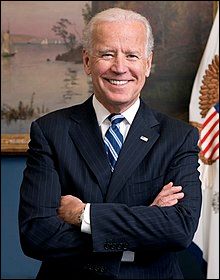
Former vice president and ex-Delaware senator Joe Biden

April 4, 2019 — Former Vice President Joe Biden has been under attack in recent days over past inappropriate behavior around women but, so far, it hasn’t yet damaged his standing with Democratic primary voters according to the latest monthly Morning Consult poll (March 25-29; 12,940 US likely Democratic primary or caucus voters).

While Biden has been hit with a series of negative articles and television news reports, which may be only the beginning of political assaults as the other candidates need to dislodge the former vice president from the front runner position, he still stands atop the Democratic field with his best showing from any recent poll.

According to the Morning Consult data, Biden has open up a 33-25-8-8 percent advantage over Vermont Sen. Bernie Sanders, Sen. Kamala Harris (D-CA), and ex-Rep. Beto O’Rourke (D-TX), respectively. The 33 percent figure is the single-best number that Biden has attracted from any poll during his pre-announcement period.

For his part, Sen. Sanders continues to command a strong-second place position, while Harris drops back a bit from her 10 percent showing in the March 10 Morning Consult track. Her high point from any MC survey came in early February when she touched 14 percent. O’Rourke continues to hover consistently around his eight percent mark, always placing either in third or fourth position.

Continue reading

With Brown Bowing Out,
Does That Mean Biden Will Begin?

By Jim Ellis

Ohio Sen. Sherrod Brown (D) – not running for president

March 11, 2019 — Ohio Sen. Sherrod Brown, another of the potential Democratic presidential candidates who most observers thought would enter the race, is not.

His announcement late last week was a bit surprising considering his home state with 136 first-ballot delegates and 153 overall (the seventh largest state delegation at the Democratic National Convention) moved the primary to March 10, partially with the idea of giving him a boost.

Sen. Brown’s decision provides us a clue as to what else may happen, however. He, like former New York City Mayor Michael Bloomberg, basically said the reason for not becoming a candidate is that the victory path is not evident. The underlying conclusion is they obviously believe former Vice President Joe Biden will enter the race.

Though all three men (Biden, Bloomberg, and Brown) certainly must be considered liberals on the ideological scale, they are not part of the far-left faction that Sens. Bernie Sanders, Kamala Harris, Elizabeth Warren, Cory Booker, and others are attempting to attract. Therefore, if the Bloomberg and Brown paths are blocked, then it is Biden who is their most formidable impediment.

If the former vice president and Delaware senator enters the race, and some say he will do so early next month, is he a lock for the nomination? Polling indicates he would jump to the top of the current heap but would be nowhere close to the majority of delegate votes required to win the nomination on the first convention ballot. In four late February national polls of likely Democratic primary voters, Biden tops them all but with preference percentages of 27, 30, 29, and 31 – hardly dominating numbers.

Continue reading

Bloomberg & Other Surprises

By Jim Ellis

Former New York City Mayor Michael Bloomberg (D)

March 8, 2019 — Former New York City Mayor Michael Bloomberg’s decision earlier this week not to enter the Democratic presidential race becomes the first major surprise move of the early campaign.

It was clearly expected that he would become a candidate. After all, he was talking about committing $500 million of his own money to the effort, he’d hired key campaign staff, designed a presidential campaign logo, and even organized an announcement tour beginning in his birthplace of Boston, Massachusetts.

Speculation continues to surround former Vice President Joe Biden’s decision regarding whether or not he may also ultimately decide to take a pass on the race; Bloomberg’s reasoning provides us a key clue that at least he thinks Biden will soon form a campaign.

So far, 11 Democrats have become candidates with two more filing exploratory committees. The pair remaining in pre-candidate status are Sen. Kirsten Gillibrand (D-NY) and Rep. Tulsi Gabbard (D-HI).

It is conceivable that one or both of the latter women could decide not to become candidates. Rep. Gabbard has run into organizational trouble, is being attacked for her foreign policy positions, and now has drawn serious primary opposition for her congressional seat. Just recently, state Sen. Kai Kahele (D-Hilo) has earned public endorsements from former governors and key Hawaii Democratic Party leaders.

While many in the media cast Sen. Gillibrand as a top-tier candidate, she has gone nowhere since her exploratory announcement, failing so far to even break one percent in any released poll.

Continue reading

Poll: Harris Underwhelms in CA

By Jim Ellis

Declared presidential candidate, Democrat Sen. Kamala Harris of California.

Feb. 19, 2019 — A new Change Research poll was just released of the California Democratic presidential electorate and should former Vice President Joe Biden enter the race, he apparently would fare quite well in Sen. Kamala Harris’ home state.

According to the survey (Feb. 9-11; 948 likely California Democratic presidential primary voters) Biden and Sen. Harris would actually tie at 26 percent apiece. Sen. Bernie Sanders (I-D/VT) closely trails with 20 percent.

Considering the delegate proportionality rules, the two men would score a handsome number of committed delegates in Sen. Harris’ own backyard if this poll happens to correctly predict what could happen a year from now.

California is projected to send 495 delegates to the July 2020 Democratic National Convention, the largest contingent from any state. If Sen. Harris is to become a first-tier presidential candidate, she will have to reap a major delegate bounty in her home domain. Thus, merely breaking even with Mr. Biden would certainly be considered a disappointment in her quest for the nomination.

The rest of the field trails badly. No one, aside from the top three, even breaks into double-digits. In this survey, former Rep. Beto O’Rourke (D-TX) is fourth with eight percent, followed by Massachusetts Sen. Elizabeth Warren who posts a paltry seven percent, ahead of Sen. Cory Booker (D-NJ) with three percent, while former Housing & Urban Development secretary Julian Castro holds a two percent preference.

Continue reading

The Campaign Begins

By Jim Ellis

Feb. 8, 2019 — President Donald Trump used his State of the Union Address on Tuesday night to informally begin his re-election drive.

While some theorized that the president might decide not to seek a second term as we got closer to the primaries, the text of his speech told us just the opposite. In fact, instead of being a State of the Union Address, his subject matter and delivery made it closer to a campaign announcement speech.

In addition to using the address to frame the beginning of his re-election effort, the president also outlined what will likely become his key strategic tenets. In other words, he showcased the speech to begin painting the picture of his Democratic opponents that he wants the electorate to see.

It was clear from his emphasis points that Trump intends to create a clear contrast between he and the Democrats, and certainly the future party nominee whomever that may be, by attempting to position himself as the center-right candidate and driving his opponents into the far left ideological realm.

He also displayed the key points that will likely serve as the foundation for his campaign offensive: increasing jobs, economic prosperity, and the number of small businesses; re-emphasizing his America First theme with both the country’s allies and adversaries in relation to foreign affairs and trade issues; and, how the Trump Administration has made the world a safer place because of its foreign policy decisions and initiatives.

The president also used the speech as a tool to put the Democrats on the defensive, and even apparently shocked them at least a couple of times if their initial reaction is any indication.

Continue reading

Poll: Trump Behind All, But Skewed?

By Jim Ellis

Jan. 25, 2019 — A new Public Policy Polling company national survey (Jan. 19-21; 750 US registered voters) finds President Trump, who is likely at his lowest ebb in popularity during his two-year stewardship in office, trailing seven prospective Democratic opponents, but the study appears to be nothing short of a push poll.

Initially, the survey sample finds President Trump trailing Hillary Clinton by a net four points more than the actual 2016 national campaign result when the respondents are queried about who they supported in the last presidential election. This alone points to at least a slight sample skew.

The historical presidential vote tabulation is followed by a series of questions, all designed to place President Trump in a negative light.


Verbatim from the PPP study, the questions are:

  • Do you think that Donald Trump is honest, or not? Yes 35%; No 58%
  • Do you think that Donald Trump is a liar, or not? Yes 48%; No 44%
  • Do you think that Donald Trump has made America Great Again, or not? Yes 38%; No 55%
  • Do you think Donald Trump should release his tax returns, or not? Yes 55%; No 38%
  • Do you think that members of Donald Trump’s campaign team worked in association with Russia to help Trump win the election for President, or not? Yes 45%; No 43%
  • Continue reading

What to Expect

We’re back after going dark briefly over the Christmas holiday. (No, just in case you were wondering, we’re not part of the government shutdown.) We trust that you are rested, recharged and ready for the new year and the ever-evolving political developments that will come.

By Jim Ellis

Jan. 2, 2019 — We kick off a new calendar and political year looking at several anticipated events. On the presidential front, we can expect several candidate announcements coming in January, along with a changing primary/caucus schedule. Additionally, some close losing congressional candidates are already declaring they want a re-match.

Sen. Elizabeth Warren (D-MA) began the new year by forming a presidential exploratory committee and stating that she would begin her potential national campaign with a four-city information-gathering tour in Iowa, site of the first presidential votes scheduled for early February of 2020.

Four potential Democratic candidates are reportedly close to hiring key personnel either as national managers or Iowa state leaders. Aside from Sen. Warren, Sens. Kamala Harris (D-CA), Cory Booker (D-NJ), and Kirsten Gillibrand (D-NY), are apparently poised to make staffing announcements possibly within the first two weeks of this new month and year.

An imminent presidential candidacy declaration is expected from former Housing and Urban Development Secretary Julian Castro (D-TX), who formed an exploratory committee in early December. Rumors in Texas abound, however, that while Castro may begin to compete in the presidential race he could pivot out of the national campaign and into a US Senate challenge against Sen. John Cornyn (R-TX) if he fails to gain traction.

Continue reading