Tag Archives: President Trump

Georgia Rep. Rob Woodall to Retire:
A Look at the Seat’s 2020 Contenders

By Jim Ellis

Georgia Rep. Rob Woodall (R-Lawrenceville)

Feb. 11, 2019 — Five-term Georgia Rep. Rob Woodall (R-Lawrenceville), who survived the closest raw vote election of any winning incumbent last November (419 votes from just over 280,000 ballots cast against former state Senate committee staff director Carolyn Bourdeaux), announced late last week that he won’t seek re-election in 2020.

This opens a seat that was obviously highly competitive in the ’18 election cycle, but this lone result might not tell the entire story.

Only at the very end of the election cycle did Rep. Woodall launch a campaign, previously believing that his seat would perform as a safe Republican enclave just as it had since its inception under the 2001 redistricting plan, and then reconfigured in the 2011 remap. Then-Congressman John Linder (R) represented the district at the time and until his retirement before the 2010 election, always enjoying landslide re-election percentages.

Woodall was badly outspent by challenger Bourdeaux, falling behind her by a 2:1 ratio as his campaign posted less than $1.5 million in direct expenditures.

Continue reading

The Campaign Begins

By Jim Ellis

Feb. 8, 2019 — President Donald Trump used his State of the Union Address on Tuesday night to informally begin his re-election drive.

While some theorized that the president might decide not to seek a second term as we got closer to the primaries, the text of his speech told us just the opposite. In fact, instead of being a State of the Union Address, his subject matter and delivery made it closer to a campaign announcement speech.

In addition to using the address to frame the beginning of his re-election effort, the president also outlined what will likely become his key strategic tenets. In other words, he showcased the speech to begin painting the picture of his Democratic opponents that he wants the electorate to see.

It was clear from his emphasis points that Trump intends to create a clear contrast between he and the Democrats, and certainly the future party nominee whomever that may be, by attempting to position himself as the center-right candidate and driving his opponents into the far left ideological realm.

He also displayed the key points that will likely serve as the foundation for his campaign offensive: increasing jobs, economic prosperity, and the number of small businesses; re-emphasizing his America First theme with both the country’s allies and adversaries in relation to foreign affairs and trade issues; and, how the Trump Administration has made the world a safer place because of its foreign policy decisions and initiatives.

The president also used the speech as a tool to put the Democrats on the defensive, and even apparently shocked them at least a couple of times if their initial reaction is any indication.

Continue reading

Two New Polls Show Tracking Trends In 2020 Presidential Race

By Jim Ellis

Feb. 6, 2019 — The Emerson College Polling Institute and Monmouth University just released two presidential polls, the former of Iowa voters, the latter, a national study.


The Emerson poll (Jan. 30-Feb. 2; 831 registered Iowa voters, 260 likely Iowa Democratic caucus attenders) finds former Vice President Joe Biden leading Sens. Kamala Harris (D-CA) and Bernie Sanders (I-D/VT), 29-18-15 percent, while Sen. Elizabeth Warren (D-MA) posts 11% support.

The other candidates land in single digits: ex-Rep. Beto O’Rourke (D-TX) at six percent; Sens. Cory Booker (D-NJ) and Sherrod Brown (D-OH) both with four percent; Sen. Amy Klobuchar (D-MN) has three percent; while former HUD Secretary Julian Castro posts two percent, and ex-Rep. John Delaney (D-MD) each register one percent support.

The results are consistent with previous polls conducted of the Iowa Caucus sampling universe even though the Democratic sample in this survey is very low.

During the period of Jan. 25-27, Monmouth University tested a national sample of 735 registered US voters from a pool of 805 adults to determine perceptions mostly of the Democratic candidates, but also queried the aggregate respondent universe about President Trump.

Continue reading

American Electorate Tracking Poll:
A Look at The Underlying Numbers

By Jim Ellis

Jan. 29, 2019 — In the past couple of days, the new Morning Consult American electorate tracking poll (Jan. 18-22 — 1,996 US registered voters; 35 percent self-identified Democrats, 33 percent Independent, 32 percent Republican) captured media attention because it released a national Democratic presidential primary ballot test.

The results concluded that former Vice President Joe Biden is leading Sen. Bernie Sanders 17-12 percent while 19 other candidates or potential candidates all fell into single digits. (Some reports indicated Biden’s edge over Sanders was 26-16 percent, but this was done by eliminating some minor candidates and extrapolating the remaining preference votes among the major candidates. The actual polling results for the entire field are the ones quoted in the first sentence of this paragraph.) But, the figures are largely irrelevant because the ballot test was asked of the whole respondent pool and not just the Democrats and Independents who lean Democratic.

The inclusion of the Republican and Republican-leaning Independents certainly would skew this data, thereby not accurately depicting where the candidates stand among Democrats, and more particularly, Democratic primary voters and likely caucus attenders. This makes the results highly questionable as they relate to where national Democrats are headed in choosing a presidential nominee.

The ballot test, however, was just one query of 82, an extensive segmented questionnaire that, for the most part, provides us interesting and useful issue data.

While President Trump is clearly in what could be the lowest point of his presidency in terms of popularity and job approval – Morning Consult finds him with a 40:57 percent favorable to unfavorable ratio – those highly negative opinions don’t necessarily carry through to other Republicans.

Continue reading

Special Election Called in PA

By Jim Ellis

Pennsylvania Congressional Map | Source: Pennsylvania State Supreme Court (click on image to see full size)

Jan. 29, 2019 — While most of the special election banter surrounds the still undecided North Carolina situation (NC-9), the first new election of the year has just been scheduled.

With Pennsylvania Rep. Tom Marino’s (R-Williamsport) surprise announcement earlier this month that he was resigning from the House, a move he made official on Jan. 23 to accept a position in the private sector, Gov. Tom Wolf (D) has already called the replacement special election to fill the new vacancy.

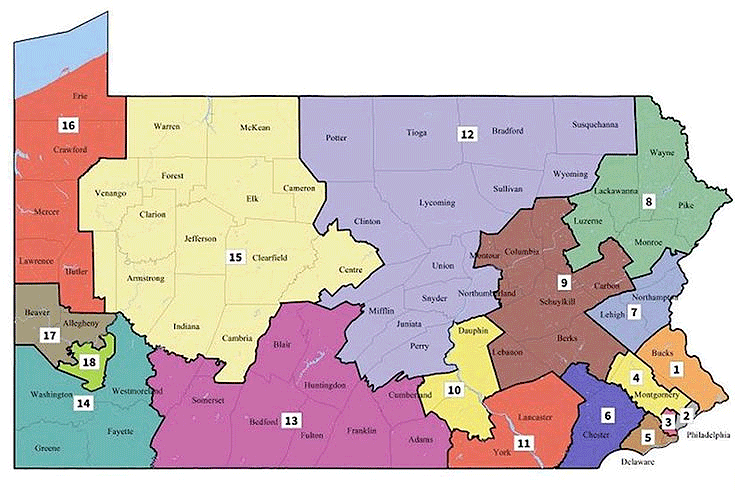
As expected, Gov. Wolf made the 12th District special election concurrent with the Pennsylvania statewide municipal primary, which is scheduled for May 21. There will be only the one election, and the candidate receiving the most votes, regardless of percentage attained, will serve the balance of the current term.

In the meantime, the 15 county chairmen from the qualified political parties will schedule a convention in the district to choose their respective nominee. Generally, the convention is weighted to accurately reflect the population spread throughout the district. Therefore, the most populous counties within the 12th CD, Lycoming and part of Centre that together possess 29 percent of the district’s population, will likely have a commensurate number of votes at the special nominating convention.

Continue reading

Poll: Trump Behind All, But Skewed?

By Jim Ellis

Jan. 25, 2019 — A new Public Policy Polling company national survey (Jan. 19-21; 750 US registered voters) finds President Trump, who is likely at his lowest ebb in popularity during his two-year stewardship in office, trailing seven prospective Democratic opponents, but the study appears to be nothing short of a push poll.

Initially, the survey sample finds President Trump trailing Hillary Clinton by a net four points more than the actual 2016 national campaign result when the respondents are queried about who they supported in the last presidential election. This alone points to at least a slight sample skew.

The historical presidential vote tabulation is followed by a series of questions, all designed to place President Trump in a negative light.


Verbatim from the PPP study, the questions are:

  • Do you think that Donald Trump is honest, or not? Yes 35%; No 58%
  • Do you think that Donald Trump is a liar, or not? Yes 48%; No 44%
  • Do you think that Donald Trump has made America Great Again, or not? Yes 38%; No 55%
  • Do you think Donald Trump should release his tax returns, or not? Yes 55%; No 38%
  • Do you think that members of Donald Trump’s campaign team worked in association with Russia to help Trump win the election for President, or not? Yes 45%; No 43%
  • Continue reading

Pennsylvania Rep. Marino to Resign

By Jim Ellis

New Pennsylvania Congressional Map | Source: Pennsylvania State Supreme Court (click on image to see full size)

Jan. 22, 2019 — Five-term Pennsylvania Rep. Tom Marino (R-Williamsport) announced that he is leaving Congress next week to accept a professional position in the private sector. Marino was first elected to the House in 2010, after serving five years as the US Attorney for the Middle District of Pennsylvania, and 11 years as District Attorney of Lycoming County.

In the Republican wave election of 2010, Marino ousted then-Rep. Chris Carney (D) by a 55-45 percent margin and has averaged 66.1 percent of the vote in his subsequent re-elections. The 2018 Pennsylvania court-ordered redistricting plan re-numbered his 10th Congressional District to 12 and created a seat where 68 percent of the constituency carried over from the previous district.

In 2017, President Trump nominated Rep. Marino as the Director of the Office of National Drug Control Policy, commonly referred to as the nation’s “drug czar.” But the congressman withdrew his name when experiencing some negative reaction during the confirmation process.

The 12th District will now go into a special election cycle. After the seat becomes officially vacant on Jan. 23, Gov. Tom Wolf (D) will have 10 days to issue a writ of election to fill the newly open seat. The various political parties will meet in special conventions to choose their nominees, with the winners proceeding to an election date that the governor will assign. It is most likely he will schedule the 12th District special to run concurrently with the Pennsylvania municipal primary, which is calendared for May 21.

Continue reading

Senators’ Approvals vs. Votes

By Jim Ellis

Dec. 13, 2018 — Reviewing documentation from the 2018 US Senate races, it appears there is at least a tangential correlation between an incumbent senator’s pre-campaign approval rating and the vote percentage garnered on Election Day.

(Click on image to go to full story at Morning Consult.)

The Morning Consult public affairs firm routinely surveys senators and governors to produce approval indexes for every member. Their 3rd Quarter 2018 sampling was publicly released on Oct. 10, one month before the election and just at the beginning of prime time campaigning.

Looking at the 32 incumbent senators who were on the ballot in November, the mean average increase from the individual’s approval score to the final vote percentage is 9.6 points when using the Morning Consult favorability index as our constant and the median is nine points.

The senator dropping the furthest from approval to vote percentage, down five points, was Maine Sen. Angus King (I), but the number is a bit deceiving. King scored a 58 percent positive approval rating in mid-October, but only received 53 percent in the election. Because the senator is an Independent and the Democrats with whom he caucuses did file their own candidate, the next closest opponent scored 35 percent. Therefore, his political standing still proved strong.

On the other end of the spectrum, the senator who improved the most from an upside-down favorability index rating to the vote was New Jersey Sen. Bob Menendez (D). While his October index was a poor 31:46 percent favorable to unfavorable, the worst by far among the 32 senators standing for re-election, he was successfully re-elected, 54-43 percent, over retired pharmaceutical company CEO Bob Hugin (R).

Continue reading

Yet Another Election

By Jim Ellis

Appointed Mississippi Sen. Cindy Hyde-Smith (R), left, and Democrat challenger Mike Espy

Nov. 27, 2018 — The 2018 election cycle’s final contest comes today in Mississippi. The special run-off campaign between appointed Sen. Cindy Hyde-Smith (R) and former US Agriculture Secretary and ex-Mississippi congressman, Mike Espy (D), will decide if the 116th Congress will feature a Senate that brandishes a 53-47 Republican majority or a lesser 52-48.

The run-off occurs because no candidate received an absolute majority in the Nov. 6 special jungle primary. The special election is necessary because Sen. Thad Cochran (R) resigned for health reasons in the middle of his final term in office, thus necessitating an appointed replacement and this confirming electoral vote for the winner to serve the balance of the term. Whether Sen. Hyde-Smith or Espy wins today, there will be another election in the regular 2020 cycle for the full six-year term.

In the first vote, Sen. Hyde-Smith placed first, but barely, with a 41.5 percent plurality compared to Espy’s 40.6 percent, a difference of 8,284 votes from more than 883,600 ballots cast. The third-place finisher, Tea Party activist state Sen. Chris McDaniel (R-Ellisville), captured the remaining 16.4 percent with Independent Tobey Bartee picking up the final 1.4 percent. Once the run-off began, Sen. McDaniel announced his support of Sen. Hyde-Smith, which should go a long way toward unifying her Republican base.

Controversy in this run-off campaign arose when Hyde-Smith made several unforced errors. Making statements about wanting to be present at a lynching, visiting a Confederate Museum where she donned a uniform, and now under attack for attending what was commonly referred to as a “segregation academy” for high school has put the appointed senator clearly on the defensive.

Continue reading

Mia Love Falls in UT-4

Utah Rep. Mia Love (R-Saratoga Springs)

By Jim Ellis

Nov. 21, 2018 — It appears the final undecided House race has now come to at least an unofficial end, and the result is a bit surprising.

Some, including me, were predicting the culminating vote tabulation trend in Utah’s UT-4 District would favor incumbent US Rep. Mia Love (R-Saratoga Springs), based upon her overwhelming performance from the late votes in the 4th District’s two rural counties and the more populous Utah County. But the substantial number of remaining ballots in Salt Lake County proved decisive in that Democratic nominee Ben McAdams over-performed, which flipped the race back in his direction as the count concluded.

On election night, it appeared that Rep. Love had been defeated when she fell almost 9,000 votes behind as Salt Lake County was being tabulated. But she came roaring back when the outlying counties’ votes were counted. As the late votes were finally being recorded, Love rebounded to forge a 1,615 district-wide vote edge. Her advantageous situation was precarious, however, as thousands of same-day registration, absentee, and provisional votes still remained in Salt Lake County.

Yesterday, those latter votes were counted while Love found herself slightly under-performing within the last group of Utah County votes. She garnered only 66 percent in the final Utah County vote pool, below the 74% she was posting in previous totals within this entity.

According to local reports, this meant that Democrat McAdams, the Salt Lake County mayor, could overtake the congresswoman should he score approximately 59 percent from the remaining votes. This, he did, and then some, as McAdams erased MLove’s previous lead and ended the counting day with a 739-vote advantage.

McAdam’s surge was largely due to approximately 9,000 same-day registrants, many of whom were coming to the polls to vote for the medical marijuana ballot proposal that passed the state 53-47 percent but was overwhelmingly approved in Salt Lake County. It is evident that a strong majority of these voters supported McAdams.

Continue reading