Tag Archives: Maine

Where the Senate Stands

By Jim Ellis

Oct. 13, 2020 — Now, less than a month before the official Election Day, we see multiple polls coming regularly in almost every competitive Senate race. Democrats need a net conversion of three Republican seats if Joe Biden is elected president and four seats if he is not. With 16 races now on the competitive board, we look at where they each stand. At least two surveys are included for each race.

Looking at the current trends, we see a tightening Senate from the current 53R-47D majority. Under the current swing, Democrats could reach 51, but with several races remaining as toss-ups or in range where they still could go either way. It’s conceivable, at this point, that both parties could claim 49 seats with a fight for the remaining two that would decide the next majority.

All of the polling data is from late September and early October:


ALABAMA: Sen. Doug Jones (D) vs. Tommy Tuberville (R)
• Trend: Tuberville

POLLS:
• University of Auburn @ Montgomery (Sept. 30-Oct. 3; 1,072 registered Alabama voters)
  Tommy Tuberville (R) – 54%
  Sen. Doug Jones (D) – 42%

• Morning Consult (Sept. 11-20; 658 likely Alabama voters)
  Tommy Tuberville (R) – 52%
  Sen. Doug Jones (D) – 34%


ALASKA: Sen. Dan Sullivan (R) vs. Dr. Al Gross (I/D)
• Trend: Slightly Sullivan

POLLS:
• Alaska Survey Research (Sept. 25-Oct. 4; 676 likely Alaska voters)
  Sen. Dan Sullivan (R) – 48%
  Al Gross (I/D) – 44%

• Harstad Strategic Research (Sept. 20-23; 602 likely Alaska voters)
  Sen. Dan Sullivan (R) – 46%
  Al Gross (I/D) – 45%


ARIZONA: Appointed Sen. Martha McSally (R) vs. Mark Kelly (D)
• Trend: Kelly

POLLS:
• Latino Decisions (Sept. 28-Oct. 6; 600 likely Arizona voters)
  Mark Kelly (D) – 47%
  Sen. Martha McSally (R) – 42%

• Ipsos (Oct. 3-5; 550 likely Arizona voters)
  Mark Kelly (D) – 48%
  Sen. Martha McSally (R) – 44%

• Data Orbital (Oct. 3-5; 550 likely Arizona voters)
  Mark Kelly (D) – 49%
  Sen. Martha McSally (R) – 44%

• HighGround, Inc. (Sept. 28-Oct. 5; 400 likely Arizona voters)
  Mark Kelly (D) – 50%
  Sen. Martha McSally (R) – 44%


Continue reading

Sen. Collins of Maine Hanging On

By Jim Ellis

Maine Sen. Susan Collins (R)

Sept. 25, 2020 — Our original quick analysis may be incorrect. Soon after the announcement that Justice Ruth Bader Ginsburg had passed away, Sen. Susan Collins (R-ME) made a statement indicating that she would not support until after the election a motion to proceed that would allow the Senate to vote on confirming a Supreme Court replacement.

Responding, we believed that Sen. Collins’ decision had sealed her own doom in regard to winning her re-election campaign against state House Speaker Sara Gideon (D). We reasoned that at least a part of Maine’s conservative bloc would likely turn away from Sen. Collins, one who they do not particularly trust anyway, yet a group she needs to close the polling deficit she faces against Gideon. This was also predicated upon the belief that her move would gain little from the center-left or mostly left voter who may have supported Sen. Collins in previous elections.

A just-released Maine political survey, however, suggests that such a conclusion may not be so clear. Moore Information, polling for the National Republican Senatorial Committee and the first Maine Senate data released into the public realm after Justice Ginsburg’s death (Sept. 20-22; 500 likely Maine voters, live interview), finds Sen. Collins actually gaining support to pull into a 42-42 percent tie with Gideon. This is the first survey showing Sen. Collins even or ahead since another Moore Information poll conducted in late June posted her to an eight-point lead.

The Maine seat is critical to determining the next Senate majority. Routinely, we believe it is part of a four-state firewall that Republicans must maintain to uphold their relatively slim 53-47 chamber majority. The other three being converting Alabama, and retaining Iowa and Montana. Losing any one of these four states would likely turn the focus to North Carolina where Sen. Thom Tillis (R) would be forced to score a come-from-behind win, which could then pave the way for Republicans keeping majority control with a smaller edge.

Polling has been clear for weeks that Sen. Collins is trailing. Since 2020 began, now 18 polls have been conducted of this Senate race, and Gideon has led in all but the two Moore Information surveys. Overall, the incumbent has been trailing by an average slightly over four percentage points with a median of 4.5 percent, numbers barely within the polling margin of error range.

Continue reading

Senate: A Polling Comparison

By Jim Ellis

Sept. 24, 2020 — Today, we look at the competitive Senate races and segment the group around polling consistency. Several races routinely report point spreads between the two major party candidates that are wildly inconsistent, while others vary over a small difference often within the same polling period.

The two most extreme surveys during the month are listed for each state with the most extreme first and the closest second. You will notice that the British firm, Redfield & Wilton Strategies, is often listed as the most extreme.

We begin, alphabetically by state, with the inconsistent group. Only the two Georgia races are in the September consistent segment.


INCONSISTENT


Arizona
Number of September polls: 14
Polling range: 16 points

Redfield & Wilton Strategies
(Sept. 12-16; 855 likely Arizona voters; combination online and live interview)
• Mark Kelly (D) – 52%
• Sen. Martha McSally (R) – 35%

ABC News/Washington Post
(Sept. 15-20; 579 AZ likely voters; live interview)
• Mark Kelly (D) – 49%
• Sen. Martha McSally (R) – 48%


Iowa
Number of September polls: 2
Polling range: 8 points

Fabrizio Ward/Hart Research (for AARP)
(Aug. 30-Sept. 5; 800 likely Iowa voters; live interview)
• Sen. Joni Ernst (R) – 50%
• Theresa Greenfield (D) – 45%

Selzer & Company
(Sept. 14-17; 658 likely Iowa voters; live interview)
• Sen. Joni Ernst (R) – 45%
• Theresa Greenfield (D) – 42%


Continue reading

SCOTUS: The Effect of Replacing Late Supreme Court Justice Ruth Bader Ginsburg On The 35 Senate Races

By Jim Ellis

Late Supreme Court Justice Ruth Bader Ginsburg

Sept. 22, 2020 — A secondary question surrounding the replacement process for the late Supreme Court Justice Ruth Bader Ginsburg is how will the confirmation fight over the next judicial nominee resonate in the 35 Senate races?

In the 18 campaigns that appear non-competitive (9D; 8R) – for example, in Illinois (Sen. Dick Durbin-D), Rhode Island (Sen. Jack Reed-D), Arkansas (Sen. Tom Cotton-R), and Idaho (Sen. Jim Risch-R) to name a representative quartet – the Supreme Court battle will have little influence over the Senate outcome since those situations are virtually decided.

If the individual campaigns play the issue correctly, however, the Supreme Court vacancy development could be a boon to most competitive Republican incumbents and candidates in traditionally conservative states that are moving closer to the political center.

Democratic challengers in the more conservative states could have trouble because the issue matrix likely to be discussed through the nomination and confirmation process should activate the more conservative voting base. This is likely the case in the key competitive southern domains (AL, GA, NC), and in the Midwest and Rocky Mountain states, particularly in Iowa, the Kansas open seat, and for the Montana duel, in addition to the far west campaign in Alaska.

Perhaps the senator in the worst confirmation question situation, and one who can ill afford to be embroiled in such a predicament, is Maine Sen. Susan Collins (R). Already trailing in polling to state House Speaker Sara Gideon, Sen. Collins’ immediate call to postpone the process, and what will likely lead to a vote against the motion to proceed, will likely cost her conservative votes that she badly needs.

Her position to postpone has likely angered many who comprise the conservative base and gained her nothing with the Independents and soft Democrats that she desperately needs to close the gap between she and Gideon.

Continue reading

The Senate Trends

By Jim Ellis

Sept. 14, 2020 — The AARP organization yesterday released a series of polls covering nine Senate races in eight states that help set benchmarks for the most recent data.

AARP contracted with four polling firms, two Republican and two Democratic, and paired each with the opposite party pollster. The Benenson Strategy Group (D) partnered with the GS Strategy Group (R) for surveying Arizona, Michigan, and North Carolina.

The Fabrizio Ward firm (R) and Hart Research Associates (D) conducted the joint Colorado, Georgia (both races), Iowa, Maine, and Montana survey research. All of the polls were live interview with large sampling universes of likely voters unless otherwise noted.

Predominantly, the ballot tests find the Democratic candidate typically leading, but with the Republican improving his or her position in comparison to the previously released polling results.

Below are the AARP results followed by the two most recent reported surveys in each state:


ARIZONA
Benenson Strategy/GS Strategy (Aug. 28-Sept. 8; 1,600 likely Arizona voters)
• Mark Kelly (D) – 48%
• Sen. Martha McSally (R) – 45%
Previous:
• Change Research (D) – (Sept. 4-6) – Kelly +6
• Redfield & Wilton Strategies (UK) – (Sept. 30-Aug. 4) – Kelly +15


COLORADO
Fabrizio Ward/Hart Research (Aug. 30-Sept. 5; 800 likely Colorado voters)
• Ex-Gov. John Hickenlooper (D) – 51%
• Sen. Cory Gardner (R) – 46%
Previous:
• Morning Consult – (Aug. 21-30) – Hickenlooper +9
• Public Policy Polling (D) – (Aug. 18-19) – Hickenlooper +9 (voters)


GEORGIA-A
Fabrizio Ward/Hart Research (Aug. 30-Sept. 5; 800 likely Georgia voters)
• Jon Ossoff (D) – 48%
• Sen. David Perdue (R) – 47%
Previous:
• Public Policy Polling (D) – (Aug. 13-14) – Even (voters)
• Garin Hart Yang Research (D) – (Aug. 10-13) – Ossoff +2


Continue reading

Where the Senate Stands

By Jim Ellis

Aug. 28, 2020 — A tough battle is underway for the US Senate majority, and both parties are fiercely attempting to assume control in the next Congress. Republicans hold a 53-47 majority, but a win in Alabama would send them to 54-46, and that makes the Democrats’ road to the majority all the more difficult.

Democrats need a net conversion of three Republican seats if Joe Biden is elected president, and four if President Trump wins re-election.

Today, we take a snapshot look at polling figures in the key campaign states. How the states listed below eventually fall will determine which party runs the Senate for the 117th Congress.

Below, we provide you the two most extreme results of recent publicly released surveys from the competitive campaigns. The Ellis Insight ratings depict where the race is today, which is not solely based upon polling.


ALABAMA – Lean R (possible conversion)

Morning Consult (July 24-Aug. 2; 80 likely Alabama voters)
• Tommy Tuberville (R) – 52%
• Sen. Doug Jones (D) – 35%

Auburn University at Montgomery (July 2-9; 55 registered Alabama voters)
• Tommy Tuberville (R) – 44%
• Sen. Doug Jones (D) – 36%


ARIZONA – Lean D (possible conversion)

Redfield & Wilton Strategies (Aug. 16-18; 856 likely Arizona voters)
• Mark Kelly (D) – 53%
• Sen. Martha McSally (R) – 34%

OnMessage (Aug. 2-4; 40 likely Arizona voters)
• Mark Kelly (D) – 48%
• Sen. Martha McSally (R) – 48%


COLORADO – Lean D (possible conversion)

Public Policy Polling (Aug. 18-19; 731 Colorado voters)
• Ex-Gov. John Hickenlooper (D) – 51%
• Sen. Cory Gardner (R) – 42%

Morning Consult (July 17-26; 61 likely Colorado voters)
• Ex-Gov. John Hickenlooper (D) – 48%
• Sen. Cory Gardner (R) – 42%


GEORGIA–A – Lean R/Toss

Garin Hart Yang Research Group (Aug. 10-13; 60 likely Georgia voters)
• Jon Ossoff (D) – 48%
• Sen. David Perdue (R) – 46%

Survey USA (Aug. 6-8; 62 likely Georgia voters)
• Sen. David Perdue (R) – 44%
• Jon Ossoff (D) – 41%


Continue reading

Beneath the Numbers

By Jim Ellis

Is Maine Sen. Susan Collins (R) in trouble?

July 30, 2020 — Two Senate polls were released earlier this week, and though the ballot tests in Maine and South Carolina didn’t show us anything particularly new, the pollsters asked their respective sampling universes some interesting ancillary questions.

Colby College, a Waterville, Maine institution housing approximately 1,800 students, released its second political poll of 2020 in conjunction with the McVey Data Science Initiative. The questions touched upon the presidential and Senate ballot tests but delved deeper into the attitudes and perspectives of their 888-person sample over the July 18-24 period.

The presidential ballot test found former vice president Joe Biden leading President Trump statewide, 50-38 percent. The Senate ballot test was closer in that former state House speaker Sara Gideon (D) leads Sen. Susan Collins (R), 44-39 percent.

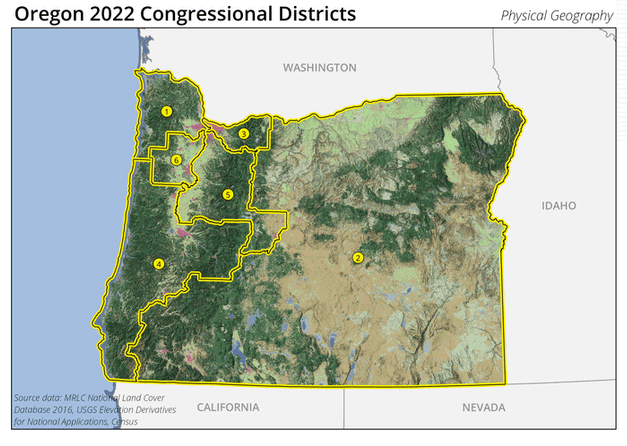
In looking deeper, it is probable that the actual race standings are likely a bit closer. There appears to be a Democratic skew in that all favorability indexes for Democratic public officials were positive and those of the tested Republican officials were decidedly negative. Additionally, 52 percent of the sampling universe comes from the state’s southern congressional district, the 1st, which is decidedly more liberal than the northern 2nd District. Together, these factors provide us the indication that the results are a few points more favorable for Democrats than what we might see in actual voting.

Continue reading

Tuberville, Sessions & Sessions;
Moore, Hegar & Valenzuela

By Jim Ellis

Former Auburn Football coach Tommy Tuberville (center) overwhelms Jeff Sessions in Alabama.

July 15, 2020 — The Texas and Alabama runoffs were held yesterday along with the postponed Maine primary, and we have some winners and cliff hangers.

In Alabama, retired Auburn University head football coach Tommy Tuberville, as expected, pretty much demolished former US attorney general and ex-Alabama senator Jeff Sessions last night with the margin of victory being larger than expected. Though earlier polls had predicted spreads as large as 22 points, a 61-39 percent Tuberville victory margin was not forecast even though every pollster found the former coach leading the race. The Tuberville victory was so complete that Sessions, a man who ran unopposed in his previous Senate re-election campaign (2014), was limited to winning only three counties.

Tuberville advances into the general election to face incumbent Democrat, Sen. Doug Jones, who won a special election in 2017 ironically to replace Sessions after he was appointed to his Trump Administration position. Early polling suggests Tuberville will open the general election with a discernible lead over Sen. Jones in what will likely be a top-three state for President Trump.

Alabama hosted two significant Republican runoff elections last night, both of which almost assuredly identified a pair of new congressmen. In the Mobile-anchored 1st District, Mobile County Commissioner Jerry Carl topped former state senator Bill Hightower, 52-48 percent, and will easily win the general election in November. In the adjoining 2nd District, despite being outspent by a 5:1 ratio, former state Rep. Barry Moore (R-Enterprise) easily defeated moving company owner Jeff Coleman who finished first in the regular primary.

Moore scored a 60-40 percent win over Coleman who dropped more than $1 million of his own money into his campaign and earned retiring Rep. Martha Roby’s (R-Montgomery) endorsement. Moore ran as a Trump Republican and mixed his campaign message with attacks on DC and clever issue targeting. He did not run a negative race against Coleman who had been attacked in the primary. Coleman attracted 38 percent on March 3 but could only expand his runoff vote to 40 percent. Moore, on the other hand, who barely qualified for the runoff – just 591 votes ahead of third place finisher Jessica Taylor – was able to build a winning runoff coalition of 60 percent as compared to his 20 percent in the primary.

Turning to the Texas Senate Democratic runoff, retired Army helicopter pilot M.J. Hegar defeated state Sen. Royce West (D-Dallas) by only about 40,000 votes statewide with further precincts to count. Hegar was mathematically projected the winner, but her margin could continue to shrink once the final tabulations are calculated and reported. She will now challenge Sen. John Cornyn (R) in a race that should break the incumbent’s way by a comfortable margin in November.

Continue reading

Maine’s Ranked Choice Primary

By Jim Ellis

Maine Congressional Districts

July 9, 2020 — It is likely we are going to soon see another Maine congressional race decided through the controversial Ranked Choice Voting system. A new Fair Vote commissioned Survey USA poll, from this group that supports Ranked Choice Voting, finds the three 2nd District Republican congressional candidates in a relatively close battle, but with no one realistically nearing the majority support necessary to win the party nomination.

According to the S-USA poll (June 30-July 6; 604 likely ME-2 Republican primary voters), former state representative Dale Crafts would lead ex-gubernatorial aide and former journalist Adrienne Bennett and ex-state senator and 2018 Republican US Senate nominee Eric Brakey, 37-25-19 percent. While Crafts seems to have a comfortable lead even though the three are bunched relatively close together, the fact that no one is likely to reach the 50 percent threshold means that some voters’ alternative choices would next be counted.

The Ranked Choice Voting system was adopted by the Maine electorate in 2016 and first used two years later. Though former US representative Bruce Poliquin (R) had enough votes to place first in the 2018 race, which would have normally awarded him the election, he lost in the Ranked Choice rounds. Poliquin attempted to overturn the system in a federal court challenge but failed to advance it beyond the district level.

The RCV, or “instant runoff,” system, is designed to produce a majority winner after multiple rounds of voting. Maine is the only state that employs the concept. Other domains, mainly in the South, who want party nominees to win a primary with over 50 percent support, hold a secondary election on a future day. In the RCV system, the initial primary and runoffs are conducted on the same ballot.

In the 2nd District Republican primary this coming Tuesday, since there are only three candidates, voters will mark their ballots from 1 to 3, thus clarifying their preferences beyond the individual they initially choose from the field. After the first round of voting, the last-place candidate is eliminated, and election officials then comb through all of the cast ballots to find those where the last place candidate was the first choice. These ballots are then added back into the pool with their second choice added to the aggregate vote. If no candidate receives a majority after the second round, a third begins sans the new last place candidate if there are more than two contenders remaining.

Continue reading

The Senate Firewall

By Jim Ellis

June 29, 2020 — As many pollsters have done, Siena College and their New York Times polling partner just released survey data for the Arizona, Michigan, and North Carolina Senate races. This is largely because those three states have attracted much attention in the Democrats’ battle to topple the Republican majority.

But a group of four other states may be a better indicator of whether the Senate will flip in November, and all are competitive.

As Siena/NYT found, Democrats Mark Kelly and Sen. Gary Peters are maintaining an approximate 10-point lead in their respective contests in Arizona and Michigan. The North Carolina race, as it typically does, will generally sway between a one to four-point edge for either candidate depending upon the pollster and the time in which the specific survey was conducted. In the Siena/NYT poll, Democrat Cal Cunningham holds a tenuous three percentage point lead over Sen. Thom Tillis (R). During the same polling period as S/NYT (June 8-18), Gravis Marketing (June 17) found Sen. Tillis ahead by one point.

The GOP majority firewall, however, contains four other states. If the Republicans, likely now in the person of retired Auburn University head football coach Tommy Tuberville, converts the Alabama seat, and Sens. Susan Collins (R-ME), Joni Ernst (R-IA), and Steve Daines (R-MT) all win their respective campaigns, the Democrats’ road to majority control becomes rocky. Therefore, watching this quartet of states should provide us a better clue as to which party will control the Senate in the new Congress.

Since February, 14 polls have been released in Arizona and 12 in North Carolina according to the Real Clear Politics polling archives. The Michigan total is 13 and began in March.

In the four actual firewall states, however, little polling attention has been paid. Since February, the Alabama and Maine Senate races have seen just three public polls, apiece. Montana has been surveyed three times since March, and Iowa four from April to the present time.

Let’s now look at the path to the majority if the Republicans win and/or hold their four firewall states. In summary, Alabama must first be converted back to the Republican column. This brings the GOP majority to 54. Additionally, the 54 number must include incumbent victories for Sens. Collins, Ernst, and Daines.
Continue reading