Tag Archives: Gov. Rick Scott

A Florida Polling Bonanza

By Jim Ellis

Feb. 9, 2018 — The 2018 Florida Senate race is on the cusp of becoming one of the top political campaigns in the country, but polling has been scarce … until yesterday.
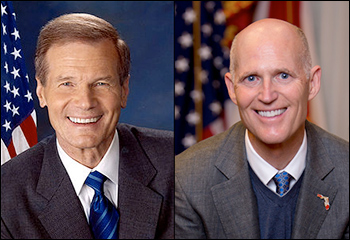
Left: Sen. Bill Nelson (D) | Right: Gov. Rick Scott (R)

Left: Sen. Bill Nelson (D) | Right: Gov. Rick Scott (R)

Three different pollsters released data from their recent Florida electorate surveys, each testing the impending contest between Sen. Bill Nelson (D) and Gov. Rick Scott (R). Though the governor has not announced his candidacy, a loosely affiliated Super PAC has been spending heavily touting his accomplishments through various substantial statewide media buys. Since no other Republican candidate is even contemplating running, few doubt that the governor will make the race.

That being said, Florida Atlantic University, the University of North Florida, and Mason-Dixon Polling & Strategy all released surveys this week. Though each arrived at different ballot test results, and all three have some methodological flaws, it is clear that the overall conclusion tells us that the Florida campaign is already in the toss-up realm.

The FAU poll (Feb. 1-4; 750 registered Florida voters; 375 on-line, 375 via automated telephone system) returns the most surprising result. According to their sampling universe, Gov. Scott has a 10-point, 44-34 percent lead over Sen. Nelson. This seems far-fetched, especially in comparison with the two succeeding polls taken during the same time frame. Additionally, the polling sample contains too many Independents, and is a bit low for both Democrats and Republicans. This makes the ballot test response even more curious and suspect.
Continue reading

Looking at the Governors’ Races

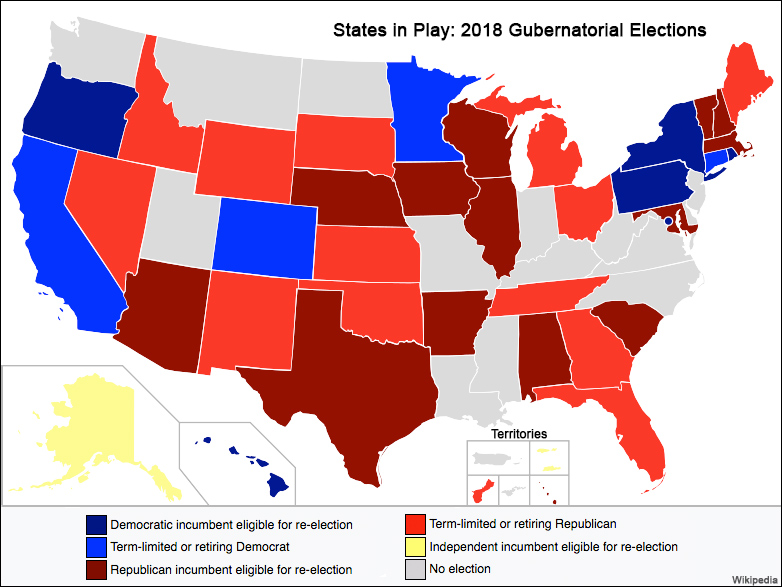
2018-gubernatorial-elections

By Jim Ellis

Jan. 25, 2018 — Earlier this month, we set the stage for the Senate and House campaigns. Today, we look at another important election platform, that of the nation’s governors. Though these races will elect people who will obviously determine future individual state policy, most of the 2018 gubernatorial winners will carry redistricting veto power in 2021. Therefore, these elections also carry national implications.

Of the 36 governors’ campaigns, 17 will be open races mostly due to state term limit laws. While the Democrats must protect the preponderance of US Senate seats this year, the opposite situation exists in the governors’ races. Here, Republicans must defend 26 state houses, 13 of which are open seats.

Of the 13 GOP incumbents seeking re-election, three are actually running for governor for the first time. Govs. Kay Ivey (R-Alabama), Kim Reynolds (R-Iowa), and Henry McMaster (R-South Carolina) were all lieutenant governors who ascended to their current position because the person elected in 2014 is no longer in office.

Alabama’s Gov. Robert Bentley (R) was forced to resign as part of a plea bargain arrangement over campaign finance violations. The other two state chief executives, Terry Branstad (IA) and Nikki Haley (SC), accepted positions in the Trump Administration. At this point in the election cycle, all three unelected governors are favored to win a full term.

Continue reading

New Year Senate Preview – Part II

By Jim Ellis

Jan. 5, 2018 — Continuing our New Year’s preview, today we look at the 2018 Senate races from the Democrats’ perspective.

THE DEMOCRATS

Sen. Claire McKaskill | (Facebook)

Sen. Claire McKaskill | (Facebook)

Because they are now defending 26 of the 34 in-cycle seats, with the addition of the Minnesota special election, the Dems must primarily develop a solid defense before venturing into attack mode. If they are to have any chance of gaining a 51-49 majority, they will realistically have to win all 26 of the incumbent and open seat races they are forced to risk. This includes three contests already considered toss-up campaigns: Missouri Sen. Claire McCaskill likely facing Attorney General Josh Hawley (R), Sen. Joe Donnelly in the Indiana race, and the budding Florida campaign likely between Sen. Bill Nelson and Gov. Rick Scott.

Regardless of whom Sen. Donnelly ultimately faces in the Hoosier State, he will draw a top-tier opponent. Reps. Todd Rokita (R-Brownsburg/Lafayette) and Luke Messer (R-Greensburg/Muncie) battle for the Republican senatorial nomination, and they also face a credible third challenger in former state Rep. Mike Braun (R-Jasper). Braun has the strong ability to finance his own campaign, thus allowing him to adequately compete with the two congressmen. Since he has the promise of becoming his own force, Braun could conceivably strike a chord with the Republican electorate if the two congressmen continue fighting amongst themselves and allow him to slip by both of them.

Republicans will also be competitive in several other Senate races, as they project to have a strong opponent against West Virginia Sen. Joe Manchin (Attorney General Patrick Morrisey and Rep. Evan Jenkins battle for the GOP nomination to be decided in May), while state Treasurer Josh Mandel looks to provide a stronger challenge to Ohio Sen. Sherrod Brown (D) than he did in 2012 when he fell 51-45 percent. The Pennsylvania GOP electorate looks to be coalescing behind Rep. Lou Barletta (R-Hazelton) but upsetting Sen. Bob Casey Jr. is still a highly formidable task, and this developing contest must be considered a long shot as the new year begins.

Continue reading

Scott Gaining Momentum in Florida;
Illinois Filing Closes

Left: Florida Sen. Bill Nelson (D) | Right: Florida Gov. Rick Scott (R)

Left: Florida Sen. Bill Nelson (D) | Right: Florida Gov. Rick Scott (R)

By Jim Ellis

Dec. 6, 2017 — In what should be a premier Senate race next year, the Florida political contest that likely will develop between Sen. Bill Nelson (D) and Gov. Rick Scott (R) has not yet drawn a great deal of national media coverage, but that will certainly change over time.

A new St. Leo University poll (Nov. 19-24; 500 Florida residents) finds Gov. Scott opening up a sizable lead over the three-term Democratic incumbent, 42-32 percent. The results definitely detect a swing toward the term-limited Republican governor; but previous polling conducted since Sept. 10 has forseen a much closer skirmish.

Two polls from September, St. Leo University (Sept. 10-15; 500 Florida residents) and the Florida Chamber of Commerce (Sept. 17-24; 615 likely Florida voters), both projected Gov. Scott to be holding a two-point lead over Sen. Nelson, 35-33 percent and 47-45 percent, respectively. The University of North Florida (Oct. 11-17; 834 Florida voters), however, gave the incumbent a scant 38-37 percent edge in mid-October, while Mason-Dixon Polling & Research (Oct. 17-19; 625 Florida voters) cast the two prospective candidates as tied at 44 percent each.

Continue reading

The Emerging Senate Cycle

By Jim Ellis

Tennessee state flag

Tennessee state flag

Oct. 25, 2017 — Though we still have more than two full months remaining in calendar year 2017, the 2018 US Senate field is beginning to take clear shape. With 34 statewide contests to be decided, including the Alabama special election that will conclude Dec. 12, no fewer than 10 campaigns are basically set. Action is occurring in an additional 13 states suggesting that some sort of primary or general election competition will soon come to the forefront. Eleven incumbents seeking re-election are rated as “safe” at the present time.

Former Tennessee US Rep. Stephen Fincher (R-Crockett County) announced Monday that he would join the open US Senate Republican primary battle, attempting to succeed retiring Sen. Bob Corker (R). This race already appears to be evolving into a possible two-way primary between ex-Rep. Fincher and current 7th District veteran incumbent Marsha Blackburn (R-Brentwood).

Andy Ogles, the former Tennessee director for Americans for Prosperity, remains in the race after launching what is now a moot primary challenge to Sen. Corker but it is unclear how strong he will be now that several conservative organizations are already beginning to coalesce behind Rep. Blackburn.

The only other bit of Volunteer State intrigue centers around Democratic former Gov. Phil Bredesen and whether he will enter the statewide contest. Originally, Bredesen took himself out of consideration, but now agrees to consider becoming a candidate. He says a decision will be forthcoming in a matter of weeks. Without Bredesen, the Democrats would likely concede the seat to the eventual Republican nominee since other strong potential candidates, specifically US Rep. Jim Cooper (D-Nashville) and Nashville Mayor Megan Barry, have already said they will not run.

Continue reading

Florida: Close Again

By Jim Ellis

Sept. 5, 2017 — Last week, Florida Atlantic University released new survey research data (Aug. 25-26; 800 registered Florida voters via online questioning and telephone automated response) that tested the Sunshine State electorate about the impending Senate contest between three-term incumbent Sen. Bill Nelson (D) and term-limited Gov. Rick Scott (R).

Though we haven’t seen numbers here for months, the FAU data shows little has changed since the last surveys were released. Accordingly, Sen. Nelson tops Gov. Scott by only a 42-40 percent margin, meaning a virtual tie. Close races are nothing new in Florida, as we all know, so the polling results seem plausible.

Gov. Scott is not yet an official Senate candidate and repeatedly says he is no hurry to make a decision. But, the Florida political establishment and other prospective candidates believe he is going to run, which explains why there is so little activity around a Democratic incumbent who could be vulnerable.

Through his first term, the governor had been routinely plagued with poor job approval ratings but still managed to win a close 2014 re-election battle against former governor and now Congressman Charlie Crist (D-St. Petersburg). Though the FAU poll did not publicize candidate favorability ratios, previous 2017 studies found the governor’s index significantly rebounding into positive territory. It is likely Gov. Scott is sustaining a positive image, since he continues run close to Sen. Nelson on the ballot test question.

Continue reading

More Sunshine Polling

By Jim Ellis

March 24, 2017 — The Sunshine State of Florida may set an aggregate polling record if the current surveying pace continues. Already we have seen four different pollsters test what may evolve into a US Senate political battle between incumbent Bill Nelson (D) and Gov. Rick Scott (R), including two new studies released just this week.

More telling than the sheer polling volume is seeing all four surveying entities detect virtually the same result. That is, Sen. Nelson has a discernible lead, as one would expect from a three-term incumbent, but his advantage is small and he fails to top 50 percent in any of the publicized ballot tests.

Sen. Nelson was first elected to the House in 1978 after spending six years in the Florida legislature. He served until running for governor in 1990, losing the Democratic primary to former three-term Sen. Lawton Chiles, who would go onto unseat Gov. Bob Martinez (R) to win the statewide political position. Nelson returned to win the office of Florida treasurer, insurance commissioner and fire marshal in 1994, and then was elected US senator in 2000. He will be 76 years old in November of 2018, and has said on numerous public occasions that he will run for a fourth term.

Gov. Scott came to politics after a career in the hospital industry, which led to him forming his own venture capital firm. Politically, he seems to specialize in winning close, upset elections. He nipped then-Attorney General and former US Congressman Bill McCollum in the 2010 Republican gubernatorial primary with a three-point margin of victory, and then defeated Florida CFO Alex Sink (D), 49-48 percent, in a contest that the latter was expected to win easily. Despite poor job approval ratings, Gov. Scott was able to slip past former Gov. Charlie Crist (D) in his re-election campaign, in yet another one-point race (48-47 percent).

Continue reading

Senate ’18 Updates – Part I

By Jim Ellis

March 17, 2017 — As we approach the end of first quarter 2017, we see political maneuvering beginning to occur in many in-cycle US Senate states. Despite what columnists and news reporters are already saying about the Republicans potentially sustaining big mid-term losses in 2018, the Democrats have only one legitimate Senate target: Sen. Dean Heller (R-NV).

Unfortunately for them, Democrats must defend 25 of the 34 in-cycle seats (the latter number includes the Alabama special election), and this political fundamental is likely the key reason Republicans will hold the majority irrespective of what the political climate may be like at election time. Arguably, seven of the nine in-cycle GOP seats are located in some of the strongest Republican states in the nation. Today we take a look at the states alphabetically from Alabama through Maryland.

• Alabama: Appointed Sen. Luther Strange (R) has over a year to solidify himself politically before standing for election. He may well receive a Republican primary challenge because of the circumstances under which he was appointed to succeed Attorney General Jeff Sessions. Sen. Strange, while the Alabama attorney general, was conducting an investigation into Gov. Robert Bentley (R), which was obviously stalled when the appointment was made. So far, no one has announced against Sen. Strange, but state Senate President Del Marsh (R) is a possible candidate.

Continue reading

Nelson vs. Scott

By Jim Ellis

March 10, 2017 — The 2018 Florida Senate race is already creating news. Sen. Bill Nelson (D) has repeatedly said he will seek re-election to a fourth term even though he had been rumored as a retirement candidate.

The senator will turn 76 years of age before the next election and completing 30 years of congressional service at that time has led some to believe he might call it a career in 2018. His public comments about seeking re-election are unequivocal, however.

Simultaneously, Gov. Rick Scott (R), ineligible to seek a third term, has publicly discussed challenging Nelson. Now, two contemporary polls testing the hypothetical race were just released, and the early numbers are suggesting a typically close Florida result.

The University of Northern Florida ran a somewhat flawed poll during February (Feb. 16-26; 973 “completed surveys”), over a long 11-day sampling period but featuring a large respondent pool. Referring to them in terms of “completed surveys” tells us little about the group composition, however. Thus, we cannot clearly determine whether those queried are even registered voters, let alone likely participants in a midterm election.

Continue reading

Jockeying for Position

By Jim Ellis

Nov. 21, 2016 — Already, there is a lot of talk about various senators considering races for governor in their respective states, while at least one term-limited governor publicly muses about running for Senate.

With 38 governors’ races coming to the forefront in the next 24 months — two (New Jersey, Virgninia) in 2017 and 36 in 2018 — we already know that 20 of these states, due to term limits, will choose new governors.

Virginia Gov. Terry McAuliffe (D) cannot succeed himself after four years at the state’s helm. Virginia is still the only state in the country that limits its governors to just one term. In New Jersey, Republican Gov. Chris Christie is ineligible to seek a third term. There is a chance, should Christie obtain an appointment from the Trump Administration, that Lt. Gov. Kim Guadagno (R) would ascend to the governorship and be in a position to run as an appointed incumbent, however.

In the coming even-numbered year 36 gubernatorial chairs are in-cycle. Eighteen state chief executives are barred from seeking a third term (15 Republicans; 3 Democrats), while eight GOP governors and six Democrats can run for re-election. Alaska Independent Gov. Bill Walker is also eligible for a second term.

Continue reading