Tag Archives: Daily Kos Elections

Schiff Shoved Into Lead in Flawed Poll; New Contenders in CA-27, CA-30; Complicated RI-1 Special Election?

By Jim Ellis — Monday, Feb. 27, 2023

Senate

California Rep. Adam Schiff (D-Burbank)

California: Flawed Poll Shoves Schiff Into Lead — The University of California at Berkeley conducted a statewide survey of some California voters, but their results don’t provide an accurate picture of the upcoming US Senate race. The survey only tested Democrats and those identifying with the “No Party Preference” option. No Republicans were included.

The results find Rep. Adam Schiff (D-Burbank) leading Rep. Katie Porter (D-Irvine) and Rep. Barbara Lee (D-Oakland), 23-23-8 percent, but without the Republicans, the data is not particularly useful. In a previous poll, most Republicans were headed toward Rep. Porter’s direction since they have no candidate of their own and Rep. Schiff’s national publicity during former President Trump’s impeachment hearings has made him a highly negative figure among conservative voters.

Since the California system features an all-party qualifying election, not including Republicans in the polling universe — since they certainly can vote in the jungle primary — fails to provide a salient snapshot of how the race would unfold if the election were today. More inclusive polling is needed to develop better insight into this developing campaign.

House

CA-27: New Contender Emerges — California Rep. Mike Garcia (R-Santa Clarita) is one of the few House members who has won multiple terms in a district that favors the opposite political party. One reason is because he has defeated the same opponent, former state Assemblywoman Christy Smith (D), in three consecutive elections. Now, another contender has emerged. Former NASA chief of staff and ex-Virgin Galactic CEO George Whitesides (D) has announced that he will run for the seat in 2024. For Democrats to have a chance to capture this D+8 seat (FiveThirtyEight data organization projection), they will need to field a candidate other than Smith.

CA-30: Yet Another — Rep. Schiff’s open seat has been the most popular California early congressional race. Now, a tenth candidate has announced. West Hollywood Mayor Sepi Shyne (D) confirmed that he will join the open seat contest.

The major candidates, all Democrats, are state Sen. Anthony Portatino (D-La Canada), state Assemblywoman Laura Friedman (D-Burbank), former state Assemblyman Mike Feuer, Los Angeles Unified School District Board member Nick Melvoin, and actor Ben Savage. Two advancing from this group to a double-Democrat general election is highly likely.

RI-1: Special Election Complications — The Daily Kos Elections site is featuring a story on RI-1 that indicates the special election to replace resigning Rep. David Cicilline (D-Providence) is complicated. Rhode Island has not seen a congressional special election since 1967, and the Federal MOVE Act, which requires states to provide 45 days notice to overseas and military voters before an election, is in conflict with the state’s election calendar governing such vacancies. Rep. Cicilline announced earlier in the week that he will resign June 1 to accept the position of president and CEO of the Rhode Island Foundation, a well established charitable nonprofit organization.

According to the RI Secretary of State, it appears Gov. Dan McKee (D) would only have two options to be in compliance with both Rhode Island and federal election law. Therefore, the special primary election could be no earlier than Aug. 8, with the special general on Oct. 3. He could also call a primary on Sept. 5 and make the special general concurrent with municipal elections on Nov. 7. Therefore, we can expect the RI-1 seat to remain vacant for a relatively long period once Congressman Cicilline resigns.

Greitens Gets Help in Missouri; Jones Shows de Blasio the Money in NY;
MI Gov. Whitmer Leads in Polling

By Jim Ellis — July 15, 2022

Senate

Former Gov. Eric Greitens (R)

Missouri: Greitens Gets Help — A Super PAC called Missouri First Action PAC, which the Daily Kos Elections site reports that Home Depot co-founder Bernie Marcus principally funds, is spending $820,000 on a closing media buy to defend former Gov. Eric Greitens against the recent attacks that have displaced him from the polling lead.

The text of the first ad claims the attackers are doing so because “he’ll work for us and see President Trump’s America first agenda through.” The principal attacker, however, is Greitens ex-wife, Sheena Greitens, who details the physical abuse her son endured from his father. The open Missouri primary is Aug. 2. Attorney General Eric Schmitt and US Rep. Vicky Hartzler (R-Harrisonville) are Greitens’ top GOP opponents. The seat is open because Republican Sen. Roy Blunt is retiring.

House

NY-10: Rep. Jones’s, de Blasio Report Fundraising Hauls — US Rep. Mondaire Jones (D-Westchester County), who decided to seek re-election in a New York City seat about an hour’s drive from his Westchester County district after Rep. Sean Patrick Maloney (D-Cold Spring) decided to run against him, is going to report a major resource advantage over former New York City Mayor Bill de Blasio (D). The two are disclosing similar quarterly fundraising totals, Jones’s $524,000 compared to de Blasio’s $510,000, but the congressman’s cash-on-hand total of $2.8 million at the end of June dwarfs de Blasio’s $361,000.

The pair are part of a 13-person Democratic primary field for the new south Manhattan district that the court-ordered redistricting plan created. The Aug. 23 Democratic primary winner will likely claim the seat in November, but there is a potential interesting general election scenario developing.

In addition to Jones and de Blasio, the field features state Assemblywomen Jo Anne Simon (D-Brooklyn) and Yuh-Line Niou (D-NYC), New York City Councilwoman Carlina Rivera, and former US congresswoman and ex-NYC Comptroller Elizabeth Holtzman. Four of the 13 candidates, including Jones, de Blasio, Niou, and Rivera, are also competing for the Working Families Party ballot line. This means we could see a competitive general election if different candidates win the Democratic and WF lines.

Governor

Michigan: Gov. Whitmer Leads in Polling Scenarios — The Glengariff Group, a frequent Michigan political pollster, released their latest survey, which pairs Gov. Gretchen Whitmer (D) with the leading GOP primary contenders. The poll, conducted for Detroit television station WDIV and the Detroit News (July 5-8; 600 likely Michigan general election voters; live interview) finds Gov. Whitmer comfortably ahead of the top three Republican candidates, but with margins indicating the November election could become competitive.

Against GOP polling leader Tudor Dixon, an online radio show host, Gov. Whitmer is staked to a 51-40 percent lead. Her advantage is similar against businessman Kevin Rinke and real estate broker Ryan Kelley, 52-40 percent over the former, and 50-41 percent against the latter. The Michigan GOP field was upended when early race leader, former Detroit Police Chief James Craig, was disqualified when he failed to produce the required number of valid petition signatures. With Whitmer in the low 50s in all scenarios, we can expect this race to close after the Aug. 2 primary when the GOP will choose a nominee.

Texas: More of the Same — The typical Texas polling pattern usually projects relatively close general election pairings, and the Republican candidate generally winning by a greater percentage than the data predicts. It’s likely we’re seeing the same progression emerge in the 2022 governor’s race. The latest YouGov/University of Houston poll (June 27-July 7; 1,169 registered Texas voters; 1,006 likely Texas general election voters; online) finds Republican Gov. Greg Abbott, seeking a third term, topping former US Rep. and 2020 presidential candidate Beto O’Rourke (D) by a 47-42 percent margin.

Since the Texas March 1 primary, nine gubernatorial polls have been released, with Abbott leading in each. His range roams from 42 to 56 percent, with O’Rourke placing between 37-44 percent. Expect Gov. Abbott to record a comfortable victory in November.

Masters Pulling Away in Arizona; Warnock-Walker Race in GA Tight; Ryan-Vance Neck-and-Neck in Ohio

By Jim Ellis — July 12, 2022

Senate

Venture capitalist Blake Masters (R)

Arizona: Masters Pulling Away — Two new Arizona Republican Senate primary surveys find venture capitalist Blake Masters, whom former President Trump endorses, expanding his previous advantage for the Republican nomination. OH Predictive Insights (June 30-July 2; 515 likely Arizona Republican primary voters; live interview & peer-to-peer text), whose April poll posted business executive Jim Lamon to a lead, now sees Masters pulling away. The OH ballot test forges a 25-18-14 percent advantage for Masters over Lamon and Attorney General Mark Brnovich.

Democratic pollster Public Policy Polling tested the Republican Senate field, too. Their poll (June 28; 595 likely Arizona Republican primary voters) also finds Masters holding the lead, but they see second and third place reversed. The PPP totals show Masters’ margin at 29-15-10 percent over Brnovich and Lamon. A total of 53 percent in the PPP survey say they are much more or somewhat more likely to support Masters because of ex-President Trump’s endorsement.

Georgia: Another Lead Change — Just when the polling data began to trend Sen. Raphael Warnock’s (D) way, a new Democratic poll finds Republican Herschel Walker rebounding to take back the advantage. The progressive left firm Data for Progress went into the Georgia field (July 1-6; 1,131 likely Georgia general election voters; text & online) and posts Walker to a 49-47 percent slight advantage. This wholly contrasts with Quinnipiac University’s late June survey that yielded a 54-44 percent lead for the incumbent. Two other June polls, from Moore Information (R) and East Carolina University and conducted prior to the Q-Poll, both project the two candidates tied.

Based upon the preponderance of recent data, it appears apparent that the Warnock-Walker race is tight. The Quinnipiac finding suggesting that a significant Warnock lead exists should be disregarded, at least in the short term.

Ohio: Ryan Slips Past Vance — A late June Impact Research firm (formerly ALG Research) poll for Rep. Tim Ryan’s US Senate campaign (June 27-30; 816 likely Ohio voters) posts the Democratic congressman to a slight 48-46 percent edge over Republican author J.D. Vance.

The result is typical of what we see in Ohio polls. The two major party candidates often poll close until the campaign’s final two weeks when one of the contenders — usually the Republican in races since 2010 — pulls away. It would not be surprising to see a similar pattern develop in this contest.

House

New Hampshire: House Dem Incumbents Raising Big Money — Both New Hampshire Democratic incumbents Chris Pappas (D-Manchester) and Annie Kuster (D-Hopkinton) will face competitive general election opponents after the Sept. 13 primary. Each has a politically marginal district in a state where the Right Track/Wrong Track polling responses appear to put the Democrats in serious political jeopardy.

In advance of the July 15 reporting deadline, both House members have pre-released substantial fundraising and cash-on-hand totals. Rep. Kuster reports $611,000 raised for the 2nd quarter and holds $2.6 million in her campaign account. Rep. Pappas, who likely faces the more difficult re-election challenge, will post $670,000 raised after April 1, and $2.2 million in his campaign account. The Republican candidates have not yet announced their fundraising totals.

Governor

Georgia: Kemp Up in Poll; Abrams Leads in Funding — The aforementioned Data for Progress poll (see Georgia Senate above) also surveyed the Georgia governor’s race. The ballot test projects Gov. Brian Kemp (R) to a surprisingly large 53-44 percent advantage over former state House Minority Leader Stacey Abrams (D). The comparative late June Quinnipiac poll found the two candidates tied at 48 percent apiece.

The Daily Kos Elections site is reporting that Abrams’ campaign has raised a huge $9.8 million in the past two months and an allied political action committee pulled in an additional $12.3 million. The combined cash-on-hand figure of $18.5 million for the Abrams’ team is almost $8 million more than Gov. Kemp and his allies have readily available.

Campaign Dollars – Quarter 1

By Jim Ellis

April 25, 2022 — The Federal Election Commission (FEC) has released the campaign finance reports for the quarterly period ending March 31, and the Daily Kos Elections site analysts have published their regular comprehensive summaries for all Senate and House incumbents and candidates.

In the Senate, the top fundraisers for the campaign-to-date are familiar names, and they are repeating their overwhelming performance from the 2020 election cycle. For the 2022 race, Georgia Sen. Raphael Warnock (D) reports $44.2 million in receipts with a cash-on-hand total of $25.6 million. Both are higher than any individual running for the Senate in the 2022 cycle. Sen. Mark Kelly (D-AZ) is close behind, raising $39.0 million for the campaign cycle with $23.3 million in his treasury.

Based upon state population segments, Sen. Kelly is actually the stronger of the two because he comes from a smaller state. Dividing the funding evenly by congressional district, Sen. Kelly averages $4.3 million per his state’s nine congressional districts, while Sen. Warnock posts $3.2 million per Georgia’s 14 CDs.

The next most prolific fundraisers come from the same race. Florida Congresswoman Val Demings (D-Orlando) is the top money producing challenger in the country, posting $30.5 million in receipts for the campaign cycle. Her opponent, Sen. Marco Rubio (R), is virtually even with her, attracting $29.3 million. Cash-on-hand is about dead even, too. Rep. Demings reports $13.2 million in her account; Sen. Rubio, $13.1 million.

For the Republicans, the top challenger fundraiser, though he is leagues behind general election opponent Sen. Warnock, is Georgia’s Herschel Walker with $14.2 million raised.

The aggregate group of Senate candidates raising the most in one challenger contest is found in Wisconsin, as Democrats Alex Lasry, state Treasurer Sarah Godlewski, and Lt. Gov. Mandela Barnes have cumulatively brought in $18.2 million. Lasry, an executive with the Milwaukee Bucks professional basketball club, has gross receipts of over $9 million, but $5.8 million is self-sourced. Godlewski reports $5.1 million in total dollars raised, but $3.3 million comes from herself. Lt. Gov. Barnes has raised $4 million without any self-funding. For his part, Sen. Ron Johnson (R) has obtained $10.8 million for his 2022 re-election campaign.

The most prolific open seat fundraisers are in Pennsylvania and Ohio. The combined candidate dollar total in the Keystone State exceeds $45 million, but almost $18 million of that total is self-funded from Dr. Mehmet Oz (R) and former hedge fund CEO David McCormick (R). The group from Ohio is close behind with $44.8 million obtained. In this case, we see a combined self-funding total that exceeds $21 million.

On the House side, a total of 32 incumbents and challengers raised over $1 million just during the first quarter. Naturally, the party leaders, Minority Leader Kevin McCarthy ($4.3 million), Minority Whip Steve Scalise ($3.4 million) and Speaker Nancy Pelosi ($3.3 million) are the most prolific.

Majority Leader Steny Hoyer ($510,000) and Majority Whip Jim Clyburn ($284,000) are clearly not in the top echelon, but are likely spending their time raising funds for their leadership PACs or the Democratic Congressional Campaign Committee (DCCC). Additionally, with Democratic incumbents and candidates raising considerably more than their Republican counterparts, the individual campaigns need less from Washington.

The top non-incumbents breaking the $1 million mark for the quarter are Jessica Cisneros, now in a Texas Democratic runoff with Rep. Henry Cuellar (D-Laredo) and Marcus Flowers, who is challenging Georgia Rep. Marjorie Taylor Greene (R-Rome), both at $2.4 million.

Continue reading

Rep. Jim Cooper to Retire;
Alabama Map Tossed

By Jim Ellis

Jan. 27, 2022 — The Tennessee state Senate passed the state House version of the new 9-District congressional map on Tuesday, which led to a political move. The redistricting plan now goes to Gov. Bill Lee (R), and he is expected to sign the legislation.

Retiring Tennessee Rep. Jim Cooper (D-Nashville)

Upon passage of the new map that would significantly change the Nashville area, veteran Rep. Jim Cooper (D-Nashville) quickly announced that he will not seek re-election later this year.

The map drawers divided Davidson County, which houses the Democratic city of Nashville, and split it among three districts: Cooper’s 5th, Rep. John Rose’s (R-Cookeville) 6th CD, and Rep. Mark Green’s (R-Clarksville) TN-7.

The effect creates a new 5th District that moves from a victory margin of 60-37 percent for President Biden to a seat that former President Trump would have carried 54-43 percent according to the Daily Kos Elections site statisticians. Both Reps. Rose and Green would continue to have solid Republican seats even with the Davidson County additions to their districts. Under the plan, the Tennessee delegation is expected to move from 7R-2D to 8R-1D.

Cooper is serving his 16th term in the House, winning his first election from the state’s east/southeastern 4th District in 1982, which he represented until he ran unsuccessfully for the US Senate in 1994. He returned to the House from the Nashville district in 2002 when then-Rep. Bob Clement (D-Nashville) left the seat to challenge then-Sen. Fred Thompson (R), the same man who defeated Cooper in his statewide bid.

During his second tour of duty in the House, Rep. Cooper was not seriously challenged for re-election. He is a member of the House Armed Services Committee where he chairs the Strategic Forces Subcommittee. He also is a member of the House Oversight and Reform Committee, and the House Budget panel. It appeared that Cooper was preparing for a Democratic primary challenge this year, but that is moot now that the new 5th District becomes decidedly Republican.

Rep. Cooper is the 29th Democrat not to seek re-election. Counting the Democratic and Republican retirements along with the new and created (through redistricting) open seats, the House will see a minimum of 50 new members coming into office at the beginning of 2023.
Continue reading

Michigan’s Anti-Incumbent Map

By Jim Ellis

Jan. 5, 2022 — One of the biggest complaints most commonly aired about redistricting is that it favors incumbents, but such is not the case with the recently completed Wolverine State congressional map. In fact, the members of the Michigan Independent Citizens Redistricting Commission appear to have gone out of their way to upend the state’s sitting federal office holders.

The current 14-seat map features seven Democrats and seven Republicans with two of the seats converting from Republican to Democrat in the 2018 election. Michigan loses a seat in reapportionment, and it became apparent from the start that the Republicans would absorb the loss because a great deal of the population growth deficit was coming from the middle section of the lower peninsula.

That proved to be the case, but the cut was a bit different than expected. Considering the population deficit and Michigan’s geography, i.e., being surrounded by lakes, Canada, and other states, the most logical district for collapse appeared to be Rep. John Moolenaar’s (R-Midland) 4th District because it sat in the middle of the area that the population change clearly affected.

While the Moolenaar district was certainly altered in a significant manner, it was the western district of Rep. Bill Huizenga (R-Holland) that was broken into small pieces.

While true that Moolenaar was technically paired with Rep. Dan Kildee (D-Flushing/Flint) because his home city of Midland was placed in the new 8th District, a new safe Republican 2nd CD that contains much of the current Moolenaar district lies available for him to the west. While Rep. Kildee sees his home Flint/Flushing area remaining intact, he finds himself in a more competitive seat and may be facing a challenge from former congressman, attorney general, state appellate judge, and ex-US Senate and gubernatorial GOP nominee Bill Schuette in a seat that can now conceivably elect a Republican.

Continue reading

New Redistricting Numbers

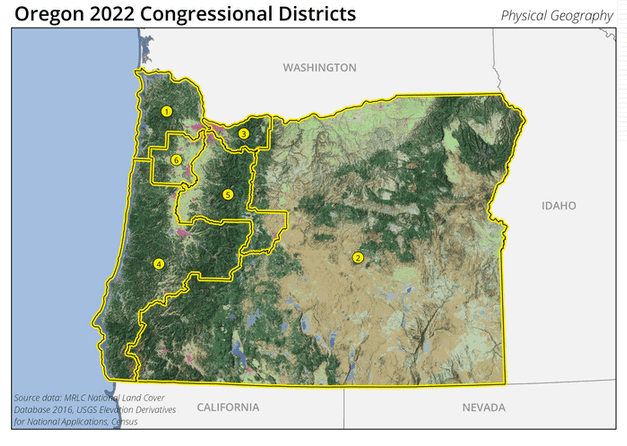
Oregon 2022 Congressional Districts (Go to Daily Kos story on Oregon’s new House map)

By Jim Ellis

Oct. 12, 2021 — The Daily Kos Elections website’s statistical team has already published presidential election numbers for some of the states that have completed their redistricting process. Therefore, we have a bit more information about the new districts in Oregon and Maine, which allows us to better analyze the political landscape.

In Oregon, the Daily Kos team has published the Biden-Trump 2020 numbers for the new six Beaver State congressional districts, which makes comparing with previous data possible.

Rep. Suzanne Bonamici’s (D-Washington County) 1st District actually makes her previously safe northwestern Oregon seat even stronger. This new district gives her all of downtown Portland. President Biden posted a 68-29 percent margin in the new 1st, a net 10-point increase from his spread in the current district (63-34 percent).

The state’s lone Republican district, OR-2, also sees its percentages increasing for the incumbent’s benefit, who is freshman Rep. Cliff Bentz (R-Ontario/East Oregon). Instead of finding a 56-42 percent margin in former President Donald Trump’s favor, the new 2nd expands to 61-37 percent, a similar net 10-point improvement for the GOP as the Democrats saw in District 1.

Making the 2nd District so overwhelmingly Republican is reflective of the Democratic legislature’s plan to pack as many GOP voters as possible into the 2nd to facilitate achieving their goal of drawing a 5D-1R statewide map.

Rep. Earl Blumenauer’s (D-Portland) 3rd District, previously the Democrats’ safest Oregon seat, remains so, but with a slightly smaller margin. Under the newly adopted district lines, President Biden would have recorded a 73-25 percent victory as opposed to his 74-23 percent spread under the current map.

Perhaps the biggest change on the Oregon map, other than adding a new district, was making the Eugene-anchored 4th District safer for veteran representative and House Transportation and Infrastructure Committee Chairman Peter DeFazio (D-Springfield).

The Biden margin in the previous 4th was 51-47 percent, and the congressman only recorded 51.5 percent in his 2020 re-election victory, one of the smallest of his 18 electoral triumphs. In the new 4th, President Biden’s victory spread would have been 55-42 percent, a net Democratic gain of nine percentage points.

Continue reading

Census by District

By Jim Ellis

Aug. 17, 2021 — We can now see exactly where each congressional district in the country stands in terms of population. The Census Bureau delivered the state redistricting data last week, and the Daily Kos Elections site data team segmented the numbers into individual congressional districts.

Below is a chart of the 38 states that have more than two districts, isolating the CDs that are the most over and under populated. The “High” column depicts the district that is the most over-populated in the state, while the “Low” is the one requiring the most new residents. The “+/-” column shows how many districts in the particular state are over and under populated.

The most robust district is that of Texas freshman Rep. Troy Nehls (R-Richmond). His southwest Houston seat houses just under one million people, at an exact count of 972,309. The least populated seat is West Virginia’s 3rd District (Rep. Carol Miller-R): 326,267 people under quota. With all of the Mountain State seats seriously down, it is clear as to why West Virginia lost a seat in reapportionment.

There are only two states, Colorado and Oregon, where all of the current districts are over-populated. Both entities gain one seat in reapportionment. On the other end of the spectrum, Michigan and Pennsylvania saw all districts falling below their new population quota, and in Illinois, 17 of their current 18 do as well. All three states are losing a district.

It is not surprising that California lost a seat for the first time in history. A total of 35 of their current 53 seats require more population versus 18 that must shed residents. New York barely lost a seat, by just 89 people statewide, which is surprising when seeing 23 of their current 27 districts requiring additional population.

The states are now converting their new data into their redistricting software systems. After that, most will hold hearings for public input prior to district construction beginning.

STATE DIST INCUMBENT HIGH LOW +/-
Alabama 5 Mo Brooks (R) 43,348 4, 3
7 Terri Swell (D) -53,143
Arizona 5 Andy Biggs (R) 86,414 3, 6
2 Ann Kirkpatrick (D) -50,133
Arkansas 3 Steve Womack (R) 86,266 2, 2
4 Bruce Westerman (R) -66,283
California 45 Katie Porter (D) 53,645 18, 35
-1 40 Lucille Roybal-Allard (D) -70,139
Colorado 4 Ken Buck (R) 148,823 7, 0
+1 3 Lauren Boebert (R) 36,543
Connecticut 4 Jim Himes (D) 25,627 2, 3
2 Joe Courtney (D) -21,288
Florida 9 Darren Soto (D) 186,381 21, 6
+1 13 Charlie Crist (D) -41,756
Georgia 7 Carolyn Bourdeaux (D) 94,304 8, 6
2 Sanford Bishop (D) -92,108
Illinois 7 Danny Davis (D) 10,986 1, 17
-1 17 Cheri Bustos (D) -79,907
Indiana 5 Victoria Spartz (R) 50,921 5, 4
8 Larry Bucshon (R) -38,579
Iowa 3 Cindy Axne (D) 61,382 1, 3
4 Randy Feenstra (R) -31,730
Kansas 3 Sharice Davids (D) 57,816 1, 3
1 Tracey Mann (R) -33,697
Kentucky 6 Andy Barr (R) 33,300 4, 2
5 Hal Rogers (R) -57,592
Louisiana 6 Garret Graves (R) 40,173 3, 3
4 Mike Johnson (R) -47,947
Maryland 4 Anthony Brown (D) 26,772 6, 2
7 Kweisi Mfume (D) -68,401
Massachusetts 7 Ayanna Pressley (D) 18,714 4, 5
1 Richard Neal (D) -50,635
Michigan 11 Haley Stevens (D) -17,368 0, 14
-1 5 Dan Kildee (D) -104,476
Minnesota 3 Dean Phillips (D) 24,586 5, 3
7 Michelle Fischbach (D) -39,978
Mississippi 4 Steven Palazzo (R) 37,196 3, 1
2 Bennie Thompson (D) -65,829
Missouri 3 Blaine Luetkemeyer (R) 35,121 6, 2
1 Cori Bush (D) -54,618
Nebraska 2 Don Bacon (R) 47,170 2, 1
3 Adrian Smith (R) -53,152
Nevada 3 Susie Lee (D) 79,374 2, 2
1 Dina Titus (D) -73,332
New Jerseyy 8 Albio Sires (D) 47,314 5, 7
2 Jeff Van Drew (R) -41,606
New Mexico 2 Yvette Harrell (R) 8,181 2, 1
1 Melanie Stansbury (D) -11,264
New York 12 Carolyn Maloney (D) 34,717 4, 23
-1 23 Tom Reed (R) -83,462
North Carolina 2 Deborah Ross (D) 165,703 12, 1
+1 1 G.K. Butterfield (D) -6,238
Ohio 3 Joyce Beatty (D) 23,119 2, 14
-1 6 Bill Johnson (R) -99,512
Oklahoma 1 Kevin Hern (R) 36,806 3, 2
2 Markwayne Mullin (R) -69,793
Oregon 1 Suzanne Bonamici (D) 157,843 5, 0
+1 4 Peter DeFazio (D) 117,399
Pennsylvania 10 Scott Perry (R) -5,379 0, 18
-1 15 Glenn Thompson (R) -90,540
South Carolina 1 Nancy Mace (R) 87,689 3, 4
6 Jim Clyburn (D) -84,741
Tennessee 4 Scott DesJarlais (R) 62,976 5, 4
9 Steve Cohen (D) -77,122
Texas 22 Troy Nehls (R) 205,322 28, 8
+2 13 Ronny Jackson (R) -59,517
Utah 4 Burgess Owens (R) 65,265 1, 3
3 John Curtis (R) -31,190
Virginia 10 Jennifer Wexton (D) 100,750 6, 5
9 Morgan Griffith (R) -87,917
Washington 7 Pramila Jayapal (D) 28,862 6, 4
6 Derek Kilmer (D) -33,730
West Virginia 2 Alex Mooney (R) -275,777 0, 3
-1 3 Carol Miller (R) -326,627
Wisconsin 2 Mark Pocan (D) 52,678 2, 6
4 Gwen Moore (D) -41,320

Rep. LaHood Considering Judicial Bid

By Jim Ellis

Illinois Rep. Darin LaHood (R-Peoria)

May 25, 2021 — An interesting story is breaking in Illinois that involves four-term US Rep. Darin LaHood (R-Peoria). Reports suggest that the congressman is considering running for an open state Supreme Court position next year instead of re-election.

The move would make some sense in that winning the 3rd District Supreme Court position would appear to give Republicans a 4-3 majority on the judicial panel, the only area of power that the GOP would control in the state.

Considering the Illinois congressional map is a heavy Democratic gerrymander (13D-5R statewide) and will likely continue as such under a new 17-seat map (down one from the current 18) to be drawn when the Census Bureau reports the track data to the states, probability is high that the collapsed seat will be Republican and come from Illinois’ downstate region.

Though fewer people reside in the state of Illinois today than 10 years ago, the population loss appears greater outside the Chicago metropolitan area. Democrats, with their wide majorities in both houses of the state legislature, will assuredly capitalize upon the opportunity of collapsing two of the few remaining GOP seats into one. This means despite languishing in a severe minority, Republican congressional strength in the state will likely diminish even further.

Illinois is one of the few states that runs its Supreme Court elections by districts. Justices are initially elected in partisan elections for 10-year terms, and then must stand for a yes-no retention vote to secure succeeding terms. To win retention, a justice must receive at least a 60 percent yes vote.

Third District Justice Thomas Kilbride recorded only a 56.5 percent yes vote in the November election; therefore, he was defeated. His appointed replacement, Democratic Justice Robert Carter, has already said he will not seek a full 10-year term in 2022, meaning the position will be open for election.

Continue reading

New York Voting Patterns

New York’s Congressional Districts

By Jim Ellis

Feb. 11, 2021 — The Daily Kos Elections researchers are converting the 2020 presidential returns into congressional district totals, as they have successfully done in past election years. This allows us to compare the 2020 voting patterns with those from four years ago. Doing so reveals some interesting conclusions.

As you can see from the chart below of all 27 New York congressional seats, the patterns are striking, and while former President Trump met and exceeded his projected vote goals within his worst performing districts in New York City, he underperformed by similar ratios in the regions that should have been his strongest.

The NY congressional delegation is split 19-8 in the Democrats’ favor. When comparing the districts that President Joe Biden and former President Trump each won, we see that they match almost identically to the partisan choices those electorates made for the House of Representatives.

There is one exception, however, in addition to a pair of districts that Trump carried in 2016 but switched to President Biden in 2020. The Syracuse-anchored congressional seat that Republican John Katko (R) represents is the only New York district that split its presidential and congressional vote.

While Biden was carrying the CD with a nine-point margin, a net 3.6 percent Democratic improvement from Hillary Clinton’s 2016 result in this 24th District, Rep. Katko was re-elected to a fourth term with a 52-42 percent margin over college professor Dana Balter (D), his 2018 opponent who returned for a re-match. The result was a net four-point improvement for the GOP incumbent from 2018 his victory.

The two seats Trump won in 2016 that switched to President Biden in 2020 are the 18th and 19th Districts, those of Reps. Sean Patrick Maloney (D-Cold Spring/Peekskill) and Antonio Delgado (D-Rhinebeck) — CDs that bridge the city districts with those in the upstate region.

As the chart below shows, the striking point is that the net gains or losses in almost every 2020 district when compared to 2016 is almost opposite of what an analyst would have predicted. Former President Trump underperformed on Long Island as well as upstate, areas where he should have shown greater strength; and he over-performed in all of the New York City districts.

Trump lost the NYC seats by substantial margins, a heavily minority region, but his improvement ranged from a net 0.5 percent in Rep. Carolyn Maloney’s (D-Manhattan) Silk Stocking district to 15.5 percent in the Bronx CD of freshman Rep. Ritchie Torres (D). Four years ago, the latter NY-15 CD was the former president’s worst-performing district in the entire country.

These particular results show that despite the media image of Trump being America’s most racist president, the numbers generally depict clear improvement among people of color in New York State.

The explanation for his lesser performance on Long Island and upstate traces back to a familiar Trump 2020 problem: performing worse among women, those aged 65 years and older, in addition to right-of-center unaffiliated and minor party voters. It was his failure to equal his 2016 performance with these voting segments that cost him his re-election victory.

As we look at other numbers from across the country, we will see the patterns uncovered in New York also becoming prevalent in most other regions.


New York

INCUMBENT BIDEN ’20 CLINTON ’16 TRUMP ’20 TRUMP ’16 NET
1 – ZELDIN 47.3 42.2 51.5 54.5 8.1
2 – GARBARINO 47.4 43.9 53.0 51.6 2.1
3 – SUOZZI 54.7 51.6 44.3 45.5 4.6
4 – RICE 55.6 53.4 43.4 43.8 2.6
5 – MEEKS 83.3 85.7 16.2 12.7 5.9
6 – MENG 61.8 65.1 37.4 32.1 8.6
7 – VAZQUEZ 81.8 84.6 16.5 13.5 4.4
8 – JEFFRIES 82.9 86.9 17.3 10.4 12.0
9 – CLARKE 81.4 83.5 17.8 14.4 5.5
10 – NADLER 76.1 78.3 22.9 18.8 6.3
11 – MALLIOTAKIS 44.3 43.8 54.8 53.6 0.7
12 – MALONEY, C. 84.1 83.3 14.8 13.5 0.5
13 – ESPAILLAT 88.1 92.3 11.2 5.4 10.0
14 – OCCASIO-CORTEZ 73.3 77.7 25.9 19.8 10.5
15 – TORRES 86.5 93.8 13.1 4.9 15.5
16 – BOWMAN 75.3 75.1 23.8 22.5 1.1
17 – JONES 59.6 58.6 39.4 38.4 0.0
18 – JONES 51.8 47.1 46.8 49.0 6.9
19 – DELGADO 49.8 44.0 48.3 50.8 8.3
20 – TONKO 59.3 54.0 38.7 40.5 7.1
21 – STEFANIK 43.8 40.0 54.2 53.9 3.5
22 – TENNEY 43.3 39.3 54.7 54.8 3.9
23 – REED 43.3 39.7 54.6 54.5 3.5
24 – KATKO 53.4 48.9 44.4 45.3 3.6
25 – MORRELLE 60.1 55.5 37.8 39.1 5.9
26 – HIGGINS 62.6 57.6 35.6 38.0 7.4
27 – JACOBS 41.1 35.2 56.8 59.7 8.8