Tag Archives: Texas

Senate 2020: The Second Tier – Part II

By Jim Ellis

Dec. 17, 2018 — Friday, we covered the first part of the group of under-the-radar Senate races that could develop in 2020, but where current action is noteworthy.

The eight top-tier competitive states of Alabama (Sen. Doug Jones), Arizona (special election), Colorado (Sen. Cory Gardner), Georgia (Sen. David Purdue), Iowa (Sen. Joni Ernst), Maine (Sen. Susan Collins), New Hampshire (Sen. Jeanne Shaheen), and North Carolina (Sen. Thom Tillis) will be discussed repeatedly throughout the coming election cycle.

Yesterday’s column, however, looked at Kansas (Sen. Pat Roberts), Kentucky (Majority Leader Mitch McConnell), Minnesota (Sen. Tina Smith), Mississippi (Sen. Cindy Hyde-Smith), and Montana (Sen. Steve Daines). Today, we cover the latest news in Oregon, South Carolina, Tennessee, and Texas.

• OREGON: Sen. Jeff Merkley’s (D) seat comes before the voters in 2020, but the two-term incumbent may have other plans. Sen. Merkley confirms that he is considering entering the presidential campaign and is in the process of attempting to convince legislators to change state law to allow him to simultaneously run for president and the US Senate.
Continue reading

Analyzing the 2018 Vote

By Jim Ellis

Dec. 5, 2018 — The Pew Research Center recently released a series of reports about the 2018 electoral patterns that allow us to better understand what happened in last month’s voting.

Clearly, the election produced mixed results: Republicans gained two seats in the Senate; Democrats reached near-wave proportions in the House; Democrats converted a net seven governorships, yet only scored new majorities in six legislative chambers and produced at least temporary redistricting control in just one state (Colorado).

But, why did these unusual results happen? The Pew findings provide us clues.

Among college-educated women, according to the Pew research, 59 percent voted Democratic for the House of Representatives as compared to only 39 percent choosing the respective Republican candidate. College-educated men broke 51-47 percent for the Republican congressional candidate. Compared to other years, college-educated women, who normally break Democratic, did so to a greater degree in 2018, whereas college-educated men failed to reach Republican margins typically found.

Therefore, Democratic strategists, who heavily weighted the highly educated segment believing a turnout surge within this sector would occur, proved correct.

Perhaps indicative of how the Republicans performed, the Pew study uncovered a segment of voters that showed that only 10 percent of Republican voters mentioned economic policies in explaining their vote motivation with only two percent citing the “good economy.”

Continue reading

Election Day Is Here

2018-elections-open-seatsBy Jim Ellis,

Nov. 6, 2018 — At long last, the 2018 midterm Election Day has arrived. Democrats appear well positioned to capture the House of Representatives, but the question of how big a majority margin we will see remains. The large number of dead-even campaigns heading into today suggests that a small majority margin is the most likely outcome.

Republicans, largely because Democrats are defending 26 of the 35 Senate races, should hold control but, again, to what degree? Will their 51-49 margin increase? It appears they will successfully unseat North Dakota Sen. Heidi Heitkamp (D), but will Arizona and Nevada both hold for them, allowing more substantial gains? Does Rep. Beto O’Rourke’s (D-El Paso) new-found celebrity status and national fundraising prowess allow him to overcome Texas voting history to unseat first-term senator and former presidential candidate Ted Cruz? These and many other yet-to-be determined answers will be uncovered late tonight.

Several races may not finish tonight. Today is also the first time Louisiana voters will go to the polls during this cycle. Without a formal nomination process, the Bayou State consolidates its primary and general election into one vote. Therefore, if a candidate receives an absolute majority tonight, that individual is elected. If not, the top two finishers will advance to a Dec. 8 run-off. With no governor or Senate election on the ballot and little competition within the state’s six House districts, it appears likely that all congressional incumbents will win tonight. Next up, Gov. John Bel Edwards (D), possibly facing US Sen. John Kennedy (R), will defend his position in the 2019 odd-numbered year election.

Continue reading

The Final Outlook

2018-elections-open-seatsBy Jim Ellis

Nov. 6, 2018 — Election Day has arrived, but it is likely that a majority of those planning to vote have already done so. Early voting totals are way up in most of the 37 states that employ a pre-election ballot casting procedure in comparison to the 2014 midterm election.

According to the University of Florida’s United States Elections Project, 25 of the 37 states report receiving more early votes than they did four years ago. None, however, is larger than Texas where early voting has already exceeded that grand total votes cast in 2014. The same also has occurred in Nevada, but it’s less surprising since the last midterm aggregate turnout there was unusually low.

In Texas, just under 4.9 million votes already have been received. In 2014, the aggregate early and Election Day vote was 4.72 million. In 2014, 44 percent of the total vote was cast early. If this same pattern occurs, the current election total turnout will exceed the 2016 presidential level participation figure of 8.96 million votes, however it is unlikely that will happen. How the increased turnout will affect the election outcome is undetermined at this point, but the high number of first-time voters suggest that Democrats could improve their typical standing.

Continue reading

National Early Voting Report

By Jim Ellis

i-vote-i-countOct. 31, 2018 — Now more than halfway through the early voting period in the 37 states that offer early voting options for the populace, some places are turning in record participation rates. Each state has various nuances in their early voting procedures, so comparing the early reports to each other is of little value. Going back to contrast the current 2018 reported numbers with how that particular state voted in the last midterm election (2014) does have significance, however.

Already, in the latest available reports according to the United States Election Project administered by the personnel at the University of Florida, seven states are reporting more received early voting ballots than were recorded for the entire 2014 pre-election period. They are:

• Tennessee – 162.3% more ballots (1,029,846 versus 634,364 recorded in 2014)
• Texas – 144.3% increase (2,980,915 versus 2,066,368 recorded in 2014)
• Indiana – 127.9% increase (292,726 versus 228,932 recorded in 2014)
• Nevada – 122.5% increase (372,455 versus 304,005 recorded in 2014)
• Georgia – 111.1% increase (1,188,636 versus 1,069,912 recorded in 2014)
• Minnesota – 106.0% increase (249,909 versus 235,808 recorded in 2014)
• Delaware – 103.2% more ballots (8,550 versus 8,288 recorded in 2014)


An additional seven states have so far recorded better than 85 percent of their early voting total in comparison to their entire 2014 pre-election voting universe:

• North Carolina – 97.1% of previous (1,140,657 versus 1,174,188 recorded in 2014)
• Virginia – 94.2% of previous total (191,755 versus 203,556 recorded in 2014)
Continue reading

With Media Focused on O’Rourke, Cruz Maintains Consistent Edge

By Jim Ellis

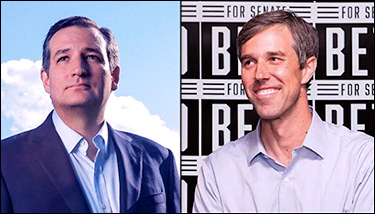
Texas Sen. Ted Cruz (R) | Rep. Beto O’Rourke (D-El Paso)

Texas Sen. Ted Cruz (R) | Rep. Beto O’Rourke (D-El Paso)

Oct. 25, 2018 — The Texas Senate race has become the premier political contest of this midterm election. With Rep. Beto O’Rourke (D-El Paso) becoming a national celebrity due to constant media attention, and now with record fundraising, this election has stretched beyond Texas and evolved into a national campaign.

Though the media continually promotes O’Rourke, extensive polling has only put him ahead of Sen. Ted Cruz (R) just once during the entire election cycle. Despite O’Rourke raising an eye-popping $38 million during the last quarter, an all-time record for any Senate race, Cruz’s margins are actually growing.

During this calendar year, 35 polls have been conducted of the Texas Senate race from 19 different polling firms. In only one, an online survey from Ipsos Reuters in early to mid-September (Sept. 6-14; 992 Texas respondents), did Rep. O’Rourke score an advantage over Sen. Cruz. In that poll, the El Paso congressman led 47-45 percent.

While Sen. Cruz held an advantage in the other 34 polls, his margin was typically small. His average support factor is 45.6 percent. He hits 50 percent or more in only 13 of the surveys. Rep. O’Rourke records an average of 41.1 percent and reaches 50 percent in one survey. While these numbers and margins clearly show weakness for an incumbent, as we pointed out when covering Sen. Claire McCaskill (D-MO) and Sen. Joe Donnelly (D-IN) in similar columns earlier this week, Sen. Cruz is demonstrating growth as the early voting period begins and Election Day draws nearer in contrast to the others who appear to be losing momentum.

In the last 10 polls, covering the Oct. 1-21 period from 10 different pollsters, Sen. Cruz averages 50.2 percent preference and posts majority support in seven of the 10 studies. Rep. O’Rourke averages 45.2 percent, leads in none, and obviously never reaches 50 percent. While Cruz maintains a consistent edge, O’Rourke remains in position if not to score an upset, at least to record the best Democratic statewide percentage since 1990, which was the last time a Democratic candidate won a Texas statewide office.

Continue reading

Surprising Q3 Financial Disclosures

By Jim Ellis

Oct. 19, 2018 — The third quarter financial disclosure reports are now public, and more details are readily available. Thus, we are able to learn about various record-setting fundraising efforts.

FEC-moneyIn addition to Texas US Senate candidate Beto O’Rourke (D) attracting $38 million in the third quarter, an all-time record for any such campaign, several House candidates also reported financial numbers that have never been seen for district-level politics.

In the third quarter of 2018, nine House contenders exceeded raising $3 million, eight Democrats and one Republican.

In California’s 22nd District, incumbent Rep. Devin Nunes (R-Tulare), the chairman of the House Intelligence Committee, was the top Republican fundraiser and appears to have accumulated more financial resources for the entire campaign than any other congressional candidate of either party. In the quarter, Rep. Nunes raised $3.14 million. For the campaign, he has exceeded the $10.5 million mark.

But his Democratic opponent, attorney Andrew Janz, brought in over $4 million for the quarter, the only congressional candidate in the US to do so, and an all-time record for a quarter. He still trails Rep. Nunes in overall receipts (Janz posted $7.13 million for the campaign), however. Together, this campaign leads the nation in combined fundraising with over $17 million. For a regular cycle congressional campaign – not including the special elections we saw earlier that became national contests – this, too, is likely an all-time record for a House contest.

Continue reading

The CBS/YouGov Series

By Jim Ellis

Oct. 9, 2018
CBS News and the YouGov international online pollster again teamed to test four key US Senate races as part of the former’s Battleground Tracker series and finds Republican and Democratic candidates both leading in two states. All of the polls were conducted between Oct. 2-5. The polling margin of error ranges from 3.4 to 3.9 percent. The responses were submitted online and not via live telephone operators.

CBS News/YouGov Poll

CBS News/YouGov poll results (click image above to see full results posted on CBSNEWS.com)

In Arizona (1,010 registered Arizona voters), Rep. Kyrsten Sinema (D-Phoenix) continues to lead Rep. Martha McSally (R-Tucson) by a small plurality. According to this poll, which is consistent with other known data, Sinema claims a 47-44 percent edge.

Regarding the economy, 80 percent of the Arizona respondents believe the economy is very good (26 percent) or somewhat good (54 percent). Rep. McSally is viewed as the stronger candidate on immigration, crime, and gun policy. Rep. Sinema is considered to be the stronger candidate with regard to healthcare, which is the most important issue cited.

The respondents are breaking evenly about supporting or opposing President Trump, though his job approval is an upside down 46:53 percent favorable to unfavorable.

CBS/YouGov then surveyed Sen. Bob Menendez’s (D) chances of winning re-election in New Jersey (1,009 registered New Jersey voters). Here, the senator scores a 49-39 percent advantage, one of the better reported polls for him during this election cycle.

Continue reading

Forecasting the Results – Part II

By Jim Ellis

2018-democrat-house-majority-breakdown-text-graphicOct. 8, 2018 — The Democrats need to convert a net 24 seats to secure a one-seat majority in the US House on Election Day, Nov. 6. Many reports quote the number 23 as what is necessary to win control, but the new Pennsylvania map will yield one seat coming back to the Republicans — the new open 14th District — thus pushing the total up to 24.

As stated Friday, our forecasts listed below are based upon a series of factors, including current polling numbers, voter history, candidate personal and job approval favorability, fundraising, other races on the state ballot that could drive turnout, and outside issues such as the confirmation vote to for Judge Brett Kavanaugh to become a Supreme Court Justice, which could change the turnout model, etc.

According to our new analysis, the Democrats are on the cusp of converting the requisite number of Republican seats to take a bare majority and seeing their caucus become significantly larger. At this point, the Democratic gain range appears to reach 23 on the low side and 35 at the apex.

Looking at the country by state and region, it appears the Democrats will do well in the Midwest, in particular. The Great Lakes region that delivered President Trump his surprise victory appears to be snapping back to the Democrats in the midterm House races. Michigan looks particularly good for them at both the statewide and district levels.

Continue reading

TX-31: Carter vs. Hegar

TX-31 -- The 31st Congressional District in Texas

TX-31 — The 31st Congressional District in Texas


By Jim Ellis

Sept. 26, 2018
–For the first time since his original election to the House back in 2002, Texas Rep. John Carter (R-Round Rock) has drawn a top-tier Democratic challenger.

Consultant and Afghanistan War veteran M.J. Hegar (D) is giving the veteran congressman all he can handle, but a new Democratic poll finds him still hanging onto to a lead despite absorbing over $1 million in money spent opposing him.

Some of Hegar’s expenditures included financing an introductory 3:29 minute promotional video that went viral nationally and attracted well over 2.8 million views. The video, mostly about Hegar’s military career and being wounded in action, her life after the service, and the battle to allow women in combat, also created a fundraising bonanza.

Much of the money was used to tangentially hit Rep. Carter because Hegar first had to clear a four-person Democratic primary and run-off, an election that saw her placing first in the primary (44 percent), and then scoring a 62-37 percent win in the Democratic run-off vote.

The Anzalone Liszt Grove Research firm just released their second 31st District poll and the first since July. The survey (Sept. 16-20; 500 likely TX-31 voters) finds Rep. Carter leading Hegar, 46-42 percent. In July, the congressman’s margin was 48-39 percent.

The analysis indicates that Hegar is the candidate who is moving forward because she has shaved a net five percentage points from the previous lead but, considering that her campaign has been on offense and Carter defense suggests that the race could have moved more substantially.

The ALG analysis also points out that Hegar has more room to grow because her hard and soft name identification is 60 percent. Yet, they illustrate that Carter’s 63 percent name ID is weak for an incumbent. They omit to conclude, however, that the congressman can also better define himself among the 37 percent that do not possess a clear opinion of him, more of whom are more likely to be his voters than hers.

Continue reading