Tag Archives: Robert F. Kennedy Jr.

The Relevancy of RFK Jr.

By Jim Ellis — Thursday, April 4, 2024

Presidency

Presidential candidate Robert F. Kennedy Jr. (I) Photo by Gage Skidmore

Stories are popping up in the political media about President Joe Biden seeing a resurgence of strength in recent national polls, but a bigger story is evolving.

The precursor to the election’s final outcome may prove to be Robert F. Kennedy Jr. and the minor party candidates garnering enough votes to the point where their support tips the electorate towards one candidate or the other.

Additionally, while President Biden and former President Donald Trump consistently find their approval ratings upside down in double-digit point margins that are routinely closer to 20 rather than 10, Kennedy is always viewed as the more popular figure. Though his favorability index is only in slightly positive territory for the most part, generally from three to five percentage points, his standing is far superior to that of the two presidents.

Even when his unfavorable perception slightly exceeds those who view him favorably, Kennedy never drops below the three to five-point negative range. The FiveThirtyEight data organization charts most polling firms daily and finds Kennedy’s average favorability index in positive territory consecutively from May 18, 2023, all the way to today.

As we all know, the national ballot test is irrelevant in forecasting the presidential outcome because it’s the electoral votes calculated in the states that determine the eventual winner. National polling, however, generally provides a good indicator of candidate strength.

Several polls have recently been released and the four most contemporary all find Kennedy now consistently in double-digit support territory. In two polls, HarrisX for Forbes Magazine, and Quinnipiac University, the addition of Kennedy and the minor candidates to the polling questionnaire changes the outcome after the respondents are presented the initial query of a choice between Biden and Trump.

HarrisX (March 26; 1,010 registered US voters; online) returns a 50-50 percent tie between Biden and Trump when the undecided respondents are pushed to make a choice. Yet, when Kennedy and the minor party candidates are added, the lead swings to Trump by a small two percentage-point margin.

Quinnipiac University (March 21-25; 1,407 registered US voters; live interview) sees Biden topping Trump 48-45 percent, but when Kennedy and the minor party candidates are added, Trump secures a one-point edge.

The most recent YouGov/Economist poll (March 24-26; 1,415 registered US voters; online) sees Trump also holding a one-point lead with Kennedy only in low single digits. The Trafalgar Group (March 29-31; 1,029 likely US general election voters; multiple sampling techniques) also finds a consistent result with the previous pollsters: Trump 43, Biden 40, Kennedy 11, Others three percent.

Therefore, we have several conclusions that appear to be correct. First, President Biden is improving his position against the field. Second, Trump appears in a long-term stagnant position, and third, Kennedy is gaining enough support to be a factor in tipping the race from one candidate to the other.

At this particular point in time, the data responses suggest that the Kennedy presence damages President Biden to a slightly greater degree than former President Trump. But, as the campaign progresses, this factor could certainly change.

We can expect to see national and swing-state polling varying from now until the election in a seesaw fashion between President Biden and former President Trump. The unanswered question revolves around Kennedy and just how well he will perform when actual votes are cast, and just who in the end will benefit more from his presence on the key swing state ballots.

RFK Jr.’s VP Choice; Swing State Data; Casey’s Lead Diminishing; Cruz Polls Show Tight Texas Race

By Jim Ellis — Wednesday, March 27, 2024

President

Presidential candidate Robert F. Kennedy Jr. (I)

Robert F. Kennedy Jr.: VP Choice — Yesterday presidential candidate Robert F. Kennedy Jr. (I) announced that wealthy entrepreneur Nicole Shanahan, the founder of the ClearAccessIP legal technology company that she later sold, will be his vice presidential running mate. Shanahan is, like Kennedy, an environmental activist. She contributed $4 million to his campaign to help finance the Super Bowl ad that the Kennedy campaign ran to emphasize his family history. In the 2020 presidential race, Shanahan contributed to Democratic candidates Pete Buttigieg and Marianne Williamson.

Kennedy has qualified for the ballot in the state of Wisconsin but may have to re-start his petition drive in Nevada. RFK Jr. is reportedly qualified or in strong position to do so in eight states: Arizona, Georgia, Hawaii, Nevada, New Hampshire, South Carolina, Utah, and now Wisconsin. He may have problems in Nevada, however. The submitted petitions may be disqualified because Kennedy did not list a vice presidential running mate, which is a requirement under Nevada election law.

Of the eight states in which his name so far will appear, four are critical swing-state battlegrounds. Therefore, the Kennedy candidacy could affect the final result in the highly competitive entities of Arizona, Georgia, Nevada, and Wisconsin.

Morning Consult: Releases Latest Swing State Data — The Morning Consult organization released the latest data on their continuing swing state tracking project. This iteration shows improvement for President Joe Biden as he records a one-point edge in Wisconsin and is tied in Pennsylvania and Michigan. The tracking polls were conducted from October through March, and regularly surveyed at least 437 registered voters from each of the seven tested states.

The sampling universes in the remaining four states, Arizona, Georgia, Nevada, and North Carolina, continue to support former President Donald Trump. Unless one of the tied states (Michigan or Pennsylvania) falls Trump’s way, he cannot win a majority in the Electoral College even though he continues to poll ahead in the majority of swing states.

Senate

Pennsylvania: Casey’s Lead Diminishing — Two new polls are suggesting that the Pennsylvania Senate race is getting closer. Susquehanna Research just released a statewide survey completed in early March (Feb. 27-March 5; 450 likely Pennsylvania voters; live interview) that projects Sen. Bob Casey Jr. (D) to be leading former hedge fund CEO David McCormick (R) by a 48-42 percent margin. The result is virtually the same as the firm found in January (Casey leading 46-42 percent), but considerably different than the 12-point Casey advantage they detected in their survey from 10 months ago.

Emerson College, polling for The Hill newspaper (March 10-13; 1,000 registered Pennsylvania voters; multiple sampling techniques), sees an even tighter 52-48 percent margin when the undecided respondents are pushed for an answer.

While the current tendencies appear to give McCormick some momentum, the voter history, and legacy of the Casey family (aside from Sen. Casey winning three US Senate terms, the incumbent’s father, Bob Casey, Sr., served two terms as governor and eight years as attorney general) suggest upending the senator remains a very tall order.

Texas: Cruz’s Zig Zag Polling Pattern — The latest Texas statewide survey finds Sen. Ted Cruz (R-TX) leading US Rep. Colin Allred (D-Dallas) only by a relatively small margin. Marist College (March 18-21; 1,117 registered Texas voters; multiple sampling techniques) projects Sen. Cruz holding a 51-45 percent advantage over Allred. A month ago, the University of Texas found the senator holding a 12-point lead. In January, Emerson College saw Cruz claiming only a two-point edge.

It would not be surprising to see a similar zig-zag pattern continue through the bulk of the election period. Because Sen. Cruz’s favorability numbers tend to be below average for a two-term incumbent, the issue matrix within this campaign cycle, particularly in Texas, will favor the Republican office holder.

Though Rep. Allred is certainly a credible Democratic challenger it is difficult to see Sen. Cruz, or any Lone Star State Republican, losing. With President Biden leading the Democratic ticket and having to defend his energy and border policy stances in a state where his party hasn’t scored a major statewide win since 1994, it increases the difficulty factor for a Democratic upset at all political levels. Therefore, expect to see differing polls throughout the campaign cycle, but the actual election will likely culminate in a Cruz victory margin of at least five percentage points.

Is RFK Jr. Going Libertarian? Conflicting Presidential Polling; Trone Expands Lead in Maryland; Special Election Ad Spending in NY

By Jim Ellis — Friday, Feb. 2, 2024

President

Will Robert F. Kennedy Jr., currently running as an Independent general election candidate, switch to the Libertarian Party?

RFK Jr.: Flirting with Libertarian Party — Presidential candidate Robert F. Kennedy Jr. (I) and Libertarian Party leaders confirm they are discussing the possibility of Kennedy becoming the party’s presidential nominee. They are likely still a long way from coming to an agreement, though, mostly because some of Kennedy’s major issue positions such as climate change and gun control do not align with the party leadership; the move, however, makes practical sense for both entities.

First, being the Libertarian Party nominee would give Kennedy ballot access in all 50 states, something that is difficult for any Independent to obtain. The Libertarian Party was the only non-Democratic or Republican entity to achieve universal ballot status in 2020 (Libertarian nominee Jo Jorgensen appeared on the Libertarian line in 48 states and the District of Columbia; in Alabama and Tennessee, she appeared as an Independent), and they again would with Kennedy as their nominee.

Additionally, featuring RFK Jr. as their candidate, it is highly likely that the Libertarian Party would attract its highest historical number of votes. This is important for the organization’s future because many states base future party status upon performance in the national election.

Morning Consult/Bloomberg/Quinnipiac Polls: Any Given Poll — It’s a common saying in the NFL that “on any given Sunday any team can beat another.” A similar phrase appears applicable in political polling, as well. On almost any given day, we can find polls that disagree over outcome even though conducted during the same time period. Wednesday’s Morning Consult/Bloomberg News and Quinnipiac University are good examples.

The day began with Morning Consult/Bloomberg releasing their new regional survey series (Jan. 16-22; 4,596 registered voters in Arizona, Georgia, Michigan, Nevada, North Carolina, Pennsylvania, and Wisconsin; online; part of regular tracking), which finds former President Donald Trump leading in all of the key swing states with margins between three (Arizona, Pennsylvania) at 10 percentage points (North Carolina). Georgia, Michigan, and Wisconsin each posted five-point Trump margins, while Georgia and Nevada were closer to the North Carolina number at plus-eight. Turning to their national track, MC/Bloomberg posted Trump to a two-point advantage over President Joe Biden in the head-to-head ballot test.

Yet in the Quinnipiac University release, a poll that was in the field within a similar same time frame as MC/Bloomberg, though earlier in January (Jan. 4-8; 1,680 US registered voters; live interview), President Biden posted his biggest national popular vote lead of any recent poll, 50-44 percent. When the Independent and minor party candidates were added in, such as RFK Jr., for example, the Biden edge shrinks to just two percentage points, which is much more in line with other pollsters.

Senate

Maryland: Rep. Trone Expands Lead — A new internal Hickman Analytics poll for the David Trone for Senate campaign (Jan. 18-24; 1,500 likely Maryland Democratic primary voters; live interview) sees Trone, the 6th District Congressman, leading Prince Georges County Executive Angela Alsobrooks by a 45-34 percent margin in the open Democratic US Senate primary. The question, however, is for how long? The poll contained an over-sample of African Americans and females to emphasize the groups with which Rep. Trone is weakest.

Though the early numbers look good for the congressman, it must be understood that his campaign has spent well over $15 million to date, and $7 million alone just since November according to the Inside Elections publication. Trone began advertising a year before the primary election.

The Alsobrooks campaign has yet to run an ad. Since it is clear that she cannot match the congressman in an ad war with him self-financing the race from his huge personal wealth, the Alsobrooks strategists are waiting until late in the contest to unleash their own ad buys. She will be competitive as we get closer to the May 14th primary, so despite Trone’s polling and resource lead, this primary battle is far from over.

House

NY-3: Special Election Ad Spending Update — The Daily Kos Elections and AdImpact organizations charted the spending in the special congressional election to replace expelled Rep. George Santos (R-Long Island) as we approach the Feb. 13 election. According to their data, the overall Democratic operation is outspending the encompassing Republican effort by a large amount, $9.6 million to $5.7 million. The two candidates are former US Rep. Tom Suozzi for the Democrats, and Nassau County Legislator Mazi Melesa Pilip for the GOP.

The Congressional Leadership Fund, however, is coming in late to help even the score. They have reserved $2.6 million in television and digital ads to bring the final days spending into parity. In terms of spending booked for the final two weeks, the Democratic advantage narrows to $2.8 to $2.44 million.

Iowa Republican Presidential Caucus Winners, Losers & Runners-Up; California Senate Polling Update; NY-26 Special Election Nominee

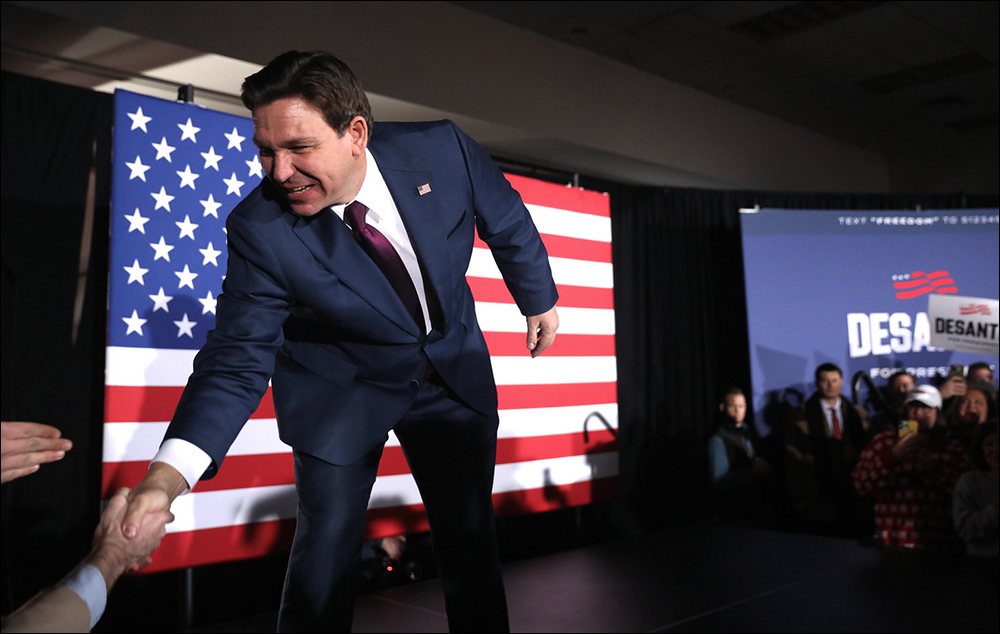
Gov. Ron DeSantis celebrates with supporters at a caucus night watch party at the Sheraton West Des Moines Hotel in Iowa. / Photo by Gage Skidmore

By Jim Ellis — Tuesday, Jan. 16, 2024

President

Iowa Republican Presidential Caucus: Winners, Losers & Runners-Up — The first votes of the presidential campaign have been cast, and former President Donald Trump met expectations last night in the Iowa Caucuses as he became the first non-incumbent candidate to secure a majority of the vote in the state’s history. The Democrats first voted in Iowa back in 1972, with Republicans following in 1976.

It appears he will place first in 98 of the state’s 99 counties, losing apparently by just one vote in Johnson County, home to the University of Iowa. He also won closely, and below 50 percent in Story County, the home of Iowa State University, and in the state’s most populous county, Polk, the home to the capital city of Des Moines. He recorded plurality victories in eight other counties.

At this writing, and mostly in the rural regions, Trump exceeded 60 percent of the vote in 41 counties, and topped 70 percent in eight. His best showing appears to be in Keokuk County, where he recorded 74 percent. There is likely to be some change in these numbers once all of the votes are counted and canvassed.

The battle for second in Iowa is close, as predicted, though it appears that Florida Gov. Ron DeSantis, and not the candidate the media proclaimed had the most momentum, former UN Ambassador Nikki Haley, finishes second. DeSantis was hovering around the 21 percent mark, some 30 points behind Trump. Haley was further back approaching 19 percent of the caucus votes. Businessman Vivek Ramaswamy, as polling also predicted, was well back with just under eight percent support. After considering his fourth-place finish, Ramaswamy announced that he was dropping out of the presidential race.

“There is no path for me to be the next president, absent things that we don’t want to see happen in this country,” he said at his Iowa watch party at the Surety Hotel in downtown Des Moines.

“I am so proud of every one of you who have lifted us up,” he said to the crowd. He then announced that he would give his “full endorsement” to Trump. Ramaswamy said he had called Trump to tell him that he was suspending his campaign and would endorse the former president.

Senate

California: Schiff and Porter Lead New Poll — The University of California at Berkeley’s Institute for Government Studies, a regular California political pollster, released their latest US Senate survey result. This poll, for the Los Angeles Times (Jan. 4-8; 8,199 registered California voters; 4,470 weighted sub-sample; online), again finds Rep. Adam Schiff (D-Burbank) leading the crowded field, but with a smaller margin than found in other recent polls.

Baseball great Steve Garvey (R), who had placed second in two December polls, is third here, but still gained support when compared to the previous Berkeley IGS survey (10 percent in October poll; 13 percent in current edition). Rep. Katie Porter (D-Irvine), second in their previous polls, is also second now, but remains stagnant at 17 percent support when compared to the two previous Berkeley IGS studies. Rep. Barbara Lee (D-Oakland) remains languishing with single digit support with nine percent preference.

The California jungle primary is scheduled for Super Tuesday, March 5. The top two finishers regardless of percentage attained or political party affiliation will advance into the November general election.

House

NY-26: Democrats Choose Special Election Nominee — The local Erie and Niagara County Democratic Party chairmen announced that they have chosen state Sen. Tim Kennedy (D-Buffalo) as their special election congressional nominee once Rep. Brian Higgins (D-Buffalo) resigns in early February. Once the seat officially becomes vacant, Gov. Kathy Hochul (D) will call a special election to fill the seat for the balance of the current term. The Republican chairmen will announce their pick at a later date.

Under New York election procedure, a district’s county chairmen have the power to nominate a special election candidate in lieu of holding a party primary or special district convention.

Nate McMurray, a former western New York local official who ran two close campaigns in the former 27th District that was collapsed in 2021 reapportionment, declared after the announcement naming Sen. Kennedy as the special election Democratic nominee that he will launch a regular Democratic primary challenge against him for the full term.

Trump Over 50 Percent in Iowa;
Dead Heats in Arizona & Michigan; Casey Expands Lead in Pennsylvania

By Jim Ellis — Monday, Jan. 15, 2024

President

Former President Donald Trump

Iowa Caucus Polls: Trump Over 50 Percent; Haley in Second Place — The first votes of the presidential campaign are to be cast tonight. In frigid temperatures, Iowa Republicans will attend their individual precinct caucus meetings to cast the first votes of the 2024 presidential election beginning at 7 p.m. Central time. Because of a schedule change on the Democratic side, only the Republicans are voting tonight. No non-incumbent has ever topped the 50 percent plateau, but polling shows that Trump may well exceed that number in these caucus votes.

Suffolk University released a new Iowa Caucus survey in preparation for today’s vote. This survey (Jan. 6-10; 500 likely Iowa Republican Caucus attenders), as every other Iowa poll has projected, sees former President Donald Trump attracting majority support (54 percent). Former UN Ambassador Nikki Haley, according to the Suffolk data, has surpassed Florida Gov. Ron DeSantis for second place with 20 percent as compared to DeSantis’ 13 percent.

In terms of interesting side questions, the sampling universe broke virtually evenly regarding the traits of the candidate they want to support. Three responses dominated the answers. The one most often articulated is the respondent’s desire to support a candidate who can defeat President Joe Biden (27.2 percent). Next, is an individual having strong moral character (25.8 percent), and a close third is a person who “has the right experience” (25.0 percent).

Asked of people who said that Donald Trump was neither their first nor second choice, 45 percent said they would support the former president if he became the party nominee, 16.5 percent said they would vote for Independent Robert F. Kennedy Jr., and 15.3 percent said they would support Biden.

No fewer than five polls have been released since Wednesday, including the survey that is typically regarded as the state’s most accurate — the Selzer & Company poll, routinely conducted for the Des Moines Register newspaper.

The Selzer poll, released late on Saturday night (Jan. 7-12; 705 likely Iowa caucus attenders; live interview) and conducted for the Des Moines Register and NBC News, found Trump below 50 percent but holding at 48 percent support, ahead of Haley, in second place again with 20 percent, and DeSantis in third, posting 18 percent preference. Businessman Vivek Ramaswamy trailed in single digits with eight percent. Of the five polls conducted during the final week of campaigning, this is the only one that projects Trump with under 50 percent support.

Senate

Arizona: New Poll Shows Virtual Dead Heat — Public Policy Polling, surveying for the Replace Sinema PAC (Jan. 5-6; 590 registered Arizona voters; multiple sampling techniques) sees a dead heat developing between Rep. Ruben Gallego (D-Phoenix) and former news anchor and 2022 Republican gubernatorial nominee Kari Lake. Incumbent Sen. Kyrsten Sinema, running on an Independent ballot line, significantly trails.

According to the ballot test data, Rep. Gallego would record a 36-35 percent edge over Lake with Sen. Sinema well behind with a 17 percent support figure. Among the key non-affiliated voting sector, Lake takes the largest share with 31 percent. Sen. Sinema posted 27 percent from this category, while Rep. Gallego trailed with 24 percent. If the race were a two-way contest between Gallego and Lake, the Republican would hold a 46-45 percent edge. This poll again shows that the Arizona Senate race continues as a true wild card campaign.

Michigan: Virtual Ties All Around — The Glengariff Group, a Michigan-based pollster who frequently conducts political surveys for media organizations, tested the Wolverine State electorate for the Detroit News and WDIV-TV Channel 4 (Jan. 2-6; 600 likely Michigan voters) though the partisan division within the polling sample looks to have comparable numbers of Democrats and Republicans. Michigan does not register voters by political party, but it is clear through voter history statistics that the state houses at least a slightly higher number of Democrats than Republicans. Therefore, these results, though weighted to decrease a bias factor, are likely skewed somewhat toward Republicans.

The ballot test results find Rep. Elissa Slotkin (D-Lansing) and three potential Republican opponents all locked into virtual ties. Retired Detroit Police Chief James Craig matches up most favorably with Rep. Slotkin, leading her 38-36 percent. Former Rep. Peter Meijer is tied with Slotkin at 36-36 percent, while former US Rep. Mike Rogers trails her by just one percentage point.

It is likely that the Michigan race will become a top-tier general election Senate campaign irrespective of which Republican candidate claims the party nomination in August.

Pennsylvania: Sen. Casey Expands Lead — The new Quinnipiac University Pennsylvania poll (Jan. 4-8; 1,680 self-identified registered Pennsylvania voters; 746 Democrats; 651 Republicans; live interview) finds three-term Sen. Bob Casey Jr. (D) expanding his lead over Republican challenger David McCormick (R) to a full 10-point advantage, 54-43 percent, an improvement of a net four percentage points when compared to the October Q-Poll. Within this survey sample, the split between Democrats and Republicans is almost spot on, with Republicans under-counted by approximately just one percentage point.

The Casey lead is strong in comparison to how President Biden fares. Biden posts a job approval rating of only 40:58 percent as compared to Sen. Casey’s 51:31 percent. The president, however, still leads former President Trump, 49-46 percent in a general election ballot test. The Pennsylvania office holder with the best job approval ratio is Gov. Josh Shapiro (D) who records a 59:23 percent favorability index.

Independent Candidates Draw More Votes From Biden; CA-20 Top Contender Disqualified; Another House Retirement; North Carolina Candidate Filing Closes

By Jim Ellis — Tuesday, Dec. 19, 2023

President

Robert F. Kennedy Jr.

Harvard-Harris Poll: Independents Draw More Votes From Biden — Originally when Robert F. Kennedy Jr. had announced as an Independent for the office of President of the United States, the subsequent early polls found him taking slightly more support from former president Donald Trump than President Joe Biden. Recently, that trend has reversed. The new Harvard University survey that The Harris Poll and HarrisX conducted (Dec. 13-14; 2,034 US registered voters; online) is now typical. They find that Kennedy and the other minor party/independent candidates are apparently siphoning away more support from President Biden than other future potential general election opponents.

In the isolated Biden-Trump ballot test, Trump would lead 52-48 percent. Adding just RFK Jr., the Trump advantage expands to 44-36-20 percent. A third ballot test, that included Biden, Trump, Kennedy, Independent candidate Dr. Cornel West, and likely Green Party nominee Jill Stein, saw a 43-35-17-2-2 percent division.

House

CA-20: Top Contender Disqualified — Because state Assemblyman Vincent Fong (R-Bakersfield) had filed for re-election for that seat, and California’s secretary of state had officially accepted his documents, the state’s chief elections officer ruled on Friday that Fong is ineligible to switch to the open congressional race. Therefore, despite his endorsement from outgoing Congressman Kevin McCarthy (R-Bakersfield), Fong will apparently not be on the congressional ballot.

This leaves the GOP field to Tulare County Sheriff Mike Boudreaux, who is president of the California Sheriffs Association, businessman David Giglio, businessman and former congressional candidate Matt Stoll, and casino owner Kyle Kirkland.

The 20th District is the safest Republican seat in the California delegation. Seeing the all-party jungle primary produce a double Republican general election appears a distinct possibility.

GA-3: Another House Retirement — Georgia US Rep. Drew Ferguson (R-The Rock/ Carrollton) announced on Friday that he will not seek a fifth term in the House, saying that “Georgia is a special place, and it’s calling us home.” Ferguson, first elected in 2016, served two terms as the Republican Chief Deputy Whip and is a member of the House Ways & Means Committee. He averaged 66.9 percent of the vote in his four successful congressional campaigns.

The 3rd District hugs the Alabama border in western Georgia, and lies among the cities of Atlanta, Columbus, and Macon. GA-3 is the third-strongest Republican congressional seat in the Peach State. The FiveThirtyEight data organization rates the district as R+38, while the Daily Kos Elections statisticians rank the seat as the 51st safest in the Republican Conference. Donald Trump defeated President Biden here 64-34 percent in the 2020 election. Rep. Ferguson’s successor will be decided in the Republican nomination process. GA-3 becomes the 37th open US House seat headed to the next election.

North Carolina: Candidate Filing Closes — The candidate filing period for North Carolina’s March 5 primary closed on Friday, and we now see a slate of contenders in the newly drawn congressional seats. The state also features an open governor’s race, but no US Senate campaign in 2024.

Republicans filed contenders in all 14 Tar Heel State CDs, but two Republicans will run unopposed unless the Democrats can petition a candidate on the ballot. Rep. Greg Murphy (R-Greenville) in the 3rd District and the eventual nominee in the Greensboro anchored 6th (Rep. Kathy Manning-D retiring), saw no Democratic candidate file.

One of the most competitive seats for the general election appears to be District 1, where freshman Rep. Don Davis (D-Snow Hill) sees his new CD yield only a 50-49 percent victory for President Biden in 2020, though Dave’s Redistricting App calculates a slightly more favorable Democratic overall partisan lean, 50.9D – 47.7R. The likely Republican nominee here is former congressional candidate Sandy Smith.

Hotly contested Republican primaries will occur in the open 6th, 8th (Rep. Dan Bishop-R running for attorney general), 10th (Rep. Patrick McHenry-R retiring), 13th (Rep. Wiley Nickel-D retiring), and 14th (Rep. Jeff Jackson-D running for Attorney General) districts. Under North Carolina voting laws, a runoff occurs only if a candidate fails to break 30 percent of the original primary vote.

Trump Sweeping Biden in Swing States; Malinowski Searches for NJ Senate Support; GOP Puts Forth Interesting NY-3 Candidate; NC-13 Rep. Wiley Nickel Out; Longtime Pol Jumps Into NJ Race

Former President Donald Trump up in polling.

By Jim Ellis, Monday, Dec. 18, 2023

President

Bloomberg/Morning Consult Polls: Trump Sweeping Biden in Swing States — Bloomberg News and Morning Consult partnered for a swing state polling series in the domains that will likely decide the 2024 presidential election: Arizona, Georgia, Michigan, Nevada, North Carolina, Pennsylvania, and Wisconsin. Individual surveys were conducted in each state during the Nov. 27 through Dec. 6 period. Sample sizes ranged from 451 registered voters to 801 such individuals depending upon the state’s population size. All included Independent Robert F. Kennedy Jr. on the questionnaire along with Independent Cornel West and likely Green Party nominee Jill Stein.

Trump led in all seven polls both when the ballot test included the minor candidates and when he and President Joe Biden were isolated. Trump’s margins (with the minor party candidates) were: Arizona (+4), Georgia (+7), Michigan (+4), Nevada (+5), North Carolina (+9), Pennsylvania (+1), and Wisconsin (+6).

To win the election, Trump would need to hold North Carolina, and carry Georgia plus one or two of the other aforementioned states. Trump’s smallest configuration to yield a victory of 270 electoral votes — and this assumes he holds all the other states he won in 2020 — would include Georgia, North Carolina, and Pennsylvania.

Senate

New Jersey: Ex-Rep. Malinowski Interviews for Party Senate Endorsements — Former US Rep. Tom Malinowski (D), who served two terms in the House before his re-election defeat in 2022 and who is now an unannounced US Senate candidate, conducted interviews with the Union County municipal Democratic Party chairmen seeking their endorsement for his potential statewide bid. Malinowski represented most of Union County in the US House. New Jersey First Lady Tammy Murphy and US Rep. Andy Kim (D-Moorestown) already are in the primary race, challenging indicted Democratic Sen. Bob Menendez.

Malinowski would have to overcome long odds in order to win the party nomination, and it is no foregone conclusion that he will actually enter the race. Despite calls for his resignation, Menendez is not leaving the Senate, nor has he ruled out running for re-election. Polls, however, suggest he would badly lose the Democratic primary.

House

NY-3: Local Republicans Nominate Mazi Melesa Pilip — The Nassau and Queens County Republican Party chairmen have nominated Nassau County Legislator Mazi Melesa Pilip, an Ethiopian-born former member of the Israeli military, as their special election congressional nominee. She will oppose the Democratic nominee, former Congressman Tom Suozzi in the Feb. 13 special election to serve the balance of expelled Rep. George Santos’ (R) term.

Interestingly, Pilip is reportedly still a registered Democrat even though she is an elected Republican and will now be the GOP congressional nominee. She is an interesting choice that will likely draw more attention to what is likely to become a competitive special election.

NC-13: Rep. Wiley Nickel Won’t Seek Re-Election, Will Return in 2026 — In an admission that he would not be successful running for re-election in North Carolina’s newly configured 13th Congressional District, Rep. Wiley Nickel (D-Cary) announced late last week that he would end his career in the US House after one term. Rather, he will return to elective politics in 2026 and challenge Sen. Thom Tillis (R). In that year, Sen. Tillis, assuming he seeks re-election, will be on the ballot for a third term.

The new 13th District begins in the Dunn area south of Raleigh in Harnett County. The seat then moves northward around Raleigh on the east side of Wake County and stretches to the Virginia border. The 2022 state Supreme Court drew a 13th District that shared part of Wake County, annexing the city of Cary, and then moved south of the capital city to include Johnston County and parts of Hartnett and Wayne Counties.

The partisan lean for new Congressional District 13, according to the Dave’s Redistricting App statisticians, is 56.6R – 41.2D. Under the map to which Rep. Nickel was elected, the 13th CD held a much different 49.5D – 48.1R partisan lean.

Also leaving the North Carolina congressional delegation are Reps. Kathy Manning (D-Greensboro) and Jeff Jackson (D-Charlotte), who like Rep. Nickel face difficult re-election odds on the new Tar Heel State congressional map. Jackson is running for the open state attorney general’s position and will probably face his colleague in the adjoining congressional district, Rep. Dan Bishop (R-Charlotte), in the statewide race.

Governor

New Jersey: Defeated State Senate President Launches ’25 Gov Campaign — Former New Jersey state Senate President Steve Sweeney (D), who served in the legislature for 20 years before his shocking upset defeat in the 2021 election, announced that he will enter the open 2025 gubernatorial campaign. Sweeney presided over the state Senate as its president for a 14-year period.

Gov. Phil Murphy (D) is ineligible to seek a third term and as in Virginia, where another odd-numbered gubernatorial position will be open, candidates are already announcing for their respective offices long before even the 2024 election transpires.

Announcing for the 2025 gubernatorial race before Sweeney was Jersey City Mayor Steven Fulop. Both US Reps. Josh Gottheimer (D-Wycoff) and Mikie Sherrill (D-Montclair) are reported to be testing the waters to also run for governor. For the Republicans, former state legislator Jack Ciattarelli — immediately after his close 2021 loss to Gov. Murphy — already announced that he would return for another gubernatorial bid in 2025.

Dems Cancel Florida Presidential Primary; Moreno Leads in Ohio; Trump Turns Against Masters; Menendez Challenged in New Jersey

President Joe Biden / Photo by Gage Skidmore

By Jim Ellis — Friday, Dec. 15, 2023

President

Florida: Dems Cancel Presidential Primary — In what could be the first of several states where the Democratic Party will suspend the presidential primary and award their delegate slate to President Joe Biden, Florida took such action with Wednesday’s announcement. This move is not uncommon for both political parties with an incumbent president seeking re-election. It is used mostly in states where the political party is responsible for financing the party primary. When the incumbent is a sure bet to win the state’s primary, the party suspends the election in order to save the money to use in the general election.

Primary suspension and the awarding of delegate slates to, in this case President Biden, is one of the reasons that Robert F. Kennedy Jr. abandoned his Democratic primary challenge to Biden and instead became an independent presidential candidate.

Senate

Ohio: Moreno Leads in Second Poll — On the heels of last week’s co/efficient poll that posted businessman Bernie Moreno to a slight Ohio Republican US Senate primary lead (15-14-13 percent over Secretary of State Frank LaRose and state Sen. Matt Dolan), the new Fabrizio Lee & Associates survey places Moreno in an even better position. The F&L poll (Dec. 3-5; 600 likely Ohio Republican primary voters; live interview & text) sees Moreno’s lead expanding to 23-19-18 percent over LaRose and Dolan.

Obviously, the Republican nomination is up for grabs and any of these three contenders can still win the March 19 primary. The eventual winner will challenge Sen. Sherrod Brown (D) in one of the country’s most important Senate races.

House

AZ-8: Trump Turns Against Masters — Early this week, former President Donald Trump surprisingly endorsed Abe Hamadeh for the Republican nomination to replace retiring Arizona US Rep. Debbie Lesko (R-Peoria). The move was unexpected because the man Trump supported for US Senate in 2022, Blake Masters, is also in the congressional race. Hamadeh was the 2022 nominee for attorney general, losing the statewide race by just 280 votes from more than 2.5 million ballots cast.

The endorsement could prove pivotal because the eventual Republican nominee will become the strong favorite to win the seat in the general election. The FiveThirtyEight data organization rates AZ-8 as R+22. Trump carried the 8th District with a 56-42 percent victory margin in 2020.

NJ-8: Hoboken Mayor to Challenge Rep. Menendez — As expected, Hoboken Mayor Ravi Bhalla officially announced his Democratic primary challenge to freshman New Jersey US Rep. Rob Menendez (D-Jersey City). Since the indictment of the congressman’s father, Sen. Bob Menendez (D-NJ), Rep. Menendez’s approval numbers had precipitously dropped to where he could be endangered in a race against Mayor Bhalla.

For his part, representatives for a Super PAC associated with his fledgling candidacy say they have already raised $500,000 to support Bhalla’s campaign. Conversely, Rep. Menendez reported a $433,244 cash-on-hand figure in his Sept. 30 Federal Election Commission campaign committee report. Expect this to become a serious nomination challenge. The New Jersey primary is scheduled for June 4.

Kennedy Breaks 20 Percent Threshold; Nevada’s Lombardo Endorses One-Time Opponent; US Governors’ Approval Ratings; Early Voting Trends Ahead of Tuesday

By Jim Ellis — Monday, Nov. 6, 2023

President

Robert F. Kennedy Jr., running as an Independent general election candidate.

Quinnipiac Poll: Kennedy Breaks 20 Percent Threshold — A new national Quinnipiac University survey (Oct. 26-30; 1,772 US Adults; 1,610 US registered voters; live interview) finds Robert F. Kennedy Jr., running as an Independent general election candidate, securing 22 percent support in a ballot test featuring him, President Joe Biden, and former President Donald Trump. The Kennedy presence dragged both President Biden (39 percent) and Mr. Trump (36 percent) below the 40 percent mark. Kennedy’s strongest groups were voters aged 18-34 (38 percent), Independents (36 percent), and Hispanics (33 percent).

As has been the case with other polling, Kennedy draws slightly more support from the Trump/Republican coalition than he does from the Biden/Democratic voter group. In this particular survey, 14 percent of Republicans and 12 percent of Democrats support Kennedy.

House

NV-4: Governor Endorses Ex-North Las Vegas Mayor — Gov. Joe Lombardo (R) has already waded into the 4th Congressional District Republican primary to endorse former North Las Vegas Mayor John Lee, a Democrat turned Republican. Interestingly, Lee opposed Lombardo in the 2022 governor’s race, but fared poorly in garnering only eight percent support. Lombardo, then the Clark County Sheriff, would go on to defeat incumbent Gov. Steve Sisolak (D) in the associated general election to become the only challenger to unseat either a sitting governor or a senator in the entire country.

The 2024 4th District Republican primary winner will challenge Rep. Steven Horsford (D-Las Vegas) in what is likely to become a competitive race. The FiveThirtyEight data organization rates NV-4 as D+5. The Daily Kos Elections site ranks the district as the 34th most vulnerable seat in the 213-member Democratic Conference.

Governor

Morning Consult: Governor Approval Survey — The Morning Consult firm released their regular report measuring job approval scores of all 50 US governors and found everyone in positive territory. Govs. Phil Scott (R-VT; 83:14 percent approval/disapproval), Mark Gordon (R-WY; 73:13 percent), Chris Sununu (R-NH; 67:28 percent), Josh Green (D-HI; 66:25 percent), and Mike Dunleavy (R-AK; 63:25 percent) were the five governors commanding the strongest ratios.

The five with the worst ratings are: Govs. Tina Kotek (D-OR; 44:41 percent approval/ disapproval), Tate Reeves (R-MS; 46:44 percent), Katie Hobbs (D-AZ; 48:40 percent), Kim Reynolds (R-IA; 49:47 percent), and outgoing Gov. John Bel Edwards (D-LA; 49:43 percent). The poorer scores were particularly concerning for Mississippi Gov. Reeves, who is on the ballot for re-election Tuesday, Gov. Reynolds in Iowa who was consistently highly rated in previous surveys, and Gov. Edwards who will leave office in December but, heretofore, had enjoyed reliably positive scores.

States

Early Voting: Monitoring Trends Before Tuesday — Since most states have adopted some form of early voting, analyzing the pre-election vote has proven to be an accurate way to forecast momentum. Monitoring early voting becomes a reliable precursor to forecasting which party will do better when all ballots are counted. Unfortunately, for Tuesday’s election, Mississippi is one of the three states that has no early voting program. Kentucky only allows in-person early voting on the Thursday, Friday, and Saturday before the election so early trends are not available in those two states.

The Virginia numbers for the state’s legislative races are interesting. As reported through Nov. 2 from the Target Smart organization, Republican early voting is up three percentage points when compared to the party’s 2021 performance, while Democrats are down 2.7 percent under the same model. Unaffiliated voters are down 0.4 percent from their 2021 performance statistics. Democrats, however, still have more people casting their ballots than do Republicans and unaffiliated voters (52.2 percent of early ballots come from Democrats, 32.7 percent from Republicans, and 15.0 percent from the unaffiliated segment).

The Virginia Public Access Project also charts the pre-election voting. In addition to the early vote by party, they also track the early in-person vote. Here, Republicans have clear momentum for the Tuesday legislative elections. Compared to the 2021 turnout (numbers are recorded in 2021 and 2023 at the 16-day before election mark), Republican early in-person turnout is up 7.4 percentage points, while Democratic early in-person participation is down 6.3 points. Again, however, more Democrats than Republicans have voted, but the comparison within each party’s previous performance has routinely proven significant.

RFK Jr.’s Equal Impact; Casey Maintains Lead in PA; Blake Masters Enters Open Arizona Race; Redistricting Map Struck Down in Georgia; Sarbanes to Retire; North Carolina News

By Jim Ellis — Monday, Oct. 30, 2023

President

Robert F. Kennedy Jr. / Photo by Gage Skidmore

RFK Jr.: Equal Impact Effect — Before Robert F. Kennedy Jr. announced his Independent candidacy, President Joe Biden and former President Donald Trump were generally at parity in national polling, with either contender clinging to a small lead or being deadlocked. We see two new national surveys adding Kennedy to their questionnaire, yet the leader still records the same type of close margins. Dr. Cornel West is included in some polls as another Independent candidate, but it is doubtful that he can qualify for enough state ballots to become a viable factor.

The HarrisX poll (Oct. 16-23; 3,029 US registered voters; online) sees Trump leading Biden and Kennedy, 40-38-18 percent. In what is now an unrealistic head-to-head pairing between Trump and Biden, Trump’s edge is four percentage points.

Suffolk University (Oct. 17-20; 1,000 US registered voters; live interview) sees a similar Biden-Trump-Kennedy 38-37-14 percent split. If the two major party candidates were only running against each other, the Suffolk data finds a 43-41 percent division in President Biden’s favor. Again, with such small margins that don’t greatly change, it appears that Kennedy may be pulling almost equally from both major party candidates.

Senate

Pennsylvania: Sen. Casey Maintains Lead — Franklin & Marshall College again surveyed the Keystone State electorate (Oct. 11-22; 873 registered Pennsylvania voters; live interview & online) as they do several times per year, and while this particular sampling period is long the US Senate ballot test results are consistent with other previously published surveys. According to the F&M data, Sen. Bob Casey Jr. (D) has a 46-39 percent advantage over Republican former hedge fund CEO David McCormick (R). Sen. Casey runs four points ahead of President Biden within the same sampling universe, while McCormick’s support percentage is three points below that of former President Trump.

House

AZ-8: Blake Masters Enters Open Race — As expected when this seat opened, 2022 Republican US Senate nominee Blake Masters announced that he will run for the 8th District seat in the 2024 election. Also in the race is Abe Hamadeh, the Republican attorney general nominee who lost the 2022 statewide race by less than 300 votes. Retiring US Rep. Debbie Lesko (R-Peoria), has already endorsed state House Speaker Ben Toma (R-Paradise), but Toma has yet to announce his congressional candidacy.

Masters’ chances of coming through a crowded primary with plurality support are good. The eventual Republican will be a heavy favorite in the general election. The FiveThirtyEight data organization rates AZ-8 as R+22. The Daily Kos Elections site ranks the seat as the 77th most vulnerable district in the Republican Conference.

Georgia: Federal Judge Strikes Down Congressional Map — In a developing story, a federal judge has struck down the Georgia congressional map as a racial gerrymander. The main district in question is Rep. Rich McCormick’s (R-Suwanee) 6th CD. It remains to be seen what steps the state takes. The judge is giving the lawmakers until Dec. 8 to redraw the map.

MD-3: Rep. John Sarbanes (D) to Retire — Nine-term Maryland US Rep. John Sarbanes (D-Baltimore) announced late last week that he will retire from the House after this current Congress ends. In a statement, Sarbanes said, “ … before coming to Congress, I also found great reward in working with nonprofits, volunteering and otherwise contributing to my community. That too is a powerful form of public service. For some time now, I have found myself drawn back to that kind of work — wanting to explore the many opportunities to serve that exist outside of elected office. With that in mind, I have decided not to seek re-election in 2024.”

Sarbanes’ departure will ignite a major Democratic primary for the open seat. The FiveThirtyEight data organization rates this seat as D+14. President Biden carried the district with a 62-36 percent margin. The Daily Kos Elections site ranks MD-3 as the 79th most vulnerable district in the Democratic Conference. In a presidential election year, this race will be decided in what promises to be a crowded Democratic primary.

NC-14: Rep. Jackson (D) to Run for Attorney General — As expected, Rep. Jeff Jackson (D-Charlotte), saying a Democrat cannot win the newly drawn 14th District, announced that he will not seek re-election and instead is now a candidate for the open attorney general’s position. In a video showing him as a boxer giving and taking punches, Jackson said he is targeting corrupt politicians, big corporations, and organized crime in his run for the top law enforcement job in the Tar Heel State.

As in the nine other Republican districts on the new congressional map, the new 14th that begins in Charlotte and moves west to encompass all or parts of five other counties, will likely elect the GOP nominee. All indications point to state House Speaker Tim Moore (R-Cleveland County) as Rep. Jackson’s eventual successor.

North Carolina: Redistricting Passes into Law; Ex-Rep. Walker Will Run — Both the North Carolina House and Senate passed the new congressional and state legislative maps, thus enacting them into law as Gov. Roy Cooper (D) has no veto authority over redistricting legislation. The map favors Republicans in 10 of the state’s 14 districts.

In Rep. Kathy Manning’s (D-Greensboro) new 6th District, which voted for Donald Trump by a 57-41 percent split according to the Daily Kos Elections statisticians, former US representative and 2022 US Senate candidate Mark Walker (R) announced that he will leave the governor’s race and instead run for this new district. For three terms, Walker represented a similar 6th District. He chose not to run in 2020 after a court-drawn map made NC-6 a heavily Democratic seat that Manning was able to claim.