
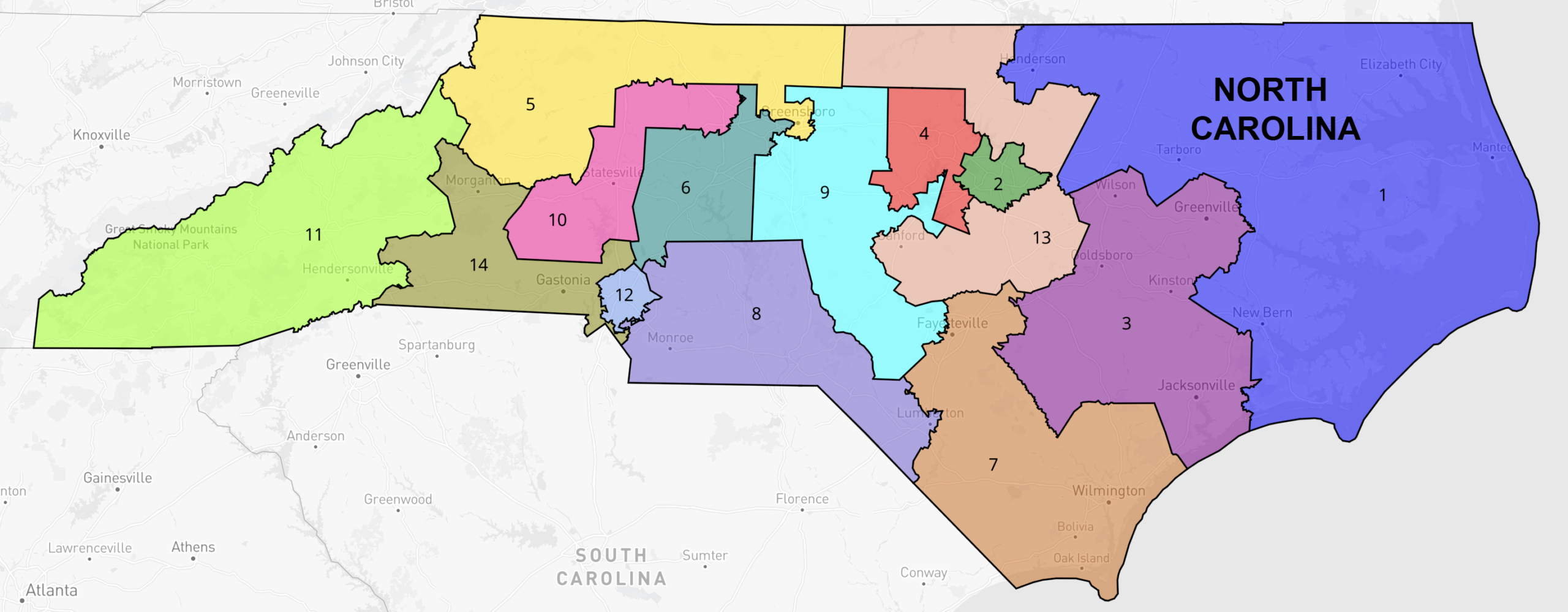
Click on map above to see interactive version at DavesRedistrictingApp.com.
By Jim Ellis — Tuesday, October 13, 2026
House
One of the key redistricting driven congressional contests likely to become a point race, and a major indicator of the national House trend on election night, lies in eastern North Carolina where conflicting signals are emerging.
Earlier this year, the Republican legislature redrew the state’s congressional map with the explicit goal of transforming the 1st Congressional District, which two-term Rep. Don Davis (D Snow Hill) represents, into a Republican leaning seat. In 2024, Rep. Davis defeated retired Army officer Laurie Buckhout (R) by a narrow 49.5 – 47.8 percent margin, a spread of just 6,307 votes from 376,324 ballots cast.
The legislature changed the 1st District with a direct territory swap from Rep. Greg Murphy’s (R-Greenville) 3rd District. The trade of just over 271,000 people, about 36 percent of the total 1st District population, significantly changes the political complexion of both CDs, and should allow the Republican congressional nominee to win both.
Under the 2026 map, the 1st District now covers most of North Carolina’s Atlantic coastal region and includes 23 counties and parts of two others, compared to 21 counties and part of one in 2024.
Four counties, Greene, Lenoir, Wayne, and Wilson, shifted from District 1 to District 3, while Beaufort, Carteret, Dare, Pamlico, and part of Onslow moved from District 3 into District 1. These changes make the 1st District almost 10 points more Republican, while the 3rd becomes roughly nine points more Democratic. Even so, Rep. Murphy remains a strong favorite for re election.
The presidential numbers illustrate the magnitude of the shift. Under the previous map, President Trump lost the 1st District in 2020 by a 50-49 percent margin. Using the 2026 overlay, he would have carried the district in 2024 by a calculated 55-44 percent spread.
To better illustrate the changes, we look at the Dave’s Redistricting App’s (DRA) published partisan lean calculations for both the 1st and 3rd CDs, before and after the redistricting changes. In the 2024 version of the district that yielded Rep. Davis 49.5 percent against Buckhout, the DRA partisan lean was 50.9D – 47.7R. Under the new plan, the partisan lean flips to 52.4R – 45.9D. Conversely, the 3rd District’s calculation moves from 57.2R – 40.7D to 52.8R – 45.2D.
Notably, in the two elections conducted under the prior map, Republican candidates performed almost exactly in line with DRA’s projected lean of 47.7 percent, recording 47.6 percent in 2022 and 47.8 percent in 2024. This consistency reinforced the legislature’s decision to redraw the district to alter its partisan trajectory.
Until recently, Rep. Davis appeared to be defying the region’s political history, but the newest polling suggests a tightening race. Since June, three Democratic surveys and one Republican poll have been released. The Democratic firms, GQR (twice) and GBAO, showed Davis leading by an average of 47.3 – 41.0 percent.
The co/efficient Research survey (Oct. 6–8; 623 likely voters; live interview & text) found Buckhout slightly ahead, 43-42 percent, marking a notable improvement for the Republican and potentially reflecting the deeper GOP strength of the newly added territory more accurately than earlier polls.
In the 2024 campaign, polls from Noble Predictive Insights and GQR released in late September and mid-October, respectively, found Rep. Davis holding an average 9.5 percent lead. As we saw in the 2024 final result, that lead decreased to a 1.7 percent margin. If a similar Republican undercount occurs, as has been common in many regions over the past four election cycles, Buckhout may be in a stronger position than the topline numbers suggest.
North Carolina’s new 1st District is a very important part of the Republican formula to either hold their slim majority or mitigate the size of a new Democratic majority. Should Rep. Davis defy the political odds and win re-election, the Democrats would be well-positioned to secure their sought-after House majority.