Tag Archives: Rep. Tim Ryan

Laxalt, Lombardo, Looking Good in NV; Palin Should Be A Lock in AK

By Jim Ellis — June 14 2022

Senate

Former Attorney General Adam Laxalt leads among likely Nevada GOP primary voters.

Nevada: Laxalt Holding Comfortable Lead — As we move into the Nevada nomination vote today, OH Predictive Insights released a final pre-primary survey of the Senate Republican candidate field. The poll results (June 6-7; 525 likely Nevada GOP primary voters; live interview & text) show former Attorney General Adam Laxalt leading disabled Afghan War veteran Sam Brown by a 48-34 percent count. Laxalt has led the entire race, and his advantage margin, though not as robust as one might have expected, should well be enough to carry the party favorite to victory tomorrow night. The new Republican nominee will then face Sen. Catherine Cortez Masto (D) in the general election.

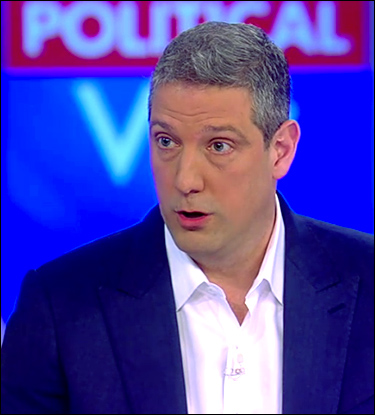
Ohio: Rep. Ryan Leads in New Survey — After the May 3 primary, Suffolk University was first in the field (May 22-23; 500 likely Ohio voters) and found Republican J.D. Vance leading US Rep. Tim Ryan (D-Warren/Youngstown) by a slight 42-39 percent spread. Now, a new study from Democratic pollster Grow Progress (conducted for the Innovation Ohio organization; May 30-June 3; 2,018 registered Ohio voters; online) finds Rep. Ryan holding a 44-41 percent edge. The Ohio electorate typically polls close and these surveys indicate that such a pattern continues in 2022. We can expect toss-up survey research results to continue well into October. At that point, a victory trend will develop for one candidate or the other.

House

AK-AL: Palin First of 48; Four Advance — Alaska held its first election under the state’s new top-four jungle primary format and though just over half of the votes are counted, it appears clear that former governor and 2008 vice presidential nominee Sarah Palin (R) will finish first. The special election is held because veteran Rep. Don Young (R-Ft. Yukon) unexpectedly passed away in March.

At this writing, Palin has recorded 29.8 percent of the vote within the huge field of 48 candidates. Republican Party-endorsed candidate, Nick Begich III, is second with 19.3 percent, followed by Dr. Al Gross (12.5 percent), the 2020 Democratic US Senate nominee who is running under the Non-Partisan label in this election. Democratic former state Rep. Mary Peltola, from the tribal Bethel region, appears in the best position to secure the fourth and final run-off position with her 7.5 percent vote total. She leads the fifth-place finisher, former US Interior Department Deputy Assistant Secretary Tara Sweeney (R), by just over two percentage points.

Twenty-five of the 48 candidates, including all top four finishers, also filed for the regular election. Six individuals, none of whom appear to be a major contender, filed only for the regular term. The jungle primary process for that election then begins again in a separate vote, also on Aug. 16.

NY-23: Republicans Choose Nominee — While New York Republican Party chairman Nick Langworthy will likely be the NY-23 party nominee for the regular election, the group of local county chairmen who have the power to choose the special election nominee have selected Steuben County Republican Party chairman Joe Sempolinski as the party standard bearer for the Aug. 23 special election to replace resigned Rep. Tom Reed (R-Corning).

Democrats have tabbed retired Air Force officer Max Della Pia for both the special election in the current 23rd CD and for the new 23rd in the regular election. According to the FiveThirtyEight data organization, the new NY-23 rates as R+23, so Langworthy is the clear long-term favorite. Sempolinski will not be a candidate in the regular election.

Governor

Michigan: James Craig to Run As Write-In Candidate — Former Detroit Police chief James Craig, who was disqualified from the ballot because of submitting a lack of valid petition signatures, said on Friday that he would launch a write-in campaign for the Republican nomination. With half the GOP field rejected for the same reason, the race against Gov. Gretchen Whitmer (D) has radically turned.

Nevada: Sheriff Lombardo Leads with Plurality Support — The aforementioned OH Predictive Insights poll (see Senate section above) also tested the GOP race for governor. Today’s primary winner will then challenge Democratic Gov. Steve Sisolak.

The OH poll results project Clark County Sheriff Joe Lombardo leading attorney and former professional boxer Joey Gilbert, ex-US senator and representative, Dean Heller, and North Las Vegas Mayor John Lee by a 34-21-10-10 percent margin. Nevada has no runoff law, so the top vote-getter — most likely Sheriff Lombardo — will claim the Republican nomination.
Ohio Senate, Maine Gubernatorial Races Tight

By Jim Ellis — June 3, 2022

Senate

Ohio: First Post Primary Poll Tight — The Ohio primary was May 3, and now we see the first public general election poll testing US Rep. Tim Ryan (D-Warren/Youngstown) and Republican best-selling author J.D. Vance. Suffolk University surveyed the Ohio electorate (May 22-24; 500 likely Ohio general election voters; live interview) and finds Vance jumping out to a slight three-point lead, 42-39 percent. The poll’s tight results is not unusual for an Ohio race, which typically are rated as toss-ups until the final two weeks.

In other questions, 42.6 percent of the respondents answered that either the economy or inflation was their most important issue, with abortion registering third at 11.6 percent. Even though he was leading the race, Vance’s favorability index was surprisingly upside down at 35:38 percent positive to negative. Rep. Ryan held a 40:23 percent positive ratio. President Biden fell to 39:56 percent. A total of 49 percent said they want to change the direction in which President Biden is leading the nation, while 24 percent said they want to support the President’s leadership.

Governor

Maine: Gov. Mills Holds Tepid Edge — Maine Gov. Janet Mills (D), who has seen her approval ratings drop from strong heights of late, still tops former Gov. Paul LePage (R) in a combined new statewide survey from Fabrizio Lee & Associates (R) and Impact Research (D) for AARP (May 10-13; 1,050 likely Maine voters with a representative sample of 500 likely voters; live interview & text), but the respondents have a sour outlook regarding the future. While Gov. Mills holds a 51-46 percent edge on the ballot test against ex-Gov. LePage, her lead drops to just one point, 44-43 percent, among those who say they are definitely committed to one of the candidates.

By a whopping margin of 18:82 percent, however, the respondents believe the country is on the wrong track. The state of Maine is also viewed negatively in a 43:56 percent ratio. President Biden’s job approval is upside-down at 45:54 percent. Gov. Mills’ job approval ratio barely remains in positive territory at 49:47 percent favorable to unfavorable.

House

MI-3: Rep. Meijer Trails in New Survey — Michigan freshman Rep. Peter Meijer (R-Grand Rapids) fared poorly in redistricting, taking his Grand Rapids-anchored district from a R+9 rating according to the FiveThirtyEight data organization to a D+3 with 50 percent new territory. A new Public Policy Polling survey (May 25-26; 676 registered MI-3 voters; interactive voice response system) shows Rep. Meijer falling behind Democrat Hillary Scholten, his 2020 general election opponent, by a 39-37 percent clip. The change in district lines and the new partisan complexion certainly makes this result believable. The 2022 MI-3 race will be rated a toss-up with no clear favorite.

SC-1: GOP Primary Tightening — A new Trafalgar Group survey (May 26-29; 556 likely SC-1 Republican primary voters; multiple data collection sources) sees the Republican primary challenge of former state representative and 2018 congressional nominee Katie Arrington coming within potential upset range of freshman Rep. Nancy Mace (R-Charleston). The Trafalgar organization sees the race closing to 46-41 percent, which is much different than a Basswood Research poll taken around the same period (May 21-22; 400 likely SC-1 Republican primary voters). The latter poll found the congresswoman taking a commanding 44-24 percent lead. The South Carolina primary is scheduled for June 14.

Primary Results in Ohio, Indiana;
An Odd Lt. Gov. Appointment in NY

By Jim Ellis
May 4, 2022

Primaries

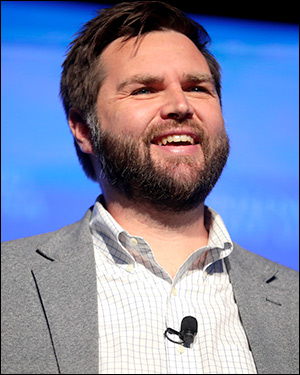
Author J.D. Vance, Ohio Senate Candidate

Ohio: Vance, Ryan Move to General — Best-selling author J.D. Vance, armed with an endorsement from former President Donald Trump, won the open Ohio US Senate Republican nomination last night with a 32-24-23 percent victory over former state Treasurer Josh Mandel and state Sen. Matt Dolan (R-Chagrin Falls). Businessman Mike Gibbons, who spent almost $17 million of his own money on the race, finished fourth with 12 percent, ahead of ex-Ohio Republican Party chair Jane Timken who posted only six percent support.

Polling proved to be accurate. The late race surveys were consistently showing Vance breaking into the lead, and the ballot tests were projecting he would win a close finish over Mandel and Sen. Dolan, which happened.

Ohio Rep. Tim Ryan

For the Democrats, as expected, US Rep. Tim Ryan (D-Warren/Youngstown) was an easy winner, capturing 70 percent of the Democratic vote from a turnout that was significantly lower than the party performance in the most recent 2018 midterm election. Thus, Vance and Ryan now advance into what should be a competitive general election.

Turning to Cleveland, which hosted the most competitive Democratic congressional primary, freshman Rep. Shontel Brown (D-Warrensville Heights/Cleveland) easily turned back former state senator and 2020 Bernie Sanders for President campaign national co-chair Nina Turner by a landslide 66-34 percent margin. The two ran against each other in the 2021 special election that first elected Rep. Brown.

In the Toledo-anchored 9th District, Iraq War veteran and Trump campaign activist J.R. Majewski (R) claimed the Republican nomination, defeating both state Rep. Craig Riedel (R-Defiance) and state Sen. Theresa Gavarone (R-Bowling Green). Majewski now advances into the general election against the Democratic US House member who has served longer than anyone in her party. Rep. Marcy Kaptur (D-Toledo) was first elected in 1982. This will be a highly competitive general election in a new 9th CD that carries a R+6 rating.

Former Trump White House aide Max Miller (R), armed with the former president’s endorsement, easily won the Republican nomination since incumbent Rep. Bob Gibbs (R-Lakeville) surprisingly decided to retire after filing for re-election. Miller now becomes the heavy favorite to capture the R+14 open seat in the general election.

Staying in the northern Ohio region, the new open 13th District that looks to be playing as an even political domain, will feature a battle between state Rep. Emilia Sykes (D-Akron), who was unopposed in the Democratic primary, and TV commentator and former Miss Ohio in the USA beauty pageant, Michelle Gesiotto Gilbert, who captured the party nomination against six Republican opponents as another Trump-endorsed Ohio candidate. The Sykes-Gilbert contest begins as a toss-up general election campaign.

Indiana: Ex-Sen. Houchin Wins Open Seat GOP Nod — The Hoosier State battle in the southeastern corner of the state to succeed retiring Rep. Trey Hollingsworth (R-Jeffersonville) ended as many predicted. There, resigned state Sen. Erin Houchin, a former congressional aide to ex-Sen. Dan Coats (R-IN), won the Republican primary last night, defeating former Congressman Mike Sodrel and Bronze Star medal winner Stu Barnes-Israel, 37-26-21 percent.

Houchin now becomes the prohibitive favorite in the open 9th District general election. She will face educator Matthew Fyfe who won the Democratic primary but raised and spent less than $50,000 for his primary campaign.

In the northwestern 1st District, US Air Force Reserve Lt. Col. Jennifer-Ruth Green easily defeated former La Porte Mayor Blair Milo, 47-22 percent, to capture the Republican nomination. She advances to face freshman Rep. Frank Mrvan (D-Highland/Gary) who is on the ballot for a second term. The congressman was renominated in an 86 percent landslide.

Governor

Ohio: Gov. DeWine’s Unimpressive Win — Incumbent Mike DeWine successfully won re-nomination for a second term, but with only 48 percent support from within his own party. Had the anti-DeWine voters coalesced behind one candidate, it is now apparent that such an individual may have denied the governor a primary victory. Former US Congressman Jim Renacci scored 28 percent of the vote and farmer Joe Blystone posted 22 percent.

For the Democrats, Dayton Mayor Nan Whaley easily defeated former Cincinnati Mayor John Cranley with 65 percent of the vote. Whaley carried all but eight of the state’s 88 counties, including nipping Cranley in his home county of Hamilton. Whether or not Mayor Whaley can force Gov. DeWine into a tight November contest remains to be seen, but she did exhibit strength within her party while the governor’s performance among Republicans was clearly disappointing.

House

NY-19: Rep. Delgado Chosen as Lieutenant Governor — Yesterday, Gov. Kathy Hochul (D) chose US Rep. Antonio Delgado (D-Rhinebeck) as her new lieutenant governor. Delgado replaces her first choice, Lt. Gov. Brian Benjamin (D) who was indicted for bribery and forced to resign. The selection of Rep. Delgado is an interesting one in that the appointment creates another vacancy in the US House and forces an additional special election. Currently, four Republican and one Democratic House seats are vacant for various reasons.

The Upstate 19th District may undergo significant change when the new congressional maps are court drawn later this month. The move to choose a House member is curious in that it creates further uncertainty for the Democrats now that their 22D-4R map has been disqualified as a partisan gerrymander. The current 19th District is rated R+4, while the re-drawn district on the rejected map rates D+4. Under a new draw, this seat will almost assuredly become a top Republican conversion target. Delgado was first elected to the House in 2018.

Self-Funding Candidates Saving GOP

By Jim Ellis

April 21, 2022 — The first-quarter financial reports are now public and we see a stark difference between Democrats and Republicans in funding for the key May primary Senate races, particularly in Pennsylvania and Ohio. If it wasn’t for self-funding candidates in these two states, the GOP would be in trouble.

In Pennsylvania, Democratic Lt. Gov. John Fetterman holds strong polling leads over his primary opponents as well as a major fundraising advantage over all contenders. According to the Federal Election Commission’s March 31 campaign finance reporting, Fetterman has raised just over $15 million for his US Senate effort.

His receipts total is well over $9 million more than his chief Democratic primary opponent, Rep. Conor Lamb (D-Pittsburgh), and his $5.7 million aggregate figure. The third competitive Democrat, state Rep. Malcolm Kenyatta (D-Philadelphia), has obtained $1.8 million. None of the three Democrats have self-funded their races to any degree.

The Pennsylvania Republicans, on the other hand, offer a stark contrast. While the top two GOP resource candidates, television doctor Mehmet Oz and ex-hedge fund CEO David McCormick, report aggregate receipts in the same realm as Fetterman, the sources are very different.

Dr. Oz posts total receipts through March 31 of $13.4 million and McCormick has $11.3 million. The difference, however, is that 82 percent of Dr. Oz’s money comes from him, and 61 percent of McCormick’s money is self-donated, mostly in the form of campaign loans.

The same pattern also appears for the third-highest funded Republican candidate, former US Ambassador Carla Sands. She reports $4.62 million in receipts, but 85 percent of that total comes from her personal funds. The fourth-place candidate, former lieutenant governor nominee Jeff Bartos, is the only one with a majority percentage of his dollars coming from contributors. He has raised $3.4 million, with 62 percent coming from individuals other than himself.

The story is the same in neighboring Ohio. There, the two top fundraising Republicans report self-funding as their major source.

Businessman Mike Gibbons leads all candidates in total receipts with $17.4 million raised. In his case, all but $1 million, or 94 percent of his aggregate total, comes from his own funds. The second-highest Republican in terms of dollars raised is state Sen. Matt Dolan (R-Chagrin Falls), who is a minority owner of the Cleveland Guardians MLB baseball club, with $11.1 million in receipts. He also has self-donated, mostly in terms of personal loans, 94 percent of his campaign treasury.

We also see the same pattern appear for the Ohio Democrats that exists in Pennsylvania. US Rep. Tim Ryan (D-Warren/Youngstown) is the consensus party candidate, way ahead of former Consumer Financial Protection Bureau official and 2020 congressional candidate Morgan Harper in terms of polling and money.

Continue reading

Ohio Entering Home Stretch

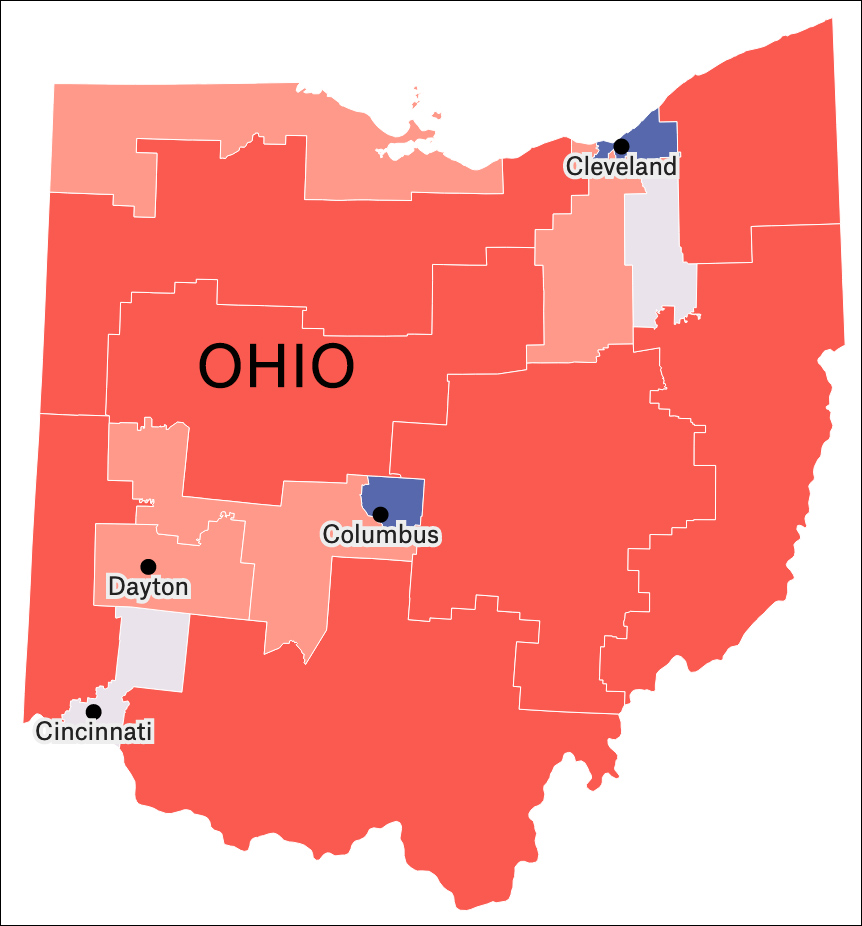
Ohio redistricting map in question (click on map above or here to go to FiveThirtyEight’s interactive map)

By Jim Ellis

April 18, 2022 — We’re on the threshold of entering the final two weeks before the Ohio primary on May 3, and the candidates for all offices are swinging into high gear just as the state Supreme Court rejected another set of redistricting maps.

The state House of Representatives and Senate primaries having been postponed, because the legislature and state Supreme Court cannot find common ground pertaining to the new district lines; no new primary date has been set. Late last week, for the fourth time, the judicial body rejected the legislature’s draw for their own political boundaries in both chambers. Since the Ohio Constitution does not give the courts the authority to draw maps, all the justices can do is return the plans to the legislature and order them to begin yet again.

News is occurring in the races that are headed toward nominations. The new Remington Research Group US Senate GOP primary survey (April 11-12; 884 likely Ohio Republican primary voters, interactive voice response system) finds former state treasurer, Josh Mandel, forging back into the lead and state Sen. Matt Dolan (R-Chagrin Falls), a minority owner of the Cleveland Guardians MLB franchise, moving into contention.

The statewide GOP primary ballot test finds Mandel leading the pack with 23 percent as compared to businessman Mike Gibbons’ 17 percent, Sen. Dolan’s 15 percent, former Ohio Republican Party chair Jane Timken posting 12 percent, and author J.D. Vance trailing at 10 percent.

Reports suggest that an endorsement coming for Vance from former President Donald Trump is imminent. If so, the polling standings will change. Remington posed a second ballot test question to the current respondent pool asking how they would vote if knowing Trump had endorsed Vance. While Mandel would still lead, his edge shrinks to 19 percent; Gibbons, Dolan, and Vance would bunch together at 15 percent; and Timken drops to 11 percent.

If the reports of Trump endorsing Vance prove true, the Remington poll suggests that such a move would likely change the race’s flow. The Trump involvement in such a manner appears to make a close contest even closer.

The Remington survey is the tenth poll taken of the Republican Senate primary since the beginning of February. Gibbons has led in six of them and Mandel three, with one showing a three-way tie among the two aforementioned men and Vance. The fact that all five of the key candidates, at one time or another, have been within shouting distance of the lead suggests that any one of them could catch a flyer at the end and propel themselves into a nomination victory with a small plurality.

On the Democratic side, US Rep. Tim Ryan (D-Warren/Youngstown) appears to be cruising toward an easy nomination victory against former Consumer Financial Protection Bureau official and 2020 failed congressional candidate Morgan Harper.

Continue reading

Ohio Numbers Crunched

Ohio 2022 Congressional Redistricting map. Click on image to go to FiveThirtyEight’s fully interactive map.

By Jim Ellis

April 11, 2022 — When Ohio Rep. Bob Gibbs (R-Lakeville) announced the suspension of his re-election campaign on Wednesday, it brought some national attention to what has become a Buckeye State redistricting debacle.

Gibbs called out the Ohio State Supreme Court for allowing the replacement congressional district map to languish in political limbo after they rejected the first iteration for excessive political gerrymandering. Though congressional candidate filing was delayed until March 4 from the original Feb. 2 deadline in association with the state’s May 3 primary, the court still took no action toward finalizing a new map. Therefore, candidates were forced to file for districts that may or may not change before election day.

When the Ohio state high court finally informed the Democrat plaintiffs who were challenging the map that the decision regarding the first map constituted the final ruling, the complaint process had to rewind, beginning with a new lawsuit. Now filed, it is apparent that first judicial action on the new challenge is still months away. Therefore, the replacement map appears set for the 2022 elections, at least through the nomination process.

That finally being the case, we can now look at what is becoming a relatively competitive map for the upcoming general election.

Ohio loses a seat, therefore a new congressional map must be in place for the 2022 elections, otherwise all 15 US House contests would be decided on a statewide basis.

The state will now feature two open seats, Gibbs’ 7th CD and the newly configured open 13th District that Rep. Tim Ryan (D-Warren/Youngstown) is vacating to run for US Senate. Two new House members, Reps. Shontel Brown (D-Warrensville Heights/Cleveland) and Mike Carey (R-Columbus), who were both elected in November 2021 special elections, will stand for full terms this year.

Of the 13 incumbents seeking re-election, two, Reps. Steve Chabot (R-Cincinnati) and Marcy Kaptur (D-Toledo) — the latter being the fourth longest-serving member of the House who was first elected in 1982 — find themselves in toss-up general election situations.

In Rep. Chabot’s 1st District, which covers much of greater Cincinnati, the FiveThirtyEight data organization rates the seat as a D+3. Dave’s Redistricting App largely agrees, finding the average Democratic vote over a historical set of races registering 49.91 percent as opposed to 47.93 percent for Republicans. Already, the general election is largely set with Rep. Chabot seeking re-election and the Democrats having a consensus candidate is Cincinnati City Councilman Greg Landsman.

Rep. Kaptur sees the Cleveland portion of her district redacted, meaning her Toledo-anchored seat now features an even mix between Democrats and Republicans. The FiveThirtyEight group rates Kaptur’s new 9th CD at R+6, but Dave’s Redistricting App sees this seat differently. According to the party averages over the course of past political contests, the Democratic vote is 48.77 percent, as compared to a virtually even percentage for Republicans, 48.63.

Rep. Kaptur has no Democratic primary opposition, but four Republicans have filed, two of whom would be significant general election contenders. They are state Sen. Theresa Gavarone (R-Bowling Green) and state Rep. Craig Riedel (R-Defiance). It is likely that one of these two will advance into the general election and make the OH-9 general election campaign one of the most hotly contested in the nation.

Continue reading

DCCC’s Red to Blue Targets

By Jim Ellis

March 14, 2022 — The Democratic Congressional Campaign Committee released their first targets in what they call their Red to Blue program or, in other words, the districts they hope to convert from Republican to Democrat. Curiously, two districts on the list are already blue.

Below is a look at the DCCC’s dozen released targets:


CA-22: Rep. David Valadao (R-Hanford)
2020 Win Percentage: 50.4% in District 21

• FiveThirtyEight: D+10
• Dave’s Redistricting App: 42.3% R / 55.1% D
Endorsed Candidate: State Assemblyman Rudy Salas (D-Bakersfield)

By the numbers, this is one of the Democrats’ best national targets, but Rep. Valadao has consistently won in Democratic seats. He lost in 2018, but won the seat back two years later. Assemblyman Salas is the Democrats’ top recruitment target. Despite the lopsided Democratic numerical advantage, the finish here will again likely be razor-thin.


CA-45: Rep. Michelle Steel (R-Orange County)
2020 Win Percentage: 51.1% in District 48

• FiveThirtyEight: D+5
• Dave’s Redistricting App: 45.8% R / 52.2% D
Endorsed Candidate: Jay Chen – Community College Trustee

Freshman Rep. Steel is another Republican to whom the California Citizens Redistricting Commission members were not kind. Moving into the more inland Orange County district from her coastal seat, Steel has been a well known figure in Orange County politics for many years, particularly with her service time on the Orange County Board of Supervisors before winning the congressional seat.

A D+5 seat is exactly the type the Republicans must win to achieve their goal of re-taking the majority. With national redistricting cutting against them, the GOP must win a sizable number of the 22 seats so far within the Even to D+5 category.


CO-7: Rep. Ed Perlmutter (D-Arvada) – Open Seat
2020 Win Percentage: 59.1%

• FiveThirtyEight: D+6
• Dave’s Redistricting App: 43.8% R / 51.7% D
Endorsed Candidate: State Sen. Brittany Petterson (D-Lakewood)

This district does not really belong on the list since it is already a blue seat. Democrats are favored to hold the seat and Sen. Petterson is clearly their candidate to do so.


IA-1: Rep. Mariannette Miller-Meeks (R-Ottumwa)
2020 Win Percentage: 50.0% (6 votes districtwide) in District 2

• FiveThirtyEight: R+4
• Dave’s Redistricting App: 49.7% R / 46.8% D
Endorsed Candidate: State Rep. Christina Bohannan (D-Iowa City)

Rep. Miller-Meeks won the closest race in the country in 2020, a literal six-vote affair against former state senator and 2018 lieutenant governor nominee Rita Hart (D). This year, the congresswoman will see a different opponent since Hart chose not to return for a re-match. State Rep. Bohannan has two Democratic opponents, but she should have little trouble in winning the party nomination on June 7.

This will be another close eastern Iowa campaign, and this district is actually one point more Democratic than the previous 2nd according to the FiveThirtyEight statistical organization. This is a top Democratic target, but Rep. Milller-Meeks will be favored assuming the political climate remains favorable for Republicans.


IA-2: Rep. Ashley Hinson (R-Marion/Cedar Rapids)
2020 Win Percentage: 50.0% in District 1

• FiveThirtyEight: R+6
• Dave’s Redistricting App: 51.1% R / 45.4% D
Endorsed Candidate: State Sen. Liz Mathis (D-Hiawatha)

In the first redistricting map presented last year, Rep. Hinson would likely have been defeated. With the legislature rejecting that draw, a new one emerged. This gives the congresswoman a more favorable seat but one this is still highly competitive. Democrats have recruited a strong candidate in Sen. Mathis. She has no primary opposition at this time. In a favorable GOP political climate, this seat would become difficult for the Democrats to convert despite its statistical closeness.
Continue reading

Senate Candidate Gibbons Confirmed to be in Top Tier of Ohio Race

By Jim Ellis

Ohio US Senate candidate Mike Gibbons forges into a small lead.

Feb. 15, 2022 — At the end of January, a Cygnal research poll found investment banker and 2018 Ohio US Senate candidate Mike Gibbons forging into a small lead over perennial GOP primary leader Josh Mandel, the state’s former treasurer and 2012 US Senate nominee. Two new polls now confirm Gibbons’ outright lead in the battle to succeed retiring Republican Sen. Rob Portman.

The previously released internal Gibbons’ campaign Cygnal January poll (Jan. 28-30; 929 likely Ohio Republican primary voters, SMS text & email) gave their candidate a 16-13 percent lead over Mandel, with author J.D. Vance showing in double-digits at 10 percent.

The new pair of statewide Buckeye State Republican US Senate primary surveys find the businessman again overtaking Mandel to claim first place. A co/efficent independent survey (Feb. 6-8; 613 likely Ohio Republican primary voters, text & automated interview responses) posts Gibbons to a 20-18 percent lead over Mandel, with state senator and Cleveland Guardians MLB club minority owner Mike Dolan, former state Republican Party chair Jane Timken, and Vance trailing with 7, 6 and 5 percent support, respectively.

The new Cyngal research firm’s internal poll for the Gibbons campaign (Feb. 8-10; 609 likely Ohio Republican primary voters, SMS text & email), however, gives their candidate a much larger margin over the rest of the field.

One possible reason for the increase in support is that another business candidate, car dealer Bernie Moreno, who had reached as high as 11 percent in a January poll, withdrew from the race in early February, reportedly at the behest of former President Donald Trump. It is conceivable that much of the Moreno support base went to Gibbons, since the two candidates were similar in several ways.

The most recent Cygnal numbers find Gibbons holding a surprisingly large 23 percent support figure, with Mandel, Vance, Timken, and Dolan trailing with 11, 9, 8 and 6 percent, respectively. The Gibbons’ media blitz, to an extent featuring Sen. Rand Paul (R-KY) endorsing the investment banker’s candidacy, has clearly achieved its goal of propelling Gibbons into serious contention for the party nomination that will be decided in the open May 3 primary election.

Though the study’s analysis report doesn’t provide segmented numbers, the Cygnal pollsters claim the Gibbons lead is widespread within the key Republican voter groups. They report Gibbons leads by double digits among “self-identified Trump Republicans as well as Traditional Republicans.”

Gibbons also maintains similar leads with “self-identified Extremely Conservative, Very Conservative, and Somewhat Conservative voters, and over the nearest competitor among both men and women.” He also “holds strong advantages among Evangelical Protestants, Mainline Protestants, and Catholic voters.”

Gibbons’ effort is almost exclusively self-financed, to the tune of $11.4 million, all as a loan to the campaign. He has spent $5.8 million and had a cash-on-hand reserve of $6.4 million at the end of 2021. Therefore, even if his fundraising operation does not raise major money, Gibbons has enough to compete for the nomination.

Continue reading

Ohio Congressional Map Tossed

The Ohio State Supreme Court invalidated the state’s newly enacted congressional map and returned the plan to the Ohio state legislature to be redrawn. The state lost a seat in reapportionment. (Map: Dave’s Redistricting App)


By Jim Ellis

Jan. 19, 2022 — The Ohio State Supreme Court, on a 4-3 vote with the Republican Chief Justice Maureen O’Connor voting with the three Democratic members, last Friday invalidated the state’s newly enacted congressional map and returned the plan to be redrawn. The decision may result in a blow to Republican hopes of re-capturing the US House majority as the Ohio draw is one of the party’s most important maps.

The high court’s action followed a similar 4-3 decision the previous day to reject the state House and Senate maps. All of the plans were invalidated for the same reason: they did not meet the competitiveness provision in the Ohio redistricting proposition that the people’s vote enacted prior to the commencement of the re-mapping process. The justices claimed the plan must better reflect the partisan statewide voting pattern, a measure that favors Republicans but not to the extent of the district ratios projected for the jettisoned maps.

The current Ohio congressional map stands at 12 Republicans and four Democrats. The state lost a seat in reapportionment, so the advisory redistricting commission members and the legislature were tasked with creating a new 15-district congressional plan.

By most accounts, the new map would have likely elected 10 Republicans and two Democrats, while featuring three politically marginal districts, those of Reps. Steve Chabot (R-Cincinnati) and Marcy Kaptur (D-Toledo) and an open seat largely created because Reps. Anthony Gonzalez (R-Rocky River) and Tim Ryan (D-Warren) are leaving their seats to retire and run for the Senate, respectively. Therefore, the state’s electoral split could have swung anywhere from 10R-5D all the way to 13R-2D.

The ruling likely creates the greatest change for two of the aforementioned members. The court specifically cited the Hamilton County draw in Rep. Chabot’s seat that attached a swath into downtown Cincinnati. This created a city attachment to Butler County, thus placing it in Rep. Warren Davidson’s (R-Troy) strongly Republican 8th District. As a result, the 1st District became more Republican for Chabot, but still left him with a swing seat at best.

Continue reading

Ohio Redistricting Set to Pass

WBNS TV – Channel 10 – Columbus

By Jim Ellis

Nov. 19, 2021 — The Ohio legislature has sent the new congressional and state legislative maps to Gov. Mike DeWine (R) for his approval. Ohio loses one seat in reapportionment.

As expected, the new map radically changes the seats that outgoing members Tim Ryan (D-Warren/Youngstown) and Anthony Gonzalez (R-Rocky River) currently hold. Rep. Ryan, running for the Senate, sees his eastern Ohio 13th District collapsed, with a sizable chunk of Akron remaining in the seat and the remainder going to Rep. Bob Gibbs’ (R-Lakeville) 7th District.

Instead of moving east, as under the current map, the new 13th moves to the west, annexing Medina County and the western part of the Cleveland metro area in Cuyahoga County. Much of this territory comes from the retiring Rep. Gonzalez’s current 16th District, a seat whose territory gets absorbed in several neighboring CDs.

At first glance, the map looks to break 12R-3D, meaning Democrats would take the seat loss in typical election years. Three of the districts, however, two of which Democrats now hold, would become highly competitive.

The members with the most competitive districts would again be Reps. Steve Chabot (R-Cincinnati) in the 1st District, in addition to Marcy Kaptur’s (D-Toledo) 9th CD, and the open 13th District.

The safest members are Reps. Brad Wenstrup (R-Cincinnati), though he loses a significant part of his anchor city, Joyce Beatty (D-Columbus), Jim Jordan (R-Urbana), Bob Latta (R-Bowling Green), Bill Johnson (R-Marietta), Bob Gibbs (R-Lakeville), Warren Davidson (R-Troy), Shontel Brown (D-Cleveland), and Troy Balderson (R-Zanesville).

Reps. Mike Turner (R-Dayton), David Joyce (R-Russell Township, and Mike Carey (R-Columbus) all would get reliable Republican districts, but not overwhelmingly so. Turner’s composite improves his marginal district a net three points in his party’s favor. Rep. Joyce sees his partisan complexion remaining at about a 10-point positive district for him when comparing the composite average to the 2020 presidential results.

Continue reading