Tag Archives: New York

New York, 2020: A Political Hotbed?

By Jim Ellis

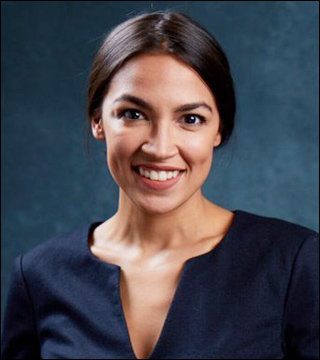
Rep. Alexandria Ocasio-Cortez’s (D-Bronx) upset in the 14th District Democratic primary during the last cycle has awakened the New York left.

Feb. 20, 2019 — The state of New York, which generally features mostly non-competitive congressional campaigns in its 27 districts may see a very different 2020. Already, individuals are making preliminary political moves in at least 18 of the 27 CDs, including many budding primary challenges.

Rep. Alexandria Ocasio-Cortez’s (D-Bronx) upset of then-Rep. Joe Crowley (D-Queens) in the 14th District Democratic primary during the last cycle has awakened the New York left. Now, it appears several other New York City veteran Democrats could face their own 2020 primary challenge.

Even Ocasio-Cortez, who has angered many establishment Democrats with some of her actions and comments, could also see primary competition as rumors of a return match for Crowley, who remains as the Queens Borough Democratic Party chairman, begin to swirl.

In terms of potential Democratic primary challenges, individuals are coming forward to at least begin talking about developing a potential campaign. Those targeted include Reps. Tom Suozzi (D-Glen Cove), Yvette Clarke (D-Brooklyn), Jerrold Nadler (D-Manhattan), Carolyn Maloney (D-New York City), Jose Serrano (D-Bronx), and Eliot Engel (D-Bronx). And, Ocasio-Cortez even listed new House Democratic Conference chairman Hakeem Jeffries (D-Brooklyn) as an incumbent for the Justice Democrats organization, apparently much to the chagrin of the rest of the NY Democratic delegation.

Continue reading

Apportionment Projections:
Who is Gaining, Who is Losing

By Jim Ellis

Jan. 3, 2019 — Late last year, we covered the new Census Bureau report for the states gaining and losing population during the past 12-month period. Now, we see the agency’s latest just-released numbers for the decade through this past July. Armed with the new data, outside mathematicians have made apportionment projections to provide a more defined picture as to which states will be gaining or losing US House seats in the 2020 post-census reapportionment.

With two years remaining in the present decade, trends can still change and we must remember that the reapportionment formula is complex, but the new projections give us a strong idea as to just how many seats, give or take a small variance, will transfer. At this point, according to the Washington, DC-based Election Data Services, it appears that as many as 22 seats could change location affecting 17 states.

Texas, having gained 3.55 million people since the 2010 census, looks to be adding as many as three seats for the 2022 elections and beyond. This will give the Lone Star State 39 seats during the next decade, and 41 electoral votes in the succeeding presidential elections.

Florida was the second largest gainer with just under 2.5 million new residents, meaning the Sunshine State will likely gain two seats, going from 27 to 29. In terms of raw numbers, California gained more than 2.3 million people, but it actually dropped a tenth of a point below the national growth average of 6.3 percent for the past eight years. This means the Golden State is currently on the hook to actually lose a district for the first time in history.

Continue reading

Looks Like the House Settles at 235

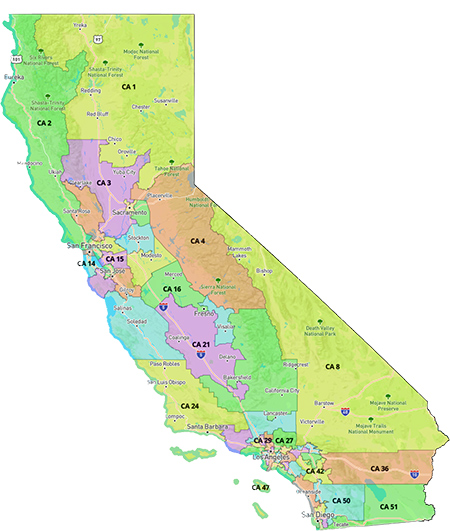
California Congressional Districts


By Jim Ellis

Nov. 29, 2018 — The 2018 House election cycle is finally drawing to a close, and it looks like the Democrats are gaining their 40th conversion seat. Monday night in California, as the state’s marathon vote counting process meanders on, Democratic challenger T.J. Cox overtook Rep. David Valadao (R-Hanford/Bakersfield) and may well be headed toward victory.

Rep. Valadao, who had earlier been projected as the winner, trails his opponent by 438 votes, but the counting is still not complete. New votes were counted in Kern County that greatly favored Cox, allowing him to take the lead for the first time.

The California counting system literally takes weeks because the state allows voters to postmark their mail ballots on Election Day, and the counties only process ballots on certain days. The 21st District is split among four counties, so it is difficult to know exactly how many mail, overseas, and provisional ballots still remain since the numbers are only released by complete county domain.

It is probable that we will not have a final result until next week because Kern won’t release more totals until Monday. The remaining counties: Fresno, Kings, and Tulare, should record their final numbers this week.

Continue reading

The Final Outlook

2018-elections-open-seatsBy Jim Ellis

Nov. 6, 2018 — Election Day has arrived, but it is likely that a majority of those planning to vote have already done so. Early voting totals are way up in most of the 37 states that employ a pre-election ballot casting procedure in comparison to the 2014 midterm election.

According to the University of Florida’s United States Elections Project, 25 of the 37 states report receiving more early votes than they did four years ago. None, however, is larger than Texas where early voting has already exceeded that grand total votes cast in 2014. The same also has occurred in Nevada, but it’s less surprising since the last midterm aggregate turnout there was unusually low.

In Texas, just under 4.9 million votes already have been received. In 2014, the aggregate early and Election Day vote was 4.72 million. In 2014, 44 percent of the total vote was cast early. If this same pattern occurs, the current election total turnout will exceed the 2016 presidential level participation figure of 8.96 million votes, however it is unlikely that will happen. How the increased turnout will affect the election outcome is undetermined at this point, but the high number of first-time voters suggest that Democrats could improve their typical standing.

Continue reading

Surprising Q3 Financial Disclosures

By Jim Ellis

Oct. 19, 2018 — The third quarter financial disclosure reports are now public, and more details are readily available. Thus, we are able to learn about various record-setting fundraising efforts.

FEC-moneyIn addition to Texas US Senate candidate Beto O’Rourke (D) attracting $38 million in the third quarter, an all-time record for any such campaign, several House candidates also reported financial numbers that have never been seen for district-level politics.

In the third quarter of 2018, nine House contenders exceeded raising $3 million, eight Democrats and one Republican.

In California’s 22nd District, incumbent Rep. Devin Nunes (R-Tulare), the chairman of the House Intelligence Committee, was the top Republican fundraiser and appears to have accumulated more financial resources for the entire campaign than any other congressional candidate of either party. In the quarter, Rep. Nunes raised $3.14 million. For the campaign, he has exceeded the $10.5 million mark.

But his Democratic opponent, attorney Andrew Janz, brought in over $4 million for the quarter, the only congressional candidate in the US to do so, and an all-time record for a quarter. He still trails Rep. Nunes in overall receipts (Janz posted $7.13 million for the campaign), however. Together, this campaign leads the nation in combined fundraising with over $17 million. For a regular cycle congressional campaign – not including the special elections we saw earlier that became national contests – this, too, is likely an all-time record for a House contest.

Continue reading

Forecasting the Results – Part II

By Jim Ellis

2018-democrat-house-majority-breakdown-text-graphicOct. 8, 2018 — The Democrats need to convert a net 24 seats to secure a one-seat majority in the US House on Election Day, Nov. 6. Many reports quote the number 23 as what is necessary to win control, but the new Pennsylvania map will yield one seat coming back to the Republicans — the new open 14th District — thus pushing the total up to 24.

As stated Friday, our forecasts listed below are based upon a series of factors, including current polling numbers, voter history, candidate personal and job approval favorability, fundraising, other races on the state ballot that could drive turnout, and outside issues such as the confirmation vote to for Judge Brett Kavanaugh to become a Supreme Court Justice, which could change the turnout model, etc.

According to our new analysis, the Democrats are on the cusp of converting the requisite number of Republican seats to take a bare majority and seeing their caucus become significantly larger. At this point, the Democratic gain range appears to reach 23 on the low side and 35 at the apex.

Looking at the country by state and region, it appears the Democrats will do well in the Midwest, in particular. The Great Lakes region that delivered President Trump his surprise victory appears to be snapping back to the Democrats in the midterm House races. Michigan looks particularly good for them at both the statewide and district levels.

Continue reading

The Healthcare Air Wars

By Jim Ellis

Oct. 2, 2018 — With the economy performing well, most recent polling finds jobs and taxes often dropping to third place as an answer to the most important issue question. Depending upon the geographic region, immigration ranks as the second most mentioned topic, but almost all now cite healthcare as number one.

(NY-24, Democrat Dana Balter’s healthcare ad)

Therefore, it is not surprising to see campaigns on both sides driving very different healthcare messages.

Democrats are consistently hitting Republicans over their vote to repeal the Affordable Care Act, as the Dems call it, or Obamacare, as is the GOP reference. The Democrat attacks claim that, because of this vote, the Republican House members wanted to rescind insurance coverage for those with pre-existing medical conditions. Lately, they’re adding an attack that Republicans attempted to invoke an “age tax”, claiming that the vote to repeal would have increased insurance costs five-fold for people over 50 years of age.

Republicans are countering that the “Medicare for all” plan that some Democrats advocate will cost $32 trillion dollars and result in a “doubling of the income tax.”

Continue reading

Will He Stay Or Will He Go?
New Duncan Hunter Poll Released

By Jim Ellis

California Rep. Duncan Hunter (R-Alpine)

California Rep. Duncan Hunter (R-Alpine)

Oct. 1, 2018 — One of the more interesting asides for the coming election is whether the two indicted congressmen, California’s Duncan Hunter and New York’s Chris Collins, can still win re-election. Since the House partisan division may be close, every seat is of critical importance particularly to Republicans who are attempting to hold their tenuous majority and risk both of these seats.

Monmouth University just released their new poll in California’s 50th Congressional District, testing Rep. Duncan Hunter’s political strength. As you may remember, Hunter is under federal indictment for campaign finance violations.

According to the Monmouth data (Sept. 22-26; 401 potential CA-50 voters who have cast a ballot in at least one of the last four primary or general elections or have newly registered to vote since January 2016), Hunter still has majority support in a district that President Trump carried, 55-40 percent.

Monmouth has been testing different turnout models in all of their latest polls. They look at all registered voters, a standard midterm model, and one that features a “Democratic surge.” In this poll, as in many other Monmouth surveys around the country, the tested Democratic candidate performs better under the registered, or “all voters” model, than under a Democratic surge, so it’s unclear as to the value of the latter test framework.

Continue reading

NY State Results; The Fox Polls

By Jim Ellis

Sept. 14, 2018 — Gov. Andrew Cuomo, as predicted, easily won the Democratic gubernatorial primary last night with a 65-35 percent victory over actress Cynthia Nixon. Late polling projected the governor to be breaking the 60 percent threshold with Nixon lagging way behind. He will now have little trouble winning a third term in the general election against the new Republican nominee, Duchess County Executive Marc Molinaro.

fox-news-polls-for-key-senate-racesUS Rep. Sean Patrick Maloney’s (D-Cold Spring/West Point) quest to become the state’s attorney general ended last night. Despite a late poll suggesting he had forged into the lead, Maloney dropped to third position in the actual vote.

The Democratic primary winner was New York City Public Advocate Letitia James, who said that she “ … can’t wait to wake up each and every day, go to the office, sue somebody and then go home,” in her victory speech and stated that she wants to target President Trump, the NRA, and state corruption, captured 38 percent of the Democratic primary vote.

In second, with 30 percent, was frequent Democratic candidate Zephyr Teachout who challenged Gov. Cuomo back in the 2014 party primary. Rep. Maloney drew only 24 percent. He will now return to the congressional campaign trail since he was re-nominated back in the June federal primary.


THE FOX POLLS

Fox News just released a series of five polls in key US Senate states where they find very close races. Fox conducts its surveys jointly through two research entities, a Democratic polling company, Anderson Robbins Research, and the Republican firm of Shaw & Company Research.

All five studies were conducted during the Sept. 8-11 period. The organizations used the live interview method to conduct their data gathering through a combination of landline and cell phone calls. The polling universes begin with a registered voter pool from which likely voter segments are derived. Results are reported for both the larger and more refined polling cells. In all cases, the candidates’ individual approval ratings differed very little between registered voters and likely voters.

Arizona (801 registered Arizona voters; 710 likely voters)
• Rep. Kyrsten Sinema (D-Phoenix) has a 47-44 percent edge over Rep. Martha McSally (R-Tucson) among likely voters and 46-42 percent within the broader registered voters universe.
• President Trump’s Arizona job approval rating is 49:49 percent positive to negative. This contrasts with Rep. Sinema’s 52:35 percent index and McSally’s 47:43 percent.

Obviously, the ballot test shows that either candidate can win the race. Rep. McSally has a lesser favorability rating than Rep. Sinema largely because she was attacked in a multi-candidate primary, whereas the latter woman was a consensus Democratic candidate who breezed through the primary without being forced to absorb negative hits.
Continue reading

Rhode Island Results

By Jim Ellis

RHODE-ISLANDSept. 13, 2018 — The Ocean State conducted the final primary before the general election yesterday, and Gov. Gina Raimondo was successfully re-nominated in the Democratic primary. But her victory margin wasn’t particularly impressive.

Now, all states with the exception of Louisiana have held their federal nomination elections. Because the Bayou State leaders desire a system that allows candidates to win an office in one election – by obtaining majority support – such a procedure is only legally possible when that one election is scheduled concurrently with the regular general vote. For those who fail to achieve majority support, the top two finishers, regardless of political party affiliation, advance into a Dec. 8 run-off to determine the final outcome.

In Rhode Island, Gov. Raimondo scored a 57-33 percent re-nomination victory percentage against former Secretary of State Matt Brown, with a turnout basis of just over 116,000 Democratic primary voters. Minor candidate Spencer Dickinson captured the remaining nine percent of the vote. The fact that almost 43 percent of Democratic voters chose a candidate other than their sitting governor is obviously not a good sign for her as Gov. Raimondo now embarks upon a general election campaign.

But her positive spin is that Cranston Mayor Allan Fung, was also the party nominee in 2014, win the Republican primary again last night. His victory percentage last night was virtually the same as the governor’s — about 56.5 percent — but from a small Republican voter base of just under 33,000 individuals. State House Minority Leader Patricia Morgan, who was running to ung’s right, took 40 percent of the GOP vote.

Continue reading