Tag Archives: NC-1

Carolina’s Critical Campaigns

By Jim Ellis — Thursday, September 17, 2026

The state of North Carolina is playing a major role in terms of which party will control the Senate and House in the next Congress. The Tar Heel State hosts three individual campaigns that could contribute to changing the balance of power in Washington.

NC-Senate
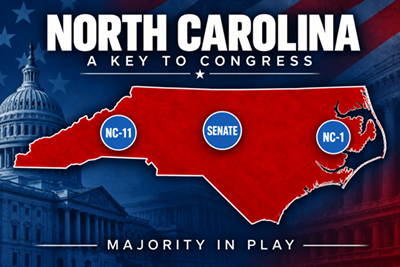
Sen. Thom Tillis (R) is retiring, and all available polling suggests the open seat is poised to flip to the Democrats.

Former Gov. Roy Cooper, who has won six statewide elections (two for governor and four for attorney general), is the strongest candidate in the race; he dominated the 2026 contest from the outset. Republicans nominated former Republican National Committee chairman Michael Whatley, who also served as North Carolina GOP chairman, but this is his first campaign as a candidate.

Since the March 3 primary, 21 publicly released polls have tested the NC Senate race, and Cooper leads in all. Across six major poll aggregators – 270toWin, Decision Desk HQ, FiftyPlusOne, Race to the White House, RealClearPolitics, and Silver Bulletin – the Cooper average advantage is 8.2 percentage points.

North Carolina routinely produces close statewide races, and Republicans tend to win slightly more than Democrats. Both parties, however, can prevail here in any given election.

Among all 2026 Senate contests, this race currently appears as the most likely to flip away from the incumbent party. If Cooper wins, Democrats would still need to convert three additional Republican states, however, in addition to defending their vulnerable seats in Georgia, Michigan, Minnesota, and New Hampshire.

NC-1

North Carolina is one of several states that redrew its congressional map before the 2026 election. Because the Governor has no role in redistricting, the Republican legislature controlled the process. Their redraw transformed the previously lean‑Democratic northeastern 1st District into a lean‑Republican seat.

In 2020, President Trump narrowly lost NC‑1 by one percentage point. In 2024, he rebounded to win here 51-48 percent. Despite Trump’s improved performance, Democratic Rep. Don Davis (D-Snow Hill) still won re‑election, but with a small margin of less than two percentage points.

The legislature then redrew the district to the point where Trump would have carried the new version by 10-plus points. Dave’s Redistricting App now calculates a 52.4R – 45.9D 1st District partisan lean under the new map. After the redraw, 2024 Republican nominee Laurie Buckhout returned for a rematch with Rep. Davis in a new district with much more GOP friendly terrain.

A new Democratic survey, however, suggests converting the seat may be more difficult than expected. The GBAO firm’s poll (Sept. 8-11; 500 likely voters) shows Rep. Davis leading 50-43 percent, which is beyond the polling margin of error. A June GQR poll (June 22-28; 500 likely voters) also found Rep. Davis ahead, though by a smaller 45-41 percent spread.

The data currently points to a Republican under‑performance. NC‑1 is a must‑win for the GOP if they hope to retain their narrow House majority. Expect significant outside spending to flood the district as the campaign advances through political prime time.

NC-11

The second NC competitive House seat is found in the western 11th District contest anchored in the city of Asheville. In early August, Rep. Chuck Edwards (R-Flat Rock) withdrew from his re‑election bid following revelations of an inappropriate relationship with young female staff members, conduct that resulted in a House censure.

Local Republican leaders then replaced him with state Rep. Jennifer Balkcom (R-Henderson County), but she had to create a congressional campaign from scratch just three months before election day. Balkcom faces Democrat Jamie Ager, who has already raised more than $2 million and is attempting to brand himself as a “Mountain Democrat” in order to distance himself from the national party’s socialist wing.

NC‑11 is the weakest of the 11 Republican‑held districts under the new map, though it still carries a 51.9R – 45.8D partisan lean (Dave’s Redistricting App).

A new Public Policy Polling survey (Sept. 10-11; 531 likely voters) offers Republicans some encouragement. Ager leads just 47-44 percent over an opponent who has not yet reached full campaign strength.

Because the last two District 11 Republican incumbents were forced out after short tenures (Edwards; and Rep. Madison Cawthorn, who lost renomination in 2022 after a series of personal scandals), the GOP must again persuade a likely weary electorate to support a new candidate who again promises steadier representation.

NC‑11 is another must‑win Republican seat, and like NC‑1, it will likely attract substantial outside spending aimed at securing a victory from what is now an underdog position.

North Carolina will be a key early‑reporting state on election night. The competitive Tar Heel State contests are part of the group that will provide early national trend indicators as results begin to unfold across the country.
NC-1 Rematch;
TX-18 Special Election Overview

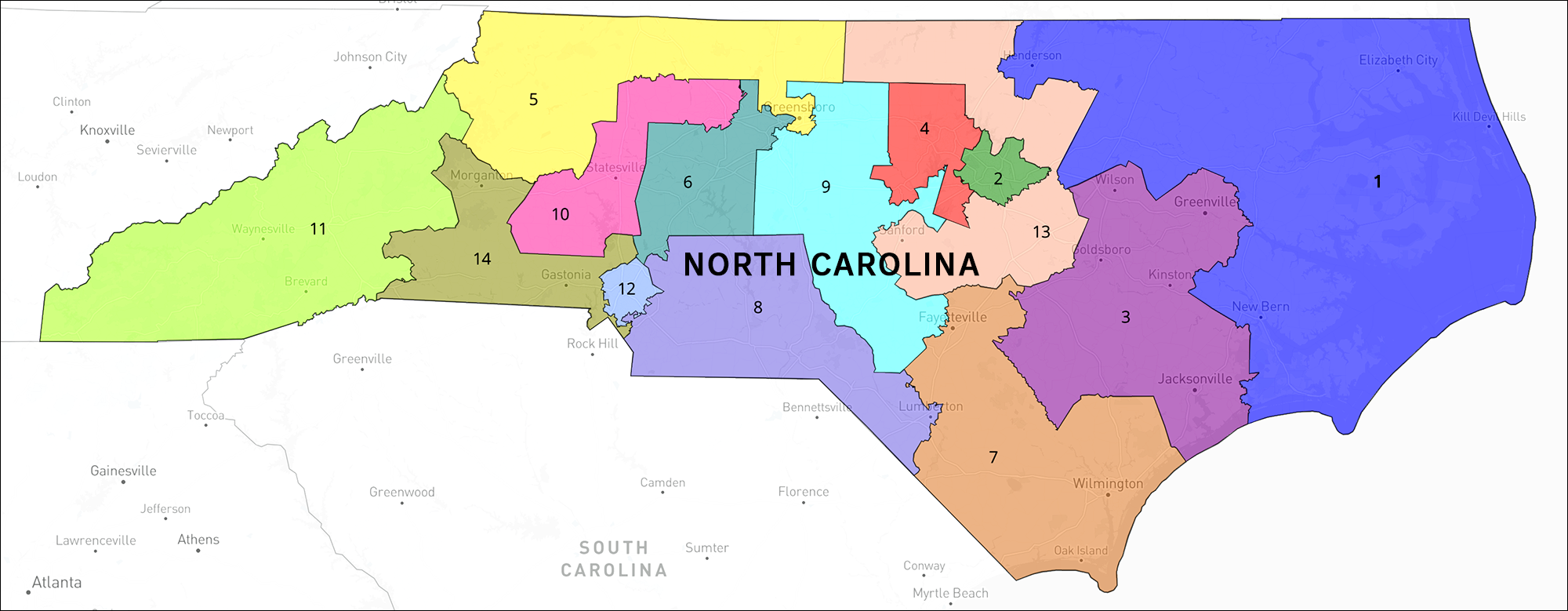
North Carolina 2026 Congressional District map (Click on image or here to go to: DRA-North Carolina)

By Jim Ellis — Tuesday, Dec. 23, 2025

NC-1

A surprising turn of events has occurred in North Carolina’s eastern 1st Congressional District, as we move past last week’s North Carolina candidate Friday filing deadline for the March 3 primary.

The 1st District is the focal point of the new North Carolina redistricting map. Republican legislators redrew the congressional plan several weeks ago with the goal of flipping the district from Democratic Rep. Don Davis (D-Snow Hill) to a Republican. Now, we see a major change on the candidate slate.

Rocky Mount Mayor Sandy Roberson (R), who earlier loaned his congressional campaign $2 million, decided earlier last week to end his candidacy. On Thursday, 2024 congressional nominee Laurie Buckhout, who had endorsed Roberson, decided she would make a comeback in his absence and declared her candidacy.

Buckhout had accepted a Department of Defense position from the Trump Administration but will now leave Washington, DC and re-enter the 1st District race. In 2024, Buckhout held Rep. Davis to a razor-thin 49.5 – 48.7 percent re-election margin in District 1’s more Democratic version. In the same election, however, President Trump carried the district with a 51.2 – 48.1 percent margin over Kamala Harris.

At this point, with candidate filing closed as of Friday, the announced Republican candidates in addition to Buckhout are Carteret Count Sheriff Asa Buck, state Sen. Bobby Hanig (R-Powells Point), Lenoir County Commissioner Eric Rouse, and attorney Ashley-Nicole Russell.

Rep. Davis, saddled with what is now an unfavorable district, has filed for re-election. The Dave’s Redistricting App partisan lean for the new NC-1 is 52.4R – 45.9D. The 2024 election’s partisan lean was 50.9D – 47.7R.

The North Carolina primary is scheduled for March 3. In order to avoid a runoff, the first-place finisher must exceed the 30 percent vote threshold. NC-1 is now a prime conversion opportunity for the GOP.

TX-18

The special election to replace the late Texas Rep. Sylvester Turner (D-Houston) has had the longest campaign cycle of the five 2025 US House vacancies. Turner passed away earlier this year on March 5.

Gov. Greg Abbott decided to schedule the special election concurrently with the state’s municipal elections on Nov. 4. Under Texas law, a runoff election, necessary if no candidate receives 50 percent in the first vote, is calendared once it becomes official that no contender reached the majority mark.

In this case, Gov. Abbott slotted the runoff for Jan. 31. Qualifying for that election are Harris County Attorney Christian Menefee and former Houston City Councilwoman Amanda Edwards.

Redistricting has played havoc with this Houston-anchored CD, which is fully contained within Harris County. Immediately after the special election concludes, both Menefee and Edwards, regardless of the outcome, will advance into the regular term primary election for new District 18 that will be settled on March 3. There, however, they will face 9th District veteran Congressman Al Green (D-Houston) who is running for a 12th term in new District 18.

The new map puts both Menefee and Edwards at a major disadvantage against Rep. Green because 64.5 percent of the new district constituency comes from the Congressman’s current 9th CD according to The Down Ballot political blog redistribution analysis. Only 25.8 percent carries over from the current 18th where the special election is being conducted.

Turning to the special, a new Lake Partners Research survey (Dec. 8-14; 437 likely TX-18 Democratic primary voters; live interview & text) conducted for the Jan. 31 runoff finds Menefee posting a 43-30 percent edge.

Looking at the district stats and comparing them with the new map, it appears that the special election winner will likely have only a short tenure in the House as Congressman Green will be favored to prevail for the regular term party nomination on March 3.

US House News

By Jim Ellis — Friday, Oct. 10, 2025

We saw several key US House announcements during the week, all of which will lead to competitive campaigns.

ME-2

Rep. Jared Golden (D-Lewiston) has drawn a strong Democratic primary opponent. State Auditor and former Secretary of State (appointed positions in Maine) Matt Dunlap announced he will challenge Golden for the party nomination in the June 9 primary.

Dunlap has already unleashed a one-minute digital ad (see above video) attacking both Rep. Golden and former Governor Paul LePage, who at this point is unopposed in the Republican primary. The Dunlap ad attacks Rep. Golden as “bad,” and ex-Gov. LePage as “worse.” The attack centers around their lack of opposition to (Golden) and support for (LePage) President Trump.

Clearly, Dunlap is executing a Democratic primary strategy, moving far to the left with rhetorical talking points attempting to attract the party’s Democratic socialist faction. While this approach may well pay dividends in the Democratic primary, it will place him in a difficult place for the general election in a 2nd District that is the most Republican seat in the nation to elect a Democratic Congressman, and one that President Trump carried in all three of his national campaigns.

The Golden-Dunlap congressional primary will be an interesting race, and with ex-Gov. LePage running as the Republican nominee in a district he carried in all three of his statewide elections, ME-2 could realistically become the GOP’s top national conversion target.

NC-1

North Carolina’s 1st District is the focal point of the Republican legislative leadership wanting to redraw the state’s congressional map. Rep. Don Davis’ (D-Snow Hill) seat is one of 13 that voted for President Trump but then rebounded to elect a Democrat to the US House. In Rep. Davis’ case, his victory margin was a tight 49.5 – 47.8 percent, thus making him an obvious target for the redistricting pen.

To reiterate from past Updates, North Carolina has a unique redistricting system. The legislature controls the entire map construction process because the Governor has no veto power over legislative action directly relating to redistricting. Now that Republicans have a majority on the state Supreme Court, which means the Republican legislature and the high court are united in their interpretation of redistricting law, again redrawing the congressional map with minimal alterations is a real possibility.

This week, Lenoir County Commissioner Eric Rouse (R) signaled that redistricting is forthcoming with his entrance into the 1st District congressional campaign. Rouse will face former Rocky Mount Mayor Sandy Roberson and state Sen. Bobby Hanig (R-Currituck County) in the Republican primary if not others. If redistricting is completed, the eventual Republican nominee will have a strong chance of unseating Davis. If not, we will likely see a toss-up battle form in a district with an electorate proven to swing between both parties.

The North Carolina primary is scheduled in the early cycle for March 3. The state has a 30 percent runoff rule, meaning a candidate is nominated if his or her vote percentage exceeds this percentage plateau. If no one reaches such a number, the top two finishers will runoff on May 12.

TX-21

As expected when he resigned his position as a Federal Election Commissioner, Republican Trey Trainor this week announced his candidacy for one of Texas’ eight open US House seats under the new redistricting map. Incumbent Rep. Chip Roy (R-Austin) is risking his TX-21 seat to run for state Attorney General.

Trainor has long served President Trump. With the original 2016 presidential campaign, Trainor was a legal counsel for the Republican National Platform Committee, then a transition team appointee for the Department of Defense, leading to President Trump appointing him to the Federal Election Commission in 2020.

During his tenure, Trainor served as both Chairman and Vice Chairman of the body. In his official position, he represented the United States as an election observer for the Romanian presidential election and the Costa Rica national elections.

Already in the 21st District race is former baseball player Mark Teixeira who came to sports fame when playing for the New York Yankees and was a member of the 2009 championship team. Teixeira was born in Annapolis, Maryland; attended Georgia Tech University; and lived in Connecticut for a decade with no political experience, which will contrast with Trainor who was born and raised in Texas, and been involved with the state’s political system during his entire career.

Also in the race are businessman Jason Cahill, healthcare company executive Kyle Sinclair, State Republican Executive Committee member Michael Wheeler, and several minor candidates.

The GOP primary will be decisive here because the new 21st is again solidly Republican. The Texas flood tragedy, which occurred in this district during July, will be a major focal point of this campaign as the candidates will argue as to who best can help manage the massive recovery operation for which the federal government will maintain a key lead role.

The Texas primary is an early March 3. Should no candidate receive majority support, which is likely, a runoff between the top two finishers will occur on May 26.

Rep. Ilhan Omar Again Faces Serious Primary Challenge; Former Navajo Nation President Declares in Arizona; MI-10 Field Grows; North Carolina Redistricting Positioning

By Jim Ellis — Wednesday, Oct. 18, 2023

House

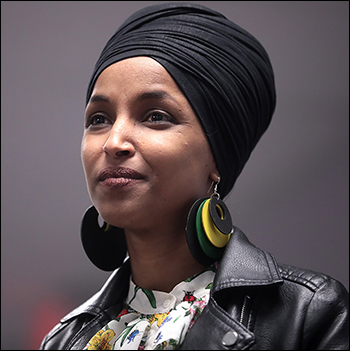
Rep. Ilhan Omar (D-Minneapolis) again faces a serious primary challenge. / Photo by Gage Skidmore

MN-5: Rep. Omar Opponent to Return –– Former Minneapolis City Councilman Don Samuels, who held Rep. Ilhan Omar (D-Minneapolis) to a tight 50-48 percent Democratic primary victory in 2022, announced he will return for a re-match next year. Expect this to again become a serious primary challenge. Already in the race are attorney Sarah Gad and businessman Tim Peterson, but Samuels is the key challenger. This seat will be decided in the Democratic primary scheduled for Aug. 13. The FiveThirtyEight data organization rates MN-5 as D+57.

AZ-2: Former Navajo Nation President Declares for House Seat — Jonathan Nez (D), the former Navajo Nation president who lost his re-election bid in 2022, is now looking to challenge for a congressional seat. He is organizing to oppose freshman Rep. Eli Crane (R-Oro Valley), one of the eight Republican members who voted to oust Speaker Kevin McCarthy. In 2022, Crane unseated Rep. Tom O’Halleran (D-Sedona) in a northern Arizona district that now significantly favors the Republicans. The FiveThirtyEight data organization rates the seat as R+15. Dave’s Redistricting App calculates the partisan lean as 53.4R – 44.4D.

MI-10: Dem Challenger Field Grows Larger — Surgeon and former congressional candidate Anil Kumar (D) declared his candidacy in the Detroit suburban 10th Congressional District hoping to oppose freshman Rep. John James (R-Farmington Hills). Kumar is now the seventh Democrat to enter the race. The field includes former prosecutor and judge Carl Marlinga who held James to a tight 48.8 – 48.3 percent victory in the 2022 general election from a district rated as a pure toss-up. We can expect another tough campaign here next year.

NC-1: Rep. Davis Draws New Opponent Before New Maps are Unveiled — Retired Army Colonel Laurie Buckhout (R), who now runs a successful consulting business and has the ability to self-fund her campaign, surprisingly announced her congressional candidacy just before the new North Carolina redistricting maps are set to be released. Freshman Rep. Don Davis’ (D-Snow Hill) 1st District could be one of the seats that dramatically changes under the new plan. Three other Republicans had previously announced. The redistricting map will go a long way toward determining the degree of competitiveness of this and several other seats in the Tar Heel State delegation.

NC-6: Rep. Manning to Possibly Face High Point Mayor — Another potential congressional candidate announced his political intention just before the new North Carolina congressional map will soon be made public. High Point Mayor Jay Wagner (R), looking to take advantage of what is very likely to be a more Republican 6th District is the early favorite to become Rep. Kathy Manning’s (D-Greensboro) general election challenger. Also in the race is 2022 GOP challenger Christian Castelli who lost to Rep. Manning 54-45 percent in a result that was a bit closer than most observers expected.

Rep. Budd’s Nomination Secure in NC?
A Close Gov. Race Brewing in NM

By Jim Ellis
May 16, 2022

Senate

North Carolina Rep. Ted Budd (R-Advance)

North Carolina: Dueling General Election Polls — With US Rep. Ted Budd (R-Advance) now substantially ahead in 12 consecutive Republican primary polls from the end of March to present, it appears clear he is going to be nominated on Tuesday. Therefore, attention is already being paid to the formulating general election. Two polls featuring Rep. Budd and consensus Democratic nominee Cheri Beasley, the former state Supreme Court Chief Justice, have just been released.

The first, from the Beasley campaign that the Global Strategy Group conducted (April 28-May 4; 800 likely North Carolina general election voters) finds the poll sponsor and Rep. Budd tied at 45 percent. Emerson College also released their survey (May 7-9; 1,000 registered North Carolina voters) that gives Budd a 48-41 percent advantage. We can expect this to be one of the top Senate races in the country come November and will feature a plethora of public polls.

House

NC-1: Dems Have Clear Poll Leader; Republicans Attacking Their Own — The GQR survey research firm ran a poll of the open 1st District Democratic primary (May 6-8; 407 likely NC-1 Democratic primary voters) and find state Sen. Don Davis (D-Snow Hill) leading former state senator and 2020 US Senate candidate Erica Smith, 44-31 percent, as the candidates make their final pitch before Tuesday’s primary election.

The Republican-oriented Congressional Leadership Fund, loosely associated with House Minority Leader Kevin McCarthy (R-CA), is actively running ads against GOP candidate Sandy Smith, the 2020 CD-1 nominee who held incumbent Rep. G.K. Butterfield (D-Wilson) to a 54-46 percent re-election victory.

The CLF does not indicate support for another candidate, but former Rocky Mount Mayor Sandy Roberson appears to be Smith’s strongest competitor. The move is curious in that the ads lay out personal negatives against Smith that could be used against her in the general election should she win the GOP nomination. The new 1st, which the state Supreme Court drafted, is rated D+5, thus suggesting a competitive general election.

Governor

New Mexico: Close Race Brewing — Survey USA polling for KOB-TV in Albuquerque (April 29-May 7; 1,389 likely New Mexico general election voters; interactive voice response system and online) tested the upcoming governor’s race and finds 2020 US Senate Republican nominee and former television weatherman Mark Ronchetti pulling to within the margin of polling error against Gov. Michelle Lujan Grisham (D).

The ballot test breaks 47-43 percent in favor of the incumbent. More troubling for Gov. Lujan Grisham, however, is her results against the entire Republican field. Paired individually with each of five candidates, Gov. Lujan Grisham, though leading in every case, fails to reach 50 percent against any of her GOP opponents. The cumulative results portend a highly competitive November race.

Pennsylvania: Senate President Drops Out — Just days before Tuesday’s Pennsylvania primary, state Senate President Jake Corman has dropped his Republican gubernatorial bid and endorsed fellow contender Lou Barletta, the former congressman and 2020 US Senate nominee. With Corman never able to increase his support from low single digits, his withdrawal is designed to help Barletta overcome the polling lead that state Sen. Doug Mastriano (D-Fayetteville) has established.

Pennsylvania Republican leaders are reportedly nervous that Sen. Mastriano, who was a legislative leader in attempting to determine if there was widespread fraud in the state during the 2020 election, would be unable to defeat Attorney General Josh Shapiro, who is the consensus Democratic gubernatorial nominee. It is likely that the Corman-Barletta move will prove too little, too late, however.

States

Texas Attorney General: Paxton Leading Big — A CWS Research poll (May 4-10; 992 likely Texas Republican primary runoff voters; interactive voice response system and text) reports that Attorney General Ken Paxton is substantially ahead of Land Commissioner George P. Bush, the son of former Florida governor and 2016 presidential candidate Jeb Bush. The CWS results find AG Paxton holding a whopping 58-31 percent lead as the candidates move toward the state’s May 24 runoff election date. In the primary, Paxton garnered 42.7 percent of the vote, which is obviously short of the majority vote a candidate needs to win the nomination outright. In a field of four candidates, Bush finished second with 22.8 percent.

Nevada Numbers; Carolina Chaos

Feb. 24, 2016 — As expected, Donald Trump placed first in the Nevada Caucuses scoring just under 46 percent of the attender preference; his strongest performance to date, though the turnout was only in the 75,000 range. Sen. Marco Rubio (R-FL) was second with 24 percent, followed by Texas Sen. Ted Cruz at 21 percent. Dr. Ben Carson and Gov. John Kasich (R-OH) trailed with five and four percent, respectively.

Though he didn’t emphasize Nevada at all, Gov. Kasich’s dead last finish behind Carson cannot be good for his pre-Ohio staying power.

Carolina Chaos

Surprise move follows surprise move in the continuing North Carolina redistricting saga that has unleashed political turmoil in the Tar Heel State.

After the three-judge federal panel sitting in Raleigh struck down Congressional Districts 1 (Rep. G.K. Butterfield; D-Wilson) and 12 (Rep. Alma Adams; D-Greensboro) in early February, the legislature, fulfilling the court-ordered directive, re-configured the map and passed it into law by the imposed Feb. 19 deadline. The March 15 primary has been moved to June 7 and, surprisingly, the run-off portion of the election process has been eliminated for the congressional contests. Primary elections for all other offices continue on March 15 and will feature the state’s traditional 40 percent threshold run-off system.

Continue reading →

North Carolina Chaos

Feb. 9, 2016 — Late Friday afternoon a federal three-judge panel sitting in Raleigh invalidated two North Carolina congressional districts even after absentee ballots had been issued throughout the state and votes are being cast. The North Carolina state primary is being held concurrently with the presidential vote on March 15. The court has ordered the state legislature to redraw the map by Feb. 19 so that the primary can move forward as scheduled.

The court, in ruling on a case filed more than a year ago, has thrown the primary campaigns into chaos. Republicans will immediately file a motion to stay the ruling with the US Supreme Court, but the identical move in Virginia was rejected on Feb. 1 in a similar case. The Virginia primary, however, is not until June 14, and that state has the option of choosing nominees in a convention format.

The North Carolina panel ruled that Districts 1 (Rep. G.K. Butterworth, D-Wilson) and 12 (Rep. Alma Adams, D-Greensboro) are unconstitutional because of racial gerrymandering. The judges stated that the legislative map drawers did not “narrowly tailor” the districts as they sought to comply with the Voting Rights Act.

Continue reading →