Tag Archives: Attorney General Ken Paxton

Texas: Cornyn Defeated Soundly;
Other Runoff Results

By Jim Ellis — Wednesday, May 27, 2026

Senate

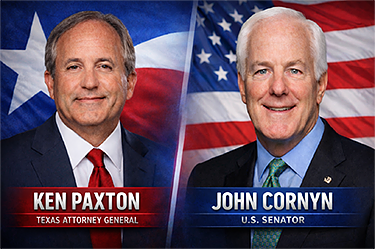
Texas Sen. John Cornyn (R) suffered a crushing defeat yesterday in the Texas Republican runoff election.

Early vote totals initially suggested a favorable runoff turnout model for the Senator, but that expectation ultimately proved unfounded as Attorney General Ken Paxton convincingly secured the party’s nomination. Paxton, who held a lead beyond the polling margin of error in the campaign’s final weeks, appears poised to finish the runoff with a support figure exceeding 60 percent.

Clearly, Sen. Cornyn’s failure to win renomination stemmed from losing touch with the Republican base and allowing himself to be cast as a centrist incumbent – even though, according to his own messaging, he voted with President Trump 95 percent of the time.

Now Paxton advances to the general election, where he will face state Rep. James Talarico (D-Austin) in a contest that will feature sharp contrasts. The Texas race is expected to be both hard‑fought and expensive, with Democrats focusing their attacks on Paxton’s character and Republicans targeting Talarico’s more extreme – and at times unusual – issue positions, particularly those relating to Christianity.

Cornyn is now the second Senate incumbent to lose a renomination bid in the early 2026 cycle, joining Louisiana Sen. Bill Cassidy (R), who was defeated in his May 16th primary while seeking a third term. In total, there are now 13 open US Senate seats among the 35 contests up for election this cycle.

House

Sen. Cornyn was not the only veteran incumbent to fall last night. In the Houston-anchored 18th Congressional District, 11‑term Rep. Al Green (D-Houston), who gained national attention after shaking his walking cane at President Trump during a televised address and being escorted from the House chamber, also lost in a landslide.

Rep. Green was paired in the 18th District under the new redistricting plan with congressional newcomer Christian Menefee (D-Houston). Rep. Menefee had previously won a differently configured version of the 18th District in a November special election to succeed the late Rep. Sylvester Turner (D).

What makes Rep. Menefee’s victory so striking is that he previously represented only 26 percent of the newly drawn 18th District. Despite that limited geographic base, he defeated Rep. Green with a projected 68 percent of the vote. Rep. Menefee now heads into the general election as a heavy favorite and will win comfortably.

A freshman House incumbent also won’t be returning to Congress next year. In Dallas, Rep. Julie Johnson (D-Farmers Branch) lost her renomination bid to former Congressman and 2024 US Senate nominee Colin Allred. After initially announcing plans for another Senate run, Allred unexpectedly reversed course as the filing deadline approached and declared his intention to instead pursue a House comeback.

Allred’s decision to enter the 33rd District Democratic primary – after incumbent Marc Veasey (D) chose not to seek re‑election when his Fort Worth power base was removed from the redrawn district – proved to be a well‑timed move. Yesterday, he defeated Rep. Johnson by a 55-45 percent margin and now will have an easy run in the general election.

Rep. Johnson was elected to the previous 32nd District in 2024. The new redistricting plan shifted the seat into Republican territory, making District 33 her most viable option for re‑election. Rep. Allred, however, had previously represented a much larger share of the newly drawn 33rd than Rep. Johnson, and the absence of a more favorable district left her with no realistic path to continue in Congress, limiting her tenure to a single term.

The 33rd District now becomes an open seat for the general election, marking the 66th open US House seat nationwide and the 13th in Texas.

Another US House incumbent lost his primary, though Rep. Chip Roy (R-Austin) was not seeking re‑election to Congress. Instead, he pursued the open state Attorney General’s office but fell to state Sen. Mayes Middleton (R-Galveston) yesterday, 55-45 percent.

No surprises emerged in the remaining runoffs. Consistent with primary results across the country so far, President Trump’s endorsed candidates again routinely prevailed.

In the newly created Harris County-based 9th Congressional District, investment banker and Army veteran Alexandra “Alex” Mealer, another Trump endorsed candidate, easily won the Republican runoff over state Rep. Briscoe Cain (R–Deer Park), who Gov. Greg Abbott supported. Though votes remain to be counted, Mealer is currently just under 69 percent of the vote.

Moving to the Lubbock anchored 19th CD, as expected, agribusinessman Tom Sell defeated conservative activist Abraham Enriquez, who Gov. Abbott endorsed, by a lopsided 64-36 percent margin. Sell took more than 40 percent of the vote in the primary, so his runoff victory came as no surprise.

In the newly drawn 35th District, which stretches from San Antonio halfway to Corpus Christi, another Trump‑versus‑Abbott proxy contest broke in the President’s favor. Businessman Carlos De La Cruz, the brother of Rep. Monica De La Cruz (R-McAllen), defeated state Rep. John Lujan (R-San Antonio) by nearly a 60-40 percent margin.

For the Democrats, as expected, Bexar County Deputy Sheriff Johnny Garcia won the party’s runoff with more than 62 percent of the vote, defeating therapist Maureen Galindo, who had previously made controversial and bigoted public statements. The general election is likely to be competitive, though the newly drawn district leans at least somewhat in the Republicans’ favor.

Returning to Harris County, in the 38th District that Rep. Wesley Hunt (R-Houston) risked to run for the Senate, the expected outcome materialized. Trump‑endorsed financial advisor Jon Bonck easily won the Republican runoff over businesswoman and pilot Shelly deZevallos, taking 65 percent of the vote.

Bonck had secured roughly 47 percent in the primary, leaving little doubt about the runoff result. The 38th District is safely Republican, positioning Bonck to join the incoming freshman class in Washington early next year.

Texas Runoffs; 17 Decided Today

By Jim Ellis — Tuesday, May 26, 2026

While the highly publicized Texas Republican primary campaign between Sen. John Cornyn and Attorney General Ken Paxton will be settled today, 16 US House runoffs will also be decided, including six major contests.

President Trump may have helped tilt the race in Paxton’s favor, but the early vote turnout model seems to favor Sen. Cornyn.

For US Reps. Nathaniel Moran (R-Whitehouse/Tyler), Lance Gooden (R-Terrell), Lizzie Fletcher (D-Houston), Randy Weber (R-Friendswood/Galveston), Veronica Escobar (D-El Paso), Pete Sessions (R-Waco), Beth Van Duyne (R-Irving), and Greg Casar (D-Austin), along with open seat contenders Frederick Haynes (D-Dallas) and Jace Yarborough (R-Rockwall), today’s results will determine their general election opponents.

All eight incumbents, as well as Pastor Haynes and Yarborough, enter the fall campaign as prohibitive favorites.

Six competitive House runoff results tonight will likely determine the districts’ next US Representative. The half‑dozen include open CD-9, created under the new 2026 redistricting plan; CD‑18, featuring the incumbent pairing between Reps. Al Green and Christian Menefee; and Lubbock‑based District 19, where agribusinessman Tom Sell faces conservative activist Abraham Enriquez.

Turning to the Dallas Metroplex, the CD‑33 runoff features freshman Rep. Julie Johnson (D‑Farmers Branch) facing former Congressman and 2024 US Senate nominee Colin Allred. Farther south along I‑35, the new redistricting‑created 35th District-anchored in San Antonio will also be decided tonight; as will the Houston open seat that Rep. Wesley Hunt (R‑Houston) risked to pursue a Senate bid.

TX-9

The newly created east Harris County-anchored 9th District is designed to elect a Republican, which is why today’s runoff will likely determine the general election winner. The two Republican candidates are investment banker and Army veteran Alexandra “Alex” Mealer, who President Trump endorses, and state Rep. Briscoe Caine (R-Deer Park), who Gov. Greg Abbott supports.

Mealer finished first in the primary with 35.8 percent, ahead of Rep. Cain’s 31.2 percent. The runoff is again expected to be close, particularly given that runoff turnout is typically lower than in the primary. The winner will face Democratic nominee Letty Gutierrez, a lobbyist and former Houston City Council staff member. According to the Dave’s Redistricting App analysis, the new 9th District carries a 51.6R–46.6D partisan lean.

TX-18

The new Houston-anchored, safely Democratic 18th District pairs veteran Rep. Al Green with special election winner Christian Menefee in a Democratic runoff that will determine which of the two members will continue his congressional career. In the primary, Menefee, despite representing only 26 percent of the newly drawn district, edged Rep. Green 46.0 to 44.2 percent. As with all runoffs, the candidate who most effectively turns out his voter base is likely to prevail.

TX-19

Agribusinessman Tom Sell came very close to winning the Republican nomination outright on March 3. He is widely expected to seal the nomination tonight. In the primary, he finished first with 40.4 percent of the vote. Because the margin between second and third place was only 193 votes, it took several weeks to determine that Abraham Enriquez had qualified for the runoff.

The closeness of the primary is of little consequence because Sell is expected to easily win tonight. With a 72.4R – 25.4D partisan lean, he will also enter the general election as the prohibitive favorite.

TX-33

The 33rd District contest is another Democratic runoff featuring candidates with prior electoral success. Freshman Rep. Julie Johnson previously represented the 32nd District, which was converted to a Republican seat during redistricting. She now faces former Rep. Colin Allred, who entered the race after withdrawing from the Senate campaign.

In the primary, Allred finished first with a substantial 44.0 to 33.2 percent margin. He also reported an approximate $400,000 cash-on-hand advantage through the May 6 financial disclosure deadline. Tonight’s winner secures the seat in November. The DRA partisan lean for the newly configured 33rd CD, now fully contained within Dallas County, is 70.9D – 26.7R.

TX-35

Texas’s new 35th CD is another product of the 2026 redistricting plan. The seat covers a large portion of the southeastern San Antonio suburbs and extends roughly halfway toward Corpus Christi. The district’s DRA partisan lean is 50.9R to 46.7D, indicating a Republican advantage but before an electorate that has the potential of becoming competitive in November.

Both parties are locked in runoffs tonight. The Republicans feature state Rep. John Lujan (R-San Antonio) battling businessman Carlos De La Cruz, the brother of Rep. Monica De La Cruz (R-McAllen). This is another race that pits a President Trump-endorsed candidate (De La Cruz) against one who Gov. Abbott supports (Lujan).

On the Democratic side, Bexar County Sheriff’s Deputy Johnny Garcia has support from party leadership as he faces former San Antonio City Council candidate Maureen Galindo, who has reportedly expressed anti‑Semitic views. Outside organizations have been “attacking” Galindo with messages aimed at appealing to and energizing far‑left voters. Democratic officials argue these ads are being funded by Republican‑aligned groups attempting to boost Galindo over Garcia in the primary.

Whoever emerges from both party runoffs tonight will set up an especially interesting general election.

TX-38

As in TX‑19, the outcome of this runoff appears largely pre-determined. Competing in the Republican contest to succeed departing Rep. Wesley Hunt in this safely Republican district (DRA partisan lean: 60.5R to 37.4D) are mortgage broker Jon Bonck and businesswoman Shelly deZevallos. Bonck led the initial primary with a 46.8 to 18.9 percent margin – just about three points short of securing the nomination outright.

Unlike the TX‑32 primary, where the challenger conceded before the runoff, deZevallos pushed this contest into a second round. While the race is still competitive, most indicators point toward a Bonck victory, though deZevallos has had sufficient resources to remain viable. Regardless of tonight’s outcome, the eventual Republican nominee is expected to hold this safely GOP seat in November.

Texas Senate Race: Not So Fast

By Jim Ellis — Thursday, May 21, 2026

Senate

The Texas Senate Republican runoff is Tuesday, and President Trump’s endorsement this week of Attorney General Ken Paxton over Sen. John Cornyn has certainly drawn even more attention to this race. But is it the clinching blow? Several points suggest otherwise.

To recap, Sen. Cornyn placed first in the March 3 primary with a 41-40 percent edge over AG Paxton. The incumbent performed well in the state’s major population centers while Paxton handily carried most of the Texas rural regions with the notable exceptions of the Panhandle and South Texas.

As we have seen recently with the defeats of Louisiana Sen. Bill Cassidy and Kentucky Rep. Thomas Massie, the President has been on a strong political run in helping his endorsed candidates secure victories.

There are several reasons why the Texas situation differs from the previously mentioned campaigns. In both the Cassidy and Massie races, President Trump’s involvement centered on Republican officeholders who had openly opposed him. Trump sought to defeat Sen. Cassidy because of his vote to convict during the 2021 impeachment proceedings.

Rep. Massie, meanwhile, had long been a member who frequently broke with the President’s proposals and was widely viewed as the least loyal House Republican in terms of supporting Trump’s policy agenda.

The Texas situation is different. First, the President is not attacking Cornyn as an enemy; in fact, for a time he appeared inclined to endorse the Senator. This, even though Paxton has been a loyal Trump supporter since the very beginning of the President’s political rise in 2016.

Secondly, both four‑term Sen. Cornyn, previously elected as state Attorney General and to the Texas Supreme Court, and AG Paxton, who has won three statewide general elections and two competitive primaries, are already very well known to Texas Republican primary voters. As a result, the extent to which a last‑minute presidential endorsement can sway or energize voters on Paxton’s behalf is open to question.

Third, it’s possible the President is influenced with the latest polls because the most recent May research studies have produced results suggesting the closing trends were moving away from the incumbent.

Peak Insights (May 2-5; 800 likely Texas Republican runoff voters) found Cornyn and Paxton virtually tied with a 47-46 percent split in the Senator’s favor. The Remington Research Group and the Global Strategy Group, the latter a Democratic pollster, detected a much different result slightly later in the month. The RRG data (May 3-5; 1,810 likely Texas Republican runoff voters) reported Paxton leading 47-36 percent, while GSG (May 6-11; 600 likely Texas Republican runoff voters) saw an even wider 52-40 percent Paxton advantage.

If polls factored into the President’s endorsement, the decision may have been hasty. In the primary, the six surveys conducted closest to Election Day showed Paxton leading by an average of seven percentage points. Yet Cornyn ultimately prevailed by a single point, indicating an eight‑point average polling miss.

Additionally, polling for a runoff is even more challenging than polling for a primary. Turnout in a Texas secondary election is typically one‑third to one‑half lower than in the primary, making accurate measurement even more difficult and the results less certain.

Furthermore, turnout tends to be higher in metro areas than in rural communities, a dynamic that could help Cornyn since he did well in the cities on March 3.

While the state does not have a mass vote‑by‑mail program, it does allow in‑person early voting for roughly a month before Election Day in regular elections and over a five‑day period for runoffs. According to the Target Early Target Smart organization, which tracks early voting, three‑quarters of the 2024 Texas general‑election vote was cast before Election Day.

With early voting ending on Friday, the Trump endorsement may have less impact because a substantial share of ballots are already cast.

The Texas Senate race remains one of the more compelling contests of the 2026 election cycle and will continue to draw significant attention through the general election, regardless of Tuesday’s Republican runoff result.

While the Trump endorsement has proven golden for many Republicans seeking a party nomination, the factors outlined above suggest the outcome on May 26 could be different. Once again, significant political attention will soon be focused on the Lone Star State.

Cornyn vs. Paxton: Dead Heat

By Jim Ellis — Friday, April 17, 2026

Senate

Two new polls were released in the red-hot Texas US Senate Republican runoff between Sen. John Cornyn and Attorney General Ken Paxton and the results are identical.

Peek Insights conducted its survey for Texans for a Conservative Majority, a Super PAC that supports Sen. Cornyn (April 6-9; 800 likely Texas voters), and the co/efficient polling firm, in an independent release (April 11-14; 1,143 likely Texas Republican runoff voters; text and live interview), each find Sen. Cornyn leading AG Paxton by a narrow 44-43 percent.

The surveys provide underlying good news for Sen. Cornyn, however. In the primary, polling consistently found Paxton leading the race. In fact, from the final six publicly released pre-primary polls, the Attorney General led the Senator by an average of seven percentage points. In the actual election, Cornyn topped Paxton by one percentage point, meaning the pollsters underestimated the Senator’s Republican primary position by eight full points.

Therefore, if a similar under-counting of Cornyn’s support is again present in the latest data, it is possible that the Senator’s lead is greater than the one percentage point that both pollsters currently detect.

Included in co/efficient’s data release are their crosstabs, which reveal some interesting points.

While the two candidates are virtually even in support among the likely May 26 runoff voters, the co/efficient segmentation allows us to see where each candidate can target and improve.

Possibly the most surprising finding is that Paxton enjoys a 14-point advantage among self-identified Christians. Considering Paxton’s well-publicized extra-marital affairs that led to his wife filing for divorce, one might expect his personal behavior to be a negative factor within this group.

Therefore, expect the Cornyn campaign to improve the Senator’s standing in this sector as the campaign moves toward culmination in late May.

While most segments show the candidates at parity as does the actual ballot test, the two candidates do enjoy advantages within certain groups pertaining to turnout propensity.

Among the respondents who have voted in four of the last four and three of the last four elections, obviously those with the highest vote propensity, Paxton claims a four-point advantage. Sen. Cornyn posts a three-point edge among those with moderate voting propensity — the two of four categories — while Paxton has the advantage among those most likely not to vote.

The other traditionally high-vote propensity group, those over 65 years of age, favor Cornyn by four points. The Senator also has the edge with those aged 18 through 54, but Paxton posts a double-digit advantage within the 55-64 age sector.

The fact that most of the age segments favor Cornyn by an average of four points, yet Paxton dominates the 55-64 group by 19 points fails to make sense. Therefore, it is probable that his very large margin is an anomaly.

The runoff will prove to be a battle between the urban and rural areas. In the primary election, Cornyn won in the state’s largest metro areas, meaning Harris County (Houston), the Dallas-Ft. Worth Metroplex, San Antonio-Austin I-35 corridor, and the populous region along the Mexican border then north to the Corpus Christi area. Paxton was strong throughout the state’s rural areas both in East and West Texas.

While a great deal of money and campaign time will be spent between now and the May 26 election, with heavy emphasis on the early voting process scheduled during the May 18-22 period, the winner will be the candidate whose campaign best energizes its primary election supporters to come back and vote again in the runoff election. Typically, Texas runoff elections turn out about two-thirds of the number who voted in the primary.

May will be an interesting month for vulnerable Republican Senators. Just before the Texas runoff, Louisiana Republican voters will largely determine Sen. Bill Cassidy’s fate in the May 16 partisan primary vote. Some polls show Cassidy trailing both of his Republican challengers — Rep. Julia Letlow (R-Start) and state Treasurer John Fleming. Therefore, the Louisiana and Texas intra-party elections means late May will host a very intriguing political period.

Texas Senate: A Plethora of Polling

By Jim Ellis — Thursday, February 12, 2026

Senate

Texas state flag

A series of political surveys conducted in late January and early February are now in the public domain, and we again see data suggesting that four-term Sen. John Cornyn is virtually assured of being forced into a runoff election once votes are cast and counted in the March 3 Texas Republican primary.

Four new polls have been released, and while each produces different ballot test numbers the conclusion is similar: that is, we will see two of the three major contenders, Sen. Cornyn, Attorney General Ken Paxton, and Rep. Wesley Hunt (R-Houston), advancing into a secondary nomination election on May 26.

The University of Houston conducted its poll during the Jan. 20-31 period (550 likely Texas Republican primary voters; 550 likely Democratic primary voters; online); Ragnar Research Partners polled for the pro-Cornyn Texans for a Conservative Majority Super PAC during Jan. 29 – Feb. 1 (sample size not released); J.L. Partners queried their sample during Jan. 31 – Feb. 1 (600 likely Texas Republican primary voters); and Pulse Decision Science went into the field during the Feb. 1-3 period (801 likely Texas Republican primary voters; live interview).

The results below detail the closeness of this race:

University of Houston (Jan. 20-31)

Candidate Percent
Paxton 38
Cornyn 31
Hunt 17

 
Ragnar Research for Texans for a Conservative Majority (Jan. 29-Feb. 1)

Candidate Percent
Cornyn 31
Paxton 29
Hunt 24

 
J.L. Partners (Jan. 31-Feb. 1)

Candidate Percent
Paxton 27
Cornyn 26
Hunt 26

 
Pulse Decision Science (Feb. 1-3)

Candidate Percent
Paxton 34
Cornyn 26
Hunt 18

The four polls have several factors in common. First, they were all conducted within the same 15-day time frame. Second, all show Sen. Cornyn performing poorly for a four-term incumbent within his own party. Third, that a runoff is a foregone conclusion. Fourth, that all three major candidates have a chance of qualifying for the secondary election.

The addition of Rep. Hunt to the primary campaign is largely the reason that the race will advance to a runoff stage. Hunt has gone from being relegated to a pure spoiler role to a status where at least two current pollsters suggest he has an outside path on March 3 to eliminate one of his two opponents from further consideration.

This being the case, expect both Cornyn and Paxton along with their outside supporters to turn their negative attacks to Hunt, since driving him deeper into third place will guarantee that both statewide officials advance.

This has begun to happen already. The targeted electorate is seeing a great deal of negative attacks being lobbed in Rep. Hunt’s direction. The Texans for Conservative Majority polling memo suggests that $3.4 million in ads have already aired, or time is reserved for negative Hunt commercials.

The campaign balance sheet favors Sen. Cornyn, however, as the year-end Federal Election Commission filings reveal. The veteran incumbent reported $5.9 million in his campaign account at the end of 2025, while AG Paxton posted $3.7 million. Rep. Hunt showed a lesser $1.8 million cash-on-hand.

Only one of the four pollsters recently releasing Texas Senate political data tested the Democratic primary. The University of Houston found Rep. Jasmine Crockett (D-Dallas) leading state Rep. James Talarico (D-Austin), 47-39 percent.

It is Talarico, however, who has the funding advantage. He reported $7.1 million in his account, a larger sum than any candidate from either party. Rep. Crockett posted receipts of $6.5 million raised with $5.6 million in the bank. Because there are only two major candidates on the Democratic side, it is probable that this election will be decided on March 3.

Real estate broker Ahmad Hassan is also a Democratic Senate primary candidate. Even though his status is minor, any votes he receives could be enough to force the other two into a runoff should they finish close. The tightness of such an outcome could mean that Hassan attracting a vote total even as little as two to three percent could result in the top Democratic candidates being forced into a secondary election because the leader barely missed topping the 50 percent mark.

Texas early voting begins next week on Feb. 17 in preparation for the March 3 primary. Tracking the early vote will give us a clue into political enthusiasm between the voters within the two parties. In less than a month we can expect a close finish in both parties from what promises to be one of the most exciting primary elections of the entire 2026 election cycle.

Three-Way Race Unfolding in Texas

By Jim Ellis — Thursday, Dec. 18, 2025

Senate

Rep. Wesley Hunt (R-Houston) / Facebook photo

The Texas Senate election has already drawn a great deal of attention during the 2026 early campaign segment and likely will attract more based upon recent polling.

When the Lone Star State’s Rep. Wesley Hunt (R-Houston) entered the Republican US Senate primary, most observers believed he would act as a spoiler for the battle between Sen. John Cornyn and Attorney General Ken Paxton. Rep. Hunt’s presence, it was believed, would siphon enough votes away from the two leading candidates to force a secondary runoff election in order to decide the Republican nomination.

According to four different polls, all conducted between the Dec. 1-4 period, Rep. Hunt is now attracting enough support to position himself to secure one of the runoff slots.

The four polls came from four different pollsters: three Republican companies and one Democratic research firm. The Republican pollsters were McLaughlin & Associates, J.L. Partners, and co/efficient, while Public Policy Polling was the lone Democratic firm to test the Republican primary in early December.

Public Policy Polling (Dec. 1-2; 527 likely Texas Republican primary voters; text & live interview) was the initial pollster in the field, and their result was the first of the December data to find Rep. Hunt forging into polling parity with both Sen. Cornyn and AG Paxton. The ballot test showed Paxton leading Cornyn and Hunt, 32-22-22 percent.

Both co/efficient (Dec. 1-3; 1,022 likely Texas Republican primary voters; online) and J.L. Partners (Dec. 1-3; 600 likely Texas Republican primary voters) were in the field simultaneously but arrived at different results.

The Partners find Paxton leading with 29 percent and Cornyn and Hunt tied at 22 percent; co/efficient’s conclusion found Sen. Cornyn topping the group at 28 percent support, with AG Paxton pulling into a virtual tie at 27 percent. Though co/efficient found Rep. Hunt lagging, he was still within single digits of the two leaders at 19 percent preference.

McLauglin & Associates (Dec. 1-4; 800 likely Texas Republican primary voters) then found Paxton leading Hunt and Cornyn in a closely bunched field at 33-28-27 percent.

Averaging these four polls, we find Paxton having the most aggregate support, averaging 29.7 percent per survey. Sen. Cornyn’s average was 26.3 percent, while Rep. Hunt recorded 23.7 percent. Therefore, these numbers — again derived from professional polling firms all within the same time period — find a wide-open three-way race where each of the three have a legitimate chance of qualifying for the runoff … or being left out.

The latest campaign financial disclosure reports (period ending Sept. 30) find that Sen. Cornyn is in the best financial position with more than $6 million cash-on-hand. Paxton has just over $3 million, while Rep. Hunt posts slightly more than $1.5 million in his campaign account.

With the short campaign season to the March 3 primary, we can expect heavy spending as each candidate works to position themselves to clinch one of the two runoff slots. Count on seeing a Republican mad dash to the finish beginning in late February.

We also saw the first post-candidate filing deadline poll on the Democratic side. Texas Southern University surveyed the likely Democratic voters and found Rep. Jasmine Crockett (D-Dallas) leading state Rep. James Talarico (D-Austin) beyond the polling margin of error.

According to the Texas Southern data (Dec. 9-11; 1,600 likely Texas Democratic primary voters; online), Rep. Crockett’s advantage over Talarico is 51-43 percent. Contrary to the situation on the Republican side, with two major candidates the Democratic nomination fight will very likely end on March 3 because either Crockett or Talarico should be positioned well enough to command majority support on the first vote.

The Texas Surprises

By Jim Ellis — Thursday, Dec. 11, 2025

Texas Elections

Texas Sen. John Cornyn (R)

The old saying, “you can’t tell the players without a scorecard,” certainly applies to the 2026 Texas federal office slate. Now that candidate filing is closed, the clouded political situation is becoming a bit clearer.

Texas has a unique filing system that makes following which candidate is running where confusing. Instead of filing with a government agency, the candidates file with their political party. Yet, the process is further complicated.

Candidates filing for offices where the jurisdiction covers more than one county turn their qualifying documents in to their state party office. If a district is fully contained within a single county, the candidates file with their county political party. Once the paperwork is received, the political party entities eventually report the qualified candidates’ names and particulars to the Secretary of State. Therefore, the process takes longer to determine who will be on the ballot than it does in most other states.

In the Senate race, we now have a clear picture for the March 3 partisan primaries. For the Republicans, amidst minor candidates the three major participants, Sen. John Cornyn, Attorney General Ken Paxton, and Rep. Wesley Hunt (R-Houston), are vying for the party nomination. This race is expected to be close and moving toward a runoff, which is necessary if no candidate receives majority support in the first vote. At this point, it appears that Sen. Cornyn and AG Paxton will advance to the secondary election.

For the Democrats, we see a battle between Rep. Jasmine Crockett (D-Dallas) and state Rep. James Talarico (D-Austin). Five minor candidates have filed, and it is unclear just how many will qualify for the ballot. Irrespective of these latter candidates’ presence, it is likely that we will see either Rep. Crockett or state Rep. Talarico claim the party nomination on March 3.

In the House delegation, 11 seats are open with the addition of TX-30, the seat that Rep. Crockett is leaving to run statewide. It appeared that Rep. Marc Veasey (D-Ft. Worth) would move into that district, but he surprisingly chose not to file. Instead, Veasey decided to run for Tarrant County Judge (Executive) where he will face a Republican incumbent and other significant candidates.

The Veasey move allows Rep. Julie Johnson (D-Farmers Branch), who sees her 32nd District transform into a Republican domain and stretch into East Texas, to run in District 33, which is fully contained within Dallas County. Her major obstacle to winning a second term in Congress is former Representative and 2024 US Senate Democratic nominee Colin Allred. Though announcing for the Senate in October, Allred instead changed his mind at the last minute and filed to return to the House, this time in District 33. Also in the race is former state Representative and ex-Dallas City Councilman Domingo Garcia. Therefore, the top two candidates falling into a runoff becomes a possibility. The eventual Democratic nominee will easily win the seat in the general election.

Another new development is the return to the political wars of former Congressman Steve Stockman (R). He has filed in new open District 9. Stockman was twice elected to Congress in non-consecutive elections. He was convicted of violating certain financial laws, but President Trump commuted his 10-year prison sentence. The other major candidate within the crowded field is state Rep. Briscoe Cain (R-Deer Park).

With 11 filed candidates in the CD-9 race, advancing to a runoff election is probable. It remains to be seen how many of the filed candidates qualify for the ballot. Under the new redistricting plan, the 9th District should be one of the seats that Republicans gain.

Another surprising move came in Houston’s 18th District. This seat is currently in special election mode, with Harris County Attorney Christian Menefee (D) and former Houston City Councilwoman Amanda Edwards (D) vying to replace the late Congressman Sylvester Turner (D). Immediately after the special election, it was thought the winner would then face Rep. Al Green (D-Houston) in a battle for the new 18th District. The regular primary is scheduled for March 3 after a special election winner is declared on Jan. 31.

Only Menefee, however, filed in new District 18. Therefore, should Edwards win the special election, she will only serve the balance of the current term. Win or lose on Jan. 31, Menefee will advance into the regular Democratic primary against Rep. Green.

The truly surprising facet from the Texas congressional filings is the fact that only two state legislators, Cain and state Rep. John Lujan (R-San Antonio; open new District 35), entered one of the 11 open-seat congressional campaigns. Therefore, the Texas delegation will feature a large number of incoming freshmen entering the House with no legislative experience.

More Texas News in the Spotlight:
Latest Senate, Redistricting Updates

By Jim Ellis — Monday, Nov. 24, 2025

New polling data was just released in Texas that confirms what many observers have opined about the Lone Star State’s US Senate campaign, and a scathing dissent from one of the three-judge panel members who heard the latest redistricting case could pave the way for a Supreme Court stay.

Senate

Texas state flag

Ragnar Research (Nov. 12-17; 1,000 likely Texas voters; live interview) released a new Texas US Senate poll that supports the common political supposition pertaining to the Lone Star State Senate race. That is, Sen. John Cornyn (R) would lead both 2024 Senate nominee and ex-Congressman Colin Allred (D) and state Rep. James Talarico (D-Austin), but Attorney General Ken Paxton would be in danger of losing the general election.

In this poll, Sen. Cornyn leads Allred 47-40 percent and Talarico by a similar 46-40 percent split, both beyond the polling margin of error. As predicted, the two Democrats fare better against Paxton. Allred would lead 44-43 percent, and Rep. Talarico would tie the scandal-tainted AG at 44-44 percent.

The third announced Republican in the race, Rep. Wesley Hunt (R-Houston), was not tested, nor was Rep. Jasmine Crockett (D-Dallas) on the Democratic side. Crockett has been leading in other Texas Democratic statewide primary polls but has not yet made a decision about whether to enter the Senate race.

The latest judicial redistricting ruling from the El Paso three-judge panel suggests Rep. Crockett may stay in the House since the 2025 Texas map invalidation restores her 30th Congressional District to its previous boundaries.

According to Ragnar Research partner Chris Perkins, who conducted this poll, wrote “John Cornyn is the strongest candidate for Republicans in a general election, as he has a clear lead. Paxton is statistically tied with either of the Democrat candidates and jeopardizes the ability of Republicans to hold the seat.”

The Texas Senate race is one of the key focal points of the 2026 election cycle. It will be perhaps the only Senate contest that features a contested primary in both parties along with a highly competitive general election.

Redistricting

Fifth District Circuit Judge Jerry E. Smith, a member of the three-judge panel that invalidated the 2025 Texas redistricting map as a racial gerrymander over his objection, published a scathing dissent to the ruling. In his document, Judge Smith referred to lead Judge Jeffrey Brown’s decision as “the most blatant exercise of judicial activism that I have ever witnessed.” Judge Smith stated that he has been a federal judge for 37 years.

The dissent opinion begins by saying that, “the main winners from Judge Brown’s opinion are George Soros and Gavin Newsom. The obvious losers are the People of Texas and the Rule of Law.”

Throughout a 104-page document, Judge Smith details 11 different examples of how ruling that the 2025 Texas map is a racial gerrymander is either “false, misleading, deeply misleading, or deceptive.”

The state of Texas has already appealed, asking that the current ruling be stayed. Appealing a three-judge panel decision goes directly to the US Supreme Court and an official answer must be rendered. The justice assigned to oversee the 5th Circuit Court of Appeals, in which Texas resides, is Samuel Alito. The justices have the individual power to issue stays on cases from the circuits in which they oversee.

If Justice Alito were to grant a stay on the Brown panel redistricting ruling, the 2025 map would return as the official Texas map. With candidate filing closing on Dec. 8, a quick ruling on the stay motion is imperative since the two maps are radically different in 11 of Texas’ 38 congressional districts.

Rep. Hunt Enters Texas Senate Race

By Jim Ellis — Thursday, Oct. 9, 2025

Senate

As has been speculated upon for months, two-term US Rep. Wesley Hunt (R-Houston) officially entered the 2026 Republican US Senate primary in Texas. He joins a campaign that has been active for almost a year between GOP principal participants, Sen. John Cornyn, the four-term incumbent, and three-term Attorney General Ken Paxton.

Though Rep. Hunt only became an official candidate this week, a Super PAC supporting him has already spent an estimated $6 million, according to a Texas Tribune news story, to positively promote him around the state. The advertisements were run in media markets throughout Texas with the exception of Houston, from where the Congressman resides and represents.

In his announcement address, Rep. Hunt basically outlined his campaign strategy. A comment from his speech is indicative of how he intends to conduct his effort. Hunt said, “the US Senate race in Texas must be about more than a petty feud between two men who have spent months trading barbs. With my candidacy, this race will finally be about what’s most important: Texas.”

Assuming he follows through on his rhetoric, Rep. Hunt’s strategy will be to bunch Cornyn and Paxton together as if they are one, and campaign against the pair as a singular negative unit. He hopes to feed the fires of negative campaigning between the two men, and then come from the outside as a positive alternative. This approach has worked in many competitive multi-candidate campaigns when two contenders begin to attack each other, thus leaving a lane open for a third credible person to become a positive alternative.

Realistically, the Hunt for Senate campaign, which obviously has outside financial support and at least $3 million in his congressional campaign account that is fully transferrable to a Senate campaign, is most likely to deny either Cornyn or Paxton the opportunity of reaching the 50 percent mark to clinch the March 3 Republican primary. This means the two would advance to a runoff election on May 26.

Early three-way polling suggests the runoff scenario is likely. Nine polls from eight different pollsters have been conducted of the Texas Senate Republican primary that included all three individuals. Two organizations, Real Clear Politics and Decision Desk HQ, have averaged all the poll results and consistently find Hunt well behind in third place.

The Real Clear Politics average finds Paxton leading Sen. Cornyn 36.7 to 32.7 percent with Rep. Hunt capturing 19.0 percent support. Decision Desk HQ sees a closer battle between Cornyn and Paxton, 37.0 to 36.3 percent, respectively, with Hunt bunched together with the Other/Undecided option for a total support factor of 26.7 percent.

In the underlying polls that comprise the DDHQ average, the undecided percentage is running equivalent to Hunt’s support figure, so it would be reasonable to project the Congressman’s total at approximately 14 percent.

Therefore, at the campaign’s early juncture, the preponderance of polling data suggests that Hunt’s entry forces a runoff between Cornyn and Paxton.

With Rep. Hunt having entered the Senate race, it also means his 38th District US House seat will come open. There are temporarily 34 open House seats, including two vacancies being filled in special elections later this year.

Of the 34, a total of 21 are now in Republican-held districts versus just 10 from the Democratic side. The Texas redistricting plan created three new open seats in previously non-existent districts. Rep. Hunt not running again for the House means that at least eight of Texas’ 38 congressional seats will be open in the next election.

The 38th District is fully contained within the central portion of Harris County under the new configuration. According to the updated partisan lean figures from Dave’s Redistricting App, the new 38th carries a 60.5R – 37.4D voting history calculation. Therefore, we can expect a crowded and competitive Republican primary here, with the eventual GOP nominee becoming the prohibitive favorite to clinch the general election.

Returning to the national open House seat count, from the 29 open districts around the country (the number excludes those created in redistricting (three) or where a member passed away or resigned from office (two), 11 Representatives are leaving the House to run for Senate, 10 are running for Governor in their respective state, one is competing for another statewide office (Attorney General of Texas), and seven are retiring from elective politics.

Allred Joins Texas Race

By Jim Ellis — Tuesday, July 8, 2025

Senate

Former Texas Rep. Colin Allred (D-Dallas) / Photo: ReformAustin.org

Former Congressman and ex-Senate nominee Colin Allred (D) is returning to the campaign scene. Late last week, Allred formally announced his 2026 US Senate candidacy and is “pledging to be a better candidate.”

Despite his self-deprecating comment, Allred proved himself an able candidate and certainly a prolific fundraiser, accumulating $94.7 million for his 2024 statewide Senate campaign against incumbent Sen. Ted Cruz (R). The dollar amount was the fourth-largest raised nationally among all individual Senate candidates. The money did not help Allred secure victory, however, since he lost to Sen. Cruz by a 53-45 percent margin.

As many believed would be the case, 2024 was not the year Texas would flip to the Democrats considering that then-President Biden’s energy and border policies were proving harmful to the Lone Star State. In addition to Allred losing by a much greater margin than polling suggested, Democratic presidential nominee Kamala Harris fell to President Trump by an even larger 56-42 percent count.

Now, Allred is counting on a better Democratic political climate due to the budding and likely divisive Senate Republican primary between Sen. John Cornyn and Attorney General Ken Paxton. Therefore, the 2026 situation may be better aligned for a Texas Senate Democratic nominee.

Because a dozen 2025 polls have all found Paxton leading Cornyn, Democrats see a chance for victory against a weaker general election candidate if the scandal-tainted Attorney General follows through and prevails in next March’s GOP primary.

Allred, however, may not have a clear path to the Democratic nomination. Former Congressman, ex-presidential candidate and Senate nominee Beto O’Rourke, and Rep. Joaquin Castro (D-San Antonio) continue to say that they are considering entering the Senate race even after the Allred announcement.

Though O’Rourke and Castro may be considering running, it is probable that neither will launch their candidacy. Rep. Castro has flirted with running statewide before but has always backed away. He would clearly begin a race against Allred as an underdog.

Beto O’Rourke once had a promising political future when he left the House in the 2018 election cycle to challenge Sen. Cruz and held him to a 51-48 percent win after running a strong campaign. He then immediately jumped into the 2020 presidential campaign but was an early exit after a disastrous start. He then returned to Texas to launch an ill-fated 2022 run against Gov. Greg Abbott (R), losing by an 11-point margin, 55-44 percent.

An interesting development occurred on the Republican side just before the Allred announcement that suggests a possible change in direction. Yet another GOP primary poll had been released showing Sen. Cornyn again trailing Paxton by a large margin (Pulse Decision Science; June 17-22; 806 likely Texas Republican primary voters; Paxton 57 – Cornyn 38 percent), potentially prompting the four-term incumbent, for the first time, to make a statement hinting that he might not run. Sen. Cornyn stated publicly that ‘if a Republican candidate were to come forward who he was confident would beat Paxton,’ the Senator would step aside.

Turning to potential general election pairings, the most recent poll that tested Allred against the Republicans was released in May. YouGov, polling for Texas Southern University (May 9-19; 1,200 registered Texas voters; online), actually found very little difference between Cornyn and Paxton as the prospective Republican nominee against Allred.

From their ballot test result, Sen. Cornyn led Allred 48-44 percent. Paxton fared similarly in that he also led Allred, but by a slightly smaller 48-46 percent spread.

Polling in Texas was considerably inaccurate in 2024 and demonstrated the recurring flaw of underestimating Republican strength. According to the Real Clear Politics polling archives’ cumulative data, 17 polls were conducted of the Trump-Harris race in Texas and the President led by an average of just under seven percentage points. The final result found him carrying the state by almost 14 points.

The Cruz-Allred race was polled in similar fashion. A total of 15 polls from 11 different pollsters were conducted from August through early November of 2024 and, again with cumulative data from the Real Clear Politics polling archives, the race was miscast. The polling average found Sen. Cruz lead at just over four points, yet he won the election with an 8.5 percentage point spread.

Considering that recent election year polling tends to undercut Republican strength, and particularly so in the south, it is likely that both Sen. Cornyn and AG Paxton hold at least somewhat stronger margins over Allred than the early published polling suggests.

There is no question that the Texas Senate race will again be a 2026 political focal point from the beginning of next year until the election cycle closes. We can expect a very competitive campaign with a tighter finish than those consistently seen from the Texas electorate.