Tag Archives: Michael Bloomberg

Biden’s Survival Path

By Jim Ellis

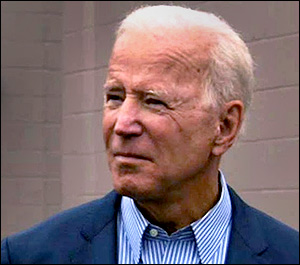
2020 Presidential Candidate and former vice president, Joe Biden (D)

Feb. 11, 2020 — Former Vice President Joe Biden said his campaign took a “gut punch” with his fourth-place finish in the Iowa Caucuses and, in the nationally televised debate on Friday night from New Hampshire, lowered future expectations when indicating that finishing close to Sen. Elizabeth Warren (D-MA) in the state’s first-in-the-nation primary would be an acceptable showing.

Recent polls suggest Sen. Warren will do no better than third place, meaning Biden, who can no longer be considered the national front runner, again looks to be lagging behind in fourth place among the Democrat candidates. Does another fourth-place finish doom his national campaign? Would Biden have a path to the nomination even if failing to win yet again in Nevada on Feb. 22?

The answers to the two queries are no and yes, and South Carolina is the key. After a win in the Palmetto State, he would then need to strongly springboard into Super Tuesday just three days hence on March 3. On that day, citizens in 14 states and one territory are scheduled to cast votes, and half of those states are in the South, a region where the former vice president has been dominant in polling.

Sen. Bernie Sanders (I-VT), the likely national leader headed to Super Tuesday, should find some relative strength in the southern states, and billionaires Tom Steyer and Michael Bloomberg will likely also break the 15 percent threshold in some of these places and others to score a limited number of bound delegate votes. If Biden wins most or all of the southern states with approximately 30 percent of the aggregate vote, it would likely give him approximately 200 delegates, a number that certainly could boost his viability within a national context.

From a delegate count perspective, even if he fails to break 15 percent to qualify for convention votes in New Hampshire tonight and doesn’t win Nevada, he is still not going to be unreasonably behind. In Iowa, the projected delegate count suggests that former mayor, Pete Buttigieg, will record 14 first-ballot national convention votes, Sanders’ 12, Warren 8, Biden 6, and Sen. Amy Klobuchar (D-MN), 1.
Continue reading

The Iowa Debacle

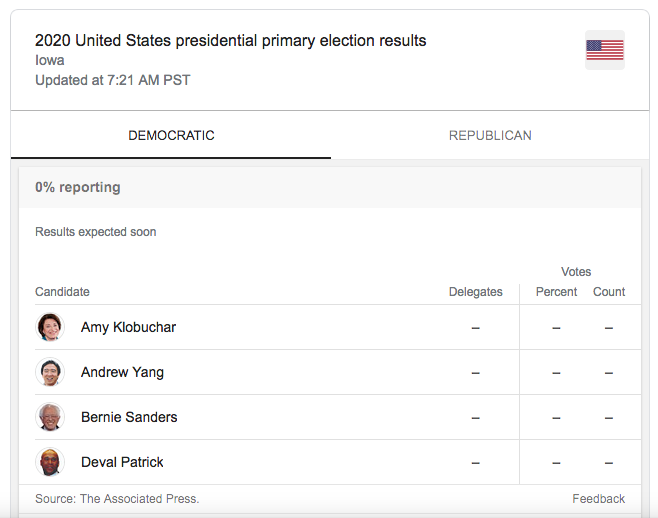
Iowa Caucus results as of 10:21 am Eastern, 7:21 am Pacific time, Tuesday, Feb. 4, 2020.

By Jim Ellis

Feb. 4, 2020 — The reporting problem that arose in the Iowa Democratic Caucuses last night have left us with no results for what could be as long as a full day or more after votes were cast, but it still appears as if a clear winner and loser have emerged. The winner and loser terms have a different meaning in the Iowa Caucus context, however.

Voters attended meetings in 1,679 precincts and the party organizers were supposed to submit their first ballot and final alignment numbers through a specially designed application. The app failed, and so did the party’s back-up plan. Therefore, while voting occurred in all of the precincts, less than one-third of the totals have been received at the Iowa Democratic Party headquarters at the end of the night. The party spokespeople say they will not release any numbers until the entire state reports, and the 1st and 2nd round totals have been verified.

Meeting attenders cast their first ballot and the candidates failing to attain 15 percent support in the precinct were eliminated. In the final alignment round, those voting for a non-qualifying candidate were then lobbied to vote for a candidate who did surpass the 15 percent threshold and would thus qualify for delegates to advance to the state convention on June 13. The state delegates will then vote to assign Iowa’s 41 first-ballot delegates to the Democratic National Convention, but the eventual official apportionment will closely follow the Caucus votes.

What we began seeing from the fastest reporting precincts that were released, and that was less than two percent of the statewide vote, was a bunching at the top among Sens. Bernie Sanders (I-VT) and Elizabeth Warren (D-MA), and South Bend Mayor Pete Buttigieg. Former Vice President Joe Biden and Sen. Amy Klobuchar (D-MN) were in need of further support from around the state to reach the 15 percent mark, but both are close. Therefore, it does appear possible that all five of these contenders could qualify for a share of the state’s delegates.

The unfolding situation seems to favor one person in particular, while disfavoring another. On the short end is Sen. Sanders, even though he looks to clinch first place. The glitch cost him the opportunity to declare outright victory in a timely fashion before a national television audience. The most fortunate candidate looks to be Biden, whose early performance suggests he might not even qualify for delegates in a substantial number of precincts. The reporting problem prevented headline stories claiming that he was Iowa’s under-performer.

Continue reading

Sen. Cory Booker Ends Run for 2020

By Jim Ellis

Sen. Cory Booker (D)

Jan. 15, 2020 — With less than three weeks from the first votes being cast in the Democratic presidential nomination process, Sen. Cory Booker (D-NJ) announced via Twitter that he is ending his national effort.

The move is not surprising, as Sen. Booker rarely reached or surpassed three percent support in any presidential primary poll. Like Sen. Kamala Harris (D-CA), who left the race just before the California candidate filing deadline in early December, visions of Senate re-election may have at least in part driven the timing of Booker’s move. While Sen. Harris doesn’t face voters in a strong Democratic state until 2022, Sen. Booker is on the New Jersey ballot this year.

Before the presidential race began, New Jersey legislators and Gov. Phil Murphy (D) changed the state election law to allow candidates to run simultaneously for more than one office. The move was obviously made to assist Sen. Booker’s presidential efforts. Now, however, the simultaneous filing option becomes moot.

Leaving the race now provides him an excuse for finishing poorly in the first four voting states: Iowa, New Hampshire, Nevada, and South Carolina, though he filed for each primary and caucus vote and will still be on the ballot in at least New Hampshire and South Carolina.

Though Sen. Booker appears safe for re-election, the New Jersey filing deadline isn’t until March 30. Poor finishes in all primary and caucus states could have left him in a vulnerable state, and while the Garden State is highly unlikely to elect a Republican to the Senate, it’s not out of the realm of possibility that a strong Democrat could have begun to mount a primary challenge. Now we can expect Sen. Booker to invest all of his political capital into cementing his re-election for a second full six-year term.

Continue reading

Sanders, Steyer With Momentum

By Jim Ellis

2020 presidential candidate, Tom Steyer

Jan. 14, 2020 — For the first time in this Democratic primary cycle, Sen. Bernie Sanders (I-VT) has taken the lead in an Iowa Caucus poll, while billionaire Tom Steyer is moving into contention in both Nevada and South Carolina.

Several surveys released on Friday point to these conclusions. In Iowa, Selzer & Company, polling for the Des Moines Register newspaper and Mediacom (Jan. 2-8; 701 likely Iowa Democratic primary voters) finds Sen. Sanders taking a 20-17-16-15 percent slight edge over Sen. Elizabeth Warren (D-MA), South Bend Mayor Pete Buttigieg, and former Vice President Joe Biden. The close results suggest that all four of these contenders are in position to qualify for the all-important delegate apportionment.

Des Moines based Selzer & Company has long been considered the polling industry standard for the Iowa electorate. According to their analysis, Sen. Sanders has the most committed support, and is in the best position to deliver his supporters to the individual caucus meetings on Feb. 3, which will translate into committed delegate votes.

The Selzer poll produces similar results to other pollsters in that the top four contenders are closely bunched, but the rest find a different leader. Instead of Sen. Sanders, most have recently found Mayor Buttigieg holding first position. All, however, suggest the top four finishers will likely qualify to split the 41 first ballot votes that the Democratic National Committee allots to Iowa.

Fox News conducted a series of research studies in Nevada, South Carolina, and Wisconsin over the Jan. 5-8 period and, in the two early states, Steyer has moved into a third place Nevada tie with Sen. Warren and is in sole possession of second place in South Carolina.

The Fox News Nevada poll (Jan. 5-8; 635 likely Nevada Democratic caucus attenders) gives Biden the overall edge in recording 23 percent, Sanders follows at 17 percent, and Steyer and Warren are tied with 12 percent.

Continue reading

Sanders Leading in California

By Jim Ellis

2020 Presidential candidate Sen. Bernie Sanders takes the lead in California

Jan. 13, 2020 — The new Capitol Weekly research survey (Jan. 1-9; 1,053 likely California Democratic primary voters) finds Sen. Bernie Sanders (I-VT) taking a slight polling lead in the California Democratic primary over Sen. Elizabeth Warren (D-MA), former Vice President Joe Biden, and South Bend Mayor Pete Buttigieg in what is consistently becoming a closely bunched field.

With two months to go before the Golden State primary is conducted but less than a month before early voting begins there on Feb. 3, the possibility of multiple candidates receiving portions of the state’s 415 first ballot delegates is becoming very real.

Sanders leads Warren, Biden, and Buttigieg by a 24-21-20-11 percent spread. Under party rules, a candidate must secure 15 percent of the statewide vote to earn at-large delegates. Therefore, Buttigieg must work to gain strength during the remaining time in order to reap the all-important mandated delegate commitments.

If he were to obtain 15 percent, and the others remained constant with these present percentages, the at-large delegate division would break 43 for Sanders and 38 for Warren, while Biden would earn 36 and Buttigieg 27 votes.

Should only the top three qualify for at-large delegate apportionment, Sanders would earn 53 votes, Warren 46, and Biden 45. Therefore, Buttigieg qualifying would significantly change the state and overall race because the large California delegation will be a major presence at the Democratic National Convention.

Scoring at-large delegate commitments is not the only way to earn votes, however. A larger total of 271 delegates will be awarded through the state’s 53 congressional districts. Each district, based upon its historical support performance for Democratic candidates, is awarded between 4 and 7 delegates, inclusive.

Continue reading

Castro Out; Bernie Brings in $34.5M

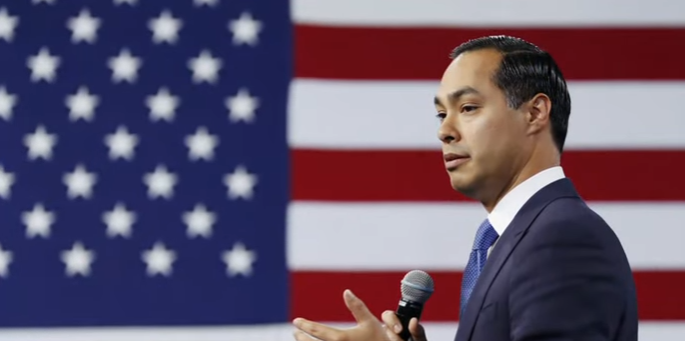
Julian Castro, 2020 Presidential candidate and Former Housing and Urban Development Secretary, bows out of the race.


By Jim Ellis

Jan. 6, 2020 — Saying that it simply “isn’t our time,” former Housing and Urban Development Secretary Julian Castro announced late last week that he is ending his bid for the Democratic presidential nomination now, exactly one month before the campaign’s first votes are cast in the Iowa Caucuses.

Castro, who served the final two-and-a-half years of the Obama Administration in the president’s cabinet after a five-year stint as mayor of San Antonio and previously being elected to one term on the city council, was one of the first candidates to enter the 2020 presidential campaign. Beginning the race as a little-known political figure despite serving in a national office, Castro couldn’t get his campaign untracked. He never came close to attaining high single digit support in any poll, even when including those from his home state of Texas.

On the money front, Castro raised slightly over $10 million for his national effort. Through Sept. 30, he attracted $7.6 million in financial backing with estimates of approximately $3.5 million for his final quarter in the race. Castro qualified for participation in four of the six national candidate forums, taking a major risk in one of them that proved to backfire.

Continue reading

Impeachment: First Political Clues

By Jim Ellis

President Donald Trump | whitehouse.gov

Dec. 16, 2019 — As we move toward the impeachment vote in the full House and the impending Senate trial to determine whether President Trump should be removed from office, a great deal of speculation exists about how voters will respond to this situation. A series of early December polls from the most critical swing states gives us a clue.

Firehouse Strategies/Optimus commissioned simultaneous polls within the Dec. 3-5 period in the top swing states of Pennsylvania, Michigan, and Wisconsin. As we remember, all of these places gave Trump a small victory margin in 2016. Phoenix-based pollster OH Predictive Insights conducted a poll of the Arizona electorate during the same period. Firehouse found sampling groups numbering between 551 and 610 respondents in the three states. OH used a slightly larger 628 person sample cell in the Grand Canyon State.

Both pollsters tested President Trump in each targeted state against former Vice President Joe Biden, Sens. Elizabeth Warren and Bernie Sanders, South Bend Mayor Pete Buttigieg, and ex-New York City mayor, Michael Bloomberg.

In all instances President Trump led his prospective opponent when individually paired. Since he had been trailing in similar ballot test responses from several previous polls in the Great Lakes States and was about even in Arizona, the change at the height of the impeachment proceedings suggests that he is seeing a net positive early return from the legal attack.

Of course, much could change before the process concludes, but this first data does provide us an interesting political snapshot as it relates to impeachment perceptions. As a rule, general election polling before the parties nominate their presidential candidates is usually irrelevant but, considering the present impeachment overlay, these numbers appear to be significant and particularly so because they are originating from critically important states.

For President Trump to win re-election, he must carry all five of the states in his 2016 coalition that typically vote Republican but have been trending closer to the Democrats since the last presidential election. Those are: Arizona, Georgia, and Texas. Florida and North Carolina are always swing states in virtually every election and will be again in 2020. To win, the president must first carry all of these aforementioned states. If so, he then would need to win just one of the Michigan, Pennsylvania, Wisconsin trio in order to yield a bare Electoral College majority.

Continue reading

Buttigieg Tops New Hampshire Field

By Jim Ellis

South Bend Mayor Pete Buttigieg

Dec. 13, 2019 — It has been clear for some time that South Bend Mayor Pete Buttigieg is making a strong move in Iowa, perfectly understandable for a candidate hailing from the Midwest; but could an Iowa-New Hampshire sweep be in the forecast for the upstart national contender?

A new MassInc poll for WBUR radio, the public news station in Boston, finds Mayor Buttigieg, for the first time, posting a small lead in the Granite State. The survey (Dec. 3-8; 442 likely New Hampshire Democratic primary voters) gives Buttigieg a slight 18-17-15-12 percent edge over former Vice President Joe Biden, and Sens. Bernie Sanders (I-VT) and Elizabeth Warren (D-MA), respectively, as a clear four-way race is beginning to crystallize for the first-in-the-nation primary.

The latest Iowa Caucus public polling, from Nov. 8 – Dec. 10 through four different survey research firms (Selzer & Company, YouGov, Civiqs, and Emerson College), finds Mayor Buttigieg either leading or tied in three of the studies.

Should such a trend come to fruition in February, we would see the underpinnings of not only Buttigieg becoming a legitimate contender, but a serious national four-way contest taking shape.

The New Hampshire poll is significant not only because it reveals a state base for Buttigieg but also finds that neither New England stalwart politicians Sanders nor Warren have clinched the state, as one might surmise. It was only four years ago when Sen. Sanders posted a 60 percent victory over Hillary Clinton in the 2016 Democratic New Hampshire presidential primary. At this point, now exactly two months from the Granite State primary vote, it would be reasonable to believe that both would be doing better than the MassInc survey and other recent polls suggest.

The MassInc/WBUR poll also provides another key data point. Despite former New York City mayor Michael Bloomberg’s major media spending, apparently on a national basis, his favorability ratings among Democrats continue to languish. His personal index will have to substantially improve if he is to make a push to develop a five-way nomination campaign.

Yesterday, we covered a Monmouth University national poll that found Bloomberg being regarded as the most unpopular of the well-known Democratic candidates, and this MassInc/WBUR New Hampshire survey returns similar results.

Continue reading

Shock Poll – Hillary Leading

By Jim Ellis

Hillary Clinton

Dec. 11, 2019 — The Harris polling organization in conjunction with Harvard University has just released what appears to be the first national poll to include former secretary of state and 2016 presidential nominee Hillary Clinton, and it finds her pulling into a small lead when tested against the rest of the Democratic field.

Looking at the large sample survey (Nov. 27-29; 1,859 registered voters — 756 Democratic registered voters, online), Hillary would take a 21-20-12-9-5 percent lead over former Vice President Joe Biden, Sens. Bernie Sanders and Elizabeth Warren, and South Bend Mayor Pete Buttigieg.

Without Hillary included, the field breaks 29-16-13-8-7 percent in favor of Biden, Sens. Sanders and Warren, Mayor Buttigieg, and former New York City mayor Michael Bloomberg, respectively.

There are negatives associated with the methodology, however. First, an online poll is less reliable than a live-interview survey, and generally even less so than an automated response device study.

Additionally, the Harris/Harvard poll was taken during the Thanksgiving holiday weekend, which again potentially skews the sample because so many people would not be included in the sampling universe because of deviations from their normal routines.

Third, the survey included former secretary of state and ex-US senator John Kerry within the field of candidates, and he received five percent support. That, too, could certainly skew the overall results to a degree because he is not running in the 2020 campaign.

Negatives notwithstanding, the fact that Clinton would already land among the leaders in the first of what will likely be several credible national surveys is significant. If anything, this data will lend more fuel to the fire that the former presidential nominee, secretary of state, US senator, and First Lady is seriously considering becoming a national candidate in 2020.

The Harris/Harvard poll again reiterates the most recent polling trend that, without Hillary being tested, Biden is establishing a clear lead but is nowhere close to the necessary 50 percent mark in order to secure nomination. The latest data also confirms that Sen. Warren dropped back into the pack after moving into a virtual tie with Biden six to 10 weeks ago. Sen. Sanders maintains his consistent supporters and is clearly going to be a top-tier factor as the race moves forward.

The candidates appearing to suffer the most from a Clinton re-emergence are Sen. Warren and Mayor Buttigieg. They both drop back significantly with her in the race, each falling into single digits. Biden and Sanders appear to hold most of their strength even with her in the field, which tells us that Warren and Buttigieg’s joint prospects will suffer if she were to return to active candidate status.

Continue reading

Alabama & Arkansas: The Filings

By Jim Ellis

Nov. 15, 2019 — Candidate filing for the 2020 election cycle is now closed in two states, Alabama and Arkansas, and several individuals unexpectedly became candidates.

First, in the presidential race, not only did former New York City mayor Michael Bloomberg file in Alabama, as was widely reported last week, but he also submitted papers for the Arkansas presidential primary. This doesn’t necessarily mean he will enter the national race, but it certainly gives him the option to become an active candidate.

Reports are now surfacing, however, that Bloomberg will not file for the New Hampshire presidential primary at today’s deadline. This move is even more surprising in light of his filing in Alabama and Arkansas. Polling must tell him he would be shut out in the Granite State and, with only a total of 24 first-ballot delegates, skipping the state would not greatly affect his potential delegate acquisition count.

Another surprise came in Arkansas where, at least for now, first-term Sen. Tom Cotton (R) has no Democratic opponent. When filing closed, Fayetteville Democrat and former congressional candidate Josh Mahony complied with the deadline requirements and said in his exit statement said he had been working the state for six months in order to lay groundwork for his statewide campaign. Before the day ended, however, he decided to rescind his candidacy.

Mahony said a family issue keeps him from running, but the Arkansas Republican Party had also just filed an ethics complaint against him, so it is possible that this development also had some influence on his decision to leave the race. In any event, Mahony is no longer a candidate even though he would have been unopposed for the Democratic nomination.

At this point, the Democrats have no Senate candidate, but state law will allow the party members to meet and choose a new nominee to oppose Sen. Cotton. Either way, Cotton’s re-election prospects appear completely sound.

Of course, the Alabama Senate race, now that former US attorney general and Alabama senator, Jeff Sessions, is returning in an attempt to re-capture his previous position, has drawn the most political attention. The entire Republican field for the office includes the aforementioned Sessions, Secretary of State John Merrill, US Rep. Bradley Byrne (R-Mobile), former Auburn head football coach Tommy Tuberville, ex-state Supreme Court Chief Judge and 2017 special Senate nominee Roy Moore, state Rep. Arnold Mooney (R-Shelby County), and businessman Stanley Adair.

The other somewhat surprising filing came in Arkansas’ 2nd Congressional District, where state Sen. Joyce Elliott (D-Little Rock) will run to oppose three-term Rep. French Hill (R-Little Rock). The 2nd District, which is comprised of the Little Rock metropolitan area, is the most politically marginal of Arkansas’ four congressional districts.

Continue reading