Tag Archives: Gov. Mike DeWine

Palin Gets Endorsement; Hawaiian Announces for Congress; More

By Jim Ellis

April 29, 2022:

House

HI-2: Another Announces for Congress — Confident that freshman Rep. Kai Kahele (D-Hilo) will soon declare his intention to run for governor, former state Sen. Jill Tokuda (D) formally exited the lieutenant governor’s race and announced that she will enter the 1st Congressional District contest.

Though Rep. Kahele is still technically a congressional candidate, Tokuda follows the
lead of state Sen. Jarrett Keohokalole (D-Kailua), state Rep. Angus McKelvey (D-Lahaina),
and Honolulu City Council chairman Tommy Waters (D) who have all entered what they
believe will be an open congressional race. The Hawaii candidate filing deadline is June 7
for the Aug. 13 statewide primary, so Rep. Kahele will soon have to make known his
2022 political plans.


Governor
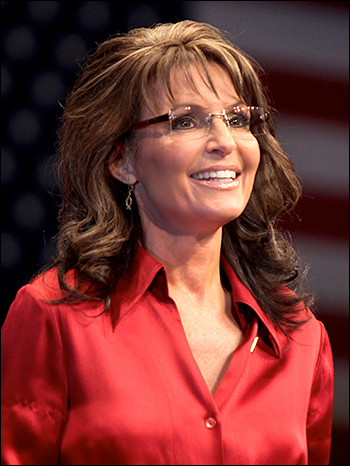
Sarah Palin, former Alaska governor and vice presidential candidate

Alaska: GOP Co-Endorses — After the Alaska Republican Party, which has also endorsed businessman Nick Begich, III over former governor and 2008 vice presidential nominee, Sarah Palin, in the US House special election, had already officially endorsed the party’s incumbent Gov. Mike Dunleavy (R), the political entity has now expanded its official support list. In addition to the governor, the Alaska GOP voted to also endorse Kenai Peninsula Borough Mayor Charlie Pierce, who is the governor’s Republican primary challenger.

Connecticut: New General Election Poll — Fairfield, Connecticut’s Sacred Heart University released a new poll of the governor’s campaign, which is expected to become competitive once we enter the post-primary period. The survey (March 24-April 11; 1,000 Connecticut residents; online) finds Gov. Ned Lamont (D) opening with a substantial lead over businessman and 2018 gubernatorial nominee Bob Stefanowski (R). The ballot test finds the governor holding a 48-30% advantage.

The poll, however, has a questionable methodology. The sampling period of 18 days is very long, and the respondent universe did not segment for likely or even registered voters. Therefore, the result likely places Gov. Lamont in a better position than he might be before a better segmented poll.

Nebraska: Gov Primary Tight — State Sen. Brett Lindstrom (R-Omaha) released a new internal poll of the upcoming May 10 Republican primary that features a very tight contest among himself, businessman Charles Herbster, and former University of Nebraska Regent Jim Pillen. The Data Targeting/Neilan Strategy Group poll (April 19-20; 858 likely Nebraska Republican primary voters; interactive voice response system) finds Sen. Lindstrom claiming a small lead at 28-26-24 percent edge over Herbster and Pillen, who both have significant support.

The results are a marked improvement for Herbster, who former President Trump endorses, after multiple women accused him of sexual harassment. A previous poll showed him losing support. The eventual Republican nominee becomes a prohibitive favorite to win the general election and succeed term-limited Gov. Pete Ricketts (R).

Ohio: DeWine Leading Gov Primary but Below 50 percent — Fox News released the results of their new Ohio poll (April 20-24; 906 likely Ohio Republican primary voters; live interview) that finds Gov. Mike DeWine leading his Republican primary opponents, former US Rep. Jim Renacci and farmer Joe Blystone by a 43-24-19 percent margin. This represents a downward trend for the governor of a net 11 points from March’s Fox Poll. Combined, the opponents equal DeWine’s support, but with the anti-incumbent vote split, it is likely that the governor wins a plurality nomination race next Tuesday.
Ohio Entering Home Stretch

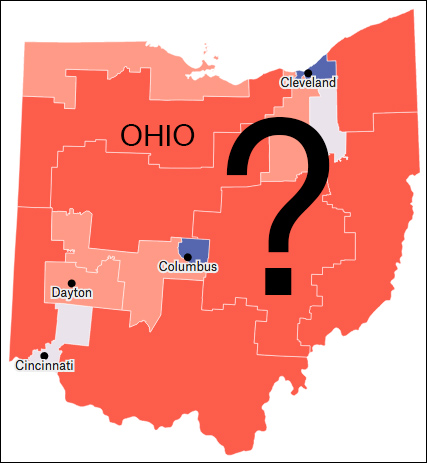
Ohio redistricting map in question (click on map above or here to go to FiveThirtyEight’s interactive map)

By Jim Ellis

April 18, 2022 — We’re on the threshold of entering the final two weeks before the Ohio primary on May 3, and the candidates for all offices are swinging into high gear just as the state Supreme Court rejected another set of redistricting maps.

The state House of Representatives and Senate primaries having been postponed, because the legislature and state Supreme Court cannot find common ground pertaining to the new district lines; no new primary date has been set. Late last week, for the fourth time, the judicial body rejected the legislature’s draw for their own political boundaries in both chambers. Since the Ohio Constitution does not give the courts the authority to draw maps, all the justices can do is return the plans to the legislature and order them to begin yet again.

News is occurring in the races that are headed toward nominations. The new Remington Research Group US Senate GOP primary survey (April 11-12; 884 likely Ohio Republican primary voters, interactive voice response system) finds former state treasurer, Josh Mandel, forging back into the lead and state Sen. Matt Dolan (R-Chagrin Falls), a minority owner of the Cleveland Guardians MLB franchise, moving into contention.

The statewide GOP primary ballot test finds Mandel leading the pack with 23 percent as compared to businessman Mike Gibbons’ 17 percent, Sen. Dolan’s 15 percent, former Ohio Republican Party chair Jane Timken posting 12 percent, and author J.D. Vance trailing at 10 percent.

Reports suggest that an endorsement coming for Vance from former President Donald Trump is imminent. If so, the polling standings will change. Remington posed a second ballot test question to the current respondent pool asking how they would vote if knowing Trump had endorsed Vance. While Mandel would still lead, his edge shrinks to 19 percent; Gibbons, Dolan, and Vance would bunch together at 15 percent; and Timken drops to 11 percent.

If the reports of Trump endorsing Vance prove true, the Remington poll suggests that such a move would likely change the race’s flow. The Trump involvement in such a manner appears to make a close contest even closer.

The Remington survey is the tenth poll taken of the Republican Senate primary since the beginning of February. Gibbons has led in six of them and Mandel three, with one showing a three-way tie among the two aforementioned men and Vance. The fact that all five of the key candidates, at one time or another, have been within shouting distance of the lead suggests that any one of them could catch a flyer at the end and propel themselves into a nomination victory with a small plurality.

On the Democratic side, US Rep. Tim Ryan (D-Warren/Youngstown) appears to be cruising toward an easy nomination victory against former Consumer Financial Protection Bureau official and 2020 failed congressional candidate Morgan Harper.

Continue reading

Gov. DeWine’s Primary Trouble

By Jim Ellis

Ohio Gov. Mike DeWine (R)

Jan. 28, 2022 — The Ohio Republican gubernatorial race has been rather quiet to this point, but it appears the May 3 primary is beginning to get interesting.

A Fabrizio Lee research firm survey (Jan. 11-13; 800 Ohio Republican primary voters and Independents who choose to vote in the Republican primary, live interview) finds Ohio GOP Gov. Mike DeWine, one of the leading 2020 COVID shutdown governors, in trouble for re-nomination against his Republican primary opponent, former Congressman Jim Renacci.

According to the poll results, Renacci would top Gov. DeWine in his quest for re-nomination by a relatively substantial 46-38 percent margin. The governor falling under 40 percent among a voting sample within his own party is certainly a warning sign. It appears what was thought to be a relatively minor primary challenge is transforming into a highly competitive contest.

Earlier in the month, the Harris Poll (Jan. 4; 1,146 likely Ohio Republican primary voters, online) tested the Ohio primary and found the two contenders tied at 42 percent, possibly the first public tangible indication of the incumbent’s weakness within his own party.

Of Renacci’s 46 percent support in the Fabrizio Lee study, 22 of the 46 said they would “definitely” vote for the GOP intra-party challenger. Another 19 percent said they would “probably” back him, with the final five percent saying they are “leaning” toward the former congressman. Turning to DeWine’s supporters, 20 percent of his 38 percent said they would “definitely” vote for the governor, 16 percent retorted “probably” so, with the final two percent indicating they are “leaning” toward the incumbent.

Furthermore, Gov. DeWine’s score on the accompanying re-elect question is troublesome for any incumbent. A total of 33 percent from his own party said “I will definitely vote against Mike DeWine for governor regardless of who runs against him in the Republican primary” as compared to just 14 percent of Republicans and Republican voting Independents who said “I will definitely vote to re-elect Mike DeWine for governor, regardless of who runs against him in the Republican primary.”

Looking at the extremes on such a question is telling, and the fact that DeWine sees his opponent’s hard-core supporters more than doubling the number of his own strong backers is a major warning sign indicating that he could face losing the party nomination if this pattern is verified and continues.

Continue reading

Ohio Redistricting Set to Pass

WBNS TV – Channel 10 – Columbus

By Jim Ellis

Nov. 19, 2021 — The Ohio legislature has sent the new congressional and state legislative maps to Gov. Mike DeWine (R) for his approval. Ohio loses one seat in reapportionment.

As expected, the new map radically changes the seats that outgoing members Tim Ryan (D-Warren/Youngstown) and Anthony Gonzalez (R-Rocky River) currently hold. Rep. Ryan, running for the Senate, sees his eastern Ohio 13th District collapsed, with a sizable chunk of Akron remaining in the seat and the remainder going to Rep. Bob Gibbs’ (R-Lakeville) 7th District.

Instead of moving east, as under the current map, the new 13th moves to the west, annexing Medina County and the western part of the Cleveland metro area in Cuyahoga County. Much of this territory comes from the retiring Rep. Gonzalez’s current 16th District, a seat whose territory gets absorbed in several neighboring CDs.

At first glance, the map looks to break 12R-3D, meaning Democrats would take the seat loss in typical election years. Three of the districts, however, two of which Democrats now hold, would become highly competitive.

The members with the most competitive districts would again be Reps. Steve Chabot (R-Cincinnati) in the 1st District, in addition to Marcy Kaptur’s (D-Toledo) 9th CD, and the open 13th District.

The safest members are Reps. Brad Wenstrup (R-Cincinnati), though he loses a significant part of his anchor city, Joyce Beatty (D-Columbus), Jim Jordan (R-Urbana), Bob Latta (R-Bowling Green), Bill Johnson (R-Marietta), Bob Gibbs (R-Lakeville), Warren Davidson (R-Troy), Shontel Brown (D-Cleveland), and Troy Balderson (R-Zanesville).

Reps. Mike Turner (R-Dayton), David Joyce (R-Russell Township, and Mike Carey (R-Columbus) all would get reliable Republican districts, but not overwhelmingly so. Turner’s composite improves his marginal district a net three points in his party’s favor. Rep. Joyce sees his partisan complexion remaining at about a 10-point positive district for him when comparing the composite average to the 2020 presidential results.

Continue reading

Special Elections Update: LA Votes

https://www.facebook.com/Karen.Carter.Peterson/videos/2521633831472770/Karen Carter Peterson promotional video.


By Jim Ellis

March 22, 2021 — Five special congressional elections are now on the political calendar, and we see current action in all.

Beginning with the two Louisiana seats, voters went to the polls Saturday in the first round of elections in the state’s 2nd and 5th Congressional Districts.

The 2nd, anchored in New Orleans and Baton Rouge, is a Democratic seat left vacant when former Rep. Cedric Richmond (D-New Orleans) was appointed to a White House position in the Biden Administration. The northeastern Louisiana Republican 5th CD became vacant when Rep-Elect Luke Letlow (R), three weeks after winning the seat in a post-general runoff election, passed away from a heart attack and COVID.

The 2nd District sees 15 Democrats, Republicans, minor party, and Independent candidates all on a jungle primary ballot. The political odds favor two Democratic New Orleans state senators, Troy Carter and Karen Carter Peterson, advancing to a general election runoff on April 24. The tone of this week’s candidates’ ads, with Sen. Peterson already being attacked, suggest that the special general between Carter and Peterson is already underway.

Prospects were promising that we would see a winner in Saturday’s 5th District race. Though 12 candidates are on the ballot, just one has strong campaign resources and public backing. Julia Letlow (R), wife of the deceased congressman-elect, looks well positioned to exceed the majority support threshold tomorrow night meaning she would claim the seat outright.

Armed with a 9:1 fundraising lead over her closest competitor at the end of February and holding endorsements from former President Trump, former Vice President Mike Pence, Sen. John Kennedy (R-LA), the Louisiana Republican Party, and the Louisiana Sheriffs of the 5th Congressional District committee, among others, Ms. Letlow appears poised to score a convincing win over a crowded field.

The first poll for the Texas special election was just released. In this 6th District race, vacated because of Rep. Ron Wright’s (R-Arlington) death from cancer and COVID, a whopping 23 candidates are vying to replace the late incumbent. The first election is May 1. If no one receives majority support, which is likely, a runoff will be scheduled after the primary voters officially determine the final results.

Continue reading

Florida Poll Boosts DeSantis

By Jim Ellis

Florida Gov. Ron DeSantis (R) at the recent CPAC.

March 3, 2021 — Florida Gov. Ron DeSantis (R) is quickly becoming a national talking point with regard to the 2024 presidential campaign, but he first must further prove himself with a 2022 re-election victory in the always politically close Sunshine State.

Over the weekend at the annual Conservative Political Action Conference (CPAC), Gov. DeSantis was clearly the choice of the conservative base as a potential heir-apparent to former President Donald Trump.

In the future presidential straw poll, former President Trump placed first among the several thousand individuals who participated. He took 55 percent of the first-place ranked choice votes. Gov. DeSantis was a clear second pick, however, with 24 percent. Without Trump in the field, it was Gov. DeSantis running away with the lead, capturing 43 percent with South Dakota Gov. Kristi Noem a distant 11 percent second-place finisher. Donald Trump, Jr. followed with eight percent support.

Just after CPAC, Mason-Dixon Polling & Research released the findings from their Florida poll conducted during the Feb. 24-28 period. The organization surveyed 625 registered Sunshine State voters through a live interview process.

According to the M-D results, Gov. DeSantis’ job approval rating has improved to 53:42 percent favorable to unfavorable, a net 15-point gain from his standing in the July 2020 M-D survey that found him saddled with an upside-down ratio of 45:49 percent.

The job approval ratings are a precursor to his ballot test standing opposite a prospective Democratic gubernatorial nominee, of whom the two leading choices appear to be State Agriculture & Consumer Affairs Commissioner Nikki Fried and US Rep. Charlie Crist (D-St. Petersburg) who may make his third run for governor.

From 2007-11, Crist was governor of the state, but served as a Republican. He switched parties after a failed run for the US Senate as an Independent, and won the Democratic gubernatorial nomination in 2014, but lost to then-Gov. Rick Scott (R) in the general election.

Continue reading

Ryan Hedging on Senate Run

By Jim Ellis

Ohio Rep. Tim Ryan (D-Warren/Youngstown)

March 2, 2021 — Last month, Ohio Rep. Tim Ryan (D-Warren/Youngstown) indicated that he would launch a statewide campaign for retiring Sen. Rob Portman’s (R) open seat in March. Now, he looks to be backpedaling.

In an interview with the Spectrum News Service, Rep. Ryan said, “we’ll make a decision here, I guess, in the coming weeks. I don’t think a March kickoff is going to happen.”

Such equivocation has seemingly been the congressman’s standard operating procedure over the years. Several times before he has been looking seriously at races for the US Senate, governor, and even lieutenant governor, but has always retreated to the relative safety of his House seat.

He did briefly campaign for president in 2020 but dropped out of the race when it was obvious his message was falling on deaf ears, exiting in plenty of time to meet the Ohio candidate filing deadline. Last November, Rep. Ryan went onto win a more competitive House race than he normally sees, defeating former state Rep. Christina Hagan (R), 52-45 percent.

Going back to the House race, if that’s what Rep. Ryan ultimately decides, may look different in 2022. If redistricting actually happens, considering all of the Census Bureau delays, Ohio faces the loss of another congressional seat in reapportionment, and it may well be Ryan’s.

His current 13th District stretches from the Pennsylvania border, encompasses Youngstown and the congressman’s hometown of Warren, and then captures a large part of the Akron metropolitan area. From preliminary census reports, it appears OH-13 will require an influx of more than 75,000 people once the final numbers are calculated. The Ryan district looks to rank 13th in population of the 16 Ohio congressional districts.

Perhaps a bigger problem for the 10-term incumbent, and what makes his 13th District vulnerable to collapse, is the adjacent 11th District that houses the western side of Akron in Summit County, is the least populated seat in Ohio and will need to gain as many as 100,000 individuals.

Therefore, collapsing the 13th District portion of Akron into the 11th in order to keep the city and at least most of the county together would be a sensible draw, thus leaving Rep. Ryan’s eastern district sector as a standing fragment. Since Districts 14 to the north, 6 and 7 to the south, and 16 to the west will all require more population, eliminating District 13 becomes a plausible option.

Continue reading

Jockeying for Ohio’s Senate Seat

By Jim Ellis

Jan. 28, 2021 — Monday’s surprise announcement that Sen. Rob Portman (R) will not seek re-election next year has ignited a flurry of activity and speculation from potential candidates and political observers alike. Some looking to challenge Gov. Mike DeWine (R) are now also beginning to survey and assess how an open US Senate candidate field might unfold.

Recent voter history suggests that the eventual Republican nominee will at least begin the general election campaign in the favorite’s role. The GOP, with a large number of statewide office holders, former elected officials, and a dozen sitting US House members, has an array of candidates from which to choose, and many will take the plunge.

For example, former US Rep. Jim Renacci, who held Sen. Sherrod Brown (D) to a 53-47 percent victory in the 2018 campaign and was reportedly looking to challenge Gov. DeWine in the 2022 Republican primary, may now set his sights on the open Senate seat.

Another ex-office holder, Pat Tiberi, who averaged 60.6 percent of the vote over nine elections from a Columbus area congressional district that former governor and presidential candidate John Kasich once held, still sits on more than $5 million in his federal campaign account even though he hasn’t been on the ballot since 2016.

It was widely believed that he was amassing a huge war chest to run against Sen. Brown in ’18, but family considerations led him to change his mind, resign from Congress and instead take the reins of the Ohio Business Roundtable.

Still another former elected official, ex-state Treasurer Josh Mandel (R), who lost the 2012 Senate election to Sen. Brown, was planning to run again in 2018 until leaving the race because of his wife’s health issue. Mandel raised almost $20 million for his Senate race eight years ago and has over $4 million in his campaign account even though he has not been a federal candidate in eight years.

Republicans hold all of the state’s constitutional offices. Lt. Gov. Jon Husted, Secretary of State Frank LaRose, Attorney General Dave Yost, state Treasurer Robert Sprague, and State Auditor Keith Faber are all credible potential US Senate candidates.

Continue reading

Primary Day; Ohio on Hold

By Jim Ellis

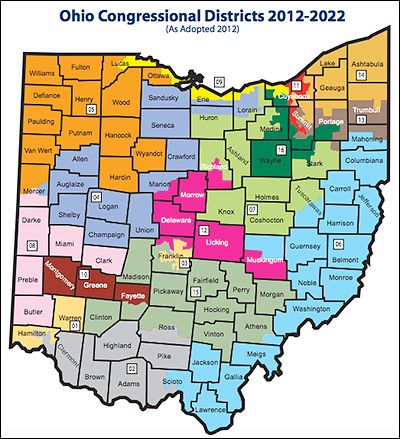
Ohio’s Congressional Districts

March 17, 2020 — Today is a defining day for the Democratic presidential primary but it looks like former vice president Joe Biden will easily march toward the party nomination without participation from Ohio.

Originally, the Buckeye State primary was planned for March 10, but then re-scheduled for today, March 17. Yesterday, Gov. Mike DeWine (R) requested a judge stay the primary election in response to the COVID-19 virus but was turned down. Then, in a statement late last night, the state health director stepped in to halt the primary voting process under a statewide emergency order. The governor and secretary of state are working on ways to increase mail and absentee voting, but how and when people are supposed to vote remains uncertain.

This means only Arizona, Florida, and Illinois voters are casting their ballots today. State officials in each of those places are moving forward with voting as planned. Of this group, only Illinois, like Ohio, is scheduled to hold its state primary.

Regardless of Ohio not being in the mix, at the end of voting this day, Biden will effectively become the Democratic presidential nominee, but not yet officially. Perhaps more importantly, at least as it pertains to Ohio, is what happens to the candidates running for the down-ballot offices.

There is no US Senate race in Ohio this year, but all 16 congressional seats are on the ballot as well as 115 electoral contests for the state legislature (16 state Senate seats; all 99 state House seats), and a large number of local offices.

The confusion surrounding the primary could well become the foundation for eventual lawsuits from some of the candidates who may eventually lose close votes. Therefore, the decision to postpone could result in a very long primary, and post-primary cycle.

Continue reading