Category Archives: House

Election Day Upsets and Surprises

By Jim Ellis

Nov. 4, 2021 — Now that Tuesday’s election numbers are becoming more available and final, we can explore the contests that proved to be upsets and ones providing us with some surprises. In most instances, the Republicans performed better in these races than expected.

The first obvious upset, though a mild one as we approached election day because most people understood that Republican Glenn Youngkin had a legitimate chance to score a victory over former Gov. Terry McAuliffe, is the Virginia statewide race. The biggest surprise was New Jersey Republican Jack Ciattarelli within one percentage point of defeating Democratic Gov. Phil Murphy.

With that background, let’s begin with our upsets:

• Georgia: Former Atlanta Mayor Kasim Reed (D), attempting to regain his former position in the open seat 2021 race, has apparently failed to qualify for the runoff. Atlanta City Council President Felicia Moore (D) placed first, with City Councilman Andre Dickens (D) running 612 votes ahead of Reed for second position with all of the precincts reporting.

Mail votes and ancillary ballots could still push Reed into a runoff with Moore, but it appears that Dickens has the inside track to nose the former mayor out of this race.

• Maine:• New Jersey: State Senate President Steve Sweeney (D) has apparently lost his southern New Jersey seat to truck driver Edward Durr (R) who spent only about $5,000 on his campaign. Durr leads 52-48 percent, which should be enough for him to eventually claim victory.

• New York: Big Republican local election wins occurred in Suffolk and Nassau County on Long Island. GOP candidates won the Suffolk and Nassau County District Attorney’s offices, and defeated the Nassau County Executive. They also reclaimed the majority on the Suffolk County legislature for the first time since 2005.

• Texas: Continuing a GOP rebound among Hispanic voters in Texas, Republican John Lujan converted a 71 percent Hispanic district in southeast Bexar County (San Antonio). Lujan was a 51-49 percent winner in Texas House District 118.

• Virginia: Glenn Youngkin (R) defeated Terry McAuliffe (D), 51-48 percent. Winsome Sears (R) topped state Del. Hala Ayala (D), 51-49 percent. State Del. Jason Miyares (R) ousted Attorney General Mark Herring (D), 51-49 percent. Republicans have clinched or lead in 52 House of Delegates races, enough for them to re-claim the majority. Not only did Youngkin score an upset win, but he had obvious coattails.

There were several interesting surprises on election night, too:

• Florida: Miami area Democrats went to the polls to choose a special election nominee to replace the late Rep. Alcee Hastings (D-Delray Beach) and the result yielded a photo finish. Recounts will be ordered and a long post-election process is expected before someone advances to the January 11th special general election.

At first take with supposedly all votes counted, businesswoman Sheila Cherfilus-McCormick looks to have secured the party nomination by just 31 votes. A later count then put Broward County Commissioner Dale Holness on top by an even smaller 12-vote margin. Expect this one to be in the courts long before a Democratic nominee is finally settled upon.

Continue reading

Youngkin Wins in Virginia;
New Jersey’s Races are Teetering;
Ohio Congressional Races & More

By Jim Ellis

Nov. 3, 2021 — Republican Glenn Youngkin claimed the Virginia governor’s race with his victory over former Gov. Terry McAuliffe (D), becoming the first Republican to win a Virginia statewide office since the 2009 election.

In New Jersey, Republican Jack Ciattarelli is fighting Gov. Phil Murphy (D) to a virtual tie, but outstanding ballots suggest the Democratic governor may barely hang on to win a second term. It was a surprisingly strong showing for Ciattarelli in such a heavily Democratic state. Though both houses of the New Jersey legislature will remain under Democratic control, Republicans appear to have added seats in both chambers.

While mail votes are still being tallied and other ballots can be received in Virginia until Friday, it appears Youngkin did exceed the 50 percent plateau with McAuliffe about two percentage points behind. The Youngkin victory helped pull his lieutenant governor Republican partner, Winsome Sears, over the top to claim the state’s second position.

The Virginia attorney general’s race features another Republican, state Delegate Jason Miyares, leading incumbent Mark Herring (D), who is running for a third term. This is the closest of the three races, so uncounted mail ballots and votes to be received after election day could make a difference. Some entities have projected Miyares a winner, and he is certainly in the better position, but the final outcome may not yet be conclusive.

Several other races are still close, but Republicans may have converted the six seats they need to re-claim the state House majority. In any event, the party gained seats.

Turnout was higher than expected in Virginia. More that 3.2 million ballots have been tabulated, meaning that more than 73 percent of the number of people who voted in the record setting 2020 election returned to cast their votes in the 2021 governor’s race. When comparing the 2017 gubernatorial election to the 2016 presidential, the return rate was 66 percent.

OHIO

In the US House, two new Ohio members-elect completed their special election victories with ease. In the vacant Cleveland-Akron seat that Housing and Urban Development Secretary Marcia Fudge (D) represented, Democratic Cuyahoga County Councilwoman Shontel Brown, as expected, easily won the congressional special general election with 79 percent of of the vote.

Continue reading

Today’s Election Scorecard

By Jim Ellis

Nov. 2, 2021 — Today is a significant Election Day, and the menu of races stretches beyond a Virginia governor’s race that has attracted the lion’s share of political attention.

While the VA governor’s race will of course be top of mind as results come in tonight and analysts attempt to assign precursor status to the contest regardless of the final result, other campaigns will also be of significance.

In the Virginia race, if Republican Glenn Youngkin scores an upset win, and the late indications are clearly moving his way, it may be cast as an affront to the Biden Administration and the Democratic majorities in Congress relating to their legislative agenda. In actuality, it is a more locally based issue, education, that should correctly be cast as the linchpin to describe a Youngkin victory.

Former Gov. Terry McAuliffe’s (D) debate comment saying he did not believe “parents should be telling schools what they should teach,” will actually prove to be the key turning point to a Youngkin victory should it materialize. In McAuliffe wins, then the talk of a coming Republican wave election next year will certainly dissipate at least in the short term.

In addition to the Virginia governor’s race, the remainder of the statewide ticket, the lieutenant governor and attorney general races could be of significance. If Winsome Sears (R), running for lieutenant governor, and Jason Miyares (R), running for attorney general, both win their races to compliment a Youngkin victory, then talk of a clear precursor or budding Republican wave election will carry a more serious tone.

New Jersey voters will decide their governor’s contest as well. In Jersey, late polling, after seeing some closer numbers not even 10 days ago, seems to show Gov. Phil Murphy (D) pulling away from Republican Jack Ciattarelli in the closing week. The final result will likely be closer than most analysts would have projected at the beginning of the odd-numbered year election cycle, however.

In both Virginia and New Jersey, voters will also be electing members of the state legislature. In the Old Dominion, only the House of Delegates is on the ballot, as state senators, with their four year terms, won’t face the voters as a unit until the 2023 election cycle.

In the Garden State, both parties are projecting they will gain seats, but no one believes the strong Democratic majorities in the state Senate and Assembly are in any danger. In the Virginia House of Delegates, Republicans need to convert a net six seats to re-claim the majority they lost in the 2019 election.

Continue reading

Illinois Redistricting Advances;
Rep. Kinzinger Out

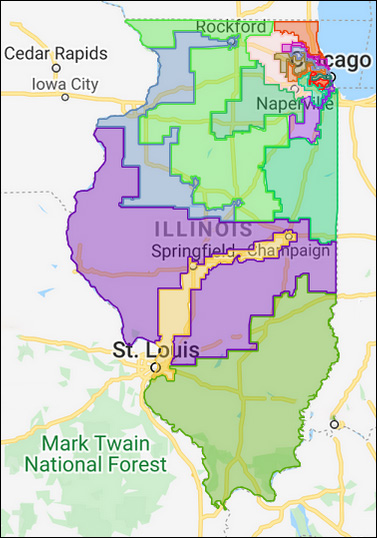
Latest Illinois Congressional redistricting map

By Jim Ellis

Nov. 2, 2021 — On Friday, the Illinois legislature voted to send a new congressional redistricting map to Gov. J.B. Pritzker (D), altering what they had drawn at the beginning of last week. This third map design came largely because of objections from both Reps. Sean Casten (D-Downers Grove) and Marie Newman (D-La Grange) who had been paired in one Chicago suburban district for the 2022 party primary.

A recent court decision rejecting the Illinois state legislative maps influenced the Democratic leadership to draw a second congressional map. A 10-year argument as to whether a second Hispanic seat should be drawn in Chicago this time became the principle discussion point.

In the 2011 redistricting plan, such a seat wasn’t drawn, and also wasn’t part of this year’s original Illinois congressional map. Seeing the Mexican American Legal Defense and Educational Fund (MALDEF) already threatening to sue over the first draw even before a final map had been adopted clearly was a factor in creating a second plan that did feature an additional Hispanic seat.

While this new third congressional version did assuage Rep. Casten and MALDEF, such was not the case for freshman Rep. Newman. She remains paired, but now with Rep. Jesus “Chuy” Garcia (D-Chicago) in an inner city Hispanic district. This is an even more difficult situation for Newman. She appears to be a leadership target likely because she defeated Chicago machine Democrat Dan Lipinski in the 2020 Democratic primary, and this latest map could well be a payback for her challenging the local party authorities.

Another political casualty is Rep. Adam Kinzinger (R-Channahon). Facing a paired situation with Rep. Darin LaHood (R-Peoria) in a Republican primary for the newly drawn 16th District — mostly foreign territory for Kinzinger in a seat that stretches from the Wisconsin border all the way to central Illinois — the congressman announced on Friday that he will not seek re-election to a seventh term.

Continue reading

First California Map Released

The California Citizens Redistricting Commission released its first congressional redistricting map in rudimentary form, not even including district numbers.

By Jim Ellis

Oct. 29, 2021 — The California Citizens Redistricting Commission released its first congressional map, and, while a long way from completion, the first edition gives us an idea as to where the members are headed. Though the map was released for public comment, it is rudimentary in form, not even including district numbers.

Since California loses a seat in reapportionment, the mystery of which area and political party will absorb the seat loss appears to be answered. Using raw numbers, because all 18 congressional districts that are self-contained within or partially occupy Los Angeles County need more residents, the seat loss should come there.

Such is the case with this first commission map, and it is the district that Rep. Karen Bass (D-Los Angeles) is vacating to run for mayor. Most of the current Bass district is collapsed into Rep. Maxine Waters’ (D-Los Angeles) seat under this first plan. If this were the final draw, Democrats would sustain the seat loss.

Dave Wasserman of the Cook Political Report released a partial analysis of the map, and finds that each party would benefit in an equivalent number of seats. Using the Biden-Trump ’20 numbers, the incumbents getting the worst draws appear to be Reps. Darrell Issa (R-San Diego), Devin Nunes (R-Tulare), and Josh Harder (D-Turlock/Modesto).

The Issa seat in San Diego appears to annex the Democratic city of Chula Vista before expanding all the way to Arizona through Imperial and Riverside Counties. It would move from a Trump plus-6 to a Biden plus-3 according to the Wasserman analysis. The Issa district was radically changed even though the current version required only 3,240 more people to meet the state population quota of 760,350 residents per congressional district.

Rep. Nunes’ Central Valley district would move from a Trump plus-5 seat to a Biden plus-3 but still maintain most of the congressman’s political base. Rep. Nunes’ current 22nd District is one of 18 CDs that are over-populated, the sixth highest in fact, having to shed 27,443 individuals. Clearly, most of the exiting individuals are from Republican areas.

Continue reading

Illinois Democrats
Alter Congressional Map

By Jim Ellis

Oct. 27, 2021 — A legal setback in court at the end of last week over the Illinois state legislative maps has apparently been part of the reason the Democratic leadership issued a new congressional map this Monday. The changes are very significant leading to three sets of incumbent pairings.

The overall partisan goal of creating a 14D-3R map from the current 13D-5R map looks on paper to be achieved, at least using the 2020 presidential race as a benchmark. The statisticians at Dave’s Redistricting App released their quick calculations to support the partisan division, but in previous data sets we saw the underlying races trending more Republican in some districts than the presidential race alone would have suggested.

Under this supposition, thinking the underlying races may show greater Republican strength when they are fully calculated, the new Illinois map may be a bit more competitive than meets the eye.

The big change is the creation of a second Hispanic plurality open seat in Chicago. The Mexican American Legal Defense Foundation was preparing to file suit on the first plan charging that, among other points and for the second time in two decades, the legislature bypassed the opportunity of drawing a second Hispanic seat in the city even though the numbers were clearly supporting such an addition. The various pressure points caused the leadership to draw a new map containing the second Hispanic district.

This draw causes a Democratic incumbent pairing in Chicago. Freshman Rep. Marie Newman (D-La Grange), who defeated former Rep. Dan Lipinski in the 2020 Democratic primary, would be placed in the same district as second-term Rep. Sean Casten (D-Downers Grove). Originally, Rep. Newman was paired with GOP Rep. Adam Kinzinger (R-Channahon) in a general election battle that would have favored her.

This new 6th District is one of the seats that could play a bit more competitive than the 55-43 percent Biden-Trump result last November yields. Certainly, the pairing winner, and Rep. Casten is at least considered the early favorite, would have a big advantage in the general election. A strong Republican candidate and a wave GOP election could make even the general election in this district interesting.

Continue reading

Two Veteran Democrats to Retire

By Jim Ellis

Democratic Reps. David Price (D-NC) , left, and Mike Doyle (D-PA)

Oct. 20, 2021 — Democratic Reps. David Price (D-NC) and Mike Doyle (D-PA) announced Monday that they are not seeking re-election in 2022. Combined, the two will have served 62 years in the House once the current congressional session adjourns.

David Price was first elected to his Raleigh, North Carolina area seat in 1986, but lost in the 1994 Republican landslide. He regained the seat two years later, and hasn’t faced a serious challenge since. He will be 82 years old before the next election.

Pennsylvania Democarat Doyle, ironically, first won his seat in the 1994 Republican landslide year, coming to Washington as one of the few freshmen Democrats of that election year. He has not been seriously challenged since, and will be 69 years old before the 2022 election.

Reps. Price and Doyle are now the ninth and tenth sitting Democrats who will not be on the ballot in the 2022 House election cycle. Republicans have eight such members. Adding the seven new seats created in reapportionment, the aggregate open seat total is currently 25. This number does not count the three seats — OH-11, OH-15, and FL-20 — that are currently in special election cycles and will have new incumbents before the next regular voting period.

The Price and Doyle districts are likely to remain in Democratic hands, but the retirements likely affect their state’s redistricting plans. North Carolina has released a map that would have given Rep. Price one of four safe Democratic seats in his state’s delegation, while the Pennsylvania legislative leadership has yet to release a draft map.

Whether Rep. Price’s retirement will spur adjustments on the Republican-drawn map remains to be seen, but it is likely that at least four safe Democratic seats will remain in what will be a 14-seat delegation since the Tar Heel State gained a district in reapportionment.

The Pennsylvania situation is exactly opposite that of North Carolina as it loses a district in reapportionment. With Rep. Doyle and neighboring Rep. Conor Lamb (D-Pittsburgh) now being the only two members of the state delegation so far not to seek re-election, the Pittsburgh area becomes the prime location to absorb the seat loss.

In looking at the state, all of its 18 congressional districts are short on population, hence the reason for losing the seat. The population shortfall is accentuated in Pennsylvania’s western sector.

Continue reading

Illinois Redistricting Map Released

By Jim Ellis

The new Illinois redistricting plan, featuring 17 new districts that twist, turn, and meander throughout the state.

Oct. 19, 2021 — It had been speculated that the Illinois Democrats were attempting to draw a new congressional map to reduce the state’s Republican contingent from five members to three. The new plan, featuring 17 new districts that twist, turn, and meander throughout the state, appears to accomplish their goal.

Democratic leaders from the House and Senate Redistricting committees defend their actions, saying the plan is “designed to comply with federal law and ensure the broad diversity of the state is reflected in the elected officials sent to represent Illinois in Washington, D.C.” The map must still clear both houses of the Illinois legislature and obtain Gov. J.B. Pritzker’s (D) signature before becoming law but with Democrats holding big partisan majorities, enactment seems certain.

Republicans and even some analytical observers say the map is a blatant partisan gerrymander designed to net the Democrats three seats nationally. Under this plan, 14 at least “lean Democratic” districts are created opposite three Republicans. The current map stands at 13D-5R, but Illinois loses a congressional seat in reapportionment.

Therefore, if the map performs as designed, the Republicans will be down a net three seats nationally because the Democrats would convert two GOP districts while the latter party absorbs the loss of the 18th seat that went to another state.

A potential legal problem, in addition to a political gerrymandering lawsuit, is the lack of drawing a second Hispanic seat in Chicago, and the Mexican American Legal Defense Foundation (MALDEF) is reportedly poised to file suit. As was the case in the last decade, the demographic numbers appear high enough for Hispanics to have two seats within Chicago. Such a second seat was not drawn in 2011, and it is again not created on this map, but the black majority seats are reinforced.

One of the re-draw’s top targets is Rep. Adam Kinzinger (R-Channahon). His current 16th District is divided into several parts in an effort to sustain the marginal Democratic district that Rep. Cheri Bustos (D-Moline) is relinquishing in western Illinois, and help strengthen Rep. Lauren Underwood’s (D-Naperville) district in the Chicago metro area. Under the current map, Underwood won a second term with just a 51-49 percent margin.

Continue reading

Michigan’s Redistricting Complexities

One of the draft Congressional maps put forward by the Michigan Independent Citizens Redistricting Commission for public review this week.

By Jim Ellis

Oct. 18, 2021 — In this redistricting cycle’s early going, one state appears to be adopting a unique map-drawing approach, and its design likely assures a long and challenging legal process to follow.

The 13-member Michigan Independent Citizens Redistricting Commission has drafted 10 maps of the congressional, state Senate, and state House maps and made them available for public testimony and comments at a series of upcoming public hearings. Within the series, four relate to the congressional boundaries with the remaining six being divided evenly between the state Senate and House.

The multiple congressional maps go in several different geographical directions and radically alter the state’s district layout to the point of even changing the entire numbering system.

It appears the basis could be in place for many lawsuits and possibly from people or organizations associated with both parties, since the final version will likely draw complaints from both Republicans and Democrats. This would be particularly true if the final map collapses a Voting Rights Act minority district as one version features.

While four draft maps were released, the congressional plan base outline seems to be in place. Remember that Michigan will lose one congressional seat, reducing the delegation size to 13 members, and we will inevitably see at least one pairing of incumbents. At this point, no sitting member has indicated that he or she will retire.

The map versions suggest several options for the Detroit metro area; for example, meaning Reps. Rashida Tlaib (D-Detroit) Brenda Lawrence (D-Southfield), Andy Levin (D-Bloomfield Township), Debbie Dingell (D-Dearborn), and Haley Stevens (D-Rochester Hills) could all find themselves in some type of a paired situation.

Looking at what little partisan political numbers are available, most of the maps point to the Democrats gaining a net of one seat, but some of the districts would be competitive to the degree of making the final outcome unclear.

Below is a synopsis of where each current member could land:

• District 1: Rep. Jack Bergman (R) – looks to receive a strongly Republican northern Michigan seat bordering Canada from the upper peninsula that will drop even further into the lower peninsula. Labeled District 12.

• District 2: Rep. Bill Huizenga (R) – could be in a paired situation with either Reps. Fred Upton (R) or John Moolenaar (R), as the commissioners take his current 2nd District to the southeast instead of due east or north as expected. The primary winner would get a safe Republican district. Labeled District 9, though Huizenga could run in a new District 13 in a potential pairing with Moolenaar.

Continue reading

Impeachment Republicans’ Trouble

By Jim Ellis

Rep. Liz Cheney (R-WY), one of 10 Republican House members who voted to impeach former President Donald Trump

Oct. 15, 2021 — As we know, 10 House Republicans voted to impeach then-President Donald Trump over the Jan. 6 US Capitol controversy and now it appears that the nine running for re-election are currently facing a bumpy political road.

Reports have surfaced in the political media that identify billionaire Peter Thiel, a Trump supporter, as contributing to the campaigns of the Trump-endorsed candidate opposing at least two of the Impeachment Republicans, Reps. Liz Cheney (R-WY) and Jaime Herrera Beutler (R-WA). The big question is whether Thiel and other like-minded mega donors will fund Super PAC efforts against the House incumbents who supported the impeachment resolution.

Already, Thiel is reportedly committing $10 million to a Super PAC supporting Arizona Senate candidate Blake Masters. He faces a credible field in the GOP primary, including Attorney General Mark Brnovich, solar company owner Jim Lamon, retired Arizona National Guard Adjutant General Mick McGuire, and State Corporation Commission member Justin Olson.

It is unknown whether Thiel will put that type of money behind the Trump endorsed House candidates trying to deny the impeachment Republicans re-nomination, but he has made the maximum campaign contribution to at least two of the contenders, Harriet Hageman, who is opposing Rep. Cheney, and retired Army officer Joe Kent, Rep. Herrera Beutler’s GOP challenger.

Let’s look at how the 10 are currently faring in their re-election efforts:

• CA-21 – Rep. David Valadao: With California’s top-two qualifying system there are effectively no Republican or Democratic primaries. The candidates finishing first and second from the June primary will advance into the general election regardless of party affiliation. There is little chance of denying Rep. Valadao one of the two finalist positions, but he will face a difficult general election campaign irrespective of the Trump-backed efforts.

• IL-16 – Rep. Adam Kinzinger: Reports suggest that the Democratic state legislative leadership is attempting to collapse Rep. Kinzinger’s seat since Illinois loses a seat in reapportionment. He faces a multi-candidate Republican field, but the redistricting lines will be the biggest factor in whether or not Rep. Kinzinger continues his congressional career. The situation won’t be fully known until the redistricting plan is formally introduced and passed into law.

• MI-3 – Rep. Peter Meijer: Freshman Rep. Meijer may have the most favorable situation of all the impeachment Republicans. While he does have primary opposition, none of the candidates appear particularly formidable. Additionally, the preliminary redistricting maps suggest that while Meijer’s district will significantly change, he will still have a Republican seat anchored in Grand Rapids. Adding the city of Kalamazoo would make re-election more competitive, but the overall district would still favor a Republican nominee in most instances.

• MI-6 – Rep. Fred Upton: Multiple Republican candidates have surfaced against Rep. Upton, but his bigger problem may be redistricting. The Michigan Independent Citizens Commission has released four draft maps, and all pair Rep. Upton with another Republican incumbent, either Reps. Bill Huizenga (R-Holland) or John Moolenaar (R-Midland).

Though Trump has endorsed state Rep. Steve Carra (R-Kalamazoo), Upton’s bigger problem would likely be facing another incumbent. It is also possible that Carra finds himself placed in another district.

• NY-24 – Rep. John Katko: Like Rep. Upton, Katko’s biggest re-election problem appears to be redistricting and not the two Republicans who have announced against him. Though the New York preliminary congressional redistricting map has not yet been released, it appears the Democratic leadership is looking to take as many as five of the eight Republican seats away from the GOP.

This very likely means that Rep. Katko would find himself paired with another Republican incumbent, even potentially House Republican Conference Chair Elise Stefanik. Redistricting will likely be the key factor in whether or not Rep. Katko returns to Congress after the next election.

Continue reading