Category Archives: 2022

New State Fundraising Figures

By Jim Ellis

No surprise that Speaker Nancy Pelosi (D-San Francisco) tops the fundraising list.

July 20, 2021 — The second quarter Federal Election Commission financial disclosure reports are now public, and while it will take some time to comprehend the individual filings, we can look at the aggregate state data to begin drawing some early US House political situation conclusions:

The following is a list of the 80 office holders and candidates who exceeded $1 million-plus in receipts since Jan. 1, 2021, including 74 incumbents.

A total of 45 are Democrats as compared to 35 Republicans. A brief explanation of why certain individuals have raised this much money is also included.

California

INCUMBENT PARTY DIST RECEIPTS CASH-ON-HAND
Pelosi, Nancy D CA-12 $6,873,128 $7,150,847
McCarthy, Kevin R CA-23 $6,312,663 $6,305,397
Porter, Katie D CA-45 $4,887,831 $12,859,730
Schiff, Adam D CA-28 $3,979,554 $15,639,499
Nunes, Devin R CA-22 $2,525,366 $11,539,624
Khanna, Ro D CA-17 $2,307,112 $3,822,319
Harder, Josh D CA-10 $1,987,919 $5,040,053
Kim, Young R CA-39 $1,594,073 $1,447,568
Garcia, Mike R CA-25 $1,353,194 $822,554
Steel, Michelle R CA-48 $1,352,557 $1,008,266
Collins, Joe R CA-43 $1,199,044 $180,383
Swalwell, Eric D CA-15 $1,085,947 $654,799

No surprise that the two party leaders, Speaker Nancy Pelosi (D-San Francisco) and Minority Leader Kevin McCarthy (R-Bakersfield) top the fundraising list, though House Minority Whip Steve Scalise (R-LA) exceeded by just over $600,000 the top GOP total.

Reps. Katie Porter (D-Irvine) and Devin Nunes (R-Tulare) had their typically strong fundraising periods. Rep. Adam Schiff (D-Burbank) has the lowest population number of any district, and he sits in the middle of the San Fernando Valley. Both points make him vulnerable in redistricting from a state that is losing a congressional district. Joe Collins (R) is opposing Rep. Maxine Waters (D-Los Angeles). It is obvious from his large receipt total and small cash-on-hand figure that he is raising his money through direct mail prospecting, which is an expensive proposition.

Colorado

INCUMBENT PARTY DIST RECEIPTS CASH-ON-HAND
Boebert, Lauren R CO-3 $1,794,955 $1,252,630
Donovan, Kerry D CO-3 $1,179,347 $479,246

Obviously, the western slope 3rd District race will be competitive and expensive.

Florida

INCUMBENT PARTY DIST RECEIPTS CASH-ON-HAND
Gaetz, Matt R FL-1 $3,277,058 $1,585,935
Cherfilus-McCormick, Sheila D FL-20 $2,409,407 $2,081,704
Mast, Brian R FL-18 $1,749,636 $1,720,117
Donalds, Byron R FL-19 $1,468,065 $958,339
Salazar, Maria Elvira R FL-27 $1,201,681 $672,473
Murphy, Stephanie D FL-7 $1,165,011 $1,973,288

Sheila Cherfilus-McCormick (D) is in the special election to replace the late Rep. Alcee Hastings (D-FL). Most of her money is self-contributed. Rep. Matt Gaetz (R-Ft. Walton Beach) may soon be facing legal charges, so much of his campaign treasury may be paying legal fees. Reps. Maria Elvira Salazar (R-Miami) and Stephanie Murphy (D-Winter Park) look to be facing serious re-election opposition.

Georgia

INCUMBENT PARTY DIST RECEIPTS CASH-ON-HAND
Greene, Marjorie T. R GA-14 $4,775,059 $2,792,569
Flowers, Marcus D GA-14 $2,018,385 $547,579
McBath, Lucy D GA-6 $1,575,051 $1,326,020
Bourdeaux, Carolyn D GA-7 $1,240,567 $1,131,140

There is no doubt that the 14th District race featuring controversial Rep. Marjorie Taylor Greene (R-Rome) will be expensive and attract a great deal of media attention. Reps. Lucy McBath (D-Marietta) and Carolyn Bourdeaux (D-Suwanee) face uncertain redistricting challenges.

Illinois

INCUMBENT PARTY DIST RECEIPTS CASH-ON-HAND
Krishnamoorthi, R. D IL-8 $2,282,380 $10,090,383
Kinzinger, Adam R IL-16 $1,954,927 $3,075,610
Underwood, Lauren D IL-14 $1,685,298 $1,479,294

Rep. Raja Krishnamoorthi (D-Schaumberg) is a consistent major fundraiser. Rep. Adam Kinzinger (R-Channahon) faces an uncertain redistricting situation along with a strong Republican primary challenge. Rep. Lauren Underwood (D-Naperville) will likely receive a more Democratic seat in redistricting.

Iowa

INCUMBENT PARTY DIST RECEIPTS CASH-ON-HAND
Hinson, Ashley R IA-1 $1,443,371 $929,482
Axne, Cindy D IA-3 $1,292,496 $1,038,635
Miller-Meeks, M. R IA-2 $1,045,361 $1,174,066

As we can see from the fundraising totals, Iowa could be the most competitive US House state in 2022 with three of the state’s four seats being top-tier challenger races.

Kansas

INCUMBENT PARTY DIST RECEIPTS CASH-ON-HAND
Davids, Sharice D KS-3 $1,192,865 $1,222,016

2022: The Unannounced

By Jim Ellis

July 19, 2021 — The Fox News website ran a story late last week saying that there remain five in-cycle US senators who have not yet revealed their political plans for 2022. Below is a review of those senators’ political situations and clues that could provide a glimpse whether they are headed toward re-election or retirement.

The best hints will be forthcoming in a matter of days as the second quarter campaign financial disclosure reports will be released shortly on the Federal Election Commission website. Last Thursday was the deadline for filing the reports for the period covering April 1 through June 30.

The five senators, listed alphabetically by state are Sens. Lisa Murkowski (R-AK), Chuck Grassley (R-IA), John Thune (R-SD), Patrick Leahy (D-VT), and Ron Johnson (R-WI).


Sen. Murkowski:

State: Alaska
Appointed: 2002
Re-elected: 2004, 2010, 2016
Age at time of 2022 election: 65
Victory Margin 2016: 44.4 – 29.2%

Announced Major Opponents:
• Karl Speights (R) – Retired Air Force officer
• Kelly Tshibaka (R) – Former AK Administration Commissioner

It is assumed that Sen. Murkowski will run for re-election, though her return path to Washington may be a difficult one to traverse. Last night, her campaign spokesperson stated that the Senator’s second quarter disclosure report would show $1.15 million raised for the quarter with $2.3 million cash-on-hand. These are financial numbers that suggest she will seek re-election.

Alaska has changed its nominating system and will be the first state to adopt a “top four” primary procedure. Similar to California, Louisiana, and Washington that use the jungle primary format to send the top two candidates to the general election, Alaska will instead advance the top four from the slate primary. The change virtually ensures that Sen. Murkowski will not again lose the Republican primary as she did in the 2010 election. In that year, she was forced to run a highly efficient general election write-in operation to win her second full term.

Early polling numbers find Sen. Murkowski with very poor favorability numbers among Republicans and running a distant third behind Kelly Tshibaka (R), who is already the state Republican Party’s officially endorsed candidate. Dr. Al Gross (D), the 2020 Senate nominee, has not yet committed to running again, but he, too, runs ahead of the Senator in the previously released surveys.

While the top four system guarantees Sen. Murkowski will secure a ballot position for the general election, winning her re-election is in doubt.


Sen. Grassley:

State: Iowa
First Elected: 1980
Re-elected: 1986, 1992, 1998, 2004, 2010, 2016
Age at time of 2022 election: 89
Victory Margin 2016: 60.1 – 35.7%

Announced Major Opponents:
• Jim Carlin (R) – State Senator; former State Representative
• Glenn Hurst (D) – Minden City Councilman; Physician
• Dave Muhlbauer (D) – Ex-Crawford County Commissioner; Farmer

Last week Sen. Grassley stated that he would make his political plan public before Nov. 1. Despite his advanced age, it is presumed in all sectors now that Sen. Grassley will seek re-election. He has filed a 2022 campaign committee with the FEC, has a semi-updated website, and it will be interesting to see how active his fundraising became in the second quarter. His March 31 report revealed a cash-on-hand figure of $2.04 million to begin the re-election cycle.

Continue reading

House Vulnerables – Part II

By Jim Ellis

July 13, 2021 — On Monday, we began a two-part series on what are arguably the most vulnerable dozen US House seats based upon the individual district’s political performance over the past two elections.

Below is the priority order update covering the second half of the top 12 most vulnerable CDs. As you will continue to see below, all of the seats except one are Republican held.

To refresh, the first six covered were:

• IA-2 (Rep. Mariannette Miller-Meeks, R-Ottumwa)
• IA-1 (Rep. Ashley Hinson, R-Marion/Cedar Rapids)
• IA-3 (Rep. Cindy Axne, D-Des Moines)
• FL-27 (Rep. Maria Elvira Salazar, R-Miami)
• CA-48 (Rep. Michelle Steel, R-Orange County)
• NY-22 (Rep. Cynthia Tenney, R-New Hartford)

Here’s our look at the next six:

UT-4: Rep. Burgess Owens (R-Salt Lake City) – Ave R vote: 48.8%
• Former NFL football star and businessman Burgess Owens defeated freshman Rep. Ben McAdams (D) by one percentage point in 2020, and we can expect another competitive race here again within this mostly suburban Salt Lake City congressional district located in the metropolitan area’s southern sector.

Republicans, who are in full control of the Utah redistricting process, will attempt to improve the district for Owens, which is possible since the 4th CD is the fastest growing district in the fastest growing state over the past decade. The best estimates suggest that the 4th District must shed approximately 50,000 people to other CDs. This should allow map drawers to subtract a substantial number of Democratic voters from the district, thus yielding Burgess a slightly more favorable political domain.

At this point, McAdams, who was the Salt Lake County mayor prior to his election to Congress, has not indicated whether he will return for a re-match.

MN-1: Rep. Jim Hagedorn (R-Rochester) – Ave R vote: 49.3%
• Two-term Rep. Hagedorn just announced that his cancer has returned, meaning an immediate treatment regimen. How this will affect his re-election campaign is yet to be determined. Hagedorn has won two close elections, as has his Democratic colleague in the adjacent district, Rep. Angie Craig (D-Eagan).

Minnesota is the only state in the nation that sees a split control legislature, meaning each party controls one house. Since the state did not lose a congressional district in apportionment as originally projected, it would not be surprising to see a legislative deal made where Democrats and Republicans are flipped between the two adjoining districts. The changes would result in Hagedorn gaining Republicans and Craig adding Democrats. Redistricting will perhaps be the most critical factor in determining the outcome of both districts come 2022 and beyond.

Continue reading

House Vulnerables – Part I

By Jim Ellis

July 12, 2021 — Much of the early 2022 election cycle narrative places the Republicans in an advantageous position to re-claim the US House majority they lost in 2018, but there are mitigating factors that make predicting such an outcome premature.

To begin, analysts cite the historical voting pattern that yields large midterm losses for the party that wins the White House in the previous election – a mean average House seat loss of 25 for the president’s party in the first midterm in the 11 such elections from Eisenhower in 1954 to Trump in 2018 – which is a key influence factor for the 2022 election cycle.

Since we are immediately following a new census, redistricting will change at least to a small degree all of the districts in the 44 states that will have more than one seat. Most analysts believe Republicans will be at least slight beneficiaries of the new maps because their party controls most of the state legislatures that will draw the new lines.

The states, however, do not yet even have their census tract data and won’t until mid-August at the earliest; therefore, redistricting will be later and even more chaotic than we are accustomed to seeing. The delays could lead to more interim court maps being placed for the 2022 election, which could neutralize any gain the GOP achieves from their favorable position in the majority of state legislatures that have redistricting power.

Additionally, one must look at the 2020 race results to determine which of the seats will become major targets. In November, 53 current House members won their elections with less than 52 percent of the vote, 27 Democrats and 26 Republicans. In terms of the closest election results, and likely meaning the most vulnerable conversion targets for the 2022 re-election cycle, we see 11 Republicans in the 12 seats where the incumbent’s party averaged 50 percent of the vote or below in the previous two electoral contests.

This tells us that the national Republican strength factor heading into the midterm vote may be somewhat weaker than noted in a cursory overview.

Continue reading

Carey Claims Big Lead in OH-15

Graphic from Ohio Coal Association chairman and congressional candidate Mike Carey’s Facebook page.

By Jim Ellis

June 30, 2021 — Ohio Coal Association chairman Mike Carey (R) released his internal Fabrizio, Lee & Associates survey on Tuesday, which posts him to a big lead for the Aug. 3 special congressional primary in his state’s vacant 15th District. Carey’s advantage widely expands when the Republican primary electorate is aware that he is being endorsed by former president, Donald Trump.

According to the Fabrizio Lee poll (June 23-24; 400 likely OH-15 special Republican primary voters, live interviews), Carey would maintain a 44-10-9-8-5 percent advantage over state Rep. Jeff LaRe (R-Lancaster), former state Rep. Ron Hood, state Sen. Bob Peterson (R-Fayette County), and state Sen. Stephanie Kunze (R-Hilliard), respectively, among those claiming to be familiar with the campaign and candidates.

The original ballot test gave Carey a 20-9 percent lead over Rep. LaRe, who has the backing of resigned Rep. Steve Stivers (R) and is the beneficiary of the former congressman spending some of his substantial leftover campaign war chest as a support independent expenditure. Hood and Sen. Peterson trial with seven percent apiece, followed by Sen. Kunze’s six percent preference. The remaining six candidates individually garner three percent or less.

When all respondents are then informed that the former president has endorsed Carey, however, the candidate’s lead grows to a whopping 60-8-7-7-6 percent margin over Hood, LaRe, Peterson, and Kunze, respectively.

The initial ballot test also identified 44 percent of the respondents who said they are undecided about who to support in the special election. When informed of the Trump endorsement, the undecided segment then broke 46-3 percent for Carey over LaRe. Peterson and Kunze each gained one percent support, with the remainder divided among the minor candidates. This largely accounts for the big swing toward Carey when comparing the initial ballot test to the aided responses.

The poll was conducted during the buildup to Trump’s first public rally since he left the White House, an event held in rural Wellington, OH on Saturday about 40 miles due west of Akron that drew close to 20,000 people according to news estimates.

Continue reading

Where DeSantis Stands

By Jim Ellis

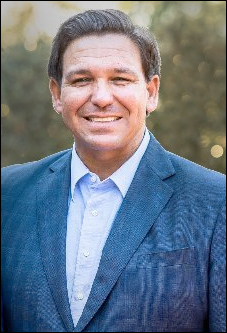
Florida Gov. Ron DeSantis (R)

June 29, 2021 — Florida Gov. Ron DeSantis (R) has been a hot political property of late, and no less than three political pollsters were in the field during late June to test his popularity in several scenarios.

Two of the firms, Echelon Insights and McLaughlin & Associates, tested Gov. DeSantis nationally in anticipation of a possible presidential run in 2024, while the Political Matrix/Listener Group surveyed the more timely Sunshine State 2022 governor’s race.

From the interactive voice response system poll released late last week, Political Matrix/Listener Group, on June 21, surveyed a total of 716 Florida likely voters who have a gubernatorial preference. They found DeSantis faring well against both announced Democratic gubernatorial candidates.

If US representative and former governor, Charlie Crist (D-St. Petersburg), were his 2022 general election Democratic opponent, Gov. DeSantis would hold a 55-45 percent advantage. Opposite state Agriculture Commissioner Nikki Fried (D), Florida’s only Democratic statewide elected office holder, the DeSantis margin would expand to a huge 61-39 percent spread; this, in a state where Republicans consistently perform a few points better than polling numbers typically predict.

The other two survey research firms tested Gov. DeSantis against a large number of commonly viewed ’24 GOP presidential prospects. Echelon Insights (June 18-22; 1,001 registered US voters, online from representative sample of registered voters) finds the governor topping the field of 19 named potential candidates within the 386 Republican primary voters segment with a 21 percent support figure, which is seven points higher than the former vice president, Mike Pence.

Donald Trump, Jr. posted seven percent, one point ahead of ex-UN Ambassador and former South Carolina governor, Nikki Haley, and Sen. Ted Cruz (R-TX) who both followed with six percent apiece. This group of five are the only potential contenders exceeding five percent preference. Former president, Donald Trump, was not included in the Echelon Republican nomination ballot test.

McLaughlin and Associates (June 16-20; 1,000 likely US voters, 444 GOP likely presidential primary voters) tested a two-tiered national GOP primary vote, one with former President Trump and one without.

If Trump does not run in 2024, McLaughlin, like Echelon, finds Gov. DeSantis to be the leading early candidate. In the field sans the ex-president, Gov. DeSantis places first with 24 percent followed by ex-VP Pence who attracts 19 percent, while Donald Trump, Jr. places third with 15 percent. Sen. Cruz (six percent) is the only other potential candidate who tops five percent of the vote.

Continue reading

The Controversy over Donald Trump’s Endorsement of NC Senate Candidate, Rep. Ted Budd


By Jim Ellis

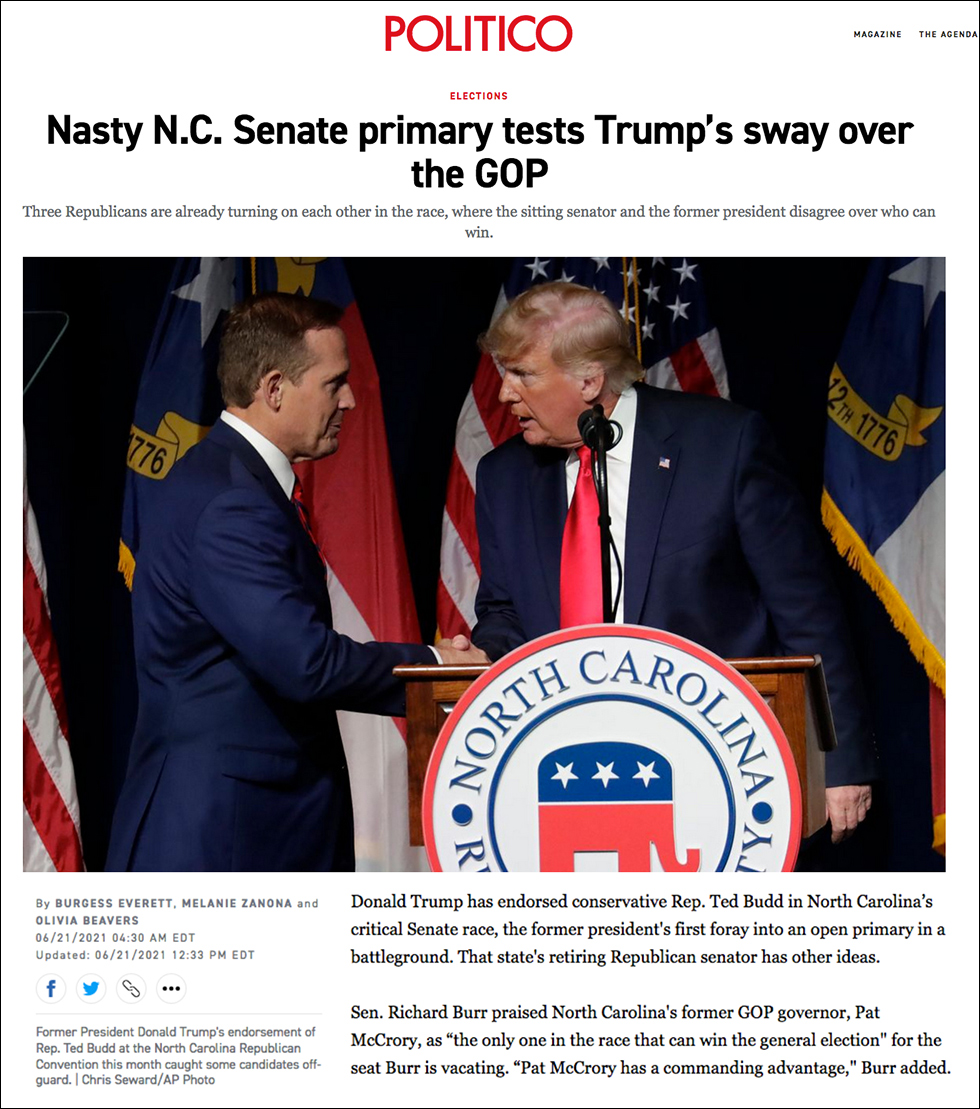
June 23, 2021 — Three Politico publication reporters, Burgess Everett, Melanie Zanona, and Olivia Beavers, combined on an article published yesterday (Nasty N.C. Senate primary tests Trump’s sway over the GOP) that merits refutation.

The piece details former President Trump’s public endorsement of US Senate candidate Ted Budd, the 13th District congressman, at the North Carolina Republican Party convention on June 5, and reactions to the development. Generally, and not surprisingly, it casts the endorsement and Rep. Budd’s statewide chances in a negative light.

Therefore, a number of points require balance.

1. To begin, the story quotes key Republicans, such as retiring North Carolina US Sen. Richard Burr (R) and South Carolina Sen. Lindsey Graham (R), who are downplaying the Trump endorsement’s effectiveness, with Sen. Burr going so far as claiming that ex-governor Pat McCrory is basically the only candidate who could win the upcoming general election. It is important to note here that McCrory failed to win re-election in 2016, the last time he was on a statewide ballot.

2. Secondly, a released Meeting Streets Insight poll conducted for the Budd campaign (June 9-10; 500 likely North Carolina Republican primary voters; live interview) highlights a different perspective.

The MSI survey found McCrory leading the GOP field 45-19-12 percent over Rep. Budd and former US representative, Mark Walker, respectively. When the polling sample is informed of the Trump endorsement – only 20 percent were aware before the pollsters provided the information – the ballot test completely flips to 46-27-8 percent with Rep. Budd leading, followed by ex-governor McCrory and former Rep. Walker. Obviously, this suggests the Trump endorsement still has power within the North Carolina Republican primary voter segment.

Continue reading

It’s Down to a Dozen in SC-7

By Jim Ellis

South Carolina state Rep. William Bailey (R-Myrtle Beach)

June 17, 2021 — South Carolina state Rep. William Bailey (R-Myrtle Beach), who became the first individual to announce a Republican primary challenge to Rep. Tom Rice (R-Myrtle Beach) has become the first candidate to withdraw, with his announcement this past Tuesday. Bailey initially entered the race immediately after the congressman voted to impeach former President Trump in relation to the Jan. 6 assault on the Capitol.

Rep. Bailey indicated that there are ‘enough conservatives in the race to give Mr. Rice a strong challenge,’ and says he is leaving the congressional race to seek re-election to his state House position.

After Bailey’s departure, and including Rep. Rice, there are a dozen announced candidates for the Republican congressional primary in a 7th District that currently occupies South Carolina’s northeastern sector and includes the cities of Myrtle Beach and Conway. In the two Trump presidential elections, the district’s voters strongly supported the former president and with very consistent margins: 58-39 percent in 2016 and 59-40 percent last November.

Normally, a large field of opponents would help an incumbent, but maybe not under the South Carolina election system. The state, like many others in the south, adopts a secondary runoff election process, meaning the winning candidate must secure an absolute majority. If no one can achieve the mark in the primary election, the top two vote-getters advance to a secondary election.

What makes the Palmetto State’s system different is that the runoff cycle lasts only two weeks. Typically, South Carolina holds its primaries in mid-June with the associated runoffs following in the latter part of the month.

Therefore, an incumbent under attack doesn’t have much time to recover before the next election commences. This calendar likely enhances the most common pattern of incumbents generally losing a runoff election if they are forced into a secondary vote.

The large number of contenders notwithstanding, and without Rep. Bailey in the field, the two most prominent challengers appear to be Horry County School Board chairman Ken Richardson and former Myrtle Beach mayor, Mark McBride, though the latter man was defeated in a runoff election for a third term. McBride was also beaten badly in a 2020 special election for the state House of Representatives.

Continue reading

Trump Endorsement Matters in North Carolina Senate Primary

By Jim Ellis

Former President Donald Trump’s endorsement changes the face of the race for Senate in North Carolina.

June 16, 2021 — North Carolina US Rep. Ted Budd’s (R-Advance) Senate campaign released an internal Meeting Street Insights poll (June 9-10; 500 likely North Carolina Republican primary voters, live interview) Monday that finds former President Donald Trump’s endorsement completely changes the 2022 statewide Republican primary.

Rep. Budd is challenging former Gov. Pat McCrory and ex-US Rep. Mark Walker for the GOP nomination succeeding Sen. Richard Burr (R) who is not seeking re-election to a fourth term.

According to Meeting Streets, former Gov. McCrory would lead the field, as other polls have shown, by a wide margin. On the first ballot test, McCrory scores 45 percent preference as opposed to 19 perecent for Rep. Budd, while 12 percent choose ex-representative Walker.

The picture drastically changes, however, when the pollsters ask if the respondent is aware that former President Trump has endorsed Rep. Budd. Only 20 percent of the sampling universe expressed knowledge of this development. On what the pollster terms the “educated” ballot test, meaning the respondent is told that Trump has, in fact, endorsed Rep. Budd, we see the drastic transformation.

With the Trump endorsement becoming known, Rep. Budd soars to the lead with 46 percent support, while McCrory drops to 27 percent, and ex-Rep. Walker falls to eight percent.

McCrory’s campaign fielded a Public Opinion Strategies survey in early April (April 6-8; 500 likely North Carolina Republican primary voters, live interview) and found the former governor leading 48-13-9 percent over Walker and Budd, respectively.

This was followed later in the month by a Spry Strategies study (April 21-24; 700 likely Republican North Carolina primary voters; combination live interview and interactive voice response system) that found a 40-11-5 percent split, again with Rep. Budd trailing his two opponents.

Continue reading

Youngkin Within Two of McCauliffe in Virginia Governor’s Campaign

By Jim Ellis

Glenn Youngkin (R), Terry McCauliffe (D), left-to-right, Virginia gubernatorial candidates

June 15, 2021 — A just-released Virginia governor’s campaign survey yields a surprising ballot test result, especially when seeing that the data was collected before last week’s Democratic primary.

WPA Intelligence (WPAi), in their most recent poll for the Glenn Youngkin for Governor campaign (June 2-6; 506 likely Virginia voters, live interview), already finds the Republican gubernatorial nominee climbing to within two percentage points (48-46 percent) of the newly crowned Democratic nominee, former governor, Terry McAuliffe.

While certain elements point to a slight Republican survey skew, it does signal, as other research has, that the 2021 Virginia governor’s race may be tighter than the state’s most recent elections that have definitively favored the Democratic candidates.

Several analysis points need reviewing. First, WPAi is a credible Republican pollster. According to the FiveThirtyEight statistical website pollster rankings, WPA Intelligence has a very respectable 0.8 predictive rating with just a slight 0.7 percent Republican bias factor.

Second, some of the geographic segmentation returns, however, appear a bit too optimistic for the Youngkin team. While the Washington, DC DMA sector breaking 56-39 percent for McAuliffe and the Roanoke/Lynchburg DMA posting a 49-46 percent edge for Youngkin are both wholly believable, the projections for two other segmented regions raise eyebrows.

Youngkin leading 51-44 percent in the Norfolk/Portsmouth/Newport News DMA, which also includes the Virginia Beach area, isn’t particularly consistent with the way the Tidewater region has voted in the most recent elections. Additionally, the same should be said for the Richmond/Petersburg DMA where WPAi sees Youngkin pulling ahead with a 48-44 percent split.

Third, these latter numbers appear too favorable for Youngkin, and particularly so in the Richmond/Petersburg area where the McAuliffe favorability rating in this same poll is 45:40 percent favorable to unfavorable. Conversely, however, if the trend were to continue for these two places and is proven accurate, it would basically signal a return to the voters’ previous electoral pattern. The Virginia historical election matrix was much better for Republicans than the numbers found in elections since the early 2000s.

Continue reading