
By Jim Ellis — Tuesday, November 3, 2026
Election Day
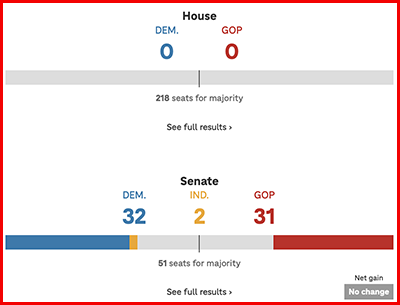
You can watch Election Day results in a number of locations; NPR is just one of dozens, if not hundreds of spots you can track in real time as election results unfold: NPR Election Results.
In the Senate, Republicans have a 53-47 majority and are likely to return with a smaller conference if not in the minority. The Democrats need a net gain of four seats to reach the 51 majority threshold. Republicans, as we know, will retain the Senate at 50-50.
The first race to monitor is Michigan, while conceding that the Republican seat in North Carolina will easily go to Democratic former Gov. Roy Cooper. If former Republican Congressman Mike Rogers flips Michigan’s open Senate seat by defeating former Wayne County health director Abdul El-Sayed, Republicans would have a strong chance of preserving their majority.
Democrats can reach 51 seats with a Cooper victory in North Carolina, a hold in Michigan, and wins in three of the following four states: Maine (defeating Sen. Susan Collins), Ohio (defeating Sen. Jon Husted), Texas (capturing the open seat being vacated by Sen. John Cornyn), and Alaska (defeating Sen. Dan Sullivan). If Republicans win any of these contests in addition to Michigan, their majority would likely be secure.
At this point, the Iowa race featuring Rep. Ashley Hinson (R-Marion/Cedar Rapids) and the Nebraska contest involving Sen. Pete Ricketts are both trending Republican. Kansas remains a wild card. Though the polling trajectory resembles both 2014 and 2020, when late surveys showed close races before Republicans ultimately won by 10 and 11 points, respectively, the contest between Sen. Roger Marshall and Democrat Adam Hamilton continues to remain tight.
The final Senate race to watch in the early time zones is Minnesota. The Republican nominee is former national sports media figure Michele Tafoya, who has an outside chance at scoring an upset. As in Michigan, a Tafoya victory would likely ensure continued Republican control of the Senate.
The House appears poised to shift Democratic, but the size of the emerging majority remains uncertain. Among the most important early House races is New York’s 17th District, where two-term Rep. Mike Lawler (R-Pearl River) faces former National Security Council official Cait Conley. Rep. Lawler holds one of three districts that voted for Kamala Harris but sends a Republican to the House. He is a strong campaigner with a proven track record. A Lawler defeat would suggest that Democrats have a realistic opportunity to approach 240 seats in the new House.
The same is true in Pennsylvania’s 1st District. Rep. Brian Fitzpatrick (R-Levittown) also represents a suburban Philadelphia seat that Harris won but sends a Republican to the House. If Bucks County Commissioner Bob Harvie (D) defeats Fitzpatrick, Democrats would be well on their way to a significant national victory.
In Virginia, the districts of Reps. Rob Wittman (R-Montrose) and Jen Kiggans (R-Virginia Beach) represent key Democratic pickup opportunities. Conversely, Republicans need to flip North Carolina’s 1st District, currently held by Rep. Don Davis (D-Snow Hill), after the seat was redrawn in the state’s 2026 redistricting plan. Failure to capture NC-1 would deal a major blow to Republican hopes nationwide.
Florida is crucial to Republican House prospects. The new redistricting map was expected to produce a net gain of four seats through victories over Reps. Darren Soto (D-Kissimmee), Kathy Castor (D-Tampa), and Jared Moskowitz (D-Parkland/Ft. Lauderdale), along with the capture of the newly created open 22nd District, which stretches across the peninsula from Fort Lauderdale to Marco Island. Any result short of a four-seat gain would point toward a large Democratic majority.
Michigan is another key House battleground in the Eastern Time Zone. Republicans are defending three highly competitive districts: Rep. Bill Huizenga’s seat in the southwestern part of the state, Rep. Tom Barrett’s Lansing-area district, and the open 10th CD anchored in Oakland County.
Ohio is also pivotal. Republicans initially expected to gain two seats under the new congressional map but now find themselves fighting to protect much of their existing delegation. Democratic incumbents Marcy Kaptur of Toledo and Greg Landsman of Cincinnati represent GOP targets, and Republicans need to defeat both.
At the same time, they must defend competitive districts held by Reps. Max Miller in suburban Cleveland, Mike Turner in Dayton, and Mike Carey in the Columbus area. Winning all of these races becomes considerably more difficult if Republican gubernatorial nominee Vivek Ramaswamy loses or if Sen. Jon Husted is defeated.
The Texas map became the centerpiece of the national Republican redistricting strategy and was expected to produce a net gain of five congressional seats. Polling and electoral trends, however, suggest that Republicans are unlikely to achieve that objective and instead may finish with a net gain of only two or three seats.
The significant inroads Republicans made in South Texas over the previous two election cycles appear to be eroding, with several districts showing movement back toward the Democrats. As a result, the political tailwinds that once fueled GOP expansion in the region are no longer providing the same level of electoral advantage, blunting the party’s anticipated gains under the new map.
Many additional contests will come into focus as results begin arriving from the Mountain and Pacific time zones. Nevertheless, the races highlighted above should provide some of the earliest and clearest indications regarding the size of a potential Democratic House majority and whether Democrats can also engineer a Senate takeover.