By Jim Ellis — Monday, November 2, 2026
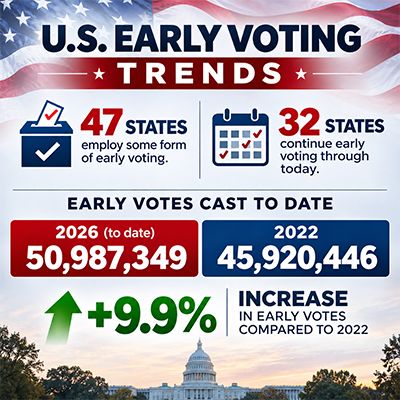 While 32 states continue early voting through today, with some accepting ballots until the polls close tomorrow, the process has concluded in 15 places. In those states, preliminary reports are now available.
To recap, 47 states employ some form of early voting. The three that continue to use the traditional Election Day model are Alabama, Mississippi, and New Hampshire.
Among the 15 states where early voting has ended, comparative reporting with the previous midterm election cycle (2022) is available in all but two. Missouri did not offer early voting in 2022, while Tennessee reported only in-person early voting totals four years ago and did not include mail ballots. Because the Volunteer State now reports both categories, comparisons with 2022 become inconsistent.
Nationally, according to the University of Florida’s Election Lab project, 50,987,349 individuals have cast early ballots. Although early voting remains underway in 32 states as of this writing, the current national total already exceeds the 45,920,446 early votes cast in 2022, representing a 9.9 percent increase. The trends are not uniform across the 13 places where valid comparisons are available, however. Five states, Florida, Nevada, Pennsylvania, Utah, and West Virginia, are reporting fewer early voters than they did four years ago.
Perhaps the biggest surprise in the early voting data comes from Louisiana, where participation has increased 42.4 percent compared to the 2022 midterm election. Other states posting significant gains include Maine (29.8 percent), Texas (28.9 percent), Maryland (23.1 percent), and Idaho (15.6 percent). Additional increases ranging from 11.8 percent to 3.1 percent are recorded in Georgia, Arizona, and Massachusetts.
In nine states, partisan turnout can be compared directly with 2022, and the results are mixed. The most consistent pattern is among non-affiliated, or Independent, voters. Their participation levels are higher in seven of the nine comparison states. Only in Idaho and West Virginia are non-affiliated voters underperforming their 2022 totals.
While most observers assume Democratic participation is rising significantly across the board, the early voting data do not consistently support such a conclusion. In the nine states where valid comparisons exist, Democratic early vote participation is up in six states, Florida, Idaho, Louisiana, Nevada, Utah, and West Virginia, but down in three, Arizona, Maryland, and Pennsylvania.
Republicans are exceeding their 2022 early voting participation levels in four states, Arizona, Idaho, Pennsylvania, and West Virginia, but trail their previous numbers in five others: Florida, Louisiana, Maryland, Massachusetts, and Texas. The two major parties have improved their early vote participation in Idaho and West Virginia, yet both are down in Maryland. Democrats and non-affiliated voters are together posting higher participation rates in Florida, Louisiana, Nevada, and Utah. Republicans and non-affiliated voters are together showing gains in only one state, Arizona.
The early vote numbers do not tell the full story regarding which candidates may be faring better, because election officials record only that individuals have voted, not how they voted.
Some clues can nevertheless be found in the data. Democrats may hold the edge many analysts are projecting in Texas when considering the state’s 28.9 percent increase in early voting compared to 2022. The strongest evidence comes from the fact that the largest proportional increases are occurring within the state’s major metropolitan areas. Texas reports only the total number of individuals who cast early ballots. Because the state does not register voters by party affiliation, partisan turnout figures are unavailable. Texas also does not release early voting data by demographic categories.
Democrats may also have a slight advantage in Nevada, where the party participation is up 1.5 percentage points compared with 2022 while Republican participation is down 4.3 percentage points.
Republicans, however, may be performing better than expected in Arizona. Democratic participation there trails the 2022 benchmark by three-tenths of a percentage point, while Republicans are exceeding their prior level by a full point.
The most significant shift may be occurring in Pennsylvania, where Democratic early vote participation is down 4.3 percentage points and Republican participation is up four points. Democrats still maintain an overwhelming advantage in ballots returned, 64.9 percent to 25.3 percent, but Republican candidates have remained competitive in statewide races even under previous early voting patterns.
Four of the states where early voting is complete provide demographic data by age. Nationally, preliminary participation numbers suggest a substantial increase in early voting among senior citizens, and three of the four states that can be analyzed, Georgia, Idaho, and Pennsylvania, see that trend. In Idaho, however, voters between the ages of 41 and 65 constitute the largest participating group.
This analysis provides only a snapshot of the 2026 early voting electorate. Meaningful conclusions will be possible only after the election is completed and the states release their official certified results.