
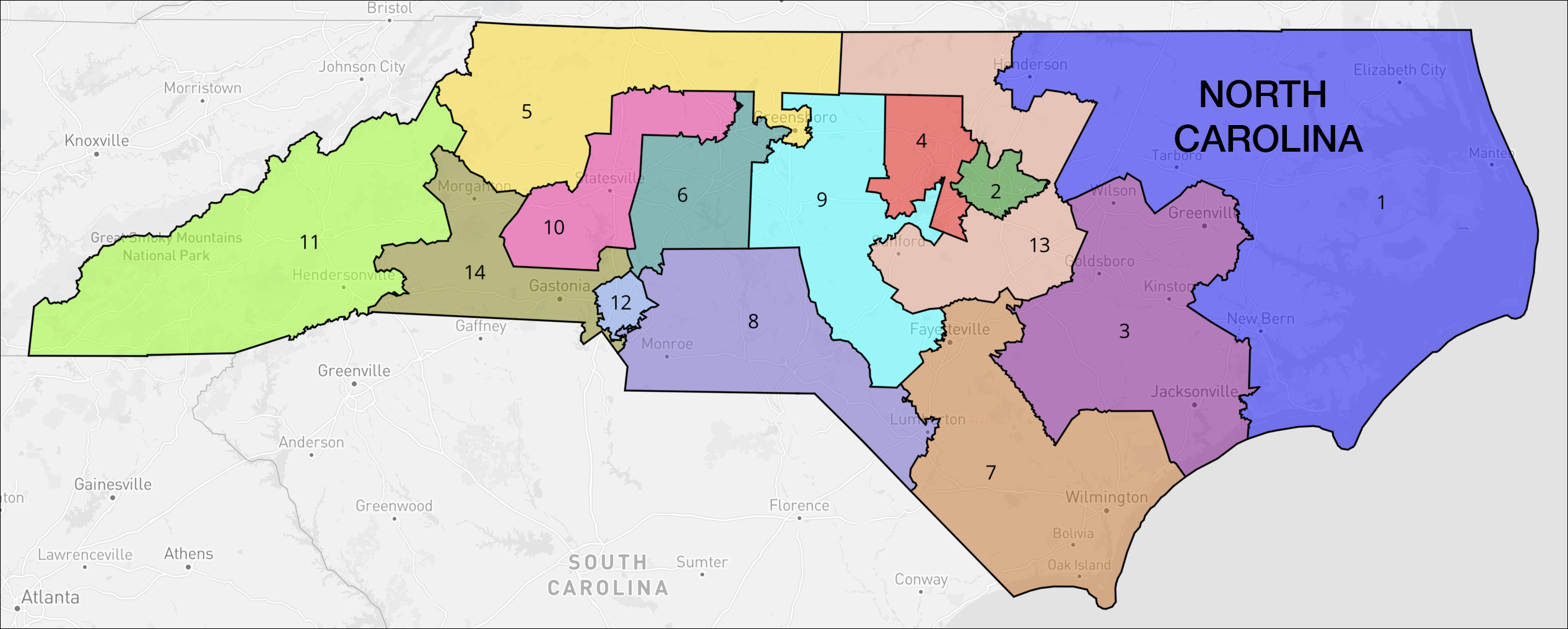
Click on above image to go to Dave’s Redistricting App to view interactive North Carolina map.
By Jim Ellis — Thursday, November 19, 2026
On an election night filled with surprising outcomes, none surpassed the results in North Carolina. On a congressional map of 14 seats in which 11 were drawn to favor Republicans, GOP candidates won only three. The new 2026 map performed in the exact opposite manner of what its political architects intended. Now we look for answers.
North Carolina has been redistricted more frequently than any other state over the past two decades. For several years a battle raged between the Republican-controlled legislature and a Democratic majority on the state Supreme Court. Under North Carolina’s redistricting procedures, the Governor has no formal role. Once Republicans flipped the state Supreme Court, the legal dispute largely ended because the new court majority and the legislature aligned on the relevant redistricting law.
Regardless of whether the legislature or the court drew previous maps, the districts had generally performed as designed until this year, making the 2026 outcome even more striking.
Before the 2026 election the legislature revised the congressional map, as did 10 other states. The Republican plan reconfigured the eastern 1st District of Rep. Don Davis (D-Snow Hill) into what was intended to be a Republican seat. To achieve such an end, mapmakers shifted strong Republican territory from neighboring Rep. Greg Murphy’s (R-Greenville) 3rd District, weakening Murphy’s seat but without any expectation that he would lose.
The Davis seat, one in which he won by only 1.7 percentage points in 2024, was swung from having a 3.5 percent Democratic partisan lean (according to the Dave’s Redistricting App statisticians) to one that held a Republican lean of 6.5 percent. The changes left both Rep. Davis’ 1st District and Rep. Murphy’s 3rd CD in the 52.5 percent Republican partisan lean range. That number would later prove too little for either Rep. Murphy or 1st District GOP nominee Laurie Buckhout to win the 2026 election.
In fact, the other six North Carolina seats that flipped from Republican to Democratic also fell into a similar partisan lean range, though the others all had GOP lean scores of approximately 55 percent. Even in these districts, the partisan lean, which was on average 11-13 points higher than the respective Democratic number, again according to Dave’s Redistricting App, was not strong enough to avoid defeat in such a massive blue wave election year. This compared to Rep. Murphy’s new 3rd CD that carried only a 7.6 Republican lean factor.
North Carolina is widely regarded as a politically competitive, or purple, state. Most statewide races are decided by low single-digit margins. Yet within that same electorate, Republicans sought to secure 11 of 14 congressional seats, or almost 79 percent of the delegation, in a state where competitive statewide winners rarely exceed 52 percent.
Except for Democrat Jamie Ager’s clearer victory over replacement Republican nominee Jennifer Balkcom in the western 11th District (a margin of 54,366 votes), the other flipped races were close. The 11th District contest had originally pitted Ager, who brands himself a “Mountain Democrat,” against incumbent Republican Rep. Chuck Edwards.
After Edwards was censured by the House for inappropriate conduct involving female staffers and withdrew from his re-election campaign, Republicans selected state Rep. Balkcom, at a special convention, but she was forced to enter the race too late to close the gap.
The remaining flipped districts fell to Democrats by vote margins ranging from just 258 (Raymond Smith over Greg Murphy in the 3rd) and 331 votes (Chuck Hubbard over Virginia Foxx in the 5th) up to 7,966 votes in the 13th District (Paul Barringer defeating Rep. Brad Knott).
It is difficult to argue that the Senate race at the top of the ticket drove the House results. Former Gov. Roy Cooper (D) defeated former Republican National Committee chairman Michael Whatley by a comfortable margin (59-39 percent in the unofficial final tally), but the outcome had been widely expected for months and did not appear to be a major turnout catalyst.
Turnout rose statewide compared to 2022. Voter participation increased 11.4 percent while the population grew roughly 4.4 percent over the same period. In the seven districts that flipped, however, the aggregate increase was somewhat lower (around 9.6 percent). Much of that relative lag is attributable to the heavily reconfigured 3rd District, which saw a net decline of 9,284 votes while the other flipped districts averaged an increase of 25,513 voters.
While the reasons for the blue wave diving deeper in North Carolina than virtually every other state will be debated for some time, it is painfully obvious to Republicans that if they don’t quickly rebound here, their chances of capturing the 2028 national election become poor if the Tar Heel State 2026 vote proves to be the beginning of a new political trend.