Tag Archives: South Carolina

Major Primaries Today

By Jim Ellis — Tuesday, June 23, 2026

Three more state primaries and one runoff are on today’s political calendar, featuring several major contests. Primary voters in Maryland, New York, and Utah will cast their final ballots for nomination, while South Carolina Republicans choose their gubernatorial and 1st District congressional nominees in runoff elections.

Maryland

Republicans will select a candidate to challenge Gov. Wes Moore (D), though the GOP winner will enter November as a severe underdog.

Several congressional races are drawing attention. All seven Maryland US House incumbents seeking re‑election face primary challengers, though five of those contests appear noncompetitive.

The marquee race is in the state’s western 6th District, where former Congressman David Trone (D), who vacated the seat in 2024 for an unsuccessful Senate bid, now seeks to reclaim it from his successor, Rep. April McClain Delaney (D‑Potomac). Trone, the billionaire founder of Total Wine & More, has spent roughly $30 million on the race, while Delaney has countered with nearly $9 million. Polling has been inconsistent, though Delaney appears to have a slight edge.

In Baltimore, City Councilman Mark Conway is challenging veteran Rep. Kweisi Mfume (D‑Baltimore), one of several races nationwide where younger Democrats are raising age and vitality concerns about long‑serving incumbents. Rep. Mfume, who is 77 years old, is again favored to prevail.

Rep. Steny Hoyer’s (D‑Mechanicsville) retirement after 45 years of congressional service has triggered a crowded Democratic primary in the safely blue 5th District, with 23 candidates competing.

Establishment figures including Rep. Hoyer, Gov. Moore, and Sen. Angela Alsobrooks have endorsed state Delegate Adrian Boafo (D‑Bowie), though he has been outspent by healthcare company executive Quincy Bareebe and former Capitol Police officer Harry Dunn. Other notable contenders include state Sen. Arthur Ellis (D-Charles County) and former Prince George’s County Executive Rushern Baker, though neither appears to have gained enough momentum to finish first.

New York

With the gubernatorial nominations effectively settled – Gov. Kathy Hochul (D) and Nassau County Executive Bruce Blakeman (R) will easily secure their primaries tonight – the focus shifts to several competitive congressional races.

Two incumbents are on the political hot seat tonight and upsets are possible.

In Brooklyn’s 7th District, four Democrats are vying to replace retiring Rep. Nydia Velázquez (D), serving her 17th term. Three elected officials: Brooklyn Borough President Antonio Reynoso, Assemblywoman Claire Valdez, and NYC Councilwoman Julie Won, are the leading contenders. New York’s plurality election system means tonight’s vote will decide the nominees regardless of percentage attained.

In the 10th District, former NYC Comptroller Brad Lander, running as the Democratic Socialist candidate with support from Sens. Bernie Sanders and Elizabeth Warren, and NYC Mayor Zohran Mamdani along with their associated organizations, is challenging Rep. Dan Goldman (D). Polling shows that Rep. Goldman, an heir to the Levi Strauss company fortune, is significantly trailing despite outspending Lander 4:1. Lander scoring an upset victory is very possible.

The 12th District, vacated by retiring Rep. Jerrold Nadler (D‑NYC), features eight Democrats competing for the politically safe CD. Four major contenders: attorney George Conway, Assemblymen Alex Bores and Micah Lasher, and John “Jack” Bouvier Kennedy Schlossberg, grandson of President John F. Kennedy, are locked in a competitive race. Early polling showed Bores and Lasher trading the lead, but no recent data has been released.

In the 13th District, Rep. Adriano Espaillat (D‑Harlem) faces his toughest challenge since winning his initial congressional primary in 2016. Community organizer Darializa Avila Chevalier has built a strong ground operation and performed well in polling. Two June surveys showed Espaillat at 35 percent support, and one (Data for Progress, June 3-9; 319 likely NY-13 Democratic primary voters) even had Chevalier leading 39–35 percent; therefore, we see another incumbent upset possibility.

In Upstate District 17, a key November battleground, five Democrats are competing to challenge two-term Rep. Mike Lawler (R‑Pearl River). Former National Security Council official Cait Conley has led in recent polling and is favored to clinch victory tonight.

Utah

Redistricting has significantly reshaped Utah’s congressional map, creating a new Salt Lake City-anchored Democratic seat. Four Democrats are competing, with former Congressman Ben McAdams and state Sen. Nate Blouin (D‑Salt Lake City) emerging as the top contenders. Early polling suggested Rep. McAdams held a significant advantage. McAdams is favored to win tonight, which will pave his return to Congress.

Despite radical changes to district boundaries, GOP Reps. Blake Moore (R‑Salt Lake City), Celeste Maloy (R‑Cedar City), and Mike Kennedy (R‑Alpine) are expected to win renomination. Rep. Kennedy is unopposed in the new 4th District despite the seat being completely different from the 3rd District he won in 2024. Rep. Burgess Owens (R‑Salt Lake City) opted to retire, thus avoiding a paired Republican primary for Reps. Maloy or Kennedy.

South Carolina

In the Republican gubernatorial runoff today, four‑term Attorney General Alan Wilson, son of veteran Rep. Joe Wilson (R‑Springdale), is likely to score a big victory. Several polls show him holding substantial leads, and President Trump has just issued a co‑endorsement after previously backing Lt. Gov. Pamela Evette. Wilson is expected to win easily this evening and claim the Governorship in November.

In the open 1st District, a close race is expected between Charleston County Councilwoman Jenny Costa Honeycutt and state Rep. Mark Smith (R‑Daniel Island), who finished first and second in the June 9 primary. The winner will be a strong favorite in November. Incumbent Rep. Nancy Mace (R‑Charleston) vacated the seat to run unsuccessfully for Governor.

Yesterday’s Primary Election Results

By Jim Ellis — Wednesday, June 10, 2026

Primaries

Voters finalized, or nearly finalized, their nomination votes yesterday in four states, and the generally expected results were produced though some featured close endings.

While the South Carolina Republican Governor’s campaign was thought to be headed toward a razor-thin vote margin among five candidates, instead the race ended with two clear runoff participants. In Maine, where one individual posted clear leads in polls during the length of the campaign, saw a very close five-way contest advancing to Ranked Choice Voting rounds.

Maine

In the Senate race against no active primary opposition, controversial oyster farmer Graham Platner won the Democratic primary with approximately 72 percent of the vote. Gov. Janet Mills, who suspended her Senate campaign when it became obvious that she could not overtake Platner, recorded approximately 20 percent of the vote.

Sen. Susan Collins was unopposed for renomination on the Republican side. The Collins-Platner general election will be another tough campaign, but a much different one than she faced in 2020. In that election, Sen. Collins’ opponent was a seasoned politician in then-state House Speaker Sara Gideon.

This time, it is an opponent portraying himself as a local working man but as more becomes known about him, many of his previous statements lead to questions about his veracity. Count on hearing a great deal about the Maine Senate race in the general election.

The Democratic Governor’s campaign will take some time to unfold. While Dr. Nirav Shah held healthy leads in polls throughout the year, four finished within six points of one another. With Dr. Shah placing first with only 26.5 percent, the Ranked Choice rounds will determine the outcome.

It is possible that any of the four, Dr. Shah, former state House Speaker Hannah Pingree, ex-state Senate President Troy Jackson, and Secretary of State Shenna Bellows all have a path to victory in the Ranked Choice rounds. This race will consume at least a week to decide and possibly more.

For the Republicans, RCV rounds will also be required though former Assistant Secretary of State Bobby Charles has a substantial 18 percentage point lead. Therefore, both gubernatorial campaigns are headed to political overtime.

In the 2nd Congressional District, the Democratic field will go to the Ranked Choice Voting rounds as state Sen. Joe Baldacci (D-Bangor), former congressional aide Jordan Wood, and State Auditor Matt Dunlap are all within a three percentage point split. Fourth place finisher Paige Loud will be eliminated when the other three advance to the RCV rounds.

It will likely be more than a week before we also know the outcome of this campaign. The eventual winner will face former Gov. Paul LePage (R) in the open general election. Incumbent Rep. Jared Golden (D-Lewiston) did not seek re-election.

Nevada

The Nevada gubernatorial campaign was a non-event. Gov. Joe Lombardo received just short of 92 percent in the Republican primary and Attorney General Aaron Ford was a 65 percent winner on the Democratic side. A close general election race is expected. In a point of good news for the GOP, approximately 14,000 more Republicans than Democrats are projected to have voted in the respective primaries.

In the House races, all three Las Vegas Democratic incumbents were easily renominated, and each Republican favorite also won.

In District 1, state Sen. Carrie Buck (R-Henderson) will oppose veteran Rep. Dina Titus (D-Las Vegas). The Congresswoman is favored for re-election, but Sen. Buck is clearly the best candidate the GOP has filed in this district.

In CD 3, musical composer and video gaming company co-owner Marty O’Donnell was an easy Republican primary winner giving him the opportunity of facing four-term Rep. Susie Lee (D-Las Vegas) in one of the few districts that supported President Trump but sent a Democrat to the House. This is a toss-up general election campaign.

In District 4, where veteran Rep. Steven Horsford (D-Las Vegas) was unopposed for renomination, businessman and rancher Cody Whipple was an easy Republican primary winner. Of the three Las Vegas congressional districts, this is the most Democratic seat.

In District 2, the state’s lone Republican congressional seat, it appears that Trump-endorsed retired Air Force officer David Flippo is headed for a close victory over State Conservation Secretary and Gov. Lombardo-endorsed candidate James Settelmeyer.

Former state House Majority Leader Teresa Benitez-Thompson is the Democratic primary winner. The Reno-anchored 2nd CD should remain in the Republican column but expect Democrats to make a concerted effort here to make the general election competitive.

North Dakota

There was little in the way of political intrigue in North Dakota last night. As expected, freshman at-large Rep. Julie Fedorchak (R-Mandan) was easily renominated with 73 percent of the vote.

On the Democratic side, 2024 nominee Trygve Hammer, who lost in a landslide in the last election, was unopposed for renomination last night. It is likely we will see a repeat performance in the 2026 at-large congressional election.

South Carolina

In a Republican gubernatorial primary campaign that was expected to be close among five candidates, the first two finishers ended the race breaking away from the field.

Lt. Gov. Pamela Evette, who carried both President Trump and Gov. Henry McMaster’s endorsements, placed first with 28.9 percent of the vote. Four-term Attorney General Alan Wilson was second with 26.1 percent support. Both now advance to a quick runoff election scheduled for June 23. The winner of that race will have the inside track to winning the general election in safely Republican South Carolina.

Approximately 10 percentage points behind the top two finishers was a closely bunched group; in order of finish, they were Rep. Ralph Norman (R-Rock Hill), businessman Rom Reddy, and Rep. Nancy Mace (R-Charleston). These three are now eliminated.

On the Democratic side, state Rep. Jermaine Johnson (D-Hopkins) was an easy winner, scoring approximately 58 percent of the vote against two opponents. Because he exceeded the majority threshold figure, Johnson advances directly into the general election.

In the Senate race, as expected, Sen. Lindsey Graham (R), on the ballot seeking a fifth six-year term, captured 57 percent of the vote against five opponents and will advance directly into the general election where he will again be favored to win re-election.

For the Democrats, pediatrician Annie Andrews was an easy 62 percent winner over two opponents. She, too, advances directly into the general election.

Turning to Rep. Mace’s open 1st District, a runoff election between Charleston County Councilwoman Jenny Honeycutt and state Rep. Mark Smith (R-Columbia) will be held on June 23. Honeycutt placed first with 22 percent against 10 opponents, four points ahead of Rep. Smith. The winner will become a heavy favorite in the general election.

Different Primaries, Different Ways of Tallying the Votes

By Jim Ellis — Tuesday, June 9, 2026

Primaries

Four states are holding primary elections today – Maine, Nevada, North Dakota, and South Carolina – and each has different ways of managing its votes.

Maine uses a Ranked Choice Voting system, which recent polling suggests could drastically alter the Democratic gubernatorial primary outcome once second- and third-choice preferences are tabulated. North Dakota relies on a strong party endorsement process that often makes the state primary, including today’s, largely a formality.

Nevada employs a straightforward plurality system in which the top vote getter advances regardless of the percentage received. South Carolina, by contrast, requires a runoff if no candidate reaches the 50 percent threshold.

Therefore, in today’s June 9 primary elections, we see nearly every major type of nominating system in use. The only other method, observed last week in California, is the top-two “jungle” primary, in which all candidates, regardless of party preference, appear on a single ballot and the two highest finishers advance to the general election irrespective of the vote percentage attained.

Lively debate often arises in political circles over which nominating system works best. For those who believe it is essential for a party’s nominee to demonstrate majority support, a secondary runoff election is the preferred approach. States such as Alabama and Georgia, which will hold runoffs next week, and South Carolina, which follows on June 23, use this method to ensure the eventual nominee surpasses the 50 percent threshold.

Other states simply rely on a basic plurality system: whoever receives the most votes wins. The drawback, however, is that in a crowded field a candidate can secure a nomination with less than 30 percent support. North Carolina uses a modified approach – its runoff provision is triggered only if no candidate reaches 30 percent. South Dakota and Iowa also hold a secondary process (SD: a runoff; IA: a state party convention) should no candidate receive 35 percent in the primary election.

In addition to North Dakota, several states – most notably Colorado, Michigan, Minnesota, and Utah, with Virginia also having the option of holding a binding nominating convention – conduct important state party endorsement conventions. These gatherings often play a decisive role in shaping the field. Candidates who fail to secure the party’s backing frequently withdraw afterward, and in many cases are expected to step aside if they do not win the delegate vote.

The one procedure that can significantly alter the outcome from the initial vote count is the Ranked Choice Voting system used in Maine. According to a recent Democratic gubernatorial primary poll, it is possible for a candidate who finishes third in the actual vote count to ultimately secure the nomination once all ranked choice votes are distributed.

The poll, conducted by SurveyUSA for the Bangor Daily News and FairVote, the organization that advocates for Ranked Choice Voting, tested both the initial ballot preferences and the subsequent RCV rounds. SurveyUSA (May 28-June 3; 484 likely Democratic primary voters; 466 likely Republican primary voters; multiple sampling techniques) provided a credible model for how the ranked choice tabulation could unfold after the first round vote.

In the Republican gubernatorial primary, the Ranked Choice Voting model closely mirrored the initial ballot test. Former Assistant Secretary of State Bobby Charles placed first among respondents on the ballot test question. Businessman Jonathan Bush, nephew and cousin to Presidents George H. W. and George W. Bush, placed second, followed by former state Senate Majority Leader Garrett Mason, with the remaining candidates trailing well behind.

After three rounds of Ranked Choice Voting, during which voters’ preferences are redistributed as lower finishing candidates are eliminated, the model shows Charles surpassing the 50 percent threshold. Under the RCV rules, reaching a majority in a tabulation secures the nomination.

The Democratic contest presents a very different dynamic, and it is here that critics highlight what they view as a flaw in Ranked Choice Voting. While supporters argue that the system ensures the candidate with the broadest overall backing ultimately prevails, detractors contend that, in practice, it can amplify the influence of the most ideologically extreme voters participating in the primary. They argue that the ranked preferences may elevate a candidate who was not among the top initial vote getters.

When a candidate is eliminated for lack of support, only the voters who ranked that individual first have their subsequent preferences redistributed into the tally. Critics argue that this dynamic can distort the outcome. Opponents of Ranked Choice Voting contend that giving these later round preferences additional weight can allow a small, highly motivated faction to alter the final result to the detriment of the initial top-tier finishers.

In the Maine Democratic example, former Maine Health Department Director Nirav Shah placed first in the initial ballot test, followed by former state Senate President Troy Jackson, ex-state House Speaker Hannah Pingree, businessman Angus King III, and Secretary of State Shenna Bellows.

With no candidate reaching 50 percent, the last-place finisher, in this poll, Secretary of State Shenna Bellows, would be eliminated. Election officials would then identify the ballots on which she was ranked first and redistribute those voters’ next preferences to the remaining candidates. This process continues through successive RCV rounds until one contender attains an adjusted majority.

In the SurveyUSA poll, the Ranked Choice Voting simulation requires four rounds and ultimately elevates the third-place finisher, former state House Speaker Hannah Pingree, daughter of US Rep. Chellie Pingree (D-North Haven/Portland), to the top position, with Dr. Nirav Shah finishing a close second in the adjusted tally.

This example illustrates how a candidate who does not lead in the initial vote count can nonetheless emerge as the nominee once lower ranking preferences are redistributed.
While this is only a poll and not an actual election, the outlined scenario is structurally possible under Maine’s RCV system. We will see how the real results unfold tonight, and in the days ahead, as election officials complete the multi round tabulation that the Ranked Choice Voting system requires.

Redistricting: Alabama, Yes — SC, No

By Jim Ellis — Thursday, May 14, 2026

Alabama

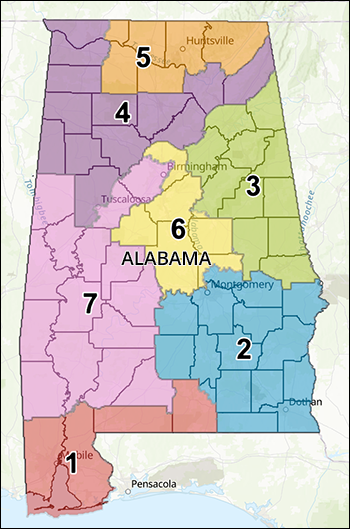
Click the map above or here to see an interactive version: Alabama Congressional Districts map.

The US Supreme Court acted quickly and decisively earlier this week to resolve the Alabama redistricting situation.

The high court vacated all lower-court federal injunctions related to Alabama’s 2023 congressional map, which had previously been ruled a racial gerrymander. The Court’s opinion in Callais v. Louisiana effectively invalidated the prior rulings, clearing the way for Alabama to proceed with enacting a new congressional redistricting plan.

Gov. Kay Ivey (R) summoned the legislature into a special redistricting session following the Callais decision, and lawmakers moved to reinstate the congressional map they passed in 2023. The plan is expected to give Republicans an additional seat and return the state to a 6R–1D delegation. The map shifts the 2nd District back into southeastern Alabama after a court order had previously required the creation of a second majority minority district anchored in the city of Montgomery.

Returning to the 2023 map resolves a major Republican redistricting challenge in southern Alabama. With Rep. Barry Moore (R-Enterprise) running for the Senate, former Rep. Jerry Carl (R) had been set for a Republican primary battle with state Rep. Rhett Marques (R-Enterprise) in the open 1st District, which stretched from Mobile to the Georgia border.

Under the newly enacted plan, however, Carl and Marques will run in separate Republican-leaning districts, each of which would make them nominal favorites in their respective congressional campaigns.

Now seeing a legal resolution, Gov. Ivey announced that the primaries for the affected districts, meaning CDs 1, 2, 6, and 7, are now scheduled for Aug. 11. The remaining districts, 3, 4, and 5, will continue their nomination process on May 19, the state’s original primary election date. Because the boundaries of those latter three districts remain unchanged, there is no need to postpone their primaries.

Although Alabama is a runoff election state, the districts holding delayed primaries will not be subject to a secondary runoff. Instead, the candidates receiving the highest number of votes in their respective primaries will secure their party nominations and advance to the general election.

There had been speculation that the legislature might attempt to draw a 7R – 0D congressional map, but the lawmakers ultimately bypassed the opportunity in order to quickly enact a new plan.

South Carolina

While Alabama moved forward with redistricting, the South Carolina legislature did not. Falling two votes short of the two-thirds majority needed to suspend the regular order rules to move a new bill, lawmakers will conclude the 2026 legislative session today without making any changes to the state’s congressional map.

The opportunity for change, however, may not be over. Gov. Henry McMaster (R) still has the power to call a special legislative session for the purpose of drawing a new congressional map. If convened quickly, a revised plan could still be implemented for the 2026 election cycle.

In a special session, only a simple majority vote would be required to bring the measure forward and secure final passage. Since the state House approved the proposed map with two-thirds support and the Senate fell only two votes short of that threshold, Republicans would likely have sufficient backing to enact a new 7R–0D congressional map.

Gov. Henry McMaster has previously said he would not call a special session, but he could still change course. It is clear that President Trump and congressional Republican leaders are likely to lobby him to move forward with a new federal redistricting map.

Now that Alabama, Florida, Louisiana, and Tennessee have all enacted new congressional maps in recent days, it remains to be seen if South Carolina will ultimately follow suit.

Redistricting Review, Post Virginia

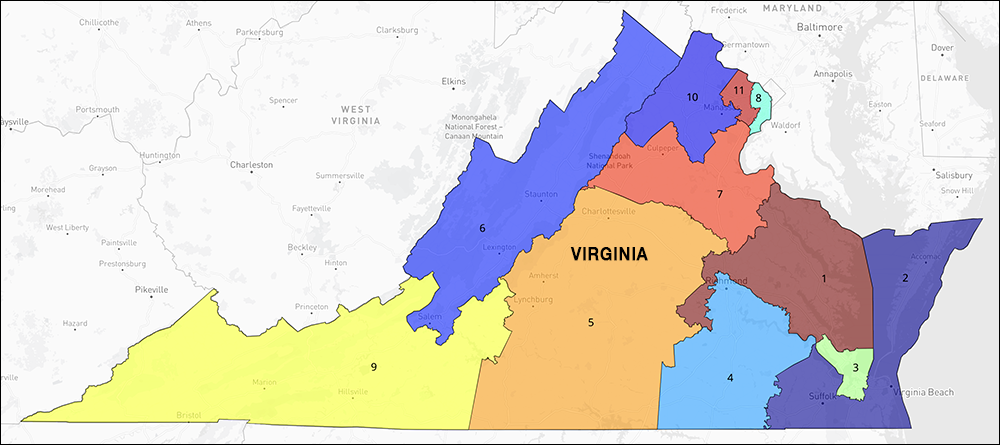
Virginia Congressional Districts / Dave’s Redistricting App (6D-5R map)

By Jim Ellis — Monday, May 11, 2026

The Virginia state Supreme Court decision to uphold the lower court ruling, finding that the legislature violated its own rules by rushing a referendum onto the ballot and, in the process, violated the Old Dominion Constitution, has significantly altered the outlook for the House midterm elections.

Instead of the cumulative effect of the new congressional maps being largely a wash, with neither party gaining a significant number of seats, Republicans are now positioned to net between 8 and 12 seats. Added to their current 220 seats, the new maps could expand their current prospective majority to more than 230 seats.

The following is an update on where the affected states stand in terms of 2026 electoral outlook under the new congressional maps, Starting with Virginia first:

Virginia

On Friday last week, the state Supreme Court invalidated the statewide redistricting referendum vote, upholding the lower court ruling that said the legislature violated its own rules and the state constitution in rushing the referendum to the ballot. While congressional redistricting is now effectively closed for this year here, meaning the 6D-5R map will remain in place for the 2026 elections, the process could be revisited in time to produce a new Virginia map for the 2028 cycle.

Certainly, the state Supreme Court ruling is a big win for Republicans, but the victory is likely to be short lived. For 2026, however, expect all Virginia incumbents to be favored for re-election.

California; Texas

The nation’s two most populous states became the focal points of the early redistricting battles, with party leaders in both parties predicting that their new maps would yield a net gain of five seats for their respective parties.

A closer examination of the partisan data and voting histories in the affected areas, however, suggests that gaining five seats under these new maps may be ambitious. What does appear likely, however, whether the eventual gain is three, four, or five seats, is that the two states will largely cancel each other out in terms of national seat gains.

Alabama

After the US Supreme Court’s ruling in the Callais v. Louisiana established clearer criteria for the construction of minority districts, the Alabama legislature reinstated a congressional map it had originally passed in 2023, only to have it later struck down by a court as a partisan gerrymander. Under the Supreme Court’s new directive, however, the plan could no longer be characterized as a racial gerrymander.

There is one remaining legal hurdle for the map to overcome, so it is possible that Gov. Kay Ivey (R) could suspend the congressional primaries until the map issue is resolved. Campaigns competing in the regularly scheduled May 19 primary for other offices would likely still be allowed to proceed.

The 2023 map would eliminate the majority minority 2nd District that a previous court had ordered drawn. Assuming no further legal complications arise, Alabama’s congressional delegation would likely revert to a 6R-1D partisan split. Rep. Shomari Figures’ (D-Montgomery) 2nd District would be dismantled and shifted back into southeastern Alabama, like its configuration during the previous decade.

Florida

The new Florida map has cleared the legislative process and now must face a legal challenge before the state Supreme Court. The plaintiffs are expected to file suit pertaining to the state ballot initiative voters approved to establish criteria for drawing legislative and congressional districts.

It is probable the court will rule that the map, which is predicted to net the Republicans three to four seats, is a partisan gerrymander with a projected 24R-4D partisan split; but other provisions of the voter-passed initiative may violate the SCOTUS’ Louisiana ruling. But the new map will likely stand for now, and net the GOP three to four seats.

Louisiana

The Bayou State is at the center of the determinative racial gerrymandering ruling, and Louisiana is now moving toward adopting a new congressional map that would produce a 5R-1D partisan split; thus, returning to the configuration that existed before the series of court rulings that ultimately reached the US Supreme Court.

The new map is reportedly being designed to preserve a Baton Rouge-anchored seat for Rep. Cleo Fields (D) while eliminating the New Orleans-based district that Rep. Troy Carter (D) currently holds.

Mississippi

Gov. Tate Reeves (R) has called a special redistricting legislative session, but only for the purpose of redrawing the state’s Supreme Court districts.

With the primary election already held on March 10, ordering a new round of congressional redistricting would effectively invalidate the 2026 primary, requiring all candidates to re-file and compete under a revised map. As a result, it appears unlikely that Mississippi congressional redistricting will take place in 2026.

Missouri

The Missouri map was enacted months ago, but opponents gathered enough signatures to qualify a repeal initiative for the ballot. The Missouri Supreme Court is now considering whether to stay the new map pending the vote or allow it to remain in effect for the 2026 election cycle. In the meantime, candidates have already filed under the current district lines.

If the map is allowed to stand, Republicans are expected to gain one seat in the delegation at the expense of veteran Rep. Emanuel Cleaver (D-Kansas City), though the Congressman has already filed for re-election. According to the Dave’s Redistricting App statisticians, the new 5th District has a partisan lean of 56.6R – 41.1D.

North Carolina

The Tar Heel State was among the first to complete the redistricting process, and the new congressional map will stand. The revised plan effectively shifts one district from Democratic to Republican control. Rep. Don Davis (D-Snow Hill) now sees his eastern North Carolina district move from a lean Democratic seat to one that is likely to favor a Republican in the general election.

In 2024, Rep. Davis won re-election by a margin of less than 1.5 percentage points. Retired Army officer Laurie Buckhout (R) is returning for a rematch, and this time the political landscape is more favorable to her chances of unseating the Congressman. With North Carolina’s primary having been held on March 3, the general election field is now set, and campaigning is underway.

South Carolina

While Gov. Henry McMaster (R) has said he would not call the legislature into a special redistricting session, lawmakers — still meeting in regular session — are moving forward with efforts to redraw the state’s congressional map.

Because the session is nearing adjournment, new legislation, including any proposal to adopt a revised congressional redistricting plan, would require a two-thirds vote of members to be added to the legislative calendar.

Republicans believe they have the votes to advance a 7R-0D plan from the House of Representatives, though they may be slightly short of the necessary support in the state Senate. If the new redistricting map is to pass, it will need to do so this week.

Tennessee

The Tennessee legislature and Governor passed a new 9R-0D congressional map soon after the Supreme Court ruled on the Louisiana racial gerrymandering case. With the Tennessee primary not scheduled until Aug. 6, the new map will stand. As a result, Rep. Steve Cohen (D-Memphis), the state’s only remaining Democratic member of the House, faces long odds of returning to the next Congress.

Utah

Months ago, the Utah court system invalidated the state’s 4R–0D congressional map, ruling that the legislature had disregarded voter-approved criteria for drawing district boundaries. As a result, the courts imposed a new map that creates a Salt Lake City–based district that Democrats are expected to win. Overall, Utah’s redistricting is projected to result in a net gain of one Democratic seat.

First 2028 Decision Looms

By Jim Ellis — Thursday, April 9, 2026

Super Tuesday

While the 2028 presidential campaign is still almost two full years away, the beginning of an important decision-making process occurs this week.

The Democratic National Committee Rules and Bylaws Sub-committee will meet to hear the first oral presentation from the 12 states applying as candidates for the pre-Super Tuesday window; that is, the states allowed to hold delegate-binding primaries or caucuses prior to the March date that will be selected for Super Tuesday voting events. Though the calendar is not yet officially set, Super Tuesday 2028 will likely be March 7.

Under rules in both parties, as many as five states can be designated for the pre-Super Tuesday voting window. Traditionally, four have held window slots: Iowa, New Hampshire, Nevada, and South Carolina. Republicans kept the traditional calendar in 2024, but Democrats did not.

The DNC dropped Iowa and New Hampshire, though both state Democratic parties held non-binding events (meaning delegates were not apportioned based upon the voting results): Iowa, a caucus, and New Hampshire, a primary. Both states are back again in 2026 applying for an official pre-Super Tuesday window position.

Instead, the 2024 Democratic calendar began in South Carolina, and then went to Nevada. The newcomer in the window became Michigan, which was the first state in the ’24 nominating cycle where both parties held their vote on the same day.

The DNC argument for ejecting Iowa and New Hampshire from their traditional prominent positions was that the two states did not adequately represent the Democratic Party’s vote base because the pair have such low minority populations.

While it is unlikely the two will be restored, both the Iowa and New Hampshire state chairmen say their states will continue to hold early votes regardless of the DNC’s ultimate scheduling decision.

The ultimate early window voting schedule is important not only to the states, but to certain likely presidential candidates, namely Illinois Gov. J.B. Pritzker, currently running for a third term, and Michigan Gov. Gretchen Whitmer, who is in her last year of service. The delegate vote bump from their home states, if in the early window, could give their campaigns a significant early momentum boost directly before Super Tuesday.

The 12 applying states, down from 20 that competed for an early slot in 2024, are, in the East: Delaware and New Hampshire; from the South: Georgia, North Carolina, South Carolina, Tennessee, and Virginia; the Midwest: Illinois, Iowa, and Michigan; and, in the West: Nevada and New Mexico.

The Rules and Bylaws Sub-committee will recommend to the full DNC one state from each geographic region and can choose an at-large entry from the remaining eight applicants.

It would be hard to deny South Carolina, since the state has been historically significant in giving candidates from both parties the critical thrust toward winning the national nomination. The Palmetto State became the deciding factor for Joe Biden’s 2020 campaign, giving him the necessary momentum to succeed on Super Tuesday, which made him unstoppable for the party nomination. He would then, of course, go onto win the Presidency that year.

Since it would be difficult to see this panel reversing the 2024 Iowa-New Hampshire decision, it would appear that Delaware will become the Eastern sector pre-Super Tuesday voting state. Likewise, in the West, Nevada would appear to have the inside track to securing a slot since they were one of the traditional early voting states. New Mexico, a newcomer to the application process, is the only other to come forth from the West.

The Midwest decision will likely come down to a choice between Illinois and Michigan. The committee, however, could install both if they again award Michigan the regional slot and give Illinois the at-large position.

In addition to New Mexico applying for the first time, the other three newcomers are North Carolina, Tennessee, and Virginia.

Nancy Mace for Governor in SC

By Jim Ellis — Tuesday, Aug. 5, 2025

Governor

Two-term Rep. Nancy Mace (R-Charleston).

As has been expected for months, Rep. Nancy Mace (R-Charleston) yesterday officially entered the open South Carolina Governor’s campaign.

The June 2025 primary already has the makings of a Republican Battle Royal as at least five contenders will be competing for the party nomination to succeed term-limited Gov. Henry McMaster (R).

Rep. Mace will be facing four-term Attorney General Alan Wilson, son of Rep. Joe Wilson (R-Springdale); Lt. Gov. Pamela Evette; Rep. Ralph Norman (R-Rock Hill), who announced last week; and state Sen. Josh Kimbrell (R-Spartanburg).

The personal battle rages between Mace and Wilson, which is likely to carry over into the campaign. Rep. Mace accuses AG Wilson of not being aggressive in his position and particularly so regarding her accusations against a former fiancé and several of his associates for alleged sexual-related offenses.

Rep. Mace claims Wilson has ignored the case. The AG explains that his office has no jurisdiction over individual cases and that the South Carolina Law Enforcement Division (SLED), which does have jurisdiction, is addressing the matter. The SLED spokesperson indicates that a large number of interviews have been conducted regarding the Mace complaints, and the investigation has not been completed. The Congresswoman’s former fiancé and his associates all vehemently deny any wrongdoing.

The personal battle between who most believe are the two leading candidates could prove a distraction in the gubernatorial nomination contest. Often, when two candidates begin to attack each other neither win, and another comes from the outside to snatch the election. It remains to be seen how this race unfolds, but we can certainly expect major campaign fireworks and a great deal of national political attention.

The South Carolina election format is unique in that the state maintains a two-week runoff election after the primary should no candidate receive majority support. With a well-funded and crowded field such as we will have in the race, the top two finishers advancing to the quick runoff is a virtual certainty.

The Palmetto State primary is scheduled for June 9, with the runoff, if necessary, calendared for June 23. The eventual Republican winner will become the prohibitive favorite to claim the Governorship in November of next year.

Rep. Mace’s decision to enter the Governor’s race will leave her 1st Congressional District open for the first time in a regular election cycle since 2010. The seat was open for a special election in 2013. Then-Rep. Tim Scott (R) was appointed to the US Senate that year, thus opening the 1st District. Former Governor and ex-1st District Congressman Mark Sanford (R) won the special election.

In 2018, however, Sanford was defeated for renomination, thus opening the seat in the general election. Democrat Joe Cunningham won the 2018 election and became the first Democrat to represent the district in 30 years. Two years later, Mace, then a state Representative, unseated Cunningham to return the seat to the GOP column.

In her two re-elections, Rep. Mace has averaged 57 percent of the vote, which is consistent with the Dave’s Redistricting App’s reported partisan lean. According to the DRA statisticians, SC-1 posts a 55.6R – 42.3D partisan lean, which is almost identical to the statewide partisan lean of 55.8R – 42.3D.

With Rep. Mace vacating the Charleston area anchored district, that brings to 24 the number of open House seats before the next election. Of the two dozen total, 13 are Republican-held versus 11 for the Democrats. Four of the seats (3D and 1R) will be filled in special elections before the end of the year, thus reducing the regular election open seat count to 20.

The 1st District begins almost at the Georgia border and then stretches northeast along the Atlantic Ocean to the city of Georgetown’s outskirts. The district includes the communities of Beaufort, Hilton Head, Mt. Pleasant, and Moncks Corner, along with James Island, Kiawah Island, Sullivan’s Island, and the Isle of Palms. The 1st CD contains Beaufort and Berkeley Counties, along with parts of Charleston, Colleton, Dorchester, and Jasper counties.

President Trump carried the district with a 56-43 percent margin over Kamala Harris in 2024, and defeated President Biden here, 53-45 percent in 2020.

Review: House Open Seats

By Jim Ellis — Tuesday, July 1, 2025

House

US HOUSE

The next House election cycle will again conclude with few seats changing hands, and one party or the other controlling the chamber in 2027 with only a small margin.

Throughout the past decade and into the first two elections of the current decennium, we have seen an inordinately large number of open US House seats in each individual election cycle, usually between 48 and 63 seats; but not so for 2026.

To date, there are only 16 open House seats for the next election, and three of those are due to the incumbent member passing away. Therefore, the AZ-7 (Raul Grijalva), TX-18 (Sylvester Turner), and VA-11 (Gerry Connally) seats will be filled later this year in special elections.

Regarding the 13 announced open seats for the regular 2026 election (7R; 6D), only one, IL-9 (Rep. Jan Schakowsky-D), derives from a true retirement. The other dozen incumbents will leave the House to seek another elective office.

While the open seat number is sure to grow as candidate filing deadlines approach (beginning in December), we are still unlikely to see a plethora of House campaigns without an incumbent running in political prime time next year.

Therefore, the open count provides a further clue toward seeing a House election cycle that will again conclude with few seats changing hands, and one party or the other controlling the chamber in 2027 with only a small margin.

At this point, we see an additional five members who are soon to announce bids for other offices:

  1. MI-4: Michigan Rep. Bill Huizenga (R-Holland), against the wishes of the national and state Republican Party leadership, looks to soon announce that he will challenge former Representative and 2024 US Senate nominee Mike Rogers for the open Republican US Senate nomination.
     
    Huizenga would begin a Senate campaign in an underdog position for the primary, and his open southwestern Michigan congressional seat would become hotly contested in the general election.
  2.  

  3. NJ-11: Rep. Mikie Sherrill (D-Montclair) is the Democratic gubernatorial nominee for the 2025 New Jersey statewide election. If she wins, and the Congresswoman is rated as an early favorite for the November vote, her 11th CD will go to a 2026 special election. Should she lose the Governor’s race, Rep. Sherrill would be eligible to return and seek re-election.
  4.  

  5. NY-21: Rep. Elise Stefanik (R-NY), who was nominated as US Ambassador to the United Nations only to see her appointment pulled back in fear of the GOP losing her congressional seat in a special election, now looks perched to announce a bid for Governor.
     
    With incumbent Kathy Hochul (D) posting poor job approval numbers and facing at least one strong Democratic primary opponent, a credible Republican’s chance to win the Governorship, while still a reach, appears better than in most election cycles. Even if she runs and loses, Rep. Stefanik would likely then be in line for another Trump appointment.
  6.  

  7. SC-1: South Carolina Congresswoman Nancy Mace (R-Charleston) is close to making an official gubernatorial announcement.
     
    The three-term House member has been confirming for months that she is considering the open statewide race and when Attorney General Alan Wilson declared his gubernatorial candidacy earlier this week, Rep. Mace came out swinging, publicly attacking him as being “soft on crime.” Her swift response and comments are a discernible clue that she will soon officially enter the statewide campaign.
  8.  

  9. SC-5: Another South Carolina Congressman, Rep. Ralph Norman (R-Rock Hill), is scheduling a “special announcement” for July 27, which is a clear signal that he, too, will run for Governor.
     
    Assuming AG Wilson and the two House members all compete for the GOP nomination, a highly competitive Republican primary battle would transpire, culminating next June. Should no one obtain majority support in the June 11, 2026 primary, the top two finishers will participate in a runoff election two weeks later on June 25. The eventual GOP nominee will have the inside track to succeed retiring Gov. Henry McMaster (R).

There are several more members who have confirmed they are considering running for a different office but to date have yet to make any discernible move toward developing a statewide campaign. The Representatives in this category are:

  • Barry Moore (R-AL-1) — Senate
  • Rich McCormick (R-GA-7) — Senate
  • Mike Collins (R-GA-10) — Senate
  • Marjorie Taylor Greene (R-GA-14) — Governor
  • Darin LaHood (R-IL-16) — Governor
  • Ritchie Torres (D-NY-15) — Governor
  • Dan Meuser (R-PA-9) — Governor
  • Harriet Hageman (R-WY-AL) — Governor

In the past, the following members have been mentioned as possible statewide candidates but are now considered unlikely prospects:

  • Cory Mills (R-FL-7) — Senate
  • Jared Moskowitz (D-FL-23) — Governor
  • Carlos Gimenez (R-FL-28) — Mayor of Miami-Dade County
  • Mike Lawler (R-NY-17) — Governor

House, Governor, City & State Wrap up

By Jim Ellis — Thursday, June 12, 2025

House

Virginia Rep. Gerry Connolly passed away Wednesday, May 21, 2025.

VA-11 — Gov. Glenn Youngkin (R) has scheduled the special election to replace the late Rep. Gerry Connolly (D-Fairfax) for Sept. 9. It is now up to the local party congressional district committees to decide upon the type of nomination system to employ. Democrats have chosen the “firehouse primary” option, which features only a few polling places throughout the district. The firehouse special primary is scheduled for June 28. Republicans have yet to decide between a firehouse primary or a party convention.

Democrats will be heavily favored to hold the seat. The leading candidates are Fairfax County Supervisor James Walkinshaw (D) and state Sen. Stella Pekarsky (D-Centreville).

CO-3 — Former Colorado Republican Party Vice Chair Hope Scheppelman announced a primary challenge from the right to freshman Rep. Jeff Hurd (R-Grand Junction). It remains to be seen if this challenge will develop into a serious campaign. Irrespective of the primary situation, Rep. Hurd will be favored for renomination and re-election in a district where the Dave’s Redistricting App statisticians calculate a 52.6R – 43.3D partisan lean.

GA-13 — State Rep. Jasmine Clark (D-Lilburn) has joined the crowded Democratic primary challenging veteran Rep. David Scott (D-Atlanta). Previously announced major candidates are state Sen. Emanuel Jones (D-Decatur) and former Gwinnett County School Board chairman Everton Blair (D). While Rep. Scott says he plans to seek a 13th term in the House, he has major health concerns, and the prevailing political opinion is that he will announce his retirement before the state’s March candidate filing deadline.

MD-5 — Saying the 85-year-old longest-serving House Democrat should retire due to his advanced age, public safety consultant Harry Jarin, 35 years old, announced a Democratic primary challenge against former House Majority Leader Steny Hoyer (D-Mechanicsville). For his part, Rep. Hoyer has yet to say whether he will seek a 24th term, but most expect him to run again. He will be 87 years old at the time of the next general election.

NE-2 — State Sen. John Cavanaugh (D-Omaha), whose father, former US Rep. John J. Cavanaugh, III (D), served two terms in the House during the 1970s, announced that he will run for the congressional seat in 2026. He will face a crowded Democratic primary featuring political consultant Denise Powell, surgeon Mark Johnston, and attorney Van Argyrakis. The eventual nominee will face five-term Rep. Don Bacon (R-Papillion) who says he will announce whether he will seek another term during the summer. Nebraska’s 2nd District continues to be one of the most competitive in the country.

PA-8 — Former six-term Congressman Matt Cartwright (D), who lost his seat last November to freshman Rep. Rob Bresnahan (R-Dallas Township/Scranton), said he will not return for a re-match next year. This leaves the Democrats with no major candidate in a what is projected to be a competitive 2026 congressional race. Republicans ousted two incumbent Pennsylvania House members in 2024, Reps. Cartwright and Susan Wild (D-Allentown). Neither are forging a comeback attempt next year.

WA-9 — Former Seattle City Councilwoman Kshama Sawant, a self-identified socialist, announced that she will challenge veteran Rep. Adam Smith (D-Bellevue) as an Independent in next year’s general election. Sawant served three terms as an at-large City Councilwoman, leaving office in 2023. She survived a recall attempt in a close 2021 vote. Rep. Smith, the Ranking Minority Member of the House Armed Services Committee, is expected to seek a 16th term and will be a prohibitive favorite for re-election.

Governor

Arizona — A new survey that the American Commitment organization sponsored (May 23-25; 1,147 likely Arizona Republican primary voters; online) finds Rep. Andy Biggs (R-Gilbert) moving into a commanding lead over 2022 gubernatorial candidate Karrin Taylor Robson for the state’s Republican gubernatorial nomination. According to the ballot test result, Rep. Biggs would lead Robson, 57-25 percent.

Earlier, Noble Predictive Insights released their general election poll (May 12-16; 1,026 registered Arizona voters; online) and projects Gov. Katie Hobbs (D) to be leading Rep. Biggs 40-38 percent, and Robson by a similar 41-39 percent count. This latter poll confirms what has been expected, that the 2026 Governor’s race will yield another hotly contested political battle.

Connecticut — In a news conference with reporters to discuss the end of the Connecticut legislative session, Gov. Ned Lamont (D) sent clear signals that he is heading toward announcing his candidacy for a third term. The political field has largely been frozen awaiting the Governor’s political decision. Should he announce for re-election, Lamont will be rated as a clear favorite to secure a third term.

Florida — Former Rep. David Jolly, who won a 2014 special election in the Pinellas County seat as a Republican lobbyist but then lost re-election in 2016 to party switcher Charlie Crist (D), became a GOP critic on national news shows. He switched his party identification to Independent after losing the House seat and then moved to the Democratic column.

This week, Jolly announced his candidacy for the Democratic gubernatorial nomination. He becomes the first significant Democrat to enter the race. While Jolly may be competitive for his new party’s nomination, Republicans will be favored to hold the Governorship in an open election. Gov. Ron DeSantis (R) is ineligible to seek a third term. Rep. Byron Donalds (R-Naples) is the leading Republican gubernatorial candidate.

Iowa — While most political observers are watching whether state Attorney General Brenna Bird will join the open Republican gubernatorial primary to battle Rep. Randy Feenstra (R-Hull/Sioux City) for the party nomination, state Rep. Eddie Andrews (R-Johnston) announced that he is joining the race. State Sen. Mike Bousselot (R-Des Moines) is also a GOP gubernatorial candidate. Democrats are coalescing behind their lone statewide elected official, state Auditor Rob Sand. Gov. Kim Reynolds (R) is not seeking a third term.

Maine — A newly published Pan Atlantic research firm poll (May 12-26; 840 likely Maine voters; 325 likely Maine Democratic primary voters; online) finds businessman Angus King, III leading the open Democratic gubernatorial primary with 33 percent preference. In second place is Secretary of State Shenna Bellows at 24 percent. Following is unannounced candidate Hannah Pingree with 20 percent while former state Senate President Troy Jackson posts 13 percent support. King is the son of Sen. Angus King (I-ME), while Pingree is Rep. Chellie Pingree’s (D-North Haven/ Portland) daughter. Gov. Janet Mills (D) is ineligible to seek a third term.

South Carolina — Democratic state Rep. Jermaine Johnson (D-Hopkins), a former basketball star for the College of Charleston, has formed an exploratory committee to test his chances in the open Governor’s race. Rep. Johnson is the first Democrat to make any move toward running for Governor which will be an uphill open general election race against the eventual Republican nominee.

City & State

Detroit — According to a new Detroit News and WDIV-TV poll that the Glengariff Group conducted (May 27-29; 500 likely Detroit mayoral election voters; live interview), City Council President Mary Sheffield (D) has a large lead to replace incumbent Mayor Mike Duggan, who is running for Governor as an Independent. The poll results post Sheffield to a 38-14-9-8 percent advantage over local Pastor Solomon Kinloch (D), former Detroit Police Chief James Craig (R), and ex-City Council President Saunteel Jenkins (D). The city’s jungle primary is scheduled for Aug. 5.

New Orleans — A JMC Analytics poll (May 27-28; 500 likely New Orleans mayoral election voters; live interview) sees New Orleans City Councilwoman Helena Moreno (D) capturing a majority vote for the upcoming open Oct. 11 jungle primary to replace term-limited incumbent LaToya Cantrell (D). According to the polling data, Moreno would lead City Councilman Oliver Thomas (D) 52-23 percent, with no other candidate in close proximity. If no one receives majority support on Oct. 11, the top two finishers will advance to a Nov. 15 runoff election.

A Senate Review – Part II

By Jim Ellis — Wednesday, May 7, 2025

Senate

Today concludes our two-part series covering the latest in competitive US Senate campaigns. This edition examines developing contests in Michigan through Virginia.

In this report, if a state is not listed, it means the incumbent is currently expected to seek re-election and face little in the way of credible opposition.

Michigan — The 2024 open Senate contest surprisingly proved to be the tightest in the nation, so a second open contest in successive election cycles will draw much greater early national attention and resources. Republican former Congressman Mike Rogers, despite being badly outspent, lost to then-Rep. Elissa Slotkin (D) by just 19,006 votes statewide. He returns to again battle for a Senate seat; this time left open because Sen. Gary Peters (D) is retiring.

Rogers should be a clear favorite for the Republican nomination, though Rep. Bill Huizenga (R-Holland) says he is considering entering the race. For the Democrats, Rep. Haley Stevens (D-Birmingham) and state Sen. Mallory McMorrow (D-Royal Oak) are announced candidates. Term-limited Attorney General Dana Nessel is also a potential Democratic candidate. Count on this race being considered a toss-up all the way through the Nov. 4, 2026, election day.

Minnesota — Sen. Tina Smith (D) is not seeking a second six-year term, which opens the door for a highly competitive Democratic primary. In the race are Lt. Gov. Peggy Flanagan, Rep. Angie Craig (D-Prior Lake), and former state Senate Minority Leader Melisa Lopez Franzen. Others may join but count on this race advancing through the party endorsing convention to the August primary ballot.

Republicans, at this point, do not have a credible announced candidate, which means it is highly likely that Sen. Smith’s successor will be the Democratic primary winner.

New Hampshire — Sen. Jeanne Shaheen (D) will retire at the end of the current Congress, and Rep. Chris Pappas (D-Manchester) is well on his way to becoming a consensus Democratic candidate long before next year’s candidate filing deadline. Already publicly endorsing Pappas are a host of New Hampshire Democratic leaders including Sen. Shaheen, the state’s junior Senator, Maggie Hassan, Rep. Maggie Goodlander (D-Nashua), former four-term Gov. John Lynch, and ex-Rep. Annie Kuster.

Republicans lost their best candidate option when former four-term Gov. Chris Sununu declined to run. Ex-Massachusetts Sen. Scott Brown, who lost to Sen. Shaheen in 2014 on a 51-48 percent count, looks to be running again and could well win the nomination. Without Sununu in the race, however, the edge goes to the Democrats particularly with Rep. Pappas performing so well early.

North Carolina — This is yet another situation where party leaders are trying to convince a sitting or former Governor to challenge the opposite party’s incumbent Senator. Ex-Gov. Roy Cooper (D), who was ineligible to seek a third term in 2024 under his state’s election law, remains uncommitted about challenging Sen. Thom Tillis (R).

In the race for the Democrats, however, is former Rep. Wiley Nickel who did not seek re-election to a second term in 2024 because of an adverse redistricting map. Originally, Nickel said he would stand aside for Cooper but does not appear to be saying such any longer. This could be a clue that the former Governor will not run for Senate to instead prepare for a 2028 presidential campaign.

The nature of North Carolina politics suggests that the 2026 Senate race will again be close irrespective of whose running. The state traditionally features tight statewide elections in almost every cycle. Consider this race a toss-up, particularly if Cooper decides to run, though former Congressman Nickel will prove an able candidate.

Ohio — As in Florida, Ohio will host a special election to fill the balance of a current Senate term. After then-Sen. J.D. Vance was elected Vice President, Gov. Mike DeWine (R) appointed Lt. Gov. Jon Husted (R) to the Senate seat. Husted now must run in 2026 to fill the balance of the six-year term, and then again in 2028 for a full six-year stint.

Last week, former Representative and 2022 US Senate nominee Tim Ryan (D) announced he would not challenge Sen. Husted but still expresses interest in the Governor’s race.

Ohio is another state where potential candidates, in this case Democrats, are frozen in time waiting for a decision from another. Former three-term Sen. Sherrod Brown (D), who lost his seat to Bernie Moreno (R) in November, is a potential candidate for both Senate and Governor. Until Brown decides where to run, if anywhere at all, expect little movement among other prospective Democratic candidates.

South Carolina — Talk of a Republican primary challenge to Sen. Lindsey Graham has died down since both Reps. Nancy Mace (R-Charleston) and Ralph Norman (R-Rock Hill) are looking toward an open Governor’s race. Sen. Graham showing almost $16 million in his campaign account also is dissuading potential challengers from both parties. At this point, expect Sen. Graham to have an easy road to re-election.

South Dakota — Recently, Sen. Mike Rounds (R) stated that he would not enter the open Governor’s race which would be an attempt to regain a political position he once held. Curiously, he did not announce a bid for re-election in declining to run for Governor.

Rounds is still expected to stand for election to the Senate in 2026, and with his state featuring a Governor’s race that could yield a major Republican primary battle, the two-term federal incumbent is expected to breeze through another re-election next year.

Texas — Several recent polls show incumbent Sen. John Cornyn badly trailing Attorney General Ken Paxton, who is an announced Republican primary competitor. The polling, however, is not the full story.

A non-profit organization, Standing for Texas, is running ads in the major media markets with the exception of Rep. Wesley Hunt’s (R) hometown of Houston, positively profiling the Congressman and clearly laying the groundwork for a statewide run. Curiously, however, the latest polls do not include Rep. Hunt as a Senate candidate, even though signs are clear that he intends to enter the contest. The addition of Rep. Hunt, and/or other candidates, could certainly change the campaign trajectory.

Sen. Cornyn’s problem is that large numbers within the Texas GOP base believe him to be a RINO (Republican In Name Only) because he has strayed from the typical party position on several issues. A fair characterization or not, it is clear that Sen. Cornyn will have to neutralize this image in order to forge a winning coalition.

On the Democratic side, no major candidate has yet come forth but 2024 Senate nominee Colin Allred, now a former Congressman, confirms he is considering returning for a 2026 campaign. Ex-Congressman and failed presidential, Senate, and gubernatorial candidate Beto O’Rourke says he is not “closing the door” on entering the Senate race. Rep. Joaquin Castro (D-San Antonio) is another possibility as is astronaut Terry Verts.

It appears we will see a great deal of early action from candidates in both parties for the Texas Senate race. The party primaries are scheduled for March 3, 2026, with a runoff on May 26 if no candidate secures majority support. Regardless of the outcome of each nomination contest, expect the Texas Senate campaign cycle to yield a tough and close months-long campaign.

Virginia — Sen. Mark Warner (D) is on the ballot for a fourth term, and unless Gov. Glenn Youngkin (R) decides to challenge him, the Democratic incumbent should have little trouble again winning re-election. If the Governor does run, the contest will prove close, but the Senator would still be rated as at least a slight favorite to win the general election.

Gov. Youngkin is another of the state chief executives said to have presidential aspirations, so it remains to be seen if he is looking toward launching a national campaign, running for the Senate, or simply retiring from elective politics. Virginia is the only state in the country that limits its Governors to one term, so Youngkin’s future political options are narrow.