Tag Archives: Sen. Elizabeth Warren

Sanders, Steyer With Momentum

By Jim Ellis

2020 presidential candidate, Tom Steyer

Jan. 14, 2020 — For the first time in this Democratic primary cycle, Sen. Bernie Sanders (I-VT) has taken the lead in an Iowa Caucus poll, while billionaire Tom Steyer is moving into contention in both Nevada and South Carolina.

Several surveys released on Friday point to these conclusions. In Iowa, Selzer & Company, polling for the Des Moines Register newspaper and Mediacom (Jan. 2-8; 701 likely Iowa Democratic primary voters) finds Sen. Sanders taking a 20-17-16-15 percent slight edge over Sen. Elizabeth Warren (D-MA), South Bend Mayor Pete Buttigieg, and former Vice President Joe Biden. The close results suggest that all four of these contenders are in position to qualify for the all-important delegate apportionment.

Des Moines based Selzer & Company has long been considered the polling industry standard for the Iowa electorate. According to their analysis, Sen. Sanders has the most committed support, and is in the best position to deliver his supporters to the individual caucus meetings on Feb. 3, which will translate into committed delegate votes.

The Selzer poll produces similar results to other pollsters in that the top four contenders are closely bunched, but the rest find a different leader. Instead of Sen. Sanders, most have recently found Mayor Buttigieg holding first position. All, however, suggest the top four finishers will likely qualify to split the 41 first ballot votes that the Democratic National Committee allots to Iowa.

Fox News conducted a series of research studies in Nevada, South Carolina, and Wisconsin over the Jan. 5-8 period and, in the two early states, Steyer has moved into a third place Nevada tie with Sen. Warren and is in sole possession of second place in South Carolina.

The Fox News Nevada poll (Jan. 5-8; 635 likely Nevada Democratic caucus attenders) gives Biden the overall edge in recording 23 percent, Sanders follows at 17 percent, and Steyer and Warren are tied with 12 percent.
Continue reading

Sanders Leading in California

By Jim Ellis

2020 Presidential candidate Sen. Bernie Sanders takes the lead in California

Jan. 13, 2020 — The new Capitol Weekly research survey (Jan. 1-9; 1,053 likely California Democratic primary voters) finds Sen. Bernie Sanders (I-VT) taking a slight polling lead in the California Democratic primary over Sen. Elizabeth Warren (D-MA), former Vice President Joe Biden, and South Bend Mayor Pete Buttigieg in what is consistently becoming a closely bunched field.

With two months to go before the Golden State primary is conducted but less than a month before early voting begins there on Feb. 3, the possibility of multiple candidates receiving portions of the state’s 415 first ballot delegates is becoming very real.

Sanders leads Warren, Biden, and Buttigieg by a 24-21-20-11 percent spread. Under party rules, a candidate must secure 15 percent of the statewide vote to earn at-large delegates. Therefore, Buttigieg must work to gain strength during the remaining time in order to reap the all-important mandated delegate commitments.

If he were to obtain 15 percent, and the others remained constant with these present percentages, the at-large delegate division would break 43 for Sanders and 38 for Warren, while Biden would earn 36 and Buttigieg 27 votes.

Should only the top three qualify for at-large delegate apportionment, Sanders would earn 53 votes, Warren 46, and Biden 45. Therefore, Buttigieg qualifying would significantly change the state and overall race because the large California delegation will be a major presence at the Democratic National Convention.

Scoring at-large delegate commitments is not the only way to earn votes, however. A larger total of 271 delegates will be awarded through the state’s 53 congressional districts. Each district, based upon its historical support performance for Democratic candidates, is awarded between 4 and 7 delegates, inclusive.

Continue reading

New Arizona Data

By Jim Ellis

Arizona Senate candidate, retired astronaut Mark Kelly (D), and Sen. Martha McSally (R)

Jan. 10, 2020 — Public Policy Polling conducted a study of the Arizona electorate (Jan. 2-6; 760 registered Arizona voters) to test the highly important impending US Senate race between appointed Sen. Martha McSally (R) and retired astronaut Mark Kelly, the presumed Democratic nominee.

PPP also ran ballot tests involving President Trump paired individually against the major Democratic presidential contenders. Even though Arizona is a critical state in the 2020 presidential general election, the early projection numbers are not particularly salient because the contest has yet to begin in earnest, but the Trump results do provide a credibility foundation to analyze the PPP Senate numbers.

The Senate ballot test shows, as does every other previous survey of this race, that the McSally-Kelly battle is within the polling margin of error. The PPP numbers, at 46-42 percent in Kelly’s favor, project a four-point spread between the candidates, which is a bit more separation than revealed in past Arizona surveys.

Both Kelly and McSally have been near the top of national Senate fundraising charts, so it is clear that each will have plenty of resources to communicate their specific campaign messages in addition to expected independent expenditures that will come into the state to aid and attack both candidates. It is already clear that the Arizona Senate race will become a national campaign.

At this point, the Grand Canyon State campaign looks to be the Democrats’ best conversion opportunity, and a victory for them becomes even more important to offset what is likely a predicted loss for Sen. Doug Jones (D) in Alabama. With the Democrats needing a net gain of at least three seats, or four depending upon the presidential race outcome, every swing seat becomes critical for both parties.

Continue reading

Castro Out; Bernie Brings in $34.5M

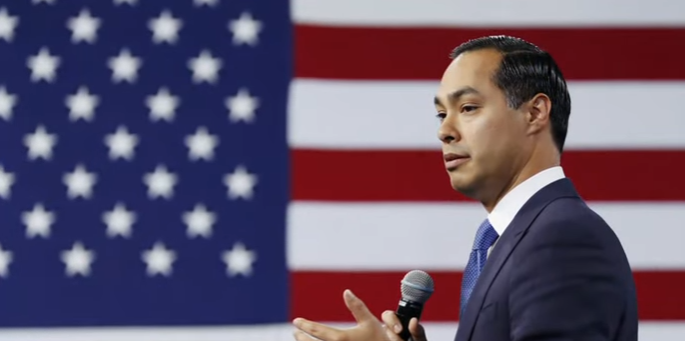
Julian Castro, 2020 Presidential candidate and Former Housing and Urban Development Secretary, bows out of the race.


By Jim Ellis

Jan. 6, 2020 — Saying that it simply “isn’t our time,” former Housing and Urban Development Secretary Julian Castro announced late last week that he is ending his bid for the Democratic presidential nomination now, exactly one month before the campaign’s first votes are cast in the Iowa Caucuses.

Castro, who served the final two-and-a-half years of the Obama Administration in the president’s cabinet after a five-year stint as mayor of San Antonio and previously being elected to one term on the city council, was one of the first candidates to enter the 2020 presidential campaign. Beginning the race as a little-known political figure despite serving in a national office, Castro couldn’t get his campaign untracked. He never came close to attaining high single digit support in any poll, even when including those from his home state of Texas.

On the money front, Castro raised slightly over $10 million for his national effort. Through Sept. 30, he attracted $7.6 million in financial backing with estimates of approximately $3.5 million for his final quarter in the race. Castro qualified for participation in four of the six national candidate forums, taking a major risk in one of them that proved to backfire.

Continue reading

Impeachment Politics

By Jim Ellis

Dec. 20, 2019 — As the most recent polling from national research sources and in key states shows President Trump gaining political strength, the US House last night, on a virtual party line vote, approved the resolution to send the Articles of Impeachment to the US Senate for trial.

The vote was 229-198, with three Democrats voting against the articles and one Republican-turned-Independent, Michigan’s Justin Amash, supporting the measures. Presidential candidate Tulsi Gabbard, who represents the 2nd District of Hawaii, voted “Present”. Three members, two Republicans and one Democrat, were absent. Rep. Duncan Hunter (R-CA) will soon resign his seat due to pleading guilty to a federal campaign finance charge. Retiring Reps. Jose Serrano (D-NY) and John Shimkus (R-IL) were the others who did not vote. All present and voting Republicans opposed the impeachment measures.

Two of the three opposition Democrats were expected to vote no, Reps. Collin Peterson (D-MN) who represents the strongest Trump district in the country to elect a Democrat to the House, and New Jersey’s Jeff Van Drew who is about to leave his party to join the Republicans. The third no vote came from freshman Rep. Jared Golden (D-ME), who represents the northern district in Maine that delivered its electoral vote to Trump in 2016 even though the state voted for Hillary Clinton. Maine and Nebraska are the only two states that choose to divide their electoral votes.

Two pollsters who had been showing national political support for the impeachment are now projecting a swing toward the opposite conclusion.

The CNN poll, conducted by their usual research partner, the SSRS firm, surveyed 1,005 adult respondents over the Dec. 12-15 period. A total of 45 percent of the respondents favored impeaching the president, while 47 percent said, “they don’t feel that way.” In contrast, their Nov. 21-24 survey found 50 percent favoring impeachment while 43 percent said they didn’t agree with the move. Previously, the CNN polls had reported positions consistently favoring impeachment since late September.

Continue reading

Impeachment: First Political Clues

By Jim Ellis

President Donald Trump | whitehouse.gov

Dec. 16, 2019 — As we move toward the impeachment vote in the full House and the impending Senate trial to determine whether President Trump should be removed from office, a great deal of speculation exists about how voters will respond to this situation. A series of early December polls from the most critical swing states gives us a clue.

Firehouse Strategies/Optimus commissioned simultaneous polls within the Dec. 3-5 period in the top swing states of Pennsylvania, Michigan, and Wisconsin. As we remember, all of these places gave Trump a small victory margin in 2016. Phoenix-based pollster OH Predictive Insights conducted a poll of the Arizona electorate during the same period. Firehouse found sampling groups numbering between 551 and 610 respondents in the three states. OH used a slightly larger 628 person sample cell in the Grand Canyon State.

Both pollsters tested President Trump in each targeted state against former Vice President Joe Biden, Sens. Elizabeth Warren and Bernie Sanders, South Bend Mayor Pete Buttigieg, and ex-New York City mayor, Michael Bloomberg.

In all instances President Trump led his prospective opponent when individually paired. Since he had been trailing in similar ballot test responses from several previous polls in the Great Lakes States and was about even in Arizona, the change at the height of the impeachment proceedings suggests that he is seeing a net positive early return from the legal attack.

Of course, much could change before the process concludes, but this first data does provide us an interesting political snapshot as it relates to impeachment perceptions. As a rule, general election polling before the parties nominate their presidential candidates is usually irrelevant but, considering the present impeachment overlay, these numbers appear to be significant and particularly so because they are originating from critically important states.

For President Trump to win re-election, he must carry all five of the states in his 2016 coalition that typically vote Republican but have been trending closer to the Democrats since the last presidential election. Those are: Arizona, Georgia, and Texas. Florida and North Carolina are always swing states in virtually every election and will be again in 2020. To win, the president must first carry all of these aforementioned states. If so, he then would need to win just one of the Michigan, Pennsylvania, Wisconsin trio in order to yield a bare Electoral College majority.

Continue reading

Buttigieg Tops New Hampshire Field

By Jim Ellis

South Bend Mayor Pete Buttigieg

Dec. 13, 2019 — It has been clear for some time that South Bend Mayor Pete Buttigieg is making a strong move in Iowa, perfectly understandable for a candidate hailing from the Midwest; but could an Iowa-New Hampshire sweep be in the forecast for the upstart national contender?

A new MassInc poll for WBUR radio, the public news station in Boston, finds Mayor Buttigieg, for the first time, posting a small lead in the Granite State. The survey (Dec. 3-8; 442 likely New Hampshire Democratic primary voters) gives Buttigieg a slight 18-17-15-12 percent edge over former Vice President Joe Biden, and Sens. Bernie Sanders (I-VT) and Elizabeth Warren (D-MA), respectively, as a clear four-way race is beginning to crystallize for the first-in-the-nation primary.

The latest Iowa Caucus public polling, from Nov. 8 – Dec. 10 through four different survey research firms (Selzer & Company, YouGov, Civiqs, and Emerson College), finds Mayor Buttigieg either leading or tied in three of the studies.

Should such a trend come to fruition in February, we would see the underpinnings of not only Buttigieg becoming a legitimate contender, but a serious national four-way contest taking shape.

The New Hampshire poll is significant not only because it reveals a state base for Buttigieg but also finds that neither New England stalwart politicians Sanders nor Warren have clinched the state, as one might surmise. It was only four years ago when Sen. Sanders posted a 60 percent victory over Hillary Clinton in the 2016 Democratic New Hampshire presidential primary. At this point, now exactly two months from the Granite State primary vote, it would be reasonable to believe that both would be doing better than the MassInc survey and other recent polls suggest.

The MassInc/WBUR poll also provides another key data point. Despite former New York City mayor Michael Bloomberg’s major media spending, apparently on a national basis, his favorability ratings among Democrats continue to languish. His personal index will have to substantially improve if he is to make a push to develop a five-way nomination campaign.

Yesterday, we covered a Monmouth University national poll that found Bloomberg being regarded as the most unpopular of the well-known Democratic candidates, and this MassInc/WBUR New Hampshire survey returns similar results.

Continue reading

Shock Poll – Hillary Leading

By Jim Ellis

Hillary Clinton

Dec. 11, 2019 — The Harris polling organization in conjunction with Harvard University has just released what appears to be the first national poll to include former secretary of state and 2016 presidential nominee Hillary Clinton, and it finds her pulling into a small lead when tested against the rest of the Democratic field.

Looking at the large sample survey (Nov. 27-29; 1,859 registered voters — 756 Democratic registered voters, online), Hillary would take a 21-20-12-9-5 percent lead over former Vice President Joe Biden, Sens. Bernie Sanders and Elizabeth Warren, and South Bend Mayor Pete Buttigieg.

Without Hillary included, the field breaks 29-16-13-8-7 percent in favor of Biden, Sens. Sanders and Warren, Mayor Buttigieg, and former New York City mayor Michael Bloomberg, respectively.

There are negatives associated with the methodology, however. First, an online poll is less reliable than a live-interview survey, and generally even less so than an automated response device study.

Additionally, the Harris/Harvard poll was taken during the Thanksgiving holiday weekend, which again potentially skews the sample because so many people would not be included in the sampling universe because of deviations from their normal routines.

Third, the survey included former secretary of state and ex-US senator John Kerry within the field of candidates, and he received five percent support. That, too, could certainly skew the overall results to a degree because he is not running in the 2020 campaign.

Negatives notwithstanding, the fact that Clinton would already land among the leaders in the first of what will likely be several credible national surveys is significant. If anything, this data will lend more fuel to the fire that the former presidential nominee, secretary of state, US senator, and First Lady is seriously considering becoming a national candidate in 2020.

The Harris/Harvard poll again reiterates the most recent polling trend that, without Hillary being tested, Biden is establishing a clear lead but is nowhere close to the necessary 50 percent mark in order to secure nomination. The latest data also confirms that Sen. Warren dropped back into the pack after moving into a virtual tie with Biden six to 10 weeks ago. Sen. Sanders maintains his consistent supporters and is clearly going to be a top-tier factor as the race moves forward.

The candidates appearing to suffer the most from a Clinton re-emergence are Sen. Warren and Mayor Buttigieg. They both drop back significantly with her in the race, each falling into single digits. Biden and Sanders appear to hold most of their strength even with her in the field, which tells us that Warren and Buttigieg’s joint prospects will suffer if she were to return to active candidate status.

Continue reading

Is Sen. Kamala Harris Protecting
Her California Senate Seat?

By Jim Ellis

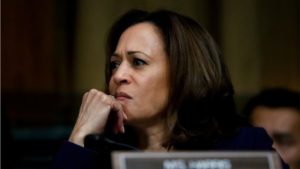
Democrat Sen. Kamala Harris of California

Dec. 5, 2019 — Sen. Kamala Harris (D-CA) became the first of what one might consider the top-tier candidates to end her presidential effort, but the announcement timing on Tuesday likely has more to do with her 2022 Senate race than the presidential contest.

The California candidate filing deadline is tomorrow, so Sen. Harris deciding to end her presidential effort means she won’t be on the Golden State presidential primary ballot, and thus avoids an embarrassing loss within her own constituency. Recent polling was forecasting her in the single-digit range even in California.

Obviously, losing any race in one’s home state reveals political weakness, and though she is virtually invulnerable against a Republican in the 2022 general election, the same might not be true if her opponent were a strong Democrat.

Under the California election system that features the jungle primary concept, variations of which are also seen in Washington state and Louisiana, members of the same party can advance into the general election. Florida voters will have the opportunity of adopting that jungle primary concept via ballot initiative next year.

Because California and Washington hold regular primaries before the general election, a pair of candidates always advance irrespective of percentages attained. Conversely, Louisiana holds one election concurrent with the general, meaning a candidate exceeding 50 percent is elected outright; otherwise the top two finishers advance into a December run-off election.

In the California 2022 Senate race, for example, two candidates will move into the general election from their March or June primary (California has continually alternated their primary election dates between the two months, depending upon the political situation at the time the legislature acted) so long as more than one candidate files. Thus, a strong Democrat — and California has many such individuals — could challenge Sen. Harris, draw a relatively meager percentage in the primary while finishing second, and then rally to make a serious general election challenge against her.

Other previous presidential candidates have often found the political going much tougher than expected when returning home to seek re-election after engaging in the national contest, and it remains to be seen if Sen. Harris will find her road to re-election any bumpier.

Continue reading

Winning vs. Ideology

By Jim Ellis

Nov. 21, 2019 — As the 10 Democratic presidential candidates again took the debate stage last night, this time from Atlanta, they all needed recognize a few things: They needed to walk a fine line. The contenders needed to carefully navigate between appealing to their party’s ideological base, which is key to winning the nomination, and preparing for the general election where a more centrist approach appears to be the probable course toward achieving national victory.

The Gallup organization just completed a new national survey (Nov. 1-14; 1,015 US adults from all 50 states and the District of Columbia, 437 self-identified Democrats and Independents who lean Democratic) that compared the importance between choosing an ideologically sound nominee with one who is best equipped to win the general election irrespective of where that individual stands on the party’s base issues.

Looking at the current results in the prism of Gallup asking the same questions of Republican respondents when President Obama was running for re-election in 2012, and a Democratic cell group when President George W. Bush was seeking a second term in 2004, this sample skews towards electability over ideology in the starkest proportion.

According to Gallup’s questions asked of Democrats and lean Democrats whether they believed it is more important to find a candidate who can unseat President Trump or one who agrees with the individual respondent on issues, by a margin of 60-36 percent the poll showed that the favored candidate would be the one having the best chance to win the November 2020 election.

In 2012, Republican responses to this choice involving replacing President Obama, surveyed in mid-September of 2011, leaned toward a candidate who could win over the ideologically pure contender in a 53-43 percent spread. Eight years earlier, when President Bush was seeking his second term, the ratio among Democrats at the end of 2003 was 50-44 percent in favor of ideology, but six weeks later, in early February 2004, the margin switched to 55-40 percent toward finding the candidate who was best equipped to unseat Bush.

Continue reading