Tag Archives: Sen. Elizabeth Warren

Projecting Delegates

By Jim Ellis

Feb. 24, 2020 — It is becoming clearer that the Democratic presidential contest could result in an open, or “brokered”, convention. This would occur if no candidate secures majority support after the electorates in all the voting entities have cast their ballots and the delegates’ first ballot tallies are locked into place under the individual state laws.

Discounting the Nevada Caucus held over the weekend, only 65 of the 3,979 first-ballot delegate votes have been assigned. By the evening of March 3, however, the aggregate assigned delegate total will soar to 1,398 and we will begin to see sustaining patterns developing.

By March 17, 61 percent of the first-ballot votes will be locked. At that time, it is highly likely we will be able to determine if a candidate can attain majority support or whether multiple ballots will be required to choose a nominee. If this latter scenario occurs, it will be the first time since 1952 that a major party convention is forced to call for more than one ballot to choose a nominee.

Looking past Nevada and onto South Carolina on Saturday, Feb. 29, and then to Super Tuesday just three days later, we can begin to make delegate projections based upon available polling data. Of the 19 total voting entities that will record votes from the time the Iowa Caucuses began to the end of voting on Super Tuesday, relevant polling exists in 14 of those states.

Using the available data and delegate quotas that are noted from each place, rudimentary projections can be calculated regarding which candidates might receive delegate votes from the specific states for purposes of comparing aggregate totals against the 50 percent threshold.

Early in the cycle, it appeared that former Vice President Joe Biden would be in the strongest position post Super Tuesday because of what looked to be his early dominance in the South. The voting schedule appeared to favor him since half the March 3 voting states lie in that region. His trouble in Iowa and New Hampshire, plus his poor debate performances, and Sen. Bernie Sanders’ strength along with the recent emergence of Michael Bloomberg, has apparently already relegated Biden to also-ran status.

Continue reading

Sanders, Buttigieg, Klobuchar

By Jim Ellis

Feb. 12, 2020 — At the beginning of this presidential campaign, the odds would have been very long to bet that neither former VP Joe Biden nor Massachusetts Sen. Elizabeth Warren would earn bound delegate votes from the nation’s first primary in New Hampshire, but that is exactly what happened last night.

All night long, Sen. Bernie Sanders (I-VT), former mayor, Pete Buttigieg, and Sen. Amy Klobuchar (D-MN) placed first, second, and third, and with all three of these contenders easily exceeding the 15 percent delegate apportionment threshold in both the at-large vote and in the two congressional districts, it is they who split the state’s 24 first ballot delegates.

Sen. Sanders ran just under 26 percent in first position, while Buttigieg was close behind with just over 24 percent, and Sen. Klobuchar hovered consistently around the 20 percent mark throughout the evening. Sen. Warren fell just short of 10 percent while Biden, who for most of the early campaign cycle was polling near the top of the candidate heap, dropped all the way to fifth place recording just about 8.5 percent of the vote.

While this is a crushing performance for both Warren and Biden, it is actually worse for the Massachusetts senator. Biden still has a base in the southern states and with so few delegates being chosen in Iowa and New Hampshire – 65 total from a 3,979 first ballot universe – he can easily soar to the top with a string of southern state victories on Super Tuesday.

Sen. Warren, on the other hand, has what now appears to be few opportunities for wins. Her home state of Massachusetts is on the Super Tuesday calendar and has 91 first-ballot delegates, but her performance in the interim will have to improve to make her competitive even there. The next state, Nevada, must become a point of emphasis for her to show viability because she has never demonstrated significant polling strength in the south.

Continue reading

New Hampshire Primary Today

By Jim Ellis

Feb. 11, 2020 — At long last, the New Hampshire nomination election has arrived, and voters have already begun casting their ballots in what is often referred to as the “first in the nation primary.” The initial state in a line of 48 primaries (the other nine states and territories have caucuses), just how important is today’s vote in determining who wins the 2020 Democratic presidential nomination?

Considering the split Iowa vote where it appears that five different candidates will be awarded a certain number of first-ballot national convention delegate votes ranging from 14 to one, New Hampshire’s 24 aggregate delegates will not likely alter the current race trajectory; therefore, multiple candidates will still be battling through Nevada and South Carolina before Super Tuesday with no one having a clear early path to majority support.

First-ballot victory at the Democratic National Convention in July can only come when one candidate top 50 percent of delegate support. Therefore, regardless of the importance media analysts attempt to assign this New Hampshire race in terms of a momentum boost, it is the delegate numbers that will still tell the story.

Coming from Iowa, former South Bend mayor, Pete Buttigieg, looks to earn 14 delegates with Sen. Bernie Sanders (I-VT) close behind with 12. Now, Sen. Sanders’ team is requesting a partial recount in Iowa that might earn him an extra delegate or two, but it is doubtful the Iowa Democratic Party, with a party leadership still reeling over the vote counting debacle, will grant their request.

Continuing the projected delegate apportionment, Sen. Elizabeth Warren (D-MA) would earn eight bound delegate votes, former vice president, Joe Biden six, and Minnesota Sen. Amy Klobuchar, one.

Polling suggests that Sen. Sanders will place first tonight, but several candidates look to break the 15 percent threshold to also qualify for bound delegate votes. Polling finds scenarios where Buttigieg, Warren, Biden, and even Klobuchar will surpass the minimum threshold, though it is unlikely that all will do so. In fact, with Biden’s early support evaporating before our eyes, it is possible that he will fall short of 15 percent tonight meaning that he would be shut out of delegate votes. Though Sen. Klobuchar appears to be closing fast, it is also likely that she finishes under 15 percent.

Continue reading

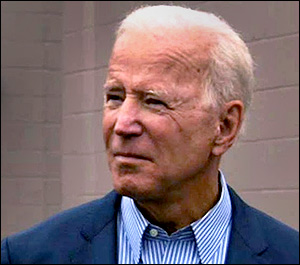
Biden’s Survival Path

By Jim Ellis

2020 Presidential Candidate and former vice president, Joe Biden (D)

Feb. 11, 2020 — Former Vice President Joe Biden said his campaign took a “gut punch” with his fourth-place finish in the Iowa Caucuses and, in the nationally televised debate on Friday night from New Hampshire, lowered future expectations when indicating that finishing close to Sen. Elizabeth Warren (D-MA) in the state’s first-in-the-nation primary would be an acceptable showing.

Recent polls suggest Sen. Warren will do no better than third place, meaning Biden, who can no longer be considered the national front runner, again looks to be lagging behind in fourth place among the Democrat candidates. Does another fourth-place finish doom his national campaign? Would Biden have a path to the nomination even if failing to win yet again in Nevada on Feb. 22?

The answers to the two queries are no and yes, and South Carolina is the key. After a win in the Palmetto State, he would then need to strongly springboard into Super Tuesday just three days hence on March 3. On that day, citizens in 14 states and one territory are scheduled to cast votes, and half of those states are in the South, a region where the former vice president has been dominant in polling.

Sen. Bernie Sanders (I-VT), the likely national leader headed to Super Tuesday, should find some relative strength in the southern states, and billionaires Tom Steyer and Michael Bloomberg will likely also break the 15 percent threshold in some of these places and others to score a limited number of bound delegate votes. If Biden wins most or all of the southern states with approximately 30 percent of the aggregate vote, it would likely give him approximately 200 delegates, a number that certainly could boost his viability within a national context.

From a delegate count perspective, even if he fails to break 15 percent to qualify for convention votes in New Hampshire tonight and doesn’t win Nevada, he is still not going to be unreasonably behind. In Iowa, the projected delegate count suggests that former mayor, Pete Buttigieg, will record 14 first-ballot national convention votes, Sanders’ 12, Warren 8, Biden 6, and Sen. Amy Klobuchar (D-MN), 1.

Continue reading

Iowa Drags On

By Jim Ellis

South Bend Mayor Pete Buttigieg

Feb. 5, 2020 — Almost a full day after voting ended, the Iowa Democratic Party released what now accounts for almost three-quarters of the state’s precinct totals, and we may be headed for a split decision.

While South Bend Mayor Pete Buttigieg is being credited as the leader and potential victor, the complicated Iowa system suggests that two candidates can claim a victory of sorts.

Buttigieg leads among the state delegate count, as caucus attenders choose individuals to serve as delegates to the state party convention in order to determine how Iowa’s 41 first-ballot delegates will vote at the Democratic National Convention in mid-July. At this writing, Buttigieg has 26.8 percent of the state delegate contingent, ahead of Sen. Bernie Sanders’ 25.2 percent.

In actuality, however, it is Sanders who has more raw votes. At this point, the Vermont senator maintains an approximate 1,300-vote lead over Buttigieg, and 7,000 more than Sen. Elizabeth Warren. Former Vice President Joe Biden performed poorly, attracting only half the total number of votes that Sanders has so far recorded.

Each caucus awards a certain number of delegates regardless of how many people attend the precinct meeting. Like the electoral college in the general election, the bigger entities receive more delegate votes. Therefore, even though Buttigieg received fewer popular votes he did better in the largest areas, thus awarding him a few more state delegates.

In terms of the published projections for the national convention delegate slate it appears that Buttigieg would have 12 votes, Sanders 10, Warren 6, and Biden 3 with ten more to be decided once all of the votes are finally tabulated. It’s possible that while Sen. Amy Klobuchar (D-MN) failed to reach the 15 percent threshold she might earn a delegate or two based upon the individual congressional district vote.

Biden, who is currently at just 15.4 percent of the state delegate vote is just barely qualifying for apportionment. If the final outstanding votes cut against him, it’s possible that he could fail to reach the final 15 percent, which would prevent him from earning any at-large national convention delegate votes.

The Iowa Debacle

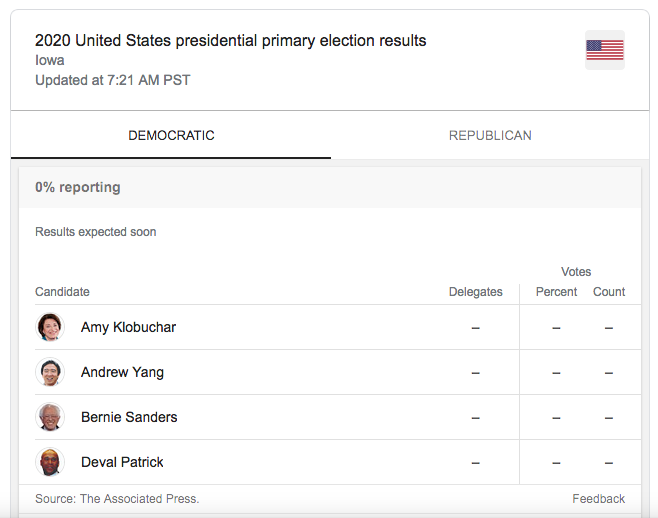
Iowa Caucus results as of 10:21 am Eastern, 7:21 am Pacific time, Tuesday, Feb. 4, 2020.

By Jim Ellis

Feb. 4, 2020 — The reporting problem that arose in the Iowa Democratic Caucuses last night have left us with no results for what could be as long as a full day or more after votes were cast, but it still appears as if a clear winner and loser have emerged. The winner and loser terms have a different meaning in the Iowa Caucus context, however.

Voters attended meetings in 1,679 precincts and the party organizers were supposed to submit their first ballot and final alignment numbers through a specially designed application. The app failed, and so did the party’s back-up plan. Therefore, while voting occurred in all of the precincts, less than one-third of the totals have been received at the Iowa Democratic Party headquarters at the end of the night. The party spokespeople say they will not release any numbers until the entire state reports, and the 1st and 2nd round totals have been verified.

Meeting attenders cast their first ballot and the candidates failing to attain 15 percent support in the precinct were eliminated. In the final alignment round, those voting for a non-qualifying candidate were then lobbied to vote for a candidate who did surpass the 15 percent threshold and would thus qualify for delegates to advance to the state convention on June 13. The state delegates will then vote to assign Iowa’s 41 first-ballot delegates to the Democratic National Convention, but the eventual official apportionment will closely follow the Caucus votes.

What we began seeing from the fastest reporting precincts that were released, and that was less than two percent of the statewide vote, was a bunching at the top among Sens. Bernie Sanders (I-VT) and Elizabeth Warren (D-MA), and South Bend Mayor Pete Buttigieg. Former Vice President Joe Biden and Sen. Amy Klobuchar (D-MN) were in need of further support from around the state to reach the 15 percent mark, but both are close. Therefore, it does appear possible that all five of these contenders could qualify for a share of the state’s delegates.

The unfolding situation seems to favor one person in particular, while disfavoring another. On the short end is Sen. Sanders, even though he looks to clinch first place. The glitch cost him the opportunity to declare outright victory in a timely fashion before a national television audience. The most fortunate candidate looks to be Biden, whose early performance suggests he might not even qualify for delegates in a substantial number of precincts. The reporting problem prevented headline stories claiming that he was Iowa’s under-performer.

Continue reading

Iowa Caucus Voting Tonight

By Jim Ellis

Feb. 3, 2020 — The final Iowa Caucus research surveys are providing very different results, while what is traditionally the state’s most reliable poll, from the Des Moines Register through Selzer & Company, is being held back.

The DMR and Selzer have decided not to release their latest data because of potential methodology errors in that a particular candidate’s name was omitted from an unknown number of survey questionnaires. This means the results could be compromised. Therefore, this particular poll will not be made publicly available.

The American Research Group (Jan. 27-30; 400 likely Iowa Democratic caucus meeting attenders) and Park Street Strategies’ (Jan. 24-28; 600 likely Iowa Democratic caucus meeting attenders) studies find different leaders but have a key new point in common.

The ARG findings post Sen. Bernie Sanders (I-VT) atop the field, as most recent polls have shown, with former Vice President Joe Biden in second place with 17 percent. Park Street, however, sees Biden pulling first place support with 20 percent as compared to Sen. Sanders’ 18 percent.

But the biggest change, as both of these pollsters detect, is a late surge coming from Minnesota Sen. Amy Klobuchar. ARG places her third with 16 percent, just ahead of Sen. Elizabeth Warren (D-MA) who posts 15 percent. Former South Bend Mayor Pete Buttigieg drops to just nine percent backing.

Park Street also sees Klobuchar jumping into double digits, but not as high as ARG forecasts. PSS projects the Minnesotan to a 12 percent level behind Buttigieg and Warren who both have 17 percent support.

Continue reading

One Week Out From Iowa,
It’s Looking Like a Four-Way Split

A four-way split? 2020 Democratic presidential candidates (from left) South Bend Mayor Pete Buttigieg, Sen. Bernie Sanders, former Vice President Joe Biden and Sen. Elizabeth Warren. (PBS.org photo)

By Jim Ellis

Jan. 28, 2020 — Now, just about one week from the first votes of the 2020 presidential election campaign being cast in Iowa, the most current polling suggests that we could see a four-way split for delegate apportionment in the first two voting states. After Iowans meet in their precinct meetings next Monday, New Hampshire voters will visit their polling places in the nation’s first 2020 presidential primary eight days later on February 11th.

Two new surveys each come from the two states: YouGov/CBS News and Suffolk University/USA Today in Iowa, and the University of New Hampshire/CNN and Marist College/NBC News in the Granite State.

In Iowa, Suffolk University/USA Today (Jan. 23-26; 500 likely Iowa Democratic Caucus attenders) finds former Vice President Joe Biden leading Sen. Bernie Sanders (I-VT) and the rest of the field, 25-19-18-13-8 percent. In third place is former South Bend Mayor Pete Buttigieg, while Sen. Elizabeth Warren (D-MA) follows, and Sen. Amy Klobuchar (D-MN) takes the drop into fifth place.

Based upon this poll, Biden, Sanders, and Buttigieg would qualify for delegate apportionment, while the actual vote would likely push Sen. Warren over the minimum threshold, as well. Iowa has 41 first-ballot delegates.

Continue reading

Latest Early-State Polling

By Jim Ellis

Jan. 16, 2020 — The most recent early-state polling again underscores the distinct possibility that we will not see a clear Democratic presidential leader emerge before Super Tuesday.
We are now inside three weeks before the Iowa Caucuses and the survey data and candidate messaging strategies are beginning to take firm hold. Polling is close among the top four candidates, though they appear to be in a proverbial pinball machine as the four bounce from top to bottom at least in the Hawkeye State.

It is likely that either former Vice President Joe Biden, Sen. Bernie Sanders (I-VT) or former South Bend Mayor Pete Buttigieg places first. Sen. Elizabeth Warren (D-MA) is likely to finish midway within the four leaders, seeing her support drop as we get closer to actual voting.

The Caucus rules could change some precinct outcomes. It is probable that the party will adopt a rule, as they have in the past, that allows a voter to change his or her vote if their candidate finishes last in a precinct Caucus tally. In any event, projections suggest that the top four will each exceed 15 percent of the at-large vote to qualify for delegates, and potentially achieve such a preference number in each of the four congressional districts.

This means we could well see a splitting of the 41 first-ballot delegates among the four candidates with the first-place finisher getting approximately just 12 delegates and the fourth-place qualifier earning as many as eight.

The news improves for Biden in New Hampshire, but the just released Patinkin Research Strategies study (Jan. 5-7; 600 likely New Hampshire Democratic primary voters) also shows at least three candidates qualifying for delegate apportionment. Here, Sen. Warren again appears to be falling off the pace.

Continue reading

Sen. Cory Booker Ends Run for 2020

By Jim Ellis

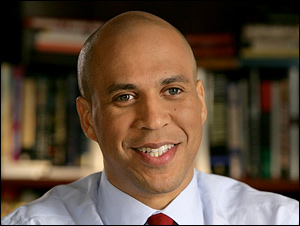
Sen. Cory Booker (D)

Jan. 15, 2020 — With less than three weeks from the first votes being cast in the Democratic presidential nomination process, Sen. Cory Booker (D-NJ) announced via Twitter that he is ending his national effort.

The move is not surprising, as Sen. Booker rarely reached or surpassed three percent support in any presidential primary poll. Like Sen. Kamala Harris (D-CA), who left the race just before the California candidate filing deadline in early December, visions of Senate re-election may have at least in part driven the timing of Booker’s move. While Sen. Harris doesn’t face voters in a strong Democratic state until 2022, Sen. Booker is on the New Jersey ballot this year.

Before the presidential race began, New Jersey legislators and Gov. Phil Murphy (D) changed the state election law to allow candidates to run simultaneously for more than one office. The move was obviously made to assist Sen. Booker’s presidential efforts. Now, however, the simultaneous filing option becomes moot.

Leaving the race now provides him an excuse for finishing poorly in the first four voting states: Iowa, New Hampshire, Nevada, and South Carolina, though he filed for each primary and caucus vote and will still be on the ballot in at least New Hampshire and South Carolina.

Though Sen. Booker appears safe for re-election, the New Jersey filing deadline isn’t until March 30. Poor finishes in all primary and caucus states could have left him in a vulnerable state, and while the Garden State is highly unlikely to elect a Republican to the Senate, it’s not out of the realm of possibility that a strong Democrat could have begun to mount a primary challenge. Now we can expect Sen. Booker to invest all of his political capital into cementing his re-election for a second full six-year term.

Continue reading