Tag Archives: Joe Biden

Wisconsin Primary Moving Forward

By Jim Ellis

Wisconsin Gov. Tony Evers

April 8, 2020 — Whether or not the Wisconsin primary would be held as scheduled took rulings from two Supreme Courts to decide, but we will see voting today throughout the Wolverine State.

The Democratic presidential primary is interesting since the Wisconsin electorate will be the first to vote post-March 17, and so far, becomes the only group to cast ballots during the COVID-19 lockdown situation. How this affects today’s vote in terms of turnout and candidate loyalty will be interesting to analyze.

Whether or not this election would even happen today has been a point of discussion for the past two weeks. Many Democratic strategists were lobbying Gov. Tony Evers, a fellow Democrat, for several days to move the election, but he was slow to act. Late last week, Gov. Evers decided to ask the legislature to pass a bill changing the election date, but the Republican majority leadership in the two chambers refused. Gov. Evers then made a last-ditch effort to declare a state of emergency and attempted to move the election.

The latter action drew the Republican leadership’s ire, and they immediately petitioned the state Supreme Court arguing that the governor has no power to arbitrarily move an election. They also went to the US Supreme Court attempting to get a lower-court ruling to extend the absentee ballot return deadline past the original election schedule countermanded.

At the heart of the election date becoming a political football was not the presidential race, but rather an important state Supreme Court election. Though the race is ostensibly nonpartisan, it is clear that Democrats believe chances for the candidate they are backing improve in a later election, while Republicans think the appointed incumbent they support fares better in a quicker, and presumably lower turnout contest.

Continue reading

GA Poll: Senate/Trump

By Jim Ellis

Georgia Sen. Kelly Loeffler (R) in serious political trouble

April 7, 2020 — The Battleground Connect consulting firm that predominately polls for Republican clients in the South again surveyed the impending Georgia special Senate election as they did on March 24, but this time added questions about the presidential race.

The survey data (March 31-April 1; 1,03 likely Georgia general election voters, live interviews) confirm the previous results that found appointed Sen. Kelly Loeffler (R) languishing in deep political trouble presumably because of her highly publicized stock transactions reportedly executed after receiving Senate COVID-19 briefings. Much of this poll’s analytical coverage, however, highlights that President Trump leads former vice president Joe Biden only by two percentage points in one of his must-win states.

The Senate numbers show some changes from Battleground’s last poll conducted on March 24. Rep. Doug Collins (R-Gainesville) continues to hold first place and increases his support by two points to 36 percent in the jungle primary. Rev. Raphael Warnock (D), who the Democratic Senatorial Campaign Committee has already endorsed, moves into second place (16 percent) but remains a full 20 points behind the leader.

Sen. Loeffler pulls just 13 percent preference while Atlanta businessman Matt Lieberman, son of former Connecticut senator and 2000 vice presidential nominee Joe Lieberman who was in second position in the last poll, drops to 11 percent. Former US Attorney Ed Tarver (D) then falls to just three percent preference.

In the presidential race, President Trump leads Biden 48-46 percent. Trump’s favorability index is the same as the ballot test, 48:46 percent favorable to unfavorable. Biden’s favorability was not tested, but Rep. Collins posted a 35:29 percent positive ratio while Gov. Brian Kemp (R) recorded a relatively strong 50:32 percent. Sen. Loeffler, on the other hand, notched a very poor 20:55 percent, thus providing further statistical evidence of the appointed incumbent’s recent severe downward trend.

The president’s numbers are not particularly surprising even though some analysts are pointing out that his small margin is a warning sign toward potentially losing the state in the fall. Looking back to 2016, however, suggests that a two-point lead seven months before the general election in a southern state where Republicans typically under-poll tracks with where Trump found himself at a commensurate time four years ago.

Continue reading

Will Michigan & Wisconsin Voters Determine 2020 Presidential Election?

By Jim Ellis

April 6, 2020 — Polls were just released in both Michigan and Wisconsin, obviously two critically important states that will weigh heavily in determining the final outcome of the next presidential election. While it’s too early to take any general election poll as a true projection of what may happen in November, particularly in light of the current unique situation, the survey did reveal some interesting points.

Progress Michigan’s Lake Effect newsletter: “The governors’ approval ratings pertaining to the [coronavirus] crisis are better than those of the president.”

Public Policy Polling tested the Michigan electorate for the Progress Michigan progressive left organization (March 31-April 1; 1,01 registered Michigan voters) and Marquette Law School just completed their quarterly survey of Wisconsin voters (March 24-29; 81 registered Wisconsin voters). Both made public their results.

We won’t pay too much attention to the ballot tests because it is so far away from the actual vote and the political situation is obviously going to change during the coming months, but the two pollsters found President Trump and former vice president Joe Biden within the margin of error in each state. In both cases, it was Biden who enjoyed a three-point lead.

Within this prism, it is important to recall the 2016 race in which polling badly underestimated Trump’s strength against Hillary Clinton in these two places. According to the 270 To Win organization, which tracked polling throughout that election year, the final averages going into the final weekend found Trump trailing by six points in Michigan and seven in Wisconsin. He won each state by approximately one percentage point, thus proving a large error factor in virtually all of the late polling.

A post-election analysis in which the Pew Research Center and CNN participated, among other firms and media outlets, concluded that a major reason for the flawed projections were the much larger number of Democrats willing to respond to the polling questions than Republicans. Even understanding this was the case at the time, the pollsters’ weighting formulas and algorithms still badly missed the mark throughout the crucial Great Lakes region.

Continue reading

Is Biden’s Victory Secure?

By Jim Ellis

Former VP Joe Biden

March 30, 2020 — Articles have appeared in publications on successive days that somewhat surprisingly contemplate whether former vice president Joe Biden will actually reach majority delegate support for a first ballot win at the Democratic National Convention still scheduled to begin in mid-July.

Should the former VP somehow fail to obtain 1,991 votes on the first roll call a contested convention would begin, and some are introducing the idea that a deadlock could lead toward New York Gov. Andrew Cuomo emerging as an alternative to Biden.

Gov. Cuomo is receiving favorable media coverage for his handling of the COVID-19 virus situation in his state, which is one of the hardest hit areas in the country. Originally thought of as a possible presidential candidate at the very beginning of the process, Cuomo was first of the potential contenders to definitively pull his name from consideration.

Arriving at a contested convention at this stage of the process when calculating the delegate numbers is not a reasonable conclusion, however. While true that approximately half the states and territories still have not voted in their respective presidential primary, only 42 percent of the delegate universe (1,688) remains unclaimed. With Biden 777 votes away from the victory number according to the Green Papers election stats firm, it would take quite a negative swing for him to lose at this point.

Using simple arithmetic calculations, Biden needs only to secure 46 percent of the remaining bound first ballot delegates to win the party nomination. While he still must participate in the various primaries and attain that total, the chances of him winning are far greater than not. Post-Super Tuesday, his cumulative percentage among the nine states voting is 53.9 meaning that the future results would have to completely reverse for him to somehow lose the nomination.

Continue reading

Biden Wins Easily; Lipinski Loses

By Jim Ellis

Former vice president and 2020 presidential candidate, Joe Biden (D)

March 18, 2020 — In a night that was originally scheduled to have two full state primaries and two stand-alone presidential contests that would determine if a Democratic candidate could reach majority support on the first ballot, last night’s results proved somewhat anticlimactic.

Voters in Arizona, Florida, and Illinois cast their ballots, with only the latter state conducting its full primary. Ohio, which also had its statewide primary scheduled for yesterday, postponed their vote likely to June 2 because of COVID-19 virus precaution.

As expected, former vice president Joe Biden wrapped up three easy victories, beginning with capturing the Florida primary with a whopping 62-23 percent margin over Sen. Bernie Sanders (I-VT) from a Democratic electorate that topped 1.72 million voters. The total includes the early votes, even though the outcome of this stand-alone primary election became a foregone conclusion just after Super Tuesday.

The vote totals were somewhat closer in Illinois, but still a landslide victory for Biden. The former vice president captured 59 percent of the Land of Lincoln Democratic vote as compared to 36 percent for Sen. Sanders. The turnout here was just slightly over 1.5 million, but the entire statewide and district office campaigns were also on this ballot, which helps accounts for what appears to be a fairly large turnout.

In Arizona, the race was much closer, as Biden’s victory margin rather surprisingly dropped to 44-31 percent with approximately 12 percent of the ballots outstanding. The turnout is not expected to reach 600,000 when all the ballots are counted. A quarter of the Arizona electorate voted for one of the also-ran candidates, which compares to 15 percent doing so in Florida and just five percent in Illinois.

Delegate wise, Biden looks to have captured about 159 Florida delegate votes with Sen. Sanders only clinching 60 bound first ballot delegates. The Illinois total projects a 95-60 Biden advantage, while in Arizona the total split looks to be approximately 39-28 if the present pattern continues. Without the Ohio primary taking place, the total delegate universe yesterday was 441, with Biden unofficially clinching 293 of them, or 66 percent of the March 17 bound first-ballot votes.

Continue reading

Primary Day; Ohio on Hold

By Jim Ellis

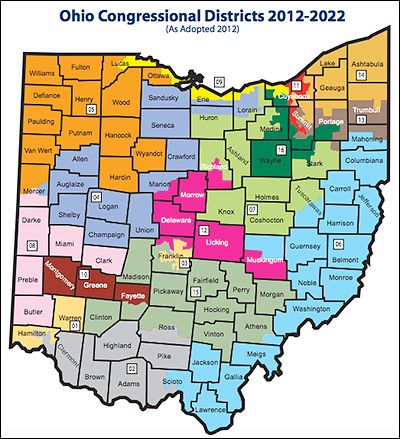
Ohio’s Congressional Districts

March 17, 2020 — Today is a defining day for the Democratic presidential primary but it looks like former vice president Joe Biden will easily march toward the party nomination without participation from Ohio.

Originally, the Buckeye State primary was planned for March 10, but then re-scheduled for today, March 17. Yesterday, Gov. Mike DeWine (R) requested a judge stay the primary election in response to the COVID-19 virus but was turned down. Then, in a statement late last night, the state health director stepped in to halt the primary voting process under a statewide emergency order. The governor and secretary of state are working on ways to increase mail and absentee voting, but how and when people are supposed to vote remains uncertain.

This means only Arizona, Florida, and Illinois voters are casting their ballots today. State officials in each of those places are moving forward with voting as planned. Of this group, only Illinois, like Ohio, is scheduled to hold its state primary.

Regardless of Ohio not being in the mix, at the end of voting this day, Biden will effectively become the Democratic presidential nominee, but not yet officially. Perhaps more importantly, at least as it pertains to Ohio, is what happens to the candidates running for the down-ballot offices.

There is no US Senate race in Ohio this year, but all 16 congressional seats are on the ballot as well as 115 electoral contests for the state legislature (16 state Senate seats; all 99 state House seats), and a large number of local offices.

The confusion surrounding the primary could well become the foundation for eventual lawsuits from some of the candidates who may eventually lose close votes. Therefore, the decision to postpone could result in a very long primary, and post-primary cycle.

Continue reading

Not Quite a Sweep for Biden

By Jim Ellis

March 11, 2020 — Former vice president Joe Biden expanded his lead for the Democratic presidential nomination, but he didn’t quite deliver the knockout blow that many predicted.

He racked up big percentages over Sen. Bernie Sanders (I-VT) in Michigan (53-37 percent), the biggest delegate prize of the night with 125 bound first-ballot votes, Mississippi (81-15 percent), and Missouri (60-35 percent), and carried Idaho with a smaller margin (49-43 percent), but looks to have fallen short in North Dakota (42-49 percent), and Washington (33-33 percent).

Biden earned an approximate total of 211 bound first-ballot delegates as opposed to Sen. Sanders’ projected 138, as the following unofficial list suggests (updated vote totals as reported in the Daily Kos Elections website; delegate projections from The Green Papers website):

Idaho (99% reporting)

Biden ……………….. 48.9%
Sanders …………….. 42.5%
Total First-Ballot Delegates: 20
Biden ……………….. 11
Sanders …………….. 9
Turnout: …………… 103,577   |   2016 Turnout: 23,884 (caucus)


Michigan (99% reporting)

Biden ……………….. 52.9%
Sanders …………….. 36.5%
Total First-Ballot Delegates: 125
Biden ……………….. 73
Sanders …………….. 52
Turnout: …………… 1,557,615   |   2016 Turnout: 1,205,552


Mississippi (98% reporting)

Biden ……………….. 81.0%
Sanders …………….. 14.9%
Total First-Ballot Delegates: 36
Biden ……………….. 34
Sanders …………….. 2
Turnout: …………… 262,252   |   2016 Turnout: 227,164


Missouri (100% reporting)

Biden ……………….. 60.1%
Sanders 34.6%
Total First-Ballot Delegates: 68
Biden ……………….. 44
Sanders …………….. 24
Turnout: …………… 664,305   |   2016 Turnout: 629,425


North Dakota (78% reporting)

Biden ……………….. 42.4%
Sanders …………….. 48.5%
Total First-Ballot Delegates: 14
Biden ……………….. 6
Sanders …………….. 8
Caucus: North Dakota does not report caucus turnout figures


Washington (67% reporting – all mail vote)

Biden ……………….. 32.5%
Sanders …………….. 32.7%
Warren ……………… 12.3%
Bloomberg …………. 11.1%
Total First-Ballot Delegates: 89 (projected results)
Biden ……………….. 43
Sanders ……………….. 43
Bloomberg …………. 2
Warren ……………….. 1
Turnout: …………… 1,024,530 (in progress)   |   2016 Turnout: 26,314 (Caucus)


Continue reading

Biden Poised to Have Potentially Defining Day in Today’s Primaries

Former VP Joe Biden

By Jim Ellis

March 10, 2020 — During the early prognostication phase regarding the Democratic presidential nomination campaign, the two most important primary dates appeared to be March 3, Super Tuesday, and March 17. The latter date is important because more than 60 percent of the first ballot would be locked into place once St. Patrick’s Day voting ends.

That actually may not now be the case, however. Rather, the clinching primaries may be today.

The March 10 elections, featuring six states, haven’t attracted much attention, but the half-dozen results tonight could be the defining moment for coalescing around a new nominee.

Looking at today’s voting in Idaho, Michigan, Mississippi, Missouri, North Dakota, and Washington, Sen. Bernie Sanders (I-VT) looks to have his back up against the wall. It would be hard to see him continuing in viable fashion if he fails to win all of the day’s northern states, and particularly Michigan, which has 125 first-ballot bound delegates.

Late polling, however, is suggesting that former vice president Joe Biden may sweep the six states, and that might be what he needs to at least unofficially clinch the party nomination.

Three late Michigan surveys, from a place where Sen. Sanders held the lead over the Democratic field and slipped past Hillary Clinton in 2016, 50-48 percent, suggest the electorate is now turning toward Biden in a big way. In fact, the Target Insyght poll taken on Sunday, typically not a good polling day, through an automated voice response system (March 8; 600 likely Michigan Democratic primary voters) finds Biden outpacing Sen. Sanders by 41 percentage points, a breathtaking turnaround from pre-Super Tuesday research studies. The TI result finds the Biden split over Sanders at 65-24 percent.

Others don’t show this level of separation, but they are projecting Biden to be developing a substantial advantage. YouGov (March 6-8; sample size not disclosed) finds the Biden margin to be 54-42 percent. Monmouth University (March 5-8; 411 likely Michigan Democratic primary voters) sees a 15-point Biden advantage, 51-36 percent. Michigan-based pollster EPIC-MRA (March 4-6; 400 likely Michigan Democratic primary voters) finds a similar 51-27 percent. All suggest a big Wolverine State night for Biden, the exact opposite of what Sen. Sanders needs to rebound.

Continue reading

With Warren Out, Projecting
the Future Trajectory of
the Democratic Candidacy

By Jim Ellis

Feb. 6, 2020 — Sen. Elizabeth Warren (D-MA) yesterday announced that she was suspending her presidential campaign, which became an eventuality when she finished third in her home state primary last Tuesday. Her exit helps evolve the Democratic presidential contest into a two-way affair.

Can Sen. Bernie Sanders (I-VT) win a two-person race when starting behind in the delegate count?

With political endorsements regularly being announced for former vice president Joe Biden during the post-Super Tuesday period, and momentum clearly behind his reinvigorated campaign, Sen. Sanders appears to have his political back against the figurative wall.

Currently, the unofficial delegate standing according to The Green Papers statistical website, a group that fully extrapolates the count in conjunction with Democratic National Committee apportionment rules, projects Biden to hold 656 bound first-delegate votes as compared to Sanders’ 584, an obvious difference of 72, which is a much better position than the media is currently portraying.

The March 10 primaries, which have not received much attention to date largely because most of the six states voting are relatively small, will become very important. Combined, the states possess a total of 352 bound first-ballot delegates led by Michigan’s 125 votes. The other states are Idaho (20 delegates), Mississippi (36), Missouri (68), North Dakota (14), and Washington (89).

From a national perspective, Sen. Sanders may well be in a position of having to score first-place finishes in four of these states. In the remaining two, Mississippi and Missouri, Biden has run strong in their region so there is little reason to believe that Sen. Sanders will be particularly competitive in either state.

The Vermont lawmaker has done well in traditionally Republican states among Democratic voters, so his chances in small Idaho and North Dakota should be strong.

Continue reading

Numbers Rolling in From the
Texas and California Primaries

By Jim Ellis

March 5, 2020 — Tuesday’s elections in Texas and California were subject to slow counting, but at least in the Lone Star State, the numbers are near final.
More than 780,000 votes have currently been received in California but not yet counted. More votes are coming into county offices. To be valid, voters could have postmarked their mail ballots on Election Day and as long as they are received in the county election offices by close of business on March 6, they will be counted. Therefore, an unknown number will be added to the received but uncounted total.

The large total explains why some of the California congressional races remain uncalled even though the vote spreads among the affected candidates is sometimes quite large.

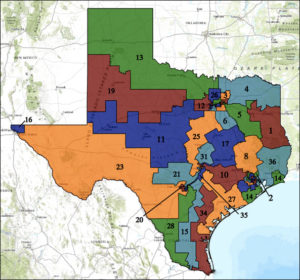
Map of US Congressional districts in Texas

In Texas, US Senate candidate Cristina Tzintzun Ramirez conceded the second Democratic run-off position to state Sen. Royce West (D-Dallas). The two battled for the slot all evening and into yesterday, but the small margin in Sen. West’s favor was definitive enough that Ramirez officially ended her bid. The May 26 statewide run-off election will feature first-place finisher M.J. Hegar, a retired Army helicopter pilot who held veteran Rep. John Carter (R-Georgetown) to a 51-48 percent re-election victory in the 2018 CD-31 campaign that encompasses Williamson and Bell Counties, and now Sen. West. The winner opposes Sen. John Cornyn (R) in November.

The final unofficial Democratic presidential tally finds former vice president Joe Biden scoring 34.5 percent of the vote as compared to 30.0 percent for Sen. Bernie Sanders (I-VT). Though Biden and Sanders were the only candidates to break the 15 percent barrier to qualify for at-large delegates, former New York City mayor Michael Bloomberg and Sen. Elizabeth Warren (D-MA) both obtained the threshold percentage in certain congressional districts, so they, too, earned several delegate votes; both, however, have ended their campaigns, Sen. Warren just this morning. The final unofficial delegate board finds Biden capturing 111 bound Texas first-ballot delegates, Sen. Sanders 102, Bloomberg 10, and Sen. Warren, five.

Just over 2 million people voted in the Democratic presidential primary. President Trump garnered 94 percent of the Republican vote, translating into more than 1.863 million votes. Just under 2 million voters cast ballots in the GOP primary despite there being no real race for president.

Continue reading