Tag Archives: Florida

The Emerging Senate Cycle

By Jim Ellis

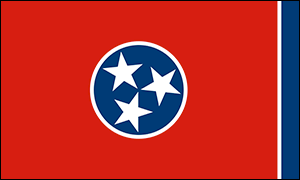
Tennessee state flag

Tennessee state flag

Oct. 25, 2017 — Though we still have more than two full months remaining in calendar year 2017, the 2018 US Senate field is beginning to take clear shape. With 34 statewide contests to be decided, including the Alabama special election that will conclude Dec. 12, no fewer than 10 campaigns are basically set. Action is occurring in an additional 13 states suggesting that some sort of primary or general election competition will soon come to the forefront. Eleven incumbents seeking re-election are rated as “safe” at the present time.

Former Tennessee US Rep. Stephen Fincher (R-Crockett County) announced Monday that he would join the open US Senate Republican primary battle, attempting to succeed retiring Sen. Bob Corker (R). This race already appears to be evolving into a possible two-way primary between ex-Rep. Fincher and current 7th District veteran incumbent Marsha Blackburn (R-Brentwood).

Andy Ogles, the former Tennessee director for Americans for Prosperity, remains in the race after launching what is now a moot primary challenge to Sen. Corker but it is unclear how strong he will be now that several conservative organizations are already beginning to coalesce behind Rep. Blackburn.

The only other bit of Volunteer State intrigue centers around Democratic former Gov. Phil Bredesen and whether he will enter the statewide contest. Originally, Bredesen took himself out of consideration, but now agrees to consider becoming a candidate. He says a decision will be forthcoming in a matter of weeks. Without Bredesen, the Democrats would likely concede the seat to the eventual Republican nominee since other strong potential candidates, specifically US Rep. Jim Cooper (D-Nashville) and Nashville Mayor Megan Barry, have already said they will not run.

Continue reading

Follow the Money

By Jim Ellis

Oct. 24, 2017 — The 3rd Quarter Federal Election Commission US House disclosure reports are available, and they provide valuable clues as to which campaigns could become first-tier efforts next year. The Daily Kos Elections Page once again completed their quarterly analysis, which became the major source for this column.

federal-elections-commission-logoThirty-five incumbents and two challengers have already raised more than $1 million for the current election cycle. Another seven (six incumbents; one challenger) have crossed the $900,000 mark in current cycle receipts.

Most of the million-dollar incumbents are in projected competitive primary or general election campaigns.

Arizona two-term incumbent Rep. Martha McSally (R-Tucson) is again raising and spending huge amounts in the early going. She has gathered $2.8 million, a great deal of which comes through expensive direct mail, hence her cash-on-hand total is $1.453 million. Her potential leading Democratic opponent, former 1st District Rep. Ann Kirkpatrick (D-Flagstaff) who has re-located to Tucson in order to challenge McSally, is showing only $269,000 on hand in comparison, but that is the largest amount among the five Democrats filing disclosure reports in this district.

Continue reading

Senate Candidate Review

By Jim Ellis

Sept. 25, 2017 — After Friday’s review of the open House races, today we update the first half of the 33 in-cycle Senate races in terms of serious candidate personnel. Tomorrow, we will complete the remaining 17 states.

In contrast to the House where 26 regular cycle seats are open, no current Senate incumbent has announced his or her retirement.

(Regular type means the individual is an announced contender; italics denote possible candidate.)

ARIZONA — TOSS UP
Sen. Jeff Flake (R)
Kelli Ward (R) – former State Senator
Jeff DeWit (R) – State Treasurer
Rep. Kyrsten Sinema (D) – US Representative
State Rep. Randy Friese (D) – Physician; Tucson area state legislator
• Sen. Flake is in trouble in the Republican primary largely due to his personal feud with President Trump. Rep. Kyrsten Sinema (D-Phoenix) waits in the wings. Should she enter the race, there is a strong chance the Democrats coalesce behind her.

CALIFORNIA — SAFE D
Sen. Dianne Feinstein (D)
State Sen. Kevin de Leon (D) – State Senate President
• Indications are suggesting that Sen. Feinstein, now 84 years old, will seek re-election. She should have little in the way of opposition, but state Senate President Kevin de Leon (D-Los Angeles) made public statements about challenging the senator after the latter made a favorable comment about President Trump. Unlikely such a challenge will actually happen, however.
Continue reading

Florida: Close Again

By Jim Ellis

Sept. 5, 2017 — Last week, Florida Atlantic University released new survey research data (Aug. 25-26; 800 registered Florida voters via online questioning and telephone automated response) that tested the Sunshine State electorate about the impending Senate contest between three-term incumbent Sen. Bill Nelson (D) and term-limited Gov. Rick Scott (R).

Though we haven’t seen numbers here for months, the FAU data shows little has changed since the last surveys were released. Accordingly, Sen. Nelson tops Gov. Scott by only a 42-40 percent margin, meaning a virtual tie. Close races are nothing new in Florida, as we all know, so the polling results seem plausible.

Gov. Scott is not yet an official Senate candidate and repeatedly says he is no hurry to make a decision. But, the Florida political establishment and other prospective candidates believe he is going to run, which explains why there is so little activity around a Democratic incumbent who could be vulnerable.

Through his first term, the governor had been routinely plagued with poor job approval ratings but still managed to win a close 2014 re-election battle against former governor and now Congressman Charlie Crist (D-St. Petersburg). Though the FAU poll did not publicize candidate favorability ratios, previous 2017 studies found the governor’s index significantly rebounding into positive territory. It is likely Gov. Scott is sustaining a positive image, since he continues run close to Sen. Nelson on the ballot test question.

Continue reading

A Not So Open Seat

By Jim Ellis

Aug. 22, 2017 — Currently, we see a low number of open US House seats during this 2018 election cycle, and the number is about to get even smaller. Colorado Rep. Ed Perlmutter (D-Golden) is expected to announce that he has changed political course once again and now will seek re-election.

In April, the six-term congressman announced his candidacy for governor, only to withdraw two months later. At the time when ending his statewide bid, Perlmutter confirmed that he would not be seeking re-election to a seventh term in the House. Believing the 7th District, a likely Democratic seat, would be open in 2018, three state legislators and a former US Ambassador jumped into the party primary.

At the very least, each of the three legislators has previously indicated that they would end their congressional campaigns and defer to the returning incumbent should he decide to return. Therefore, it is likely Perlmutter’s re-entry into the congressional race will not spur a competitive primary campaign.

Assuming this predicted new course of action proves true, the number of open regular cycle House seats will temporarily drop to 20. At this point in time, the total open seat universe is half of what it was in the last two election cycles, and less than one-third the high water number of 64 we saw in 2012.

Continue reading

A New Republican Governor

By Jim Ellis

Aug. 7, 2017 — West Virginia Gov. Jim Justice made national news the other night at President Trump’s rally in Huntington, WV, when the Democratic state chief executive took the stage to announce that he is switching to the Republican Party.

When addressing the Trump rally, Justice said, “like it or not, but the Democrats walked away from me … West Virginia, I can’t help you anymore by being a Democratic governor.”

The move now gives Republicans control of the entire West Virginia governmental apparatus, owning both houses of the state legislature and the governor’s office. Factoring Justice’s party change, the GOP holds the West Virginia chief executive post for the first time since Gov. Arch Moore (R) was defeated for re-election in 1988. There are now 26 states where Republicans control the legislature and governor’s office, including Nebraska where the legislature only has one ostensibly non-partisan legislative chamber but is clearly overwhelmingly Republican. In contrast, Democrats have full power in only five states.

The development means the Democrats drop to holding just 15 governors, an all-time low number for the party. Republicans, on the other hand, reach their historical apex with 34 governors as party members. The 50th governor, Bill Walker of Alaska, is an Independent.

Continue reading

The Crystal Ball:
Points of Disagreement

By Jim Ellis

July 31, 2017 — University of Virginia professor Larry Sabato has released his latest “Crystal Ball” political ratings, but further arguments must come to the forefront about some of his individual race categorizations.

In the first part of his latest report, Sabato illustrates that the number of Democrats already running for Congress shatters the new candidate rate of previous off-election years. Currently, 209 Democrats have declared themselves as US House candidates at this point in the election cycle, obliterating the mean average of 42.6 derived from the period beginning in 2003 to the present. For Republicans, 28 non-incumbent candidates have currently declared, well below their non-election year average of 42.8 within the same post-2003 time frame.

But, so many Democratic candidates are declaring in the same districts, thus skewing the situation. For example, in the 14 seats where a GOP incumbent voted in favor of the healthcare legislation sitting in a district that Hillary Clinton carried, 57 Democratic candidates have already declared. In the seven competitive California Republican seats where national Democratic Party leaders pledge to heavily contest, 34 Dems have become candidates, though duplication does exist to some extent between the two aforementioned categories. In three more sites featuring presumed competitive 2018 campaigns: AZ-2 (Rep. Martha McSally, R-Tucson), FL-27 (open seat; Rep. Ileana Ros-Lehtinen, R-Miami), and VA-10 (Rep. Barbara Comstock, R-McLean), an additional 23 candidates are competing within this trio of CDs.

Therefore, we find in these 16 unique, prime, targeted congressional seats, a total of 72 individuals who are active Democratic candidates. We also know today that 56 of these competitors will lose their primary because, of course, every district can only nominate one candidate per political party.

Continue reading