Category Archives: OHIO

Ohio Numbers Crunched

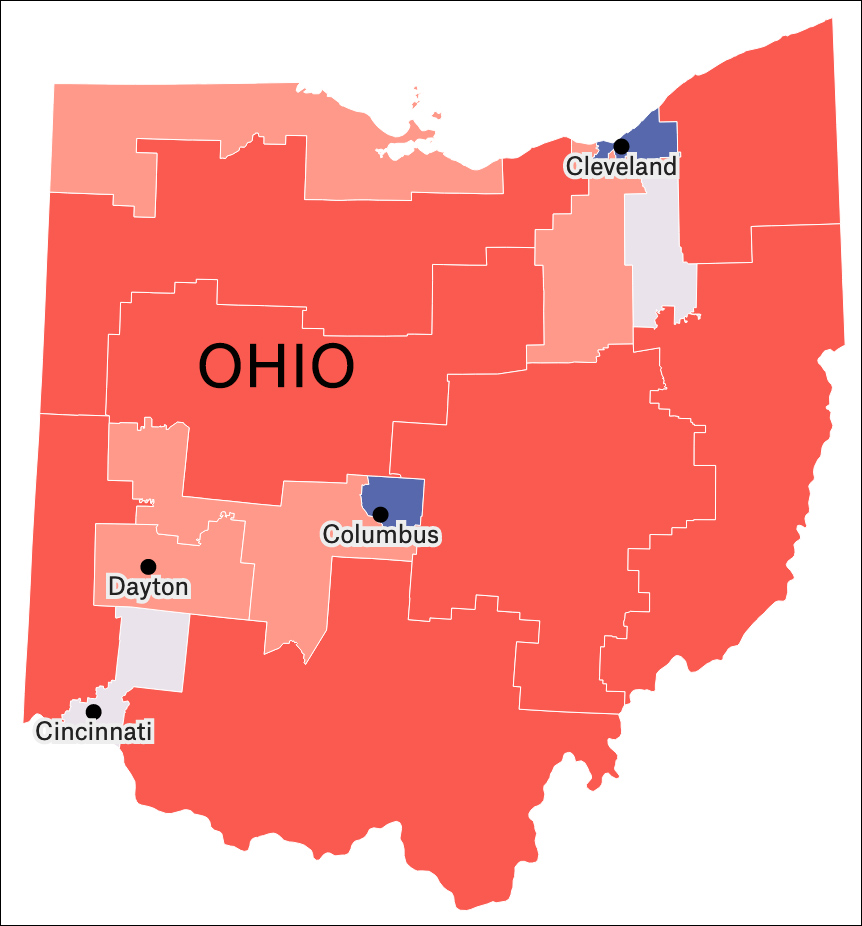
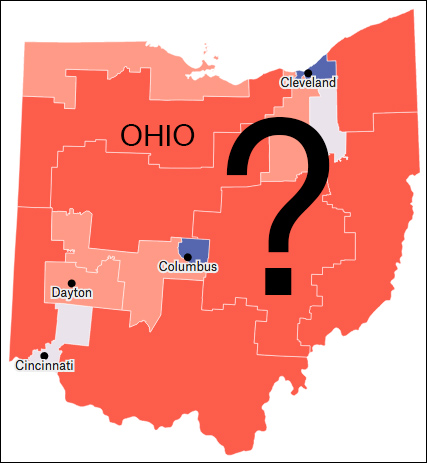
Ohio 2022 Congressional Redistricting map. Click on image to go to FiveThirtyEight’s fully interactive map.

By Jim Ellis

April 11, 2022 — When Ohio Rep. Bob Gibbs (R-Lakeville) announced the suspension of his re-election campaign on Wednesday, it brought some national attention to what has become a Buckeye State redistricting debacle.

Gibbs called out the Ohio State Supreme Court for allowing the replacement congressional district map to languish in political limbo after they rejected the first iteration for excessive political gerrymandering. Though congressional candidate filing was delayed until March 4 from the original Feb. 2 deadline in association with the state’s May 3 primary, the court still took no action toward finalizing a new map. Therefore, candidates were forced to file for districts that may or may not change before election day.

When the Ohio state high court finally informed the Democrat plaintiffs who were challenging the map that the decision regarding the first map constituted the final ruling, the complaint process had to rewind, beginning with a new lawsuit. Now filed, it is apparent that first judicial action on the new challenge is still months away. Therefore, the replacement map appears set for the 2022 elections, at least through the nomination process.

That finally being the case, we can now look at what is becoming a relatively competitive map for the upcoming general election.

Ohio loses a seat, therefore a new congressional map must be in place for the 2022 elections, otherwise all 15 US House contests would be decided on a statewide basis.

The state will now feature two open seats, Gibbs’ 7th CD and the newly configured open 13th District that Rep. Tim Ryan (D-Warren/Youngstown) is vacating to run for US Senate. Two new House members, Reps. Shontel Brown (D-Warrensville Heights/Cleveland) and Mike Carey (R-Columbus), who were both elected in November 2021 special elections, will stand for full terms this year.

Of the 13 incumbents seeking re-election, two, Reps. Steve Chabot (R-Cincinnati) and Marcy Kaptur (D-Toledo) — the latter being the fourth longest-serving member of the House who was first elected in 1982 — find themselves in toss-up general election situations.

In Rep. Chabot’s 1st District, which covers much of greater Cincinnati, the FiveThirtyEight data organization rates the seat as a D+3. Dave’s Redistricting App largely agrees, finding the average Democratic vote over a historical set of races registering 49.91 percent as opposed to 47.93 percent for Republicans. Already, the general election is largely set with Rep. Chabot seeking re-election and the Democrats having a consensus candidate is Cincinnati City Councilman Greg Landsman.

Rep. Kaptur sees the Cleveland portion of her district redacted, meaning her Toledo-anchored seat now features an even mix between Democrats and Republicans. The FiveThirtyEight group rates Kaptur’s new 9th CD at R+6, but Dave’s Redistricting App sees this seat differently. According to the party averages over the course of past political contests, the Democratic vote is 48.77 percent, as compared to a virtually even percentage for Republicans, 48.63.

Rep. Kaptur has no Democratic primary opposition, but four Republicans have filed, two of whom would be significant general election contenders. They are state Sen. Theresa Gavarone (R-Bowling Green) and state Rep. Craig Riedel (R-Defiance). It is likely that one of these two will advance into the general election and make the OH-9 general election campaign one of the most hotly contested in the nation.

Continue reading

Ohio Rep. Bob Gibbs Suspends Campaign for Re-election

By Jim Ellis

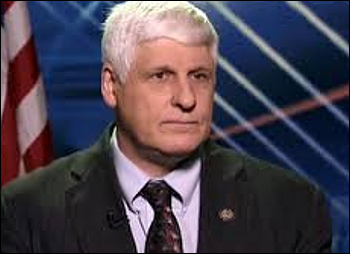
Ohio Rep. Bob Gibbs (R-Lakeville) to retire.

April 8, 2022 — Expressing frustration with the Ohio courts and constituent complexion of his new district, six-term Buckeye State Rep. Bob Gibbs (R-Lakeville) on Wednesday surprisingly became the 22nd Republican US House member who has decided not to seek re-election.

This retirement announcement is different from all the others — 31 Democrats have also made public their decision to leave the House at the end of the current session — because Gibbs had filed for re-election and Ohio early voting has already begun.

Lashing out at the state Supreme Court that has delayed for weeks in providing 2022 candidates a clear direction with regard to the redistricting maps, Gibbs said in his retirement announcement statement, “It is irresponsible to effectively confirm the congressional map for this election cycle seven days before voting begins, especially in the Seventh Congressional District, where almost 90 percent of the electorate is new and nearly two-thirds is an area primarily from another district, foreign to any expectations or connection to the current Seventh District.”

Rep. Gibbs has a valid point about the state Supreme Court. After rejecting the original congressional map under partisan gerrymandering reasoning, the legislature returned a second map, and the court did not render a decision, even after again rejecting the alternative version maps for the state House and Senate. Therefore, the congressional incumbents and candidates have been languishing for weeks not knowing precisely the location of the new district lines, and long past the candidate filing deadline that occurred on March 4.

The court justices then informed the Democratic plaintiffs regarding their lawsuit challenging the congressional lines, after waiting for several weeks with no action, that the original decision on the first map constituted their final ruling, thus the plaintiffs would have to file a new lawsuit for them to consider further arguments to the second plan. The Democratic plaintiffs did file again, but even preliminary action of any kind is reportedly now months away. Hence, the second map is, at least for now, in place for the 2022 election cycle.

The court and legislature were also in a battle over whether the high court even has jurisdiction to order new maps. Under the Ohio Constitution, the courts do not have authority to draw new redistricting maps. They may only remand any rejected map back to the legislature. Thus, the continuing saga of 2022 Ohio redistricting.

Considering Gibbs’ late withdrawal, Secretary of State Frank LaRose (R) immediately announced that the congressman’s name cannot be removed from the ballot, and any vote cast for him would now not be counted. The move puts former Trump White House aide and Marine Corps veteran Max Miller in the favorite’s position for the Republican primary.

Continue reading

Redistricting News – Ohio; Florida

By Jim Ellis

March 31, 2022 — Two long awaited key redistricting situations became clearer Tuesday, as the important electoral states of Ohio and Florida took action. While the Ohio congressional plan may finally be set for this election, the Sunshine State map, while still not close to finalization, is trending toward resolution.

Ohio

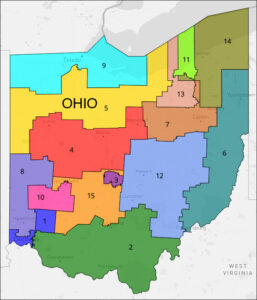
Click on map or here to go to: Interactive Ohio Congressional Redistricting map.

The state of Ohio has had the rockiest redistricting path this year, as the legislature and state Supreme Court have been passing and rejecting congressional and state legislative district maps since early in the year.

Last week, the high court, from which people were waiting for a new decision over the congressional map before them for several weeks, surprised the Democratic plaintiffs by informing them that they would have to file a new lawsuit. The justices explained that they had already issued a final ruling on the first map, hence the process would have to begin again with this second installment.

It now appears that the legislature-passed congressional map currently before the court will be used for the 2022 election. The briefing schedule was set for the new lawsuit, but the submission deadline is two months beyond the state’s May 3 primary. Therefore, the new congressional map looks to remain in place for 2022.

The new map would create a swing open 13th District south and east of Cleveland that would likely have been where Rep. Tim Ryan (D-Warren/Youngstown) would have run for re-election had he stayed in the House. On this map, the other member not seeking re-election, Rep. Anthony Gonzalez (R-Rocky River), would have been paired with GOP Rep. Bob Gibbs (R-Lakeville) in a new strongly Republican 7th District that encompasses the western Cleveland suburbs.

The two incumbents in the most competitive situations are Reps. Steve Chabot (R-Cincinnati) and Marcy Kaptur (D-Toledo) who both will face electorates favoring Democrats.

The lawsuit against the congressional map could well move forward during the latter part of this year, but any changes resulting from related legal action would likely mean a new draw for the 2024 election. After a string of favorable congressional map court rulings for Democrats, the lack of further judicial action in Ohio looks to benefit the Republicans, at least for the short term.

Continue reading

DCCC’s Red to Blue Targets

By Jim Ellis

March 14, 2022 — The Democratic Congressional Campaign Committee released their first targets in what they call their Red to Blue program or, in other words, the districts they hope to convert from Republican to Democrat. Curiously, two districts on the list are already blue.

Below is a look at the DCCC’s dozen released targets:


CA-22: Rep. David Valadao (R-Hanford)
2020 Win Percentage: 50.4% in District 21

• FiveThirtyEight: D+10
• Dave’s Redistricting App: 42.3% R / 55.1% D
Endorsed Candidate: State Assemblyman Rudy Salas (D-Bakersfield)

By the numbers, this is one of the Democrats’ best national targets, but Rep. Valadao has consistently won in Democratic seats. He lost in 2018, but won the seat back two years later. Assemblyman Salas is the Democrats’ top recruitment target. Despite the lopsided Democratic numerical advantage, the finish here will again likely be razor-thin.


CA-45: Rep. Michelle Steel (R-Orange County)
2020 Win Percentage: 51.1% in District 48

• FiveThirtyEight: D+5
• Dave’s Redistricting App: 45.8% R / 52.2% D
Endorsed Candidate: Jay Chen – Community College Trustee

Freshman Rep. Steel is another Republican to whom the California Citizens Redistricting Commission members were not kind. Moving into the more inland Orange County district from her coastal seat, Steel has been a well known figure in Orange County politics for many years, particularly with her service time on the Orange County Board of Supervisors before winning the congressional seat.

A D+5 seat is exactly the type the Republicans must win to achieve their goal of re-taking the majority. With national redistricting cutting against them, the GOP must win a sizable number of the 22 seats so far within the Even to D+5 category.


CO-7: Rep. Ed Perlmutter (D-Arvada) – Open Seat
2020 Win Percentage: 59.1%

• FiveThirtyEight: D+6
• Dave’s Redistricting App: 43.8% R / 51.7% D
Endorsed Candidate: State Sen. Brittany Petterson (D-Lakewood)

This district does not really belong on the list since it is already a blue seat. Democrats are favored to hold the seat and Sen. Petterson is clearly their candidate to do so.


IA-1: Rep. Mariannette Miller-Meeks (R-Ottumwa)
2020 Win Percentage: 50.0% (6 votes districtwide) in District 2

• FiveThirtyEight: R+4
• Dave’s Redistricting App: 49.7% R / 46.8% D
Endorsed Candidate: State Rep. Christina Bohannan (D-Iowa City)

Rep. Miller-Meeks won the closest race in the country in 2020, a literal six-vote affair against former state senator and 2018 lieutenant governor nominee Rita Hart (D). This year, the congresswoman will see a different opponent since Hart chose not to return for a re-match. State Rep. Bohannan has two Democratic opponents, but she should have little trouble in winning the party nomination on June 7.

This will be another close eastern Iowa campaign, and this district is actually one point more Democratic than the previous 2nd according to the FiveThirtyEight statistical organization. This is a top Democratic target, but Rep. Milller-Meeks will be favored assuming the political climate remains favorable for Republicans.


IA-2: Rep. Ashley Hinson (R-Marion/Cedar Rapids)
2020 Win Percentage: 50.0% in District 1

• FiveThirtyEight: R+6
• Dave’s Redistricting App: 51.1% R / 45.4% D
Endorsed Candidate: State Sen. Liz Mathis (D-Hiawatha)

In the first redistricting map presented last year, Rep. Hinson would likely have been defeated. With the legislature rejecting that draw, a new one emerged. This gives the congresswoman a more favorable seat but one this is still highly competitive. Democrats have recruited a strong candidate in Sen. Mathis. She has no primary opposition at this time. In a favorable GOP political climate, this seat would become difficult for the Democrats to convert despite its statistical closeness.
Continue reading

The Redistricting Scorecard

By Jim Ellis

In the trifecta of political parties controlling the House, Senate and Executive branches in a state, how many will really benefit from that power in the redistricting process?

Feb. 11, 2022 — There has been quite a bit of redistricting news surfacing during the past few weeks, with many analysts now reversing their earlier predictions about which party is the clear beneficiary from the re-draw process.

Most said early that the Republicans would benefit the most from redistricting and that map drawing alone would be enough to allow the party to reclaim the House majority. We, on the other hand, were showing that the cut would more than likely be about equal even though the GOP has a major advantage in trifecta states, that is, those where one party controls all three legs of the legislative stool, meaning the state Senate, state House, and the governor’s office.

Though the Republicans control 25 states outright from a redistricting perspective compared to the Democrats’ 15, the number of states where each can draw maps to expand their party’s congressional delegation really comes down to seven where Republicans control and a commensurate four for the Democrats.

What balances the process this year is that Republicans appear to have have only one state where they can gain multiple seats — North Carolina — while Democrats can run the table, and have, in two big states, New York and Illinois.

Where both parties suffer in their trifecta states is the number of places where they already control the maximum number of seats, or redistricting power has been transferred to a commission. Either one party already has all the seats in a state like the Democrats do in Massachusetts and the Republicans have in Arkansas, for example, or the state has only one at-large member.

In one place, West Virginia, even though the Republicans have a legislative trifecta, they will drop a seat post election. Currently, the West Virginia delegation consists of three Republicans, but the state loses a seat in national reapportionment. Therefore, the GOP majority had no choice but to collapse one of their own districts.

Articles are now appearing that suggest it is the Democrats who could end the redistricting process with a net seat advantage rather than the Republicans. This, as it has been from the beginning, is true.

In looking at the states once all 50 have adopted new congressional lines, it projects today that the Republicans would add approximately 13 seats, while the Democrats, with multiple seat additions in Illinois and New York, would gain 11 new members. Seven states remain undecided because their level of political competition is predicted to be intense.

Continue reading

Alabama Map Ruling Stayed; Redistricting Update

By Jim Ellis

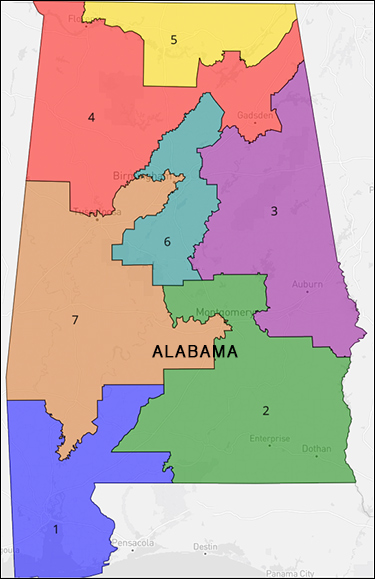
Alabama redistricting map (Click on the map above or go to DavesRedistricting.org to see interactive map)

Feb. 9, 2022 — On a 5-4 vote, the US Supreme Court voted to stay the lower court ruling that invalidated the new Alabama congressional map. A Republican three-judge panel had ruled that a second majority minority district could have been drawn among the state’s seven congressional districts, and thus disqualified the plan on Jan. 23.

Writing a concurring opinion, Justice Brett Kavanaugh stated that the lower court decision was made too close to the 2022 election, meaning that the judicial process would not have proper time to hear the appeal and make an educated ruling prior to the state’s scheduled primary election. The ruling does not mean the appeal was granted, but merely postpones hearing the case to a later date.

Analysts say the stay ensures that the original map will be in place for this year’s election. It does not mean, however, that the map won’t be altered for the 2024 election and beyond.

The new plan is virtually an extension of the current map, which elected six Republicans and one Democrat in the 2020 election. It was a curious original decision, not only because the judges that ruled against the GOP map drawers were appointed by former President Donald Trump (2) and the late President Ronald Reagan (1), but that the same map footprint stood unencumbered for the past 10 years.

The major change made from the current map to the new draw came in the 7th CD, which is the Voting Rights district. The legislature, however, had no choice but to make a substantial change. AL-7 was 53,143 people short of reaching the state’s congressional district population quota of 717,754 individuals.

The previous ruling also postponed the Jan. 28 candidate filing deadline for the Alabama US House candidates. Those running for all other offices have now already filed and been qualified for the respective party primary ballots. The congressional candidates will now file on Feb. 11.

Redistricting Notes

• Summarizing the legal action in other states, the North Carolina map has been disqualified and the legislature will now return to redraw the congressional and state legislative maps. As has been the case throughout the previous decade, the partisan Republican legislature and the partisan Democratic state Supreme Court continue to go back and forth over the issue of partisan gerrymandering.

• The lower court ruling in Michigan rejected the Detroit area Democratic current and former state legislators’ claim that the Michigan Independent Citizens Redistricting Commission members violated the Voting Rights Act in drawing the city of Detroit’s congressional and state legislative maps. Unless an appeal is granted, the new Michigan maps will stand for this year’s elections.

• The Kansas legislature adjourned without voting to override Gov. Laura Kelly’s (D) veto of the state’s congressional map. The hasty adjournment move, however, allows the legislature to reconsider the veto override. Without a successful override vote, the map will go to the courts for a redrawing of the Kansas City metro area.

Continue reading

Ohio Congressional Map Tossed

The Ohio State Supreme Court invalidated the state’s newly enacted congressional map and returned the plan to the Ohio state legislature to be redrawn. The state lost a seat in reapportionment. (Map: Dave’s Redistricting App)


By Jim Ellis

Jan. 19, 2022 — The Ohio State Supreme Court, on a 4-3 vote with the Republican Chief Justice Maureen O’Connor voting with the three Democratic members, last Friday invalidated the state’s newly enacted congressional map and returned the plan to be redrawn. The decision may result in a blow to Republican hopes of re-capturing the US House majority as the Ohio draw is one of the party’s most important maps.

The high court’s action followed a similar 4-3 decision the previous day to reject the state House and Senate maps. All of the plans were invalidated for the same reason: they did not meet the competitiveness provision in the Ohio redistricting proposition that the people’s vote enacted prior to the commencement of the re-mapping process. The justices claimed the plan must better reflect the partisan statewide voting pattern, a measure that favors Republicans but not to the extent of the district ratios projected for the jettisoned maps.

The current Ohio congressional map stands at 12 Republicans and four Democrats. The state lost a seat in reapportionment, so the advisory redistricting commission members and the legislature were tasked with creating a new 15-district congressional plan.

By most accounts, the new map would have likely elected 10 Republicans and two Democrats, while featuring three politically marginal districts, those of Reps. Steve Chabot (R-Cincinnati) and Marcy Kaptur (D-Toledo) and an open seat largely created because Reps. Anthony Gonzalez (R-Rocky River) and Tim Ryan (D-Warren) are leaving their seats to retire and run for the Senate, respectively. Therefore, the state’s electoral split could have swung anywhere from 10R-5D all the way to 13R-2D.

The ruling likely creates the greatest change for two of the aforementioned members. The court specifically cited the Hamilton County draw in Rep. Chabot’s seat that attached a swath into downtown Cincinnati. This created a city attachment to Butler County, thus placing it in Rep. Warren Davidson’s (R-Troy) strongly Republican 8th District. As a result, the 1st District became more Republican for Chabot, but still left him with a swing seat at best.

Continue reading