Tag Archives: Voting Rights Act

Nevada Numbers; Carolina Chaos

Feb. 24, 2016 — As expected, Donald Trump placed first in the Nevada Caucuses scoring just under 46 percent of the attender preference; his strongest performance to date, though the turnout was only in the 75,000 range. Sen. Marco Rubio (R-FL) was second with 24 percent, followed by Texas Sen. Ted Cruz at 21 percent. Dr. Ben Carson and Gov. John Kasich (R-OH) trailed with five and four percent, respectively.

Though he didn’t emphasize Nevada at all, Gov. Kasich’s dead last finish behind Carson cannot be good for his pre-Ohio staying power.

Carolina Chaos

Surprise move follows surprise move in the continuing North Carolina redistricting saga that has unleashed political turmoil in the Tar Heel State.

After the three-judge federal panel sitting in Raleigh struck down Congressional Districts 1 (Rep. G.K. Butterfield; D-Wilson) and 12 (Rep. Alma Adams; D-Greensboro) in early February, the legislature, fulfilling the court-ordered directive, re-configured the map and passed it into law by the imposed Feb. 19 deadline. The March 15 primary has been moved to June 7 and, surprisingly, the run-off portion of the election process has been eliminated for the congressional contests. Primary elections for all other offices continue on March 15 and will feature the state’s traditional 40 percent threshold run-off system.

Continue reading

North Carolina’s New Map

Feb. 22, 2016 — Last week, the North Carolina state Senate passed a new congressional map, responding to a court-ordered directive to remedy what a three-judge federal panel determined to be an illegal draw in Districts 1 (Rep. G.K. Butterfield-D) and 12 (Rep. Alma Adams-D). The lines were struck down just 39 days before the state’s primary election.

The resulting map, constructed and passed within a 14-day period, is substantially different from the current map. It pairs one set of incumbents, likely causes two Republican House members to square-off in a primary election, eliminates an African-American district, makes several of the 10 Republican districts more competitive, and calls upon the Board of Elections to re-schedule the congressional primary election while nomination contests for all other offices proceed as scheduled on March 15.

Since the court in its ruling about the two original African-American majority districts declared there is no evidence of polarized voting in North Carolina, Section 2 of the Voting Rights Act does not apply. Therefore, the Republican map drawers took the opportunity to break up the famous “I-85 district” that traveled from Charlotte up Interstate 85 to capture predominately black precincts in Winston-Salem, Greensboro, and at one time, as far away as Durham. Greensboro’s Rep. Adams’ 12th District that the court invalidated is now eliminated. Adams will find herself in a new Republican-leaning 13th District, while the new 12th is fully contained within Mecklenburg County and will probably elect a white Democrat from Charlotte.

Continue reading

Redistricting Moves Far From Over

June 15, 2015 — It’s very possible that a large number of the nation’s congressional districts will be re-drawn before the next census; the key unanswered question is, will most of it happen before the next regular vote, or will the district line adjustment process be pushed forward to the 2018 election cycle?

The US Supreme Court has been active in cases involving the Voting Rights Act (VRA) and methodology used to draw congressional districts. They first struck down a key VRA section in the Shelby County (AL) case that virtually eliminated the pre-clearance requirement associated with Voting Rights Act, Section V. This took a great deal of redistricting power away from the federal government (Department of Justice) and strengthened the states.

Awaiting a decision to be released before the end of the month is the Arizona congressional commission case. In this instance, Grand Canyon State Republicans filed suit against the voter-created special redistricting commission that has power to create state legislative and congressional districts. The Arizona Republicans are challenging the legitimacy of the commission itself, arguing that the US Constitution gives power to redistrict the House of Representatives only to the state legislatures.

Legal experts suggest the Arizona Republicans have a 50/50 chance of prevailing, and most agree the final vote will be 5-4, one way or the other.
Continue reading >

Virginia Congressional Map Struck Down; McAllister’s Path in LA-5

A federal three-judge panel, on a 2-1 vote, yesterday declared the 3rd Congressional District of Virginia (Rep. Bobby Scott-D) unconstitutional because of racial gerrymander. This means a partial re-draw will commence at some point after the 2014 election and before the 2016 nomination cycle begins.

The 3rd District begins in downtown Richmond, travels to Petersburg, comes back toward the James River, and then juts south to annex most of the cities of North Newport News, Hampton, Portsmouth, and downtown Norfolk. The plaintiffs’ argument was basically that the Republican-dominated legislature drew this seat to pack as many African American Democratic voters as possible into this one district.

Because the specific communities were added to make the seat 56.9 percent black, the plaintiffs claimed the territory was “packed” for political reasons. They said the final racial composition figures diluted the regional African-American vote by drawing one such strong black district. Many have argued that this area could sustain two districts where African-American influence is heightened. The Republican defendants argued they were not retrogressing the district as dictated by the Voting Rights Act.
Continue reading >

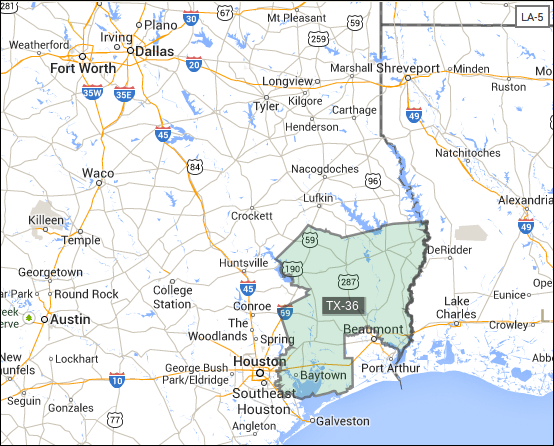
The Wacky 36th CD in Texas

Texas' 36th Congressional District

Texas’ 36th Congressional District

When Rep. Steve Stockman (R-TX-36) signed his official candidate documents to run against Texas Republican Sen. John Cornyn, only hours remained in the candidate filing period. After the figurative dust cleared, Republican Party officials decided that there needed to be an extended opportunity for more individuals to enter the now incumbent-less 36th District congressional race. So after citing some legal technicalities in the way Rep. Stockman withdrew his previous filing from the House race, they extended the qualification period for this race alone through Monday, Dec. 16. But, the extra period is not open to all.
 Continue reading >

Michaud Still Up in Maine; DoJ Moves on Texas

Eliot Cutler

Eliot Cutler

The Maine Education Association commissioned a Greenberg Quinlan Rosner poll (July 11-16; 400 registered Maine voters) and found Rep. Mike Michaud (D-ME-2) to be leading the three-way contest for governor. According to the GQR data, Michaud has a 40-31-26 percent advantage over Gov. Paul LePage (R) and Independent attorney Eliot Cutler.

The poll comes on the heels of Gov. LePage being embroiled in a budget controversy, which came to a head in late June. Though the survey gives Michaud a clear lead, Cutler’s strength suggests that the same three-way configuration that elected LePage in 2010 could again present itself. In that election, LePage won a 38-36-19 percent victory over Cutler and Democratic nominee Libby Mitchell, then a state senator.

At this point, Michaud has filed a 2014 gubernatorial exploratory committee, while both Cutler and the governor have made public their intention to run. The Democrats clearly want Cutler out of the race, but there is no suggestion that the Independent will withdraw. Based upon his strong 2010 finish and Maine’s penchant for looking favorably upon independent candidates – former Gov. Angus King was elected to the Senate in 2012 on the Independent line, for example – it will be difficult for the Democratic leadership to make it worthwhile for Cutler to exit.

Isolating Michaud and LePage in a secondary GQR ballot test question underscores just how detrimental the Cutler candidacy is to the Maine Democrats. If the Independent attorney were not in the race, GQR scores the race a whopping 61-34 percent in Michaud’s favor.

Right now, Rep. Michaud appears to be in a favorable position to unseat Gov. LePage, even in a three-way scenario, but things can change dramatically with so much time remaining in the campaign cycle. It remains to be seen if these are the kind of numbers that will convince Michaud to relinquish his safe House seat in order to pursue the statewide run.
 Continue reading >

What They’re Missing

The analyses and coverage of the Supreme Court’s decision this week that invalidated Section 4 of the Voting Rights Act (VRA) is typically missing a very subtle but highly important point.

As mentioned in many articles and interviews, now that the official formula determining whether a jurisdiction must adhere to US Justice Department supervision is invalid, the laws previously stayed through the denial of pre-clearance procedure have taken effect. A representative sampling of recent laws that failed the pre-clearance test but are now fully enforceable are several polling place voter identification statutes from various states.

In terms of political district map drawing, there is now another crucial factor present in some places. Most states have what is commonly described as a “county line law.” The statute typically says that a county must be kept whole unless more population is needed to reach the proper district target figure. Often times counties are split between or among two or more districts for purposes of adding more minorities to a congressional or legislative district in order to protect that seat under Section 5 of the Voting Rights Act. Now that the elimination of Section 4 effectively debilitates Section 5, the county line laws will presumably be stronger than the VRA, the reverse of what had, heretofore, been the usual practice.

Florida could be the state most quickly affected by the county line situation. In 2010, voters passed a ballot initiative that defined new and additional redistricting criteria. One of the included items is the county line provision. Currently, the state is embroiled in live redistricting litigation, and apparently headed for a January trial in Leon County (Tallahassee). The Supreme Court’s opinion this week will likely bear major influence upon the state judge’s ultimate decision, and it is probable that the tables have turned in the plaintiffs favor. If they do in fact win at the lower and upper court levels, new congressional and legislative maps will likely be mandated, and that could happen as early as the 2014 election cycle.

Florida is particularly vulnerable on the county line issue. The state has seven counties that are larger than a congressional district. Within those seven counties is enough population to complete 10 CDs. The  Continue reading >

Texas Maps Tossed

For the better part of this year, the Texas congressional and legislative maps have been before the United States Court of Appeals for the District of Columbia Circuit. The state submitted their proposed district lines to this body for pre-clearance purposes, in compliance with the Voting Rights Act, instead of the Obama Department of Justice.

Clearly Attorney General Greg Abbott and the Texas Republican legal brain trust felt their approval chances were better going this route than the traditional one – the DoJ. It turns out they were wrong. The Court, yesterday, rejected all of their submissions: congressional, state Senate, and state House. Abbott said Texas will immediately appeal the ruling to the Supreme Court, so the interim maps, ironically drawn by a different federal panel, will hold for the 2012 general elections.

The DC high court ruled that the state eroded the Latino community’s “clout” and took the “economic guts” from the African-American districts. The decision was broader than many believed would be the case, particularly because the San Antonio federal three-judge panel had already drawn interim maps based upon US Supreme Court direction as it pertained to legislative intent. The main areas of concern are the Dallas-Ft. Worth area, particularly as it relates to new District 33 (open seat), which stretches between the two major cities, the Austin-San Antonio corridor, and District 23 (Rep. Quico Canseco) that stretches from San Antonio to El Paso. But, if the African-American districts are also affected, then Houston could come into play, as well.

This ruling suggests major changes will come next year, as Texas redistricting will apparently, once again, begin anew.

A December New Hampshire Primary?

Earlier this week, New Hampshire Secretary of State Bill Gardner indicated that he might consider setting a Presidential primary date as early as Dec. 6 unless Nevada moves back the date of its caucuses to January 17th or later.

Gardner, who has set the date of New Hampshire’s “first-in-the-nation” primary since 1976, issued a memo on Wednesday calling both Tuesday, Dec. 6, and Tuesday, Dec. 13, “realistic options” unless Nevada agrees to its nomination contests after Jan. 17.

Florida’s recent rescheduling of its primary to Jan. 31, which we reported in our Oct. 3 edition, is the action that set the dominoes in motion. As a result of the Sunshine State’s action, Iowa, Nevada and South Carolina have all moved up the dates of their primaries to maintain their status — in that order — as the first nominating contests in the 2012 cycle. Gardner has sent an early signal that the New Hampshire date will be significantly earlier by moving up the Granite State’s candidate filing period to open on Oct. 17 and close 11 days later on Oct. 28.

South Carolina has set its primary for Jan. 21, and Nevada officials have already set its caucus for Jan. 14. Iowa officials have indicated that Jan. 3 is going to be the date of the nation’s first caucus.

Gardner is bound by a New Hampshire state law requiring the Secretary of State to set their primary at least one week before any other nominating contest that would undercut the state’s much cherished “first-in-the-nation” primary status.

Gardner’s memo clearly states, “If Nevada does not adjust its caucus date to a later time, I cannot rule out the possibility of a December primary.”

Gardner subsequently told news organizations that he will not set the presidential primary date until sometime after Oct. 17.

“When I set the date, I will explain all the reasons why it ends up on that date. It’s not my preference to put it in December. The problem is all of our choices are bad choices. I just want to be pick the best of the bad,” he told NBC News last Friday.

As we reported on Oct. 3., Florida’s move, which set off this chain reaction, to change its primary date to Jan. 31 in violation of Republican National Committee rules looks to drastically alter the GOP presidential nomination fight. Under RNC rules, the only states permitted to conduct a delegate selection event prior to the March 6th Super Tuesday date are Iowa, New Hampshire, Nevada, and South Carolina. Florida is willing to accept penalties that will reduce their 99 member Republican National Committee delegation to approximately 50, coupled with other sanctions, in order to make the move.

But accepting intra-party punishment is not the only factor involved in altering their election schedule. Under the Voting Rights Act, all or parts of 16 states are subjected to federal approval of all electoral moves, including primary/caucus date selection. Therefore, it is the Obama Justice Department that will have to grant Florida, New Hampshire, and South Carolina “preclearance” or, in this case, permission to schedule a nominating event in January 2012. Only Iowa and Nevada, in this group of five states, may move unencumbered because they are not part of the group of 16.

At this stage, it’s anybody’s guess how this calendar hopping might affect the outcome of these early nominating contests, but clearly the present front-runners, especially Mitt Romney, who polls show has now opened up a large lead over the rest of the Republican field, might like the nominations to be held sooner rather than later. This way, the vote will occur before the recently fickle GOP primary electorate has a chance to change its mind again.

A New Primary Schedule

Florida’s move this past weekend to change its primary date to Jan. 31 in violation of Republican National Committee rules will drastically alter the GOP presidential nomination fight. Under RNC dictates, the only states permitted to conduct a delegate selection event prior to the March 6 Super Tuesday date are Iowa, New Hampshire, Nevada and South Carolina. Florida is willing to accept penalties that will reduce their 99-member Republican National Committee delegation to approximately 50, coupled with other sanctions, in order to make the move.

But accepting intra-party punishment is not the only factor involved in altering their election schedule. Under the Voting Rights Act, all or parts of 16 states are subjected to federal approval of all electoral moves, including primary/caucus date selection. Therefore, it is the Obama Justice Department that will have to grant Florida, New Hampshire, and South Carolina “pre-clearance” or, in this case, permission, to schedule a nominating event in January 2012. Only Iowa and Nevada, in this group of five states, may move unencumbered because they are not part of the group of 16.

The RNC’s originally proposed calendar began with the Iowa Caucus in early February, but Florida’s attempted move to the last day in January means the other four states are forced to leap-frog the Sunshine State in order to maintain their prominent political position. This means five nominating events, two caucuses (IA, NV) and three primaries (NH, SC, FL), will be held in the first month of next year followed by a five-week void until Super Tuesday in early March.

How does the proposed schedule change affect the current crop of candidates and potential late entries? The big winners under the new calendar are the two front-runners, Mitt Romney and Rick Perry. The early and compressed voting schedule favors the better-known candidates and those having the largest campaign war chests. The quicker time frame featuring five shotgun-style nominating events in a 29-day period gives less time to the current also-rans to ramp up a credible campaign and makes gaining momentum from an early surprise victory even more difficult because there simply won’t be enough time to cement a previous win.

But the potential late entries are an even greater disadvantage under the new voting schedule because they will now have less time to construct a major campaign operation from scratch. Therefore, Florida’s decision this weekend makes it even more unlikely that New Jersey Gov. Chris Christie, former New York City Mayor Rudy Giuliani, and former Vice-Presidential nominee Sarah Palin will become official candidates.

If the GOP fight winnows down to a two-candidate race in January, then watch for a very interesting race. Perry wins a one-on-one match with Romney if he can successfully cast himself as the conservatives’ candidate and frame Romney as the moderate. On the other hand, as we have seen particularly in the last 10 days, Romney has the superior campaign apparatus, so Perry will have to make a rapid operational improvement or he risks losing his early strong standing.

As so often in American politics, the schedule can be the determining factor in deciding battles. Such may be the case with the 2012 GOP presidential contest. At the very least, however, this weekend’s Florida decision has set this campaign upon a brand new course.