
Tag Archives: RNC

GOP Starting to Spend

By Jim Ellis — Thursday, September 24, 2026

Finance

While national Republican organizations hold a sizable cash‑on‑hand advantage over their Democratic counterparts, the GOP is now beginning to spend aggressively — and they have substantial resources to deploy.

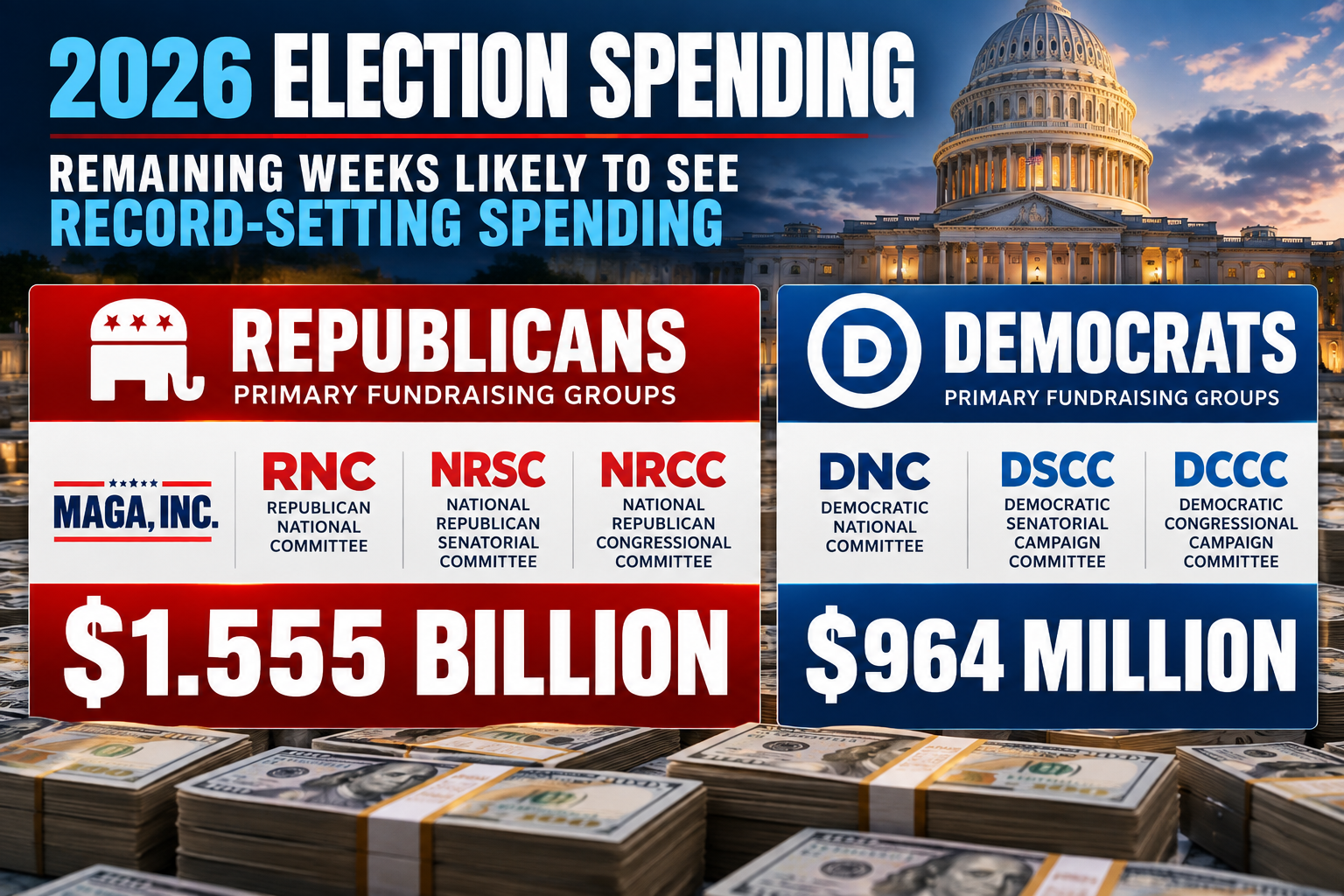
Among the major presidential and party committees, Republicans are led by President Trump’s MAGA, Inc., along with the Republican National Committee (RNC), the National Republican Senatorial Committee (NRSC), and the National Republican Congressional Committee (NRCC). Democrats counter with the Democratic National Committee (DNC), the Democratic Senatorial Campaign Committee (DSCC), and the Democratic Congressional Campaign Committee (DCCC).

Each party also benefits from major outside spending arms aligned with congressional leadership: the Senate Leadership Fund and Congressional Leadership Fund on the Republican side, and the Senate Majority PAC and House Majority PAC for Democrats.

Collectively, these committees have raised more than $2.5 billion in the current election cycle. The largest single entity is President Trump’s MAGA, Inc., which reported an extraordinary $424,389,502 raised through the Aug. 31 monthly filing. The RNC follows with $316,215,037. In aggregate, Republican committees have taken in $1.555 billion for the 2026 cycle, compared to $964 million for the Democratic committees.

Democrats, however, have been the more aggressive early spenders. Across all major party and party‑affiliated committees, Republicans report a combined cash‑on‑hand total of $1.029 billion, while Democrats hold 38 percent of the GOP total: $392 million.

All financial figures come from committee disclosure reports filed on Aug. 31, except those from the Senate Leadership Fund, Congressional Leadership Fund, and Senate Majority PAC, whose next reporting deadline is Sept. 30, with public access beginning Oct. 15.

Another major funding channel for both parties is their online donor platforms, which serve as conduits for small‑dollar contributions to individual campaigns. These entities act as holding companies, transferring funds to campaigns upon receipt. Though campaigns pay significant fees for the service, they benefit from streamlined fundraising without major overhead.

In this arena, Democrats dominate. Despite ActBlue — the party’s flagship online fundraising platform — facing a congressional investigation over potential foreign contributions and other alleged irregularities, and its leaders invoking their Fifth Amendment rights before congressional committees, the organization continues to operate at full speed.

In this cycle, ActBlue has transferred an extraordinary $2.26 billion to Democratic Senate and House candidates. The Republican counterpart, WINRED, has moved more than $748 million to GOP candidates, or 33 percent of Act Blue’s total.

Even with the significant Democratic advantage in online fundraising, the umbrella Republican apparatus still maintains a $564 million overall financial edge. The next question is how the GOP intends to deploy these resources. The first major answers come in Texas and Ohio.

According to AdImpact, the Senate Leadership Fund — through its Texas affiliate — is reserving $100 million in advertising to support Republican Senate nominee Ken Paxton against Democratic state Rep. James Talarico of Austin. The investment is critical for Paxton, whose campaign reported just $1.75 million in cash on hand as of June 30, compared to Talarico’s $21.5 million.

AdImpact also reports that Ohio Sen. Jon Husted’s campaign is positioned to outspend former Democratic Sen. Sherrod Brown by a $90 million to $60.2 million margin in reserved ad time, not including a newly announced $30 million expenditure from the cryptocurrency‑aligned Super PAC Fairshake.

Fairshake spent heavily in 2024 to help defeat Sen. Brown, who, as chairman of the Senate Banking Committee, was one of Washington’s most outspoken cryptocurrency critics.

The remaining weeks of the 2026 election cycle are likely to see record‑setting spending. This cycle has already established a new fundraising benchmark, but it will almost certainly be surpassed, and in short order.

Expect the 2028 presidential cycle to be the most expensive in American campaign history — and the gap between first and second place election cycle spending will not even be close.

A December New Hampshire Primary?

Earlier this week, New Hampshire Secretary of State Bill Gardner indicated that he might consider setting a Presidential primary date as early as Dec. 6 unless Nevada moves back the date of its caucuses to January 17th or later.

Gardner, who has set the date of New Hampshire’s “first-in-the-nation” primary since 1976, issued a memo on Wednesday calling both Tuesday, Dec. 6, and Tuesday, Dec. 13, “realistic options” unless Nevada agrees to its nomination contests after Jan. 17.

Florida’s recent rescheduling of its primary to Jan. 31, which we reported in our Oct. 3 edition, is the action that set the dominoes in motion. As a result of the Sunshine State’s action, Iowa, Nevada and South Carolina have all moved up the dates of their primaries to maintain their status — in that order — as the first nominating contests in the 2012 cycle. Gardner has sent an early signal that the New Hampshire date will be significantly earlier by moving up the Granite State’s candidate filing period to open on Oct. 17 and close 11 days later on Oct. 28.

South Carolina has set its primary for Jan. 21, and Nevada officials have already set its caucus for Jan. 14. Iowa officials have indicated that Jan. 3 is going to be the date of the nation’s first caucus.

Gardner is bound by a New Hampshire state law requiring the Secretary of State to set their primary at least one week before any other nominating contest that would undercut the state’s much cherished “first-in-the-nation” primary status.

Gardner’s memo clearly states, “If Nevada does not adjust its caucus date to a later time, I cannot rule out the possibility of a December primary.”

Gardner subsequently told news organizations that he will not set the presidential primary date until sometime after Oct. 17.

“When I set the date, I will explain all the reasons why it ends up on that date. It’s not my preference to put it in December. The problem is all of our choices are bad choices. I just want to be pick the best of the bad,” he told NBC News last Friday.

As we reported on Oct. 3., Florida’s move, which set off this chain reaction, to change its primary date to Jan. 31 in violation of Republican National Committee rules looks to drastically alter the GOP presidential nomination fight. Under RNC rules, the only states permitted to conduct a delegate selection event prior to the March 6th Super Tuesday date are Iowa, New Hampshire, Nevada, and South Carolina. Florida is willing to accept penalties that will reduce their 99 member Republican National Committee delegation to approximately 50, coupled with other sanctions, in order to make the move.

But accepting intra-party punishment is not the only factor involved in altering their election schedule. Under the Voting Rights Act, all or parts of 16 states are subjected to federal approval of all electoral moves, including primary/caucus date selection. Therefore, it is the Obama Justice Department that will have to grant Florida, New Hampshire, and South Carolina “preclearance” or, in this case, permission to schedule a nominating event in January 2012. Only Iowa and Nevada, in this group of five states, may move unencumbered because they are not part of the group of 16.

At this stage, it’s anybody’s guess how this calendar hopping might affect the outcome of these early nominating contests, but clearly the present front-runners, especially Mitt Romney, who polls show has now opened up a large lead over the rest of the Republican field, might like the nominations to be held sooner rather than later. This way, the vote will occur before the recently fickle GOP primary electorate has a chance to change its mind again.

Muscial Chairs Again

In 2008, states began climbing over each other in order to obtain a better schedule for their own presidential nominating event, whether it be by caucus or primary. Places like Florida moved into a more prominent position, defying party rules, and were penalized half of their delegate slots, among other perks, at the respective national conventions. Saturday, the deadline for states to inform the Republican National Committee about their primary or caucus schedule will finally give us the opportunity of seeing how the primary/caucus calendar will unfold. Under RNC rules, only Iowa, New Hampshire, Nevada and South Carolina are allowed to conduct delegate selection events prior to Super Tuesday, which, in 2012, is March 6.

The Florida commission charged with selecting the Republican primary date is already indicating they may choose Jan. 31 for their primary vote at their meeting tomorrow afternoon, in direct violation of RNC rules. Such a move will cost them half of their 99 Republican National Convention delegates. Should they move in this direction, watch Iowa, New Hampshire, Nevada, and South Carolina all move to an early or mid-January date. This will again drastically change each candidate’s campaign strategy, and the short calendar will make each early victory all the more important in terms of political momentum.

Interestingly, should the early states split their votes and different candidates win the first caucuses and primaries, then the late states will ultimately find themselves holding all the political cards, and with their full complement of delegates. If no clear leader emerges from the early states, then the bigger late states like Pennsylvania, Ohio, Texas and California will have a much greater say in determining who becomes the Republican nominee. With the nominating schedule finally being set on Saturday, the official calendar could tell us a great deal about who may become the eventual winner.