Category Archives: MISSOURI

Gov. McKee Loses in Rhode Island;
More Missouri Redistricting Chaos

By Jim Ellis — Thursday, September 10, 2026

Rhode Island

Rhode Island Democratic Gov. Dan McKee

As polling had been forecasting for months, Rhode Island Democratic Gov. Dan McKee last night became the first Ocean State chief executive in 30 years to lose renomination. He fell to former CVS corporation executive Helena Foulkes by a landslide 62-38 percent margin in the state’s primary election.

Gov. McKee is the 14th incumbent and first Governor to lose renomination in the current election cycle. A total of 11 House members along with two Senators failed to win their party primary. The defeats are bipartisan as eight Democrats and six Republicans lost to intra-party opponents.

Gov. McKee had trailed badly throughout the year. Many observers point to the prolonged construction on Providence’s Washington Bridge, a major Interstate I-195 artery linking the capital city to East Providence. With more than 60 percent of Rhode Island’s population living in Providence County, the closure of the westbound lanes at the end of 2023 – engineers warned of structural concerns – became a persistent political liability. The Governor’s office estimates the project still won’t be completed until 2028.

Lt. Gov. Dan McKee ascended to the governorship in 2021 when then‑Gov. Gina Raimondo (D) resigned to become US Commerce Secretary in the Biden Administration. The following year, McKee narrowly won a three‑way Democratic primary, defeating Foulkes and then-Secretary of State Nellie Gorbea with a 33-30-26 percent split.

Four years later, the Governor couldn’t increase his support base beyond his initial victory percentage. His political standing deteriorated to the point that even the Rhode Island Democratic Party declined to endorse its own incumbent.

Foulkes, the niece of former Connecticut Sen. Christopher Dodd (D), will now have an easy run in the general election in a state where Democrats dominate. The Republican gubernatorial primary has still not been called as we see a close race between trade association executive Aaron Guckian and magazine publisher Elaine Pelino.

In the Senate race, five‑term incumbent Jack Reed scored another landslide renomination victory, taking 77 percent against two under‑funded Democratic challengers. The Senator is well positioned to win a sixth term in November.

Both of Rhode Island’s US House members, Reps. Gabe Amo (D‑Providence) and Seth Magaziner (D‑Cranston), ran unopposed for renomination and are heavy favorites in the general election.

The 2026 primary season concludes next Tuesday in Delaware.

Missouri

Just when it appeared that Missouri’s congressional redistricting saga had finally reached its conclusion – after US Supreme Court Associate Justice Brett Kavanaugh denied the state’s appeal of a Missouri Supreme Court ruling disqualifying the new Republican map – another chapter is developing.

Justice Kavanaugh, who administers emergency matters for the 8th Circuit, ruled that the ballot initiative to approve or overturn the congressional map may appear on the November ballot. Under Missouri procedure, any qualified initiative that could alter a proposed law suspends that law until voters decide its fate; therefore, the 2026 congressional map is suspended.

Complicating matters further, US District Judge Stephen Clark issued a separate ruling barring the state from reverting to the 2022 map.

His decision came in response to a lawsuit filed by Rep. Bob Onder (R-Augusta) and state Sen. Rick Brattin (R-Kansas City), who argued that voters participating in the Aug. 4 primary under the new map would be disenfranchised if district lines were changed afterward. Judge Clark agreed with the plaintiffs’ argument and blocked the state from reinstating the 2022 boundaries.

Onder represents Missouri’s 3rd District, and Brattin is the Republican nominee in the 5th District – the seat Republicans expect to flip under the 2026 map. If the 2022 map were to be restored, the 5th District would likely revert to veteran Democratic Rep. Emanuel Cleaver (D-Kansas City).

Election officials now face conflicting directives. The Missouri Supreme Court insists the 2022 map must be used, while the federal ruling states that only the 2026 map is permissible.

The organization People Not Politicians, which spearheaded the ballot initiative, immediately appealed to the 8th Circuit Court of Appeals, but the appellate court has declined to act on the motion. As a result, the dispute is likely to return to Justice Kavanaugh.

The conflict must be resolved before Sept. 19, the deadline for Missouri to deliver ballots to overseas voters under federal law.

Two Key Races Develop in NH Primary; Missouri Map Out

By Jim Ellis — Wednesday, September 9, 2026

New Hampshire

Granite State voters chose their nominees last night, and two contests important to the national political landscape in November are now set.

In the Senate race, as expected, Rep. Chris Pappas (D-Manchester) and former Sen. John E. Sununu (R) easily won their respective primaries and will meet in a shortened general election campaign. Rep. Pappas defeated scientist and far left activist Karishma Manzur, 65-33 percent, a result roughly in line with pre election polling.

Sununu posted an even larger victory over former Massachusetts Senator and 2014 New Hampshire GOP Senate nominee Scott Brown, 68-27 percent in the Republican primary.

Early general election polling suggests a competitive race. Though Democrats have held a consistent advantage in New Hampshire for much of this century, the Sununu family has also performed strongly statewide; John Sununu’s brother, Chris Sununu (R), for example, won four consecutive two year gubernatorial terms before retiring in 2024.

In the state’s closely watched 1st Congressional District, former Portsmouth City Councilwoman Stefany Shaheen – daughter of retiring Sen. Jeanne Shaheen (D) – appears to have eked out a narrow 37-35 percent victory with several thousand ballots still outstanding. While the remaining votes could theoretically shift the outcome, it would be difficult for former Biden Administration official Maura Sullivan to overcome Shaheen’s advantage. The tight margin is notable: the Shaheen name has been a fixture in New Hampshire politics for decades, so a narrow win in a Democratic primary represents an under performance relative to historical expectations.

On the Republican side, automobile business owner Anthony DiLorenzo scored a decisive victory, winning a majority of the vote and defeating former New Hampshire Republican Party Vice Chair Hollie Neveletsky by a 52-26 percent spread.

Although the 1st District has long been considered competitive, Rep. Pappas secured the seat for the Democrats through four consecutive terms. Prior to Pappas first winning here in 2018, the last time the 1st District electorate re-elected an incumbent came in 2004. Based upon the most recent electoral trends, Stefany Shaheen begins the general election with a substantial advantage.

In the 2nd District, the expected rematch materialized: Rep. Maggie Goodlander (D-Nashua) and 2024 Republican nominee Lily Tang Williams each won easy primary victories. Rep. Goodlander enters November as the clear favorite to retain the seat.

The gubernatorial primaries also unfolded without suspense. Gov. Kelly Ayotte won 91 percent of the vote in the Republican contest, while former Executive Councilor Cinde Warmington was unopposed for the Democratic nomination. Gov. Ayotte begins the general election as the favorite to secure a second two-year term.

Statewide primary turnout, driven largely by strong participation in the 1st District, clearly favored Democrats. Approximately 57 percent of all ballots cast yesterday were in the Democratic primary.

Missouri

In an emergency ruling issued due to the compressed election timetable, Associate Justice Brett Kavanaugh, who serves as the presiding justice for both the 6th and 8th Circuits, encompassing Michigan and Missouri, yesterday rejected Missouri’s appeal of a state Supreme Court decision disqualifying the new congressional map.

Justice Kavanaugh had previously ruled on a Michigan case that closely resembled the Missouri situation: in both states, ballot initiatives appeared to meet the statutory requirements for ballot placement, but election officials denied certification.

The two rulings, however, appeared inconsistent. Justice Kavanaugh declined to allow the Americans for Citizen Voting organization’s proof of citizenship measure onto the Michigan ballot yet permitted the Missouri initiative – seeking voter approval or rejection of the state’s new congressional map – to proceed. In both instances, he provided no explanation for his decisions.

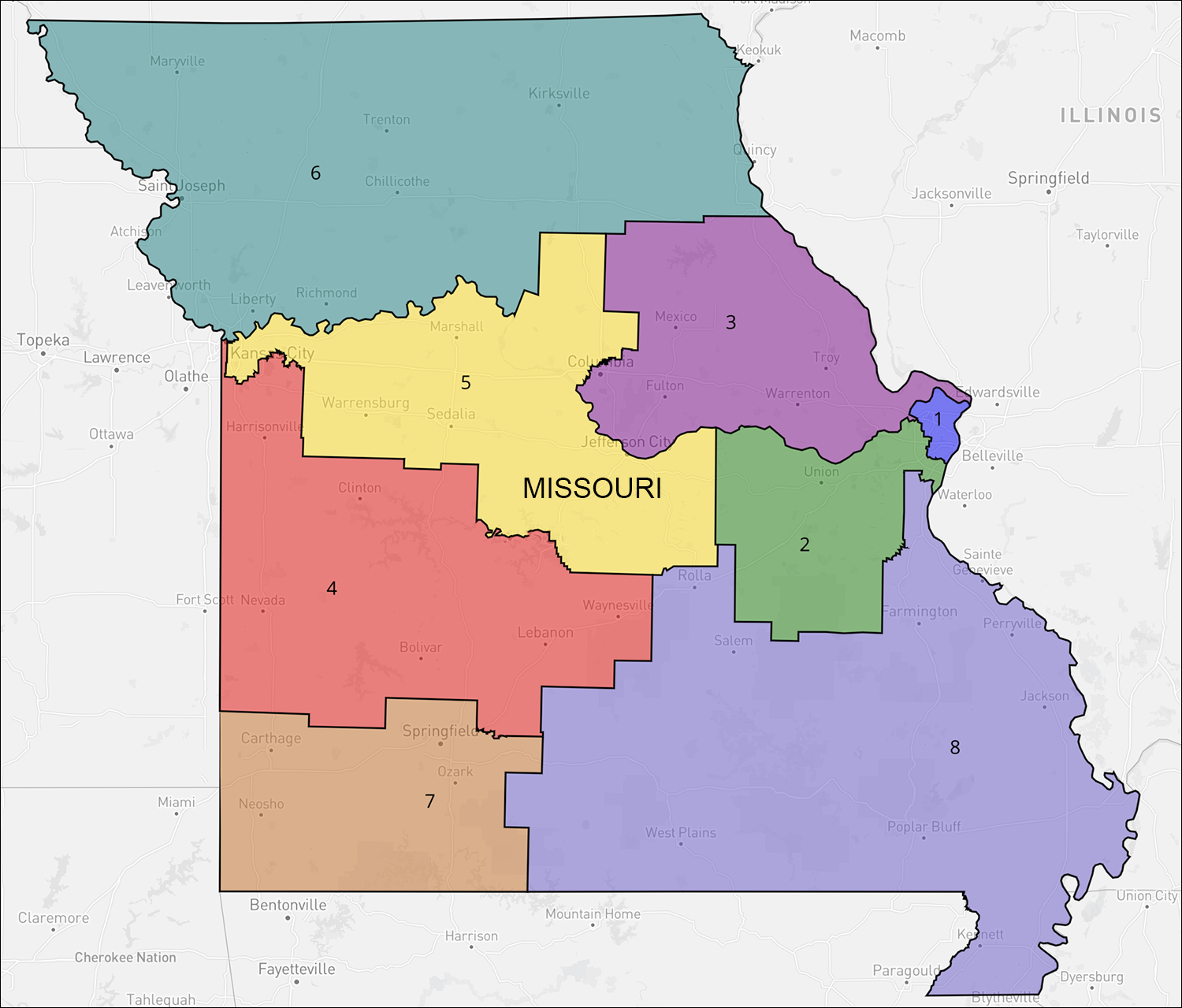
The final outcome leaves the new 2026 Missouri map disqualified and reinstates the 2022 congressional boundaries. As a result, Republicans lose the opportunity to convert the Kansas City-anchored 5th District. Because the 2026 congressional nominees were chosen under the now invalidated map, the state must determine how to select nominees under the restored 2022 lines. Complicating matters further, it remains unclear which state official or entity has the authority to make such determinations.

With statutory deadlines rapidly approaching, Missouri faces significant time pressure to comply with its election laws, meaning nomination decisions will need to be made quickly.

Missouri Map Disqualified

To see an interactive version of this map, go to: Dave’s Redistricting App.

By Jim Ellis — Tuesday, September 8, 2026

Redistricting

Just when it appeared that redistricting litigation had ended for the 2026 election cycle, the Missouri Supreme Court late last week ruled that Secretary of State Denny Hoskins (R) lacked the authority to reject a ballot initiative allowing voters to approve or reject the state’s new congressional map.

According to a comprehensive report from The Down Ballot political blog, Secretary Hoskins had argued that the state constitution “does not authorize” an initiative on congressional redistricting. The court unanimously rejected that position, holding that the Missouri constitution does not prohibit citizens from bringing an initiative on any subject. The justices further ruled that this particular initiative was “legal, sufficient, and timely.”

Missouri Attorney General Catherine Hanaway (R) announced she will immediately appeal the ruling to the US Supreme Court. On Sept. 3, the high court denied an emergency motion from the Michigan‑based organization American for Citizens Voting, which had petitioned the justices to place a proof‑of‑citizenship ballot measure before voters.

As in the Missouri case, the Citizens Voting group had collected well above the required number of signatures to qualify for the ballot, but election officials refused to certify the initiative. The Court offered no explanation for its denial, prompting AG Hanaway to seek a similar ruling on her appeal.

Conversely, if the federal high court takes no action, the newly adopted congressional map – one that would almost certainly have delivered Republicans the Kansas City-anchored seat of Rep. Emanuel Cleaver (D) – is suspended. The Missouri court also reinstated the previous map, under which Rep. Cleaver’s 5th District remains safely Democratic.

What the state court did not address is how to resolve the fact that nominees have already been elected under the now‑disqualified map in the Aug. 4 primary. Missouri will have to account in some manner for the fact that it has congressional nominees in districts that no longer legally exist. The situation is especially difficult because the Missouri ballot certification deadline of Aug. 25 for the Nov. 3 general election has already passed.

It is also unclear who has the authority to decide how replacement nominees should be chosen. Reports suggest “election officials” would determine the new nomination process, but that term is undefined. Would the decision fall to the Secretary of State? The Governor? The Attorney General? Would the legislature be called into special session to enact a remedy? These questions must be resolved before the elections can proceed.

Several electoral options are being discussed. One would be to hold a new primary concurrent with the general election in a jungle format. If no candidate receives a majority, a runoff would be held in early December. Louisiana has adopted this approach because it faces a similar situation.

Another possibility is to conduct partisan primaries on Election Day, followed by a special general election in December. A third option is to rely on state law allowing political parties to appoint nominees when a vacancy occurs.

Yet another suggestion is to assign each nominee to the district number in which they originally ran. While administratively simple, that approach would likely invite litigation because it substitutes an appointed decision for the voters’ and/or parties’ expressed preferences.

Furthermore, the ballot certification process itself poses a major logistical obstacle. Because the certification deadline has already passed, ballot printing is underway. The timeline is further compressed by Missouri’s early‑voting commencement date of Oct. 20.

Additionally, Missouri, like all other states, must comply with the federal Uniformed and Overseas Citizens Absentee Voting Act (UOCAVA), which requires that individuals covered under the act have 45 days official notice before an election. For 2026, affected voters must receive notice beginning Sept. 19.

Once again, a late‑cycle court ruling has placed election administrators in an extremely difficult position as they attempt to meet their legal obligations. What happens next remains uncertain.

Redistricting Review, Post Virginia

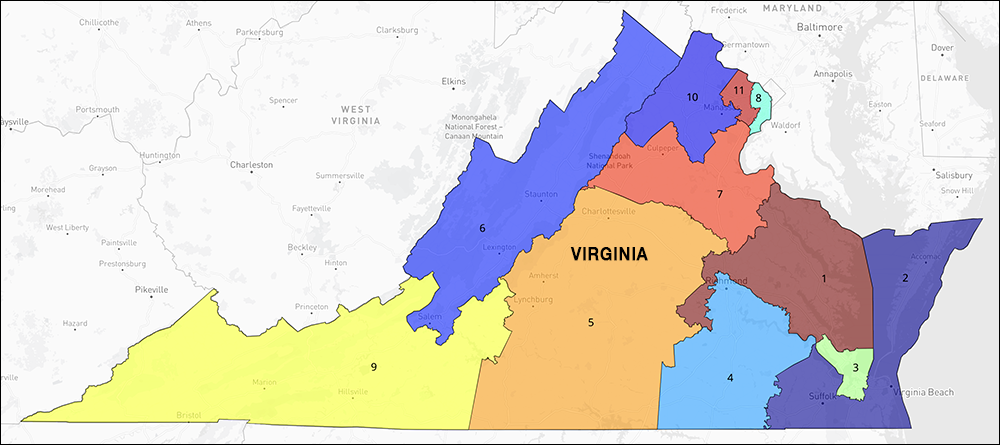
Virginia Congressional Districts / Dave’s Redistricting App (6D-5R map)

By Jim Ellis — Monday, May 11, 2026

The Virginia state Supreme Court decision to uphold the lower court ruling, finding that the legislature violated its own rules by rushing a referendum onto the ballot and, in the process, violated the Old Dominion Constitution, has significantly altered the outlook for the House midterm elections.

Instead of the cumulative effect of the new congressional maps being largely a wash, with neither party gaining a significant number of seats, Republicans are now positioned to net between 8 and 12 seats. Added to their current 220 seats, the new maps could expand their current prospective majority to more than 230 seats.

The following is an update on where the affected states stand in terms of 2026 electoral outlook under the new congressional maps, Starting with Virginia first:

Virginia

On Friday last week, the state Supreme Court invalidated the statewide redistricting referendum vote, upholding the lower court ruling that said the legislature violated its own rules and the state constitution in rushing the referendum to the ballot. While congressional redistricting is now effectively closed for this year here, meaning the 6D-5R map will remain in place for the 2026 elections, the process could be revisited in time to produce a new Virginia map for the 2028 cycle.

Certainly, the state Supreme Court ruling is a big win for Republicans, but the victory is likely to be short lived. For 2026, however, expect all Virginia incumbents to be favored for re-election.

California; Texas

The nation’s two most populous states became the focal points of the early redistricting battles, with party leaders in both parties predicting that their new maps would yield a net gain of five seats for their respective parties.

A closer examination of the partisan data and voting histories in the affected areas, however, suggests that gaining five seats under these new maps may be ambitious. What does appear likely, however, whether the eventual gain is three, four, or five seats, is that the two states will largely cancel each other out in terms of national seat gains.

Alabama

After the US Supreme Court’s ruling in the Callais v. Louisiana established clearer criteria for the construction of minority districts, the Alabama legislature reinstated a congressional map it had originally passed in 2023, only to have it later struck down by a court as a partisan gerrymander. Under the Supreme Court’s new directive, however, the plan could no longer be characterized as a racial gerrymander.

There is one remaining legal hurdle for the map to overcome, so it is possible that Gov. Kay Ivey (R) could suspend the congressional primaries until the map issue is resolved. Campaigns competing in the regularly scheduled May 19 primary for other offices would likely still be allowed to proceed.

The 2023 map would eliminate the majority minority 2nd District that a previous court had ordered drawn. Assuming no further legal complications arise, Alabama’s congressional delegation would likely revert to a 6R-1D partisan split. Rep. Shomari Figures’ (D-Montgomery) 2nd District would be dismantled and shifted back into southeastern Alabama, like its configuration during the previous decade.

Florida

The new Florida map has cleared the legislative process and now must face a legal challenge before the state Supreme Court. The plaintiffs are expected to file suit pertaining to the state ballot initiative voters approved to establish criteria for drawing legislative and congressional districts.

It is probable the court will rule that the map, which is predicted to net the Republicans three to four seats, is a partisan gerrymander with a projected 24R-4D partisan split; but other provisions of the voter-passed initiative may violate the SCOTUS’ Louisiana ruling. But the new map will likely stand for now, and net the GOP three to four seats.

Louisiana

The Bayou State is at the center of the determinative racial gerrymandering ruling, and Louisiana is now moving toward adopting a new congressional map that would produce a 5R-1D partisan split; thus, returning to the configuration that existed before the series of court rulings that ultimately reached the US Supreme Court.

The new map is reportedly being designed to preserve a Baton Rouge-anchored seat for Rep. Cleo Fields (D) while eliminating the New Orleans-based district that Rep. Troy Carter (D) currently holds.

Mississippi

Gov. Tate Reeves (R) has called a special redistricting legislative session, but only for the purpose of redrawing the state’s Supreme Court districts.

With the primary election already held on March 10, ordering a new round of congressional redistricting would effectively invalidate the 2026 primary, requiring all candidates to re-file and compete under a revised map. As a result, it appears unlikely that Mississippi congressional redistricting will take place in 2026.

Missouri

The Missouri map was enacted months ago, but opponents gathered enough signatures to qualify a repeal initiative for the ballot. The Missouri Supreme Court is now considering whether to stay the new map pending the vote or allow it to remain in effect for the 2026 election cycle. In the meantime, candidates have already filed under the current district lines.

If the map is allowed to stand, Republicans are expected to gain one seat in the delegation at the expense of veteran Rep. Emanuel Cleaver (D-Kansas City), though the Congressman has already filed for re-election. According to the Dave’s Redistricting App statisticians, the new 5th District has a partisan lean of 56.6R – 41.1D.

North Carolina

The Tar Heel State was among the first to complete the redistricting process, and the new congressional map will stand. The revised plan effectively shifts one district from Democratic to Republican control. Rep. Don Davis (D-Snow Hill) now sees his eastern North Carolina district move from a lean Democratic seat to one that is likely to favor a Republican in the general election.

In 2024, Rep. Davis won re-election by a margin of less than 1.5 percentage points. Retired Army officer Laurie Buckhout (R) is returning for a rematch, and this time the political landscape is more favorable to her chances of unseating the Congressman. With North Carolina’s primary having been held on March 3, the general election field is now set, and campaigning is underway.

South Carolina

While Gov. Henry McMaster (R) has said he would not call the legislature into a special redistricting session, lawmakers — still meeting in regular session — are moving forward with efforts to redraw the state’s congressional map.

Because the session is nearing adjournment, new legislation, including any proposal to adopt a revised congressional redistricting plan, would require a two-thirds vote of members to be added to the legislative calendar.

Republicans believe they have the votes to advance a 7R-0D plan from the House of Representatives, though they may be slightly short of the necessary support in the state Senate. If the new redistricting map is to pass, it will need to do so this week.

Tennessee

The Tennessee legislature and Governor passed a new 9R-0D congressional map soon after the Supreme Court ruled on the Louisiana racial gerrymandering case. With the Tennessee primary not scheduled until Aug. 6, the new map will stand. As a result, Rep. Steve Cohen (D-Memphis), the state’s only remaining Democratic member of the House, faces long odds of returning to the next Congress.

Utah

Months ago, the Utah court system invalidated the state’s 4R–0D congressional map, ruling that the legislature had disregarded voter-approved criteria for drawing district boundaries. As a result, the courts imposed a new map that creates a Salt Lake City–based district that Democrats are expected to win. Overall, Utah’s redistricting is projected to result in a net gain of one Democratic seat.

The New Missouri Lines

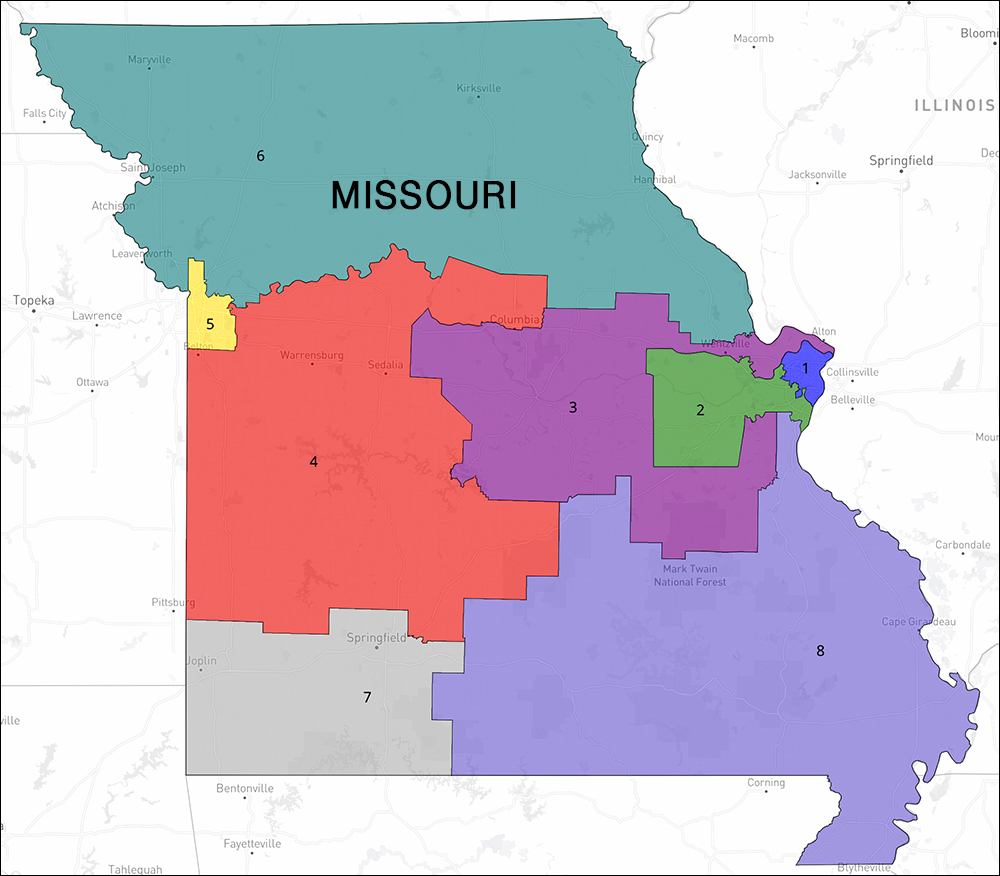
Missouri Congressional Districts / Click on image to go to Dave’s Redistricting interactive map.


By Jim Ellis — Monday, Oct. 6, 2025

Redistricting

Missouri Gov. Mike Kehoe (R) signed the legislature’s new congressional redistricting map this week, so it appears that the Show Me State delegation will compete in new districts next year.

Naturally, lawsuits are being filed to nullify the new map, and it remains to be seen how the courts will rule through the continuing legal process. Depending upon the lawsuit’s subject matter, the Louisiana racial gerrymandering case before the US Supreme Court could have an effect upon future Missouri map rulings. Oral arguments for the Louisiana case are scheduled for Oct. 15, with a decision to come before the year ends.

The new Missouri map protects all six GOP incumbents, though most shed Republican voters in order to create a new western Republican 5th District. At the heart of the new plan is changing the Kansas City area to create a new Republican leaning seat instead of 11-term Rep. Emanuel Cleaver’s (D-Kansas City) urban downtown district.

To make the plan work for the GOP, the map drawers expanded the 4th District’s Jackson County share, including drawing the seat directly into Kansas City. Previously, the 4th contained part of Jackson County but none of Kansas City. The design then drives the new 5th CD into rural areas, while still keeping a large portion of Kansas City. The new draw then extends the seat east all the way past Jefferson City, meaning the 5th district’s eastern boundary is now closer to St. Louis than Kansas City.

The new partisan lean of 58.4R – 40.1D (Dave’s Redistricting App calculations) is quite different from the previous 5th’s 60.8D – 35.9R division. The difference is a net swing of 43.2 percentage points in the Republicans’ favor.

Though the new 5th District appears reliably Republican, Kansas City Mayor Quinton Lucas (D) indicated he might consider running for Congress there, believing the seat will still be competitive and assuming 80-year-old Rep. Cleaver does not seek re-election. The Mayor indicated he wants to ensure that “Kansas Citians … have a choice at the ballot box that represents Kansas City viewpoints and values.”

The 4th District alterations are also substantial. According to the Dave’s Redistricting App calculations, the new partisan lean is 59.9R – 38.7D. The previous 4th held a partisan break of 66.8R – 29.9D under the same projection formula, so we see a net change of almost 16 percentage points toward the Democratic line.

Rep. Mark Alford’s (R-Lake Winnebago) 4th is still strongly Republican, and the Congressman will be a clear favorite to win re-election, but he may have to wage a more active campaign than he would have from his original 4th CD.

The remaining six districts all keep their population cores though the partisan leans change in some cases.

The 1st District is again largely the city of St. Louis, but the partisan lean has been made just slightly more Democratic. In the 2021 map, the partisan division was projected at 77.1D – 20.4R. The new 1st carries a 77.9D – 20.3R break. Here, we are likely to see a Democratic primary re-match.

Earlier in the week, former Rep. Cori Bush, who lost renomination in 2024, said she will return to face now-Congressman Wesley Bell (D-St. Louis). Irrespective of who prevails in next year’s Aug. 4 Dem primary, the winner will claim the new 1st in the general election.

Another Republican redraw goal was to improve Rep. Ann Wagner’s (R-Ballwin) re-election prospects in her St. Louis suburban 2nd District by adding more Republican voters. According to the Dave’s Redistricting App calculations, the new partisan lean is 54.9R – 43.4D, which is a further cushion of about a point and a half for the seven-term incumbent.

The Republicans from District 3 (freshman Rep. Bob Onder) and 6 (Rep. Sam Graves) both see their respective districts become slightly more Democratic, but the two seats remain firmly in the GOP camp and neither incumbent will have trouble being re-elected.

The two southern Missouri congressional seats, District 7 (Rep. Eric Burlison) and 8 (Rep. Jason Smith), actually see their two safe Republican seats become even more so under the new plan.

Assuming the new map withstands the legal challenges, expect the Republicans to see a net gain of one seat in the Missouri delegation.

Brooks Continues Momentum in Alabama; An Unusual Alaska Endorsement; Redistricting News

By Jim Ellis
May 23, 2022

Senate

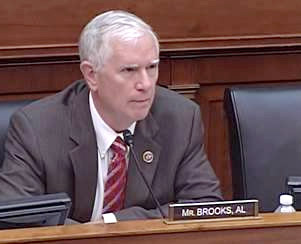
Alabama Rep. Mo Brooks (R-Huntsville)

Alabama: Brooks With Momentum — US Rep. Mo Brooks (R-Huntsville) continues to make strong strides to capture one of the two runoff positions in Tuesday’s primary election. All polling suggests that none of the three top candidates will reach the 50 percent plateau to claim the nomination outright. The latest survey, from the Cygnal research group for the Alabama Daily News and Gray Television (May 15-16; 634 likely Alabama Republican primary voters), sees Rep. Brooks moving past retired “Black Hawk Down” pilot Mike Durant, while knocking on race leader Katie Britt’s door.

The ballot test breaks 31-29-24 percent (Britt, Brooks, Durant) meaning that all three candidates still have the potential of qualifying for the two-person runoff. Tuesday’s vote will undoubtedly be close. The eventual Republican nominee is a lock to succeed retiring Sen. Richard Shelby (R) in November. The runoff election is scheduled for June 21.

House

AK-AL: Cross-Endorsing — Previously, the Alaska Republican Party endorsed businessman Nick Begich III in the special election to replace the late US Rep. Don Young (R-Ft. Yukon) over former governor and 2008 vice presidential nominee Sarah Palin (R). Now, we see another unusual endorsement. Begich is the grandson of the late US Rep. Nick Begich (D), who died in a plane crash in 1972. This led to Young winning the special election in 1973. While Nick Begich III is following in his family’s footsteps in running for public office, he is doing so as a Republican. This move now leads his uncle, former US Sen. Mark Begich (D), to endorse Anchorage Assemblyman Chris Constant (D) in the large field of 48 candidates instead of his nephew.

Under the new Alaska electoral system, four of the 48 candidates on the June 11 jungle primary ballot, regardless of party affiliation, will advance to the Aug. 16 special general election.

NY-17: Internal Dem Chaos — Assuming the presiding judge adopts the special master’s redistricting map, it appears that Democratic Congressional Campaign Committee chairman Sean Patrick Maloney (D-NY) has created a political hornet’s nest with his declaration that he would challenge freshman Rep. Mondaire Jones (D-Westchester County), who happens to be African American, in the new 17th District rather than compete for the seat directly to the north, the new 18th District. Rep. Maloney said he is running in the 17th because that is where the map placed his home, but a substantial part of his current constituency also lies in the new 18th.

Rep. Alexandria Ocasio-Cortez (D-Bronx) criticized Maloney saying, “I don’t think he should be DCCC chair if he’s going to challenge another member. It’s completely inappropriate.” Neighboring Rep. Jamaal Bowman (D-Yonkers) was more critical. He said Rep. Maloney is trying “to dismantle and tear down Black power in Congress” and should run in his own district (meaning District 18).

Redistricting

Missouri: Map Adopted — Gov. Mike Parson (R) signed the legislation enacting the new Missouri congressional districts. With that, now New Hampshire remains the only state that has not completed the re-mapping process. The Missouri map is largely an extension of the current eight-district plan and will likely continue to send six Republicans and two Democrats to Washington. Rep. Ann Wagner’s (R-Ballwin) 2nd District becomes more Republican, thus stabilizing her seat. Interestingly, the legislature did not change the candidate filing deadline of March 29, so no new individuals can enter the congressional races even though the district lines are somewhat different.

Governor

Alabama: Gov. Ivey Back Over 50 percent — A new Emerson College survey (May 15-16; 706 likely Alabama Republican primary voters; live interview; interactive voice response system; and text) tested the governor’s Republican primary. In another poll, Gov. Kay Ivey (R) had dropped below the 50 percent threshold, but Emerson finds her rebounding in this study. Here, she captures 53 percent support, while developer Tim James, son of former Gov. Fob James, posts 21 percent preference and ex-ambassador to Slovenia, Lindy Blanchard, records 13 percent. All other candidates fall into single digits.

Wrapping Up Redistricting

2022 Louisiana Congressional Redistricting Map (click on above map or here to go to an interactive version: Louisiana)

By Jim Ellis

April 1, 2022 — Looking at Wednesday’s redistricting finishing action in Louisiana and beyond, the only outstanding states in terms of drawing new congressional lines are Florida, Missouri, and New Hampshire. A total of 397 of the 435 districts nationwide have been completed, though many will eventually face legal action.

According to the FiveThirtyEight data organization, of the 397 districts, a total of 22 seats rate Even to D+5, with an additional 18 CDs categorized as D+6 through D+9. Of these combined 40 seats that statistics find at least slightly favoring the Democrats, Republicans hold seven. Conversely, the new maps yield a total of 14 Even to R+5 Republican districts, with another 16 rated as R+6 through R+9. In these 30 GOP-leaning seats, Democrats actually hold almost half, for a total of 13.

Members of the opposite party also hold five seats of 10-point partisan spreads or greater. Democrats claim three of the newly configured strong Republican seats in Arizona (Rep. Tom O’Halleran), Maine (Rep. Jared Golden) and Tennessee (Rep. Jim Cooper – retiring), while GOP members hold similarly stout Democratic CDs in California (Rep. David Valadao) and New York (Rep. John Katko – retiring).

It is clear the major competitive 2022 races will come from this aforementioned combined political universe of 75 seats.

Louisiana

For only the third time in state history, the Louisiana legislature voted to override a governor’s veto. The state Senate joined the state House Wednesday in voting to bypass Gov. John Bel Edwards’ (D) rejection of the new congressional map. The plan largely keeps the 5R-1D delegation split intact, with little change from the current map.

Gov. Edwards vetoed the bill, saying that a second black district can be drawn in and around the major population centers of New Orleans and the capital city of Baton Rouge. The override means the new map becomes law, but lawsuits can certainly be filed against the plan. Unless and until such is done and a court strikes the map down, the Louisiana 2022 redistricting cycle is now completed.

Maryland

The Maryland legislature is complying with the state judge’s schedule to return a less partisan map to the court. Senior Judge Lynne Battaglia last week struck down Maryland’s new congressional map as an “impermissible partisan gerrymander.”

Continue reading →