Tag Archives: South Carolina

Handel and Norman

By Jim Ellis

June 21, 2017 — It’s difficult to characterize a Republican candidate winning a Republican congressional district as an “upset”, but Karen Handel’s victory in the north Atlanta suburbs last night, at least in terms of the money spent, polling, and how the media covered the campaign, seems to qualify for such a description.

From a huge turnout of 259,622 voters, just about 58 percent of the entire registered 6th district universe and almost 50,000 more than participated in the last regular mid-term election, Handel, a former Georgia Secretary of State, topped Democratic filmmaker and ex-congressional aide Jon Ossoff by a 52-48 percent margin, a spread of 9,702 votes when all of the ballots were counted. She retains for the Republicans Health and Human Services Secretary Tom Price’s former congressional seat.

Simultaneously, over 200 miles away via Interstate 85 northeast of Atlanta in central South Carolina, Republican Ralph Norman claimed the evening’s other special congressional election with a surprisingly close 51-49 percent win over Democrat Archie Parnell from a small turnout of 87,840 voters. Office of Management & Budget Director Mick Mulvaney left open this seat to assume his national position.

The GA-6 contest, which became a national election because of the record amounts of money spent — an aggregate total that will likely exceed $50 million when the final accounting is published, and where the Democratic leadership virtually invested their entire special election season budget and emphasis — is now a crushing defeat for the party and what is termed the “anti-Trump resistance.”

Continue reading

Election Day Today

By Jim Ellis

June 20, 2017 — Voters in Georgia and South Carolina complete their special election processes today, with Republicans protecting both vacant US House seats and Democrats trying to make one of them a major national gain. The GA-6 and SC-5 seats of Trump Administration appointees Tom Price of Georgia and Mick Mulvaney from South Carolina have been vacant for months, but will have new representatives as tonight draws to a close.

GA-6

This is the big one. More than $40 million will be spent in the aggregate for this campaign, more money than ever expended for a single congressional contest. Democrats went “all in” on this contest at the beginning of the special election cycle, using President Trump’s 1.5 percentage point victory performance as a harbinger of a changing Republican district.

Polling shows the race between Democrat Jon Ossoff and Republican Karen Handel as being a dead heat. Ossoff has maintained a slight lead for most of the post-primary period, but the polling sample selections have often over-emphasized the 2016 presidential campaign, which has led to a greater number of Democratic respondents. This, plus the Republicans tending to under-poll in the South could give Handel a better chance than the pure numbers indicate.

Democrats are using this race as proof that they can sweep the mid-term elections, but GA-6 isn’t representative of their coming campaigns. First, they won’t be able to raise and spend $25 million for every congressional race in the 2018 cycle, so the financial aspect skews the outcome. Second, the Democratic spokespeople will make this result, should Ossoff win, a statement suggesting that the voting public is rejecting President Trump. This is only a surface argument because Ossoff’s public positions don’t often mention the chief executive, nor do they espouse liberal economic principles. Therefore, it is likely their post-election victory analysis won’t reflect Ossoff’s actual reasons for winning.

Continue reading

Unelecteds and Opens

By Jim Ellis

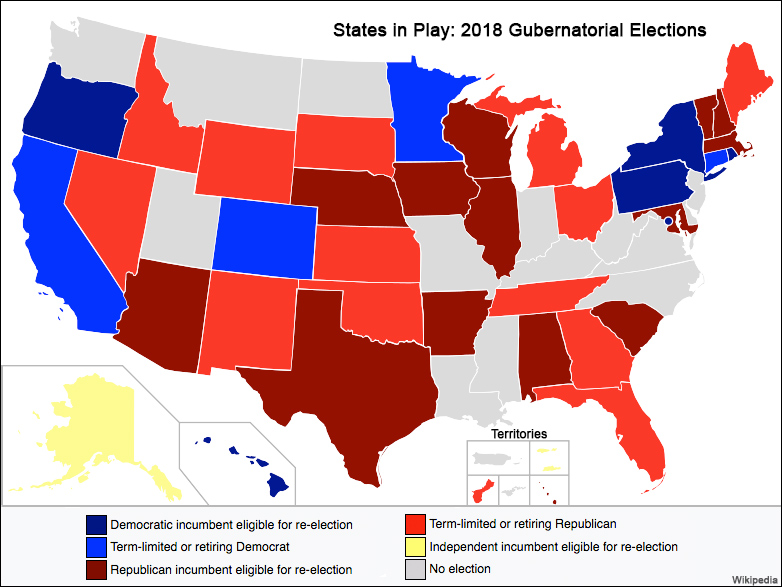
June 12, 2017 — It was always known that a large number of 2017-18 cycle governors’ races would be open contests, but finding several unelected incumbents running to hold their new positions is an unforeseen nuance.

In three states, and possibly soon a fourth, governors have been appointed to Trump administration positions or forced from office, thus allowing the lieutenant governor to move into the state’s top position.

South Carolina’s Nikki Haley, now UN Ambassador; Terry Branstad of Iowa becoming US Ambassador to China and Alabama Gov. Robert Bentley being forced from office for misappropriation of state funds have made Henry McMaster (SC), Kim Reynolds (IA), and Kay Ivey (AL) overnight governors. While on paper and in practice this is a big advantage for the former lieutenant governors in running for the state’s top position, none of them have easy campaign roads, and not even for their respective party nominations.

Last week’s announcement from Kansas Secretary of State Kris Kobach (R) that he will enter his state’s open gubernatorial contest next year may soon lead to him battling a new incumbent if on-again, off-again Washington, DC appointment rumors eventually prove true.

Speculation has abounded that President Trump will tap Gov. Sam Brownback (R-KS) for an open United Nations position, or another associated with foreign policy. Though such talk has been a subject of discussion since February and he has yet to be appointed, it is unclear if such will ever happen. Should it, however, then Secretary Kobach, oil businessman Wink Hartman, and ex-state Rep. Ed O’Malley will have to face a new sitting Republican governor, Jeff Colyer, the current lieutenant governor.

Continue reading

Utah’s Lightning Speed; Norman Wins

By Jim Ellis

May 23, 2017 — Utah Gov. Gary Herbert (R) just scheduled the special election to replace resigning Rep. Jason Chaffetz (R-Alpine/Sandy), and the candidate filing deadline will occur even before the congressman leaves office.

Chaffetz announced last week that he will resign from the House effective June 30. It was thought there would be a battle over the UT-3 special election process because Utah election law sets no procedure parameters. The state has not hosted a special federal election since 1930.

Utah election law merely says that a special election will be scheduled in the event of a vacancy. Some in the legislature are indicating that they need to be called into special session to determine the procedure, i.e., primary schedule, whether a nominating convention will be held, etc.

But over the weekend, Gov. Herbert usurped such an idea and had Lt. Gov. Spencer Cox (R) publicly announce the special election schedule.

Continue reading

Another Close One in SC-5;
Ohio Senate Decision

By Jim Ellis

May 18, 2017 — Tuesday’s special Republican SC-5 run-off election ended in almost as close a fashion as did the primary two weeks ago. Former South Carolina state representative and 2006 congressional nominee Ralph Norman has scored an apparent 203-vote victory over state House President Pro Tempore Tommy Pope. In the original May 2 vote, Pope nipped Norman by 135 cast ballots. Since no one was close to the majority mark, the secondary run-off election was thus necessitated.

The totals are unofficial, so a recount will likely be ordered, and it is not clear whether any absentee, provisional, or disputed ballots remain uncounted. Assuming the Norman margin holds, he will face Democrat Archie Parnell, a former Wall Street executive and congressional aide, in the special general vote scheduled for June 20. The winner of that election serves the balance of the current congressional term. The seat is vacant because former Rep. Mick Mulvaney (R-Lancaster/Rock Hill) resigned to become director of President Trump’s Office of Management & Budget.

In the primary, the two candidates not only spilt the district, but they virtually halved their joint home county of York, the dominant population center. Such was not the case Tuesday, as Pope carried the entity, where 54 percent of the entire district’s ballots were cast, by a 1,414-vote margin, substantially better than his 187 ballot spread in the primary.

Continue reading

South Carolina Run-off Numbers

By Jim Ellis

May 15, 2017 — Northern South Carolina Republican voters will go to the polls Tuesday to choose a special election nominee in the vacant 5th Congressional District run-off election. The June 20 special general winner will replace former Rep. Mick Mulvaney (R-Lancaster) who resigned from Congress to become Director of the Office of Management & Budget.

We remember the results from the special primary vote held 10 days ago that almost ended in a tie. Seven Republicans originally entered the GOP contest, and it quickly became clear that a two-week run-off period would be necessary to determine a final nominee. Few expected, however, that the original vote would come close to deadlocking.

https://youtu.be/R0KBL4rbTWs

State House Speaker Pro Tempore Tommy Pope (above) arguably began as the favorite for the nomination. Ironically, it is likely that he wouldn’t have even been a congressional candidate had not incumbent Gov. Nikki Haley (R) been appointed US Ambassador to the United Nations. The move allowed Lt. Gov. Henry McMaster (R) to ascend to the state’s top job where he can now run for a full term unencumbered by the term limit that would have ended Gov. Haley’s tenure. In an open seat situation, Pope intended to run for governor.

The second major candidate, state representative and former congressional nominee Ralph Norman (below) quickly jump-started his political effort by resigning from the legislature to go “all-in” for the congressional race. His campaign aggressiveness paid off as he drew virtually even with Pope in the primary vote.

https://youtu.be/e22ffDReSxM

Continue reading

SC Run-off and Outright Win

By Jim Ellis

May 4, 2017
— Voters went to the polls in South Carolina Tuesday to begin the nomination process in the special election to replace Office of Management & Budget director Mick Mulvaney. The results were as predicted.

For the Republicans, the two leading candidates going into the partisan primary, state House Speaker Pro Tempore Tommy Pope and former state representative and 2006 congressional nominee Ralph Norman, virtually tied in the final result. Pope finished first with only a 112-vote margin, scoring 30.5 percent in a field of seven Republican candidates. Norman’s percentage was 30.2.

The 5th District contains all or part of 11 north-central South Carolina counties. Both Pope and Norman hail from York County, the district’s largest population entity. There, Pope outdistanced Norman by 137 votes. That means the difference between the two was just 25 votes in the remaining 10 counties.

Turnout was 38,903 in the Republican primary with the Democrats adding an additional 18,573 who voted in their nomination contest. The total participation factor of 57,476 represented only 12.5 percent of the district’s registered voters. This number pales in comparison to the GA-6 turnout that exceeded 192,000, as we saw on April 18, but was much stronger than the Los Angeles special earlier last month that drew just under 29,000 voters.

Continue reading

South Carolina Special

By Jim Ellis

May 3, 2017 — Voters in north-central South Carolina’s 5th District cast ballots yesterday in partisan primaries as the people voted to choose a replacement for ex-Rep. Mick Mulvaney (R-Lancaster/Rock Hill), now director of the Office of Management and Budget.

Unlike the four previous special elections in California, Kansas, Montana, and Georgia, the Palmetto State neither holds a jungle primary nor a nominating convention. Just as in the regular election cycle, candidates first run in partisan primaries. If no one secures a majority in the first vote, partisan run-offs occur in a short two-week time frame under South Carolina election law. The eventual nominees then advance to the general election.

In a district that voted 57-39 percent for President Trump, and elected Rep. Mulvaney four times by an average of 57.6 percent of the vote, including his initial percentage when defeating veteran incumbent Rep. John Spratt (D) in 2010, the Republicans were heavy favorites to hold the seat in the current special election process.

Seven Republicans are on the ballot, and most observers agree that former state representative and 2006 congressional nominee Ralph Norman and state House Speaker Pro Tempore Tommy Pope were the two leading candidates. With five others on the ballot, it appeared unlikely that either Norman or Pope would command a majority of the primary vote, hence a May 16 GOP run-off was viewed as the likely outcome of yesterday’s voting.

Norman had the most in the way of funding, securing almost $600,000 according to the pre-primary Federal Election Commission filing report through the period ending April 12. Half of that amount was from a candidate loan, however. State Rep. Pope, who was planning to run for governor had not Lt. Gov. Henry McMaster (R) become the incumbent state chief executive when Gov. Nikki Haley (R) was appointed US Ambassador to the United Nations, had only banked $226,002 during the same period, which was a surprisingly low amount.

Both of these candidates have cut television ads, but more airings have been through the digital medium rather than the airwaves. (See below samples)

https://youtu.be/e22ffDReSxM

https://youtu.be/nBlzlU-DORU

Continue reading

Updating the Four Specials

By Jim Ellis

April 25, 2017 — Coming through the highly publicized GA-6 special election, the political overtime campaign season is hitting its stride as we approach May voting. In Georgia, South Carolina, Montana, and California, political action is now in full swing.

The GA-6 contest has eliminated all but finalists Jon Ossoff (D) and Karen Handel (R) in a race well on its way to becoming the most expensive congressional special election in American history. Right after last Tuesday’s vote, the Democratic Congressional Campaign Committee sponsored an initial post-primary $450,000 flash media buy, which was quickly followed by the National Republican Congressional Committee’s $250,000 airtime purchase.

While the two sides exceeded $16 million in pre-primary fundraising, it appears the special general spending pattern is already following suit to no one’s surprise. We can count on seeing very active campaigning here all the way to the June 20th special general vote.

Continue reading

New Apportionment Patterns

By Jim Ellis

March 27, 2017 — The Census Bureau released new population estimate data at the end of last week, and their information about the largest growth areas and places losing the most residents helps us project how the states will change in congressional representation. With almost four years remaining until reapportionment occurs at the end of 2020, much can still change, but the current population shift patterns provide some early clues as to what may be the future state gain/loss formula.

According to the Bureau’s new estimates, Maricopa County (Arizona) ended 2016 as the nation’s largest growing local entity replacing Harris County (Texas), which had been in the first position for the last eight consecutive years. The population estimates show that the Phoenix area gained 81,360 people from July 1, 2015 to the same date one year later. The Houston area net resident total increased 56,587 during the same period.

The calculations analyze the natural increase (number of births outpacing the number of deaths), net domestic migration, meaning those who move from one part of America to another, and net international migration figures (those coming from other countries). Maricopa County’s totals meant that an average of 222 new people came to or were born in the domain each and every day during the 2015-2016 yearly midpoints.

Continue reading