Tag Archives: Sen. Dianne Feinstein

Schiff Explores Senate Race; Valadao Re-Elected; House Candidate Filings

By Jim Ellis — Nov. 23, 2022

Senate

California Rep. Adam Schiff (D-Burbank)

California: Rep. Schiff Exploring Senate Race — With most people believing that Sen. Dianne Feinstein (D) will not seek re-election in 2024 when she will be 91 years of age, Southern California Rep. Adam Schiff (D-Burbank) said that he is considering launching a US Senate exploratory committee. Schiff is already in a battle to keep his seat on the Intelligence Committee after Rep. Kevin McCarthy (R-CA) — should he be elected Speaker — said that Schiff and Rep. Eric Swalwell (D-CA) would be removed from the panel.

Should Sen. Feinstein retire, we will see a strong Democratic battle to replace her. In California’s jungle primary system, it is likely that two Democrats would advance into the general election. One thing is certain: Rep. Schiff would be able to raise the money to compete. In his bid for re-election to the House in the current cycle, he raised more than $22 million.

House

CA-22: Rep. David Valadao Wins Re-election — The Associated Press, late Monday afternoon Pacific time, projected that Rep. David Valadao (R-Hanford) had defeated state Assemblyman Rudy Salas (D-Bakersfield) in their hard-fought congressional race. This, despite Rep. Valadao finishing a distant second on the jungle primary back in June when he received only 26 percent of the vote versus Salas’ 45 percent in a field of four candidates in the most Democratic congressional district in the country that elects a Republican to the House.

According to the California Secretary of State’s official count, Valadao held a 3,381 vote lead with just over 100,000 votes counted. Based upon the number of outstanding ballots and where they are from, the AP made the unofficial projection. The Valadao victory gives the Republicans 220 members in the new Congress as compared to 212 Democrats. Three races, two in California and one in Alaska, remain uncalled. Republicans lead in both Golden State races, Democrats in the Last Frontier.

NC-13: Hines Files 2024 Committee — The court-drawn North Carolina congressional map featured a new 13th District that contained the southern Raleigh suburbs, the city of Fayetteville, and Republican Johnston County, which made the CD a toss-up seat. Democratic state Sen. Wiley Nickel carried the district with a 52-48 percent margin, defeating Republican Bo Hines, who received the Trump endorsement in the GOP primary.

Hines, 27, was a former football player for North Carolina State University, but had no other particular ties to the region and actually planned to run in another district before this open seat was drawn. He filed a new 2024 committee on Monday, presumably sending signals that he intends to run again.

Hines did not receive particularly favorable marks as a candidate, and there is a good chance we will see a new North Carolina map drawn after the Supreme Court rules on the state’s partisan gerrymandering case before them. Even if Hines decides to run, he can expect heavy competition in the Republican primary before getting another opportunity of opposing Rep-Elect Nickel.

WV-2: State Treasurer Announces for House — Rep. Alex Mooney (R-Charles Town) already announcing that he will challenge Sen. Joe Manchin (D) in the next election year has ignited the first of what promises to be political musical chairs for what will be an open 2nd Congressional District. State Treasurer Riley Moore (R) announced his congressional candidacy Monday and is the first major candidate to enter the 2024 race. Rep. Mooney’s successor will likely be decided in the Republican primary in a seat that the FiveThirtyEight data organization rates as R+34.
Committee Continuity – Part II

By Jim Ellis

July 29, 2020 — Completing our two-part series on changes we may see on some key House and Senate committee panels, today we look at the financial, commerce, and legal committees.


SENATE COMMERCE, SCIENCE & TRANSPORTATION

Republicans – Just three of the 14 majority Republicans are on the ballot this year, and two are in competitive races. Colorado Sen. Cory Gardner (R) is in one of the most difficult campaigns in the country, while Alaska first-term incumbent Dan Sullivan (R) is a clear favorite to win in November despite early polling showing a potentially close race. There are no open seats among the Republican committee members.

Democrats – The Democrats have 12 members, and Washington Sen. Maria Cantwell would replace chairman Roger Wicker (R-MS) if her party assumes control in November.

The Dems also have just three of their Commerce Committee members in-cycle, and two are in competitive campaigns. First-term Sen. Gary Peters (D-MI) faces a difficult challenge from manufacturing company owner John James (R). Sen. Peters appears secure in polling now, but the race is likely to close. The contest was in toss-up mode before the COVID shutdown. The other competitive race is a Democratic primary, as Sen. Ed Markey faces a difficult toss-up challenge from Rep. Joe Kennedy III (D-Newton).


HOUSE ENERGY & COMMERCE

Democrats – This is one of the most important committees in the House, and majority Democrats hold a 31-24 advantage. The Dems are looking at four vacancies as Reps. Ben Ray Lujan (D-NM-3) and Joe Kennedy III (D-MA-4) are running for the Senate, Rep. David Loebsack (D-IA-2) is retiring, and Rep. Eliot Engel (D-NY-16) was defeated in the June 23 New York primary. Just one majority member, Rep. Tom O’Halleran (D-AZ-1), could face a competitive opponent. The Arizona primary is Aug. 4, and we will know more once we see who wins the Republican nomination.

Republicans – Six Republicans will leave the House at the end of this term, including Ranking Member Greg Walden (R-OR-2). Rep. Greg Gianforte (R-MT-AL) is running for governor, while Reps. John Shimkus (R-IL-15), Pete Olson (R-TX-22), Bill Flores (R-TX-17), and Susan Brooks (R-IN-5) are retiring. Michigan Reps. Fred Upton (R-MI-6) and Tim Walberg (R-MI-7) have credible opponents, and Shimkus, particularly, is embroiled in a tough race. Rep. Richard Hudson (R-NC-8) also has drawn an opponent of stature, but he remains a heavy favorite for re-election.
Continue reading

Feinstein Still Weak; Gas Tax Polling

By Jim Ellis

California Sen. Dianne Feinstein (D)

California Sen. Dianne Feinstein (D)

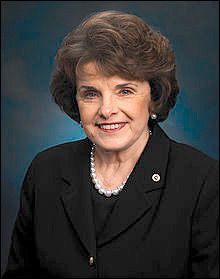
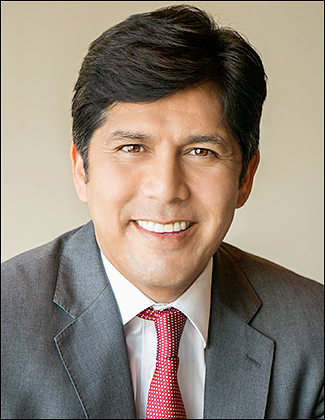
Oct. 18, 2018 — Survey USA released a poll of the California electorate, one more political study that finds Sen. Dianne Feinstein (D) failing to establish command in her race against fellow Democrat Kevin de Leon, a Los Angeles state senator.

The S-USA data (Oct. 12-14; 1,200 California adults; 964 registered California voters; 762 likely California voters) sees Feinstein again locked at 40 percent support versus 26 percent for de Leon. This is the sixth survey from four different pollsters that finds the Senator in the mid to low 40s since the June 5th jungle primary. But de Leon fares much worse, failing to break 30 percent in any of the half-dozen ballot test questions.

While all of the research suggests that Sen. Feinstein is politically weak, she will not lose this race. Though she brought in only $982,000 for the third quarter — a low number when campaigning in a state the size of California and understanding that many Democratic House candidates have brought in millions during the same period — de Leon raised just $254,000 and has a mere $309,000 cash-on-hand for the period ending Sept. 30. This is a low figure for a congressional race, let alone for a place that’s 53 times as large as a single CD.

California Senate President Kevin de Leon (D-Los Angeles)

California Senate President Kevin de Leon (D-Los Angeles)

The other feature potentially making the California Senate race a wild-card contest is the vote drop-off that we will see when comparing turnout for this office to the rest of the statewide ballot.

In 2016, when two Democrats were competing for an open Senate seat — the now-Sen. Kamala Harris vs. then-Rep. Loretta Sanchez (D-Garden Grove) — fewer votes were cast for that contest than in any other statewide election, including all of the ballot propositions. In fact, over 1.9 million more people voted in the presidential race than in the Senate race, and 1.3 million more chose to decide the last ballot initiative that banned single-use plastic bottles.

What occurred was a plethora of Republican voters simply skipping the Senate race rather than supporting one of the two Democrats. With de Leon running to the ideological left of Feinstein the Republican vote will likely drop even further, which becomes an interesting factor.

Continue reading

Senate Recap – Part I

By Jim Ellis

US Senate makeup

Current US Senate makeup

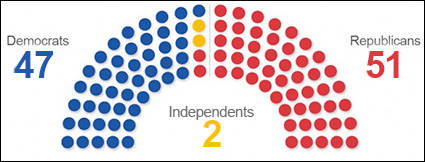
Sept. 21, 2018 — From the 35 US Senate in-cycle races it is clear that the major contests are narrowing to 16 competitive political battles. A 17th campaign, the one in California between Sen. Dianne Feinstein (D) and state Sen. Kevin de Leon (D-Los Angeles), is also competitive, at least to a degree, but since both candidates are Democrats the outcome will not alter the partisan composition. Therefore, the Golden State does not factor into the battle for the Senate majority.

Today, we look at eight of the races and provide a quick update on the latest developments. Concentrating on the 16, if Republicans win any four they will hold at least a bare majority.


ARIZONA

The race between Reps. Kyrsten Sinema (D-Phoenix) and Martha McSally (R-Tucson) has been flip flopping in the polls. Seven polls have been released in September. Rep. Sinema has led in five by an average of 3.4 percentage points. Rep. McSally took the lead in two surveys, with a mean of two percentage points.

A new independent group entitled Defend Arizona has launched a series of ads attacking Sinema that highlight previous statements advocating leniency for men who engage in child prostitution when the latter individual looks older than her age. How this line of attack will affect the race remains to be seen.


FLORIDA

Sen. Bill Nelson (D) is facing the strongest challenge of his career from Gov. Rick Scott (R). This race has been frequently polled, and no September study gives either man a lead of more than two points. Three polls project a Scott lead of one or two points. One survey gives Sen. Nelson a one-point edge, and a fifth study finds the two candidates deadlocked in a flat tie at 49 percent apiece.

Some believe that Tallahassee Mayor Andrew Gillum’s presence on the statewide ticket as the Democratic gubernatorial nominee will help Sen. Nelson, others believe it will hurt. Those arguing that Gillum helps say that he will increase minority turnout, and that Nelson will tangentially benefit because such voters would likely vote straight Democratic. Those believing Gillum is a negative indicate that he will be portrayed as being too far left, which could be an impetus to spur more conservatives to vote.


INDIANA

Sen. Joe Donnelly (D) faces former state representative and international businessman Mike Braun (R). Fox News conducted the only September poll in this race. Among likely voters, Braun had a two-point lead. But the registered voter universe tipped the scale toward Sen. Donnelly by a margin of just one point.

This is one more race that is a pure toss-up as we approach the last month of campaigning.


Continue reading

Sen. Feinstein Slips Below 40 Percent

California Sen. Dianne Feinstein (D)

California Sen. Dianne Feinstein (D)

By Jim Ellis

Sept. 10, 2018Sen. Dianne Feinstein (D) was first elected a California senator back in 1992 when she won a special election to fill Pete Wilson’s unexpired term. Wilson left the Senate when he was elected governor in 1990, ironically, defeating Feinstein to win the post. He then appointed state Sen. John Seymour as his replacement, who then lost the special election challenge to Feinstein. She won a close re-election in 1994, and then won easily in 2000, 2006, and 2012. Despite being 85 years of age, the senator currently is running for a fifth full, six-year term.

However, this 2018 campaign is a much different one for the veteran senator. Pitted against another Democrat in the general election thanks to California’s top two (regardless of political party affiliation) primary nomination system, this contest appears to be the most difficult one she has faced since losing to Wilson in the governor’s campaign, and then barely winning Senate re-election four years later against then-Congressman Michael Huffington (R).

While the senator has led in every poll and finished first in the jungle primary, she has yet to top 50 percent. The new survey released late last week from Probolsky Research (Aug. 29-Sept. 2; 900 registered California voters), actually places her not only below 50 percent, but well under 40 percent. According to the Probolsky, Sen. Feinstein leads state senator and former state Senate President Kevin de Leon (D-Los Angeles) by only a 37-29 percent margin.

Continue reading

Feinstein: More Warning Signals

By Jim Ellis

California Sen. Dianne Feinstein (D)

California Sen. Dianne Feinstein (D)

July 30, 2018 — The Public Policy Institute of California (PPIC) released a new survey of the Golden State electorate, and the pollsters uncovered some new information about the double-Democrat US Senate race that voters will decide in November.

According to the PPIC data (July 8-17; 1,711 adult California residents, 1,420 registered California voters, 1,020 likely California voters — questionnaire provided in English and Spanish), Sen. Dianne Feinstein (D) would lead state senator and former Senate President Kevin de Leon (D-Los Angeles), 46-24 percent, a margin that again shows incumbent weakness. In no poll has Feinstein ever reached the majority support plateau of 50 percent or more. Additionally, in the June 5 jungle primary, she received just 44 percent of the vote, but that compares to Mr. de Leon’s 12 percent, and he finished second. In all, 32 candidates were on the Senate jungle primary ballot.

But this PPIC poll found new key information, which provides even worse news for Sen. Feinstein. Though she still must be rated as the favorite, it is becoming clearer that de Leon is developing at least a narrow victory path. A desertion among Republicans could be problematic for Feinstein, and that appears to be happening.

In a two-person race, the PPIC poll finds just 70 percent making a candidate choice. But that does not mean the remainder is fully undecided. Actually, 20 percent are saying they will deliberately skip this race, almost all of which align themselves with the Republicans or are not affiliated with a major party.

The same phenomenon happened in the 2016 general election US Senate race when then-Attorney General Kamala Harris (D) defeated US Rep. Loretta Sanchez (D-Garden Grove). Some theorized that Rep. Sanchez could be a strong candidate because she was more likely to attract Republican votes than the much more liberal Harris. Sanchez is a female Hispanic from southern California and had a textbook profile to, at least on paper, win a statewide race there. But, such didn’t prove true because so many Republicans simply skipped the Senate race even though they were in the polling booth or cast a mail ballot.

Continue reading

Feinstein Loses

By Jim Ellis

California Sen. Dianne Feinstein (D)

California Sen. Dianne Feinstein (D)

July 17, 2018 — Five-term Sen. Dianne Feinstein (D) lost the official California Democratic Party endorsement to her general election rival and fellow Democrat, state Sen. Kevin de Leon (D-Los Angeles), this past weekend in Oakland, attracting an embarrassing seven percent of the vote among the Democratic Party delegates.

Sen. Feinstein knew she was headed for defeat within the party structure formal endorsement process, so she was campaigning for the delegates to vote “no endorsement.” This ploy garnered more votes than she received, as 28 percent of the delegates supported the party taking no official action in the Senate race. Thus, Sen. de Leon received 65 percent of the delegate vote, exceeding the minimum threshold of 60 percent to claim the party endorsement.

The action means that de Leon will be designated the official party candidate on the ballot, obviously an unusual situation for a challenging Democrat opposing an incumbent of the same party. So unusual, in fact, that in no other race where two Democrats are facing each other in the general election, from the statewide contests through the state assembly races, did the party delegates choose the challenger over the incumbent.

In winning the party endorsement, Sen. de Leon will be entitled to direct party funding and access to the state party’s fundraising and voter databases. Though having access to these resources should result in him raising an estimated several hundred thousand dollars, such an amount is just a drop in the bucket as to what a candidate in the nation’s most populous state needs in terms of financial resources necessary to compete.

Continue reading

The California Candidates

By Jim Ellis

March 13, 2018 — California candidate filing closed on Friday, and the jungle primary scheduled for June 5 will be a crowded affair.

California Congressional Districts

                                    California Congressional Districts

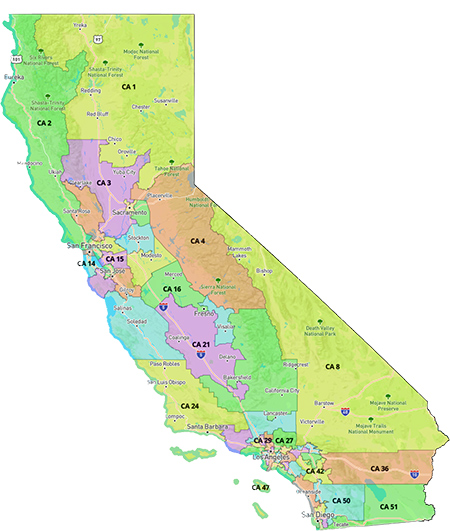
Sen. Dianne Feinstein (D), seeking a fifth full term in office, will face 39 Democrat, Republican, minor party, and Independent opponents on the qualifying election ballot. The top two finishers on June 5, regardless of political party affiliation, will advance to the general election. At this point, chances are strong that Sen. Feinstein and state Senate President Kevin de Leon (D-Los Angeles) will be the qualifying candidates.

The open governor’s race is even more crowded. Sixty candidates returned documents for ballot placement. Lt. Gov. Gavin Newsom (D) is favored to finish first, but the major remaining question concerns whether Republicans can coalesce behind one candidate to at least compete in the general election. Seventeen Republicans and 15 Democrats will be listed on the ballot if all submitted the proper qualifying documentation. The remaining contenders belong to a minor party or are Independents. The most likely pair to advance is Lt. Gov. Newsom and former Los Angeles Mayor Antonio Villaraigosa, thus creating the double-Democratic general election campaign that Republican leaders hope to avoid.

Continue reading

Democrats Maneuver in San Diego

By Jim Ellis

Feb. 27, 2018 — Two noteworthy Democrat events happened in San Diego over the past few days.

California Sen. Dianne Feinstein (D)

California Sen. Dianne Feinstein (D)

First, the California Democratic Party state convention, meeting in San Diego over the weekend, actually denied veteran Sen. Dianne Feinstein (D) the party endorsement. Though the delegates came close to endorsing state Senate President Kevin de Leon (D-Los Angeles), he also fell short.

In the vote to award the party endorsement for the 2018 US Senate race, it was state Sen. de Leon capturing 54 percent of the delegate votes as compared to only 37 percent for incumbent Sen. Feinstein. A total of 60 percent was needed for endorsement. This is not the first time that the liberal grassroots delegates have turned away from Feinstein. According to an NPR account of the convention proceedings, the party delegates chose then-Attorney General John Van de Kamp over Feinstein in the 1990 governor’s race.

The lack of an endorsement will not hurt the senator’s campaign, however. A January Public Policy Institute of California poll (Jan. 21-30; 1,705 California adults) favored Sen. Feinstein over Mr. de Leon, 46-17 percent, when tested in the jungle primary format. She has an even more commanding lead in campaign resources. The year-end Federal Election Commission disclosure report finds her holding just under $10 million in her campaign account as compared to an embarrassingly low $359,000 for de Leon.
Continue reading

The Emerging Senate Cycle

By Jim Ellis

Tennessee state flag

Tennessee state flag

Oct. 25, 2017 — Though we still have more than two full months remaining in calendar year 2017, the 2018 US Senate field is beginning to take clear shape. With 34 statewide contests to be decided, including the Alabama special election that will conclude Dec. 12, no fewer than 10 campaigns are basically set. Action is occurring in an additional 13 states suggesting that some sort of primary or general election competition will soon come to the forefront. Eleven incumbents seeking re-election are rated as “safe” at the present time.

Former Tennessee US Rep. Stephen Fincher (R-Crockett County) announced Monday that he would join the open US Senate Republican primary battle, attempting to succeed retiring Sen. Bob Corker (R). This race already appears to be evolving into a possible two-way primary between ex-Rep. Fincher and current 7th District veteran incumbent Marsha Blackburn (R-Brentwood).

Andy Ogles, the former Tennessee director for Americans for Prosperity, remains in the race after launching what is now a moot primary challenge to Sen. Corker but it is unclear how strong he will be now that several conservative organizations are already beginning to coalesce behind Rep. Blackburn.

The only other bit of Volunteer State intrigue centers around Democratic former Gov. Phil Bredesen and whether he will enter the statewide contest. Originally, Bredesen took himself out of consideration, but now agrees to consider becoming a candidate. He says a decision will be forthcoming in a matter of weeks. Without Bredesen, the Democrats would likely concede the seat to the eventual Republican nominee since other strong potential candidates, specifically US Rep. Jim Cooper (D-Nashville) and Nashville Mayor Megan Barry, have already said they will not run.

Continue reading