Tag Archives: President Joe Biden

Nevada Primary Underway, Caucus Begins Thursday; Spartz “Un-Retires”; Louisiana Redistricting Fight;
Strong Challenger in MI-3

By Jim Ellis — Tuesday, Feb. 6, 2024

President
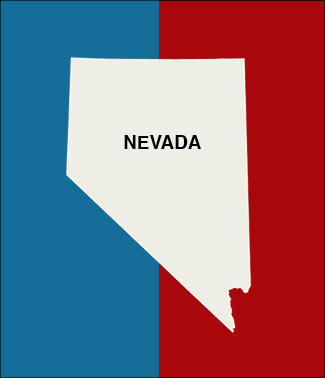
Nevada: Primary Today; GOP Caucus Thursday — Nevada voters will cast their votes for a Democratic presidential nominee with 49 delegates at stake in their primary, while Republicans will be participating in what is termed as only a “beauty contest” primary because delegate apportionment will not correspond to the cast ballots. The delegates will be awarded in a caucus system with meetings scheduled for Thursday.

President Joe Biden will easily sweep the small Democratic field, maybe not to the point of getting 97 percent support as he did in South Carolina, but he will win in a substantial landslide. On the Republican side, where the candidates chose to enter either the primary or caucus, sees ex-UN Ambassador Nikki Haley on the outside; she will win a virtually meaningless primary, against virtually meaningless minor candidates, while former President Donald Trump opted to enter the caucus and is likely to sweep Nevada’s 26 convention delegates.

House

IN-5: Rep. Spartz “Un-Retires” — In early 2023, Indiana sophomore US Rep. Victoria Spartz (R-Noblesville) became the session’s first lame duck House member when announcing that she would not seek a third term in order to spend more time with her two daughters who are entering their teenage years. Yesterday, Spartz reversed course and now becomes the first of the burgeoning departing group of members to “unretire.”

Rep. Spartz said the urging from many of her constituents to run again and what she termed as the “failed leadership in Washington,” were her reasons for deciding to stand for another term just as the Indiana candidate filing deadline approaches on Friday.

The focus now turns to the 10 Republicans who are vying to succeed Spartz and see just how many, if any, will terminate their campaigns. State Rep. Chuck Goodrich (R-Noblesville) is viewed as the leading contender and has already spent over $1 million on his congressional effort. He also has more than twice the amount of money in the bank than does Rep. Spartz ($679,000 to $313,000) according to the year-end (2023) Federal Election Commission disclosure report. No other candidate has significant resources.

Louisiana: New Map Challenged — While the Louisiana legislature and governor complied with a court order to draw a new majority minority seat in the congressional delegation, a group of “non African-American voters” have filed suit against the new plan as a racial gerrymander.

A different three-judge panel will hear the lawsuit suggesting the possibility that this map could be rendered illegal, too. The plaintiffs site a 1994 case where a similarly drawn district, one that stretches from Baton Rouge to Shreveport to create a black majority district, was in fact declared a racial gerrymander, which forced a redraw then. This lawsuit suggests that Louisiana congressional redistricting may not be quite over.

Now, House Speaker Mike Johnson (R-LA) weighed in on “X” saying, “there are multiple other map options that are legally compliant and do not require the unnecessary surrender of a Republican seat in Congress.” The new 6th District virtually cuts Johnson’s 4th District into two parts, driving through the middle of the Speaker’s current territory in order to annex the black dominated precincts in Shreveport.

MI-13: A Second Strong Democrat to Challenge Rep. Thanedar — In 2022, then-Detroit state Rep. Shri Thanedar won an eight-person Democratic congressional primary with 28 percent of the vote to claim his seat in the US House. In doing so, Thanedar self-financed his effort to the tune of $9.1 million.

In October, Rep. Thanedar’s top 2022 challenger, former state Sen. Adam Hollier, announced that he would return for a Democratic primary rematch. Yesterday, another major Detroit political figure joined the primary race. Detroit City council member and former state House Minority Leader Mary Waters filed a congressional campaign committee with the FEC. She did not run in 2022. Another potential entry is two-time former candidate John Conyers III, the son of the late Congressman John Conyers (D-Detroit), who held the seat from his initial election in 1964 to his resignation from the House in 2017.

From the freshman incumbent’s perspective, he benefits from having more opponents that will split the vote just the way the 2022 race unfolded.

Regardless of his number of opponents, the congressman looks again to be the biggest spender. According to the year-end (2023) Federal Election Commission campaign finance disclosure report, Rep. Thanedar shows $2.6 million in his political committee bank account. The Michigan candidate filing deadline is April 23 in conjunction with the Aug. 6 primary election.
Biden Sweeps SC Amid Low Turnout; Sen. Hawley Up 13; Sen. Bob Menendez Can’t Escape Single-Digit Support;
Sen. Bob Casey Jr.’s Strong Showing

By Jim Ellis — Monday, Feb. 5, 2024

President

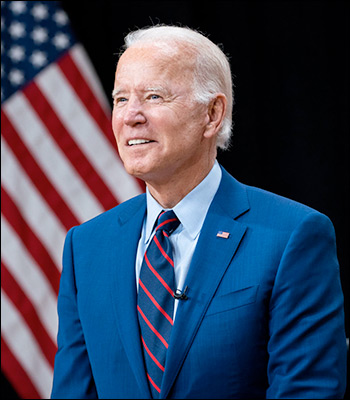
President Joe Biden

South Carolina: Biden Romps in Dem Primary — President Joe Biden claimed Saturday’s South Carolina Democratic presidential primary, capturing an almost unanimous vote share. Biden recorded a 97 percent support figure over author Marianne Williamson (2.1 percent) and Minnesota Congressman Dean Phillips (1.7 percent). Not surprisingly, the president swept all 55 of the state’s national Democratic delegate votes and placed first in each of the Palmetto State’s 46 counties.

Turnout, however, was extremely low with only about 131,000 ballots being cast. The unofficial count represents just 24 percent of the number of voters when compared to the 2020 South Carolina Democratic primary. The president was virtually unopposed in terms of the campaign efforts from Williamson and Phillips; therefore, it is not surprising to see a low participation rate. Still, three-quarters of the past electorate failing to return in 2024 does suggest a lack of enthusiasm for the pending national election.

Next, the candidates move to the Nevada primary on Tuesday where a similar result is expected. Unlike the Republicans, the Democratic primary is a delegate-apportionment event, so all candidates will be on the ballot. On the Republican side, the Nevada delegates will be awarded from the accompanying caucus events scheduled two days later, on Feb. 8. GOP candidate Nikki Haley chose to enter the primary and not the caucus, so former President Donald Trump is virtually assured of a Nevada delegate sweep.

Senate

Missouri: Sen. Hawley Up 13 — Emerson College released the first Missouri polling results of the new year. In the state’s US Senate campaign, the Emerson poll (Jan. 3-28; 1,830 registered Missouri voters; multiple sampling techniques) yields Sen. Josh Hawley (R) a 43-30 percent lead over attorney and Afghan/Iraq War veteran Lucas Kunce (D).

In 2022, Kunce ran for the Senate and performed well on the fundraising circuit, raising $5.7 million, but lost the Democratic nomination to philanthropist Trudy Busch Valentine, who was a late entry into the race. He now returns in better position to win the party nomination and has already almost equaled his 2022 fundraising total but remains a severe underdog to Sen. Hawley in a state where the Biden national campaign is sure to concede.

Therefore, considering Sen. Hawley’s incumbency and the political winds blowing against the Democrats in the Show Me State, this race is not likely to become a battleground Senate contest.

New Jersey: Sen. Menendez Again Languishing in Single Digits — Madison, New Jersey-based Fairleigh Dickinson University went into the field to test the Garden State’s Democratic electorate pertaining to the upcoming US Senate race. The survey (Braun Research conducting; Jan. 21-28; 504 likely New Jersey Democratic primary voters; live interview & text) projects US Rep. Andy Kim (D-Moorestown) to be opening a double-digit lead over New Jersey First Lady Tammy Murphy of 32-20 percent, while indicted incumbent Sen. Bob Menendez can outpace little-known labor union official Patricia Campos-Medina by only a single point, as he again polls under 10 percent.

According to the just-released Federal Election Commission year-end campaign finance reports, both Rep. Kim and Murphy held $2.7 million cash-on-hand at the end of 2023. Largely due to funds raised before being indicted, Sen. Menendez has just over $6.1 million in his campaign account.

The New Jersey primary is June 4. At this point, Sen. Menendez maintains that he is running for re-election, but a final decision from him will be likely be made just before the March 25 candidate filing deadline.

Pennsylvania: Sen. Casey Again Posts Double Digit Lead — Franklin & Marshall College, a regular Pennsylvania pollster, just released their latest statewide research iteration. The survey (Jan. 17-28; 1,006 registered Pennsylvania voters; live interview) sees Sen. Bob Casey Jr. (D) again posting a sizable lead over former hedge fund CEO David McCormick (R). The ballot test gives Sen. Casey a 12-point advantage, 47-35 percent. This counters Susquehanna Polling & Research’s findings in their Pennsylvania poll, taken partially within the same sampling period, that showed only a four-point separation between the two candidates.

The F&M result is more consistent with other released polls since mid-December. The Bullfinch Group saw a 15-point Casey margin, while Quinnipiac University projected a 10-point split. The Pennsylvania Senate race could become a top-tier contest assuming the presidential race here remains close in polling. In both the presidential and Senate contests, however, the Democratic candidate maintains the edge.

Sen. Cruz in Potentially Competitive Re-Election Bid; Senate Challenge in New Mexico; Rep. Susie Lee Draws Opponent in Nevada; Redistricting Developments in Wisconsin

By Jim Ellis — Monday, Jan. 29, 2024

Senate

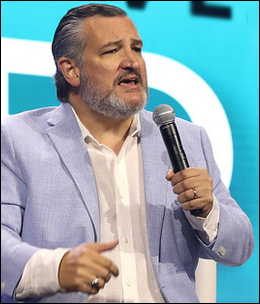
Texas Sen. Ted Cruz (R) / Photo by Gage Skidmore

Texas: Tight New Poll — Emerson College just released the results of their latest Texas statewide survey (Jan. 13-15; 1,315 registered Texas voters; interactive voice response system & online) that finds Sen. Ted Cruz (R) heading into a potentially competitive general election. The ballot test found the senator leading US Rep. Colin Allred (D-Dallas) by a slight 42-40 percent margin, and holding only a one-point, 41-40 percent split over state Sen. Roland Gutierrez (D-San Antonio). Simultaneously, former President Donald Trump leads President Joe Biden 49-41 percent.

The poll is not particularly surprising in that Sen. Cruz’s personal favorability numbers have never been particularly good. However, there are a number of things that favor Sen. Cruz: the presidential election turnout model, Trump beating Biden in the state, the Biden energy policies being detrimental to Texas, and the southern border controversy — all play politically to Sen. Cruz’s favor. Therefore, despite the likelihood that we will see many close Texas Senate polls between now and the November election, the actual votes will favor Sen. Cruz winning re-election by a relatively comfortable margin.

New Mexico: Republicans Making Move to Challenge Sen. Heinrich — In order to expand what is a favorable Republican US Senate map, a prominent member of the GOP announced her candidacy. Nella Domenici, a former hedge fund CEO and daughter of the late six-term Sen. Pete Domenici (R), is the latest Republican to declare for the seat. Last week, former Bernalillo County Sheriff Manny Gonzales switched parties to enter the GOP Senate primary. The eventual winner of the June 4 Republican primary will challenge two-term incumbent Sen. Martin Heinrich (D).

The senator is favored for re-election, but Republicans improving among Hispanics could make this a competitive contest. New Mexico’s Hispanics register 50.2 percent of the state population universe according to the latest US Census report. The last time Republicans won a New Mexico statewide race was in 2014 when then-Gov. Susanna Martinez was re-elected. An August Public Policy Polling survey showed President Biden topping former President Trump 49-41 percent, suggesting the state could become competitive in the national election.

House

NV-3: GOP Ex-State Treasurer Announces for House — Earlier this month, Republicans lost their top congressional recruit in state Assemblywoman Heidi Kasama (R-Las Vegas), who instead of running for the House will seek re-election to what could become a tight Nevada Assembly. Kasama was clearly the top contender for the GOP nomination in a seat that is the most winnable for a Republican (FiveThirtyEight data organization rating: D+2) of the three Las Vegas competitive districts.

Now, former State Treasurer Dan Schwartz (R) is coming to the forefront to announce his congressional candidacy. While winning a statewide position in 2014, Schwartz has not fared well since, losing landslide races in his attempts to be elected governor, lieutenant governor, and a previous run for the 3rd Congressional District. It is likely the Republicans will have to recruit a stronger candidate against Rep. Susie Lee (D-Las Vegas) if they are to move this race into the top tier.

Wisconsin: Congressional District Lines Challenged — A citizens group that famed Democratic election lawyer Marc Elias represents filed suit before the Wisconsin state Supreme Court arguing that the panel’s rejection of the state Senate and Assembly maps compels them to reconsider striking down the state’s congressional map.

According to the Daily Kos Elections site’s legal analysts, the legislature’s maps were returned for a re-draw because the court rejected the “least change” (from the previous map) practice that the legislature relied upon to draw the 2021 maps. The Elias group’s lawsuit maintains that the congressional map was also drawn under the “least change” practice, and therefore should be redrawn.

So far, however, the court has not taken action against the congressional map and time is running out. The secretary of state has informed the court that unless new maps are enacted into law by March 15, they will not be able to convert the electoral system in time for the 2024 election.

Trump, Biden Win in New Hampshire; Blood Challenges Flood in NE-1; North Dakota Candidates Line Up for Governor’s Race; Louisiana Redistricting Map Signed Into Law

By Jim Ellis — Wednesday, Jan. 24, 2024

President

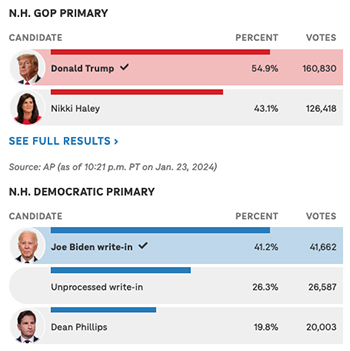
New Hampshire: Trump, Biden Win — Former President Donald Trump successfully won the New Hampshire Republican primary last night and did so by about 12 percentage points, but his performance is apparently not enough to convince former UN Ambassador Nikki Haley to leave the race.

In her concession speech, Haley pledged to continue moving forward and several times referenced going to her home state of South Carolina as a place that could reverse the political tide. Polling, however, suggests that she is not as strong there as she was in New Hampshire.

For the Democrats, President Joe Biden, despite not being on the primary ballot, won the primary with write-in ballots that tallied just over 67 percent of the vote. US Rep. Dean Phillips (D-MN), who said he had no fundamental disagreement with the president over issues but believes Democrats should have a choice particularly with an 81-year old in office, secured just over 20 percent of the vote. Author Marianne Williamson attracted the remaining votes, just under 4 percent.

The New Hampshire primary yielded a record Republican turnout. The final participation count could reach 320,000. The previous record of 284,120 was set in 2016. The final Democratic turnout number will only be in the 100,000 range.

House

NE-1: Gov. Nominee to Challenge Rep. Flood — State Sen. Carol Blood (D-Bellevue), who was the 2022 Democratic gubernatorial nominee and lost to now-Gov. Jim Pillen (R), 59-36 percent, announced that she will now challenge Rep. Mike Flood (R-Norfolk) in the state’s 1st District that surrounds the Omaha metropolitan area on three sides. Flood was elected in a 2022 special election after Rep. Jeff Fortenberry (R) resigned. He won a full term in November with 58 percent of the vote. Blood’s candidacy gives the Democrats a credible challenger in what is considered a safe Republican seat.

Rep. Flood will be favored for re-election. The 1st District carries an R+17 rating from the FiveThirtyEight data organization. Dave’s Redistricting App calculates a partisan lean of 56.7R – 40.4D. The Daily Kos Elections site ranks NE-1 as the 72nd most vulnerable seat in the Republican Conference.

Governor

North Dakota: One In, One Out — After Gov. Doug Burgum (R) on Monday announced that he will not seek a third term, other North Dakota politicos began to make public their own political plans. At-Large US Rep. Kelly Armstrong (R-Bismarck) quickly declared that he will run for governor. Armstrong leaving the House means that 46 seats will be open for the next election.

Conversely, Attorney General Drew Wrigley (R), also viewed as one of the top potential contenders to succeed Gov. Burgum, announced that he will not run for governor, instead opting to seek re-election to his current position. Former state senator and ex-congressional candidate Tom Campbell (R) will also run for governor.

The Republican statewide nominating convention is scheduled for April 6. The ND primary is set for June 11.

States

Louisiana: Redistricting Map Signed Into Law — Meeting the court-ordered requirement to draw a new majority minority seat in Louisiana, Gov. Jeff Landry (R) yesterday signed into law the legislature’s map. The new lines will cost the Republicans one seat, as an African American Democrat will be heavily favored to win a newly drawn 6th District that stretches from Baton Rouge all the way to Shreveport, cutting through the middle of House Speaker Mike Johnson’s (R-Benton) 4th CD.

Current 6th District Rep. Garret Graves (R-Baton Rouge) says he will run for the House, which likely means challenging Rep. Julia Letlow (R-Start) in the state’s newly drawn, and safely Republican, 5th CD. Rep. Graves also says he is considering filing a lawsuit against the new map.

New Hampshire Primary Today; Close Race in Delaware; Gov. Burgum to Retire; Opponents Look to Change Alaska’s Ranked-Choice Voting

By Jim Ellis — Tuesday, Jan. 23, 2024

President

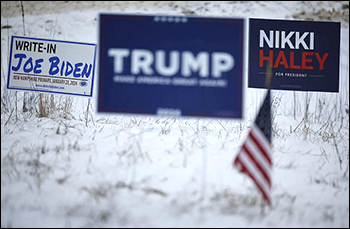
Candidate signs along the road in New Hampshire.

New Hampshire: Primary Election Today — At one point it appeared that former UN Ambassador Nikki Haley was well positioned against former President Donald Trump in the New Hampshire primary, but a plethora of late polls find the former president expanding his advantage well into double digits.

Also on the ballot tonight is the Democratic presidential primary, though sans President Joe Biden. He is bypassing this event because the state refused to accept the Democratic National Committee recommended primary schedule change that would have deprived New Hampshire of its cherished first-in-the-nation primary status.

Ten polls have been released since Saturday from as many different pollsters, and except for the American Research Group, all show Trump holding leads between 10 and a whopping 27 percentage points. The ARG survey finds Trump holding only a 33-29 percent edge.

The Democratic race is much more difficult to forecast because of the write-in campaign underway for the president. The three polls, from the American Research Group, the University of New Hampshire for CNN, and Emerson College for WHDH-TV in Boston, see the Phillips support line falling between 10 and 18 percentage points.

The New Hampshire primary could effectively spell the end to competitive challenges.

First, for Haley: it’s hard to see a path going forward should she lose by the amounts suggested in most polls. The candidates’ next stop is Nevada. The legislature and former governor forced a primary law upon the state, but Republicans still wanted to have their caucus as in years past. Thus, the Nevada GOP is holding both a primary and a caucus, with the caucus being the delegate apportionment body, not the primary.

The candidates could only participate in one of the contests, and curiously Haley entered the primary. The other candidates, when they were in the race, chose the caucus. Therefore, regardless of how many primary votes Haley attracts in the primary, Trump is going to sweep the Nevada delegation because he is the only active candidate who will be receiving pledged delegates.

The South Carolina primary — Haley’s home state — will hold their primary on Feb. 24, and it will be interesting to see whether her candidacy will even remain alive at that time. Polling already shows Trump holding strong leads in the Palmetto State.

For the Democrats, US Rep. Dean Phillips (D-MN) may well be a “one and done” candidate. He will have little in the way of an argument moving forward against President Biden if he fails to overtake him in New Hampshire where the incumbent’s name was not even on the ballot.

With data showing the respective party leaders expanding their leads, it will be an even bigger upset tonight if either President Biden or Donald Trump fail to meet their enhanced expectations.

Governor

Delaware: First Dem Primary Poll Suggests Close Race — With Gov. John Carney (D) being ineligible to run for a third term, lieutenant governor and gubernatorial candidate Bethany Hall-Long (D) released the results of her internal Public Policy Polling Democratic primary survey (Jan. 10-11; 643 likely Delaware voters; live interview & text).

The study finds the lieutenant governor posting an early 30-23 percent lead over New Castle County Executive Matt Meyer. National Wildlife Federation CEO Collin O’Mara, also an announced candidate, was not included on the Democratic primary ballot test.

The Delaware primary is one of the latest in the cycle, scheduled for Sept. 10, so much time remains for this race to develop. The eventual Democratic nominee will be in commanding position to win the open race in November.

North Dakota: Gov. Doug Burgum to Retire — Former presidential candidate Doug Burgum (R) announced yesterday that he will not seek a third term as North Dakota’s governor despite high approval ratings. With his endorsement of former President Trump, and the ex-chief executive indicating that Gov. Burgum would be primed for a position in a new Trump Administration should the 2024 election go the Republicans’ way, Gov. Burgum’s time in politics may not be coming to an end.

The decision to leave the governorship when his current term ends will open a highly competitive race for the Republican nomination through the state party convention and potentially a June 11 open primary. The eventual Republican nominee becomes a prohibitive favorite to succeed Gov. Burgum.

States

Alaska: Ranked Choice Voting Opponents File Petition Signatures — The proponents of a ballot proposition to repeal the state’s Top Four and Ranked Choice Voting systems have presented 55 percent more than the required number of signatures to reach the ballot, but they may be short on another qualifying requirement. While the group will likely have the proper aggregate number of valid signatures, there are questions as to whether they have met the requirement that certain numbers of the signatures must come from all the required districts. Therefore, it remains to be seen if this repeal measure will qualify for the 2024 election ballot.

The Ranked Choice system could have a wide-ranging effect on the coming presidential race, just as it has in the last two Alaska congressional campaigns.

DeSantis Suspends Campaign; Louisiana Map Passes Legislature, State Changes Primary System;
NY-3 Poll Shows Tightening Race;

By Jim Ellis — Monday, Jan. 22, 2024

President

Florida Gov. Ron DeSantis (R) / Photo by Gage Skidmore

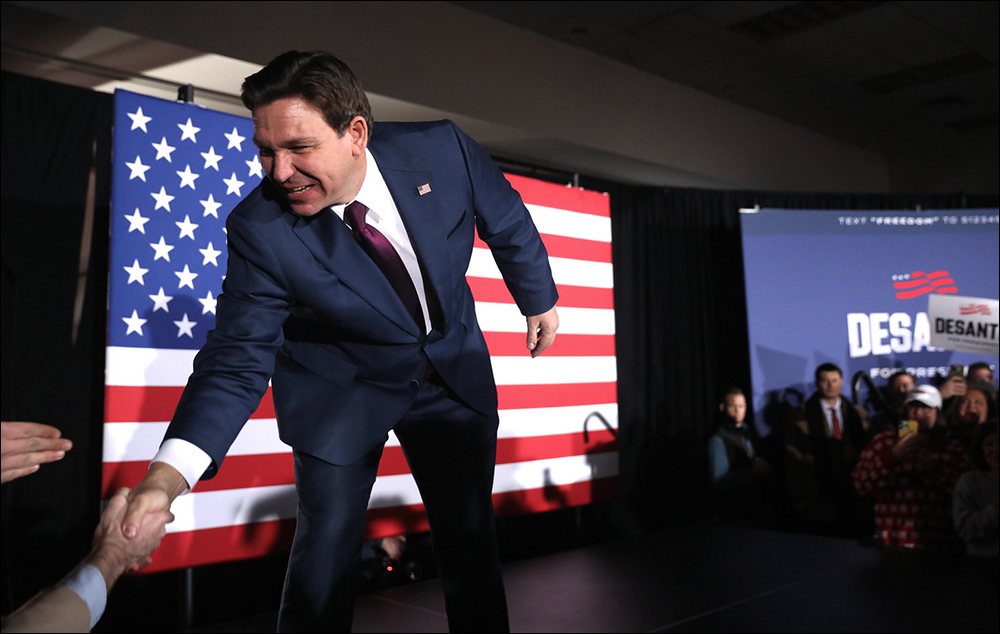
Ron DeSantis: Suspends Campaign: Two days before Tuesday’s New Hampshire primary, Florida Gov. Ron DeSantis, once thought to be former President Donald Trump’s principal Republican challenger, announced that he is suspending his national campaign and endorsed the former president.

While DeSantis suspended his campaign, he didn’t soften his attacks on both President Joe Biden and fellow GOP challenger Nikki Haley. “I look forward to working together with him [Trump] to beat Joe Biden, who is the worst and most corrupt president in the history of our country,” DeSantis said.

Referring to Haley, Gov. DeSantis was quoted as saying, “I signed a pledge to support the nominee, and I will honor that pledge. He [Mr. Trump] has my endorsement because we can’t go back to the old Republican guard of yesteryear, a repackaged form of warmed over corporatism that Nikki Haley represents.”

The GOP presidential fight now winnows to two major contenders, former President Trump, and ex-UN Ambassador Haley. Tomorrow’s New Hampshire primary may be close; Trump, however, will easily win in Nevada on Feb. 6, after which the campaign heads to Haley’s home state of South Carolina on Feb. 24 where polling finds Trump holding a 2:1 lead. If such margin holds, the Republican nomination will effectively be clinched before Super Tuesday on March 5.

House

Louisiana: Congressional Map Passes Legislature — The Louisiana state legislature agreed upon legislation to create a new congressional map as part of their special session to satisfy a court order. The bill now goes to Gov. Jeff Landry (R) for his signature. The agreed upon plan creates a new 6th District anchored in Baton Rouge, which then stretches through Speaker Mike Johnson’s (R-Benton), virtually cutting it in half, to reach Shreveport. This satisfies the court order to create a second majority minority seat in the state (54 percent black). According to the Dave’s Redistricting App statisticians, President Biden would have carried the new 6th by a 59-39 percent majority.

The big loser on this map is five-term Rep. Garret Graves (R-Baton Rouge). He is now paired with Rep. Julia Letlow (R-Start) in a new 5th District seat that stretches along the Mississippi border on the south and east and going all the way to the Arkansas border on the north. The new 5th contains at least two-thirds of Rep. Letlow’s current constituency.

The partisan division will now award another seat to the Democrats, making the future Louisiana delegation 5R-2D. Under the plan, Speaker Johnson, Majority Leader Steve Scalise, and Reps. Troy Carter (D-New Orleans), and Clay Higgins (R-Lafayette) all get safe seats from a partisan perspective.

NY-3: New Poll Shows Tight Special Election Race — A newly released Emerson College survey (Jan. 13-15; 975 registered NY-3 voters; 819 likely voters; multiple sampling techniques) sees a close special election race developing between former US Rep. Tom Suozzi (D) and Nassau County Legislator Mazi Melesa Pilip (R). The ballot test shows a 45-43 percent split in favor of Suozzi.

The best news for the former Democratic congressman is that the most likely voters within the sample break for him on a 51-37 percent split. While the majority white vote (58 percent of the district population) favors Pilip 49-40 percent, the largest minority group, Asians (24 percent of the district population), overwhelmingly favor Suozzi (60-25 percent). Hispanics (13 percent of the population) are moving toward Pilip in a 44-33 percent clip.

Possibly the most troubling news for Suozzi are President Biden’s and Gov. Kathy Hochul’s (D) poor job approval ratings. Only one-third of voters, 33 percent, approve of President Biden’s performance in office (59 percent disapprove). Gov. Hochul’s numbers are even worse. Her approval index is 25:66 percent favorable to unfavorable. The special election is scheduled for Feb. 13.

States

Louisiana: Changing to Party Primary System — As part of the special Louisiana state legislative session, the House and Senate are sending a bill to Gov. Jeff Landry (R), one that he initiated, to change Louisiana’s primary voting system from a top-two jungle system to a partisan primary. The changes would take effect for the 2026 election and would institute a modified system where registered members of the political party must vote in their own primary while non-affiliated voters would have their choice of where to cast their ballot.

The change would mean, as in most other states, that only the political party nominees and qualified Independents would advance to the general election. The legislation would affect all federal races along with the state Supreme Court, the state school board, and the Public Service Commission. All other offices would continue with the current system of sending the top two finishers regardless of political party affiliation to the general election.

Surprising New Hampshire Numbers

By Jim Ellis — Thursday, Jan. 18, 2024

President

New Hampshire citizens at a town hall meeting at Hillside Middle School in Manchester. / Photo by Gage Skidmore

New Hampshire Polling Snapshot: Two Candidates Tied — The American Research Group has released companion New Hampshire primary polls the results of which are a bit surprising for both parties.

The ARG survey (Jan. 12-15; 600 likely New Hampshire Republican primary voters; 406 Republican voters; 194 Independent voters; live interview) sees former President Donald Trump and ex-UN Ambassador Nikki Haley now tied as the candidates turn the corner toward the Granite State primary on Jan. 23. Both candidates were drawing 40 percent support. Florida Gov. Ron DeSantis and now-ex presidential contender Vivek Ramaswamy were attracting only four percent apiece.

New Hampshire has been Trump’s weakest polling state among the pre-Super Tuesday primary and caucus entities. In the ARG polling series, Haley’s support has grown from 29 percent in their Dec. 20 survey to 33 percent in the Jan. 3 version, and now 40 percent. Trump, however, has also gained growing support indicated by his polling progression from 33, to 37, to now 40 percent.

ARG is the only pollster to show the race this close. The recent St. Anselm College, Emerson College, CNN/University of New Hampshire, and the Suffolk University/USA Today surveys project Trump with leads of 14, 16, 7, and 20 points, respectively.

The Democrats — The survey research firm also tested the Democratic presidential primary in a series of four polls beginning with their release on Dec. 20. The current study (Jan. 12-15; 600 likely New Hampshire Democratic primary voters; 452 Democratic voters; 148 Independent voters; live interview), finds US Rep. Dean Phillips (D-MN) posting his best standing against President Joe Biden. According to the results, Biden, clearly identified as a write-in candidate on the questionnaire, would lead Rep. Phillips 58-28 percent, with author Marianne Williamson drawing three percent.

Based upon ARG’s four-poll series, Phillips has consistently increased his support from 17 percent on Dec. 20 to 21, 26, and now 28 percent in the Jan. 15 poll. The congressman has been advertising heavily in New Hampshire. In those same polls, President Biden increased his share from 51 to 58 percent, but has remained stagnant in the two most recent surveys.

Other pollsters don’t see Rep. Phillips as strong. In data released Jan. 9 and 11, Suffolk University/USA Today projects the president holding a whopping 64-6 percent lead over Phillips. The CNN/University of New Hampshire ballot test results agree. They record a 69-7 percent Biden advantage. Within this group only the latest Emerson College poll finds Rep. Phillips breaking into double digits. EC calculates a 49-16 percent spread in the president’s favor.

Similar to Haley on the Republican side, Rep. Phillips actually leads Biden among the Independent voters who plan to participate in the Democratic primary according to ARG. The Independent/Democrats break 46-32 percent for Phillips. The registered Democrats support President Biden, 67-22 percent.

With the Jan. 23 New Hampshire primary looming, we shortly will see the impact of Biden choosing to bypass the state because the Granite State did not agree to the proposed Democratic National Committee primary calendar changes. Because of that decision, voters wanting to support the president must now write in his name on the ballot.

The question remains as to whether Haley and Phillips getting close to Trump and Biden in their respective primary races in New Hampshire would have much of an effect upon the national nomination campaign. Could the state be the starting point for new trends, or will more favorable challenger results only prove a blip on the path to convincing national primary victories for both President Biden and former President Trump?

Chances are good that the latter scenario will occur. New Hampshire results don’t tend to be particularly reliable national predictors. For the Republicans since 1976, the non-incumbent winner of the Granite State primary has gone on to win the GOP nomination just four times. For the Democrats, they too see only four of the New Hampshire winners carrying through to become the party’s national standard bearer.

At this point, particularly when looking at other state polls around the country, it appears that the New Hampshire results are more likely an outlier than a new trend setter. Even so, we may be primed to see some interesting results come Tuesday.

GOP Presidential Field Narrows to Three; Second Redistricting Map Released in Louisiana; MD-2 Primary Opponent Challenges Incumbent

Former UN Ambassador Nikki Haley speaks with supporters at a “Countdown to Caucus” campaign rally at the Country Lane Lodge in Adel, Iowa. / Photo by Gage Skidmore

By Jim Ellis — Wednesday, Jan. 17, 2024

President

Candidates: And Then There Were Three — After former President Donald Trump’s victory in the Iowa Caucuses on Monday, two more presidential candidates, businessman Vivek Ramaswamy and former Arkansas Gov. Asa Hutchinson, suspended their campaigns.

Prominent candidates who previously dropped their bids are former Vice President Mike Pence, ex-New Jersey Gov. Chris Christie, Sen. Tim Scott (R-SC), and North Dakota Gov. Doug Burgum. The moves essentially leave the presidential field to Mr. Trump, Florida Gov. Ron DeSantis, and ex-UN Ambassador Nikki Haley. Of the exiting candidates, Ramaswamy and Burgum both have endorsed Trump. No other former candidate to date has issued an endorsement.

New Hampshire: ARG Sees Trump & Haley Tied — A third installment of the American Research Group survey series (Jan. 12-15; 600 likely New Hampshire Republican primary voters; 406 Republican voters; 194 Independent voters; live interview) sees Trump and Haley now tied as the candidates turn the corner toward the New Hampshire primary on Jan. 23. Both candidates were drawing 40 percent support. DeSantis and now-ex presidential candidate Ramaswamy fell well back to four percent apiece. Clearly New Hampshire is the only pre-Super Tuesday state where Trump fails to dominate.

New Hampshire: A Biden Warning Sign — The American Research Group also ran a companion poll for the Democratic presidential primary as it was surveying the Republican side. This study (Jan. 12-15; 600 likely New Hampshire Democratic primary voters; 452 Democratic voters; 148 Independent voters; live interview) finds US Rep. Dean Phillips (D-MN) posting his best standing against President Joe Biden of any poll. According to these results, Biden, clearly identified as a write-in candidate on the questionnaire, would lead Rep. Phillips 58-28 percent, with author Marianne Williamson drawing three percent.

The New Hampshire primary is Jan. 23, but Biden chose to bypass the state because New Hampshire did not agree to the proposed Democratic National Committee primary calendar changes. Therefore, voters wanting to support the current president will have to write in his name.

House

Louisiana: Second Redistricting Map Released — On the first day of the special legislative session for congressional redistricting and other issues, state Rep. Mike Echols (R-Monroe) released a map that was seen as potentially the basis for an eventual final draw. Under the introduced plan, Rep. Garret Graves (R-Baton Rouge) would likely find himself as the odd man out as a new Baton Rouge-anchored 6th District that would be designed to elect an African American representative. The original map was sent back to the legislature for the purpose of increasing minority representation.

The Dave’s Redistricting App statisticians have already released their calculations of all six districts in the proposed plan. Instead of the current 5R-1D plan, we would see a 4R-2D map, with the 6th District going from a partisan lean of 66.0R – 31.9D to one that favors the Democrats to the degree of 56.3D – 41.8R. Rep. Graves would be placed in the 5th District with fellow Republican incumbent Rep. Julia Letlow (R-Start). In this map version, Letlow’s current constituency would comprise two-thirds of the new district, thus giving her a major advantage if the two ultimately face each other.

Now, a second plan has been submitted but two points are clear when comparing the two versions.

First, the legislature is clearly complying with the court order to draw a second majority minority seat within the six-member congressional delegation, and second, the targeted GOP House member likely to lose his seat is to make room for the new district is Rep. Graves. Once completed and passed into law, the new court-ordered map will almost assuredly mean a net gain of one seat for the Democrats in the 2024 election.

MD-2: Primary Opponent Emerges for Rep. Ruppersberger — Two-term state Delegate Harry Bhandari (D-Nottingham) announced that he will challenge 11-term US Rep. Dutch Ruppersberger (D-Cockeysville) for the Democratic nomination in the May 14 Maryland primary election. Bhandari does not have to risk his seat in the legislature because Maryland awards its state Delegates with four-year terms, and he was re-elected in 2022. Rep. Ruppersberger has yet to announce that he will run for re-election. The Maryland candidate filing deadline is Feb. 9.

MD-2 is a safe Democratic seat. The FiveThirtyEight data organization rates the district as D+11. The Daily Kos Elections statisticians rank the seat as the 62nd most vulnerable in the House Democratic Conference.

Iowa Republican Presidential Caucus Winners, Losers & Runners-Up; California Senate Polling Update; NY-26 Special Election Nominee

Gov. Ron DeSantis celebrates with supporters at a caucus night watch party at the Sheraton West Des Moines Hotel in Iowa. / Photo by Gage Skidmore

By Jim Ellis — Tuesday, Jan. 16, 2024

President

Iowa Republican Presidential Caucus: Winners, Losers & Runners-Up — The first votes of the presidential campaign have been cast, and former President Donald Trump met expectations last night in the Iowa Caucuses as he became the first non-incumbent candidate to secure a majority of the vote in the state’s history. The Democrats first voted in Iowa back in 1972, with Republicans following in 1976.

It appears he will place first in 98 of the state’s 99 counties, losing apparently by just one vote in Johnson County, home to the University of Iowa. He also won closely, and below 50 percent in Story County, the home of Iowa State University, and in the state’s most populous county, Polk, the home to the capital city of Des Moines. He recorded plurality victories in eight other counties.

At this writing, and mostly in the rural regions, Trump exceeded 60 percent of the vote in 41 counties, and topped 70 percent in eight. His best showing appears to be in Keokuk County, where he recorded 74 percent. There is likely to be some change in these numbers once all of the votes are counted and canvassed.

The battle for second in Iowa is close, as predicted, though it appears that Florida Gov. Ron DeSantis, and not the candidate the media proclaimed had the most momentum, former UN Ambassador Nikki Haley, finishes second. DeSantis was hovering around the 21 percent mark, some 30 points behind Trump. Haley was further back approaching 19 percent of the caucus votes. Businessman Vivek Ramaswamy, as polling also predicted, was well back with just under eight percent support. After considering his fourth-place finish, Ramaswamy announced that he was dropping out of the presidential race.

“There is no path for me to be the next president, absent things that we don’t want to see happen in this country,” he said at his Iowa watch party at the Surety Hotel in downtown Des Moines.

“I am so proud of every one of you who have lifted us up,” he said to the crowd. He then announced that he would give his “full endorsement” to Trump. Ramaswamy said he had called Trump to tell him that he was suspending his campaign and would endorse the former president.

Senate

California: Schiff and Porter Lead New Poll — The University of California at Berkeley’s Institute for Government Studies, a regular California political pollster, released their latest US Senate survey result. This poll, for the Los Angeles Times (Jan. 4-8; 8,199 registered California voters; 4,470 weighted sub-sample; online), again finds Rep. Adam Schiff (D-Burbank) leading the crowded field, but with a smaller margin than found in other recent polls.

Baseball great Steve Garvey (R), who had placed second in two December polls, is third here, but still gained support when compared to the previous Berkeley IGS survey (10 percent in October poll; 13 percent in current edition). Rep. Katie Porter (D-Irvine), second in their previous polls, is also second now, but remains stagnant at 17 percent support when compared to the two previous Berkeley IGS studies. Rep. Barbara Lee (D-Oakland) remains languishing with single digit support with nine percent preference.

The California jungle primary is scheduled for Super Tuesday, March 5. The top two finishers regardless of percentage attained or political party affiliation will advance into the November general election.

House

NY-26: Democrats Choose Special Election Nominee — The local Erie and Niagara County Democratic Party chairmen announced that they have chosen state Sen. Tim Kennedy (D-Buffalo) as their special election congressional nominee once Rep. Brian Higgins (D-Buffalo) resigns in early February. Once the seat officially becomes vacant, Gov. Kathy Hochul (D) will call a special election to fill the seat for the balance of the current term. The Republican chairmen will announce their pick at a later date.

Under New York election procedure, a district’s county chairmen have the power to nominate a special election candidate in lieu of holding a party primary or special district convention.

Nate McMurray, a former western New York local official who ran two close campaigns in the former 27th District that was collapsed in 2021 reapportionment, declared after the announcement naming Sen. Kennedy as the special election Democratic nominee that he will launch a regular Democratic primary challenge against him for the full term.

Trump Over 50 Percent in Iowa;
Dead Heats in Arizona & Michigan; Casey Expands Lead in Pennsylvania

By Jim Ellis — Monday, Jan. 15, 2024

President

Former President Donald Trump

Iowa Caucus Polls: Trump Over 50 Percent; Haley in Second Place — The first votes of the presidential campaign are to be cast tonight. In frigid temperatures, Iowa Republicans will attend their individual precinct caucus meetings to cast the first votes of the 2024 presidential election beginning at 7 p.m. Central time. Because of a schedule change on the Democratic side, only the Republicans are voting tonight. No non-incumbent has ever topped the 50 percent plateau, but polling shows that Trump may well exceed that number in these caucus votes.

Suffolk University released a new Iowa Caucus survey in preparation for today’s vote. This survey (Jan. 6-10; 500 likely Iowa Republican Caucus attenders), as every other Iowa poll has projected, sees former President Donald Trump attracting majority support (54 percent). Former UN Ambassador Nikki Haley, according to the Suffolk data, has surpassed Florida Gov. Ron DeSantis for second place with 20 percent as compared to DeSantis’ 13 percent.

In terms of interesting side questions, the sampling universe broke virtually evenly regarding the traits of the candidate they want to support. Three responses dominated the answers. The one most often articulated is the respondent’s desire to support a candidate who can defeat President Joe Biden (27.2 percent). Next, is an individual having strong moral character (25.8 percent), and a close third is a person who “has the right experience” (25.0 percent).

Asked of people who said that Donald Trump was neither their first nor second choice, 45 percent said they would support the former president if he became the party nominee, 16.5 percent said they would vote for Independent Robert F. Kennedy Jr., and 15.3 percent said they would support Biden.

No fewer than five polls have been released since Wednesday, including the survey that is typically regarded as the state’s most accurate — the Selzer & Company poll, routinely conducted for the Des Moines Register newspaper.

The Selzer poll, released late on Saturday night (Jan. 7-12; 705 likely Iowa caucus attenders; live interview) and conducted for the Des Moines Register and NBC News, found Trump below 50 percent but holding at 48 percent support, ahead of Haley, in second place again with 20 percent, and DeSantis in third, posting 18 percent preference. Businessman Vivek Ramaswamy trailed in single digits with eight percent. Of the five polls conducted during the final week of campaigning, this is the only one that projects Trump with under 50 percent support.

Senate

Arizona: New Poll Shows Virtual Dead Heat — Public Policy Polling, surveying for the Replace Sinema PAC (Jan. 5-6; 590 registered Arizona voters; multiple sampling techniques) sees a dead heat developing between Rep. Ruben Gallego (D-Phoenix) and former news anchor and 2022 Republican gubernatorial nominee Kari Lake. Incumbent Sen. Kyrsten Sinema, running on an Independent ballot line, significantly trails.

According to the ballot test data, Rep. Gallego would record a 36-35 percent edge over Lake with Sen. Sinema well behind with a 17 percent support figure. Among the key non-affiliated voting sector, Lake takes the largest share with 31 percent. Sen. Sinema posted 27 percent from this category, while Rep. Gallego trailed with 24 percent. If the race were a two-way contest between Gallego and Lake, the Republican would hold a 46-45 percent edge. This poll again shows that the Arizona Senate race continues as a true wild card campaign.

Michigan: Virtual Ties All Around — The Glengariff Group, a Michigan-based pollster who frequently conducts political surveys for media organizations, tested the Wolverine State electorate for the Detroit News and WDIV-TV Channel 4 (Jan. 2-6; 600 likely Michigan voters) though the partisan division within the polling sample looks to have comparable numbers of Democrats and Republicans. Michigan does not register voters by political party, but it is clear through voter history statistics that the state houses at least a slightly higher number of Democrats than Republicans. Therefore, these results, though weighted to decrease a bias factor, are likely skewed somewhat toward Republicans.

The ballot test results find Rep. Elissa Slotkin (D-Lansing) and three potential Republican opponents all locked into virtual ties. Retired Detroit Police Chief James Craig matches up most favorably with Rep. Slotkin, leading her 38-36 percent. Former Rep. Peter Meijer is tied with Slotkin at 36-36 percent, while former US Rep. Mike Rogers trails her by just one percentage point.

It is likely that the Michigan race will become a top-tier general election Senate campaign irrespective of which Republican candidate claims the party nomination in August.

Pennsylvania: Sen. Casey Expands Lead — The new Quinnipiac University Pennsylvania poll (Jan. 4-8; 1,680 self-identified registered Pennsylvania voters; 746 Democrats; 651 Republicans; live interview) finds three-term Sen. Bob Casey Jr. (D) expanding his lead over Republican challenger David McCormick (R) to a full 10-point advantage, 54-43 percent, an improvement of a net four percentage points when compared to the October Q-Poll. Within this survey sample, the split between Democrats and Republicans is almost spot on, with Republicans under-counted by approximately just one percentage point.

The Casey lead is strong in comparison to how President Biden fares. Biden posts a job approval rating of only 40:58 percent as compared to Sen. Casey’s 51:31 percent. The president, however, still leads former President Trump, 49-46 percent in a general election ballot test. The Pennsylvania office holder with the best job approval ratio is Gov. Josh Shapiro (D) who records a 59:23 percent favorability index.