
Tag Archives: Nikki Haley

Michigan Senate Seat a Toss-Up; Cardenas to Retire; A Dead Heat in CA-47; Utah’s Special Election


The EllisInsight will take a break to enjoy the holiday Thursday and will resume regular publishing Friday. Happy Thanksgiving to all.


By Jim Ellis — Wednesday, Nov. 22, 2023

Senate

Michigan Rep. Elissa Slotkin (D-Lansing)

Michigan: Toss-Up New Poll — Regular Michigan pollster EPIC-MRA, conducting another survey for the Detroit Free Press newspaper (Nov. 10-16; 600 likely Michigan general election voters) again sees a close US Senate general election. The eventual winner will succeed Sen. Debbie Stabenow (D) who is retiring after four terms.

While the presidential ballot test finds former President Donald Trump leading President Joe Biden 46-41 percent, and with former UN Ambassador Nikki Haley posting an 11-point advantage against the incumbent president, US Rep. Elissa Slotkin (D-Lansing) still maintains a small margin over both of her leading Republicans — former Congressman Mike Rogers and retired Detroit Police Chief James Craig. Against each, Slotkin holds a two-point edge, meaning the open Michigan Senate race could soon be rated as a top-tier 2024 campaign.

House

CA-29: Rep. Tony Cardenas to Retire — Six-term California Rep. Tony Cardenas (D-Pacoima/Los Angeles) announced Monday that he will not seek re-election next year. Cardenas becomes the fifth California House member, and third from Los Angeles County, to voluntarily leave the House at the end of the current Congress.

Democrats will have little trouble holding this heavily Hispanic district (Hispanic population: 61.1 percent). The FiveThirtyEight data organization rates CA-29 as D+51, while Dave’s Redistricting App calculates a whopping 77.6D – 20.4R partisan lean. The Daily Kos Elections site ranks the district as the 28th safest seat in the Democratic Conference. Immediately upon Rep. Cardenas making his announcement, state Assemblywoman Luz Rivas (D-Arleta) announced that she will run for the newly open seat.

CA-47: Dead Heat General Election Polling — The Global Strategy Group just released the results of a late October internal poll conducted for Democrat Joanna Weiss in California’s open 47th Congressional District. The survey (Oct. 24-30; 500 likely CA-47 general election voters) finds both Weiss, an Orange County attorney, and state Sen. David Min (D-Irvine) embroiled in dead heats with former state Assemblyman Scott Baugh (R). Weiss would nip Baugh, 43-42 percent, while the Republican would hold the same edge over Min.

The pollsters tested the respondent’s reaction to Sen. Min being charged with a DWI violation where he registered a blood alcohol level twice the legal amount. A video of the arrest has also been released. The poll finds that 66 percent of the residents are “deeply concerned” about Sen. Min’s legal situation. His action, however, did not stop the California Democratic Party, at their state convention over the past weekend, from officially endorsing Sen. Min in the congressional race.

Baugh was a general election finalist in the 2022 election, losing to incumbent Rep. Katie Porter (D-Irvine) by a 51.7 – 48.3 percent count. With Rep. Porter now running for Senate, this open-seat race will be one of the most important in the country toward determining the next House majority.

UT-2: Special Election — The contest to choose a successor to resigned Rep. Chris Stewart (R-Farmington) concluded yesterday. Republican Celeste Maloy, Rep. Stewart’s formal legal counsel, and Democratic state Sen. Kathleen Riebe (D-Cottonwood Heights) were the two main contenders for the seat. The FiveThirtyEight data organization rates the district as R+23 and the Daily Kos Elections site ranks UT-2 as the 81st most vulnerable seat in the Republican Conference. Maloy prevailed, securing 58 percent of the vote to Riebe’s 34 percent. There were a handful of other candidates, all of whom registered in the very low single digits. (See results here: The Salt Lake Tribune)

This is a race the Republicans were predicted to win comfortably with a victory percentage in the high 50s. A lesser performance would suggest that translating positive polling into actual votes would continue to be somewhat elusive. That did not happen.

Trouble for Biden in Swing States; Incumbents Reign in 2023 Elections; Former Michigan Rep. Announces for Senate; What the Amo RI-1 Win Means

By Jim Ellis — Thursday, Nov. 9, 2023

President

President Joe Biden is in trouble in swing states. / Photo by Gage Skidmore

Siena College/NYT Poll: Trouble for Biden in Swing States — Siena College and the New York Times teamed up on recent polls in six key swing states all conducted during the Oct. 22 to Nov. 3 period. The six states are: Arizona, Georgia, Michigan, Nevada, Pennsylvania, and Wisconsin. The tested Republicans against President Joe Biden were former President Donald Trump, Florida Gov. Ron DeSantis, and ex-UN Ambassador Nikki Haley. In all instances, with the exception of Trump in Wisconsin, the named Republican would poll ahead of President Biden, thus unseating him if the election were today.

Of the three Republicans, Haley performs the strongest against the Biden. Her best number, +14, comes among Wisconsin likely voters. Trump’s best state is Nevada (+11); DeSantis tops President Biden by five percentage points among Arizona registered voters; Biden’s best showing comes against Trump in Wisconsin (+2).

The Democrats certainly have time to right their political ship, and if Trump is convicted in any of his criminal cases, that might get adjudicated before the election, and the tables could quickly turn. This campaign will prove the most unique of presidential elections.

Election 2023

Déjà Vu: Incumbents Reign — The 2023 odd-numbered year elections are now in the books, and, as we saw on Election Night, the results are very similar to what occurred a year earlier in the 2022 midterm elections.

Most of the political pundits are calling this election year a victory for Democrats despite having an unpopular president in office, while others cite the abortion issue as a continuing turnout driver, which also benefits Democrats. Both statements are true, but perhaps the more definitive underlying pattern is that the incumbents, just as they did in 2022, again reign supreme.

In 2022, 55 of the 56 US senators and governors who ran for re-election won. In the US House elections, 98.1 percent of incumbents who ran for re-election were successful. On Election Night, we saw two more incumbent governors win again.

Governors Andy Beshear (D) and Tate Reeves (R) in Kentucky and Mississippi, respectively, were re-elected with similar five percentage point margins. Polling in the two states suggested a closer result for both incumbents, but each was favored to win.

The Virginia situation is a bit different. Largely due to new court-imposed redistricting maps that radically changed the complexion of most districts, voters elected Democratic majorities in both houses of the legislature. It is inconsistent to rate the Virginia results as incumbent-oriented because we saw roughly one-third of all districts run without incumbents, and most of those office holders who did seek re-election found themselves in new districts vastly different from the one in which they were originally elected.

Democrats will now have at least 21 of 40 seats in the Virginia state Senate and 52 of 100 in the House of Delegates. The party division margin differences yield no change in the Senate, while Democrats converted at least four seats in the House.

While it’s difficult to overlay an incumbent victory matrix across the Old Dominion legislative elections, it is not unusual to see a state that has become reliably Democratic over the past two decades to again vote for that party’s candidates in the 2023 elections. Therefore, the fact that the state’s favored party over the course of time again performed better is consistent with the incumbent voting pattern seen elsewhere.

The abnormal facet of the incumbent-oriented elections we have witnessed in 2022 and now 2023 is that the issue polls consistently show voters certainly believing the country is headed down the wrong track, with similar feelings regarding most states. The state right direction/wrong track questions, however, are not as intensely negative as at the national level.

Yet, despite the recorded discontent, voters return to their respective polling places and almost unanimously re-elect the incumbents. This again suggests that the Republican campaign message machine needs an overhaul. It is clear that their campaign themes and approaches are not driving enough voters to support the GOP candidates in the most hotly contested races.

Once numbers become finalized, we can better understand the results. Because the 2023 vote tabulations verified the pattern set in 2022, it is likely this precursor favors incumbents at large, and more specifically the Democrats, to have another positive election year in 2024 despite what today’s issue polls may currently be projecting.

Senate

Michigan: Ex-Rep. Meijer Announces — Former one-term Congressman Peter Meijer (R), who was defeated for renomination in 2022, announced Monday that he will join the open Michigan US Senate field. The move had been expected for weeks, but is a curious one, nonetheless. It is hard to see a victory path for Rep. Meijer since he couldn’t get enough conservative support to defeat his ’22 GOP challenger, John Gibbs. Gibbs would then go onto lose the general election to now freshman Rep. Hillary Scholten (D-Grand Rapids).

The top Republican contenders for the party’s Senate nomination are former US Rep. Mike Rogers and retired Detroit Police Chief James Craig. It is possible that Meijer’s entry could actually help Rogers, since Craig and Meijer will likely both appeal to the more centrist element of the Republican voter base. If so, this will help Rogers unite the conservatives behind his candidacy and propel him to the nomination. Whoever wins the Republican primary will almost assuredly face Rep. Elissa Slotkin (D-Lansing) in the general election.

The open Michigan race is likely to be close, but Democrats will have at least a slight edge in the general election. Sen. Debbie Stabenow (D) is retiring after serving what will be four full terms once the current congressional session concludes at the beginning of 2025.

House

RI-1: Gabe Amo (D) Wins Special Election — Former Biden and Obama White House aide Gabe Amo virtually assured himself of succeeding resigned Rep. David Cicilline (D-Providence) when he won the Sept. 5 special Democratic primary. Amo easily defeated Republican Gerry Leonard Tuesday in the special general election. Upon winning the seat, Amo now will be sworn in to the House and serve the balance of the current term.

Rhode Island’s 1st Congressional District is solidly Democratic. The FiveThirtyEight data organization rates the seat as D+32. Dave’s Redistricting App calculates the partisan lean at 64.9D – 33.1R. President Biden carried the seat with a 64-35 percent victory margin in 2020. The Daily Kos Elections site ranks the seat as the 99th most vulnerable seat in the Democratic Conference — pretty secure. Therefore, there was little doubt as to which candidate would win the special election.

The Amo victory will bring the Democrats back to their full 213-member compliment in the House. The next special election, in UT-2, will be held on Nov. 21. Republican Celeste Maloy is favored to hold resigned Rep. Chris Stewart’s (R-Farmington) seat. Should she win, the House will be restored to its post-regular election division of 222R-213D.

Trump Well Below 50 Percent in Iowa; Primary Pairing Develops in AL-1; Missouri Candidate Leaves Senate Race to Run for House; West Virginia Governor Candidate Emerges

By Jim Ellis — Wednesday, Nov. 1, 2023

President

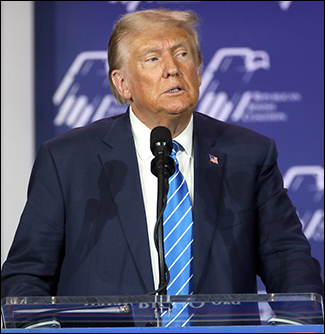
Former President Donald Trump speaks in Las Vegas Saturday. / Photo by Gage Skidmore

Iowa: Trump Well Below 50 Percent, Again — According to the new Selzer & Company poll for the Des Moines Register newspaper (Oct. 22-26; 404 likely Iowa Republican Caucus attenders; live interview), former President Donald Trump is still enjoying a healthy lead over the Republican field, but his support level continues to become stagnant. According to this survey, he has 43 percent of the impending Iowa Caucus vote, scheduled for Jan. 15, 2024. This is a one-point increase from Selzer’s August survey. Tied for second place are Florida Gov. Ron DeSantis and ex-UN Ambassador and South Carolina Gov. Nikki Haley. Both record 16 percent support.

The allegiance percentage is an increase of 10 points since the August survey for Haley but a three-point drop for Gov. DeSantis. Sen. Tim Scott (R-SC), who has now moved his whole campaign focus to Iowa, draws a seven percent preference. Former New Jersey Gov. Chris Christie and businessman Vivek Ramaswamy are tied in this poll with four percent apiece.

House

AL-1: GOP Primary Pairing Develops — The recently completed court-driven Alabama congressional map creates a new majority minority district anchored in the capital city of Montgomery, but then stretches southwest to encompass downtown Mobile. Now we see that the draw results in a pairing of two Republican congressmen. Two-term Rep. Barry Moore (R-Enterprise) announced Monday that he will challenge Rep. Jerry Carl (R-Mobile), also serving his second term, in the state’s new 1st District. The seat now spans the entire width of southern Alabama from the Mississippi border all the way to Georgia.

This will be a short-term paired campaign in that the Alabama state primary is held concurrently with the Super Tuesday presidential vote on March 5. Should no one receive majority support, the top two finishers will advance to an April 2 runoff election.

This version of AL-1 favors Rep. Carl in that he already represents 59 percent of the new territory as compared to 41 percent for Rep. Moore. The former also leads in fundraising and cash-on-hand. According to the Sept. 30 Federal Election Commission disclosure filing. Rep. Carl reported raising $1.3 million for the campaign-to-date; $257,000 in the 3rd Quarter just completed and holds $869,000 in his account.

By contrast, Rep. Moore has raised just $309,000 during the cycle-to-date, $109,000 for the Q3 period, and shows $647,000 cash-on-hand. Rep. Moore, a member of the Freedom Caucus, may be viewed as the more conservative of the two, which often proves to be the defining factor in a safe district Republican primary.

MO-1: Democratic Prosecutor Exits Senate Race to Run for House — St. Louis County Prosecuting Attorney Wesley Bell (D) who was challenging for the Democratic US Senate nomination, announced Monday that he is ending his statewide bid and will instead run a primary challenge against Democratic Socialist Congresswoman Cori Bush (D-St. Louis).

Four Democrats opposed Rep. Bush in the 2022 election, two years after she upset veteran Rep. Lacy Clay (D), but she was easily renominated with 69.5 percent of the primary vote.

Bell will be a credible challenger, but Rep. Bush must be viewed as the favorite for renomination and then an easy re-election in a 1st District that the FiveThirtyEight data organization rates as D+52.

Governor

West Virginia: First Credible Dem Candidate Announces — Though Democrats are viewed as a clear underdog to convert the open West Virginia governor’s mansion next year, the party now has a candidate capable of running a credible general election campaign. Huntington Mayor Steve Williams (D) announced his candidacy late last week. He is a former state Delegate and ex-Huntington City Manager.

Republicans are headed for a competitive gubernatorial primary among Attorney General Patrick Morrisey, state Delegate Moore Capito (R-Charleston), Secretary of State Mac Warner, and businessman Chris Miller. Capito is the son of US Sen. Shelley Moore Capito (R-WV), and Mr. Miller is US Rep. Carol Miller’s (R-Huntington) son.

Haley Gaining in Poll Test; McCarthy Out as House Speaker; Ex-North Las Vegas Mayor Announces for House Race; Majewski Returns

By Jim Ellis — Thursday, Oct. 5, 2023

President

Insider Advantage Poll: Haley Gaining — The Insider Advantage polling organization (Sept. 29-30; 850 likely US voters) finds former UN Ambassador and ex-South Carolina Gov. Nikki Haley getting a bounce from the second Republican primary debate. According to the IA ballot test, former President Donald Trump continues to dominate the field with 50 percent support. Florida Gov. Ron DeSantis is second with 15 percent, just ahead of Haley’s 14 percent score.

Haley gained three percentage points since the firm’s late August poll, while Gov. DeSantis’ support fell by the same margin. No other candidate reached double digits. The candidate falling furthest from August, businessman Vivek Ramaswamy, dropped from seven to three percent support.

House

Former Speaker of the House, Kevin McCarthy / Photo by Gage Skidmore

Speaker Vote: Eight Rs Against McCarthy; Three Not Voting — The House Speaker saga continues with Kevin McCarthy (R-CA) being removed from the post on a 216-210 vote. McCarthy likely has at least two more votes from those Republicans not voting yesterday. Texas US Reps. John Carter (R-Round Rock) and Lance Gooden (R-Terrell) were loyal McCarthy supporters in the original 15 votes. The other non-voting Republican was Rep. Anna Paulina Luna (R-FL), who typically votes with the Freedom Caucus.

With the two vacancies – the RI-1 and UT-2 special elections are scheduled for Nov. 7 and Nov. 21, respectively – the House stands at 433 members. Therefore, the winning speaker candidate must obtain 217 votes instead of the typical 218. Assuming at least two more votes from yesterday’s non-voters, McCarthy would need to convince five of the nine Republicans who either voted against him or did not vote (Luna).

The eight Republicans against are: Reps. Eli Crane (R-AZ-2), Andy Biggs (R-AZ-5), Ken Buck (R-CO-4), Matt Gaetz (R-FL-1), Matt Rosendale (R-MT-2), Nancy Mace (R-SC-1), Tim Burchett (R-TN-2), and Bob Good (R-VA-5). Six of these members consistently opposed McCarthy in January. Reps. Buck and Mace are the newcomers to this group.

Reps. Paul Gosar (R-AZ-9), Lauren Boebert (R-CO-3), Dan Bishop (R-NC-8), Byron Donalds (R-FL-19), Victoria Spartz (R-IN-5), Andy Ogles (R-TN-5), and Chip Roy (R-TX-21), who had either opposed McCarthy in January or voted “present,” all supported him in this vote. Filling that now vacant seat is a fluid and ever-evolving situation.

NV-4: Ex-Mayor Announces — John Lee (R), the former North Las Vegas mayor and ex-state legislator, announced that he will enter the competitive 4th District congressional race next year. Assuming Lee wins the Republican primary, he will face four-term US Rep. Steven Horsford (D-Las Vegas). Lee entered the 2022 gubernatorial race but did not fare well in the Republican primary. He placed fourth, only attracting eight percent of the vote.

In the congressional race, with his North Las Vegas base included within this district, he will be a formidable general election candidate in a district that the FiveThirtyEight data organization rates as D+5. The Daily Kos Elections site ranking the district as the 34th most vulnerable seat in the 213-member Democratic Conference.

OH-9: Majewski Returns — J.R. Majewski, the 2022 Republican nominee who lost to veteran Rep. Marcy Kaptur (D-Toledo) on a substantial 57-43 percent vote largely due to his January 6 history, was originally in the 2024 race, then out, and has now injected himself back into the race. Majewski was able to win a contested primary in 2022 with just a base conservative vote of 36 percent, since the remaining votes were split among three others.

His main opponent in the 2024 primary election, former state Rep. Craig Riedel, was one of the multi-candidates in the last GOP nomination contest. It appears Riedel has more unified support this time around and will likely be favored over the returning Majewski.

With the FiveThirtyEight data organization rating OH-9 as R+6, and the Daily Kos Elections site ranking the district as the fifth most vulnerable seat in the Democratic Conference, expect this race to draw a great deal of national political attention from beginning to end.

GOP Presidential Debate Qualifiers; Menendez & Son’s Challenges; Montana Libertarians Change Bylaws

Seven Republican candidates qualified for the second presidential debate. (Fox News graphic)

By Jim Ellis — Wednesday, Sept. 27, 2023

President

Presidential Debate: Seven Qualify — The second Republican presidential debate is scheduled for tonight, and Fox News announced the seven candidates who will participate. With more stringent debate requirements, it was believed that North Dakota Gov. Doug Burgum and ex-Gov. Asa Hutchinson (R-AR), who both appeared in the first debate, would be disqualified leaving six participants. Former President Donald Trump also qualifies but is again declining to appear. A last minute move from Gov. Burgum, however, allowed him to earn a debate podium spot; Hutchinson failed to do so.

The seven who will be present are: Gov. Ron DeSantis (R-FL), Sen. Tim Scott (R-SC), ex-Vice President Mike Pence, former UN Ambassador Nikki Haley, ex-New Jersey Gov. Chris Christie, businessman Vivek Ramaswamy, and Gov. Burgum. Aside from Hutchinson, national commentator Larry Elder and former US Rep. Will Hurd (R-TX) will also not meet the final requirements.

Debate: DeSantis-Newsom Forum Set — Continuing their ongoing public political feud, Florida Gov. DeSantis and California Gov. Gavin Newsom (D) have agreed to a date and state for their mutual debate challenge. The event is scheduled for Nov. 30 at a site to be determined in Georgia. Fox News will air the forum that network headliner Sean Hannity will moderate.

Senate

New Jersey: Sen. Menendez Addresses Media; Rep. Kim to Run: — Sen. Bob Menendez (D-NJ) held an indictment response news conference Monday. His statements left little doubt that he intends to fight the charges levied against him and has no intention of resigning his seat.

Some pre-news conference reports were predicting that the senator would announce his campaign for re-election. He did not specifically address his election status, only to say that he intends to remain New Jersey’s senior senator after he is cleared. He asked the Garden State voters to reserve judgment until “all the facts are known.” But Rep. Andy Kim (D-Moorestown) isn’t waiting. Kim announced that he will file a Democratic primary challenge against Sen. Menendez.

House

NJ-8: Mayor May Challenge Rep. Menendez — While Sen. Bob Menendez (D) is publicly defending himself over a new indictment brought against he, his wife, and three other associates, freshman Rep. Rob Menendez (D-Jersey City), the senator’s son who has defended his father, may be looking at a serious primary challenge.

New Jersey’s 8th Congressional District is solidly Democratic. The FiveThirtyEight data organization rates it as D+47. The Daily Kos Elections site ranks NJ-8 as the 167th safest seat of the 212-member House Democratic Conference. Therefore, Rep. Menendez’s more significant re-election obstacle is renomination.

Hoboken Mayor Ravi Bhalla (D) confirmed that he is considering launching such a primary challenge. Hoboken, with a population just over 53,000 residents, represents about seven percent of the 8th District’s population but is a considerably larger share of a Democratic primary vote.

States

Montana: Libertarians Change Bylaws — The Montana Libertarian Party has made a significant change to their party bylaws. Beginning immediately, the MLP may now officially endorse a member of another party even if a Libertarian is in the same race. This is significant because the single-digit Libertarian vote has been a thorn in the Republicans’ side since their candidates tend to draw from GOP candidates. This causes certain close races, such as in Sen. Jon Tester’s (D) past campaigns, to allow a Democrat to win with a plurality or small majority support.

Should the Montana Libertarian Party decide to endorse the Republican candidate in the upcoming Senate race and not file their own contender, it would be a plus for the eventual GOP nominee.

Harvard Poll: Some Surprises

By Jim Ellis — Thursday, Sept. 21, 2023

Polling

President Joe Biden / Photo by Gage Skidmore

National Survey: Surprises in Key Areas — Harvard University’s Center for American Political Studies recently completed an exhaustive national poll (conducted by The Harris Poll (D) and the HarrisX (R) firm; Sept. 12-14; 2,103 registered US voters; online) and while most of the responses were consistent with what we have seen from other pollsters, some of the questions produced unexpected results.

Responses about the direction of the country and economy and how President Joe Biden is performing on key issues are highly consistent with other findings. The voting public believes by an approximate 2:1 majority that the country and economy are on the wrong track, and President Biden is rated negatively on all key issue areas.

There is a small surprise on the political party approval question. Though the responses are within the polling margin of error, this is the first survey in a long while that produces slightly better numbers for the Republican Party (45:55 percent favorable versus unfavorable) than the Democratic Party (44:56 percent), though both continue to register upside-down numbers.

The Harvard pollsters tested 24 well-known individuals and found a respondent sample that views the overwhelming majority of these public figures in a negative light.

The 24 individuals included all 2024 presidential candidates from both parties with the addition of Vice President Kamala Harris, US Senate Majority Leader Chuck Schumer (D-NY), Minority Leader Mitch McConnell (R-KY), US House Speaker Kevin McCarthy (R-CA), Sens. Bernie Sanders (I-VT), Ted Cruz (R-TX), Josh Hawley (R-MO), Joe Manchin (D-WV), US Rep. Alexandria Ocasio-Cortez (D-NY), Gov. Gavin Newsom (D-CA), former Secretary of State Hillary Clinton, and Elon Musk.

Within this group, only a quarter of the men and women (6 of the 24) registered positively. Surprisingly, Robert F. Kennedy Jr. was the most favorably viewed (+15 percent), followed by former UN Ambassador Nikki Haley and businessman Vivek Ramaswamy (both at +6 percent), Sen. Tim Scott (R-SC) and Elon Musk (both at +5 percent), and Sen. Sanders (+3 percent).

The most negatively perceived were Sen. McConnell (-30 percent), ex-New Jersey Gov. Chris Christie (-20 percent), and former Vice President Mike Pence (-15 percent). President Biden scored a -12 percent, and ex-President Donald Trump fared a bit better at -6 percent.

Perhaps the biggest surprise were Vice President Harris’ ratings. While she scored -4 percent on the favorability index, her rankings in head-to-head pairings with the top Republican presidential candidates generally positive. While the survey showed that she would lose to Trump by six percentage points and tie former Vice President Pence, she leads the others.

Opposite Haley, Harris would lead by a single point. She tops Ramaswamy by two. Her best performance was against Sen. Scott (+7 percent), and Florida Gov. Ron DeSantis (+8 percent). She would also lead Kennedy 45-19 percent for the Democratic nomination if President Biden were to decide not to run.

Conversely, President Biden would trail Trump (-4 percent), Haley (-4 percent), and Sen. Scott (-2 percent). He would lead Pence (+6 percent), DeSantis (+4 percent), and Ramaswamy (+2 percent).

Legal Issues — The Harvard pollsters also queried the sample about the leading presidential candidates’ legal situations.

Regarding whether the sampling universe believes the new Biden impeachment inquiry and ex-President Trump’s prosecutions are legitimate or politically motivated, the respondents break exactly 50/50 on both questions. A majority, however (53-47 percent), support the impeachment inquiry.

There is a different view of the Hunter Biden situation and what the group believes about President Biden’s potential involvement. By a 60-40 percent majority, the respondents say that President Biden had “direct and detailed knowledge about his son’s business dealings.” The same 60/40 break was found when the pollsters asked if “Joe Biden has made false or misleading statements about his son’s business dealings, and what he knew about them.” A 57-43 percent break believes that “Joe Biden was helping his son Hunter get influence-peddling contracts.”

While there is polarization in Congress regarding the nation’s public policy, surprisingly the respondent universe answered the most important issue questions in a rather bipartisan manner.

Republicans (47 percent), Independents (41 percent), and Democrats (31 percent) all identified inflation and prices as the most important issue. Democrats (24 percent) and Independents (16 percent) tabbed climate change as second-most important; for Republicans, it was immigration (19 percent). All three groups reported crime as third-most important (Republicans 15 percent; Democrats 14 percent; Independents 13 percent).

We can count on seeing almost daily polling for the next few months from a multitude of survey research entities. Few, however, will be as extensive and detailed as this Harvard University study.

Five Republicans Lead Biden; Pelosi to Return; Hudson Announces in MI-3; Cox Draws GOP Challenge in Utah

By Jim Ellis — Tuesday, Sept. 12, 2023

President

Republican presidential candidate Nikki Haley / Photo by Gage Skidmore

CNN Poll: Five Republicans Lead Biden — The new CNN national poll (conducted by the SSRS research company, CNN’s regular polling firm; Aug. 25-31; 1,503 US adults; live interview & text) found no fewer than five of the announced Republican presidential candidates holding small leads over President Joe Biden in general election ballot tests.

Former UN Ambassador Nikki Haley fared best, scoring a six-point advantage over the president. Two-point leaders included former Vice President Mike Pence, Sen. Tim Scott (R-SC), and ex-New Jersey Gov. Chris Christie. Former President Donald Trump held a one-point edge, while Florida Gov. Ron DeSantis tied Biden. The only Republican contender to fall behind Biden, and by only one point, is businessman Vivek Ramaswamy.

This poll, consistent with many other findings, again sees the Republicans doing better in a sample comprised of adults as opposed to registered or likely voters. This suggests the GOP is doing better than Democrats with non-voters, meaning the party will have to find a way to identify, register, and turn these habitual non-voters into participants.

House

CA-11: Rep. Pelosi to Return — Though many expected 83-year-old former House Speaker Nancy Pelosi (D-San Francisco) to retire, she instead announced a re-election bid for a 20th term in Congress late last week. In her statement, Rep. Pelosi said, “our country needs America to show the world that our flag is still there, with liberty and justice for ALL. That is why I am running for reelection — and respectfully ask for your vote.” She will easily be renominated and re-elected next year.

MI-3: Ex-Judicial Candidate Announces for Congress — Attorney and Michigan Supreme Court judicial candidate Paul Hudson (R), who finished fourth in a field of five 2022 candidates, announced for Congress at the end of last week. He hopes to oppose freshman Rep. Hillary Scholten (D-Grand Rapids) in a district the FiveThirtyEight data organization rates as D+3.

Last November, Scholten defeated Republican John Gibbs, 55-42 percent, after he upset one-term Rep. Peter Meijer (R) in the GOP primary. The Michigan Independent Citizens Redistricting Commission transformed what was a safe Republican 3rd District that originally elected Meijer to one that favors the Democrats.

Hudson is the third announced Republican candidate but is clearly the most credible. Should he prevail in the Aug. 6, 2024, GOP primary, assessments will be made as to whether he will become a top-tier challenger candidate. MI-3, however, is the type of politically marginal district that the GOP must win in 2024 in order to protect and enhance the party’s slim majority.

Governor

Utah: Gov. Cox Draws GOP Challenge — State Rep. Phil Lyman (R-Blanding), who hails from San Juan County in the far southeastern corner of the Beehive State, which includes the “Four Corners” where Utah, Arizona, Colorado, and New Mexico meet, announced he will challenge Republican Gov. Spencer Cox in next year’s Republican convention and potentially the state primary.

Lyman, a land rights radical, received a pardon from former President Trump after the government arrested him for his protest activities. Gov. Cox may not be particularly popular with the Republican base, so Lyman may have a chance to assemble a significant support coalition at the state convention.