Tag Archives: former president Donald Trump

Budd Laps McCrory in N.C.

By Jim Ellis

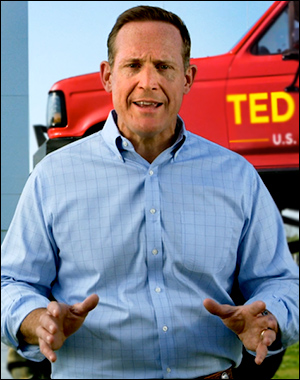
North Carolina Rep. Ted Budd (R-Advance)

April 14, 2022 — Just a month ago, some analysts and activists were questioning North Carolina Rep. Ted Budd’s (R-Advance) US Senate campaign even to the point where speculation was building that former President Donald Trump was about to pull his endorsement.

The tables have rapidly turned.

The fifth consecutive statewide survey was published Tuesday showing Budd leading former Gov. Pat McCrory as the two begin the final month of campaigning prior to the May 17 Republican primary.

Survey USA published their latest study (April 6-10; 593 likely North Carolina Republican primary voters, online) projecting Rep. Budd to a 33-23-7-2 percent advantage over McCrory, former US Rep. Mark Walker and author Marjorie Eastman. Since March 22, four other pollsters have published similar numbers. The McCrory camp has yet to counter with different figures.

Vitale & Associates was the first since early January to find Budd leading the race, a 32-29 percent margin over the former governor according to their March 22-23 survey of 504 North Carolina Republican primary likely voters.

The margin started gelling for the Budd campaign this month when three successive surveys gave the congressman double-digit leads. Cygnal, Emerson College, and WPA Intelligence — all published just before the new Survey USA study — staked Rep. Budd to leads of 11, 16, and 13 percentage points, respectively, in their polls conducted between April 1-5.

The turnaround is not particularly surprising. In relation to the Trump endorsement, early polling consistently showed the political horse race changing when the respondents were informed that the former president supported Budd. Though trailing McCrory in the initial ballot test, the fact that the two candidates flipped just on the knowledge of Trump’s endorsement was an early indicator that the former governor and fourteen-year Charlotte mayor held underlying political weaknesses.

The other clue suggesting McCrory could potentially collapse was the fact that 35 percent was his high-water mark in any of the 12 surveys results released since Jan. 5 and he only averaged 27.7 percent in those dozen polls. This, for a former governor before his own political party.
Continue reading

Notable Candidate Filings

By Jim Ellis

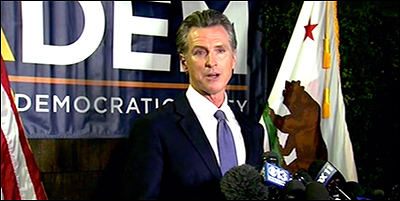
California Gov. Gavin Newsom (D) faces little in the way of strong competition in 2022.

March 15, 2022 — Candidate filing closed in three states on Friday — California, Georgia, and Idaho — and we see some highly competitive primary and general election campaigns occurring in each.

Despite 26 candidates filing against him, appointed California Sen. Alex Padilla (D) has done a good job of securing his Democratic base. As a result, he faces no serious opponent. The only way Sen. Padilla would lose in the state’s jungle primary system is if another strong Democrat surfaced and forced him into a double-Democratic general election. No such individual filed. California Gov. Gavin Newsom (D) also faces little in the way of strong competition even though he has 25 opponents.

The Georgia governor’s race features the most important May 24 primary campaign, a Republican battle between Gov. Brian Kemp and former US Sen. David Perdue. Three minor candidates are also on the ballot, and they could be a factor to force a runoff if the Kemp-Perdue race evolves into an even contest. In that scenario, a secondary election on July 26 would occur should both Kemp and Perdue be stopped short of 50 percent support.

Former Georgia state House Minority Leader and 2018 gubernatorial nominee Stacey Abrams is unopposed for the Democratic nomination. The state’s US Senate contest is already winnowing down to a battle between Sen. Raphael Warnock (D) and retired pro football player Herschel Walker (R).

In Idaho, Gov. Brad Little faces a Republican primary challenge from Lt. Gov. Janice McGeachin, who has former President Donald Trump’s endorsement. Sen. Mike Crapo has four Republican primary opponents but is in strong shape for both re-nomination and re-election to a fifth term.

In the House races, veteran Rep. Mike Simpson (R-Idaho Falls) will face a familiar foe in the Republican primary. Bryan Smith, who challenged the congressman in the 2014 Republican primary and attracted some national attention and support before falling 62-38 percent, returns for a re-match eight years after their original political battle.

Back in California in the US House races, it appears there are seven districts that will host competitive general election campaigns and many more that could send a pair of the same party’s members to the November election from the June 7 jungle primary.

Only one of the projected partisan general election battles comes in an open seat. The 3rd District, which begins in the Sacramento suburbs and stretches down along the Nevada border all the way into southern California, will yield a competitive Republican battle between state Assemblyman Kevin Kiley (R-Granite Bay) and Sacramento County Sheriff Scott Jones for one of the general election finalist positions. The state Democratic Party has endorsed physician Kermit Jones. The new 3rd, where Rep. Tom McClintock (R-Elk Grove) could have run, is rated an R+8 district.

Rep. Josh Harder (D-Turlock) will likely face San Joaquin County Supervisor Tom Patti (R) in the D+8 District 9 that retiring Rep. Jerry McNerney (D-Stockton) currently holds.

Continue reading

Georgia Turning, Again?

By Jim Ellis

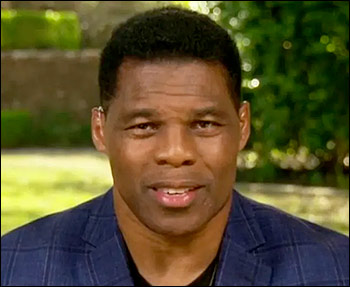
Herschel Walker (R), former University of Georgia and ex-NFL football star and current Senate candidate, enjoys his largest lead of the early election cycle.

March 11, 2022 — It was well publicized in the 2020 election cycle that the state of Georgia is beginning to swing toward the Democrats, but a new Democratic poll contains some evidence that predicting a long-standing transformational flip may have been premature. Now, the new polling suggests that Georgia voters could be open to a Republican comeback.

Blueprint Polling released their new Georgia statewide study earlier this week, and projects that GOP candidate Herschel Walker enjoys his largest lead of the early election cycle but it’s only a three-plus percentage point edge, well within the polling margin of error. The Blueprint survey (March 2-8; 662 definite (90 percent) and probable (10 percent) Georgia voters; live interview) produces a ballot test featuring Walker holding a 48.5 – 45.4 percent slight advantage over Sen. Raphael Warnock (D).

The most surprising part of the Warnock-Walker crosstabs was the Republican leading among younger voters. Walker led Warnock by just over one percentage point among those aged 18-34, typically a group that widely supports Democrats, and trails only among those aged 45-54. Among the highest turnout age sector, those 65 and older, Walker held a five-point advantage.

While Sen. Warnock still held a slight edge among Independents, 42-40 percent, Walker attracted 12 percent of Democratic votes while Sen. Warnock could manage only 9.5 percent among Republicans. The two were tied among college educated voters, a strong improvement for the Republican in this category, while Walker led by five points among those who had not attended or graduated from college.

But this result is far from the poll’s most interesting piece of information. Rather, the question about who the respondents would support in a presidential re-match produces an eye-opening result. This is particularly true when remembering that Georgia came down to an official, though disputed, small margin of 11,779 votes in Democratic candidate Joe Biden’s favor from just under 5 million ballots cast.

Continue reading

North Carolina Races Set – Part I

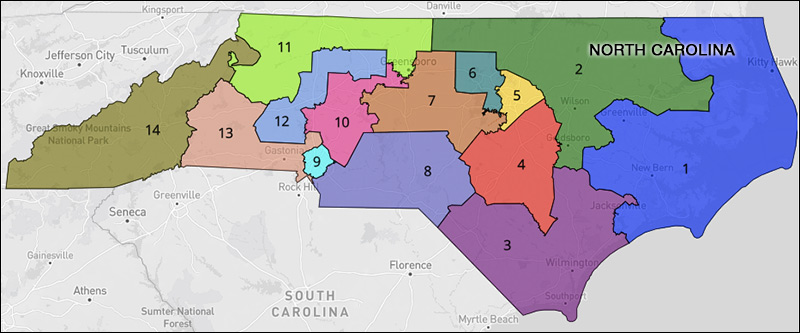
2022 North Carolina Congressional Redistricting Map

By Jim Ellis

March 8, 2022 — The chaotic Tar Heel State political scene quelled on Friday as the postponed candidate filing period finally came to a close. Today we look at the recent North Carolina redistricting past and future, along with an analysis of the open Senate race. Tomorrow, we examine the state’s 14 new US House districts.

The North Carolina state Supreme Court’s approved map will be in place for the 2022 midterm election, and as a result the candidate slate is less competitive than the originally conceived congressional plan would have yielded. While the Democrats won this most recent political battle, the state’s redistricting war, a fight between the legislature and state Supreme Court that has resulted in four different congressional maps being in passed into law and ultimately rejected since 2010, will likely continue.

The Republican legislature controls the redistricting pen because the North Carolina governor, in this case Democrat Roy Cooper, has no veto power over this subject matter. Democrats control the state Supreme Court with a 4-3 partisan majority, but there is at least an even chance that the balance of power will change after the midterm election.

Two of the Democratic judges are on the ballot this year and no Republicans. One of the two, Justice Robin Hudson, is not seeking re-election, so GOP chances of winning at least one of the two races are enhanced. If they succeed, Republicans will hold the court majority after the first of the year.

Since a court map is only an interim plan, the legislature can replace it at any time. Since the state high court did approve the legislature’s latest version of the state House and Senate maps, Republicans stand a strong chance of maintaining their majorities in both houses. Therefore, re-drawing the congressional map in 2023 should the NC Supreme Court have a different complexion could mean that the GOP would be able to enact a stronger plan next year.

Originally, North Carolina arguably looked to be the Republicans’ most important redistricting state in that it was one of just two places where the party could gain multiple congressional seats and the only one where a potential three-seat increase was within the realm of possibility. The outlook for the final 2022 map, however, gives the Democrats an advantage. It now appears more likely that the Dems will gain one or even two seats in the delegation.

The North Carolina judicial decision is a major blow to House Republican national prospects. While the party still has a good chance of re-taking the majority they lost in the 2018 election, the difficulty factor has increased through adverse court decisions here and in several other states.

Continue reading

Four More Reps Departing

By Jim Ellis

March 2, 2022 — Sen. Jim Inhofe’s (R-OK) impending resignation has begun an Oklahoma game of political musical chairs. One member of the Sooner State US House delegation announced that he will run in the special election, and another is soon expected to follow suit.

A third member, a committee chairman from Florida, announced that he will resign to become CEO of an advocacy organization. Finally, a freshman from Hawaii is sending signals that he won’t seek a second term.

Oklahoma Rep. Markwayne Mullin (R-Westville) is now a US Senate candidate, formally entering the special election to succeed resigning Sen. Inhofe. Inhofe will serve through the balance of this year, with his successor coming from the regular election calendar and taking office at the beginning of the next Congress.

Rep. Mullin announced his statewide intentions Monday, and his move will create a crowded Republican primary in the state’s easternmost congressional district, a newly drawn 2nd CD that would have supported former President Donald Trump with a whopping 76-22 percent margin.

Reports suggest that two-term Rep. Kevin Hern (R-Tulsa) will also soon join the Senate race and risk his safely Republican district anchored in the state’s second largest city of Tulsa. Both will oppose now-former Inhofe chief of staff Luke Holland, whom the senator is publicly supporting.

Additionally, state Sen. Nathan Dahm (R-Broken Arrow), who was challenging Sen. James Lankford in the regular Senate election, said that he, too, will switch to the open special election. Sen. Lankford’s other primary opponent, pastor Jackson Lahmeyer, indicated that he will also likely move to the open special election contest. Former state House Speaker and 2016 US Senate candidate T.W. Shannon is another potential Republican Senate candidate.

As sitting members, both Reps. Mullin and Hern can transfer their federal money raised for their House campaigns to a Senate committee. At the end of the year, Rep. Mullin had more than $944,000 in his account, and Rep. Hern just under $560,000. State Sen. Dahm had just under $83,000 in his US Senate campaign account. It is clear the Oklahoma Senate primary will become a major nomination campaign.

The Sooner State candidate filing deadline is April 15 for the June 28 primary election. Should no candidate receive majority support, which is a likelihood, a runoff election between the top two finishers will be held on Aug. 23.

Also, Florida Rep. Ted Deutch (D-Boca Raton), chairman of the House Ethics Committee, announced on Monday that he will be leaving Congress when the House recesses to accept a position to run the American Jewish Committee advocacy organization.

Deutch first came to the House when winning a 2010 special election after then-Rep. Robert Wexler (D) resigned the seat, and leaves what is now a safely Democratic domain in which over 80 percent of the constituency lies in Broward County and the other 20 percent in Palm Beach County. The current 22nd District supported President Biden, 57-42 percent, but with redistricting still not completed in Florida Republican map drawers may find it more appealing to significantly change the district boundaries with no incumbent on the succeeding ballot.

Continue reading

Hassan Improves; NH Voters Sour

By Jim Ellis

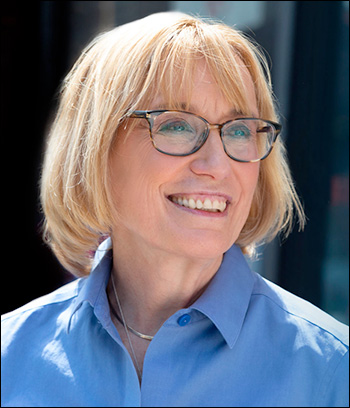
New Hampshire Sen. Maggie Hassan (D)

Jan. 24, 2022 — The New Hampshire Institute of Politics at St. Anselm’s College in Manchester, NH just completed one of their regular statewide political surveys, and while Sen. Maggie Hassan’s (D) standing has improved since their last poll, the sample participants’ underlying attitude numbers are among the most negative in the country.

In what might be the quintessential political swing state since the turn of the century, these early results spell bad news for Democrats less than 11 months from the midterm elections. In a state that Joe Biden carried with a seven-point margin in 2020, the congressional generic number now favors Republicans in a 46-40 percent clip.

St. Anselm’s poll conducted over the Jan. 11-12 period surveyed online 1,215 registered Granite State voters. Led by a Right Track-Wrong Track (direction US is headed) response ratio of a hideous 16:74 percent, only Gov. Chris Sununu (R) finds himself in a favorable realm (53:44 percent), but even his positive index has dropped a net 36 points from his rating a year ago when compared with the Institute’s February 2021 survey.

Sen. Jeanne Shaheen’s (D) job approval of 48:48 percent is the next best of the office holders tested. President Biden records a 41:58 percent positive to negative ratio. Former President Donald Trump, however, is not in much better shape with a personal approval score of 43:55 percent.

Though Sen. Hassan’s job approval has dropped to 45:51 percent, her standing against potential Republican opponents has improved. This is the first published statewide poll conducted since Gov. Sununu announced that he would not challenge her. Therefore, the GOP is left with potential 2022 candidates of much lesser standing. In earlier polling paired against Gov. Sununu, Hassan consistently trailed.

Retired army general and 2020 US Senate candidate Don Bolduc fares best among the tested Republicans, but still trailing Sen. Hassan, 43-36 percent. She tops recent Senate campaign entries Chuck Morse, the Granite State Senate president, 41-27 percent, and former Londonderry Town Manager Kevin Smith, 42-24 percent. On the other hand, the Senator not exceeding 43 percent against candidates largely unfamiliar to the respondent universe – 33 percent have not heard of Bolduc, 47 percent couldn’t identify Morse, and Smith was unknown to 59 percent — still must be considered weak.

Continue reading

GOP Battle Brewing in
North Carolina Senate

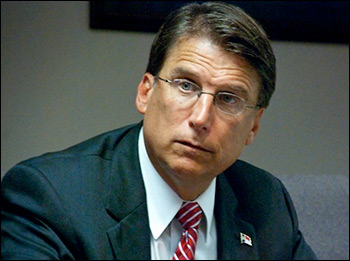
Former Gov. Pat McCrory (R-NC) – on thin ice in Senate bid? / Photo by Hal Goodtree, Flickr

By Jim Ellis

Jan. 17, 2022 — The North Carolina Senate candidates have dealt with more uncertainty than any other set of statewide political contenders in this election cycle. Some of the questions have now been answered, but others remain.

Due to the continuing congressional and state legislative redistricting legal battles that have hampered the state for virtually the entire preceding decade, even the candidate filing date and the primary schedule itself were in doubt until the courts finally set a political calendar.

In order to be more relevant for the 2020 presidential election, the legislature moved the state’s traditional May primary to early March to better influence the presidential nomination selection. By not taking action to move the primary back to May, it appeared that voters would choose their ’22 nominees on March 8.

In December, the state Supreme Court, after an early flurry of lower court redistricting action, took it upon themselves to transfer the state primary to May 17. They merely suspended the Dec. 17 candidate filing deadline, but did not issue a new date. Earlier this week, as part of its ruling upholding the GOP legislature’s congressional and legislative maps, the special three-judge panel assigned to hear the redistricting challenges set the filing deadline for March 4.

With these basic questions now answered, the candidates finally have a clear electoral timeline in which to work. With the Democrats earlier coming together on a consensus candidate, fireworks are beginning on the Republican side. In mid-December, state Sen. Jeff Jackson (D-Charlotte), thought to be a major US Senate contender, dropped his statewide bid. This makes former state Supreme Court Chief Justice Cheri Beasley an overwhelming favorite for the Democratic nomination.

In the past few days, a pair of Tar Heel State Republican primary Senate polls were released almost simultaneously, with both finding former Gov. Pat McCrory holding an edge over US Rep. Ted Budd (R-Advance). The ex-state chief executive’s advantage isn’t what one would expect for a well known party leader before his own partisan electorate, however. The McCrory campaign released their Strategic Partners Solutions survey (Jan. 5; 800 likely North Carolina Republican primary voters) that gives their man a 30-21-8 percent lead over Rep. Budd and former US Rep. Mark Walker.

The Civitas Institute’s latest Cygnal statewide poll (Jan. 7-9; 600 likely North Carolina Republican primary voters) also found McCrory holding an initial lead, but only through a 24-19 percent spread. Pushing for a decision from the 48 percent who said they were undecided and adding those preferences to the total actually finds Rep. Budd pulling into a small lead, 34-33 percent, when accounting for those who have “definitely” and “probably” made up their minds.

Continue reading

Alabama Senate:
Primary Now Competitive

Former Business Council of Alabama CEO Katie Britt

By Jim Ellis

Dec. 16, 2021 — For the most part, early polling has given Alabama US Rep. Mo Brooks (R-Huntsville) a big lead in his open Senate Republican primary race, but a series of later surveys reveal a major change on the ballot test.

According to the new McLaughlin & Associates survey of the Alabama Republican electorate, Rep. Brooks’ lead has dropped to single-digit points over former Business Council of Alabama CEO Katie Britt, with business owner and military veteran Michael Durant, a relative newcomer to the race, also making his presence felt. An earlier unrelated poll actually found Britt posting a slight edge over the field.

The McLaughlin study (Dec. 6-9; 500 likely Alabama Republican primary voters; 80 percent self-identified Republicans; 20 percent non-Republicans who say they will vote in the Republican primary, live interview) projects Rep. Brooks to be holding a 31-26-17 percent advantage over Britt, who is also a former chief of staff to retiring Sen. Richard Shelby (R), and Durant. In a troubling sign for Brooks, a hypothetical runoff contest between the congressman and Britt fell the latter candidate’s way on a 39-37 percent count.

Before November, Brooks held huge polling leads — from 23 to 43 points in surveys conducted during the August through October period. The McLaughlin poll seems to reinforce a developing trend that the Strategy Group and the Cygnal polling organization detected in November polling.

Cygnal (Nov. 3-4; 650 likely Alabama Republican primary voters, text, interactive voice response, email), polling for the Alabama Conservatives Fund, actually saw Britt, for the first time, taking a slight 24-22-9 percent lead over Rep. Brooks and Durant.

The Strategy Group (Nov. 1-4; 784 likely Alabama Republican primary voters; live interview and interactive voice response system) found the Brooks lead over Britt to be only 28-23 percent. The SG poll was conducted largely as an issue survey for the Alabama House Republican Caucus, but they asked one question to test a Brooks-Britt isolated Senate primary, which could be a precursor to a runoff contest.

The Alabama race is another where former President Donald Trump has come out early with an endorsement. His support helped Rep. Brooks build a large early lead, but the ex-president will have to come more to the forefront if his candidate is to reverse the latest trend.

Continue reading

North Carolina in Political Abeyance

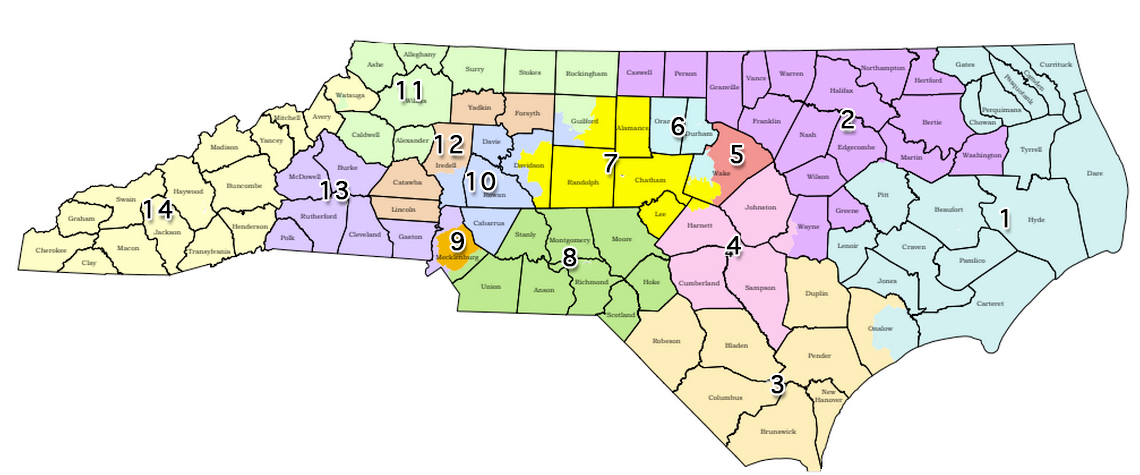
(Please click on map for expanded view.)


By Jim Ellis

Dec. 14, 2021 — Last week proved to be a topsy-turvy week in North Carolina politics, and situations are being created that won’t likely be resolved for some time.

First, a three-judge panel suspended the state’s Dec. 17 candidate filing deadline to allow consideration time for the filed partisan gerrymandering lawsuits. A day later, the en banc 15-member State Appellate Court overturned the judicial panel’s ruling and reinstated the Dec. 17 filing deadline. Just hours later, the state Supreme Court overruled the full Appellate Court and not only reinstated the original ruling suspending the candidate filing deadline, but postponed the North Carolina primary more than two months, moving it from March 8 to May 17.

The final ruling affects all candidates at every level because the primary now returns to the traditional May slot that North Carolina typically holds. The respective Democratic and Republican Party leaders moved the primary in 2020 to better position the state for the presidential nomination process. In the 2021 legislative session, the General Assembly took no action to move the primary back to May.

The judicial rulings also affect the statewide US Senate race. For example, ex-Congressman Mark Walker (R) is a Senate candidate who did not seek re-election to the House in 2020 because the late-decade court-ordered redistricting ruling tore his previous 6th District into several parts making the region unattainable for any Republican.

Many people on the right, including former President Donald Trump, are reportedly urging Walker to leave the Senate race and run in the state’s open 7th Congressional District. The newly created CD-7 in the Greensboro area, which Walker largely represented, would certainly be winnable for him. In actuality, he would only have to win a Republican primary. If this map stands, the new 7th will be safe for the GOP in any general election.

Currently, the former congressman trails badly in early US Senate polling, but he is planning to stay in the Senate race until at least the end of the year, or when the congressional map status becomes clear.

Continue reading

PA-Senate: Republicans in Trouble

Former US Ambassador to Denmark, Carla Sands — a Pennsylvania senate candidate to watch.

By Jim Ellis

Nov. 29, 2021 — The Keystone State of Pennsylvania, with an open Senate and governor’s race, will be a focal point of the 2022 election cycle, and last week the Republicans’ early problems grew worse.

The Pennsylvania GOP began this election cycle in a seemingly underdog position as they fought to hold the Senate seat from which two-term incumbent Pat Toomey (R) is retiring; now they are clearly playing from behind.

Iraq War veteran Sean Parnell (R) had former President Donald Trump’s endorsement and was leading the Republican primary in early polling. However, due to losing a child custody judgment rendered at the beginning of this week after a contentious trial in which his ex-wife had accused him of domestic abuse, Parnell withdrew from the Senate contest.

It’s a loss for his party, but Parnell wasn’t even the best of candidates. In his first bid for public office, running for the 17th Congressional District seat against Allegheny County area incumbent Conor Lamb (D-Pittsburgh), now himself a Senate candidate, Parnell came close but lost 51-49 percent. Based upon a close defeat in a winnable district, he decided to make a statewide Senate run.

Two other primary opponents, former lieutenant governor nominee Jeff Bartos and Army veteran, Trump campaign activist, and former congressional candidate Kathy Barnette, also lost their most recent political races. Therefore, the original three leading Republican candidates in either polling or fundraising hadn’t ever won a race and were falling well behind their Democratic counterparts.

The Democrats feature the overall early race leader, Lt. Gov. John Fetterman. He commands first position in primary and general election polling and has raised way more campaign capital than all of his opponents, over $9.2 million through the Sept. 30 financial disclosure period.

John Fetterman, however, isn’t without his own flaws. In 2013, when he was mayor of Braddock, a borough southeast of Pittsburgh in Allegheny County and located on the Monongahela River, Fetterman pulled a loaded weapon on an unarmed African-American jogger after hearing gunshots fired in his neighborhood. The Fetterman campaign has already produced a short video explaining the incident in anticipation of this becoming an issue in his 2022 statewide effort.

Rep. Lamb is running second to Lt. Gov. Fetterman in polling and dollars raised, almost $7 million behind his chief Democratic rival. The latest poll, from the Civiqs organization (Oct. 31-Nov. 1; 929 likely Pennsylvania Democratic primary voters, online) found Fetterman way ahead of Rep. Lamb, 52-12 percent, with other announced and possible candidates, state Rep. Malcolm Kenyatta (D-Philadelphia), Montgomery County Commissioner Val Arkoosh, and potential contender Sharif Street, a state senator and son of former Philadelphia Mayor John Street, all polling at five percent or less.

Continue reading