Tag Archives: former president Donald Trump

Iowa Map Enacted

By Jim Ellis

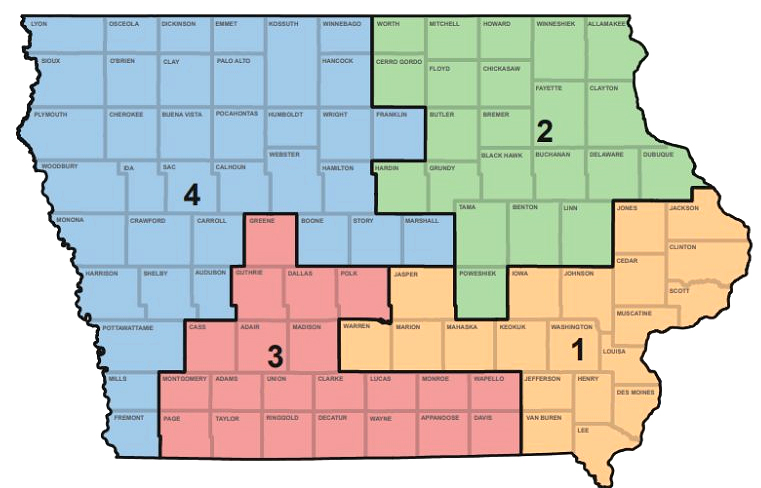
Nov. 10, 2021 — Gov. Kim Reynolds (R) signed the new Iowa redistricting map package, legislation that contained the new US House, state Senate, and state House of Representatives maps. The new congressional plan makes what appear to be minor changes to the state’s four districts, while again crafting a new quartet that would have voted in unison for former President Donald Trump. As is the case on the current map, Trump’s district victory margins featured varying percentages.

The Iowa redistricting system is unique. Some believe the state redistricts through a commission, but that is not the case. Rather, a state legislative committee is tasked with drawing the three-map plans and presenting them to the legislature for final approval. The plans must be submitted as a package, and the legislators may only vote up or down on the whole group, as no amendments to any of the maps are allowed.

The committee also employs a formulaic algorithm to create the districts without regard to political proclivities or deference to incumbents. If three map packages are rejected, the legislature then takes full control of the process.

The adopted package is the second plan iteration. The committee staff first put forth a series of maps that failed to make it through the first state Senate committee of jurisdiction. That congressional map was much different than the ultimately enacted plan. In the first draw, freshman Rep. Ashley Hinson (R-Marion/Cedar Rapids) would have been placed in a decidedly Democratic district that would have made her an underdog for re-election in 2022.

It is likely, however, that alone was not the reason for the Senate committee members rejecting the map package. The committee staff created two separate pairings of three incumbent senators apiece, thus dooming the entire package. Once returned, the congressional map plan, using a changed formula, returned to a similar configuration as under the current map.

Continue reading

Illinois Redistricting Map Released

By Jim Ellis

The new Illinois redistricting plan, featuring 17 new districts that twist, turn, and meander throughout the state.

Oct. 19, 2021 — It had been speculated that the Illinois Democrats were attempting to draw a new congressional map to reduce the state’s Republican contingent from five members to three. The new plan, featuring 17 new districts that twist, turn, and meander throughout the state, appears to accomplish their goal.

Democratic leaders from the House and Senate Redistricting committees defend their actions, saying the plan is “designed to comply with federal law and ensure the broad diversity of the state is reflected in the elected officials sent to represent Illinois in Washington, D.C.” The map must still clear both houses of the Illinois legislature and obtain Gov. J.B. Pritzker’s (D) signature before becoming law but with Democrats holding big partisan majorities, enactment seems certain.

Republicans and even some analytical observers say the map is a blatant partisan gerrymander designed to net the Democrats three seats nationally. Under this plan, 14 at least “lean Democratic” districts are created opposite three Republicans. The current map stands at 13D-5R, but Illinois loses a congressional seat in reapportionment.

Therefore, if the map performs as designed, the Republicans will be down a net three seats nationally because the Democrats would convert two GOP districts while the latter party absorbs the loss of the 18th seat that went to another state.

A potential legal problem, in addition to a political gerrymandering lawsuit, is the lack of drawing a second Hispanic seat in Chicago, and the Mexican American Legal Defense Foundation (MALDEF) is reportedly poised to file suit. As was the case in the last decade, the demographic numbers appear high enough for Hispanics to have two seats within Chicago. Such a second seat was not drawn in 2011, and it is again not created on this map, but the black majority seats are reinforced.

One of the re-draw’s top targets is Rep. Adam Kinzinger (R-Channahon). His current 16th District is divided into several parts in an effort to sustain the marginal Democratic district that Rep. Cheri Bustos (D-Moline) is relinquishing in western Illinois, and help strengthen Rep. Lauren Underwood’s (D-Naperville) district in the Chicago metro area. Under the current map, Underwood won a second term with just a 51-49 percent margin.

Continue reading

Impeachment Republicans’ Trouble

By Jim Ellis

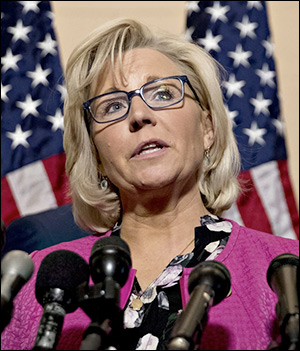
Rep. Liz Cheney (R-WY), one of 10 Republican House members who voted to impeach former President Donald Trump

Oct. 15, 2021 — As we know, 10 House Republicans voted to impeach then-President Donald Trump over the Jan. 6 US Capitol controversy and now it appears that the nine running for re-election are currently facing a bumpy political road.

Reports have surfaced in the political media that identify billionaire Peter Thiel, a Trump supporter, as contributing to the campaigns of the Trump-endorsed candidate opposing at least two of the Impeachment Republicans, Reps. Liz Cheney (R-WY) and Jaime Herrera Beutler (R-WA). The big question is whether Thiel and other like-minded mega donors will fund Super PAC efforts against the House incumbents who supported the impeachment resolution.

Already, Thiel is reportedly committing $10 million to a Super PAC supporting Arizona Senate candidate Blake Masters. He faces a credible field in the GOP primary, including Attorney General Mark Brnovich, solar company owner Jim Lamon, retired Arizona National Guard Adjutant General Mick McGuire, and State Corporation Commission member Justin Olson.

It is unknown whether Thiel will put that type of money behind the Trump endorsed House candidates trying to deny the impeachment Republicans re-nomination, but he has made the maximum campaign contribution to at least two of the contenders, Harriet Hageman, who is opposing Rep. Cheney, and retired Army officer Joe Kent, Rep. Herrera Beutler’s GOP challenger.

Let’s look at how the 10 are currently faring in their re-election efforts:

• CA-21 – Rep. David Valadao: With California’s top-two qualifying system there are effectively no Republican or Democratic primaries. The candidates finishing first and second from the June primary will advance into the general election regardless of party affiliation. There is little chance of denying Rep. Valadao one of the two finalist positions, but he will face a difficult general election campaign irrespective of the Trump-backed efforts.

• IL-16 – Rep. Adam Kinzinger: Reports suggest that the Democratic state legislative leadership is attempting to collapse Rep. Kinzinger’s seat since Illinois loses a seat in reapportionment. He faces a multi-candidate Republican field, but the redistricting lines will be the biggest factor in whether or not Rep. Kinzinger continues his congressional career. The situation won’t be fully known until the redistricting plan is formally introduced and passed into law.

• MI-3 – Rep. Peter Meijer: Freshman Rep. Meijer may have the most favorable situation of all the impeachment Republicans. While he does have primary opposition, none of the candidates appear particularly formidable. Additionally, the preliminary redistricting maps suggest that while Meijer’s district will significantly change, he will still have a Republican seat anchored in Grand Rapids. Adding the city of Kalamazoo would make re-election more competitive, but the overall district would still favor a Republican nominee in most instances.

• MI-6 – Rep. Fred Upton: Multiple Republican candidates have surfaced against Rep. Upton, but his bigger problem may be redistricting. The Michigan Independent Citizens Commission has released four draft maps, and all pair Rep. Upton with another Republican incumbent, either Reps. Bill Huizenga (R-Holland) or John Moolenaar (R-Midland).

Though Trump has endorsed state Rep. Steve Carra (R-Kalamazoo), Upton’s bigger problem would likely be facing another incumbent. It is also possible that Carra finds himself placed in another district.

• NY-24 – Rep. John Katko: Like Rep. Upton, Katko’s biggest re-election problem appears to be redistricting and not the two Republicans who have announced against him. Though the New York preliminary congressional redistricting map has not yet been released, it appears the Democratic leadership is looking to take as many as five of the eight Republican seats away from the GOP.

This very likely means that Rep. Katko would find himself paired with another Republican incumbent, even potentially House Republican Conference Chair Elise Stefanik. Redistricting will likely be the key factor in whether or not Rep. Katko returns to Congress after the next election.

Continue reading

New Redistricting Numbers

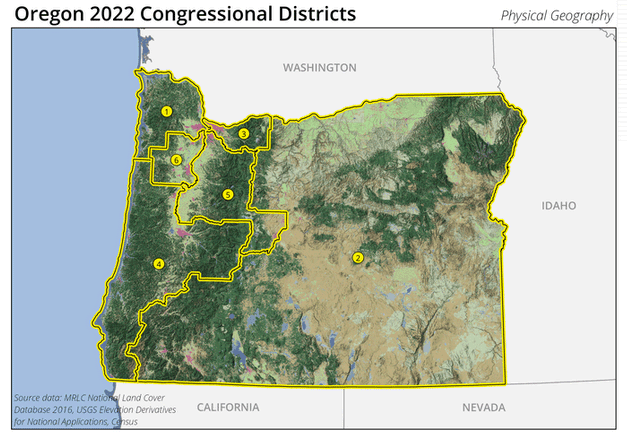
Oregon 2022 Congressional Districts (Go to Daily Kos story on Oregon’s new House map)

By Jim Ellis

Oct. 12, 2021 — The Daily Kos Elections website’s statistical team has already published presidential election numbers for some of the states that have completed their redistricting process. Therefore, we have a bit more information about the new districts in Oregon and Maine, which allows us to better analyze the political landscape.

In Oregon, the Daily Kos team has published the Biden-Trump 2020 numbers for the new six Beaver State congressional districts, which makes comparing with previous data possible.

Rep. Suzanne Bonamici’s (D-Washington County) 1st District actually makes her previously safe northwestern Oregon seat even stronger. This new district gives her all of downtown Portland. President Biden posted a 68-29 percent margin in the new 1st, a net 10-point increase from his spread in the current district (63-34 percent).

The state’s lone Republican district, OR-2, also sees its percentages increasing for the incumbent’s benefit, who is freshman Rep. Cliff Bentz (R-Ontario/East Oregon). Instead of finding a 56-42 percent margin in former President Donald Trump’s favor, the new 2nd expands to 61-37 percent, a similar net 10-point improvement for the GOP as the Democrats saw in District 1.

Making the 2nd District so overwhelmingly Republican is reflective of the Democratic legislature’s plan to pack as many GOP voters as possible into the 2nd to facilitate achieving their goal of drawing a 5D-1R statewide map.

Rep. Earl Blumenauer’s (D-Portland) 3rd District, previously the Democrats’ safest Oregon seat, remains so, but with a slightly smaller margin. Under the newly adopted district lines, President Biden would have recorded a 73-25 percent victory as opposed to his 74-23 percent spread under the current map.

Perhaps the biggest change on the Oregon map, other than adding a new district, was making the Eugene-anchored 4th District safer for veteran representative and House Transportation and Infrastructure Committee Chairman Peter DeFazio (D-Springfield).

The Biden margin in the previous 4th was 51-47 percent, and the congressman only recorded 51.5 percent in his 2020 re-election victory, one of the smallest of his 18 electoral triumphs. In the new 4th, President Biden’s victory spread would have been 55-42 percent, a net Democratic gain of nine percentage points.

Continue reading

Colorado Maps Completed


Colorado Independent Redistricting Commissions’ Final Approved Congressional Plan

By Jim Ellis

Oct. 1, 2021 — The members of the Colorado Independent Redistricting Commissions completed their task of sending congressional and state legislative maps to the state Supreme Court at the assigned deadline, with all but one person supporting the final US House product.

The adopted map was based upon the third staff-produced map, with an amendment from Democratic commission member Martha Coleman (2nd CD) in a re-draw that affected Rep. Ed Perlmutter’s (D-Arvada) 7th District and the new 8th CD.

The staff offering became the commission’s working map. The initiative that created the redistricting panels awarded an inordinate amount of power to the professional staff in the event of a commission deadlock, meaning that a two-thirds majority is not achieved. In such a situation, the staff map would then be directly sent to the state Supreme Court at the assigned deadline. The high court has until Dec. 15 to approve the maps now officially in their possession.

The congressional map now features eight seats, since Colorado was awarded a new district in reapportionment. All of the considered maps placed the new seat in a similar location, with the final product featuring a new 8th CD lying north to northeast of Denver, and encompassing the municipal population centers of Thurston, Westminster, and Greeley.

All seven current incumbents receive districts they can win. Reps. Diana DeGette (D-Denver) and Joe Neguse (D-Boulder) have the strongest Democratic seats, while Reps. Ken Buck (R-Windsor) and Doug Lamborn (R-Colorado Springs) have the safest Republican districts. Rep. Jason Crow (D-Aurora) sees his 6th District substantially improve, while Reps. Lauren Boebert (R-Silt) and Perlmutter have districts that clearly favor their party, but which could yield a degree of competitiveness.

Rep. Boebert’s 3rd CD, or the Western Slope district, remains largely intact with the exception of moving further east along Colorado’s southern border. A great deal of the public input at the various hearings expressed the desire to unite many of the Hispanic and Native American communities in that region.

The changes don’t drastically change the political nature of her district, however. In Donald Trump’s two elections, the former president carried the 3rd by 12 and 6 points, respectively, in 2016 and 2020. The aggregate score on the new CO-3 is R+9. Therefore, the partisan complexion is largely unchanged, despite the addition of some different geography.

Continue reading

Ohio Rep. Anthony Gonzalez
Won’t Seek Re-Election

By Jim Ellis

Ohio Rep. Anthony Gonzalez (R-Rocky River)

Sept. 21, 2021 — Saying he believes that former President Donald Trump “shouldn’t ever be president again,” sophomore Ohio Rep. Anthony Gonzalez (R-Rocky River) announced on Friday that he will not seek a third term in the House.

Rep. Gonzalez was one of 10 Republicans to support Trump’s second impeachment, and drew a strong Republican primary opponent as a result. Former President Trump responded to Gonzalez’s statement and decision with his own release saying, “1 down, 9 to go,” in reference to those Republican House members who supported removing him from office after the Jan. 6 Capitol invasion.

Gonzalez is the 19th member who will not be on the next election ballot for the US House seat he now holds, including the three vacancies to be filled in special elections. Of the 19, Republicans currently hold 10 seats as compared to nine for the Democrats. This is the first GOP opening with some competitive potential, however, though the Gonzalez decision will likely have a big impact upon the Ohio redistricting process currently under way within the state legislature in Columbus.

Former White House aide Max Miller had been Rep. Gonzalez’s top Republican competitor. Through the June 30 campaign financial disclosure period, Miller had raised just under $1 million ($951,520), but had only $533,153 remaining in cash-on-hand.

Despite Miller’s strong fundraising effort, Rep. Gonzalez still held the upper hand, reporting $1.22 million raised with over $1.5 million in the bank. Therefore, while the Miller challenge appeared formidable, it was not a foregone conclusion that he would have denied Rep. Gonzalez re-nomination had the congressman decided to continue running.

Rep. Gonzalez’s 16th Congressional District begins in the Westlake area to the west of Cleveland and stretches south toward the rural areas southwest of Canton. It then meanders to the northeast around Akron to end in the city of Edinburg.

Continue reading

Perdue’s Georgia Governor Test

Former US Sen. David Perdue (R-GA)

By Jim Ellis

Aug. 23, 2021 — The Fabrizio Lee polling firm, conducting a survey for former President Donald Trump’s Save America PAC, recently tested former US Sen. David Perdue opposite the Georgia Republican gubernatorial field including the party’s incumbent, Brian Kemp.

At this point, Perdue has not indicated that he will be on the ballot for any office in 2022, but that did not stop the Trump pollsters from releasing data showing how he would fare as a gubernatorial candidate. Former DeKalb County Executive and ex-state Rep. Vernon Jones, a former Democrat who became a Trump spokesman during the 2020 campaign, is Gov. Kemp’s principal challenger to date.

The Fabrizio Lee poll (Aug. 11-12; 500 likely Georgia Republican primary voters, including 100 Independents who plan to vote in the Republican primary, live interview) finds Gov. Kemp still saddled with tepid approval numbers from the GOP base. His favorability index is 69:27 percent favorable to unfavorable, which does show weakness for an incumbent within his own political party. Comparatively, Trump’s favorability index is 93:6 percent.

In the four-way primary Gov. Kemp fails to reach 50 percent, which would force a runoff vote if this poll were the final electoral result. The ballot test finds the governor leading 41-19-16-3 percent over Jones, Perdue and announced candidate Kandiss Taylor, respectively. The Perdue number is also weak, but his standing changes when another piece of information is given the respondents.

The pollsters isolated Gov. Kemp and ex-Sen. Perdue after telling the survey participants that Trump would support Purdue. Knowing that, the two-way test yields a Kemp lead of only 46-40 percent, with 25 percent saying they are “definitely” voting for Kemp while 20 percent would “definitely” support Perdue. The remainder favoring each man said they would “probably” vote for their stated individual.

The paradigm changes when all of the candidates are added to the ballot test with the respondents having the information that Trump supports Perdue. Under this scenario, it is Perdue who assumes the lead with 41 percent, while Gov. Kemp posts just 26 percent. Jones records 14 percent, and Taylor, a minor 2020 US Senate candidate, again attracts three percent support.

The Trump endorsement also played a factor in the responses for the US Senate race. Here, former University of Georgia and NFL football star Herschel Walker easily outdistances state Agriculture Commissioner Gary Black. Walker has not committed to run, while Black is an announced candidate.

Continue reading

Virginia Polling: Still Close

By Jim Ellis

Aug. 18, 2021 — The co/efficient polling organization has conducted two surveys in the Virginia governor’s race within the last month and both continue to find a toss-up race.

Former Virginia governor, Terry McAuliffe (D)

While the Glenn Youngkin (R) campaign has so far not defined former Gov. Terry McAuliffe (D) in definitive contrasting terms — something that must occur if the Republican is to remain in victory range from a state that is cutting against his party — the numbers still remain close.

In co/efficient’s first August poll, taken for the Virginia Conservatives for Clean Energy organization (July 25-27; 762 likely Virginia voters, interactive voice response system and text), McAuliffe’s lead was 45-40 percent. Six polls, from five different pollsters have been released in this race, and all show both candidates within the 40s. The first co/efficient survey, incidentally, returns the lowest individual support numbers for both candidates.

The second co/efficient survey, released yesterday according to The Hill newspaper (Aug. 8-9; 1,200 likely Virginia voters, interactive voice response system and text), sees a closer ballot test, 47-45 percent in favor of McAuliffe, again returning similar results with their previous study and consistent with all other public polling beginning with WPA Intelligence’s release in early June (McAuliffe 48-46 percent).

Averaging all six public ballot test results, McAuliffe scores a mean of 46.5 percent as compared to Youngkin’s 43.2 percent, which tells us that a group of professional polling teams finds the race as a virtual dead heat with the former governor holding a slight edge. These margins are similar to the 47.7 – 45.2 percent final result that McAuliffe recorded over Republican Ken Cuccinelli in their 2013 governor’s race.

The 2021 race could actually be even closer. Since polling in the past several elections has tended to understate Republican support typically by two or so percentage points, the idea that the current race is nip-and-tuck is even further supported. Additionally, looking at the Democratic primary election, just over 34,000 less people voted in the 2021 Democratic primary than did in 2017. This is opposite of almost all other elections during the same time period that find drastically increased voter turnout percentages.

McAuliffe has already been tying Youngkin to former President Donald Trump, attempting to paint him as an extremist and linking him to a national candidate who fared poorly in Virginia both in 2016 and 2020.

Continue reading

Brown, Carey Win In Ohio

Shontel Brown scored a convincing win in Ohio’s 11th District Democratic primary, virtually assuring her of a special general election victory on Nov. 2.

By Jim Ellis

Aug. 5, 2021 — Primary voters in two Ohio districts, for all intents and purposes, chose replacements Tuesday for resigned Reps. Marcia Fudge (D-Cleveland) and Steve Stivers (R-Columbus).

County Councilwoman and Cuyahoga County Democratic Party chair Shontel Brown scored a convincing win in the 11th District Democratic primary, virtually assuring her of a special general election victory on Nov. 2 in a seat that is safe for her party. Ohio Coal Association chairman Mike Carey did likewise in the 15th District Republican primary that occupies much of the Buckeye State’s southern sector.

Despite polling showing Brown trailing former state Sen. Nina Turner but consistently gaining momentum, it was obvious that the winner’s campaign peaked at precisely the right time. With 75,064 people voting in the Democratic primary, Brown scored a 50.2 – 44.5 percent victory. The other 11 candidates split the remaining 5.3 percent.

The 11th District contains most of the city of Cleveland in Cuyahoga County and part of Akron in Summit County. Brown’s Cuyahoga total percentage spread of 50.4 – 44.1 almost exactly mirrored the district-wide vote. Conversely, Turner scored a very tight 48.8 – 40.0 percent plurality in Summit County, a difference of just 54 votes.

Turner, the former national co-chair of the Bernie Sanders for President campaign attracted support from the Democratic socialist movement, including Rep. Alexandria Ocasio-Cortez (D-NY) and the Justice Democrats PAC. She began the campaign as almost a prohibitive favorite, leading by a 50-15 percent margin in a late May Tulchin Research organization survey. Once the final financial totals are known, it will be clear that Turner outspent the winner by a better than 2:1 margin.

Brown, receiving backing from the more establishment-oriented Democrats including House Majority Whip Jim Clyburn (D-SC), the Congressional Black Caucus, and former Secretary of State and 2016 Democratic presidential nominee Hillary Clinton, among others, began to chip away at the former state legislator’s lead about six weeks before the election and made steady gains through the closing period as polling highlighted.

The race’s most recent survey, from the Mellman Group (July 13-17; 400 OH-11 likely voters), gave Turner only a 41-36 percent advantage. A poll generally scoffed at in early July, from the Republican firm TargetPoint, found the two candidates tied at 33 percent. In the end, it was TargetPoint that proved closest to the final mark.

On the Republican side, with just 5,299 voters participating, community activist Laverne Gore was an easy winner, capturing 74 percent support. The Nov. 2 special election is now just a formality in the heavily Democratic district, however, and Brown can count on being sworn into the House toward the end of this year.

In his victory speech, 15th District Republican primary winner Mike Carey gave a large portion of the credit to former President Donald Trump who endorsed him in a crowded field of eleven candidates. “Tonight, the voters of the 15th Congressional District sent a clear message to the nation that Donald J. Trump is, without a doubt, the clear leader of our party,” Carey began his victory speech before his victory party supporters.

Continue reading

Ohio Specials Today

Ohio’s Congressional Districts

By Jim Ellis

Aug. 3, 2021 — Though the two Ohio special congressional elections won’t officially be decided until the Nov. 2 general election, today’s nomination contest in both the vacant 11th and 15th congressional districts will unofficially choose the succeeding representatives in the respective Democratic and Republican primary elections.

District 11, the vacated Cleveland-Akron seat because former Rep. Marcia Fudge (D-Cleveland) resigned to accept her appointment as Housing & Urban Development Secretary, is a solidly Democratic seat (Biden ’20: 80-19 percent; Clinton ’16: 80-17 percent). Though yielding a Democratic primary of 13 candidates, the race is boiling down to a two-way contest between former state senator and 2020 Bernie Sanders for president national co-chair Nina Turner and Cuyahoga County councilwoman and local Democratic Party chair Shontel Brown.

The 15th District lies in southern Ohio and contains some of the south Columbus suburbs of Franklin County along with 11 largely rural counties southwest, south, and southeast of the state’s capital city. The former incumbent here, Steve Stivers (R-Columbus), resigned his office in May to accept a position as president/CEO of the Ohio Chamber of Commerce. This, after testing the waters for a US Senate run. OH-15 is a reliable Republican district (Trump ’20: 56-42 percent; Trump ’16: 55-40 percent) that has grown more conservative over time.

Originally, it appeared that former Sen. Turner was a lock in the 11th District. She had big leads in polling and fundraising, but in the past six weeks, Brown has made major strides. While the latest polling still projects her trailing just outside the polling margin of error, the prevailing political trend is definitively moving in the local official’s direction.

This race is also shaping up as a battle between the two major factions within today’s Democratic Party: the Democratic socialists, led by Independent Sen. Bernie Sanders (I-VT), Reps. Alexandria Ocasio-Cortez (D-NY), Ilhan Omar (D-MN), and the political action committee known as the Justice Democrats, opposite the national party establishment featuring such individuals as House Majority Whip Jim Clyburn (D-SC), the Congressional Black Caucus leadership, and Hillary Clinton.

While keeping her ads positive, some of Brown’s outside supporters, namely the Democratic Majority for Israel PAC, have highlighted public comments Turner previously made about President Biden, Vice President Harris, all before they were elected to their present positions, and the Democratic Party in general. Conversely, Brown’s campaign ads highlight her strong support for President Biden and his stated policy agenda.

Continue reading