
Category Archives: Polling

Winning vs. Ideology

By Jim Ellis

Nov. 21, 2019 — As the 10 Democratic presidential candidates again took the debate stage last night, this time from Atlanta, they all needed recognize a few things: They needed to walk a fine line. The contenders needed to carefully navigate between appealing to their party’s ideological base, which is key to winning the nomination, and preparing for the general election where a more centrist approach appears to be the probable course toward achieving national victory.

The Gallup organization just completed a new national survey (Nov. 1-14; 1,015 US adults from all 50 states and the District of Columbia, 437 self-identified Democrats and Independents who lean Democratic) that compared the importance between choosing an ideologically sound nominee with one who is best equipped to win the general election irrespective of where that individual stands on the party’s base issues.

Looking at the current results in the prism of Gallup asking the same questions of Republican respondents when President Obama was running for re-election in 2012, and a Democratic cell group when President George W. Bush was seeking a second term in 2004, this sample skews towards electability over ideology in the starkest proportion.

According to Gallup’s questions asked of Democrats and lean Democrats whether they believed it is more important to find a candidate who can unseat President Trump or one who agrees with the individual respondent on issues, by a margin of 60-36 percent the poll showed that the favored candidate would be the one having the best chance to win the November 2020 election.

In 2012, Republican responses to this choice involving replacing President Obama, surveyed in mid-September of 2011, leaned toward a candidate who could win over the ideologically pure contender in a 53-43 percent spread. Eight years earlier, when President Bush was seeking his second term, the ratio among Democrats at the end of 2003 was 50-44 percent in favor of ideology, but six weeks later, in early February 2004, the margin switched to 55-40 percent toward finding the candidate who was best equipped to unseat Bush.

Continue reading

Unending North Carolina Redistricting

By Jim Ellis

Nov. 20, 2019 — If it seems like the North Carolina redistricting process has dragged on for the entire decade, then your senses are correct, because it has. After seeing a mid-decade re-draw before the 2016 elections, another set of lines will be in place for 2020, and then another plan for the ensuing electoral decade beginning in 2022 will be enacted during the regular decennial process. North Carolina is a sure bet to gain a new congressional seat in 2020 reapportionment.

Last week, the Republican legislature produced a new map per court order that will concede two more seats to the Democrats. This plan is not final, however, as the new map still has must clear the legal process and certainly the Democrats will challenge in an attempt to get more. Republicans will counter and attempt to move the process away from the state three-judge panel which has been favorable to the Democratic arguments, and into federal court where they feel their own points may be given a more sympathetic hearing.

Racial gerrymandering was the subject of the original challenges, but when those arguments led to a new map without a net gain of Democratic seats, the plaintiffs filed political gerrymandering lawsuits. With the Supreme Court basically returning the political gerrymandering arguments back to the state courts, the Democrats, at least in North Carolina, are in much better position to get a map that better reflects their intended outcome.

With the current split being 10R-3D, which of the current members are in the deepest trouble under the new map? Though the map looks fundamentally similar to the current plan, there are sizable differences in district configuration from a political context.

The Daily Kos Elections site ran a voting analysis of the new seats, and it appears a new Tar Heel State delegation under this map would feature eight Republicans and five Democrats, or a net gain of two seats for the latter party.

The two current incumbents who would not likely return under the plan are Reps. George Holding (R-Raleigh) and Mark Walker (R-Greensboro). Their districts go from being a plus-10 Trump district for Holding to a minus-14 CD, and for Walker an original plus-15 Trump to a minus-11.

Continue reading

Louisiana Elects a Governor;
Bevin Concedes in Kentucky

By Jim Ellis

Louisiana Gov. John Bel Edwards (D), left, and Republican challenger Eddie Rispone (R)

Nov. 18, 2019 — Louisiana Gov. John Bel Edwards (D) defied typical southern electoral history on Saturday as an incumbent winning a run-off election. Usually, when an office holder is forced into a run-off because he or she failed to secure majority support in the primary election, that individual loses the secondary vote. Not so, for Gov. Edwards as he scored a 51.3 – 48.7 percent victory over Baton Rouge developer Eddie Rispone (R).

Late polling suggested a different outcome, as the latest data proposed a trend line where Rispone might have well gone over the top. A new JMC Analytics poll (Nov. 12-13; 600 likely Louisiana voters) showed that Baton Rouge developer Rispone could slip past Gov. Edwards by a 46-45 percent count. The one-point margin was not particularly significant, since the result meant the two candidates were locked in a virtual tie, but the aggregate late-polling trend was more telling.

Since Nov. 1, five studies have been publicly released from five different pollsters and each find the spread ranging from a flat tie to four points. But even the four-point margin, 50-46 percent from Targoz Market Research (Nov. 7-13; 803 likely Louisiana voters) in Edwards’ favor, is inconsistent with the others. Removing this poll, with its strong sample size but long sampling period, means the average percentage difference between the two candidates from the four remaining surveys is only 1.25.

The actual turnout said something different, however, and the first clue came from early voting. According to the latest count on Thursday night, 46 percent of the early votes were coming from Democrats as compared to 38 percent from Republicans. In the jungle primary election, the Democratic early voting advantage was only 44-41 percent, and the GOP candidates secured 52 percent of the vote.

The Daily Kos Elections site authors calculated the percentages that Gov. Edwards would need to attain in key parishes in order to reach 50 percent. We see that the governor reached his projected benchmark in 13 of the 15 representative parishes selected, which accounts for his statewide total.

Over 1.5 million voters participated in the election, meaning a turnout percentage of 50.7 percent of registered voters. This was up 4.8 percent from the recorded primary turnout figure. Four years ago, when Gov. Edwards was first elected in defeating then-US Sen. David Vitter (R), just 40.2 percent of registered Louisiana voters cast their ballots.

Rispone centered his campaign around attacking Edwards over Louisiana ranking near the bottom of state statistics in job creation, and that he was fully in President Trump’s camp. The President came to the state to hold one of his rallies for Rispone, but even this did not help engender a victory.

Edwards’ campaign contended that Louisiana is in the top 10 of fastest growing state economies, that the $2 billion deficit the governor inherited is now a surplus and that was accomplished while increasing teacher pay and expanding Medicare.

Continue reading

Buttigieg Pulls Ahead

By Jim Ellis

South Bend Mayor Pete Buttigieg

Nov. 14, 2019 — As more potential Democratic presidential candidates, like former New York City mayor, Michael Bloomberg, ex-Massachusetts Gov. Deval Patrick, and even Hillary Clinton begin to re-emerge on the campaign’s outer horizon, the party nomination contest is moving into a sustained state of flux.

It is obvious that the potentially returning candidates are flirting with a new effort because they don’t perceive any of the active contenders as being in position to win the nomination outright or who can successfully oppose President Trump in the general election.

Now, we see a new complicating factor as an Iowa poll released Tuesday finds South Bend Mayor Pete Buttigieg grasping the lead away from both former Vice President Joe Biden and Sen. Elizabeth Warren (D-MA).

According to the new Monmouth University survey (Nov. 7-11; 451 likely Iowa Democratic caucus attenders) Buttigieg claims first place with a 22 percent preference factor. Biden and Warren follow with 19 and 18 percent, respectively. Sen. Bernie Sanders (I-VT) secures fourth position with 13 percent.

The Monmouth poll is attracting headlines because it produces a new leader, and thus a new story line for a media horde always looking for a different narrative or angle. It may, however, be premature to suggest this one poll is the beginning of a new trend in the Democratic battle especially when it is the only survey drawing such a conclusion.

Two other pollsters ran surveys in a similar time frame and arrive at entirely different results. The Morning Consult large sample online survey (Nov. 4-10; 16,400 likely Iowa voters) projects a ballot test standing like we saw when the campaign was in its early stage: Biden 32 percent; Sanders 20 percent; Warren 19 percent; Buttigieg eight percent.

Continue reading

What the First Poll Shows in Alabama With Jeff Sessions Entering Race

By Jim Ellis

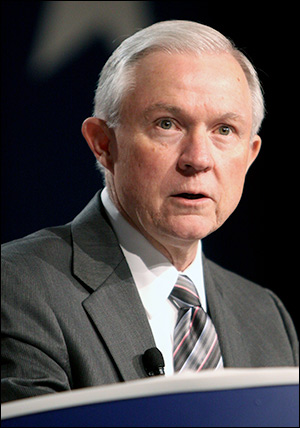
Former Senator and US Attorney General, Jeff Sessions (R)

Nov. 12, 2019 — The Club for Growth organization, the leadership of which had been encouraging former Alabama senator and US attorney general Jeff Sessions (R) to enter the state’s Senate race, conducted and released the first survey since Sessions announced his candidacy on Thursday.

WPA Intelligence administered the survey well before Sessions publicly declared, but just published the results over the weekend. The sampling period was Oct. 29-31, with a respondent universe of 511 likely Alabama Republican primary voters.

The results find Sessions leading the field with 36 percent voting preference. Auburn University former head football coach Tommy Tuberville is second with 23 percent support. The addition of Sessions to the field shows that Rep. Bradley Byrne (R-Mobile) dropping into a tie for third position with former state Supreme Court Chief Judge Roy Moore as the two record 11 percent apiece. Alabama Secretary of State John Merrill, the only current statewide elected official in the race, notches only six percent, and state Rep. Arnold Mooney (R-Shelby County) trails the entire field at just two percent.

If this poll is wholly accurate, it means that both Sessions and Tuberville would advance from the March 3 Super Tuesday primary into an April 14 run-off election to determine who will qualify for the general election opposite Democratic Sen. Doug Jones.

Just over two weeks before WPAi went into the field, the Cygnal polling organization tested the race. According to Cygnal (Oct. 10-12; 536 likely Alabama Republican primary voters), Tuberville led Rep. Byrne, 32-18 percent, and the two of them would have advanced into the second round. Secretary Merrill was next with 13 percent and Judge Moore followed with 11 percent, the same level of support that WPAi detected for the latter man when Sessions’ name was included. State Rep. Mooney records a similar one percent in this survey.

Continue reading

The Great Lakes’ Poll

By Jim Ellis

Nov. 12, 2019 — The Cook Political Report in conjunction with the Henry J. Kaiser Foundation of San Francisco sponsored a four-state survey, called the “Blue Wall Voices Project,” covering key Great Lakes states to determine Democratic presidential primary standing within the region among other issues.
The poll has an unusual methodology in that the survey period was long (Sep. 23-Oct. 15) and the 3,222 registered voter respondents, who were invited to participate, could do so through an online link or by calling to speak with an interviewer. The four selected states were Michigan (767 registered voter respondents; 208 likely Democratic primary voters), Minnesota (958; 249), Pennsylvania (752; 246), and Wisconsin (745; 274). The survey questionnaire contained 36 questions about issues, candidates, approval perception, and demographics, many with several subsets.

In terms of general election positioning, the results in all four states lead to the conclusion that President Trump is in need of refining his message since the respondents’ answers cut severely against his perceived positions on trade, immigration, and foreign affairs in particular.

Short-term, the Democratic presidential responses were of greatest interest and, in all four of these important states, we see a legitimate multi-candidate contest developing with less than three months until the first votes are cast in the Iowa Caucus.

While signs are beginning to surface that Minnesota Sen. Amy Klobuchar is gaining some traction in Iowa, a must for a Midwestern candidate, her home state poll shows her moving into the delegate apportionment mix.

Under Democratic National Committee rules, a candidate must obtain 15 percent of the at-large and congressional district popular vote in order to win committed delegate votes. According to the Cook/Kaiser survey, and including those who say they are leaning toward a particular candidate, Sen. Klobuchar attracts 15 percent among her home state Democratic respondents, in second place behind Sen. Elizabeth Warren’s 25 percent.

The top tier is tightly bunched after Warren. After Klobuchar’s 15 percent, former Vice President Joe Biden notches 14 percent, with Sen. Bernie Sanders right behind at 13 percent. Extrapolating this poll over the period before Minnesota holds its primary on Super Tuesday, March 3, suggests that all four of the contenders will qualify for a portion of the state’s 75 first-ballot delegate votes.

We see a similar split in Michigan, though Klobuchar is not a factor here or in any other tested state. Again, Sen. Warren leads the pack, also with support from a full quarter of the respondents. Following are Biden and Sanders with 19 and 15 percent, respectively. The Wolverine State has 125 first-ballot delegates.

Continue reading

Sessions Looms Over Alabama Race

Former Senator and US Attorney General, Jeff Sessions (R)

By Jim Ellis

Nov. 4, 2019 — We’re getting close to the Nov. 8 candidate filing deadline in Alabama for the March 3 Super Tuesday state primary, and more speculation is brewing that former senator and US attorney general, Jeff Sessions (R), will decide to enter the crowded GOP primary field in order to re-claim his former position.

Reporting has indicated that Sessions, who originally won the Senate seat in the 1996 election, saw his re-election percentage substantially grow in all of his subsequent campaigns from 58.6 percent in 2002 to 63.4 percent in 2008 to 97.3 percent in 2014 when he didn’t even draw a Democratic opponent, is making calls to members of the Alabama House delegation and political leaders around the state to assess his chances. Sessions, of course, relinquished the Senate seat to accept President Trump’s appointment as US attorney general, and then his political trouble began.

To set the current stage, already in the race and running are US Rep. Bradley Byrne (R-Mobile), Secretary of State John Merrill, former Auburn University head football coach Tommy Tuberville, state Rep. Arnold Mooney (R-Shelby County), and former state Supreme Court Chief Justice Roy Moore who blew the 2017 special election when it became public that he dated under-age girls while in his 30s. Judge Moore won the special election nomination when he defeated appointed incumbent Luther Strange in the GOP run-off, which led to Doug Jones becoming the first Democrat to win an Alabama Senate seat since Howell Heflin was re-elected to his third and final term in 1990.

The 2020 Yellowhammer State race, however, may well be the most important contest in the nation to decide the next Senate majority. If the Republicans regain what is normally a safe seat for them, their chamber total increases to 54, which means the Democrats would have to sweep the top vulnerable GOP incumbent defense races in Arizona (Sen. Martha McSally vs. Mark Kelly), Colorado (Sen. Cory Gardner vs. presumably former governor and ex-presidential candidate John Hickenlooper), and North Carolina (Sen. Thom Tillis, assuming he wins the GOP nomination, against former state Sen. Cal Cunningham), and win the presidency.

This scenario would bring the 2021 US Senate into a tie but give the Democrats the majority because the new vice president, who also becomes the Senate president, would be a Democrat with the power to break a tie vote.

Most believe the Republicans would be in the political driver’s seat to defeat Sen. Jones should anyone but Moore win the GOP nomination. Alabama will be one of President Trump’s strongest states (62.1 percent in 2016), and the GOP tide should be strong enough to carry the party’s Senate nominee to victory over a Democratic incumbent who has held the party line on most controversial issues and will more than likely support President Trump’s removal from office.

Continue reading