Tag Archives: FiveThirtyEight

Maryland’s New Map Filing Closes

Please click on the image above or here to go to an interactive version of the map on FiveThirtyEight.

By Jim Ellis

April 20, 2022 — A surprising court decision that invalidated the original 2022 Maryland congressional map has made the Free State slightly more competitive for the coming election, and now we see the candidate universe.

The Maryland filing deadline was moved to April 15 from the first postponed deadline of March 22. The original filing was scheduled for Feb. 22 in conjunction with the June 28 primary. The latter election date was moved to July 19 as a result of the original congressional map being disqualified in court.

With the new map in place, two districts were most affected. The new 1st District of Rep. Andy Harris (R-Cockesyville) returns to safe Republican status at R+25 according to the FiveThirtyEight statistical team. Under the rejected Democratic legislature’s map, the Harris seat was rated only R+8. Rep. David Trone’s (D-Potomac) western Maryland 6th District now moves into Republican territory at R+1, a major change from the D+12 seat that the Democratic legislature drew.

A total of 69 candidates are running for the US House in Maryland, but the most emphasis will be the Democratic primary in Rep. Anthony Brown’s (D-Bowie) open 4th District and Trone’s 6th CD in the general election.

The Democrat’s July 19 primary will determine Rep. Brown’s successor as he joins the open race for state attorney general. The new 4th District, anchored in Prince Georges County, and which stretches as far north as Laurel, is just under 60 percent black and 87.7 percent minority. Therefore, this majority minority seat will elect its new member in the Democratic primary.

A familiar face filed towards the end of the period — former 4th District Congresswoman Donna Edwards (D), who won a special election in 2008, and then clinched four more regular electoral contests. She unsuccessfully ran for the Senate in 2016, and now is attempting a comeback with her successor, Rep. Brown, moving on.

Edwards’ main competitor is former Prince Georges County State’s Attorney Glenn Ivey who was the clear leader until the former congresswoman returned. The third key candidate is former state Delegate Angela Angel. A fourth contender, state Delegate Jazz Lewis (D-Largo), decided to file for re-election and dropped out of the congressional race. Six other Democrats filed, but appear to be minor candidates as the race is winnowing to the three aforementioned contenders.

Continue reading

DeSantis Releases Congressional Map

Proposed Florida redistricting map moving from 27 to 28 districts (click on map or here to go to FiveThirtyEight interactive map).

By Jim Ellis

April 15, 2022 — After vetoing the legislature’s congressional map and forcing a special legislative session to finish the redistricting process, Florida Gov. Ron DeSantis (R) now commands the upper hand. As a result, legislative leaders say they are willing to pass his map.

Applying the district political numbers that the MCI Maps organization calculated, we see 20 of the 28 new districts that would have voted for former President Donald Trump over President Joe Biden. Overlaying the Ron DeSantis-Andrew Gillum governor’s race of 2018, a total of 18 new CDs would have supported the current state chief executive. Today’s Florida congressional delegation splits 16R-11D.

The major point of contention during the regular legislative session pertains to the elimination of the current northern Florida majority minority 5th District of Rep. Al Lawson (D-Tallahassee) that stretches from Tallahassee to Jacksonville. Gov. DeSantis wants a race neutral map. Should his map be enacted, there is no question that lawsuits would be filed immediately, and this fight could lead to a fundamental examination of the national Voting Rights Act.

Assuming the map clears the legal hurdles, the Republicans could add as many as four seats to the Sunshine State delegation, which would negate Democratic gains in New York, for example. Many of the new districts could lead to increased competition for GOP members, however, as several would drop into lean Republican seats instead of ones that are currently safe.

The only displaced incumbent is Rep. Lawson, as he would have no reasonable place from which to seek re-election. His situation would then create another seat in the Jacksonville area and give current 4th District Rep. John Rutherford (R-Jacksonville) likely the choice of running in new District 4 or 5.

As a result of this northern state map strategy, Rep. Neal Dunn’s (R-Panama City) 2nd CD would become significantly less Republican, largely because the entire city of Tallahassee would be placed in his new CD. The FiveThirtyEight data organization rates the current 2nd as R+40. Ex-President Trump would have carried the new 2nd with 54.86 percent, with Gov. DeSantis approximately a percentage point lower.

Continue reading

Ohio Numbers Crunched

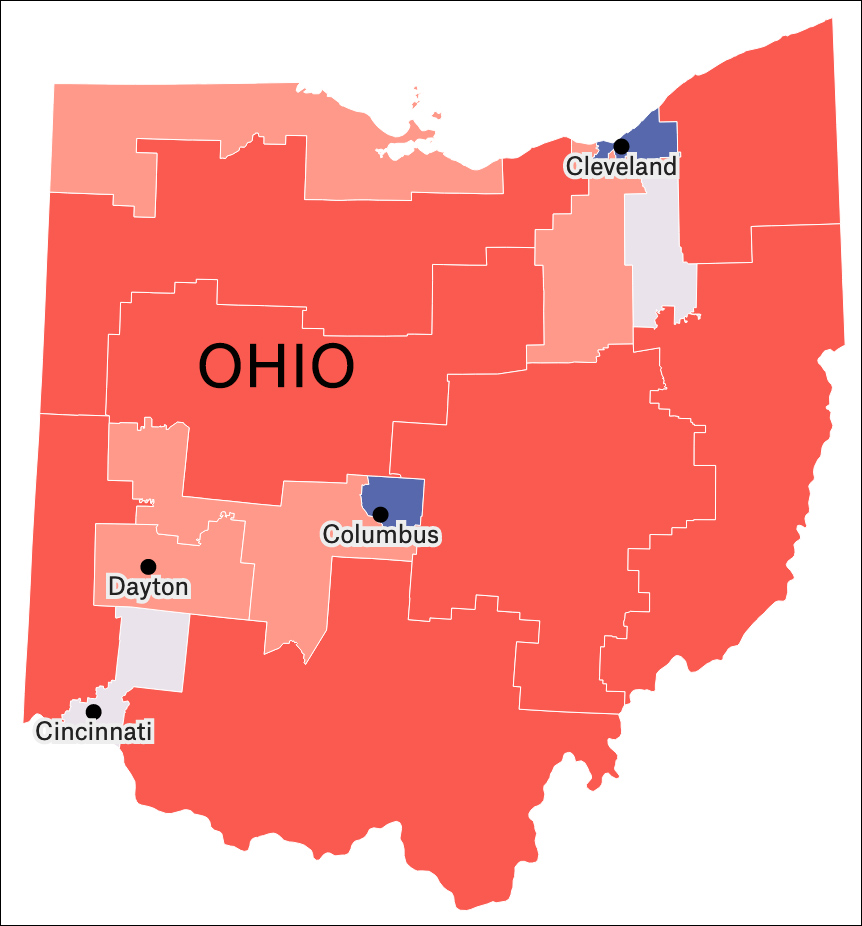
Ohio 2022 Congressional Redistricting map. Click on image to go to FiveThirtyEight’s fully interactive map.

By Jim Ellis

April 11, 2022 — When Ohio Rep. Bob Gibbs (R-Lakeville) announced the suspension of his re-election campaign on Wednesday, it brought some national attention to what has become a Buckeye State redistricting debacle.

Gibbs called out the Ohio State Supreme Court for allowing the replacement congressional district map to languish in political limbo after they rejected the first iteration for excessive political gerrymandering. Though congressional candidate filing was delayed until March 4 from the original Feb. 2 deadline in association with the state’s May 3 primary, the court still took no action toward finalizing a new map. Therefore, candidates were forced to file for districts that may or may not change before election day.

When the Ohio state high court finally informed the Democrat plaintiffs who were challenging the map that the decision regarding the first map constituted the final ruling, the complaint process had to rewind, beginning with a new lawsuit. Now filed, it is apparent that first judicial action on the new challenge is still months away. Therefore, the replacement map appears set for the 2022 elections, at least through the nomination process.

That finally being the case, we can now look at what is becoming a relatively competitive map for the upcoming general election.

Ohio loses a seat, therefore a new congressional map must be in place for the 2022 elections, otherwise all 15 US House contests would be decided on a statewide basis.

The state will now feature two open seats, Gibbs’ 7th CD and the newly configured open 13th District that Rep. Tim Ryan (D-Warren/Youngstown) is vacating to run for US Senate. Two new House members, Reps. Shontel Brown (D-Warrensville Heights/Cleveland) and Mike Carey (R-Columbus), who were both elected in November 2021 special elections, will stand for full terms this year.

Of the 13 incumbents seeking re-election, two, Reps. Steve Chabot (R-Cincinnati) and Marcy Kaptur (D-Toledo) — the latter being the fourth longest-serving member of the House who was first elected in 1982 — find themselves in toss-up general election situations.

In Rep. Chabot’s 1st District, which covers much of greater Cincinnati, the FiveThirtyEight data organization rates the seat as a D+3. Dave’s Redistricting App largely agrees, finding the average Democratic vote over a historical set of races registering 49.91 percent as opposed to 47.93 percent for Republicans. Already, the general election is largely set with Rep. Chabot seeking re-election and the Democrats having a consensus candidate is Cincinnati City Councilman Greg Landsman.

Rep. Kaptur sees the Cleveland portion of her district redacted, meaning her Toledo-anchored seat now features an even mix between Democrats and Republicans. The FiveThirtyEight group rates Kaptur’s new 9th CD at R+6, but Dave’s Redistricting App sees this seat differently. According to the party averages over the course of past political contests, the Democratic vote is 48.77 percent, as compared to a virtually even percentage for Republicans, 48.63.

Rep. Kaptur has no Democratic primary opposition, but four Republicans have filed, two of whom would be significant general election contenders. They are state Sen. Theresa Gavarone (R-Bowling Green) and state Rep. Craig Riedel (R-Defiance). It is likely that one of these two will advance into the general election and make the OH-9 general election campaign one of the most hotly contested in the nation.

Continue reading

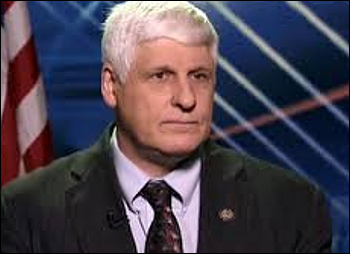
Ohio Rep. Bob Gibbs Suspends Campaign for Re-election

By Jim Ellis

Ohio Rep. Bob Gibbs (R-Lakeville) to retire.

April 8, 2022 — Expressing frustration with the Ohio courts and constituent complexion of his new district, six-term Buckeye State Rep. Bob Gibbs (R-Lakeville) on Wednesday surprisingly became the 22nd Republican US House member who has decided not to seek re-election.

This retirement announcement is different from all the others — 31 Democrats have also made public their decision to leave the House at the end of the current session — because Gibbs had filed for re-election and Ohio early voting has already begun.

Lashing out at the state Supreme Court that has delayed for weeks in providing 2022 candidates a clear direction with regard to the redistricting maps, Gibbs said in his retirement announcement statement, “It is irresponsible to effectively confirm the congressional map for this election cycle seven days before voting begins, especially in the Seventh Congressional District, where almost 90 percent of the electorate is new and nearly two-thirds is an area primarily from another district, foreign to any expectations or connection to the current Seventh District.”

Rep. Gibbs has a valid point about the state Supreme Court. After rejecting the original congressional map under partisan gerrymandering reasoning, the legislature returned a second map, and the court did not render a decision, even after again rejecting the alternative version maps for the state House and Senate. Therefore, the congressional incumbents and candidates have been languishing for weeks not knowing precisely the location of the new district lines, and long past the candidate filing deadline that occurred on March 4.

The court justices then informed the Democratic plaintiffs regarding their lawsuit challenging the congressional lines, after waiting for several weeks with no action, that the original decision on the first map constituted their final ruling, thus the plaintiffs would have to file a new lawsuit for them to consider further arguments to the second plan. The Democratic plaintiffs did file again, but even preliminary action of any kind is reportedly now months away. Hence, the second map is, at least for now, in place for the 2022 election cycle.

The court and legislature were also in a battle over whether the high court even has jurisdiction to order new maps. Under the Ohio Constitution, the courts do not have authority to draw new redistricting maps. They may only remand any rejected map back to the legislature. Thus, the continuing saga of 2022 Ohio redistricting.

Considering Gibbs’ late withdrawal, Secretary of State Frank LaRose (R) immediately announced that the congressman’s name cannot be removed from the ballot, and any vote cast for him would now not be counted. The move puts former Trump White House aide and Marine Corps veteran Max Miller in the favorite’s position for the Republican primary.

Continue reading

Convicted Rep. Fortenberry to Resign

By Jim Ellis

Convicted Nebraska US Rep. Jeff Fortenberry (R-Lincoln)

March 29, 2022 — A Los Angeles, Calif. jury convicted Nebraska US Rep. Jeff Fortenberry (R-Lincoln) of three felony counts late last week, two involving campaign finance. The jury ruled he concealed illegal campaign funds received from a foreign national, and lied to federal investigators.

The congressman announced over the weekend that he will resign from the House on March 31, answering the call of both parties’ leadership to do so.

Rep. Fortenberry further says he will appeal the verdict and wrote in his official open resignation letter that “due to the difficulties of my current circumstances, I can no longer serve you (meaning his constituents) effectively.”

Since Nebraska’s candidate filing has closed and contenders certified, it is unclear at this time whether the congressman’s name can be removed from the primary ballot. The only ballot-related deadline that has not passed in relation to the May 10 primary is the period before April 4 when county clerks can make “corrections” to the ballot.

State Sen. Mike Flood (R-Norfolk) is the leading GOP candidate in Fortenberry’s absence. Retired Air Force officer John Glen Weaver, teacher Thireena Yuki, and welder Curtis Huffman round out the Republican congressional field. The consensus Democratic candidate is state Sen. Patty Pansing Brooks (D-Lincoln).

Now that Rep. Fortenberry is resigning, Gov. Pete Ricketts (R) will call a special election to fill the balance of the term. Under Nebraska law, since the seat will open before Aug. 1 of the even-numbered year, the special election must be scheduled within 90 days of the official date of vacancy. In this case, the vote must be held on or before June 28.

There will be no primary special election under Nebraska procedure. Nominations will come from the qualified political parties, handled through the 1st Congressional District committees of the various entities. A single-party candidate must be chosen and ballot qualified no later than 65 days before the scheduled election. Qualification refers to meeting the constitutional candidate requirements, filing the proper signature petitions, and paying relevant fees.

It is presumed the Republican and Democratic committees will turn to their leading candidates in state Sens. Flood and Brooks for the two major party nominations, but they don’t necessarily have to pursue such a direction because the special election’s candidate deadline will occur before the regular primary election. It would make little sense, however, for the parties to nominate someone other than their leading contenders, because the new individual(s) would not be able to run in the general election since the regular candidate filing period has closed.

Continue reading

House Candidates File in Two Competitive States

By Jim Ellis

Candidate filings have closed in both Nevada and Iowa.

March 23, 2022 — Though both are only four-district congressional states, Iowa and Nevada will both host a large number of highly competitive US House races this year, and now the candidates have filed.

The Senate races in both states are already well defined and will come to a head in the general election. In Iowa, Sen. Chuck Grassley (R) is on the ballot for an eighth term having been first elected in 1980, and it is clear that he will face former US Rep. Abby Finkenauer (D) in the general election.

In Nevada, first-term Sen. Catherine Cortez Masto (D) defends her seat most likely against former Attorney General Adam Laxalt (R), but he must first deflect a credible Republican primary challenge from businessman and disabled Afghan War veteran Sam Brown.

The Hawkeye State House races feature only one safe member, freshman Randy Feenstra (R-Hull/Sioux City). The other three races will again host tight campaigns as they did in 2020, which of course includes Rep. Mariannette Miller-Meeks’ (R-Ottumwa) six-vote victory.

In the new 1st District, Miller-Meeks will again campaign in a district not much different than the 2nd District that she carried by the slimmest of margins in the last election. She won’t again face former state Sen. Rita Hart (D), however. Despite coming agonizingly close to victory in 2020, Hart declined to seek a re-match this year. Democrats only filed one candidate, so state Rep. Christina Bohannan (D-Iowa City) and incumbent Miller-Meeks will compete in a venue that is likely to yield another close finish.

Rep. Ashley Hinson (R-Marion/Cedar Rapids), who knocked off then-Rep. Finkenauer in what was Iowa’s 1st District, finds herself in a slightly more Republican 2nd District. Like in the new 1st CD, the Democrats filed only one candidate. In this seat, the Democrat nominee will be state Sen. Liz Mathis (D-Hiawatha) a former news anchor at the same television station where Hinson also reported the news. The new 2nd rates as R+6 according to the FiveThirtyEight data organization.

In the Des Moines-anchored 3rd CD, Rep. Cindy Axne (D-Des Moines) has won two plurality victories and looks to face another difficult re-election campaign in a seat that rates R+2. State Sen. Zach Nunn (R-Bondurant) looks to be the strongest Republican of the three GOP contenders and is the favorite to win the nomination. This will become a top national Republican conversion opportunity.

Not previously mentioned as a potential candidate against Nevada Rep. Dina Titus (D-Las Vegas) in a new 1st District that is much more Republican, former 4th District Congressman Cresent Hardy (R) filed at the deadline on Friday to officially enter the race.

Rep. Titus has expressed displeasure at the configuration of her new district that FiveThirtyEight calculates went from a current D+22 rating to a D+4 under the new plan. Dave’s Redistricting App finds the average 1st CD Democratic vote at 52.6 percent and the Republican percentage at 42.3 percent. This is considerably better than the seat where Titus averaged 62.1 percent in the five elections conducted during the previous decade.

As many as four other Republicans may qualify for the primary ballot, but Hardy appears to be the most formidable of the contenders. The new 1st District contest, in a CD that encompasses part of Las Vegas before moving south to include the cities of Henderson and Boulder City, will become competitive in the fall but is still an uphill battle for any Republican nominee.

Frequent candidate Danny Tarkanian (R), who last year was elected to the Douglas County Commission after a long string of electoral defeats, is again running for Congress. This will be his fourth quest for the US House in a third different district, on top of two Senate races. Previously, he lost a pair of campaigns in the 3rd CD and one in the 4th District.

Continue reading

Pennsylvania Candidate Filings Close

Click on image to go to FiveThirtyEight.com’s interactive redistricting map.


By Jim Ellis

March 18, 2022 — Pennsylvania’s candidate filing period closed late Tuesday, yielding official May 17 primary candidates for the Keystone State’s federal and state offices. A total of 11 contenders are competing in the Republican gubernatorial primary, while Attorney General Josh Shapiro is unopposed on the Democratic side. Gov. Tom Wolf (D) is ineligible to seek a third term.

The Senate race is also a crowded affair, with seven Republicans compared to five candidates in the Democrat primary. The Senate contest is also open because Sen. Pat Toomey (R) is not seeking a third term. A total of 66 Democrat, Republican, and some minor party candidates filed for the congressional races. The state’s Independent and minor party filing deadline does not conclude until Aug. 1.

Among the Republican gubernatorial candidates are two former US House members, Lou Barletta and Melissa Hart, two state senators, Doug Mastriano (R-Fayetteville) and Senate President Pro Tempore Jake Corman (R-Bellefonte), former US Attorney Bill McSwain, Montgomery County Commissioner Joe Gale, and former Delaware County Commissioner Dave White. Shapiro will begin the general election campaign as the favorite, if for no other reason than seeing the eventual Republican nominee having to fight through a tough crowded primary.

The Senate race features primaries on both sides. The Democrats are in basically a two-way affair between Lt. Gov. John Fetterman, who leads in all polls and fundraising, and US Rep. Conor Lamb (D-Pittsburgh). Both Democrats are from western Pennsylvania, but Fetterman should have the advantage in the vote-rich southeastern PA region considering his statewide ties, thus making him the favorite for the party nomination.

Two candidates on the Republican side have been spending heavily to attempt to separate themselves from the rest of the field, and they look to have succeeded. Former hedge fund CEO David McCormick is leading in the latest two statewide surveys over television doctor Mehmet Oz. Former US Ambassador to Denmark Carla Sands and 2018 lieutenant governor nominee Jeff Bartos are the trailing candidates.

The Pennsylvania Senate general election will be one of the most important in the nation, and the results will go a long way toward determining which party will control the majority in the next Congress.

In the congressional races, Reps. Brendan Boyle (D-Philadelphia), Dwight Evans (D-Philadelphia), Mary Gay Scanlon (D-Swarthmore), Dan Meuser (R-Dallas), Lloyd Smucker (R-Lancaster), John Joyce (R-Hollidaysburg/Altoona), Guy Reschenthaler (R-Peters Township), Glenn Thompson (R-Howard/State College), and Mike Kelly (R-Butler) all should have easy rides to re-election. Rep. Reschenthaler has no Republican or Democratic opposition post-filing. Rep. Joyce faces only one minor Republican opponent.

Rep. Fred Keller’s (R-Middleburg) safe Republican 12th District was eliminated because Pennsylvania lost a seat in national reapportionment. He originally was going to challenge Rep. Meuser in the 9th District Republican primary, but later decided to retire.

Pennsylvania hosts four major congressional races: two open seats and two top challenger efforts against vulnerable Democratic incumbents.

Rep. Lamb’s open 17th District, which sits west of Pittsburgh and stretches to the Ohio border, has a rating of D+1 according to the FiveThirtyEight data organization; this is the type of seat that Republicans must convert if they are to win the majority in November.

Continue reading

Illinois 2022 Candidate Filings Close

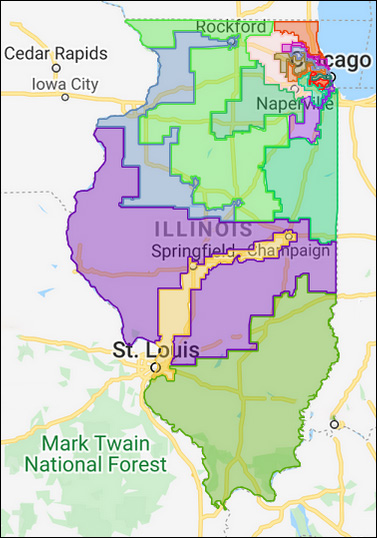
Illinois Congressional redistricting map; to see an interactive map, click here: FiveThirtyEight

By Jim Ellis

March 17, 2022 — Candidate filing in Illinois closed on Monday, and while the post-filing qualification process (most notably insufficient or invalid petition signatures) could disqualify some of those submitting documents, the candidate field for the delayed June 28 primary election is basically set.

Originally, the Illinois primary was scheduled for its typical calendar slot in March, but the legislature decided to delay the primary before redistricting began, incorrectly anticipating that they would have trouble completing the process. Instead, the Illinois Democratic political leadership produced and passed into law arguably the most gerrymandered map in the country.

Though Illinois is a strongly Democratic state, Gov. J.B. Pritzker (D) will seek a second term opposed by a surprisingly large Republican field. The most notable contenders, though none are likely to topple the governor in November, are state Sen. Darren Bailey (R-Louisville), Aurora Mayor Richard Irvin, former state Sen. Paul Schimpf, and venture capitalist Jesse Sullivan.

Sen. Tammy Duckworth (D) is on the ballot for a second term and has drawn a field of eight Republican candidates, with the likely leader being attorney Kathy Salvi, wife of former US Senate nominee Al Salvi, a favorite of conservatives. Sen. Duckworth will be safe for re-election.

While the US House map is designed to produce 14 Democrat victories in the delegation’s 17 seats, adopting the maximum partisan map could make some of the majority party seats weak, thus creating some unexpected competition in the general election.

Incumbents with safe seats are:

  • Rep. Robin Kelly (D-Matteson)
  • Rep. Jesus “Chuy” Garcia (D-Chicago)
  • Rep. Mike Quigley (D-Chicago)
  • Rep. Danny Davis (D-Chicago)
  • Rep. Raja Krishnamoorthi (D-Schaumburg)
  • Rep. Jan Schakowsky (D-Evanston)
  • Rep. Brad Schneider (D-Deerfield)
  • Rep. Mike Bost (R-Murphysboro)

The lineup features four open seats and two paired incumbent situations. Rep. Bobby Rush (D-Chicago) is retiring after serving 15 terms in the House. The Democrat primary will determine his successor, and the fight is among 20 candidates, including former Chicago Workforce Partnership CEO Karin Norrington-Reaves, who Rep. Rush has endorsed; Jonathan Jackson, son of Rev. Jesse Jackson and brother of former Chicago US Rep. Jesse Jackson, Jr.; and state Sen. Jacqui Collins (D-Chicago).

The new 3rd District is a created open seat — one drawn through redistricting. This seat is 44 percent Hispanic and is designed as the city’s second Hispanic influenced district. The leading candidates for the seat, again to be decided in the Democrat primary, are state Sen. Delia Ramirez (D-Chicago) and Chicago Alderman Gil Villegas.

The new 13th CD is also a created open seat, and one that stretches from Champaign through Decatur then Springfield and all the way into the Illinois side of the St. Louis suburbs. The district is also designed to elect a Democrat, but the general election could become at least somewhat competitive. Former Obama Administration official Nikki Budzinski appears to have the inside track to the party nomination, thus making her the favorite in the general election.

Continue reading

North Carolina Races – Part II

Click on above image or here to go to FiveThirtyEight interactive redistricting map.


By Jim Ellis

March 9, 2022 — Today’s update is the second part of our look at the new North Carolina political map. In this edition, we examine the state’s 14 new US House districts.

Incumbents who look to be in strong position under the new map and won’t get much of a challenge are the following (the rating figure comes from the FiveThirtyEight statistical organization):

  • Rep. Deborah Ross (D-Raleigh; D+24)
  • Rep. Greg Murphy (R-Greenville; R+29)
  • Rep. Virginia Foxx (R-Banner Elk; R+24)
  • Rep. Kathy Manning (D-Greensboro; D+9)
  • Rep. David Rouzer (R-Wilmington; R+16)
  • Rep. Dan Bishop (R-Union County; R+38)
  • Rep. Patrick McHenry (R-Lake Norman; R+43)
  • Rep. Alma Adams (D-Charlotte; D+25)

The state will feature four open seats in the 2022 election. Rep. G.K. Butterfield (D-Wilson) is retiring after serving what will be nine full terms, leaving his 1st District as an open seat. Rep. Butterfield complained that the original draw makes the seat less favorable for an African-American candidate to win. The new district increases the black population percentage by a point, to just over 41 percent. The total minority population registers almost 50 percent of the new 1st, with a 49.9 percent number.

Four Democrats filed for the seat, and the leading candidates appear to be state Sen. Don Davis (D-Snow Hill) and ex-state senator and 2020 US Senate candidate Erica Smith. Seven Republicans filed including 2020 nominee Sandy Smith, who held Rep. Butterfield to a 54-46 percent re-election victory, and Rocky Mount Mayor Sandy Roberson. FiveThirtyEight rates this seat as D+5, so we can expect the GOP to target this race.

Rep. David Price (D-Chapel Hill) is also retiring. He is completing 17 non-consecutive terms in the House, having lost his seat in the 1994 election after originally coming to the House in the 1986 vote. He returned to Congress in the 1996 election. Eight Democrats are vying for the party nomination and the seat in the May primary.

Since the new 4th is rated D+30, claiming the Democratic nomination is tantamount to winning the general election. The leading candidates appear to be state Sen. Valerie Foushee (D-Carrboro), Durham County Commissioner Nida Allam, and country singer and 2014 congressional nominee Clay Aiken.

Continue reading

Rep. Taylor Withdraws From Race

Former Texas Collin County Judge (Executive) Keith Self is now the new 3rd District Republican nominee after north Texas area Congressman Van Taylor (R-Plano) decided to withdraw from the runoff election resulting from Tuesday’s primary.

By Jim Ellis

March 4, 2022 — It was on a somewhat surprising note that north Texas area Congressman Van Taylor (R-Plano) was forced into a runoff from Tuesday’s primary election, but Wednesday’s related events proved astonishing.

Rep. Taylor has announced that he is withdrawing from the runoff, making public an extra-marital affair in which he engaged. Apparently, affair rumors began to surface late in the primary contest. Clearly knowing the story would become public, he admitted the indiscretion and immediately departed the race.

Under Texas election procedure, a candidate qualifying for a runoff election can decline to participate. The concession means the opponent automatically wins the party nomination. Thus, former Collin County Judge (Executive) Keith Self is the new 3rd District Republican nominee with an accompanying ticket to Washington, DC after the Nov. 8 election.

Taylor only secured 48.7 percent of the vote in Tuesday’s primary, meaning that a majority of Republican primary voters chose another candidate. This is never a good sign for any incumbent and the chief reason that most incumbents fail when forced to the secondary election. Adding the personal baggage obviously told Rep. Taylor that his re-election chances were irreparably diminished.

Self is a retired career West Point Academy Army officer who placed second in the primary with 27.1 percent, outlasting third-place finisher Suzanne Harp, a hard-charging businesswoman who proved to be surprisingly strong. The new congressional nominee presided over Collin County, an entity with now more than 1 million people, for three terms and chose to retire in 2018. In the congressional primary, he campaigned to Rep. Taylor’s right.

Continue reading