Tag Archives: Electoral College

Apportionment Surprises


By Jim Ellis

April 28, 2021 — In virtually every 10-year apportionment announcement at least one surprise occurs, but the census unveiling Monday contained multiple blockbusters.

For example, two states had their final number of congressional districts determined by less than 90 people. Reportedly, if New York had just had 89 more people, that would have saved an Empire State congressional seat. Minnesota becomes the beneficiary allowing the state to barely hold its eighth district.

Instead of 10 seats changing states as had been forecast, only seven, affecting 13 domains, switched. Perhaps the main reason for the lower number is the decade population growth rate. According to yesterday’s final report, the nation grew at only a 7.4 percent rate, the lowest since the 1930 census’s 7.3 percent. By contrast, the population increase from the 2010 total was 9.7 percent.

Pre-census projections, for better than a year, had been predicting that Texas would gain three seats, Florida two, and Arizona one. The analysts also estimated seat losses for Alabama, Minnesota, and Rhode Island. None of these projections proved accurate.

On the other hand, prognostications for the balance of the map were accurate. Texas, and Florida did gain, but two and one, respectively, instead of three and two seats. Colorado, Montana, North Carolina, and Oregon each added one district apiece as expected. The one-seat losers were California, for the first time in history, Illinois, Michigan, New York, Ohio, Pennsylvania, and West Virginia.

It’s a bit too soon to determine which party will benefit the most from these numbers at the congressional level, though Republicans should be up slightly in the Electoral College for the next presidential campaign. Once we see how the population is distributed within the states will better tell us whether Democrats or Republicans will take the most advantage of the apportionment. This will depend upon how the population spreads through the cities, suburbs, and rural regions.


Continue reading

Biden Elected; Calif. Data Published

By Jim Ellis

Dec. 16, 2020 — The Electoral College met in the various state capitols Monday, as scheduled, and the electors cast their ballots in the exact correlation with the state election data. Since the Electoral College increased to 538 members in time for the 1964 presidential election, we’ve seen faithless electors — those who vote for a candidate other than whom the state voters supported — in seven presidential elections.

No faithless elector appeared in Monday’s vote, however, meaning the final official count is Joe Biden, 306; President Trump, 232; the exact numbers produced on election night. The Supreme Court issued a ruling earlier in the year codifying that the states have the right to bind their electors. A total of 29 states and the District of Columbia had previously taken such action, so the court’s July 6, 2020 ruling in the Chiafalo v. Washington State case meant that these 30 entities’ votes would be forced to directly follow their respective electorates.

The remaining 21 states do not bind their electors, so those electors were still free to vote for someone outside of the Nov. 3 election totals. Monday, however, none did.

The action now means that Joe Biden is officially the President-Elect. The Electoral College will now report their results to the Congress on Jan. 6, 2021, where the votes will be counted and recorded. At that point, Biden will be officially elected and ready to take the oath of office as the 46th president of the United States on Jan. 20, 2021.

The California delegation is the group that put Biden over the top, allowing him to first clinch a majority vote in the Electoral College. Also coming from the Golden State is the official Statement of the Vote from the 2020 election, and it contains some interesting numbers to analyze.

Biden received more than 11.1 million votes in California, or 63.5 percent of the total ballots cast. President Trump obtained just over 6 million votes, good for 34.3 percent. Though the latter percentage is small, it is almost three full points beyond than his 2016 showing within the state.

Continue reading

The Decisions Within the Election

By Jim Ellis

Oct. 30, 2020 — The 2020 election cycle has been unique in many ways, but a series of significant decisions, typically through judicial rulings, will likely have a long-lasting effect upon the way the various states administer their elections.

Expanded early voting is likely here to stay. With more than 66 million people already voting through Wednesday, we can expect the states to continue with this relatively new process. Currently, only four states do not have some form of early voting.

Whether we see a continuance of the post-election ballot reception period may be another matter. There is likely to be controversy over this practice that 21 states will feature beginning next week. If the presidential race is close and gets bogged down in the political overtime, the negative aspects of counting votes that come in after the election could come to the forefront.

We have also seen changes in some states, most of which came in previous years, over their primary voting procedures. With reapportionment and redistricting on the political horizon, we are seeing states place measures on Tuesday’s ballot that could bring even more change to electoral systems around the country.

According to research presented from the University of Virginia’s Dr. Larry Sabato’s Crystal Ball publication and the Ballotpedia organization, voters in nine states will be deciding measures that could alter even further the way future elections are conducted. As we have seen develop, states adopting changes lead to further states following suit. Therefore, if many of the measures receive voter approval Tuesday, other states may also begin adopting some of these practices.

We start with states potentially changing their primary systems to a variation of the jungle primary system. Currently, Louisiana, where the procedure began, California, and Washington use the top-two qualifying system. In those states, all candidates are placed on the same primary ballot and the top two vote-getters advance to the general election irrespective of political party affiliation. Louisiana can elect a candidate outright if he or she receives majority support in the primary election because the state schedules the primary concurrently with the national general election.

Voters in Florida have a ballot proposition to decide if they want their state to adopt the jungle primary system. The Sunshine State voters are also considering a proposition that would allow changes voted through initiative only to take effect if the measure passes in two general elections. Therefore, should this latter idea attain approval, it, and all of the other passed measures, would be delayed until they again pass in a subsequent election.

Alaska voters are looking at another variation of the jungle primary. They are considering a measure where the primary would produce four finishers, thus setting up multi-candidate general elections.

Continue reading

Arizona’s Importance

By Jim Ellis

Does Arizona hold the key in the Trump-Biden election?

Oct. 9, 2020 — Now moving quickly toward Election Week, it is becoming apparent that the ultimate bellwether state for the 2020 presidential election is the Grand Canyon State of Arizona. Formerly a rock solid Republican political domain, the state has been trending toward the political center in recent elections, most particularly 2018.

Coming into the closing weeks of this year’s presidential campaign, it appears that Arizona may be this election’s “tell.” While it’s possible mathematically for President Trump to win in the Electoral College without Arizona, realistically doing so may be a bridge too far.

The principal reason is Arizona has 11 electoral votes, and the idea that Trump could replace it with taking Wisconsin or Minnesota, for example, fails because those states each have 10 votes. Therefore, losing Arizona would lead to him either falling into a tie, or losing the national electoral vote count, 270-268.

The latter electoral vote margin occurs if he also drops the 2nd Congressional District of Nebraska, a state that is one of a pair to split their electoral votes. The most recent public NE-2 poll, from Siena College/New York Times (Aug. 25-27; 420 NE-2 likely voters, live interview), finds the president trailing former vice president Joe Biden in the Omaha metro district, 41-48 percent.

The Trump math also fails without Arizona even if he carries Pennsylvania as his lone Great Lakes State. Losing Arizona, Michigan, and Wisconsin from his 2016 state coalition map, along with NE-2, would also yield a 270-268 Biden victory.

Earlier this week, the Data Orbital polling firm headquartered in Phoenix and is the most prolific survey research firm in testing the Arizona electorate from statewide through local offices, released their latest presidential and US Senate numbers. Their poll (Oct. 3-5; 550 likely Arizona voters, live interview) is the first Arizona survey taken wholly after both the first presidential debate and President Trump being hospitalized for COVID-19.

Continue reading

The Scenario: There’s an Electoral College Tie in the Presidential
Election; What Happens Next?

By Jim Ellis

Sept. 23, 2020 — As we move closer to Election Day, various scenarios are being discussed and theorized about who will win the presidential race and which states will fall to what candidate. A little-mentioned outcome, which is a mathematical possibility, is an Electoral College tie.

A deadlock would occur if each candidate received 269 electoral votes. Based upon the 2016 result, which saw President Trump receiving 306 electoral votes to Hillary Clinton’s 232, a tie would occur if the incumbent were to lose exactly 37 electoral votes from his previous performance.

The easiest way for that to occur is if President Trump and former vice president Joe Biden were to build the same coalition of states with the exception of Pennsylvania, Michigan and the 2nd District of Nebraska going from the Republican to Democratic column. In this instance, the two 2020 candidates, Trump and Biden, would have 269 electoral votes apiece.

If this were to happen, how is a tie in the Electoral College resolved? The answer: in the House of Representatives. The difference between the vote for president and a regular House vote is that individual members do not have his or her own vote for president. Rather, each state delegation has one vote.

Therefore, California, for example, with its 53 House members gets one vote for president. Conversely, the at-large states with one House member, such as Alaska, Delaware, Montana, North Dakota, South Dakota, Vermont, and Wyoming, would also each get one vote. So the vote for president skews toward the small states and rural regions.

Interestingly though, the Democrats control the House majority with 232 members and one Democratic vacancy to 198 Republican seats with one Libertarian sitting in what is typically a Republican seat and three GOP vacancies. Yet, if partisanship holds, the Republicans would win a presidential election vote 26 to 23 with one state, Pennsylvania, in a 9-9 split delegation. Assuming that the Keystone delegation would fail to agree on a candidate, the state would not be able to cast its vote.

Continue reading

The Maine Event

By Jim Ellis

Maine Congressional Districts

May 20, 2020 — The small state of Maine, with its two congressional districts, is going to attract a great deal of political attention between now and the election. Not only is the Pine Tree State one of the firewalls for Republican Senate majority hopes, the domain, one of two places that splits its electoral votes, will likely play a major role in determining the presidential election outcome, as well.

Maine and Nebraska divide their electoral votes such that the winning statewide candidate earns two electoral votes, while the victor in each congressional district is awarded one EV for as many districts as they carry. Maine, as mentioned, has two districts, and Nebraska three.

These districts came into play both in 2008 and 2016, when Barack Obama carried the 2nd District of Nebraska against John McCain in the former year, and Donald Trump took the 2nd District of Maine opposite Hillary Clinton in 2016. While neither CD became a factor in determining each of those elections, these CDs breaking differently than their state in a tight national election could result in the Electoral College ending in a tie.

The 48 other states and the District of Columbia use the winner-take-all system. Any state could divide their electoral votes like Maine and Nebraska, but those are the only two who choose the split vote method.

In the current presidential election scenarios, whether or not President Trump again carries ME-2 could determine if he is re-elected. Under one scenario, former vice president Joe Biden could win the national race even if he failed to carry Wisconsin so long as he takes the 2nd District of Maine and 2nd District of Nebraska. Doing so, along with winning the other swing states that touch a Great Lake, meaning Michigan and Pennsylvania, he would secure exactly 270 electoral votes, the bare minimum to claim national victory.

Continue reading

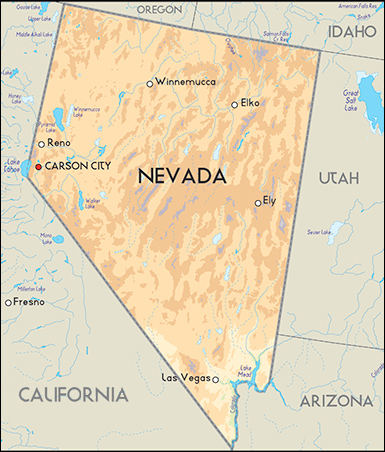
Nevada: A Target?

By Jim Ellis

May 8, 2020 — The Silver State of Nevada, with six Electoral College votes, has been regarded as a swing state in most 21st Century presidential elections, but in projecting the 2020 vote, it is routinely considered as a place destined to land in the Democratic column. But, could Nevada ultimately be in play for President Trump?

With a general election electoral vote map looking ever closer as we move toward November, introducing a new target could drastically change the eventual outcome or at least the campaign focus and strategy.

A new ALG Research poll (April 27-30; 76 likely Nevada general election voters) reports findings that are consistent with virtually all of the 2016 Nevada general election surveys. Last week, the firm found former vice president Joe Biden leading President Trump with a 49-45 percent spread. Such a margin and preference percentages fall into the same realm as all 31 polls conducted in Nevada from May through the November 2016 election.

When ‘16 ended, Hillary Clinton carried the state, but her margin was only 2.4 percentage points, meaning a 27,000-vote spread of more than 1.12 million ballots cast. And, consistent with the large number of polls that concluded a close race within the 40s would be the actual result, Clinton defeated Trump, 47.9 – 45.4 percent, validating the plethora of research conducted over the final five-plus months of that election cycle.

Four years ago, 13 different pollsters conducted the almost three dozen surveys, and in no instance did either Trump or Clinton ever reach the 50 percent plateau. On the other end of the spectrum, in just three instances did one of the candidates dip below 40 percent. Therefore, in 28 of the 31 studies logged within the 2016 Real Clear Politics polling archives, both candidates fell within the 40s, meaning this result occurred over 90 percent of the time. In terms of range, the span stretched from Clinton plus-7 to Trump plus-6, but the average between the two was only 2.7 percent, which is almost exactly the actual final total. This obviously suggests a competitive political battlefield.

Continue reading

Sanders Out;
Focus Now on Trump-Biden

By Jim Ellis

Sen. Bernie Sanders

April 9, 2020 — Sen. Bernie Sanders (I-VT) suspended his presidential campaign yesterday, therefore making former vice president Joe Biden the Democratic Party’s unofficial nominee. Biden, still 766-bound delegate votes away from clinching a first-ballot victory is now unencumbered in his bid to become the party standard bearer. It is likely that he will secure the 1,991 bound first-ballot delegate votes once the June 2 primary — now featuring 10 states — is held.

Sen. Sanders conceded that he could not overcome Biden’s strong lead but stopped short of endorsing him, though it is clear that he eventually will, and called for the Democratic Party to pull together in order to defeat President Trump.

How will a Trump-Biden general election campaign unfold? Very likely, the race will come down to what happens in about 10 states. In 2016, President Trump defeated Hillary Clinton with an Electoral College margin of 306-232, giving him a 36-vote cushion against Biden. This is a relatively substantial margin, but when remembering that three critical states containing 46 electoral votes came down to an aggregate vote spread of just over 77,000 votes, such a gap could quickly dissipate.

To win again, President Trump must keep intact five states that he carried as part of his 2016 coalition, three of which are giving signs of moving closer to the political center since the last election, and two that are always in the swing category. Arizona, Texas, and Georgia are must-wins for the Trump campaign, but these states are no longer locks for the Republican nominee. Though they should still remain part of the 2020 Trump coalition, they cannot be taken for granted.

Florida and North Carolina are always swing states, and any Republican presidential nominee must carry them in order to win the national election. The Democrats, because they win most of the other big states, can claim a national victory without Florida and North Carolina but a Republican cannot.

Continue reading

Impeachment Data: Many Polls
Show Georgia Numbers Improving

By Jim Ellis

Jan. 9, 2020 — The Mason-Dixon Polling & Strategy company surveyed the Georgia electorate to test President Donald Trump’s approval rating after being impeached in the House and, as in several other places, his Peach State standing appears slightly better today than it was in the previous year.

Georgia is a critical part of the Trump coalition and one of five base states that must support him if he is to have the necessary vote footing to again win an Electoral College majority. Arizona, Texas, Florida, and North Carolina are the other four entities that voted for the president in close margins back in 2016, are clearly politically competitive today, and must go his way again in 2020.

The Mason-Dixon poll (Dec. 19-23; 625 registered Georgia voters; live interviews) finds the president’s approval ratio within the Georgia respondent group to be 50:46 percent favorable to unfavorable despite being his impeachment. The last time M-D conducted a similar poll, in February of 2018, Trump’s approval index stood at 50:50 percent.

To put his Georgia numbers in perspective, the president’s job approval rating nationally is habitually upside-down. Such is the case today, as the latest daily job approval scores post the president at 40:55 percent (Morning Consult; Jan. 6-7; 2,038 US adults), 48:50 percent (Rasmussen Reports; Jan. 2-6; 1,500 likely US voters), and 44:54 percent (YouGov; Jan. 4-6; 731 registered US voters) positive to negative.

The encouraging Georgia statistical news for Trump is even more significant when considering that the state’s African-American population has outpaced the national black growth rate. It is well known that the African-American segment is the Democratic bedrock vote with near unanimous levels of support for the party’s candidates. The fact that Trump has improved in the face of impeachment and a growing black population means that his standing in Georgia is about as strong as could reasonably be expected considering the tall obstacles before him.

Continue reading

Impeachment: First Political Clues

By Jim Ellis

President Donald Trump | whitehouse.gov

Dec. 16, 2019 — As we move toward the impeachment vote in the full House and the impending Senate trial to determine whether President Trump should be removed from office, a great deal of speculation exists about how voters will respond to this situation. A series of early December polls from the most critical swing states gives us a clue.

Firehouse Strategies/Optimus commissioned simultaneous polls within the Dec. 3-5 period in the top swing states of Pennsylvania, Michigan, and Wisconsin. As we remember, all of these places gave Trump a small victory margin in 2016. Phoenix-based pollster OH Predictive Insights conducted a poll of the Arizona electorate during the same period. Firehouse found sampling groups numbering between 551 and 610 respondents in the three states. OH used a slightly larger 628 person sample cell in the Grand Canyon State.

Both pollsters tested President Trump in each targeted state against former Vice President Joe Biden, Sens. Elizabeth Warren and Bernie Sanders, South Bend Mayor Pete Buttigieg, and ex-New York City mayor, Michael Bloomberg.

In all instances President Trump led his prospective opponent when individually paired. Since he had been trailing in similar ballot test responses from several previous polls in the Great Lakes States and was about even in Arizona, the change at the height of the impeachment proceedings suggests that he is seeing a net positive early return from the legal attack.

Of course, much could change before the process concludes, but this first data does provide us an interesting political snapshot as it relates to impeachment perceptions. As a rule, general election polling before the parties nominate their presidential candidates is usually irrelevant but, considering the present impeachment overlay, these numbers appear to be significant and particularly so because they are originating from critically important states.

For President Trump to win re-election, he must carry all five of the states in his 2016 coalition that typically vote Republican but have been trending closer to the Democrats since the last presidential election. Those are: Arizona, Georgia, and Texas. Florida and North Carolina are always swing states in virtually every election and will be again in 2020. To win, the president must first carry all of these aforementioned states. If so, he then would need to win just one of the Michigan, Pennsylvania, Wisconsin trio in order to yield a bare Electoral College majority.

Continue reading